Publisher’s version / Version de l'éditeur:
Journal of the American Concrete Institute, 27, 9, pp. 987-1002, 1956-05
READ THESE TERMS AND CONDITIONS CAREFULLY BEFORE USING THIS WEBSITE. https://nrc-publications.canada.ca/eng/copyright
Vous avez des questions? Nous pouvons vous aider. Pour communiquer directement avec un auteur, consultez la première page de la revue dans laquelle son article a été publié afin de trouver ses coordonnées. Si vous n’arrivez pas à les repérer, communiquez avec nous à [email protected].
Questions? Contact the NRC Publications Archive team at
[email protected]. If you wish to email the authors directly, please see the first page of the publication for their contact information.
NRC Publications Archive
Archives des publications du CNRC
This publication could be one of several versions: author’s original, accepted manuscript or the publisher’s version. / La version de cette publication peut être l’une des suivantes : la version prépublication de l’auteur, la version acceptée du manuscrit ou la version de l’éditeur.
Access and use of this website and the material on it are subject to the Terms and Conditions set forth at
Basis for classifying deleterious characteristics of concrete aggregate
materials
Swenson, E. G.; Chaly, V.
https://publications-cnrc.canada.ca/fra/droits
L’accès à ce site Web et l’utilisation de son contenu sont assujettis aux conditions présentées dans le site
LISEZ CES CONDITIONS ATTENTIVEMENT AVANT D’UTILISER CE SITE WEB.
NRC Publications Record / Notice d'Archives des publications de CNRC:
https://nrc-publications.canada.ca/eng/view/object/?id=f83f3ce1-43a7-4d76-a63b-f9e7b5587870
https://publications-cnrc.canada.ca/fra/voir/objet/?id=f83f3ce1-43a7-4d76-a63b-f9e7b5587870
| ? 5'=6
Ser
THl
N2t t2
no. hl
e . 2
BI,DG
NArroruEu
Reseencn
Courlcn-C A N A D A
A N A L Y Z E D
BASIS FOR CLASSIFYING
DELETERIOT.IS
CHARACTERISTICS
OF CONCRETE
AGGREGATE
MATERIALS
TECHNIGAL PAPEFI NO 41
OF Tl{C
D I V I S I O N O F B U I L D I N G R E S E A R C H
REPRIHTED FROM THE
J O U R H A L O F T H E A M E R T C A N € O N C R E T E I N S T I T U T E v o | . . 2 7 , N O . 9 . M A Y 1 9 5 0 .
PRIEE 25 CENTS HftC SAAA
Thls publlcatLon
is
being dlstrlbuted
by
the Division of Building
Research of the
Natlonal
Research Oouncil as a contribution
torards better
buJ.ldlng ln Canada. It should not be reproduced
Ln whole or in partr wlthout pernlsslon of the
orl-gtnal publisher.
The Divislon would be glad to be
of assistance Ln obtaining such permisgton.
Publications
of the Dlvislon
of Bulldtng
Research may be obtal-ned by nalling
the approprlate
remlttance,
(a Bank, E:rpress, or Post Offlee Money
Order or a cheque made pa5rable at par ln Ottawa,
to the Receiver General of Canada, credtt NatLonaL
Research Council) to the National Research Council,
Ottawa. Sta,nps are not aceeptable.
A coupon strrsten has been lntroduced
to
rnake pay:ments for publlcatlons
relatively
sLnp3.e,
Coupons are aval-Iable
ln denonLnations of
5, 25,
and 50 cents,
and rnay be obtalned by making a
re-mittance as lrdlcated
ebove. These coupons nay be
used for
the purchase of all Natlonal
Research
CouncLl publLcatlons
lncludlng
speclficatlons
of
N.R.C. 3988
Tifle No. 52-58Bqsis for Clqssifying Deleterious Chqrqcteristics
of Concrete Aggregote Mqteriqls*
Bv E. G SWENSONT
and V. CHALYT
S Y N O P S t S
Deleterious characteristics of concrete aggregate materials are re-viewed, and a simplified arrangement for their classification is pro-posed. This arrangement is based on a recognition of harmful proper-ties rather than on types of materials, thus providing the testing engi-neer with a more systematic basis for laboratory eva'luation of aggre-gates. Harmful properties that involve chemical action h.re given the same emphasis as those involving the physical nature of the material. These properties are discussed in relation to the limitations of con-ventional methods of test and the need for supplementary testing based on petrographic and chemical techniques.
INTRODUCTION
The harmful efiect of certain substances in concrete aggregates has been recognized since early times. The Romans specified that sand used for masonry walls "must be fit to mix into moftar and have no dirt in it." Empirical tests have since been developed to detect the Presence of undesirable ma-terials, and in recent years the increased application of petrographic and chemical techniques has greatly extended the knowledge of these substances. The list of materials now known to be deleterious in concretQ is long but most of the harm{ul reactions are now understood.
Specifications for concrete aggregates name certain materials as deleterious. They are: coal, lignite, clay, soft fragments, bark, wood, material that passes through the No. 200 sieve, organic matter, and materials harmfully reactive with cement alkali. These substances are taken into account by well
stand-ardized methods of testing.
Present specifications, however, distinguish these so-called "deleterious" mater-ials, by inference at least, from other "unsound" materials which are not named. These unsound materials are, in general, related to the parent material, are
*Received by the Institute Apr. 4, 1955. Title No. 52-58 is a part of copyrighted JoURNAL oF rHE AMERTCAN Cor.rcnsrn lNsrrrurE, Y. 27, No. 9, May 1956, Proceedi,ngs v. 52. Separate prints are available at 50 cents each. Discussion (copies in triplicote) should reach the Institute not later than Sept. 1, 1956. Arldress 18263 \M. McNichols Ral., Detroit 19, Mich.
tln charge of cement and concrete research, Builtling Materials Section, Division of Building Research, National Research Council (Canaala), Ottawa, Ont.
fChief chemist, Inland Cement Co., Edmonton, Alta , Canacla. Formerly with Building Materials Section, Division of Building Research, National Research Council (Canada).
9 8 8 JOURNAL OF THE AMERICAN CONCRETE INSTITUTE M o y . 1 9 5 6
not easily identified except by petrographic analysis, and may constitute a large proportion of the aggregate. Their presence is determined indirectly by tests such as compressive strength and freeze-thaw tests on mortar and concrete.
This distinction between deleterious materials and unsound materials in aggregate is not altogether tenable. H. S. Sweetl has stated that "the subject of deleterious substances is closely allied to the soundness of aggregates and must necessarily be discussed at some length under the latter." C. W. Allen2 has noted that "the effect of deleterious particles in aggregate overlaps the effect of unsound particles." Since deleterious particles are unsound, and un-sound particles are deleterious, no distinction should be made in any general classification.
It is important that the relative nature of the term "deleterious material" be recognized. A certain type of particle may be harmless under one set of exposure conditions, but may be deleterious under other conditions. For instance, certain particles with unfavorable pore characteristics, wheq incor-porated in concrete exposed to frequent cycles of freezing and thawing, break down and rupture the concrete. In more favorable climates, or when the concrete is otherwise protected, such particles may be quite stable. The use to which concrete is put will also determine whether certain substances are to be considered as deleterious. Soft and weak oarticles in concrete are undesirable where heavy loads must be borne, o, wher. abrasion resistance is required, but they may perform satisfactorily in orher cases.
The empirical acceptance tests for aggregates are often inadequate for accurate evaluation. Materials which pass these tests satisfactorily may be unfit for use in concrete. W. A. Cordon3 has reported a case in which a rock easily passed the usual laboratory tests and appeared to be excellent marerial fo,
"ggi.gat.. However, petrographic examination revealed the presence of a considerable amount of interstitial clay which produced excessive expansion in the concrete when the latter was subjected to freezing-thawing and wetting-drying tests.
Conversely an aggregate may fail rhe usual acceptance tests but may be quite satisfactory in service. In the same report cordon has cited the case of a sandstone aggregare which failed badly in nearly all laboratory tests but showed good durability to freezing-thawing and wetring-drying resrs. Again petro-graphic examination provided the explanation: the presence of large pores in thd aggregate which permitted easy drainage during freezing.
Petrographic and chemical tests have, in many cases, successfully revealed the causes of deterioration of the concrete rvhere other methods have failed. Petrographic methods, in particular, have been developed to permit a more accurate preliminary evaluation of aggregates in the field as well as to explain cases of deterioration of concrete.a-6 Thev have become a useful and desirable supplement to conventional acceptance tests but they have required, in use, a detailed knowledge of a wide range of deleterious materials. It is now desirable that such materials be adequately classified, keeping in mind these newer methods of examination, as an aid in systematic evaluation of aggregares.
DELETERIOUS CHARACTERISTICS OF AGGREGATE 989
BASES FOR CTASSIFYING DETETERIOUS'TAATERIALS
Concrete aggregates, confined to sands, gravels, and quarried rock in this discussion, -"y Ui of igneous, sedimentary, or metamorphic origin, each class possessing certain general characteristics as to homogeneity, iointing, stratification, and other properties. Within each class there is a wide variation in properties depending on geological processes, chemical and mineralogical composition, degree of crystallization, stratification and schistosity, chemical activity, and resistance to changes in moisture. For example, a rock may be uniform in composition throughout, or composed of a succession of layers which difier mineralogically;' it may be massive or highly stratified; it may be composed of one or several fully crystallized minerals; or it may be microcrystalline or vitrified.
Natural sands and gravels, having gone through the additional processes of transportation and deposition, are subject to greater variations in properties than ledge rock. These pfocesses may have destroyed the weaker particles, thus yielding a harder and more durable material, but they may also have rendered some hard particles unsound.T
Both ledge rock and natural sand-gravel aggregate may have been altered because of weathering and aging processes such as freezing-thawing, wetting-drying, heating-cooling, as well as by leaching, oxidation, hydration, and other chemical action.8 The result is a wide variation in properties of aggregate mater-ials, some of which are undesirable for concrete.
Deleterious materials may be classified according to (a) type of mineral, rock, or other substance; (b) efiect on concrete; or (c) characteristics of materials that adversely aflect the quality of the concrete. An arrangement based on the type of material would be cumbersome because of the large number of such materials, the complex mineralogical names of many of them, and in-compatibility with any simple procedure for testing. A classification based on the efiects of deleterious materials on concrete would not be consistent with the testing of aggregates. A simple but comprehensive classification con-sistent with the methods of testing aggregates for deleterious materials would be one which is based on undesirable properties, or on classes of materials which possess characteristics injurious to concrete. Such an arrangement would provide a proper perspective for the testing engineer and a logical basis for developing a suitable testing sequence. It should be based on both physical and chemical characteristics of aggregates.8
F. C. Lang has proposed such a classification.0 He divides deleterious mater-ials into five classes:
(a) Substances having high volume ehange, e.9., lnighly absorptive shales, cherts having high capillarity, and argillaceous limestone
(b) Structurally weak substances, e.9., soft particles with low compressive and flexural strengths
(c) Surface coatings, e.g., dust, clay and encrustations of substances deposited from solution
990 JOURNAL OF THE AMERICAN CONCRETE INSTITUTE M o y 1 9 5 6
(e) Substances affectng chemical activity, e.9., clay, organic materials, sul-fides, sugar
Walker and Bloemlo divide deleterious materials into six categories: (a) Soft and friable particles which are basically sound
(b) Soft and friable particles which are basically unsound (c) Hard particles which undergo high volume change (d) Laminated rocks
(e) Materials which react with certain constituents of cement
(f) Obvious impurities such as coal, lignite, sticks, bark, and mud balls
Neither of these classifications distinguishes between various adverse chemical reactions, nor do they take into account certain harmful physical properties of aggregate particles.
In a recent paper, Mielenz8 outlines procedures for detailed petrographic examination of aggregates. Evaluation is based on physical and chemical proper-ties of the particles constituting the aggregate, these properproper-ties serving as a basis for classificadon. The term "deleterious," however, appears to be used specifically in relation to chemical reactivity of the aggregate with cement.
SUGGESTED BASIS FOR CIASSIFICATION
A classification of deleterious characteristics of concrete aggregate materials should provide the testing engineer with a background of organized information which will enable him to make an accurate evaluation of aggregates for a iob. It should enable him to recognize any limitations of standard specifications and test methods and indicate the need for supplementary tests; it should provide guidance in the selection of a proper sequence of tests; and it should aid in the proper interpretation of test results. So that such a classification can be of immediate value to the testing engineer, it must be comprehensive, but not burdened with highly technical detail and terminology. It should pro-vide general guidance rather than make all the finer distinctions which must necessarily be handled by the specialist.
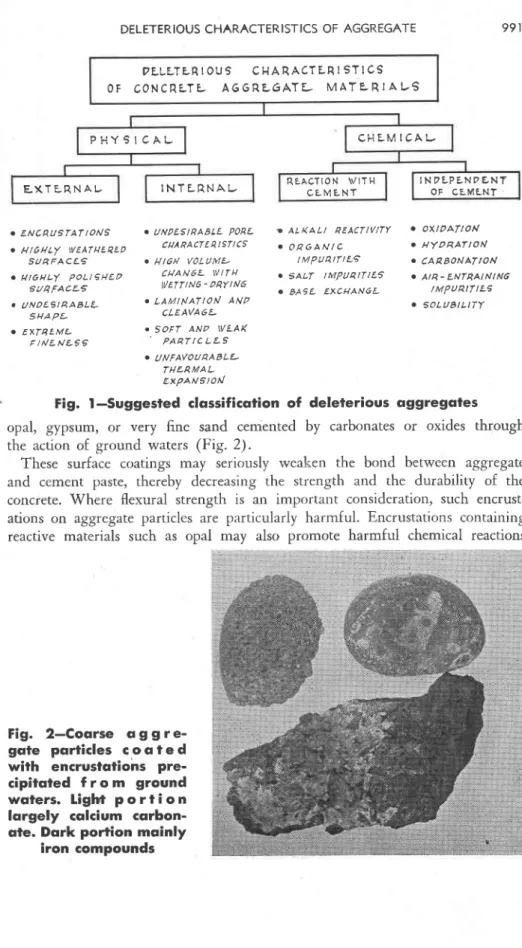
In the chart and outline in Fig. I the deleterious characteristics of concrete aggregate materials are divided into two main groups: those which are harmful to concrete due to some physical characteristics, and those involving chemical action. The fust class is further subdivided into two groups, those involving external characteristics of aggregate particles, and those concerned with internal properties. The second class, based on chemical action, is subdivided into two groups, one in which chemical action occurs independently of the cement and one where chemical reaction occurs between a cement component and some substance in the aggregate. some overlapping is unavoidable since some dele-terious materials may possess more than one harmful property.
Physicol-Externql
Enc'rustations-Parricles of natural sand, gravel, and larger rock fragments may become coated with a crust of foreign mineral substances. These encrust-ations may be composed of clay, silt, calcium or iron carbonates, iron oxide,
DELETERIOUS CHARACTERISTICS OF AGGREGATE 9 9 1 P L L L T L R I O U S C I . { A R A C T E R I S T I C S O F C O N C R , L T L A G G R , L 6 A T L M A T L R I A L S C H L M I C A L P H Y S I C A L I N ' L P L N P E N T O F C E M E N T R E A C T I O N V I T H C L M E N T I N T L R , N A L E X T L R , N A L . E N C R U S A T I O N S ' U N ' E S I R A B L L P O R L . H l 7 l l L Y T L E A T U E R E D C U A R A C T E R I S . I C S
SURFACL€ . HI6T/ VOLUME. . H I G H L Y P O L I € I ] E D C I J A N G L I V I T H 5 u 4 1 A C L ? v E r T t N 6 - D q Y t N 6 . U N D E S I R A B L L . L A M I N A T I O N A N P ;HAPE. CLEAVAGL . E X T B E M L . . ' O F T A N P I V L A K F I N E N L € ; P A R T I C L L S . LIN.AVOURAOLE-THEBMAL EXPANStON
Fig. l-Suggested clossificofion of deleterious oggregqtes
opal, gypsum, or very fine sand cernented by carbonates or oxides through the action of ground waters (Fig.2l .
These surface coatings may seriously weaken the bond between aggregate and cement paste, thereby decreasing the strength and the durability of the concrete. Where fexural strength is an important consideration, such encrust-ations on aggregate particles are particularly harmful. Encrustencrust-ations containing reactive materials such as opal may also promote harmful chemical reactions
F i g . 2 C o q r s e q g g r e -g o t e p o r " t i c l e s c , o q t e d with encruslqtions pre-cipitoted f rom ground w q l e r s . t i g h f p o r l i o n lorgely cqlcium cqrbon-qte. Dork portion moinly
iron compounds ' A L 4 A L I R E A C T I V I T Y ' O X I D A T I O N . O R G A N T C . H Y D R A T T O N I M P U A I T I L € . C A R B O N A T T O N . ' A L T I M P U R I T I L S . N 4 - E N T q A I N I N G . b A g L E X C q A N G L l M P U P , l T l L s a < n t t l a l I l 7 Y
9 9 2 J O U R N A L ' O F T H E A M E R I C A N C O N C R E T E I N S T I T U T E M o y 1 9 5 6
Fig. 3-Weothered sur-fqce crusls on qggregqte p q r t i c l e s . T o p s o n d -slone. Lower left-shole.
Lower right-limestone
with certain cement constituents. Iron oxide coatings may produce surface stains and may, through hydration, produce excessive volume change in the concrete. Clay and silt coatings tend to increase the quantity of fine material in concrete with possible harmful effects.
In cases where encrustations are strongly bonded to the aggregate particles, the cement-aggregate bonding is not likely to be harmed. A certain amount of coated material can be tolerated in concrete, and the testing engineer must base the allowable limits on the nature of the encrustations and results of tests such as abrasion, soundness, strength, and freezing-thawing.
Surface coatings of this type can be recognized visually or by binocular examination, using an ordinary penknife or needle for detaching loose particles. Identification of the nature of the coated material requires petrographic knowledge.
Higlrly oueatlzered surfaces-The surfaces of aggregate particles may become altered or decomposed due to weathering processes involving the action of temperature, humidity, frost, soil constituents, and organic materials (Fig. 3). These degenerated surface materials may be detached easily from the rock body in which case they are harmful to concrete for the same reason as encrust-ations. In addition to their poor bonding properties such materials may have high porosity and thereby decrease the durability of the concrere. Where the altered surface crusts are strongly ,bonded to the rock body, and porosity is not unfavorable, no harmful efiects occur
Altered surface materials may be chemically reacrive with cement alkali, and any appreciable amounts of such marerials should be tested for this property. As in the case of encrustations, a limited quantity of such materials can be tolerated but appreciable amounts will adversely affect rhe concrere, particularly the flexural strength. Aggregate containing considerable quanrities of weathered
DELETERIOUS CHARACTERISTICS OF AGGREGATE 9 9 3
Fig. 4-Advqnced weqlh-ering of sqndstone show-ing smoll' unqhered core
materials will usually fail in standard tests such as abrasion, soundness, strength, and freezing-thawing.
Weathered surfaces can be recognized visually or under the binocular mic-roscope. The degree of weathering can be determined by breaking the part-icles and observing the depth of the altered material (Fig. a). Petrographic e x p e r i e n c e i s n e c e s s a r y to a s s e s s t h e d e l e t e r i o u s n a t u r e o f t h e altered material.
Highly polished surfaces-Particles rvith extremely smooth surfaces may not produce a good bond with the cement paste. If present in high proportion in gravel aggregate they may be considered as deleterious materials, particularly where the flexural strength of the concrete is of major importance. In most cases the detrimental efiect of such material is compensated for, in whole or in part, by the lor.ver water requirement of the concrete mix. Comparative strength tests should be made.
Undesirable shape-Slabby or elongated particles, if presenr in appreciable quantity in aggregate, may seriously affect the strength of concrete, particularly the flexural strength. In addition, such materials accentuate the harshness of a mix and may increase the water requirement to a degree that will afiect the quality of the concrete.
Elongated and slabby particles occur mainly from the crushing of quarried rock. Examples are: schists, shales, slates, and other finely stratified sedimen-tary or metamorphic rocks.
Identification of such materials is simple, but it is important that ledge rock be given preliminary examination to determine its crushing properties.
Highly rounded particles, like highly polished particles, if they constitute a large proportion of the aggregate, may be considered as deleterious due to decreased surface for bonding to the cement paste.
Extreme fineness-Specifications for concrete aggregates limit the quantity of fine mdterials passing the No. 100 and 200 sieve sizes. ,Investigations have
9 9 4 J O U R N A L O F T H E A M E R I C A N C O N C R E T E I N S T I T U T E M o y 1 9 5 6
shown, however, that quantities of clay, for example, considerably in excess of these limits do not aflect the quality of concrete adversely.lr
The nature of these materials determines the amounts that can be tolerated, and investigational tests are required to determine the mineralogical compo-sition and the effect on the strength, volume stability, and durability of concrete. Physicol-lnternol
Undesirable pore characteristics-Ag-gregate particles which possess a com-bination of high effective porosity and small pore size produce concrete with low durability to freezing and thawing.T Interconnected pores or voids of a diameter less than 0.004 to 0.005 mm possess high capillarity but drain effectively only at hydrostatic pressures in excess of the tensile strength of some rocks and concrete. Water is therefore not readily expelled during freezing. Examples are found in all rock types, and often result from alteration due to weathering, leaching, and chemical action.
The relative size of the continuous voids in aggregate particles and in the hydrated cement paste is important to the durability and bond properties of concrete. Large voids in aggregates are drained by the smaller voids in the paste through suction. Smaller voids in the aggregate drain less readily, thereby preventing free passage of water during freezing. This condition may result in rllpture at the aggregate-paste interface. Isolated voids, whether large or small, do not appear to have any adverse effect on durability and may actually be beneficial.
Absorption tests give an indication of effective porosity but do not indicate pore size. Absorption values in excess of 2 to 3 percent for 24 hr are considered undesirable but may rule out materials of large pore size which are durable.r Two aggregates may yield comparable absorption values, but one may consist of particles of uniform absorption properties and the other may consist of some particles having high absorption and some with low absorption. Absorption tests do not difierentiate such cases. It has been found that absorption of aggre-gate does correlate with freezing and thawing durability of concrere if the material is mineralogically uniform throughour as in the case of limestone. But for lithologically complex aggregates absorption cannot be correlated with soundness.T
It has been stated that "the durability of aggregate does not always correlate with the durability of concrete." Magnesium and sodium sulfate soundness tests on aggregate often produce results at variance with results of f.reezing-thawing tests on the concrete made with that aggregate. This is due to the difierent mechanisms involved and to the susceptibility of the soundness test to small variations in temperature, salt concentration, and drying time.
Accelerated freeze-thaw tests are presumed to difierentiate between aggre-gates possessing favorable and unfavorable pore properties. It is generally ad-mitted, horvever, that such severe tests may reject materials which may be durable under normal weathering conditions. Petrographic analysis is the only
DELETERIOUS CHARACTERI3TICS OF AGGREGATE 995
certain way of ascertaining the nature of the pore structure of aggregates and of predicting the durability of the concrete in which it is used.
High uolume change uith uetting and drying-Aggregate particles that expand excessively with wetting produce distress in concrete. Where such particles constitute a large proportion of the aggregate, extensive disintegration may result. If present in small amounts, localized cracking and "popouts" may occur.
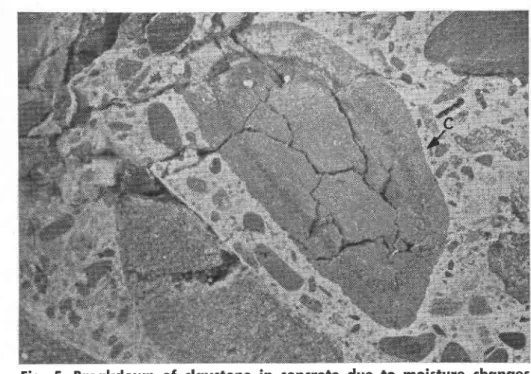
Materials possessing this property include laminated particles containing clayey substances, such as clayey limestones and sandstones, cherts, and certain shales. The presence of clay impurities, particularly of the montmorillonite type, makes a rock particle susceptible to high volume change on wetting and drying due to the efiect of hydrationt (Fig.5). Volume change may be difierent in difierent directions.
Such materials may fail in soundness tests and may show up in freeze-thaw tests in concrete but exceptions have been noted.s Wetting and drying tests on concrete are being more widely used to supplement conventional tests. A wetting and drying cycling method has also been developed to detect cement-aggregate reactivity.12
Petrographic analyses are important in preliminary examination of aggregate for this property, particularly in the examination of ledge rock to be crushed [or use as coarse aggregate.
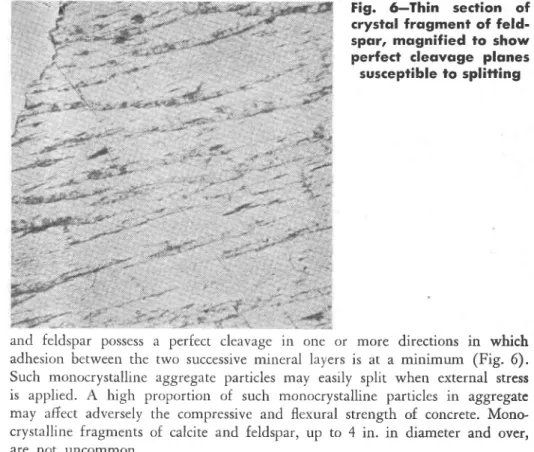
Lamination and cleauage-Cleavage is the tendency of a crystallized mineral to break in certain defined directions. Some minerals like mica, calcite, topaz)
9 9 6 J O U R N A L O F T H E A M E R i C A N C O N C R E T E I N S T I T U T E M o y 1 9 5 6
Fig. 6-Thin section of crystol frogmenl of feld-spqr, mqgnified to show perfect cleovoge plones susceptible to splifiing
and feldspar possess a perfect cleavage in one or more directions in which adhesion between the nvo successive mineral layers is at a minimum (Fig.6). Such monocrystalline aggregate particles may easily split when external strcss is applied. A high proportion of such monocrystalline particles in aggregatc may afiect adversely the compressive and flexural strength of concrete. Mono-crystalline fragments of calcite and feldspar, up to 4 in. in diameter and over, are not uncommon.
Stratification and schistosity are also conducive ro mechanical splitting due to erternal stress or to the formation of ice lenses. They occur in schists, shales, slates, and laminated limestones (trig. 7).
Standard tests for aggregates are inadequate for the detection of such ma-terials. Again petrographic examination is of importance in preliminary testing.
Fig. 7-Strolified metq-morphic rock with pro-nounced split|ing follow-ing plones of weskest
DELETERIOUS CHARACTERISTICS OF AGGREGATE 997 Soft and taeaft particle.r-Soft and friable particles are structurally weak and possess low resistance to abrasion. In addition they'often possess other unde-sirable properties such as high absorption and high volume change with wetting and drying. A distinction is made between "soft" particles in which the actual grains composing the particles are soft, and "weak" particles in which the grains, either hard or soft, are weakly bonded or interlocked together. For example, some granites are made up of hard crystals of quartz and feldspar, in which the grains are poorly interlocked; such materials are "weak" and have low strength, elasticity, and abrasion resistance.
Soft particles with a stable binding material may be basically sound and not subject to excessive volume change with freezing and thawing. Examples are soft sandstones with siliceous or calcareous binder, and certain soft limestones.
Weak particles may be basically unsound due to inherently weak bonding material, and may or may not be subject to high volume change. In this category are many stratified materials such as shales, clayey and limonitic sandstones, also ochres and certain weathered rocks (Fig. 8).
Soft and weak particles are detected readily by abrasion, soundness and strength tests, but petrographic examination is valuable for preliminary in-vestrgatlon.
Unfauorable thermal expansion-Asgregate particles that difier greatly from hardened cement paste in coefficients of thermal expansion may seriously afiect the durability of concrete subject to large temperature changes.E The coefficients for hardened cement paste range from about 5.9 to 9.0 x 10-{J, for concrete from about 3.6 to 6.8 x 10⁻⁶, and for ordinary rocks from about 0.5 to 8.9 x 10⁻⁶ per deg F. In spite of these wide ranges any differences in expansivity between
F i S . 8 - P o l i s h e d s e c -tion of q "wecrk" sqnd-slone composed of hcrd groins (lighr) cemenled together by weok, cloy-e y m q t cloy-e r i o l ( d o r k )
998 JOURNAL OF THE AMERICAN CONCRETE INSTITUTE M o y 1 9 5 6
aggregate and cement pasre have not been shown to be detrimental to the durability of concrete except in the case where the coefficient for the aggregate is belor.v abour 1.0 x 10⁻⁶ per deg F.8
Examples of such materials are found among certain granites, limestones, and marbles.
Many minerals and rock particles show different thermal coefficients of
ex-coarse textured rocks may show thermal instability for the same reason.
Ghemieol-Reoctivity with cement
It is unfortunate that chemical reactivity in general, . and cemenr-aggregate reactivity in particular, have become associated only with the alkali-aggr.g"t. reaction by many concrete engineers. The reaction between cement alkali and
Fig. 9 (lefr)-Gel exudqtions due to olkoli-oggregqfe reocfion, showing hordened gel ond globr.rles of liquid gel. Fig. to (rigtt)-Hordened gel
DELETERIOUS CHARACTERISTICS OF AGGREGATE 999
Fig. I l-"Rim" formcrtion qround qggregqte Porti-cle due to crlkqli'oggre'
gote reoction
certain reactive constituents in some aggregates is only one of several known harmful chemical reactions involving aggregate in concrete.
Alftali reactiuity-Certain minerals and rocks react chemically with the alkalies present in cement and produce silicate gels in the concrete (Fig. 9 and 10). These gels generate osmotic action in the presence of water which results in the development of hydrostatic pressures within the concrete mass. In extreme cases these pressures may exceed the tensile strength of concrete and produce deterioration (Fig. 11).
These reactive materials include minerals such as opal, chalcedony, tridymite and crystobalite; rocks such as glassy or cryptocrystalline rhyolites, dacites, and andesitesl also opaline and chalcedonic cherts and phyllites.
Most of these materials appear to be unique in that harmful amounts are limited to a relatively small fraction of the whole aggregate. Aggregates con-taining large proportions of these materials may produce no harmful effects in concrete. In cases where it is economically necessary to use potentially reactive aggregates, the danger of concrete deterioration may be effectively reduced by using low-alkali cements or by replacing part of the cement with a suitable pozzolanic material.
Potentially reactive aggregates are not revealed by the usual acceptance te$ts and special methods have been developed. These involve physical, chemical, and petrographic techniques.
Organic impurities-The presence of even small amounts of organic materials in concrete will interfere with an effective bond between cement paste and aggregate. .Interaction between an organic substance and the cement paste
r 000
J O U R N A L O F T H E A M E R I C A N CONCRETE INSTITUTE M o y 1 9 5 6soluticn may produce secondary subsances, such as hydration products, which decrease the strength and durability of the concrete.
Soil humus, wood particles, bark, coal, lignite, and other vegetable and animal products belong in this category. sand and gravel may become contaminated through carelessness in removal of ove.buroen.
The standard colorimetric test is effective in detecting harmful quantities of organic impurities in aggregate. The presence of coal or lignite may interfere with the proper interpretation of test results, however.
solwble salt impurities-The presence of soluble salt impurities in aggregate may affect the quality of concrete through salt reaction with a cemenr component or may affect the serring and hardening by changing the composition of the paste solution.
Possibly the most common salt impurity in aggregate is gypsum. This sub-stance reacts with the aluminate component of the cement, producing a calcium sulfo-aluminate compoun<i with largi volume change. The resurting expansion and deterioration of the concrete is similar in nature to that which occurs when o:din.r?- concrere is placed in contact with soils conraining high concenrrations of soluble sulfates. The rate of setting and hardening of -.or.iete may also be aflected.
Chemicol-lndependent of cement
Hydration-Minerals such as pyrites and marcasire may first be oxidized and then hydrated to sulfuric acid and hydrared iron oxides with large increase in volume. continued oxidation of iron compounds and hydration of iron oxide products in clay ironstones may cause popouts in concrete or extensive deter-ioration if present in large quantities.
DELETERIOUS CHARACTERISTICS OF AGGREGATE I 0 0 1
F i g. l2-"Popovls" i n concrele due to oxido-tion of iron compounds
in oggregole
drying are often due to hydration of clayey materials which may be present in the fine fraction of sand or in the strata of laminated rocks in the aggregate.
Standard acceptance tests for aggregate are inadequate for detecting these ma-terials and must be supplemented by petrographic methods of test'
Carbonqtion-M"gniil^ impurities in aggregate may become carbonated with a large increase in volume resulting. Such impurities are not easily detectable by the usual tests for aggregates.
Air-entraining impuritie.s-Certain organic impurities which are not revealed by the standard colorimetric test have been shown to entrain large amounts of undesirable air in concrete.ls This results in a reductidn in the unit weight and compressive strength of the concrete and interferes with the function of proper air-entraining agents.
Solubility-Particles which are made up in part of partly soluble compounds such as gypsum may be deleterious to concrete. The soluble constituents may be leached out, leaving a porous pardcle which is susceptible to freezing and thaw-ing action. Such materials are not detected by the usual tests.
SUMTAARY
Present specifications and methods of test for deleterious and unsound mater-ials in aggregate have been subject to considerable criticism.la "Instead of try-ing to .nrr-ir"t. and set limits on the various substances which are considered to be deleterious would it not be better to develop tests based on the. particular behavior of these materials which make them iniurious to the concrete in which they are embeddedl"e In this paper an attemPt has been made to provide a suitable classification on which suitable tests can be based'
The suggested arrangement gives emphasis to petrographic and chemical con-cepts which have been largely instrumental in explaining the nature and effects of deleterious materials. It focuses attention on the limitations of conventional ac-ceptance tests and provides a basis for supplementary testinS.
ACKNOWTEDGMENT
This paper is a contribution from the Division of Building Research,
Na-tional Research
council, canada, and is published with the
"approval
of the
Director.
REFERENCES
1' sweet, H. S., "Physical and chemical rests of Minerar Aggregates and Their significance," sgmposium on Minerar aggregates, ASTM srp No. gB, 194g, pp. 49-73.
2' Allen, c. w., "rntruence of Mineral Aggregates on the strength and Dur-ability of Concrete," Sgmposium on Mineral Aggregates, ASTM STp No. gB, 1g4g, pp. 1521159.
3. Cordon, W. A., .,selection of Concrete Agg"egates,,, Lecture No. 4, U. S. Bureau of Reclamation, Nov. 194g.
4' Mielenz, R. c., "petrographic Examination of concrete A.ggregates,', Bur-Letin, Geologjcal Society of America, V. b?, 1946, p, 809.
5. Mather, K., and Mather, I!., "Method of petrographic Examination of Ag-greg:ates for Concrete,,, proceedings, ASTM, V. bO, 19b0, p. 12gg.
6. Mielenz, R. C., ,,petrographic Examination of Concrete Aggregate,,, pro_ ceed.ings, ASTM, V. 84, 1984, pp. 1188-1218.
7' Blanks, R. F., "New concepts in Evaruating and resting concrete Aggre-gates"' Tecllnologu ol cement and, concrete, u.s. Bureau of Reclamation, 1949, 20 pp.
8' Rhoades, R., and Mielenz, R. c., "petrographic and Minerarogic charac-teristics of Aggregates,,, Sgmposi,uln on Mineral Aggrego,tes, ASTM STp No. gB, 1948, pp. 20-48.
_ 9. Lang, F'. c., "Testing for Deleterious Materiars in concrete Aggregates," Proceedings, Highway Research Board, V. 1g, No. 1, 1988, pp. 250_284.
10. walker, s., and Bloem, D. L., "The problem of Deleterious particles in Aggregates," circulrr No. Bb, National Sand and Gravel Assn., Feb. 19b0.
11. Lyse, rnge, "Tests rndicate Effect of Fine clay in concrete,,, Engineering News-Record, V. 113, No. 8, Aug. 1984, pp. ZgB-224.
12. scholer, c. H., "A wetting and Drying Test for predicting cement-Ag-gregate Reaction," Kansas state college Bulletin, circular No. 2, Aug. 1b, 1gb0.
13. Macnaughton, M., "A speciar problem of Air Entrainment," D.B.R. Regtort PC 6, National Research Council of Canada, Jan. 19b8, pp. 29_BB.
14. Woolf, D. O., "Needed Researclt,', Sgmgtosi,um on Mineral, Aggregates, ASTM STP No. 83, 1948, pp.221-288.
For such discussion of this poper qs mcy develop preose see pqrt