Development of a Motion-Free Tomographic Imaging
System
by
Avilash Cramer
Submitted to the Department of Electrical Engineering and Computer
Science
in partial fulfillment of the requirements for the degree of
Master of Science
at the
MASSACHUSETTS INSTITUTE OF TECHNOLOGY
February 2018
Massachusetts Institute of Technology 2018. All rights reserved.
Signature redacted
A u th o r ..._-Department of Electrical Engineering and Computer Science
,
Jan 29, 20(18
Certified by....
C ertified by ...
Accepted by ...
Signature redacted
Elfar Adalsteinsson
Professor, MIT EECS & IMES
iJesis Stu1pervisor
Signature redacted
Rajiv Gupta
Associate Professor, Harvard Medical School
Thesis Supervisor
Signature redacted
LebIie
A)olodziejski
Chair, Department Committee on Graduate Theses
OF TECHNOILN TE
MAR 26 O
LIBRARIES
Co
Development of a Motion-Free Tomographic Imaging System
by
Avilash Cramer
Submitted to the Department of Electrical Engineering and Computer Science on Jan 29, 2018, in partial fulfillment of the
requirements for the degree of Master of Science
Abstract
Computed tomography (CT) is the clinical standard for diagnosing many emergent medical conditions, such as stroke and traumatic brain injuries. Unfortunately, the size, weight, and expense of CT systems make them inaccessible for patients outside of large trauma centers.
We have designed a module containing multiple miniature x-ray source that would allow for CT scanners to be significantly lighter weight and cheaper, and to operate without any moving parts. This could expand access to this valuable diagnostic tool to rural and low-income communities, emergency medicine, battlefield care, and extended space missions.
As part of this system, we present a photocathode-based x-ray source, created by depositing a thin film of magnesium on an electron amplifier. When illuminated by a UV LED, this photocathode emits a beam of electrons, with a maximum beam current of up to 500 uA per amplifier. The produced electrons are then accelerated through a high voltage to a tungsten target. These sources are individually addressable and can be pulsed rapidly, through electronic control of the LEDs. Seven of these sources comprising a 17.5 degree arc are housed together within a custom vacuum manifold. A full ring of these modules could be used for CT imaging.
By turning the sources on and off one after another in series, we are able to demon-strate limited-angle x-ray tomography without any moving parts. With a clinical flat-panel detector, we demonstrate 3D reconstructions of several biological samples. Thesis Supervisor: Elfar Adalsteinsson
Title: Professor, MIT EECS & IMES Thesis Supervisor: Rajiv Gupta
Funding Acknowledgements
I was supported by the National Institute of Biomedical Imaging and Bioengineering (NIBIB), of the National Institutes of Health under award number 5T32EB1680; by the US Army Medical Research Contract Acquisition Activity under award number W81XWH-15-C-0052; and by the Eran Broshy Fellowship in Medical Engineering &
Acknowledgments & Author Contributions
This project was truly collaborative effort, and would not have be possible without the help of our tight-knit lab group.
While I was involved with the development of everything described in the thesis, I had particular ownership of the photocathode production, the electrical control and PCB design, and many of the source characterization exercises.
I want to give specific credit to the people below:
- Wolfgang Krull, Tim Moulton, Dr. Xiaochun Lai, Tim Boers, Dr. Dufan Wu, and Dr. Kai Yang at MGH. In particular, Tim M. is responsible for much of the mechanical design and Arduino programming; Xiaochun and Tim B. developed our calibration process; Dufan was the lead on the image reconstruction; Wolfgang was responsible for the coordinating the overall system design and integration; and Kai helped with the source characterization experiments as well as radiation safety in the lab.
- Steve Kenyon, Zaven Arzoumanian, Keith Gendreau, and the rest of the NICER team at the National Aeronautics and Space Administration's Goddard Spaceflight Center. They were the ones who first thought of coating Channeltrons with magne-sium, and did the precision aluminum and tungsten machining.
- Jake Hecla, formerly at MIT NSE, for much of the high-voltage system design,
and for his work getting this project off the ground in the year before I joined the Gupta lab.
In addition, I would also like to extend my thanks to
- Leigh Ann Kesler, Pete Stahl, Cody Dennett, Steven Jeapal and Prof. Michael Short at MIT nuclear science and engineering for all of their help disassembling, re-assembling, and using the thermal evaporator.
- Dr. Achuta Kadambi, formerly of the MIT Media Lab, for all of our long con-versations on graduate school and photon-arrival x-ray imaging. Congratulations on a successful PhD defense!
- Prof. Elfar Adalsteinsson, at MIT EECS, for his support on the production of this thesis
- Prof. Rajiv Gupta, at Harvard Medical School, for his guidance and leadership in the last few years, and his encyclopedic knowledge of the history, systems, and practice of radiology.
None of this would have been possible for me without the tremendous love and support of my friends and family. I would like to thank my parents, Alan Cramer and Jayashree Kalpathy-Cramer, for their tremendous life-long support, teaching, and encouragement. I would also like to thank my grandparents, and in particular, my grandmother Ananthy Kalpathy, who, we recently learned, was a researcher in x-ray devices in the early 60s.
Finally, the best part of my experience at MIT has been my peers. To all of my friends, classmates, and climbing buddies who help keep me sane - this one's for you.
Avilash Cramer January 29, 2018
Contents
1 Introduction
1.1 Volumetric Imaging Techniques . . . . . 1.1.1 Conventional CT . . . . 1.1.2 PET . . . . 1.1.3 Ultrasound . . . . 1.1.4 M R I . . . . 1.2 Clinical Motivation . . . . 1.2.1 Disparities in Access . . . . 1.2.2 Stroke Management . . . . 1.2.3 Traumatic Brain Injuries . . . . . 1.2.4 Combat Care . . . . 1.2.5 Space medicine . . . . 1.2.6 Tomosynthesis applications . . . 1.3 Technical Background . . . . 1.3.1 X-ray images . . . . 1.3.2 X-ray production . . . . 1.3.3 Electron generation techniques . . 1.3.4 Ultraviolet Photocathodes
2 Methods and Materials
2.1 Illumination ... ... 2.2 Magnesium Photocathode Design ...
2.3 Single Miniature X-ray Source . . . . 15 16 16 18 19 19 20 20 20 23 23 24 25 25 26 29 32 34 37 37 39 41
2.4 Multi-source Module . . . . 2.4.1 Electrical control individual sources . 2.4.2 High-Voltage controls . . . . 2.4.3 Vacuum Housing and Anode Targets 3 Results
3.1 Characterization of MXS behavior . . . . 3.2 Projection Imaging . . . . 3.3 Geometric Calibration . . . . 3.4 3D Tomography . . . . 4 Conclusions and Future Work
4.1 Specific G oals . . . . 4.2 Final R em arks . . . . A Schematic of the control PCB
B High Voltage Control panel
C HVPS Block Diagram . . . . 42 . . . . 42 . . . . 44 . . . . 47 51 . . . . 51 . . . . 53 . . . . 53 . . . . 56 59 59 62 63 67 69
List of Figures
1-1 X-ray radiograph of the author's arm following a regrettable rock climb-ing incident. . . . . 2-1 2-2 2-3 2-4 2-5 2-6 2-7 2-8 2-9 2-10
Magnesium coating system . . . . Diagram of an individual miniature x-ray source . . . Control PCB layout. . . . .
Populated control PCB. . . . .
High voltage system . . . .
Cut-through schematic of multi-source module . . . .
Rear of aluminum housing . . . . Front of aluminum housing and beryllium window . . Inside of module, with slots for Channeltrons visible . Complete imaging apparatus . . . .
3-1 Spot size measurements . . . . 3-2 Beam current in 7-source module at each source, at different Channel-tron bias voltages . . . . 3-3 Spectrum of the miniature x-ray source, with a tube voltage of 30 kV and an alloyed tungsten carbide target . . . . 3-4 Lung phantom (left) and cadaver sample (center and right) . . . . 3-5 X-ray projection imaged acquired on our system of the phantom (left) and cadaver sample (right) . . . . 3-6 X-ray projection image acquired on our system of the cadaver sample with an endoscopic catheter inserted . . . .
27 . . . . 40 . . . . 42 . . . . 44 . . . . 45 . . . . 46 . . . . 47 . . . . 48 . . . . 49 . . . . 49 . . . . 50 52 53 54 54 55 55
3-7 X-ray projection image acquired on our system of the calibration phan-tom . . . 3-8 3-9 3-10 3-11 A-i A-2 A-3
Segmented airways from cadaver swine lung reconstruction Axial slice from cadaver swine lung reconstruction . . . . . 3D reconstruction of a bell pepper . . . . Axial slice from bell pepper reconstruction . . . . Control PCB schematic, page 1 . . . .
Control PCB schematic, page 2 . . . . Control PCB schematic, page 3 . . . . B-1 Front panel of Labview high voltage controls
C-1 Block diagram of high voltage power supplies
. . . . 5 6 . . . . 57 . . . . 57 . . . . 58 . . . . 58 64 65 66 68 . . . . 69
List of Tables
1.1 Echelons of Combat Care. . . . . 24 1.2 Common scintillators in medical imaging . . . . 29 1.3 K-line of common anode element choices for x-ray imaging . . . . 31 1.4 Tube voltages and spot sizes for different medical x-ray applications . 32
Chapter 1
Introduction
X-ray computed tomography (CT) is a valuable clinical tool. As a volumetric imaging technique, it enables physicians around the world to make critical, time-sensitive decisions. Unfortunately, the size, weight, and expense of CT systems make them inaccessible for patients outside of large trauma centers.
We have designed and constructed a prototype limited angle tomography module that will allow for CT scanners to be significantly lighter weight and cheaper. Unlike conventional tomosynthesis, which moves a single source of x-rays on a gantry, our system contains no moving parts. Instead, a series of small x-ray sources are rapidly turned on and off in series. The module is designed to be portable, and useable either singly or as part of a larger arc or full ring.
To accomplish this, we developed a miniaturized photocathode-based x-ray source, created by depositing a thin film of magnesium on an electron amplifier. The sources are controlled by illuminating the cathodes with ultraviolet light. We developed cus-tom circuitry to enable rapid (up to -10 kHz) switching of ultraviolet light-emitting diodes, which provide the illumination to the sources. Electrons ejected by the pho-tocathode element are then accelerated through a high voltage to a tungsten target, which produces x-rays through Bremsstrahlung and ionization radiation.
These sources are individually addressable and can be pulsed rapidly. Seven of these sources are housed together within a custom vacuum manifold, comprising a 17.5 degree arc.
By turning the sources on and off one after another in series, we are able to demonstrate limited-angle x-ray tomosynthesis without any moving parts. With a standard clinical flat-panel detector, we demonstrate 3D reconstructions of several biological samples.
By replacing the single source and rotating gantry of conventional CT with a distributed ring of miniaturized, photocathode-based x-ray sources, our prototype demonstrates a novel reimagining of the tomographic x-ray imaging.
1.1
Volumetric Imaging Techniques
1.1.1
Conventional CT
Computed tomography (CT), also known as computed axial tomography (CAT), is a versatile 3D x-ray imaging modality, is the diagnostic standard for the management of stroke, traumatic brain injury, and many other emergent conditions. More broadly, multi-angle tomosynthesis - passing an x-ray beam through a sample and measuring its intensity at a multitude of angles around a common axis - is used in a variety of medical and industrial applications. Tomosynthesis produces a data set consisting of a large number of projections through the same cross-section at different angles. 'Tomography' is generally used to refer to volumetric imaging from a full ring of acquisition angles, while 'tomosynthesis' generally refers to a volumetric imaging from an arc ('limited angle') of acquisition angles. Computational algorithms such as the inverse Radon transform are then used to create an attenuation image of the cross-section from the series of projection images
[251.
Conventional CT systems use a large thermionic source mounted opposite a de-tector on a helical gantry. Images are acquired from hundreds of angles as the gantry spins at up to 300 rpm. As such, the spinning gantry is a substantial mechanical and electrical engineering challenge.
The design and construction of clinical CT has undergone several changes over the years. First generation CT system used a pencil beam x-ray source, and a single
detector that rotated opposite the source. The detector and source would move both linearly and radially to get a full image, an acquisition scheme known as 'translate-rotate'. The slice thickness (z-axis resolution) was determined by collimator settings on x-ray tube. First generation CT scanners had a 25-30 minute scan time.
Second generation CT replaced the pencil beam with a fan beam x-ray source. An asymmetrical spot size (created by angling the anode target relative to the electron beam) is used to reduce dose outside the detector field of view (FOV) for each acquisi-tion. As in first-gen CT, second gen used a 'translate-rotate' acquisition scheme, but with multiple detectors in an array opposite the source rather than a single detector. Having a larger fan beam and multiple detectors reduced the scan time to around 90 seconds.
In third generation CT, a large fan beam x-ray source is used, with large detector array that moves opposite the source. The x-ray irradiation area is large enough that no translation required, as the fan entirely encompasses the patient. 3rd generation CT scanners also saw the introduction of a helical slip ring, a mechanical gantry system where x-ray sources trance a single helical path around the patient, allowing for very fast scan times (on the order of 30 seconds for a whole body scan). 3rd
generation CT is widely adopted as the standard in modern hospitals.
Fourth generation CT in very similar to 3rd generation CT, with the key difference
that the detector array comprises a full 360 degrees, meaning that no detector motion is required [25, 64].
Recently, dual energy CT have been introduced in hospitals as well. In dual energy CT, a single area is imaged with x-rays at two different energies. The difference between the two resultant images can provide additional contrast. Dual energy CT imaging is accomplished using two sources at different voltages and angles, or else a single source that is quickly switching between two voltages
[24].
While a large number of variations exist on the general principle, nearly all use a moving gantry holding a thermionic x-ray source. Some non-rotating CT concepts have been realized using electron accelerators and a magnetically steered beam aimed at a large ring anode surrounding the target object, although they have not yet been
widely adopted, for technical and economic reasons.
CT can be combined with an intravenous contrast agent, such as iodine, in a technique known as CT angiography (CTA). CTA is a quick and robust method of visualizing blood vessels.
It is worth comparing and contrasting CT to three other volumetric imaging modalities: ultrasound, magnetic resonance imaging (MRI), and positron emission tomography (PET). While MRI and ultrasound deliver no ionizing radiation, the typical dose' delivered to the patient for a head CT is 2-4 milliSieverts (mSv), and for an abdomen CT is 10-20 mSv. For PET, the typical dose is on the order of 7 mSv. The average American receives a yearly radiation dose of 6.2 mSv, roughly half of which comes from medical procedures.
If the linear-no-threshold (LNT) model of cancer risk is to be believed, it is possi-ble that up to 2 percent of all cancers in the US are caused from radiation delivered by CT alone
181.
However, that figure is debated [69, 62], and assumes a whole-body, uniform dose from computed tomography. The LNT model itself widely disputed. This debate is unlikely to be resolved as a controlled trial of human radiations would be unethical and impractical, but the minimum yearly dose clearly linked to an in-crease in cancer risk is 100 mSv.In any case, CT also has many advantages over MRI. CT is a much quicker procedure than MRI. Additionally, MRI is contraindicated for patients with embedded shrapnel, cardiac pacemakers, or other ferrous metal implants, as they are a significant burn and trauma risk in the presence of powerful magnetic fields. MRI, PET, and CT are unavailable for bariatric patients who cannot fit in the bore of the respective imaging system (typically on the order of 80 cm). Many CT and MRI protocols use a contrast agent, which also presents the risk of an adverse reaction in the patient.
1.1.2
PET
Another volumetric medical imaging technique is positron emission tomography (PET). In PET imaging, a solution containing a molecule (commonly a sugar, such as
pride) tagged with an unstable radioactive isotope is injected into the patient. As the isotope decays, it releases a positron (an electron anti-particle), which annihilates an electron and release two 511 keV gamma rays in opposite directions. A ring of of high-speed gamma ray detectors surrounds the patient. By recording simultaneous detections, it is possible to form a 3D intensity map of the tagged molecule. PET is a powerful tool in that it can provide physicians and scientists with biochemical activity information within the body. However, since images are a stochastic map of the location of tagged molecules, the poor anatomical from PET images is quite poor [43, 38].
1.1.3 Ultrasound
Ultrasound is a medical imaging modality that uses the reflection of high frequency (1-18 MHz, depending on the application) sound waves to image soft tissue. Ultrasound has essentially no medical risk (such as from ionizing radiation or contrast agents), and is highly portable- as such, it is often the preferred imaging tool in low-resource environments. However, ultrasound is limited in its ability to penetrate deep into tissue or bone [34, 33].
1.1.4 MRI
In MRI, a large magnetic field (typically 3 Tesla) is used to align a small fraction of odd-numbered nuclei within the patient. A radio frequency (RF) pulse at the Larmor frequency of the protons in the magnetic field is used to flip a fraction of the aligned nuclei to a higher-energy state. As the particles 'relax' to the lower energy state, they emit an RF pulse at the same frequency. The delay before this second pulse is emitted is known as the relaxation time, and is dependent on the interaction of individual protons with charged particles in their vicinity. Different tissue types have different proton densities and thus different relaxation times. This diversity in relaxation times provides the contrast in MRI images.
re-cent years [56, 35, 41]. PET provides activity data, but poor resolution and anatomic data. CT provides anatomical information, and in conjunction with an intravenous contrast agent (CT angiography), can provide an excellent visualization of bone and blood vessels. MRI provides exceedingly high resolution anatomical data as well as soft tissue contrast.
However, the engineering challenge of having multiple modalities image the same subject without interfering with each other is non-trivial, and additional imaging procedures can have risks of their own, especially if they involve ionizing radiation. The use of PET/CT for oncological management in young people, in particular, has been critiqued
[21].
Regardless, a smaller form-factor CT system could be more easily combined with other imaging systems.1.2
Clinical Motivation
1.2.1
Disparities in Access
Worldwide, some three-quarters of the global population has no access to medical radiography of any kind, let alone computed tomography. This relative paucity of radiography equipment extends not just to advanced systems like MRI and CT, but also to simple projection x-ray imaging, leading to a widespread inability to diagnose virulent and debilitating conditions such as tuberculosis [61]. The disparities in access for volumetric imaging are even more acute. In OECD2 countries [42], there is an average on 1 CT scanner per 65,000 people. In low-income countries3, there is one CT scanner per 3,500,000 people.
1.2.2
Stroke Management
Even in high-income nations, CT systems are generally only available in major trauma center hospitals, and need to be supplied with continuous, 3-phase power. This lack
2Organization for Economic Co-operation and Development, a collection of 35 mostly high-income nations
of portability contributes the particular challenges of healthcare delivery in rural com-munities, but affects pre-hospital care in essentially every demographic community.
CT is used to diagnose a wide variety of illness and injuries: traumatic brain in-juries, pulmonary embolisms, even appendicitis4. One especially common pathology where CT helps guide critical medical decision making is stroke. Stroke - hypoperfu-sion of brain tissue - is the second leading cause of death worldwide and the leading cause of disability in the US. Stroke symptoms include one-side paralysis, slurring, vertigo, and many others. Even when survived, strokes often result in permanent brain damage. Timely interventions are crucial to stroke management
[57].
Strokes come in two broad flavors: hemorrhagic (bleeding) and ischemic. Ischemic strokes can be further subdivided' into two subcategories: thrombotic (caused by a clot), and embolic (caused by a embolus, a catch-all term for a variety of blockages). In ischemic strokes, timely treatment by thrombolytic drugs (such as recombinant tissue plasminogen activators) can be critical step to saving lives and brain tissue. However, in a hemorrhagic stroke, one of the blood vessels inside the skull is bleeding, filling a portion of the cranial cavity with blood. In the case of a hemorrhagic stroke, delivering thromobolytic drugs would be a devastating and possibly fatal mistake. Distinguishing between ischemic and hemorrhagic strokes is accomplished through neuroimaging.
As per the MGH stroke management guidelines [171, patients with symptoms indicative of a stroke first receive a non-contrast CT to determine if the stroke is hemorrhagic or ischemic, and to rule out a non-stroke pathology (termed a 'mimic')'. In the case that the stroke is ischemic, patients receive an intravenous contrast injec-tion, and CT angiography scan. This is done to visualize the occlusion, and the extent of the occluded area. Finally, a diffusion weighted MR image (DWI) is performed to determine the extent of tissue death, and subsequently whether a given patient is a candidate for more invasive, mechanical removal of a thrombus/embolus. Variations
4As the author can attest from a June 2017 incident
5
Technically, systemic hypoperfusion (low-blood pressure) can also cause ischemia in brain tissue. 6Hypo/hyperglycemia, epilepsy, multiple sclerosis, and intracranial tumors are common stroke mimics
of this protocol are used in hospitals around the world [63, 23, 7, 58, 32].
Given the importance of CT in stroke management, and the widespread prevalence of strokes, one of the most convincing applications for a mobile CT scanner is the prompt diagnosis of stroke. A CT scanner that could fit in an ambulance could possibly allow paramedics to distinguish between hemorrhagic and ischemic strokes, and in the latter case, deliver thrombolytic drugs in the field.
A few mobile head CT systems have been pioneered in recent years, but they are not without their drawbacks. Neurologica has introduced the 1592 kg BodyTom, and the 438 kg CereTom as mobile systems for body and neuroimaging, respectively; Toshiba markets a mobile CT system that requires a dedicated multi-axle trailer.
Mobile stroke units (basically, a CT scanner in a tractor-trailer) have been im-plemented by pre-hospital care providers, and provided positive patient outcomes in a few communities in Germany and in the US [11, 70]. The benefits of pre-hospital Computed Tomography Angiography (CTA), in particular, have been reported on in the last few months [23]. However, mobile stroke units (MSUs) have an annual operating cost of approximately 1 million USD (for 12 hours of use a day), and in some areas treat as few as 1.5 patients per week [7].
Because of their costs and marginal gains in health outcomes, the reception of mo-bile stroke units by the EMS community has been lukewarm. A searing 2017 review of the technology in the Journal of Emergency Medical Services notes that "[mo-bile stroke units] are expensive and financially non-sustainable. Without widespread deployment, they stand to benefit few, if any, patients. The money spent on these de-vices would be better spent on improving the current EMS system including paramedic education, the availability of stroke centers, and on the early recognition of ELVO
[emergent large vessel occlusion] strokes" [5].
An editorial in Emergency Physicians Monthly was even harsher, claiming that "Mobile CT stroke programs seem pretty nutty"
[9].
A computed tomography system that does not have any moving parts, could be significantly cheaper, lighter, and more portable than current mobile stroke units. This could address many critiques of the current MSU systems.
1.2.3
Traumatic Brain Injuries
Stroke is not the only pathology for which CT is a preferred imaging system. Although imaging guidelines in head injuries is still an area of active debate and research, CT currently (and for the foreseeable future) plays a large role in clinical management of traumatic brain injury (TBI).
In the first 24 hours following a head injury - and if imaging is indicated - CT is the preferred neuroimaging technique. CT is best imaging tool for detecting skull fractures, acute subarachnoid, and parenchymal hemorrhages, the latter two of which are deadly and rapidly emergent conditions that can require immediate interven-tion
[73,
45]. MRI is occasionally in recommended TBI management 48-72 hours after injury if there is a suspicion of certain of late-changing conditions (subtle le-sions), or in the detection of subacute and chronic conditions. PET and ultrasound not likely to be useful in acute head injury management, as the former offers too poor anatomic resolution and the latter is unable to penetrate the skull[3].
In both stroke and TBI management, CT has a vital role in early stages of care. For these conditions and many others, CT is powerful and versatile tool in emergency medical care, and especially in the critical first hours of treatment. In emergency settings, CT has the addition advantage of a quick scan time, making it easier for patients who are intubated, agitated, or who have limbs in splints or traction.
1.2.4
Combat Care
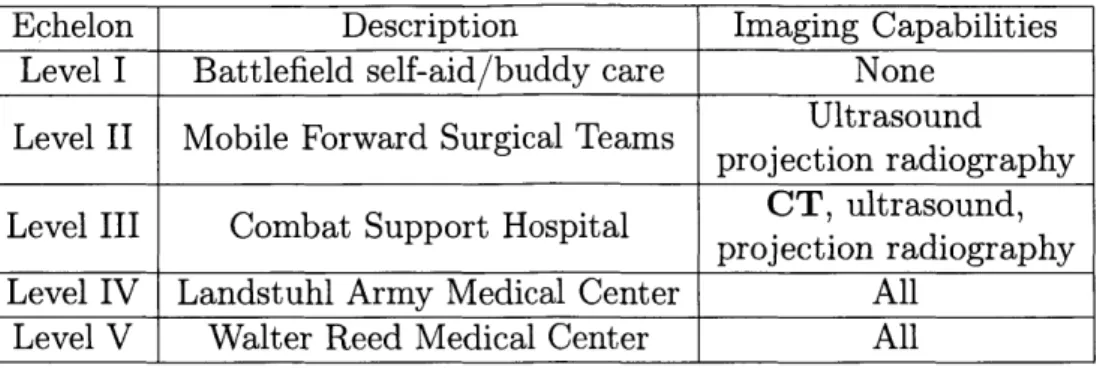
As shown in Table 1.1 NATO military care in the wars in Iraq and Afghanistan is divided into five echelons of care [1].
CT is not typically available to Echelon I or II combat care. This includes aircraft carriers, mobile forward surgical teams, and forward operating bases, which generally7 operate without a volumetric medical imaging capability, despite performing surgeries that would routinely be accompanied by volumetric imaging in the civilian world [14].
Developing a motion free CT system could dramatically increase access to this
7
During the Iraq war, one mobile forward surgical team in Mosul was occasionally equipped with a single CT system
Table 1.1: Echelons of Combat Care
Echelon Description Imaging Capabilities
Level I Battlefield self-aid/buddy care None Ultrasound Level II Mobile Forward Surgical Teams .jtrad
projection radiography Level III Combat Support Hospital CT, ultrasound,
projection radiography
Level IV Landstuhl Army Medical Center All Level V Walter Reed Medical Center All
valuable imaging tool. In particular, a system that is modular - and can be broken down into man-portable components and assembled in the field - might be able to bring volumetric imaging closer to the battlefield.
CT is the preferred tool in the hours immediately following an injury [29], due to its ability to image blood and bone. In chaotic battlefield conditions where TBI may present with a plethora of confounding factors and distracting injuries, the ability to distinguish between a mild concussion and intraparenchymal hemorrhage in the first
few hours after an injury could save lives.
In addition to TBI, a man- or truck-portable modular tomosynthesis system could also.be used to assess a variety of other battlefield injuries, such as airway burns (in conjunction with an endoscopic probe), gunshot wounds, and embedded shrapnel.
1.2.5
Space medicine
Extended space missions represent another use case for a portable tomographic imag-ining system. A manned mission to Mars, for example, will take hundreds of days at the minimum [71], and having advanced radiographic imaging capabilities could be a substantial benefit for the crew members of such a mission. Currently, radiographic imaging on the International Space Station is limited to ultrasound [13]. Unfortu-nately, a conventional CT system is not an option, due to its weight, and the fact that a rotating gantry would impart an equal and opposite rotation upon the spacecraft. A light-weight, motion-free, modular tomographic imaging system could address these
issues.
Even with a motion-free system, there remain many barriers to use for x-ray imaging in space. Most prominently, getting the mass of protective lead vests (for caregivers) out of Earth's gravity well would be a substantial expense [191. However, a manned mission to Mars is contingent on, among other things, the development of lightweight radiation protection for GeV energy cosmic rays [71], which are millions of times more energetic than medical x-rays.
1.2.6
Tomosynthesis applications
Beyond CT, limited angle tomography has a number of clinical and proposed uses. Digital Breast Tomosynthesis (DBT) is a technique that has been pioneered in recent years in which x-ray images are acquired as the source moves in an arc across the breast [51]. A 3D image of the breast is then reconstructed. It is currently unknown whether DBT provides significantly better outcomes than conventional 2D mammog-raphy. A large, randomized trial (TMIST) began in 2017 and will conclude in 2020 to assess the efficacy of DBT as breast cancer screening technique over conventional 2D mammography [22].
Another possible application for portable volumetric imaging is in the design of custom prosthetics. Modern 3D printers allow for highly customized prosthetic com-ponents. However, the global burden of amputations falls most heavily in areas that lack access to volumetric medical imaging. A portable system for extremity tomosyn-thesis could find use in the design of custom prosthetics.
Tomosynthesis of the knee and hands has also been proposed [36, 20] as a mech-anism to study the progression of arthritis and osteoporosis.
1.3
Technical Background
In this section I discuss the physical processes by which medical x-ray images are acquired, and how x-ray production is achieved, and relevant advances in ultraviolet photocathode technologies.
1.3.1
X-ray images
X-ray is a common term of energetic electromagnetic waves with a wavelength of 10-11 to 10- meters, or equivalently, photons in the 100 to 100,000 electron-Volt energy range.
X-ray tubes have been in use since the late 1800s for a variety of applications. Though the size and exact function of x-ray tubes vary greatly, they all share two ba-sic components: an electron source, and a target held at a high potential positive with respect to the electron source
[68].
The potential difference between the anode and the cathode draws electrons from the electron source and accelerates them towards a metal anode target, such as tungsten or molybdenum. The electron beam's interaction with the target metal generates x-rays. Both transmission-type and reflection-type geometries are used, the latter to create an anisotropic source at an angle to the elec-tron beam axis. Physically, the emission of x-rays is caused by the rapid deceleration of electrons that impact the target, a process known as Bremmstrahlung radiation, and by the ejection of electrons from the k- or 1-shells of the target metal. Many implementations of x-ray tubes include a method for managing the heat buildup in the target, by liquid-cooling or rotating the target.Conventionally, the electron source in medical x-ray tubes is a type of thermionic source, in which a filament (often tungsten) is heated, ejecting electrons from its surface. This occurs once the electrons have enough thermal energy to overcome the work function of the metal. For tungsten, this occurs at temperatures above 2200 degrees C [64].
In medical x-ray tubes, a molybdenum cup is commonly used to focus the ejected electrons onto the target anode. This focusing enables a small spot size.
X-ray imaging has a wide variety of uses in medicine. In this thesis, I focus on three applications in particular: radiography, mammography, and computed tomography (CT). X-ray radiography is used to diagnose orthopedic injuries, tuberculosis, and many emergent conditions.
Figure 1-1: X-ray radiograph of the author's arm following a regrettable rock climbing incident.
leading cause of death for women in the US. CT has a wide variety of uses, mostly notably in stroke and TBI management. Application of CT were covered in detail in the preceding sub-section.
X-ray imaging follows Beer's law,
I=Ioe-- (1.1)
where I is the irradiance on an image sensor, 1 is the irradiance on the attenuating object, p is the linear attenuation coefficient of the object, and 1 is the propagation distance through the object. The attenuation of a given tissue type is dependent on its density and effective atomic number [64]. When the x-ray path contains multiple materials, Beer's law can be expressed as
I = IoeEiii (1.2)
Different x-ray attenuation by different tissue types provides contrast in x-ray imaging.
In digital x-ray imaging, a detector element collects charge generated by photons. Recording x-ray photons is a non-trivial affair. For both digital and film radiography, there is a need to down convert from high energy x-ray photons to optical photons in order to generate an image. High energy photons have a low probability of interacting with a thin sheet of film, and can damage the charge collecting pixel detectors (which, in any case, do not work well at x-ray energies). A separate material is needed- one that can both stop the x-ray photons and produce optical photons, which are easily imaged with either film or a digital detector.
Stopping x-rays and producing visible light is accomplished using a crystal known as a scintillator (also referred to as a phosphor). Scintillators for a given x-ray applica-tion are chosen such that even a thin sheet will have a high stopping power for x-rays at the energy used. Generally, scintillators used for medical imaging emit around 500 nm 100 nm. Some common scintillator choices include Cesium Iodide, CsI, and Gadolinium oxysulfate, Gd202S (GOS). GOS in particular is frequently doped
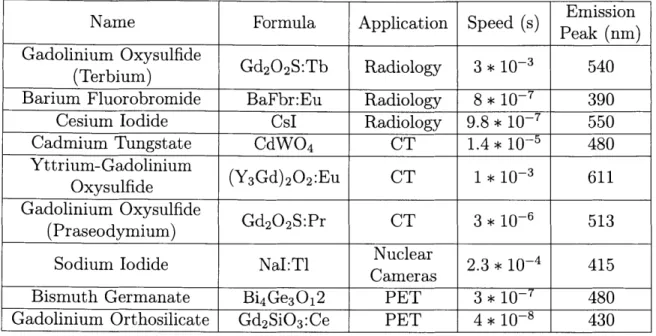
to alter its absorption and emission profiles; terbium and praseodymium are common dopant choices for radiography and computed tomography, respectively. A table of the properties of scintillators commonly used in medical imaging is below, adapted from [101.
Scintillator speed is another important factor to consider. Imaging techniques that rely on photon-counting principles, such as Positron Emission Tomography (PET), are reliant on a detector with good temporal resolution. The speed listed above refers to rise time- scintillators can have a slow turn-off time, even though they may respond quickly to an initial photon.
We used a cesium iodide-based imaging system in our experiments, due to its speed and the fact that it is a very common choice for radiography and fluoroscopic
Table 1.2: Common scintillators in medical imaging
FEmission Name Formula Application Speed (s) Peak
(nm)
Gadolinium Oxysulfide Gd202S:Tb Radiology 3 *10-3 540
(Terbium)
Barium Fluorobromide BaFbr:Eu Radiology 8 * i0 7 390 Cesium Iodide CsI Radiology 9.8 * 10-7 550 Cadmium Tungstate CdWO4 CT 1.4 * 10-5 480
Yttrium-Gadolinum (Y3Gd) 202:Eu CT 1 * 10-3 611 Oxysulfide Gadolinium Oxysuffide Gd202S:Pr CT 3 * 10-6 513 (Praseodymium) Nuclear
Sodium Iodide NaI:Tl Ncar 2.3 * 104 415
Cameras
Bismuth Germanate Bi4Ge3O12 PET 3 * 10-7 480
Gadolinium Orthosilicate Gd2SiO3:Ce PET 4 * 10-8 430
imaging.
1.3.2
X-ray production
Bremsstrahlung X-ray production can be broken down into two stages: electron pro-duction, and electron acceleration and braking. I will discuss the acceleration and braking stage first; electron production is discussed in 1.3.3.
Emitted electrons are accelerated towards a metal target through a high voltage. Common target materials for medical imaging include tungsten, molybdenum, and rhodium. Accelerated electrons striking a metal target will emit a spectrum of x-rays across a spectrum of energies. This spectrum is known as the Bremsstrahlung spectrum, and is dependent on the energy of the incident electrons, as well as the target material. The variation in emitted x-ray energy is due several factors. A representation of the Bremsstrahlung interaction is shown in equation 1.3.
A+ e~- > A+ e+hw (1.3)
emitted x-ray. Electrons expend their kinetic energy over the course of several in-teractions at varying distances from the nuclei of the target metal. Accordingly, the x-ray photons are produced at varying depths from the target metal nuclei.A com-plete quantum electrodynamics model of Bremsstrahlung radiation has been described by [4], [28], and others.
For medical applications, the energy spectrum of emitted electrons from an x-ray source is of critical importance
[641.
The maximum wavelength of emitted Bremsstrahlung radiation from an x-ray tube is given by the Duane-Hunt limit,hc
Amax = hc (1.4)
eV
where h is Planck's constant, c the speed of light, e the charge of an electron, and V the tube voltage
150].
The emitted Bremsstrahlung spectrum is given by Kramer's ruleKiZ A
I(A)dA= A2 A -1) (1.5)
where I(A) is the x-ray intensity at a wavelength (A), K is a constant, i the tube current, Z the atomic number of the target, and Amax given by 1.4. This can be
rewritten somewhat more intuitively in terms of photon energy E:
IE = KZ(EM - E) (1.6)
where IE is the intensity of photons at an energy E, K a constant, Em the energy of a photon with wavelength Amax
[26].
However, for medical imaging, low energyx-photons are filtered out by a window such as Be, Al, or Mo, depending on the application. This dramatically alters the spectral profile at lower energies.
As the Duane-Hunt limit states, for an x-ray source, the tube voltage (reported as kVp, or 'peak voltage') sets the maximum x-ray energy, not the average energy of emitted x-rays. A good rule of thumb is that the average x-ray energy (in electrons-Volts) from Bremsstrahlung sources is about one third of the peak voltage 126].
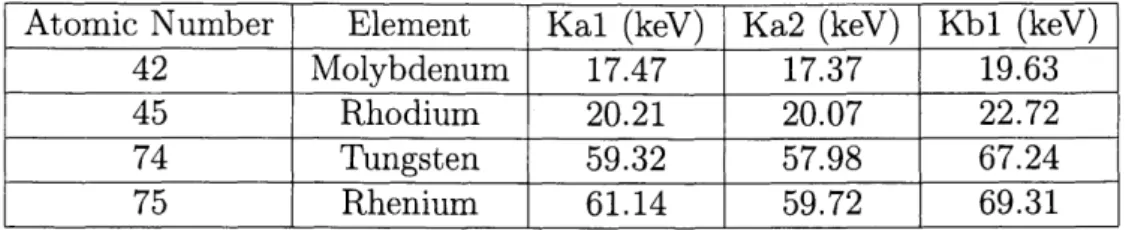
Table 1.3: K-line of common anode element choices for x-ray imaging Atomic Number Element Kal (keV) Ka2 (keV) Kb1 (keV)
42 Molybdenum 17.47 17.37 19.63
45 Rhodium 20.21 20.07 22.72
74 Tungsten 59.32 57.98 67.24
75 Rhenium 61.14 59.72 69.31
produced when the incident electrons ionize the target material, often by displacing an electron in the k- or 1- shell of the target metal. This process produces narrow, high-intensity peaks of x-ray radiation at discrete points along the energy spectrum. This k- or 1-line emission is primary source of radiation for certain applications such as mammography. This is accomplished by using a filter (usually a thin sheet of metal) to remove much of the Bremsstrahlung radiation [64].
Common target/filter combinations for mammography include molybdenum/ molyb-denum, molybdenum/ rhodium, and rhodium/ rhodium. While Mo/Mo has been reported to have the highest contrast-to-dose ratio in mammography, a system using rhodium (Z = 42) filters or anodes has a spectrum that has more energetic photons than a molybdenum filtered tube, so it may be more appropriate for a dense or large breast [16].
In radiography and CT, x-ray photons usually need to penetrate the bone and tissue that comprise the head, chest, and/or abdomen. Since this requires a more energetic photon spectrum than mammography, molybdenum is not a useful choice of target. Common targets for radiography and CT include tungsten (Z = 74) and a 10%/90% rhenium (Z = 75) tungsten alloy. For thermal management reasons, a common anode design has a rhenium/tungsten surface on top of a molybdenum or graphite core. Aluminum (Z = 13) is a common filter choice for radiography and CT applications. Bremsstrahlung radiation (as opposed to characteristic ionization radi-ation) is the significant contributor to the x-ray spectrum in radiology and CT [64].
The width of the electron beam, and the angle between the electron beam and the anode target determines the focal spot size, which determines the maximum resolution
of the resultant image. For radiography and computed tomography, a small spot size is less important due to blurring from scattering within the body; however, for mammography, which hinges on the accurate discrimination of tiny features, a small spot size is critical [39].
Table 1.4: Tube voltages and spot sizes for different medical x-ray applications Application Spot Size (mm) Tube Voltage (kV)
Mammography >0.1 ~17
Radiography 1-10 30-120
CT 1-10 150
1.3.3
Electron generation techniques
The other stage of x-ray generation is the production of electrons that are then accelerated towards the anode. In conventional x-ray tubes, electron generation is accomplished by running current through a thin tungsten filament. The current density J in a thermionic filament follows the expression
J = (1 - rav )AoT keT (1.7)
Where T is the temperature of the filament, ray the reflection rate of electrons at its surface, q the work function of the filament material, k the Boltzmann constant, and AO a constant.
While thermionic electron sources can reliably produce a large electron flux (up to 1 amp per square centimeter), they are themselves large and have substantial power requirements, and cannot be pulsed quickly. A number of alternative x-ray generation arrangements have been proposed for use in non-rotating CT, and are in various stages of development.
Field emission is an alternative to a thermionic filament or a photocathode (see section 1.3.4). In field emission, a large electric field (rather than temperature) is used to overcome the work function of a material, thereby ejecting electrons. The current
density in field emission source is described by the Fowler-Nordheim equation:
F2
J= a e F 1.8)
where a and b are constants and F the applied electric field. Unlike thermionic sources, field emission sources can be very small (nanoscale), can have a rise time as low as 50 microseconds
[46],
and can run at low temperatures. A large body of research centered around carbon nanotube (CNT) field-emission sources.CNT x-ray sources have been demonstrated in various incarnations since the 90s [67]. CNT x-ray sources typically implement a triode-like gating system, where the cathode is molybdenum substrate with the CNTs deposited on top, and the gate a metallic (often tungsten) mesh. Controlling the potential of the mesh controls the electron generation.
CNT sources can have exceedingly small spot sizes, allowing for very high resolu-tion x-ray imaging However, building a CNT source that is reliable, rapidly pusable, and has a small form factor continues to be a significant engineering challenge. Few, if any, miniaturized, pulseable carbon nanotube based field emission sources have been brought to market
[46].
Non-rotating tomosynthesis systems based off of a arrays of gated CNT sources have been demonstrated for several different applications. In particular, CNT sources have seen success in micro CT imaging of mice [30] and teeth [53], and breast tomosyn-thesis [54].
A 2014 feasibility study [60] determined that CNT sources could be used for non-rotating CT, and a subsequent 2015 PhD thesis [59] demonstrated chest tomosynthesis using a CNT array. A review published this month notes that "Conceived less than 20 years ago, CNT-enabled X-ray sources are now being manufactured on a commercial scale and are powering both research tools and experimental human imaging devices" [53]. It seems quite likely that, at least in the near term, CNT field emission sources will continue to lead the way in non-rotating x-ray tomosynthesis.
stabil-ity [72], reliabilstabil-ity [6, 551, and most significantly, an involved manufacturing process. For these reasons, we opted to explore photocathode based x-ray sources.
1.3.4
Ultraviolet Photocathodes
Much work has been done on photocathode design in the 112 years following Einstein's description [12] of the photoelectric effect. An excellent review of photocathode types is provided by [31], who subdivides photocathodes into two broad categories: metallic cathodes, and semi-conductor cathodes.
In photocathode emission, an incoming UV photon promotes an electron from the valence band on the photoemissive substance into the conduction band. If the electron has enough energy to overcome the work function 0 of the metal, it can be ejected as a free electron. In metals, the valence band overlaps the conduction band, so there will be a considerable number of electrons in the conduction band. Scattering within the conduction band creates a short escape depth, so that electrons from more than a few nm below the surface of the magnesium do not contribute to the photoemission process. By contrast, semiconductors have a significant band gap, so the conduction band is sparsely populated. Because of this, the electrons from deep within the semiconductor material can contribute to photoemission.
The number of photo-electrons a material ejects for a given illumination is known as the quantum efficiency (QE), typically define in this context as
QE = #eemitted 9
#7Yincident
Where #eemitted is the number emitted of photoelectons and #Yincident is the number of incident photons. Many semiconductor cathode materials can provide a much higher QE than metallic cathodes at ~250 nm. Cesium telluride (Cs2Te), in
particular, is of note as a very high QE cathode material [52, 37]. Unfortunately, it
has a shorter lifetime than the metallic cathodes, has a complicated and expensive production process, and has severe handling constraints. Exposure to vacuum pres-sures as high as 10- Torr - which is still lower than many turbopumps can achieve
- would be enough to ruin the cathode. Metallic cathode materials with a relatively
high QE at -250 nm include samarium, barium, and yttrium [31, 37]. However, they all have special handling concerns. Barium in particular is especially reactive, and behaves poorly in the presences of electromagnetic fields.
We opted to use magnesium as our cathode material in this project. Magnesium has a relatively high QE at wavelengths of -250 nm [44, 31, 37], is very abundant, and relatively few special handling concerns8. A magnesium photocathode will slowly absorb oxygen, and oxidize into MgO [74, 66], but the process is fortunately self-limiting [40]. This gives magnesium cathodes a long lifetime, and allows them to be exposed to atmosphere for short periods of time without catastrophe. Laser cleaning of magnesium [44, 48, 65] has been reported to greatly improve (by a factor of up to 10x) the QE of magnesium photocathodes, although this improvement of efficiency would be ruined by any exposure to all but the tightest of vacuums.
The efficiency of a metal photocathode is dependent on the thickness of the metal layer, but only for very thin films. For layers greater than 100 angstroms in thickness, the QE of the cathode is generally thickness-independent [2, 47].
A rapidly pulseable, photocathode based x-ray source in the 1-10 keV range was developed at the Goddard Space Center to test and calibrate the Neutron star Interior Composition Explorer (NICER), a payload recently installed on the International Space Station [15, 18]. NICER is an astrophysics sensing package designed for the study of pulsars, which emit radiation in the soft x-ray range. This calibration source was a starting point for the work developed in the course of this thesis.
8
There are still a few hazards: vaporized magnesium is a respiratory irritant, and powered mag-nesium can oxidize rapidly in water.
Chapter 2
Methods and Materials
This chapter discusses design considerations for illumination schemes of an array of photocathodes; the design of an ultraviolet magnesium photocathode itself; the con-struction and operation of a single miniaturized x-ray source using that photocathode; and the construction of a prototype 7-source, 17.5 degree are unit-element of a CT system.
2.1
Illumination
Our goal is to replace the single spinning x-ray source in conventional CT with a distributed ring of rapidly pulseable photocathode based x-ray sources. In order to have the same capabilities of a conventional CT, such a system would need to have the following characteristics:
1) Hundreds of sources packed tightly together
2) Each source must produce a high x-ray flux at an appropriate energy
3) Each source must be capable of switching quickly-on the order of a kilohertz, to image a full 360 degrees in a few seconds
Conventional CT sources rely on thermionic processes of electron production. A significant current is run through a filament, which then ejects electrons. This process reliably produces a large number of electrons; however, the turn on and turn off times
An alternative method of generating electrons is to exploit the photoelectric effect, by illuminating a metal with a short wavelength of light, typically in the ultravio-let (UV) range. This could be accomplished with a laser, lamp, or light emitting diode (LED). A device that emits current when illuminated with light is known as a photocathode. The design and control of a custom photocathode for electron beam generation in our x-ray source was a crucial part of this thesis.
A UV laser has several challenges. Using a laser to control dozens or hundreds of individual sources would require a means of precisely controlling the illumination of each source. There are few, if any, optical switches that work in the UV range, and developing such a switch for this application would require groundbreaking innovation in non-linear optics. Furthermore, optical fibers at this wavelength are very expensive. An alternative arrangement would be to use an infrared laser or lamp that illumi-nates a bundle of optical fibers, each leading to a separate source, each fiber having its own optical switch. Switches, fibers, and other infrastructure for guiding infrared light is relatively cheap and widely available, due to the widespread use of this wave-length in the telecommunications sector. However, the light would then have to be downconverted from infrared to UV at the junction of the source and optical fibers. This could conceivably be done using third harmonic generation, but manufacturing the crystals to achieve this would be a significant materials and optical engineering
challenge.
Fortunately, recent advances have made UV light emitting diodes (LEDs) rela-tively cheap, especially in the 200-400 nm range. These LEDs also have a quick fast response time and a stable output. So, rather than having a single light source with an optical switching scheme, we opted to have each photocathode illuminated by its own LED, and the LED itself electrically switched. This is depicted in Fig. 2-2.
However, a small photocathode alone is unlikely to produce a sufficiently large electron flux for x-ray (and especially CT) imaging applications. In order to increase the electron flux, we used a Magnum 5900 model Channeltron (Photonis Inc), a glass electron amplification device that can amplify an input current by a factor of up to 10'. Originally developed for mass spectrometry applications, Channeltrons are a
family of electron amplification devices that consist of a set of tightly wound glass spirals inside of a secondary emissive layer supplied with a bias voltage. Charged particles that impact an entrance funnel will start a cascade of successive impacts, each of which produces electrons, throughout the spirals- this produces the electron amplification.
2.2
Magnesium Photocathode Design
We constructed a photocathode by depositing a thin layer of magnesium on the active input surface of the Channeltron. The light input is provided by a UV LED (Thorlabs Ball Lens LED250J), through a quartz window (since the Channeltron is inside of the vacuum manifold).
Magnesium has a high quantum efficiency at UV wavelengths. Other photocath-ode materials, such as Cs2Te or certain semiconductor films, have even higher QEs at
250 nm
[44],
but have to be handled under high-vacuum. Metal photocathodes also have a significant advantage in that they are quick to turn on and turn off. Using a lower frequency light source means that cheaper (and easier to handle) photocathodes are possible for a given electron flux. Alternatively, a bialkali or similar photocathode allows for higher frequencyl - and thereby cheaper - illumination, but significantly increase the cost and complexity of the cathode component. Magnesium is a good compromise in terms of QE, ease of handling, cost, and temporal frequency. See section 1.3.4 for more details.Even in vacuum on the order of 10' Torr, magnesium will slowly oxidize to MgO. Although in special circumstances this oxidation can actually increase the QE of a magnesium photocathode [74], in general, oxidation of magnesium will reduce the QE of the photocathode. However, the oxidation process is self-limiting and progresses quite slowly, with a time constant on the order of years. Keeping the photocathode at low pressure, or else immersed in argon, can slow the oxidation.
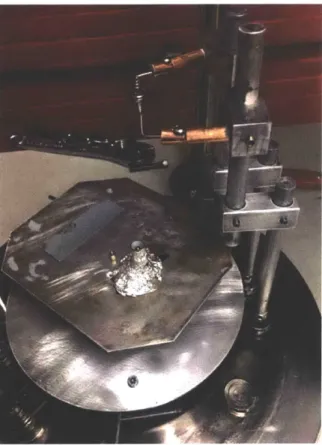
The magnesium deposition was carried out using a thermal evaporator (Denton
- - - --- - -
--Vacuum systems, 505-A). The chamber, commonly used for gold and carbon coating for use in conjunction with a scanning electron microscope (SEM) was first exten-sively cleaned to remove the possibility of any contamination with other materials. Cleaning was accomplished in a 3 step process- the chamber was disassembled, and each component scoured with acetone and 800 grit sandpaper. The process was re-peated a second time with isopropyl alcohol (IPA) instead of acetone. Finally, each component in the chamber was scrubbed using IPA and Kimwipes.
Figure 2-1: Magnesium coating system
50 mg pellets of magnesium were placed in a tungsten wire basket. The magnesium was vaporized by running 25 amps of current through the tungsten wire for 2 minutes, under high vacuum (<10Torr). Deposition occurred inside of a Pyrex bell jar pumped down to vacuum using a liquid nitrogen-cooled diffusion pump. Individual
Channeltrons were wrapped in aluminum foil and held to a rotating stage underneath the tungsten basket with carbon tape. Alongside the Channeltron, a glass microscope slide was placed on the rotation stage to confirm successful deposition.
Foreline pressure on the diffusion pump was maintained with a mechanical rough-ing pump. No other metals (besides magnesium) were used in the chamber after the cleaning process.
2.3
Single Miniature X-ray Source
A bias voltage of up to 3000 volts is applied across the Channeltron. An adjustable high voltage between 10 and 40kV is applied from the exit of the Channeltron to the tungsten anode target. An electron beam is then produced by illuminating the magnesium-coated input of the Channeltron with UV light. The 10-40kV potential difference between the Channelton and the anode accelerates the electrons from the Channeltron and imparts upon them the energy which is converted into x-ray photons at the anode by the Bremsstrahlung process.
The operation of the entire individual source is detailed in Fig. 2-2. A pulsable UV LED (1) emits UV photons which pass into the vacuum manifold (3) through a quartz window (4) and interact with a photoemission element (5). This interaction produces electrons which are amplified by an electron amplification stage (6). The amplified electrons are accelerated through a large electric field provided by an external high-voltage source (8), and impact on a target (9). This interaction produces x-ray photons (10) which leave the vacuum manifold through a beryllium window (11) and an optional filter stage (12). The filtered x-rays then pass through the sample (13) and are recorded by a detector array (14), which provides feedback to the control circuit.
MEu-
14 13 12v-rn
2 V 4 4 11 4 10 9+
-v-I-67,e 7 1-Figure 2-2: Diagram of an individual miniature x-ray source
2.4
Multi-source Module
We developed a seven source module, as a prototype towards a full ring of distributed sources for computed tomography. The module houses seven x-ray sources, spaced in 2.5 degree intervals across a 227.5 mm radius arc.
2.4.1
Electrical control individual sources
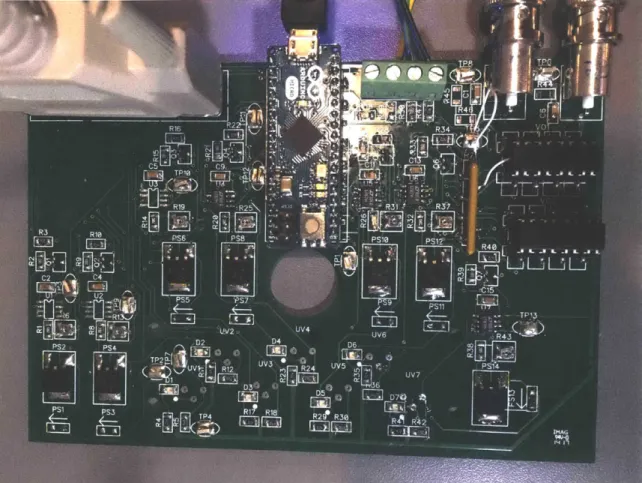
We designed a printed circuit board to control the 7 UV LEDs, the schematic for which is shown in figures 7 and 8. The PCB has two separate circuits: a 20 V power line and a 5 V logic line.