HAL Id: tel-01302875
https://tel.archives-ouvertes.fr/tel-01302875v2
Submitted on 11 Jul 2016
HAL is a multi-disciplinary open access archive for the deposit and dissemination of sci-entific research documents, whether they are pub-lished or not. The documents may come from teaching and research institutions in France or abroad, or from public or private research centers.
L’archive ouverte pluridisciplinaire HAL, est destinée au dépôt et à la diffusion de documents scientifiques de niveau recherche, publiés ou non, émanant des établissements d’enseignement et de recherche français ou étrangers, des laboratoires publics ou privés.
Language
Matias Vara Larsen
To cite this version:
Matias Vara Larsen. BCOol : the Behavioral Coordination Operator Language. Other [cs.OH]. Uni-versité Nice Sophia Antipolis, 2016. English. �NNT : 2016NICE4013�. �tel-01302875v2�
SCIENCES ET TECHNOLOGIES DE L’INFORMATION ET DE LA COMMUNICATION
T H `
E S E
pour l’obtention du grade de
Docteur en Sciences
de l’Universit´e Nice - Sophia Antipolis
Mention : Informatique
present´ee et soutenue par
Matias Ezequiel Vara Larsen
B-COoL: Un Metalangage pour la
Sp´
ecification des Op´
erateurs de
Coordination des Langages
B-COoL: the Behavioral Coordination Operator Language
Th`ese dirig´ee par: Fr´ed´eric Mallet
et encadr´ee par: Julien DeAntoni
soutenue le 11 avril 2016 Jury :
M. Olivier Barais Prof. Universit´e de Rennes 1 Rapporteur
M. S´ebastien G´erard Dr. CEA LIST Rapporteur
M. Bruel Jean-Michel Prof. Universit´e de Toulouse 2 Examinateur
M. Fr´ed´eric Mallet M.C. INRIA/I3S-CNRS Directeur de Th`ese
Les appareils modernes sont constitu´es de plusieurs sous-syst`emes de diff´erentes sortes qui commu-niquent et interagissent. L’h´et´erog´en´eit´e de ces sous-syst`emes et leurs interactions complexes rendent tr`es d´elicate leur d´eveloppement. L’approche d’ing´enierie dirig´ee par les mod`eles apporte une solution en permettant l’expression de nombreux mod`eles structurels et comportementaux de natures tr`es di-verses. Dans ce contexte, il est n´ecessaire de construire un mod`ele unique qui int`egre ces diff´erents mod`eles afin d’y appliquer des m´ethodes de validation et de v´erification pour permettre aux ing´enieurs syst`eme de comprendre et de valider un comportement global. Cependant, la coordination manuelle des diff´erents mod`eles qui composent le syst`eme est une op´eration source d’erreurs et les approches au-tomatiques proposent des patrons de coordination ad-hoc pour certaines paires de langages. Dans ces approches, le patron de coordination est souvent encapsul´e dans un outil dont il est difficile d’extraire les liens avec le syst`eme global. Cette th`ese propose le Behavioral Coordination Operator Language
(B-COoL), un langage d´edi´e `a la sp´ecification de patrons de coordination entre des langages `a
par-tir de la d´efinition d’op´erateurs de coordination. Ces op´erateurs sont employ´es afin d’automatiser la coordination de mod`eles exprim´es dans ces langages. B-COoL est impl´ement´e comme une suite de plugins qui s’appuient sur l’Eclipse Modeling Framework et pr´esente ainsi un environnement complet pour l’ex´ecution et la v´erification de diff´erents mod`eles coordonn´es. Nous illustrons cette approche avec la d´efinition d’op´erateurs de coordination entre deux langages: timed finite state machines et ac-tivities. Ensuite, nous utilisons ces op´erateurs afin de coordonner et d’ex´ecuter un mod`ele h´et´erog`ene de cam´era de surveillance.
Modern devices embed several subsystems with different characteristics that communicate and interact in many ways. This makes its development complex since a designer has to deal with the heterogeneity of each subsystem but also with the interactions among them. To tackle the development of complex systems, Model Driven Engineering promotes the use of various, possibly heterogeneous, structural and behavioral models. In this context, the coordination of behavioral models to produce a single integrated model is necessary to provide support for validation and verification. It allows system designers to understand and validate the global and emerging behavior of the system. However, the manual coordination of models is tedious and error-prone, and current approaches to automate the coordination are bound to a fixed set of coordination patterns. Moreover, automatic approaches encode the pattern into a tool thus limiting the reasoning on the global system behavior. In this thesis, we propose the Behavioral Coordination Operator Language (B-COoL) to reify coordination patterns between specific domains by using coordination operators between the Domain-Specific Modeling Languages used in these domains. Those operators are then used to automate the coordination of models conforming to these languages. B-COoL is implemented as plugins for the Eclipse Modeling Framework thus providing a complete environment to execute and verify coordinated models. We illustrate the use of B-COoL with the definition of coordination operators between two languages: timed finite state machines and activities. We then use these operators to coordinate and execute the heterogeneous model of a surveillance camera system.
This thesis involved the collaboration of many people. My thanks go to:
• My advisors Frederic Mallet and Julien DeAntoni whose advice improved my quality as research scientist.
• Doctor S´ebastien G´erard and Professor Olivier Barais, for accepting and evaluating my thesis; • The AOSTE team whose advice improved my research and for every launch;
• The GEMOC project for all the feedback that helps me a lot for improving my results;
• My family Julio, Silvia, Pilar, Julian, and my grandparents Dina, Pichi, Maria and Baltazar. Without your support and encouragement, my success would not have been possible.
To Julio, for driving a fiat 147 while putting us through college.
To Silvia, for marking us breakfast every day for twenty-three years. Each. To Julian, for joking during dinners.
To Pilar, for answering the calls during nap time.
Para Julio, por llevarnos al colegio en el fiat 147.
Para Silvia, por preparanos el desayuno cada ma˜nana por 23 a˜nos.
Para Julian, por hacernos reir durantes las cenas. Para Pilar, por las llamadas durante la siesta.
R´esum´e 3 Abstract 5 Acknowledgements 7 1 Introduction 1 2 Background 5 2.1 Introduction . . . 5 2.2 Composition Approaches . . . 6
2.2.1 Model Composition Approaches . . . 6
2.2.2 Language Composition Approaches . . . 9
2.2.3 Discussion . . . 11
2.3 Coordination Approaches . . . 12
2.3.1 Model Coordination Approaches . . . 12
2.3.2 Language Coordination Approaches . . . 16
2.3.3 Discussion . . . 20
2.4 Conclusion . . . 21 13
3 Requirements for a Language to specify Coordination Patterns 23
3.1 Introduction . . . 23
3.2 Language Behavioral Interface . . . 25
3.2.1 Review of Existing Approaches . . . 25
3.2.2 Requirements . . . 29
3.3 Correspondence Rules . . . 31
3.3.1 Review of Existing Approaches . . . 31
3.3.2 Requirements . . . 32
3.4 Coordination Rules . . . 35
3.4.1 Review of Existing Approaches . . . 35
3.4.2 Requirements . . . 37
3.5 Conclusion . . . 38
4 B-COoL: the Behavioral Coordination Operator Language 41 4.1 Introduction . . . 41
4.2 Running Example: Coordination of the Heterogeneous Models of a Coffee Machine . . 43
4.3 The Language . . . 47
4.3.1 Abstract Syntax of B-COoL . . . 48
4.3.2 Library . . . 52
4.3.3 Execution Semantics . . . 54
4.4 Implementation . . . 57
4.5 Evaluation . . . 63
5.2 Use Case: Coordination of the Heterogeneous Models of a Surveillance Camera System 68
5.3 Definition of Coordination Operators between the TFSM and Activity Languages . . . 70
5.4 Use of the Operators in a Surveillance Camera System . . . 76
5.5 Conclusion . . . 79 6 Conclusion 81 6.1 Overview . . . 81 6.2 Future Works . . . 84 Bibliography 86 15
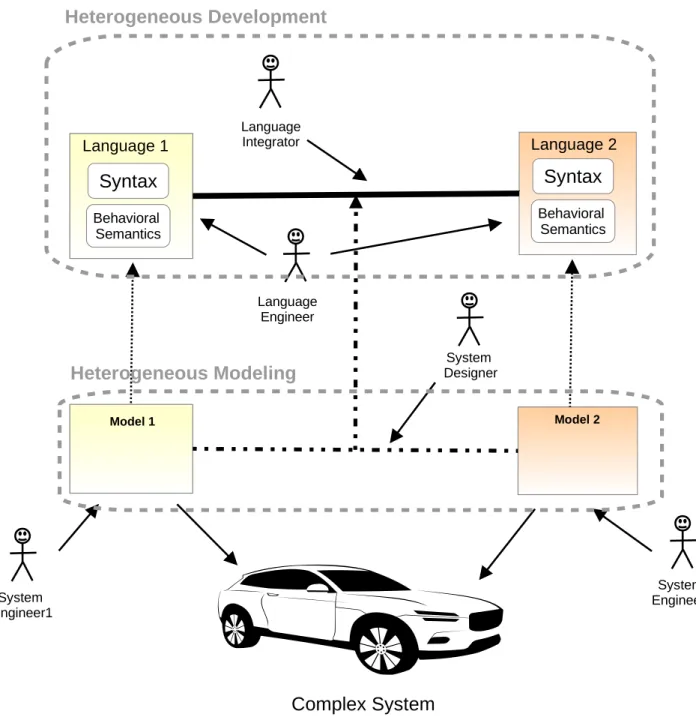
1.1 Stakeholders in the development of a Complex System . . . 3
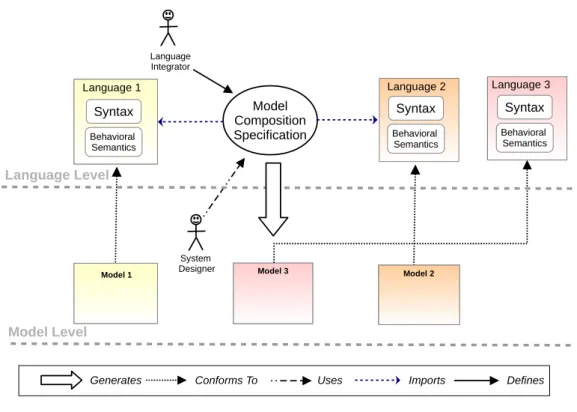
2.1 Model Composition Approaches Sketching . . . 7
2.2 Language Composition Approaches Sketching . . . 9
2.3 Model Coordination Approaches Sketching . . . 13
2.4 Specification of a client-server system in Wright [AG97] . . . 15
2.5 High level view of the approach proposed by Di Natale et al. in [DNCSSV14] . . . 18
2.6 High level view of Ptolemy [GLL99] . . . 19
4.1 Overview of the proposed approach . . . 42
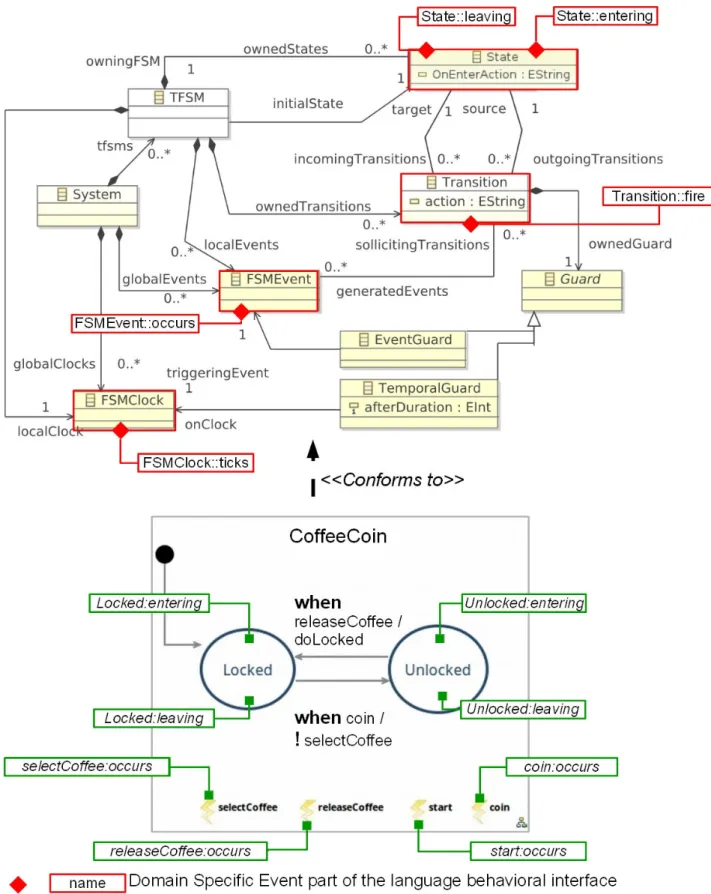
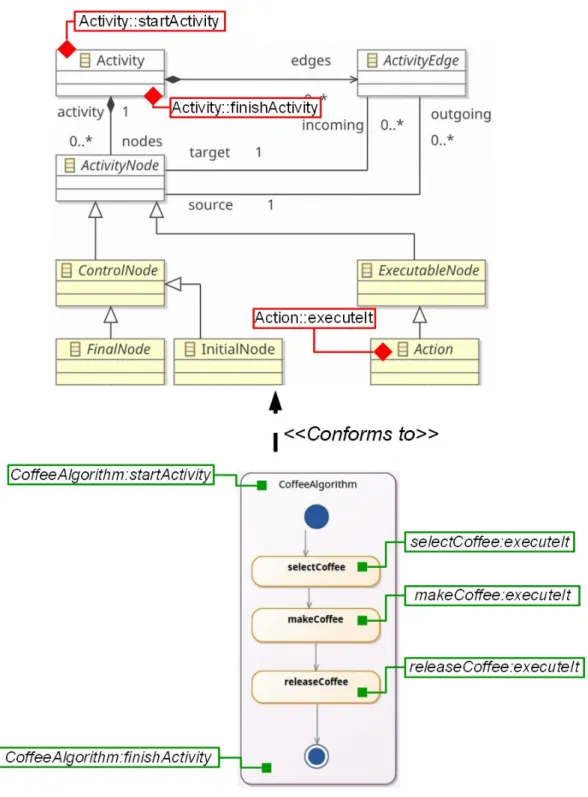
4.2 (At the top) An excerpt of the TFSM metamodel with a part of its language behavioral interface. (At the bottom) a TFSM model with a part of its model behavioral interface 44 4.3 (At the top) An excerpt of the Activity metamodel with a part of its language behavioral interface. (At the bottom) an Activity model with a part of its model behavioral interface 46 4.4 Coordination of the models of the coffee machine by constraining the corresponding mse 47 4.5 Simplified View of B-COoL abstract syntax . . . 48
4.6 Resulting coordination of the coffee machine by using the event relation Rendezvous . 50 4.7 Resulting coordination of the coffee machine by using the global event variable globalClock 51 4.8 Excerpt of MoCCML metamodel . . . 52
4.10 Resulting coordination of the Coffee Machine by using the automata relation
Ren-dezvousWithGlobalClock . . . 54
4.11 Steps in the application of the B-COoL specification between the models of the coffee
machine . . . 55
4.12 The proposed workflow for the heterogeneous development of complex applications . . 58
4.13 Overview of the implementation of B-COoL and its integration into the Gemoc Studio 59
4.14 Coordinated Execution of models by using the Gemoc Coordinated Execution Engine 62
4.15 State space representation of the coordinated model of the coffee machine, encoding the set of valid schedules. The transitions in red contain the events forced to happen
simultaneously by the coordination. . . 63
5.1 Representation of the Camera Encoder Control by using a TFSM . . . 69
5.2 Representation of the JPEG encoding algorithm by using an activity diagram . . . 70
5.3 Representation of the JPEG2000 encoding algorithm by using an activity diagram . . 70
5.4 Representation of the Battery Sensor by using an activity diagram . . . 71
5.5 Coordinated model of a surveillance camera system and a partial representation of the
model behavioral interface . . . 72
5.6 ExecuteActivityNonPeemptive event relation . . . 74
5.7 AtomicActivity event relation . . . 75
5.8 Coordinated execution of the models of the surveillance camera system by using the
Gemoc studio . . . 78
5.9 Partial resulting timing output of the surveillance camera system . . . 78
3.1 Specification of the Mascot correspondence rule by using the Epsilon Comparison
Lan-guage . . . 34
4.1 Partial ecl specification of TFSM . . . 43
4.2 Partial ecl specification of Activity diagram . . . 45
4.3 B-COoLspecification of the running example operator between the TFSM and Activity languages . . . 48
4.4 B-COoL specification of an operator that illustrates the use of Event Variables . . . . 51
4.5 B-COoL specification of an operator that illustrates the use of a moccml library . . 53
4.6 Resulting ccsl specification for the coffee machine system . . . 57
4.7 B-FloW specification for the models of the coffee machine . . . . 60
5.1 B-COoL specification of the SyncFSMEventsAndSignals operator . . . . 71
5.2 B-COoL specification of the StartActivityWhenEnter operator . . . . 73
5.3 B-COoL specification of the AtomicActivity operator . . . . 74
5.4 B-FloW specification for the Surveillance Camera System . . . . 77
Introduction
Nowadays devices are becoming more complex. They embed several subsystems with different char-acteristics that communicate and interact in many ways. For example, cars can integrate an adaptive control cruise system, GPS tracking, fuel control system and so on. Furthermore, these subsystems are widely coupled. For instance, the adaptive cruise system determines the way to get home depend-ing on the GPS tackdepend-ing, also, the fuel control system regulates the speed of the car dependdepend-ing on the level of fuel. This makes the design of these systems very complex. A designer has to deal with the heterogeneity of each subsystem but also with the interactions among them. To deal with this inherent complexity, the design is split into different domains, e.g., mechanical, electronic, software. The development is thus tackled by different Domain Experts.
Model Driven Engineering (MDE) promotes the use of Domain Specific Modeling Languages (DSMLs) to model complex systems using the adequate, domain-specific, terminology and tools (see Figure 1.1).
DSMLs are developed by Language Engineers1
as dedicated languages to make a description of a domain relying on the expert terminology so at to reduce introducing discrepancies in the model. Models must include structural aspects but also behavioral ones. Thus defining a DSML consists in defining its syntax but also its behavioral semantics. When several DSMLs, with different syntax and or semantics, are used conjointly to model a complex system, we say the model is heterogeneous, i.e., it is made of models that conform to different languages. Dealing with this kind of heterogeneity is the problem addressed in this thesis.
With heterogeneous models, the overall behavior emerges from its parts. To perform verification and
1
Also called Domain Experts.
validation activities of the whole system, designers need tools to comprehend this emerging behavior, or at least some aspects of it depending on the domain of interest. It is therefore necessary to specify how models and languages are related to each other, in both a structural and a behavioral way. In this context, the GEMOC initiative proposes to coordinate and disseminate the research results regarding the support of the coordinated use of various modeling languages, that is, the use of multiple modeling languages to support heterogeneous development of diverse aspects of a system. This thesis is part of GEMOC project and it focuses on the coordination [GC92a] of behavioral models to provide simulation and/or verification capabilities for the whole system specification.
Currently, Coordination Languages [GC92a] and Architecture Description Languages (ADLs) [MT97] provide dedicated languages to specify the coordination between particular behavioral models. This is usually done by System Designers (see Figure 1.1) that apply some coordination patterns according to their own skills and know-how. However, in large heterogeneous systems, the manual coordina-tion of models can become tedious and error prone. To automate this task, Coordinacoordina-tion Frame-works [BHLM02, BH08] have encoded a predefined coordination pattern inside a tool. However, the customization of these tools for a specific domain is difficult. Moreover, these approaches rely on a general purpose language (GPL) to express the coordination, thus limiting the task of a system designer to reason about how a system is coordinated.
In this thesis, we deal with the coordination of heterogeneous behavioral models by leveraging on the system designer’s skills. We propose a dedicated language named B-COoL (standing for B ehavioral C oordination Operator Language) that allows for capturing coordination patterns between a given set of DSMLs. These patterns are specified at language level, and then used to derive a coordination model automatically for models conforming to the targeted DSMLs. The coordination at the language level relies on a so-called language behavioral interface. This interface exposes an abstraction of the language behavioral semantics in terms of Events.
By using B-COoL, a Language Integrator (see Figure 1.1) defines operators that specify how events from different language behavioral interfaces interact. These operators are defined at the language level but they are applied between models to coordinate their behavior. This results in a model of coordination specified in the Clock Constraint Specification Language (ccsl), a declarative language that describes causal and temporal relationships between events. By relying on ccsl, we provide verification and validation facilities for the coordinated system. All this has been implemented as a
Language 1 Language 2 Model 1 Model 2
Syntax
Behavioral SemanticsSyntax
Behavioral Semantics System Designer Language Integrator System Engineer1 Language EngineerComplex System
System Engineer2Heterogeneous Development
Heterogeneous Modeling
set of plugins for Eclipse as part of the GEMOC studio2
; which integrates technologies based on Eclipse
Modeling Framework (EMF)3
adequate for the specification of executable domain specific modeling languages.
We organize the content of this thesis in six chapters. Chapter 2 presents the state-of-art approaches that give support for the developing of heterogeneous systems. First, we present approaches that propose to compose models/languages into a new model/language. Second, we present approaches that propose to coordinate the behavior of models. In particular, we focus on tools and frameworks that specify coordination patterns between languages to automate the coordination between models. We conclude this chapter by highlighting benefits and drawbacks of existing approaches.
Chapter 3 presents the requirements for a language to specify coordination patterns in the context og the heterogeneous development of complex systems. We first propose a framework to characterize the approaches that specify a coordination pattern. Then, we use this framework to compare existing approaches. From this comparison, we state the requirements to make existing approaches more flexible and well founded.
Based on these requirements, Chapter 4 presents a particular implementation of the framework named
B-COoL; a dedicated language to specify coordination patterns. To illustrate B-COoL, we rely on
a running example: the coordination of the heterogeneous models of a coffee machine, which is built by using timed finite state machines (TFSM) and activity diagrams. Then, we use this example through all the chapter to illustrate the syntax and semantics of B-COoL. We present the current implementation in the GEMOC studio by executing and verifying the coffee machine models.
To validate our approach, Chapter 5 presents the heterogeneous models of a surveillance video system decomposed into three subsystems. To coordinate these subsystems, we propose a set of B-COoL operators between the TFSM and activity languages. We use this example as a use case to illustrate the different steps from the specification of the coordination patterns, the coordination of a particular model and the verification of the coordinated system.
Finally, we provide the conclusion of this work, highlighting its main contributions and we give some perspectives in Chapter 6.
2
http://www.gemoc.org/studio
3
Background
2.1
Introduction
To deal with complexity issues in the development of applications for complex systems, Model Driven Engineering (MDE) proposes to rely on Models. A model is an abstraction of the real world made in order to facilitate an understanding of the way it works. In the context of MDE, a software model enables a developer to reduce the complexity of an application by ignoring non-essential details. This enables the developer to reason about the application.
The Object Management Group (OMG) proposes to specify models by relying on a language that has a well-defined form (syntax), meaning (semantics) and possible rules of analysis, inferences or proof for its constructs [mda03]. Thus, to build models, MDE proposes Domain Specific Modeling Languages (DSMLs). They are built by Language Engineers to describe the structure but also the behavior of a particular domain. As a result, a DSML is defined by a syntax and a semantics. The syntax is described by a metamodel that defines the concepts and relations that the language is made up. A metamodel is a model that is developed by using a metameta language, e.g., MOF, ECORE. To define the semantics, the language theory proposed three types of semantic definitions: Operational [Plo81], Axiomatic [Hoa69] and Translational [FJP90]. The concurrent theory has also proposed other ways to describe the behavior of a model. This behavior is characterized by the
so-called Models of Computation (mocc) [GBA+
09]. In this thesis, we focus on this approach for the description of the behavioral semantics of a language.
Based on a DSML, a domain expert builds a model to describe the structure and the behavior of a domain. However, the development of complex applications is often tackled by several domain experts. Each domain expert uses its own DSML to describe a part of the system. Thus, the use of several DSMLs results in a heterogeneous specification, i.e., made of models that conform to different DSMLs. At some point of the development, a global representation of the system is needed to reason about the system as a whole. For instance, a system designer must be able to perform verification and validation activities of the overall system. Thus, it is necessary to specify how models and languages are related in a structural and behavioral way.
This chapter presents the state-of-art approaches that give support for the heterogeneous development of systems by providing composition and/or coordination of models/languages. We begin by presenting Composition Approaches that propose to compose models/languages to obtain a new model/language. We continue by presenting Coordination Approaches that propose to specify the interaction between model/languages into an additional model so-called Model of Coordination.
2.2
Composition Approaches
Composition approaches propose to compose models/languages into a new model/language. We cat-egorize these approaches into approaches that compose models and approaches that compose lan-guages, in both structural and behavioral way. In the following, we first present Model Composition Approaches, and then, we continue with Language Composition Approaches.
2.2.1 Model Composition Approaches
Model composition has as goal to get a resulting model that is built by composing one or more models of the same language or from different languages. The resulting model can conform to input model languages, or to a different language (see Figure 2.1).
Some approaches [BCE+06, KPP06, FBFG08] have automated the composition between models using
two operators: matching and merging. The matching operator is used to look for syntactic similarities between models. This results in a set of correspondences between model elements that defines what elements must be composed (definition in intention). From a set of correspondences, the merging operator generates a new model in which the matched elements are composed into new model elements.
Language 1 Language 2 Model 1 Model 2 Syntax Behavioral Semantics Syntax Behavioral Semantics System Designer Language Integrator Language 3 Syntax Behavioral Semantics Model 3 Model Composition Specification Language Level Model Level Conforms To Imports
Generates Uses Defines
Figure 2.1: Model Composition Approaches Sketching
In [BCE+
06], authors identified that the composition between models always relies on a merging of structure. They propose a matching and merging operator to compare different approaches of model composition. However, they do not propose any implementation.
In [FBFG08], the composition of models is also automated by relying on two generic operators: • A matching operator that selects model elements by comparing the signature of the elements;
• A merging operator that composes the selected elements by using a generic algorithm [RFG+
05]. These operators have been implemented in a tool named Kompose which is based on the metameta-model Ecore. Thus, the operators can be used to compose metameta-models that conform to different metamod-els, but they conform to the same metametamodel (i.e., Ecore).
While in Kompose these operators are generic, Epsilon [KPP06]1 provides dedicated languages to
define both the matching and merging. The matching is specified in the Epsilon Comparison Language (ECL) and the merging is specified in the Epsilon Merging Language (EML). ECL is used to define matching rules to specify correspondences between concepts of two metamodels. Matching rules apply between models and select elements that must be composed. Then, the EML is used to define merging
1
rules that specify how the matched elements must be composed. This results in a new model. The metamodel of both the input models and the output model must conform to Ecore.
The approaches previously studied rely on structural similarities of the models for the composition. In other words, the matching operator only focus on the syntax of languages. While this works well with structural models such as class diagrams, it becomes a limitation when working, for instance, with Sequences Diagrams (SD). Thus, to produce a meaningful composition operator for SD, the order in which events and messages have to be composed is based on the semantics of the language. In the following, we present some approaches that have addressed this problem by proposing an asymmetric composition of models.
Aspect Oriented Modeling approaches (AOM) [KFJ07, KK07, KHJ06] propose an asymmetric com-position of models in which one model plays the role of base and other the role of aspects, both models conform to the same language. The composition of aspects into the base model is named weaving. An aspect is made of a pointcut and an advice. The pointcut is a predicate over a model that is used to select relevant model elements called join points. The join points are correspondences between the aspects and the base model. During the weaving, the join points are matched in the base model, and then, they are replaced by the advices, i.e., the elements of a model (aspects) are injected (woven) to another model that conforms to the same metamodel. The weaving acts as merging operator that replaces the join points by the advices.
In some approaches, the weaving of aspects considers the behavioral semantics of languages. For example, in [KK07], authors propose the weaving of aspects in which the base model and the aspects are represented by SD. An aspect is defined as a pair of SD: one SD serves as a pointcut (specification of the behavior to detect), and one serves as an advice (representing the expected behavior at the join point). When a behavior in the base model is detected, the join point is replaced by the SD that represents the advice. However, the detection of behaviors cannot be performed by only considering the syntax of the SD [KJ05]. For example, consider a loop over a basic scenario where we have a message ‘a’ and then a message ‘b’. We want to weave some extra-behavior into our system each time a message ‘a’ directly follows a message ‘b’. The only way to detect such a behavior is to unroll the loop thus using knowledge about the semantics of the loop construct. Therefore, these approaches use the knowledge of the behavioral semantics of languages for the weaving. The weaving algorithm varies depending on the approach. Thus, the resulting SD varies from one approach to another.
Language 1 Language 2 Syntax Behavioral Semantics Syntax Behavioral Semantics Language Integrator Language 1-2 Syntax Behavioral Semantics Model 3 Model Level
Conforms To Uses Imports Defines
Language Level
System Engineer
Figure 2.2: Language Composition Approaches Sketching
In this subsection, we have presented approaches that automated the composition between models by relying either on a matching and a merging operator or a weaving of aspects. Most of these approaches focus on the syntax of languages. Some of them have identified that, in some cases, is necessary information about the behavioral semantics of the languages to compose the models. These approaches support the heterogeneous modeling of a system by providing composition capabilities. In this sense, they are suitable for development of a single system by using different DSMLs. In the next subsection, we present approaches that propose to compose languages into a new language.
2.2.2 Language Composition Approaches
Language composition approaches provide techniques to compose languages into a new language (see Figure 2.2). We begin by presenting approaches that compose the syntax of languages into a new syntax [ES06]. Then, we present an approach [CSN05] that proposes to define the behavioral semantics of a language as the composition of different language behavioral semantics.
In the literature, Emerson et al. [ES06] propose three techniques that compose the syntax of different languages into a new language syntax:
• Merge: The merging composes two languages that share a concept. These concepts are used as “join points” to stitch the two languages together into a unified whole;
• Interfacing: When languages do not present join points, the composition requires an interface. Thus interfacing composes languages that capture distinct but related domains by relying on an interface;
• Refinement: One language captures in detail a modeling concept that exists only as a “black-box” in a second DSML, i.e., the concept defined in one language refines in other in the second language.
These techniques have been implemented in the GME framework [ES06], which is based on the
metametamodel MetaGME2. The refinement and interfacing have also been implemented in
Mon-ticore [KRV10]. In this approach, these techniques are named respectively: inheritance and language embedding. A different approach is Neverlang [Caz12] that relies on interfacing to build a custom language from features coming from different General Purpose Languages. A feature, such as the syntactical aspect of a loop, is encapsulated in a module block. The blocks can be composed together for generating the compiler/interpreter of the resulting language.
Semantic Anchoring [CSN05] proposes to define the behavioral semantics of a language by relying on the concept of Semantic Unit (SU). A SU is itself a language identified as “basic”, e.g., Finite State Machine (FSM), Timed Automaton (TA) and Hybrid Automaton (HA). A SU is defined in the
Abstract State Machine Language (AsmL3
) in terms of (a) an AsmL Abstract Data Model (which corresponds to the abstract syntax), (b) the behavioral semantics (which is defined by the Abstract State Machine mathematical framework). SUs can be composed into a new SU. Roughly speaking, the composition is expressed manually by using AsmL.
The approach proposes to define a DSML by: • Defining the syntax by its metamodel;
• Defining the behavioral semantics by specifying the model transformation rules between the metamodel of the DSML and the abstract data model of a SU.
Such a SU could be the result of the composition of other SUs. For example, in [CSN07], a SU
2
http://w3.isis.vanderbilt.edu/projects/gme/meta.html
3
to get a new SU called SU-EFSM. Then, this SU can be used to define the behavioral semantics of a heterogeneous DSMLs.
In this subsection, we have presented approaches that compose the syntax and the behavioral semantics of languages into a new language syntax and behavioral semantics. These approaches proposed to model a heterogeneous system by using a single language which results from the composition of different languages. In this next subsection, we discuss about the benefits and drawbacks of the reviewed approaches.
2.2.3 Discussion
In this section, we presented approaches that have addressed the problem of the use of heterogeneous DSMLs by providing composition capabilities between model/languages.
Model composition approaches automate the composition between heterogeneous models by relying
on a matching and a merging operator [BCE+06, KPP06, FBFG08]. In particular, Epsilon [KPP06]
eases the customization of operators by providing dedicated languages. Thus, the specification of the composition can be adapted as needed. In these approaches, input and output models can conform to different metamodels, but they must conform to the same metametamodel. Most of these approaches consider only the syntax of languages thus ignoring their semantics. Only a few approaches consider the semantics of languages for the composition [KFJ07, KK07, KHJ06]. However, they only compose homogeneous models, e.g., sequence diagrams [KK07]. Thus, its use in heterogeneous systems remains very limited. Furthermore, in these approaches, the composition is encoded inside a tool. Then, to modify the specification of the composition, it is necessary to modify the implementation itself thus limiting the customization.
Languages composition approaches propose to model heterogeneous systems by relying on a uni-fied language. Such a language results from the composition of different languages. The presented techniques [ES06] focus on the composition of syntaxes into a new language syntax. Only semantic anchoring [CSN05] enables the definition of the behavioral semantics of a language by composing other behavioral semantics through the notion of Semantics Units. The authors of this work stated that its solution is to define semantics for heterogeneous DSMLs as the composition of semantic units. How-ever, the developing of heterogeneous systems may involve different domain experts that use different
languages. In this context, language composition approaches do not seem suitable for separation of preoccupation and development of a single system by various domain experts.
We present in the next section a different kind of approaches that propose to coordinate heterogeneous models/languages.
2.3
Coordination Approaches
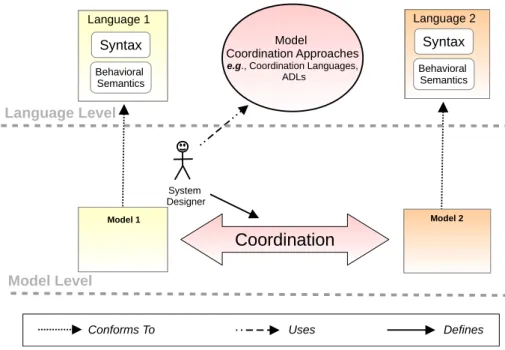
Coordination approaches focus on how behavioral models interact one each other. They propose to specify the interaction between (heterogeneous) behavioral models in an additional model named model of coordination. In this thesis, we adopt the wording of coordination as being the explicit modeling of the interactions amongst behavioral models suitable to obtain the emerging system behavior. The coordination must be executable to enable the evaluation of the emerging behavior of the whole system. We categorize the coordination approaches into Model Coordination Approaches and Language Coordi-nation Approaches. The former proposes CoordiCoordi-nation Languages [GC92a] and Architecture Descrip-tion Languages (ADLs) [MT97] to specify the coordinaDescrip-tion between behavioral models. The latter are Coordination Frameworks [BHLM02, BH08] and ad-hocs solutions [BJ01, DNCSSV14] that enable the automation of the coordination between models. To do so, they have captured the specification of a coordination pattern between languages into a tool or framework, e.g., Ptolemy, ModHel’X. In the following, we first present model coordination approaches, and then, we continue with language coordination approaches.
2.3.1 Model Coordination Approaches
Model coordination approaches provide dedicated languages to specify the coordination between (het-erogeneous) behavioral models (see Figure 2.3). We begin this subsection by presenting Coordination Languages, and then we continue with ADLs.
Coordination Languages [GC92a] propose a dedicated language to model the coordination between heterogeneous behavioral models. By relying on a coordination language, a system designer builds a coordination model to specify how behavioral models interact. Depending on the entities coordinated, approaches can be categorized into data-driven or control-driven. The former coordinates data among models whereas the latter coordinates events among models. Arbab at al. [Arb98] proposed another
Model Coordination Approaches
e.g., Coordination Languages,
ADLs Model 1 Model 2 Syntax Behavioral Semantics Syntax Behavioral Semantics System Designer Language Level Model Level
Conforms To Uses Defines
Coordination
Figure 2.3: Model Coordination Approaches Sketching
classification into endogenous and exogenous languages. Endogenous languages provide coordination primitives that must be incorporated within a model for its coordination. For instance, Linda [GC92b] provides a set of primitives like in() or out() to exchange data between models. These primitives must be added to a host language by using libraries.
Exogenous coordination languages dealt with the complexity of model behaviors by treating models as black boxes encapsulated within the boundary of an interface. A model behavioral interface gives a partial representation of the model behavior therefore easing the coordination of behavioral models. The coordination is thus specified between elements of the interface. The notion of interface varies
depending on the approach. For instance, in Opus [CHM+
97], the interface is a list of methods provided by the model. Other approaches abstract away the non-relevant parts of the behavior of models as events [Win87] (also named signals in [LSV98]). These approaches focus on events and how they are related to each other through causal, timed or synchronization relationships. Following the same idea, control-driven coordination languages rely on a model behavioral interface made of explicit
events [Esp09, AHS93, BFJ+04]. While in Esper [Esp09], the interface is only a set of events acceptable
by the model, some other approaches go further and also exhibit a part of the internal concurrency.
This is the case of [BFJ+
04] where authors propose an interface that contains services and events, but also properties that express requirements on the behavior of the components. Such requirements act as a contract and can be checked during the coordination to ensure a correct behavior. The benefits
of the use of events to coordinate the behavior of models are twofold:
• It gives support for control and timed coordination while remaining independent of the internal model implementation;
• It enables the coordination of models without any change to their implementation, thus ensuring a complete separation between the coordination and the computational concerns.
Concurrently with Coordination Languages, the software architecture community has developed so-called ADLs to gain abstraction, structuring and reasoning capabilities in the development of complex
systems [LKA+
95, AG97, SDK+
95, MT97, GS94]. An ADL usually specifies a system in terms of components and interactions among those components. They enable a system designer to:
• Clarify structural and semantics difference between a component and its interaction; • Reuse and compose architectural elements;
• Identify/enforce commonly used patterns (e.g., architectural styles).
Depending on the ADL, a Component can be an encapsulation of some procedure, an encapsulation of an object file or a (formal) abstraction of its behavior. To externally characterize the components, ADLs rely on well identified Component Interfaces. The interfaces are used by Connectors whose behavior is specified by a glue. Connectors can represent a large variety of interactions (e.g., procedure call, event broadcast or database queries) and the glue can range from a simple function to complex protocols.
Both coordination languages and ADLs make a separation between the specification of the component (i.e., the computational aspects) and the assembly of these components (i.e., the communication/-coordination aspects). The latter is usually done by a system designer that has to deal with the architecture-level communication, which is expressed with different protocols. To abstract away these protocols and make them reusable, ADLs proposed connectors as types [MT97] that can be used on the shelf to specify domain specific interactions.
For example, Clara [Dur98] is an ADL dedicated to real time systems. It proposed built-in connector types like Rendez-vous, Mutex or Mailboxes. A system designer can express the interactions by relying on these specific connectors that are relevant in his domain. This eases the task of a system designer, but also limits what can be used in the interaction.
Component type Connector type Component instance Connector instance Binding Manually specified by the System Designer
Figure 2.4: Specification of a client-server system in Wright [AG97]
Other approaches introduced the notion of User Defined Type [SDK+95, AG97, AA02] that enables a
system designer to build connector types for a specific domain. A connector type is defined by a set of roles and a glue specification. Roughly speaking, a role represents a formal parameter that is used to specify the glue which specifies how roles are coordinated. Some approaches express the glue in a formal language. For instance, in Wright [AG97], the glue is specified in a variant of CSP [Hoa85], differently in Reo, it is specified by the composition of dedicated primitives [AA02]. The connector types are later on instantiated and the roles are bound to the actual interfaces of the instances of components. By expressing the glue in a formal language, it is possible to provide reasoning about the global system behavior.
To illustrate the use of connector types, Figure 2.4 shows a simple client-server system described in Wright [AG97]. The specification defines two component types named Client and Server, and one connector type named C-S-connector. The C-S-connector has two roles (client and server ) and a glue that describes how the activities of a client and a server roles are usually coordinated. The section Instances describes a particular configuration by instantiating the corresponding component and connector types. The example describes a system where there is a single server (s), a single client (c) and a single connector (cs). Then, the section Attachments defines which component ports are
attached to the connector roles.
In this subsection, we have presented approaches that make a clear separation between the specification of the component and the assembly of these components. While the first activity is usually done by a system engineer, the second one is usually done by a system designer. To ease the task of a system designer, ADLs’ community has successfully identified the need of connector types. In [AG97], authors claimed that connector types enables to “understand a general pattern of interaction that can occur many times in any given system”. Thus, a system designer has only to instantiate and bind connector types as needed by its architecture. However, the major drawback of coordination languages and ADLs is that the coordination is specified between particular models. For example, in the case of ADLs, a system designer has to instantiate and bind connector types manually. Returning to the example of Figure 2.4, for each new client in the system, the system designer has to instantiate one component and one connector; then, he has to bind the component ports with the connector roles. With the increasing number and heterogeneity of the components, this task can quickly become difficult and error prone. We present in the next subsection approaches that automate the coordination between behavioral models by specifying coordination patterns between languages.
2.3.2 Language Coordination Approaches
Language Coordination Approaches have identified that the instantiation and binding of connector types can be a systematic activity the system designer repeats many times and may consequently be defined as a coordination pattern. Such a pattern is based on the know-how of the system designer and sometimes on naming or organizational conventions adopted by the models. In the following, we present approaches that have captured the specification of a behavioral coordination pattern inside a tool/framework to automate the instantiation and binding of connector types. In these approaches, the coordination is specified between heterogeneous languages rather than between particular models. We begin this subsection by presenting ad-hoc solutions [BJ01, DNCSSV14] which use a predefined set of languages. We continue with more systematic approaches named Coordination Frameworks [BH08, BHLM02].
Mascot [BJ01] is an approach focused on the integration of Matlab [Gui92] and SDL [ESH97]. Whereas SDL is a language suitable for control systems modeling, Matlab is better for modeling dataflow aspects of a system. These languages are rather different: while SDL processes operate on events, represented by simple signals, Matlab processes operate on vectors, represented by vectorized signals.
from Matlab. To do so, the approach deals with the integration of the timing and synchronization concepts from both languages by proposing two synchronization modes: head synchronization and tail synchronization. In the head synchronization, when a model in matlab receives a frame a1, it immediately transforms a1 into b1 (dataflow network model). Any control signal from SDL that occurs during the transformation of a1 to b1 cannot influence its value. Then, the head synchronization mode ensures that the occurrence of the control signal is taken into account when the next frame is processed. In the tail synchronization, when a model in Matlab receives a control signal from SDL, the signal is collected until it cease to occur, then, it is translated to a vector and passed to the Matlab model. The modes of synchronization ensure the communication between Matlab and SDL by relying on the knowledge about the semantics of the languages. In addition, the approach gives a set of guidelines to help the choice between the two proposed synchronization. Once the synchronization policy is defined, the approach enables the co-simulation of a SDL model and a Matlab model. A process in the SDL specification that is specified in Matlab contains a wrapper that interfaces between the SDL simulator and the Matlab engine. A SDL wrapper is made of a set methods that enable the SDL engine to control the behavior of the data signals in Matlab. To do so, the approach relies on the name of signals in SDL specification to communicate with the signals in Matlab. Thus, the approach forces a naming convention between signals in both domains. The approach has identified and specified a coordination pattern between Matlab and SDL by providing two mechanisms to coordinate signals from both domains. In addition, it provides some guidelines to help the choice between the two mechanism. The current implementation, however, partially automates the coordination since the user has to specify what synchronization mechanism is used.
In [DNCSSV14] (see Figure 2.5), authors dealt with the integration of a language to describe the func-tional aspects of a system with a language to describe the deployment platform of the system. They proposed to integrate these languages by relying on a dedicated mapping language. The mapping lan-guage syntax references syntactic elements from both the functional and the platform lanlan-guage to map the functions on specific computational resources from the platform. For instance, the SW deployment concept from the mapping language, references the T ask concept from the functional language and the CP U concept from the platform language. Based on the mapping model, the approach generates the code of the communication between the code of the functional and the code of the platform mod-els. The semantics of both the functional and the platform languages are defined by a translational
Translational semantics Syntax Conforms To Conforms To Functional Functional Model Model Platform Platform Model Model Functional Language Functional Language Translational semantics Syntax Transformation engine C++ Transformation engine C++ Mapping Language Mapping Language Transformation engine C++ Mapping Model Mapping Model Conforms To Takes advantages of Platform Language Platform Language Translational semantics Syntax references references references references includes includes Takes advantages of
Figure 2.5: High level view of the approach proposed by Di Natale et al. in [DNCSSV14]
approach into C++ code. The translational semantics of the mapping language takes advantages of some knowledges about the translational semantics of the other languages. For instance, for each subsystem described using the functional language, the approach takes advantages of the knowledge that a class is generated with a name like: SubsystemNameModelClass. It also takes advantages of the knowledge that the generated class has a step operation used for the runtime evaluation of the block outputs given its inputs and its internal state.
To express a coordination pattern between a functional and a platform language, the approach pro-posed a set of connectors to specify the mapping of a functional model to a platform model. From the mapping model, the approach generates the communication code between a functional and a platform model. In this sense, the approach is similar to others ADLs that propose a set of built-in connectors. It partially automates the coordination between models since a system designer has to instantiate the connectors.
While the previous approaches are ad-hoc solutions for two particular languages, Ptolemy [BHLM02] and ModHel’X [BH08] are systematic approaches to coordinate models that conform to heterogeneous languages. These approaches rely on a framework in which the syntax of models is described by actors and the semantics is given by a Model of Computation (MoC). Actors can be atomic (e.g., Actor 1 in Figure 2.6) or composite (e.g., Actor 0 and Actor 2 in Figure 2.6), i.e., made of internal, connected,
Syntax Semantics (SDF) Semantics (FSM) D0: SDF D0: SDF
FRAMEWORK
A3 A4 D1: FSM D1: FSM Actor 0 Actor 0 Actor 1 Actor 1 Actor 2 Actor 2 Conforms To Conforms To Conforms To Composite Actor Conforms To Atomic Actor DirectorFigure 2.6: High level view of Ptolemy [GLL99]
actors. Each composite actor is associated with a model of computation that defines a Domain. A domain specifies both the communication semantics and the execution order among internal actors. A domain is implemented by a Director. For instance, in Figure 2.6, Actor 0 has the director D0, which implements a SDF (Synchronous Dataflow) domain, and the Actor 2 has the director D1, which implements a FSM (Finite State Machine) domain. In this approach, actors, both atomic and composite, are executable. In a composite actor, the execution order of internal actors is controlled by a director. In the example of Figure 2.6, the director D0 controls the execution of the Actor 1 and Actor 2 and director D1 controls the execution of A3 and A4 whenever Actor 2 is executed. In this sense, the execution of composite actors is strictly hierarchical. The behavior of actors is represented by a generic interface that contains a set of methods, e.g., fire(). The MoC implemented by the director of a composite actor specifies when the methods in the interface of internal actors are invoked. For instance, when an actor is fired, the director associated with a composite actor fires the internal actors.
In conclusion, based on a fixed syntax and a generic interface, these approaches achieved to capture a hierarchical coordination pattern into a framework. For the syntactic aspects of the pattern, the frameworks provide composite actors. Then, for the semantical aspects, they encode the necessary
glue between interfaces of composite actors and internal actors to coordinate their execution. This results in a hierarchical heterogeneous model in which the execution of actors is strictly hierarchical. In this subsection, we have presented approaches that captured the specification of a coordination pat-tern between languages. Such specification is defined at language level and captures a systematic way to coordinate behavioral models. By specifying the coordination at language level, these approaches have achieved to automate the coordination between models. In the next subsection, we discuss about the reviewed approaches.
2.3.3 Discussion
In this section, we have studied approaches to coordinate the behavior of models. While model coordination approaches proposed dedicated languages to build a model of coordination, Language coordination approaches proposed frameworks/tools that automate the coordination between models by specifying a coordination pattern between languages.
Model Coordination approaches provide dedicated languages, i.e., Coordination Languages and ADLs, to specify the coordination between particular models. Such a model of coordination specifies how the behavioral models interact. The main benefit of these approaches is that the global behavior is explicit and amenable for reasoning (for instance for Verification and Validation activities). Furthermore, they propose languages close to system designer domain. For example, ADLs provide types in order to define domain-specific connectors. ADLs have successfully identified connector types, however, a system designer has still to instantiate the required type of connectors when needed; he has to manually instantiate them by relying on his know-how. In a complex system, such a task can quickly become tedious and error prone. Furthermore, if one of the model changes, the model of coordination must also be changed. By relying on Coordination Languages and ADLs, a system designer only captures the solution for one single problem but he does not specify a systematic way to coordinate models. Coordination frameworks achieved to capture the know-how of a system designer by specifying coordi-nation patterns. Such specification defined at the language level allows for synthesis the coordicoordi-nation between heterogeneous behavioral models.
By embedding the coordination pattern inside a tool, these approaches have two major drawbacks:
2. The system designer cannot change the proposed coordination without altering the core of the tool.
Regarding to first point, some coordination languages and ADLs already tackled this problem by using a formal language to express the coordination (e.g., CSP in Wright). This provides for verification and validation support for the coordinated system
Concerning the second point, for complex systems, the system designer may need to capture several coordination patterns and potentially combine them. However, current coordination frameworks can only support such a variation by modifying the framework itself. The coordination model is mixed with the functional model, which makes it very tricky to modify one without risking altering the other.
2.4
Conclusion
In this chapter, we have presented the state-of-art approaches that rely on two mechanisms to get a global representation of a heterogeneous system: composition and coordination.
We have presented approaches that compose heterogeneous models/languages to obtain a new mod-el/language. The composition of models has been automated by looking for correspondences between heterogeneous models, and then composing them into a new model that conform to another language. Most of the approaches consider structural correspondences and only few consider also the behavior of models to find similarities. Furthermore, we have determined that these last approaches only compose homogeneous models. This limits the use of such approaches in complex systems where heterogeneous behavioral models may be used.
We have presented approaches that compose languages to get a new language. Most of these ap-proaches focus on the composition of the syntax of languages into a new syntax. Only Semantics Anchoring [CSN05] proposes to compose behavioral semantics by relying on the notion of Semantic Units. These approaches propose to model a heterogeneous system by relying on a single language which results from the composition of other languages. From our point of view, language composition approaches are not suitable for separation of preoccupations and development of a single system by various domain experts who focus on a specific part of the system.
We have presented state-of-the-art approaches that deal with coordination of the behavior of hetero-geneous models/languages. First, we have presented the work done by Coordination Languages and ADLs that support the coordination of heterogeneous models. However, the system designer has to manually specify each relation, thus making this task tedious and error prone. Then, we have shown how language coordination approaches have leveraged on the know-how of a system designer to au-tomate the coordination between models. However, we have noted that the knowledge about system integration is encoded within a framework. Furthermore, in frameworks, the model of coordination is expressed by using a general purpose language thus limiting verification and validation activities. In this thesis, we rely on the coordination of (heterogeneous) behavioral models to get the emerging system behavior of a heterogeneous system. We propose to automate the coordination between models by specifying coordination patterns between languages. In the next chapter, we elaborate on the requirements towards a language to specify coordination patterns. Such requirements tend to improve existing language coordination approaches to make them more flexible and well founded. From these requirements, we propose a language for specifying coordination patterns named B-COoL. Then, in Chapter 4, we present the implementation of our language.
Requirements for a Language to
specify Coordination Patterns
3.1
Introduction
Language Coordination approaches are used to capture a coordination pattern between languages. These approaches go one step beyond Coordination Languages and ADLs by leveraging on the know-how of a system designer. However, current implementations seem different and not always well characterized. The lack of a systematic way to specify a coordination pattern makes these approaches ad-hoc and not flexible. Furthermore, this prevents a wider adoption of this sort of approaches. In this context, this chapter proposes a framework to compare and understand the approaches that offer solutions to capture coordination patterns. The objective of the framework is to highlight similari-ties and differences between these approaches, and to express the requirements to make them more flexible and generic. For instance, it is important that they address other languages, or other ways of coordinate them. The goal is not to make a further detailed analysis of state-of-the-art approaches but rather to highlight the good points that we intend to keep in our proposition.
The proposed framework is mainly influenced by three existing comparison/categorization frameworks. Authors proposed frameworks that focus on ADLs [MT97], Coordination Languages [PA98] and Model Composition approaches [JFB08]. For example, in [MT97], authors identify the primary blocks used to build an ADL. Based on these building-blocks, they have proposed a framework to classify and compare several existing ADLs. A similar work is presented in [PA98] where authors surveyed and classified
several coordination languages. They focused on 1) the nature of the entities being coordinated, 2) the coordination mechanism, 3) the coordination architecture and 4) the semantics of the coordination. In [JFB08], Jeanneret et al. proposed a framework to compare model composition approaches by relying on the triplet what-where-how questions, which identifies respectively which elements should be composed, where elements should be inserted or modified and how the composition process works to get the expected result.
Inspired by these works, we propose a framework to characterize approaches that specify a coordination pattern. Existing approaches have in common that:
1. They specify the coordination between languages;
2. They specify correspondences between elements of the conformed models;
3. They specify how the elements selected by the correspondences must be coordinated.
Regarding the first point, existing approaches specified the coordination at the language level by relying on information (at least partially) about the behavioral semantics of the coordinated languages. Therefore, the framework identifies such a representation of the language behavioral semantics as a Language Behavioral Interface. Concerning the second and third points, the framework identifies respectively Correspondence Rules and Coordination Rules. The former identifies how approaches specify correspondences between elements from different models, i.e., the rules that defines which elements of the two models should be coordinated. The latter identifies how approaches specify the coordination between elements selected by the correspondences, i.e., how the selected elements should be coordinated.
For this first contribution, we review some of the approaches discussed in the previous chapter and we identify precisely what we consider to be related to the language behavioral interface, the correspon-dence rules and the coordination rules. We also highlight the mechanisms used and what can, in our view, be improved to build a generic and flexible language to specify coordination patterns. We then propose some requirements to improve existing approaches by making each element of the framework explicit and better customizable.
We organize this chapter as follows. We begin by presenting the notion of language behavioral interface, then we continue by presenting correspondences between elements from the interfaces encoded into
on the requirements presented in this chapter, Chapter 4 presents a particular implementation of this framework named B-COoL.
3.2
Language Behavioral Interface
This section presents the notion of Language Behavioral Interface. We begin by reviewing the concept of language interface in existing approaches, and then, we present requirements to make the behavioral interface of a language explicit and better customizable.
3.2.1 Review of Existing Approaches
The notion of language interface has been recently the focus of some works in the context of the
globalization of modeling languages [CvdBCR15, BJL+
15, DBC+
15, DCB+
15]. From these works, it is consensual that the content of a language interface is purpose-specific, i.e., the content varies depending on the use of the interface. In particular in this subsection, we discuss the notion of a language interface for the specific purpose of specifying coordination patterns between languages. Since the coordination activity requires a view of the behavioral semantics of languages, we name such an interface Language Behavioral Interface.
From Chapter 2, at model level the notion of behavioral interface is used to expose information about the model behavior to allow its coordination. Similarly, at the language level, a language behavioral interface is used to expose only a part of the behavioral semantics of languages to allow the expression of coordination patterns. In other words, a language behavioral interface abstracts the behavioral semantics of a language, providing only the information required to coordinate it.
In the following, we show how existing approaches specify coordination patterns by relying on partial information about the syntax and behavioral semantics of the languages they use. In addition, we
review the work done in [CDVL+13] in which authors propose to specify an executable language that
exposes a part of its behavioral semantics. This work will help us to understand the benefits of an explicit language behavioral interface.
Ptolemy [BHLM02]/ModHel’X [BH08]: In these approaches, the behavioral semantics of a
the communication between different domains, each director implements a generic interface in Java. Such an interface is made of specific set of methods (e.g., initialize(), prefire(), fire(), postfire(), wrapup()). This mechanism provides a homogeneous view of all the domain behavioral semantics. The implementation of these methods depends on the domain. However, they must conform to a common goal, which is expressed in natural language. For instance, a part of the fire() function description is: “Typically, the fire() method performs the computation associated with an actor ”. Both frameworks are based on a unique abstract syntax (i.e., actor model) to represent the syntax of any language. Then, they propose composite actors to identify what actor can be refined into another actor. Hence, the coordination is done according to the hierarchy of actors. In addition, only some elements of the language syntax can be represented by a composite actor. For example, in the FSM domain only states can be a composited actor, but not the transitions. This makes that only some elements of the language syntax can contain other actors. Thus, frameworks are also aware of (a part of) the abstract syntax of the coordinated language. However, such knowledge is left implicit into the framework implementation.
The pro of these approaches is that the framework can technically coordinate actors from any do-main without knowledge about the implementation of the actor dodo-main. In this sense, the language behavioral interface correctly provides an abstract and homogeneous view of the language behavioral semantics. The methods represent the coordination points, i.e., elements that can be used to specify the coordination between different domains.
The cons of these approaches are twofold. First, the interface is specified in a particular technological domain, i.e., Java. This limits the representation of the language behavioral semantics as a set of methods and the coordination as a set of calls to such methods. It is consequently not possible to add extra coordination points without modifying deeply the framework itself. Second, all the domains have to implement consistently these methods, however, the meaning of the methods is given by their names together with some comments in the code. This remains very informal to ensure a correct implementation of these methods.
These frameworks base on a fixed syntax in which all languages are represented by using the actor model. This limits the expressiveness of the coordinated language syntax. However, it makes simple the interface that only contains information about the language behavioral semantics. In addition, the approach left implicit which elements from the syntax of a language can be refined, i.e., can be a
Di Natale et al. [DNCSSV14]: In this work, authors use a translation to a common executable language (i.e., C++) to provide the behavioral semantics of the coordinated languages. The coordi-nation is supported by a mapping language, which its behavioral semantics is also translated in C++. As a result, the behavioral semantics of both the coordinated languages and the mapping language are represented in the same technology.
In this approach, information about the syntax and semantics of the functional and platform languages is contained into the mapping language. First, it contains correspondences between syntactic elements from both languages, e.g., Task s from the functional and Cpus from the platform. Second, to express the semantics of such correspondences, the translation semantics of the mapping language is based on knowledge about the translation semantics of the coordinated languages. For instance, it contains the name of the methods that are generated for each subsystem in the functional language. Such methods are part of the translational semantics of the functional language.
The mapping language is aware of both the syntax and behavioral semantics of the coordinated languages. This information is encoded into the syntax and the behavioral semantics of the mapping language. More precisely, the language behavioral interface of each coordinated language is left implicit into the mapping language. The major cons of this solution is that any change in the semantics of the coordinated languages compromises the semantics of the mapping language. The approach lacks of a clear specification of the coordination points, i.e., the important methods (their names but also their parameters) that are resulting from the translation of some specific part of a language.
The only pro of this approach is that shows that the notion of language behavioral interface also makes sense when the behavioral semantics of the languages is given by a translation to another language.
Mascot [BJ01]: This is an ad-hoc solution to coordinate SDL and MATLAB. To coordinate these
languages, authors have knowledge about the syntax and the behavioral semantics of the languages. For instance, authors know that MATLAB relies on a data-flow MoCC which is based on the notion of streams. Besides, they know that SDL relies on a Finite State Machine which is based on events. Based on this knowledge, authors provide different mechanism to synchronize events from SDL and streams from MATLAB. However, the information about what is coordinated is left implicit into the approach. They rely on partial information about the syntax and behavioral semantics of the

![Figure 2.4: Specification of a client-server system in Wright [AG97]](https://thumb-eu.123doks.com/thumbv2/123doknet/13059179.383527/36.892.200.695.105.489/figure-specification-client-server-wright-ag.webp)
![Figure 2.5: High level view of the approach proposed by Di Natale et al. in [DNCSSV14]](https://thumb-eu.123doks.com/thumbv2/123doknet/13059179.383527/39.892.157.741.80.458/figure-high-level-view-approach-proposed-natale-dncssv.webp)
![Figure 2.6: High level view of Ptolemy [GLL99]](https://thumb-eu.123doks.com/thumbv2/123doknet/13059179.383527/40.892.154.739.80.511/figure-high-level-view-of-ptolemy-gll.webp)