Publisher’s version / Version de l'éditeur:
Design, Manufacturing and Applications of Composites: Proceedings of the Sixth Joint Canada-Japan Workshop on Composites, 2006-08-24
READ THESE TERMS AND CONDITIONS CAREFULLY BEFORE USING THIS WEBSITE.
https://nrc-publications.canada.ca/eng/copyright
Vous avez des questions? Nous pouvons vous aider. Pour communiquer directement avec un auteur, consultez la
première page de la revue dans laquelle son article a été publié afin de trouver ses coordonnées. Si vous n’arrivez pas à les repérer, communiquez avec nous à [email protected].
Questions? Contact the NRC Publications Archive team at
[email protected]. If you wish to email the authors directly, please see the first page of the publication for their contact information.
NRC Publications Archive
Archives des publications du CNRC
This publication could be one of several versions: author’s original, accepted manuscript or the publisher’s version. / La version de cette publication peut être l’une des suivantes : la version prépublication de l’auteur, la version acceptée du manuscrit ou la version de l’éditeur.
Access and use of this website and the material on it are subject to the Terms and Conditions set forth at
Rubbery and Glassy Epoxy-Clay Nanocomposites Ngo, T.-D.; Ton-That, M.-T.; Hoa, S. V.; Cole, K. C.
https://publications-cnrc.canada.ca/fra/droits
L’accès à ce site Web et l’utilisation de son contenu sont assujettis aux conditions présentées dans le site
LISEZ CES CONDITIONS ATTENTIVEMENT AVANT D’UTILISER CE SITE WEB.
NRC Publications Record / Notice d'Archives des publications de CNRC: https://nrc-publications.canada.ca/eng/view/object/?id=458c12fc-059e-4f98-9e03-d9b607807e28 https://publications-cnrc.canada.ca/fra/voir/objet/?id=458c12fc-059e-4f98-9e03-d9b607807e28
Rubbery and Glassy Epoxy-Clay Nanocomposites
T.-D. NGO1, M.-T. TON-THAT2, S. V. HOA1, K. C. COLE21
Department of Mechanical & Industrial Engineering, Concordia University 1455 De Maisonneuve Blvd., Montreal, Quebec, Canada H3G 1M8
2
National Research Council Canada, Industrial Materials Institute 75 De Mortagne Blvd., Boucherville, Quebec, Canada J4B 6Y4
ABSTRACT
The reinforcing effect of organoclays on the mechanical properties of thermoplastics has been well documented; however, it has not been clear what mechanism governs the reinforcing effect of organoclay in thermoset epoxy resins, whose characteristics can vary over a broad range from rubbery to highly glassy. This paper attempts to contribute to some extent to this lack of comprehension. The two chosen epoxy matrices, one rubbery and one glassy, were chosen to have very similar chemistry in order to minimize its impact on the comparison of properties. The epoxy resin was Shell EPON 828 and the two hardeners were based on amine-terminated polyoxypropylene diols having different average molecular weights (Mw) of 2000 and 230 g/mol, namely Huntsman Jeffamine D-2000 (D2000) and Jeffamine D-230 (D230), respectively. As a result of the difference in molecular weight of the hardener, after curing at 120°C the epoxy matrix prepared with D2000 is a rubbery material with a glass transition temperature Tg = -46.3°C, whereas the one
prepared with D230 is a glassy solid with a high Tg = 86.8°C. The nanocomposites were prepared with the organoclay
Cloisite30B (C30B) from Southern Clay Products. The quality of dispersion and intercalation/exfoliation were analyzed by X-ray diffraction (XRD), field emission gun scanning electron microscopy (FEGSEM) and transmission electron microscopy (TEM). The Tg of the materials was also determined by differential scanning calorimetry (DSC) at a
heating rate of 20°C·min-1. Tensile properties and hardness of epoxy and epoxy nanocomposites were measured according to ASTM standards D638-02 and D2240-00, respectively. Fracture surfaces were also analyzed by FEGSEM. The results indicate that the presence of C30B does not significantly affect the Tg of either the rubbery or the
glassy epoxy; however, the fracture surface and mechanical properties were found to be influenced by the presence of nanoclay. It is also found that the quality of clay dispersion and clay intercalation/exfoliation, and the mechanical behavior of the glassy and rubbery epoxy nanocomposites are quite distinct. Finally, several different reinforcing mechanisms are proposed and discussed for the rubbery and glassy epoxy nanocomposites.
Key words: nanoclay, nanocomposites, rubbery and glassy epoxy, Jeffamine, dispersion, intercalation, exfoliation, glass transition, fracture surface, mechanical properties.
INTRODUCTION
Epoxy resin reinforced with nanoscopic layered silicates has received increasing attention recently because of the possibility of obtaining improved properties in terms of stiffness, strength, fire resistance, dimensional stability, shrinkage, etc. [1-5]. Interfacial interaction, platelet aspect ratios, chemistry, and layer charge densities of the nanoclay have a direct impact on the quality of clay dispersion and clay intercalation/exfoliation, and thus on the mechanical properties of epoxy nanocomposites [2, 3]. However, it has not been clear what mechanism governs the reinforcing effect of organoclay in epoxy resins, whose characteristics can vary over a broad range from rubbery to highly glassy. Improvement in mechanical properties has been reported in several epoxy systems, mostly rubbery ones [2, 6, 7, 8], while no or almost insignificant improvement has been found in other epoxy systems, mostly glassy ones [9, 10]. Wang et al. [8] studied the effect of clay on properties of both rubbery and glassy epoxy resins. They pointed out that the exfoliated forms of the silicate nanolayers in both rubbery and glassy epoxy matrixes provided effective reinforcement. However, there is a difference in chemistry of materials and the mixing method used to fabricate these nanocomposites, and it is unclear if these parameters have an important effect on the nanocomposite performance.
The results reported here pertain to a similar approach to understand the influence of organoclay on the dispersion and the intercalation/exfoliation in rubbery and glassy epoxy resins, and thus on their mechanical properties. To simplify the problem, the nanoclay C30B, which has no chemical reaction with the matrix at the temperatures used in the study, was used. The rubbery and glassy
epoxy matrices were also carefully chosen to minimize the difference in chemistry between them, thus minimizing its effect on the interaction with clay. They are based on the same epoxy matrix and two hardeners of the same type but having different molecular weights. In addition, all the fabrication steps of the two nanocomposites, such as dispersing clay in the epoxy matrix, mixing this mixture with hardener, curing, etc., were also kept exactly the same.
EXPERIMENTAL Materials
The resin selected for this study was EPON™ 828, from Resolution Performance Products LLC (Houston, TX, USA). The two hardeners were based on amine-terminated polyoxypropylene diols having different average molecular weights of 2000 and 230 g/mol, namely Jeffamine® D-2000 and Jeffamine® D-230, respectively, from Huntsman Inc. An organo-nanoclay recommended for use with amine-cured epoxy systems was used, namely Cloisite® 30B (montmorillonite treated with methyl tallow bis-(2-hydroxyethyl) quaternary ammonium) from Southern Clay Products Inc. (Gonzales, TX, USA). Henceforth the hardeners and clay will be designated in shortened form as D2000, D230, and C30B.
Sample Preparation
A masterbatch of epoxy and 23.6 phr clay was prepared using a conventional mechanical mixer at 120°C for 1 hour, then stored at room temperature. For curing, the required amounts of masterbatch, epoxy resin, and hardener(s) to obtain 6 wt% organoclay in the final products were mixed at room temperature for 5 min then subjected to vacuum for another 30 min. Samples were finally cured at 120°C for 2 hours, with subsequent post cure at 140°C for another 2 hours.
Measurements
To evaluate the intercalation/exfoliation of the nanoclay in the polymer matrix, X-ray diffraction patterns were obtained from the surface of the samples with a Bruker Discover 8 powder X-ray diffractometer with CuKα radiation. The experiments were conducted on the exposed surface of specimens prepared by casting. A Hitachi-S4700 FEGSEM was used to observe the dispersion of clay in the epoxy matrix at the micro-level, as well as the fracture surface of the cured epoxies and epoxy nanocomposites. For clay dispersion at the nano-level, ultra-thin (50 to 80 nm) sections of nanocomposite samples were prepared with a cryo-ultramicrotome and supported on a copper 200 mesh grid for observation with a Hitachi H9000 TEM. To determine the Tg and confirm the absence
of any residual curing, the cured samples (at 120°C for 2 hours, with subsequent post cure at 140°C for 2 hours) were heated in a Perkin-Elmer Pyris 1 DSC instrument using helium atmosphere from -100°C to 150°C at 20°C·min-1 and was then cooled to -100°C at 20°C·min-1 to minimize the enthalpy relaxation in the second heating scan. Finally, the sample was reheated to 150°C at 20°C·min-1. The tensile properties of the epoxy system with and without clay were determined at room temperature according to ASTM D638-02 on the Instron machine with crosshead speeds of 5 mm/min. The hardness of epoxy and epoxy nanocomposites was determined at room temperature and relative humidity of 50% according to ASTM D2240-00 using a Shore Conveloader Instrument.
RESULTS AND DISCUSSION
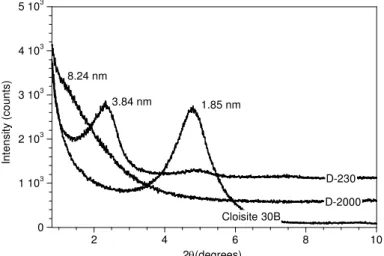
X-ray diffraction analysis of the epoxy nanocomposites based on C30B is illustrated in Figure 1. The clay layer separation (degree of intercalation) in the nanocomposites samples is more than twice as large as in the original C30B, showing that the clay has been further intercalated by the epoxy matrix. The d-spacing of samples cured with D2000 and D230 is 8.24 nm and 3.84 nm, respectively, compared with 1.85 nm for the pristine C30B. It is also noticed that D2000 leads to a much greater clay gallery distance compared to D230. The molecular weight of D230 is smaller than that of D2000, so D230 would be expected to diffuse into the clay galleries more easily during
(a)
(a) (b)
curing. However, the curing rate of the Epon828-D2000 system is extremely slow compared to the Epon828-D230 system; the gelation time of the former was more than 24 h while that of the latter was less than 4 h. As a consequence, it is reasonable to believe that D2000 and possibly Epon 828 would have more time to penetrate into the clay galleries to exfoliate the clays. Thus, the lower the curing reactivity of the epoxy system, the greater the clay intercalation in the nanocomposites. It is worth mentioning here that in thermoset systems, the intercalation and exfoliation process is controlled not only by the rate of diffusion of organic molecules (in this case, the curing agent and the epoxy molecules) into the clay gallery but also by the curing rate of the epoxy system [11].
0 1 103 2 103 3 103 4 103 5 103 2 4 6 8 10 In tens it y ( c ou nt s ) 2θ(degrees) Cloisite 30B 1.85 nm D-2000 D-230 3.84 nm 8.24 nm
Figure 1. X-ray diffraction curves of epoxy-nanocomposites based on C30B.
The microstructures of nanocomposite samples observed by FEGSEM are shown in Figure 2. The bright spots on the backscattered images correspond to clay aggregates. Apparently, a portion of the clay remains at the micro-scale level with different size populations depending on the hardener type. As can be seen in Figure 2a, there is a greater density of small particles with size below 2 µm and a lower density of large particles than in Figure 2b. This means that the clay has been dispersed better in the nanocomposite cured with D2000 than in the one cured with D230. This indicates that the lower curing rate has a positive effect not only on the intercalation (as identified by XRD) but also on the dispersion of the clay in the epoxy.
Figure 2. FEGSEM micrographs of C30B nanocomposites cured with D2000 (a) and D230 (b).
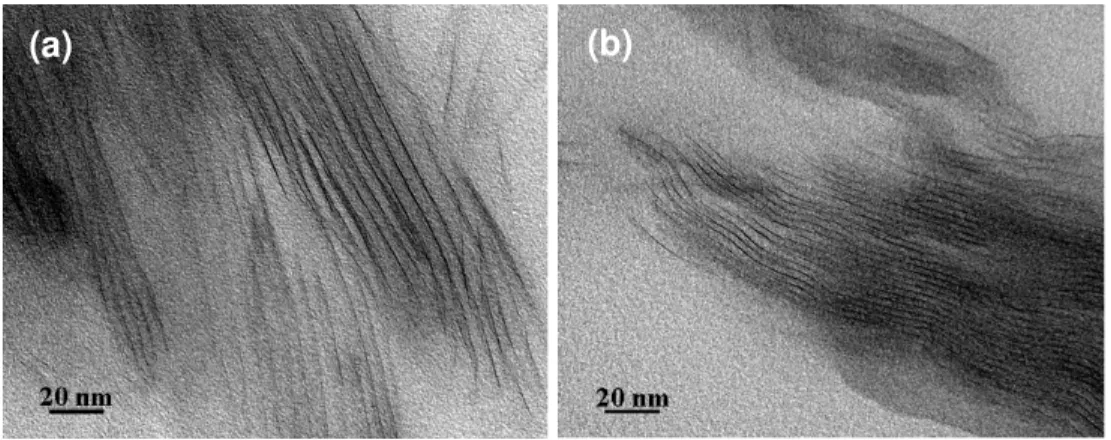
TEM micrographs for these two nanocomposites are shown in Figure 3. It is clear that the clay particles were not completely exfoliated into individual platelets. However, epoxy matrix has entered into the clay galleries, as an increase in the clay gallery distance can be seen for the two nanocomposites. From Figures 3a and 3b, the d-spacing is estimated to be around 7 nm and 3 nm for the D2000 and the D230 systems, respectively, which is in fairly good agreement with the XRD
(b) (a)
results. Again it is confirmed that D2000 leads to greater clay intercalation compared to D230. However, it is surprising that, although the gallery distance in the D2000 is fairly large (to an extent often considered as full exfoliation), the platelets still remain ordered into stacks. This may be due to the fact that the clay concentration is rather high, so the platelets tend to pack in a highly ordered state as governed by thermodynamic rules (in order to minimize the Gibbs free energy). Another reason is related to the fact that the intercalation took place in the absence of shear forces, and hardener and epoxy molecules diffused into the galleries very gradually with time. So far, the results from XRD, SEM and TEM combine to indicate that in this particular case a lower curing rate has a positive effect on the dispersion and intercalation/exfoliation of clay in the epoxy system.
Figure 3. TEM micrographs of C30B nanocomposites cured with (a) D2000 and (b) D230.
The Tg of epoxy and epoxy nanocomposites was determined by DSC. The Tg values of samples
(with and without clay) cured with D2000 are much lower than those of samples cured with D230. After curing at 120°C the epoxy matrix prepared with D2000 is a soft rubbery material with Tg
= -46.3°C, whereas the one prepared with D230 is hard and glassy with a high Tg = 86.8°C. As a
result of the difference in molecular weights, the distance between crosslinks in Epon828-D2000 is expected to be greater than in Epon828-D230. This explains the difference in the Tg of the two
samples. It was also observed that the presence of nanoclay C30B does not significantly affect the
Tg of the epoxy systems. The Tg values of nanocomposite samples cured with D2000 and D230
are -46.8°C and 86.5°C, respectively. C30B, a montmorillonite treated with methyl tallow bis-(2-hydroxyethyl) quaternary ammonium, might be expected to undergo some interaction (for example hydrogen bonding) with the epoxy resin at the temperatures used in the study. Such interaction should increase the Tg of the system significantly, but this is not the case, probably because the
hydroxyethyl groups are “hidden” under the long hydrocarbon chains of the tallow, thus inhibiting a direct interaction between these groups and the epoxy resin. It was also observed that there was only one transition step in the DSC curves for the two systems, and the transition step was quite narrow and identical, indicating that there is only one phase in the system. This excludes the possibility that the curing is different inside and outside the clay galleries [11].
The surface hardness of the samples with and without clay was determined at room temperature and the results are shown in Figure 4. As expected, adding nanoclay increases the surface hardness for both rubbery and glassy epoxy. However, the level of increase in the hardness for the rubbery system (D2000) is greater than for the glassy system (D230). This can be explained according to the rule of mixtures. Clay has a much greater surface hardness because of its ceramic nature. Therefore, at the same clay concentration, the contribution of clay to the hardness is greater for the rubbery epoxy matrix than for the glassy epoxy. Furthermore, the better dispersion and better intercalation/exfoliation of the clay in the D2000 sample may also be a contributing factor.
0 10 20 30 Ep o x y Na n o D2000 Sh or e D H a rdne s s (a) 60 70 80 90 Ep o x y Na n o D230 S h or e D H a rdne ss (b)
Figure 4. Surface hardness of epoxy and its C30B nanocomposites cured with (a) D2000; (b) D230.
The tensile properties of the epoxy matrices and their nanocomposites were evaluated and are shown in Figures 5 and 6. The presence of C30B results in a significant increase in modulus, whether the epoxy matrix is rubbery or glassy. A similar effect was also reported by other researchers [2, 5, 6, 9]. Since the modulus of clay is superior to that of the matrix, this improvement can be simply explained by the rule of mixtures. Figure 5 also illustrates an important increase in strength and toughness for the nanocomposite system cured with D2000, which is representative of soft and weak materials. The presence of 6 wt% of nanoclay substantially increases the tensile modulus more than 2 times (Figure 5a), the strength more than 5 times (Figure 5b), the strain at break 5 times (Figure 5c), and the energy to break more than 22 times (Figure 5d) relative to the pristine elastomeric polymer. A similar effect was also obtained by other researchers [2, 6, 7, 8].
0 2 4 6 8 10 Ep o x y N ano D2000 T e nsi le M o d u lu s (M P a ) (a) 0 1 2 3 Ep o x y N ano D2000 T e nsi le S tr eng th ( M P a ) (b) 0 10 20 30 40 50 60 70 Ep o x y N ano D2000 S tr a in at B reak ( % ) (c) 0 15 30 45 Ep o x y Na n o D2000 E n er g y t o B rea k ( kJ/ m 2 ) (d)
Figure 5. Tensile properties of epoxy and its C30B nanocomposites cured with D2000: (a) modulus, (b) strength, (c) strain at break, (d) energy to break.
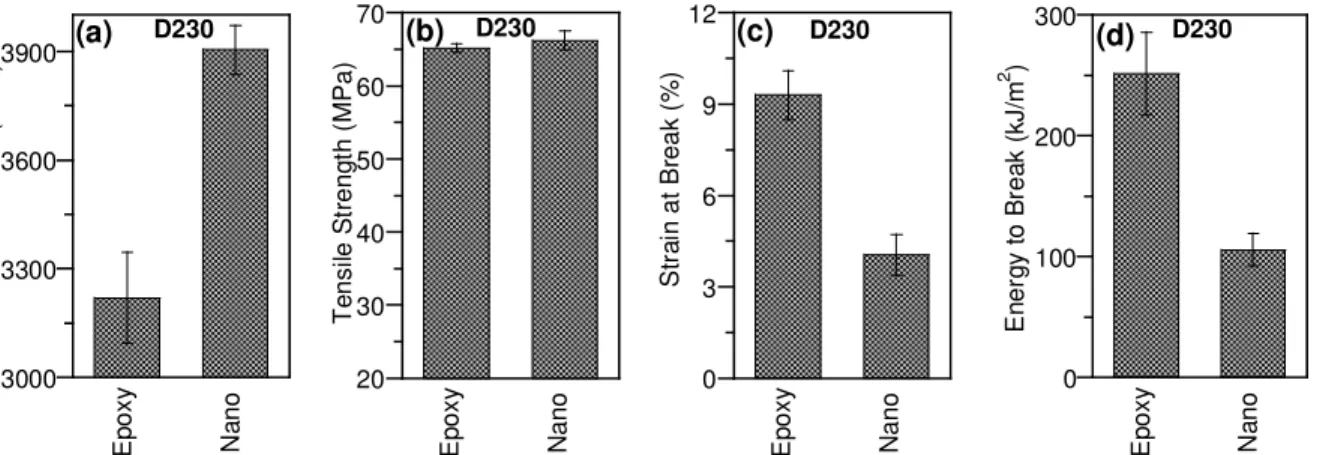
On the other hand, for the glassy system with the same clay content, the tensile modulus increases by only 21% for the nanocomposite relative to the neat epoxy (Figure 6a). While the strength remains almost unchanged (Figure 6b), the strain at break and energy to break decrease significantly (Figures 6c and 6d). This means that for high Tg epoxy thermoset, the presence of organoclay does
not lead to an improvement of the tensile strength but rather makes the materials more brittle [12, 13]. Clearly, the reinforcing effect of nanoclay is strongly dependent on the nature of the neat polymer and the nanoclay has a more positive effect on mechanical properties of the rubbery material than on the glassy one. Firstly, a better reinforcing effect of nanoclay in the rubbery system can be expected based on the rule of mixtures. Since its strength and modulus are many times smaller than those of the glassy one, the positive impact of the organoclay becomes more important. Secondly, the improvement can be explained by the fact that, owing to the ability of nanoparticles to dissipate energy because of their mobility under applied stress [14, 15], the nanoclay can provide
temporary physical crosslinks between polymer chains, providing localized regions of enhanced strength. There is also the possibility that the looser structure of the nanoclay in the rubbery structure can allow a better realignment of clay layers according to the stress direction, thus resulting in a greater reinforcing effect [2]. In addition, the better dispersion and intercalation/exfoliation in the rubbery system can also be of importance.
3000 3300 3600 3900 Ep o x y Na n o D230 Te nsi le M o d u lu s (M Pa ) (a) 20 30 40 50 60 70 Ep o x y N ano D230 T e nsi le S tr eng th ( M P a ) (b) 0 3 6 9 12 Ep o x y N ano D230 S tra in a t B re a k (% ) (c) 0 100 200 300 Ep o x y Na n o D230 E n er g y t o B rea k ( k J/ m 2 ) (d)
Figure 6. Tensile properties of epoxy and its C30B nanocomposites cured with D230: (a) modulus, (b) strength, (c) strain at break, (d) energy to break.
Table 1 summarizes the change in mechanical properties of the nanocomposites compared to the neat resin. It confirms that nanoclay has a more significant effect on the properties of soft rubbery materials (typical of material in the rubbery region above Tg), namely the system cured by D2000.
Table 1. Summary of the reinforcing effect of nanoclay on mechanical properties of rubbery and glassy epoxy Properties change (%) Nanocomposite Shore D Hardness Tensile Modulus Tensile Strength Tensile Strain at Break Energy to Break D2000 +30 +123 +430 +407 +2225 D230 +1.7 +21 +1.6 -57 -58
Typical stress-versus-strain curves for epoxy and epoxy-clay are shown in Figure 7. The response of the materials to applied stress is described as ductile to brittle depending on the curing agent used. It is clear that the toughness of Epon828-D2000 nanocomposite (Figure 7a) has been significantly improved while the toughness of the glassy Epon828-D230 nanocomposite decreased (Figure 7b).
0 1 2 3 0 20 40 60 D2000 Epoxy Nano St re s s (MPa ) Strain (%) (a) 0 25 50 75 0 3 6 9 D230 Epoxy Nano Str e ss (MP a ) Strain (%) (b)
Figure 7. Typical stress-strain curves for epoxy and its C30B nanocomposites cured with (a) D2000; (b) D230.
To further understand the reinforcing mechanism of C30B on rubbery and glassy epoxy systems, the fracture surfaces of tensile-tested specimens were observed by FEGSEM (Figure 8). It can be
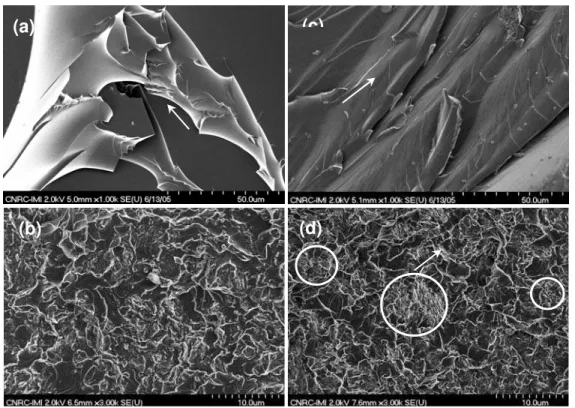
seen that neat epoxy resin exhibits a relatively smooth fracture surface. The difference in the fracture of rubbery and glassy states of the neat epoxy can be seen clearly in Figures 8a and 8c. There is yielding behavior on the fracture surface of the rubbery-state epoxy, which is a typical fractography feature of soft fracture behavior (Figure 8a). Compared with rubbery epoxy, the fracture surface of glassy epoxy is rougher and there are more cracks in different planes but almost parallel to the crack-propagation direction, indicated by a white arrow (Figure 8c). This is a typical fractography feature of brittle fracture behavior, thus accounting for the low fracture toughness of the unfilled epoxy.
Figure 8. Fracture surfaces for epoxy (top) and its C30B nanocomposites (bottom) based on D2000 (a, b) and D230 (c, d).
The failure surface of the nanocomposites containing 6 wt% C30B is shown in Figures 8b and 8d. Generally, a much rougher fracture surface is seen upon adding nanoclay into the epoxy matrix, for both rubbery and glassy states of epoxy. In addition, although the roughness of the fracture surface is quite similar in both nanocomposites, the extent of increase in roughness is more evident for the case of soft material (Figures 8a and 8b) compared to rigid material (Figures 8c and 8d). The increased surface roughness implies that the path of the crack tip is distorted because of the clay platelets, making crack propagation more difficult. More precisely, the clay is readily able to interact with the growing crack front. Therefore, the presence of clay particles or aggregates would cause perturbations along the crack front, thus altering the path of the propagating crack from the straight unperturbed growth seen in the neat resin (as evidenced by an incline relative to the initial crack propagation direction that is indicated by a white arrow). Consequently, the cracks are deflected by the clay particles into the rougher regions surrounding them. Clearly, the crack deflection observed is responsible for the increase of strength and toughness observed on incorporating clay into the epoxy matrix. On the other hand, clay particles are also very likely to act as stress concentration sites, thus usually resulting in (1) clay-matrix debonding and (2) cleavage of clay tactoids, consequently producing some micro- or nanovoids and finally reducing the performance. Figure 8d proves that many clay aggregates are observed on the fracture surface of the glassy system (several distinct agglomerations are indicated by circles). Figure 2 also demonstrates
(a)
(d) (c)
a poorer micro-dispersion of the glassy system. Therefore, it can be believed that the negative effect of the latter aspect plays a more important role in the fracture toughness of this system, which is not the case for the rubbery system. Furthermore, for the rubbery system, owing to the much greater elongation upon stress above the Tg, the improved performance of rubbery nanocomposite may
largely be due to shear deformation [2], where nanoclay under strain may align as discussed earlier thus further contributing to the improved performance.
CONCLUSION
Epoxy resins can display totally different behavior depending upon whether their glass transition temperature occurs above or below room temperature. The reinforcing effect of nanoclay in rubbery and glassy epoxy resin was evaluated. Although the presence of C30B does not influence the Tg of
either the rubbery or the glassy epoxy, it significantly affects the mechanical properties of both materials. Tensile strength, modulus, and toughness improve significantly in the rubbery system with the presence of C30B. However, in the glassy system the presence of clay does not lead to an improvement of the tensile strength and reduces the toughness and ductility. The fracture surface was also found to be influenced by the presence of nanoclay. In this particular study, the organoclay is better dispersed and better intercalated/exfoliated in the rubbery epoxy system than in the glassy one, mainly because of its lower curing rate. A better reinforcing effect of organoclay in the rubbery system can involve different contributions: 1) better micro-dispersion, 2) better intercalation/exfoliation, 3) a greater relative contribution of the clay mechanical properties because of the lower matrix properties compared to the glassy one, and 4) alignment ability of clay in response to the applied stress.
Further work is underway to quantify the clay reinforcing effect on the mechanical behavior of epoxy nanocomposites whose characteristics can vary over a broad range from rubbery to highly glassy. In addition, investigations of the influence of different types of clay as well as mixing procedures on the dispersion and properties of nanocomposites are in progress.
ACKNOWLEDGEMENTS
We acknowledge the Vietnamese Government for a scholarship to T.-D. Ngo. We also would like to thank the Natural Sciences and Engineering Research Council of Canada for funding for this project (Grant N00784 – Development of Polymer Nanocomposites, and Grant N00004 – Analysis and Vibration of Elastic and Viscoelastic systems).
REFERENCES
1. P. B. Messersmith and E. P. Giannelis, Chem. Mater. 6, 1719 (1994) 2. T. Lan, and T. J. Pinnavaia, Chem. Mater., 6, 2216 (1994).
3. J. Massam and T. J. Pinnavaia, Mater. Res. Soc. Symp. Proc. 520, 223 (1998) 4. J. M. Brown, D. Curliss, and R. A. Vaia, Chem. Mater., 12, 3376 (2000). 5. X. Kornmann, H. Linberg and L. A. Berglund, Polymer, 42, 4493 (2001). 6. Z. Wang, T. Lan and T. J. Pinnavaia, Chem. Mater., 8, 2200 (1996). 7. Z. Wang and T. J. Pinnavaia, Chem. Mater., 10, 1820 (1998).
8. Z. Wang, J. Massam and T. J. Pinnavaia, Polymer-Clay Nanocomposites, Chapter 7, 127 (2000). 9. A. Yasmin, J. L. Abot and I. M. Daniel, Scripta Materialia, 49, 81 (2003).
10. A. S. Zerda and A. J. Lesser, J. Polym. Sci.: Part B, 39, 1137 (2001). 11. X. Kornmann, H. Linberg and L. A. Berglund, Polymer, 42, 1303 (2001). 12. T. Lan, P. D. Kaviratna, and T. J. Pinnavaia, Chem. Mater., 7, 2144 (1995). 13. C. Zilg, R. Mulhaupt and J. Finter, Macromol. Chem. Phys. Lett., 200, 661 (1999). 14. D. Gersappe, Phys. Rev. Lett., 89 (2002)
15. D. Shah, P. Maiti , E. Gunn, D. F. Schmidt , D. D. Jiang, C. A. Batt, and E. P. Giannelis. Adv. Mater., 16, 1173 (2004).