
Conservation of charred archaeological textiles
170
0
0
Texte intégral
(2) HE-Arc CR, Master of Arts HES-SO in Conservation-restoration Andrea Ramirez Calderon, Conservation of charred archaeological textiles, 16.07.2018.
(3) HE-Arc CR, Master of Arts HES-SO in Conservation-restoration Andrea Ramirez Calderon, Conservation of charred archaeological textiles, 16.07.2018. « J'atteste que ce travail est le résultat de ma propre création et qu’il n’a été présenté à aucun autre. jury que ce soit en partie ou entièrement. J’atteste également que dans ce texte toute affirmation qui n'est pas le fruit de ma réflexion personnelle est attribuée à sa source et que tout passage recopié d'une autre source est en outre placé entre guillemets. » Date et signature : Neuchâtel, 16.07.2018.
(4) HE-Arc CR, Master of Arts HES-SO in Conservation-restoration Andrea Ramirez Calderon, Conservation of charred archaeological textiles, 16.07.2018. Acknowledgements: I want to express my gratitude to the Swiss National Museum, and especially to Dr. Katharina Schmidt-Ott, Head of conservation of the Archaeological Objects of the museum, and Mr. Markus Leuthard, Head of the Collection Centre, for giving me the chance to work on this exciting topic. My deepest thanks to the Kantonsarchäologie Zurich, especially to Chantal Hartmann and Kathrin Trüllinger, for providing me with the archaeological samples. I would like to thank particularly Mrs. Janet Schramm, conservator-restorer of archaeological objects, for her inexhaustible enthusiasm in supervising my work. This project could not have been completed without the advice and support of the all conservators-restorers from the archaeological team, including Mr. Alexander Dittus, Mrs. Stefanie Bruhin, Mr. Martin Bader, Mr. Cédric André and Mrs. Gaëlle Liengme. A special thanks to them for their support and for answering all my questions without complaining. I wish to sincerely thank the staff of the Swiss National Museum, particularly the conservation research team, Mr. Erwin Hildbrand, Dr. Vera Hubert and Dr. Tiziana Lombardo, for providing input and advice during the scientific experiments and analysis. I would like to thank Mrs. Nikkabarla Calonder, textile conservator, for sharing her knowledge about the conservation of archaeological textiles. Thanks also to Mrs. Veronique Mathieu and Mrs. Anna Jurt Portmann, paper conservators, as well as to Mr. Peter Wyer, sculpture conservator, for their advice about the all the materials used in this project. Sincere thanks to professor Pierre-Alain Montandon, and Dr Pierre-Antoine Gay, for their help with the carbonisation of the samples. Thank you to the reviewers Mrs. Marianna Grynchuk and Mrs. Tessa Plakida, for their patience and corrections. Among the teaching staff of the Haute Ecole Arc, I would like to sincerely thank the supervising professors and the members of the jury: Dr. Régis Bertholon (Professor and Head of the sector), Mr. Valentin Boissonnas, Mrs. Hortense de Corneillan, Dr. Christian Degrigny and Mr. Tobias Schenkel. I would also like to warmly thank Mr. Thierry Jacot, professor of preventive conservation at the HE-ARC, for his help and loan of equipment for the mould tests. I would also thank my dear friends, who were always there for me and distracted me when I needed it. All my infinite gratitude to Irene Sanz Centeno and Oana Geanina Vasilache, for their unconditional love and support. Thanks also to Naïma Gutknecht, for her patience and her friendship. Finally, I wish to thank my family, for their unwavering encouragement and love, without them I would never be where I am.. 1.
(5) HE-Arc CR, Master of Arts HES-SO in Conservation-restoration Andrea Ramirez Calderon, Conservation of charred archaeological textiles, 16.07.2018. Contents Abstract ......................................................................................................................................5 Résumé ......................................................................................................................................6 Zusammenfassung .......................................................................................................................7 Introduction ................................................................................................................................8 Chapter 1 Literature review ..........................................................................................................9 1.1 Degradation process of textiles ............................................................................................9 1.1.1 Chemical degradation of textiles ...................................................................................9 1.1.2 The influence of the excavation environment ............................................................... 11 1.1.3 The carbonisation process .......................................................................................... 12 1.2 Conservation of archaeological textiles ............................................................................... 13 1.2.1 Conservation of archaeological textiles: Past attempts .................................................. 13 1.2.2 Literature review on the drying methods ..................................................................... 15 1.2.3 The consolidation of textiles: Theoretical concepts ....................................................... 15 1.3 Physical properties of fibres affecting their conservation ...................................................... 16 1.3.1 Absorption and desorption: ........................................................................................ 16 1.3.2 Stress relaxation: ...................................................................................................... 17 1.3.3 Glass transition temperature and creasing: .................................................................. 18 1.3.4 The twist of the yarn: ................................................................................................ 18 Chapter 2 Methodology: An overview .......................................................................................... 19 Chapter 3 Charred archaeological textiles from Elgg...................................................................... 21 3.1 Archaeological context of the textiles ................................................................................. 21 3.2 Characterisation of the textiles .......................................................................................... 22 3.2.1 Identification of the fibres .......................................................................................... 23 3.2.2 Characteristics of the fabric and the threads ................................................................ 26 3.2.3 Peculiarities of some samples ..................................................................................... 29 3.3 Determination of the state of preservation.......................................................................... 30 3.4 Conclusion and Classification ............................................................................................. 36 Chapter 4 Production of test samples .......................................................................................... 37 4.1 Aim ................................................................................................................................. 37 4.2 Preparation of the samples................................................................................................ 37 4.2.1 Selection of the modern textile ................................................................................... 37 4.2.2 Washing procedure before sampling............................................................................ 39 4.2.3 Sampling process ...................................................................................................... 39 4.2.4 Carbonisation of the samples ...................................................................................... 42 4.3 Results and discussion ...................................................................................................... 47. 2.
(6) HE-Arc CR, Master of Arts HES-SO in Conservation-restoration Andrea Ramirez Calderon, Conservation of charred archaeological textiles, 16.07.2018. Chapter 5 Freeze drying the textiles ............................................................................................ 49 5.1 Pre-treatment: Soaking the modern samples ...................................................................... 49 5.1.1 Aim .......................................................................................................................... 49 5.1.2 Methodology ............................................................................................................. 49 5.1.3 Results ..................................................................................................................... 49 5.2 Pre-treatment: Cleaning and reshaping the archaeological samples ...................................... 50 5.2.1 Aim .......................................................................................................................... 50 5.2.2 Methodology ............................................................................................................. 50 5.2.3 Results ..................................................................................................................... 51 5.3 Pre-treatment: Adding polyethylene glycol (PEG) 400 .......................................................... 52 5.3.1 Aim .......................................................................................................................... 52 5.3.2 Selection of the protective agent................................................................................. 52 5.3.3 Methodology ............................................................................................................. 53 5.3.4 Results ..................................................................................................................... 54 5.4 The freeze-drying treatment.............................................................................................. 54 5.4.1 Aim .......................................................................................................................... 54 5.4.2 Methodology ............................................................................................................. 55 5.4.3 Results and discussion ............................................................................................... 57 Chapter 6. The consolidation of carbonised textiles ....................................................................... 63 6.1 Aim ................................................................................................................................. 63 6.1.1 Selection of the criteria .............................................................................................. 64 6.1.2 Selection of the application method............................................................................. 65 6.1.3 Selection of the products............................................................................................ 65 6.2 Consolidation of the archaeological and modern samples: Methodology ................................ 66 6.3 Results and interpretation ................................................................................................. 67 Chapter 7 Physical testing of textiles ........................................................................................... 68 7.1 Physical properties of Flax: Literature review ...................................................................... 68 7.2 Aim of physical testing ...................................................................................................... 69 7.3 Physical Tests: Methodology ............................................................................................. 70 7.3.1 Atmospheric conditions .............................................................................................. 70 7.3.2 Bending length test ................................................................................................... 71 7.3.3 Tensile strength test .................................................................................................. 72 7.3.4 Colour and gloss ........................................................................................................ 73 7.4 Results and interpretation ................................................................................................. 75 7.4.1 Bending length .......................................................................................................... 75 7.4.2 Tensile strength ........................................................................................................ 78 7.4.3 Colour and gloss ........................................................................................................ 79. 3.
(7) HE-Arc CR, Master of Arts HES-SO in Conservation-restoration Andrea Ramirez Calderon, Conservation of charred archaeological textiles, 16.07.2018. Discussion ................................................................................................................................. 82 Conclusion ................................................................................................................................ 84 Bibliography .............................................................................................................................. 85 Illustrations ............................................................................................................................... 92 Appendices ............................................................................................................................. 102 Appendix 1 Summary of the equipment and conservation materials ......................................... 102 Appendix 2 Cross-section observation: Location of the threads sampled ................................... 104 Appendix 3 Transversal observation: Location of the threads sampled ...................................... 105 Appendix 4 Photographic documentation of fibres observed with polarised microscopy .............. 106 Appendix 5 Charred archaeological textiles: Summary of characteristics and degradation state per sample................................................................................................................................ 109 Appendix 6 Identification of the crystal-like material: FTIR spectroscopy .................................. 114 Appendix 7 Identification of the crystal-like material: Mold test with the Lumitester® PD-20 & LuciPac Pen® ................................................................................................................................. 115 Appendix 8 Photographic documentation of the samples selected ............................................ 116 Appendix 9. FTIR spectroscopy: Analysis of carbonisation degree of modern samples ................ 125 Appendix 10: Colorimetric measurements: Modern samples with different degree of carbonisation .......................................................................................................................................... 129 Appendix 11: Three wrapping methods tested for the carbonisation of modern samples ............ 132 Appendix 12: Temperatures recorded during the carbonisation process. ................................... 133 Appendix 13 Photographic documentation of the modern samples after carbonisation ............... 134 Appendix 14: New support to clean archaeological samples ..................................................... 136 Appendix 15: Freeze-drying under vacuum: Summary of the dimensions and weight per sample before and after treatment ................................................................................................... 138 Appendix 16 Consolidants: Summary of the characteristics and references ............................... 142 Appendix 17 Bending length and flexural rigidity: Charred modern textiles ................................ 143 Appendix 18: Tensile strength: Weight applied until rupture and dimensions of the broken fragment .......................................................................................................................................... 153 Appendix 19 Photographic documentation of the archaeological samples from Group B after consolidation ....................................................................................................................... 157 Appendix 20 Photographic documentation of the archaeological samples from Group A after consolidation ....................................................................................................................... 162 Appendix 21: Content of the Digital Appendices ..................................................................... 167 A.1 Technical Data for conservation Materials ..................................................................... 167 A.2 Thermocouples: Temperature Measurements during the freeze-drying treatment ............ 167 A.3 Spectrophotometer: Colorimetric values of the samples ................................................. 167. 4.
(8) HE-Arc CR, Master of Arts HES-SO in Conservation-restoration Andrea Ramirez Calderon, Conservation of charred archaeological textiles, 16.07.2018. Abstract Archaeological textiles that were carbonised prior to their burial often survived to the present days. They are particularly friable and in recent years research has focused on the combination of consolidants and lubricants for their freeze-drying treatment. For this master thesis, consolidation tests were carried out on wet charred archaeological samples from the late medieval archaeological site of Elgg. The aim was to find a conservation method which will allow their long-term preservation, and the conservation of a larger number of textile fragments from the same site. The textiles were stabilized through freeze drying under vacuum and consolidation treatments. Before drying, half of the samples were treated with polyethylene glycol (PEG) 400, to compare the reaction of the textiles when dried with or without a plasticiser. The results indicated that applying a polyethylene glycol solution before drying is beneficial to the textile, as the cohesion of the fibres is increased, whilst they remain flexible. Then, both groups were consolidated with Klucel® G, Klucel® E, Aquazol® 500 and Paraloid® B72, except for one set of samples per group that was left untreated. Modern charred samples were created and treated to increase the collection of data. The modern textile samples were carbonised, soaked in water, and then freeze-dried and consolidated, following the same methodology as for the archaeological samples. Afterwards, the flexural rigidity, the tensile strength and the variation of lightness were calculated to compare the influence of the consolidation methods on the physical properties of the charred samples. Among the consolidants tested, Aquazol®500 seems to achieve the best results, either for the samples treated or untreated with PEG 400. The textiles remained flexible, and the loss of fibres was reduced due to the consolidant's adhesive properties. However, due to the small number of archaeological sample tested, the results are still not fully significant and further research should be carried out.. 5.
(9) HE-Arc CR, Master of Arts HES-SO in Conservation-restoration Andrea Ramirez Calderon, Conservation of charred archaeological textiles, 16.07.2018. Résumé Les textiles archéologiques carbonisés font référence aux textiles qui ont survécu jusqu'à nos jours après avoir été carbonisés puis enterrés dans cet état. Ils sont particulièrement friables et, de ce fait, très difficile à préserver et à manipuler. Ces dernières années, les recherches se sont concentrées sur la combinaison de consolidants et de lubrifiants combinés à un traitement de lyophilisation. Pour cette thèse de master, des tests de consolidation ont été réalisés en collaboration avec le Centre des Collections du Musée National Suisse. Les tests ont été menés sur des échantillons archéologiques carbonisés et en état humide, provenant du site archéologique d'Elgg, datant de la fin du Moyen Age. L'objectif était de trouver une méthode de conservation pour ces échantillons qui permette la conservation à long terme d'un plus grand nombre de fragments textiles provenant du même site. Les textiles ont été stabilisés par lyophilisation sous vide et par des traitements de consolidation. Avant séchage, la moitié des échantillons ont été traités avec du polyéthylène glycol (PEG) 400, pour comparer la réaction des textiles lorsqu'ils sont séchés avec ou sans plastifiant. Les résultats indiquent que l'application d'une solution de polyéthylène glycol avant séchage est bénéfique pour le textile, car la cohésion des fibres est accrue, tout en restant flexible. Ensuite, les deux groupes ont été consolidés avec Klucel® G, Klucel® E, Aquazol® 500 ou Paraloid® B72, sauf pour un ensemble d'échantillons par groupe qui n'a pas été traité. Des échantillons modernes carbonisés ont été créés et traités en parallèle aux échantillons archéologiques pour augmenter la quantité de données collectées. Les échantillons de textiles modernes ont été carbonisés et trempés dans l'eau, puis lyophilisés et consolidés. Ensuite, la rigidité à la flexion, la résistance à la traction et la variation de la clarté ont été calculées pour comparer l'influence des méthodes de consolidation sur les propriétés physiques des échantillons. Parmi les consolidants testés, l'Aquazol®500 semble offrir les propriétés les plus performantes, que ce soit pour les échantillons traités ou non traités au PEG 400. Les textiles restent flexibles, et la perte de fibres est réduite grâce aux propriétés adhésives de l’Aquazol® 500. Cependant, en raison du petit nombre d'échantillons archéologiques testés, d’autres recherches devraient être menés afin d’avoir une meilleure compréhension de la consolidation des textiles archéologiques carbonisées.. 6.
(10) HE-Arc CR, Master of Arts HES-SO in Conservation-restoration Andrea Ramirez Calderon, Conservation of charred archaeological textiles, 16.07.2018. Zusammenfassung Archäologische Textilien, die verkohlten, bevor sie in die Erde kamen, haben die Bodenlagerung oftmals bis zum heutigen Tage überstanden. Sie sind äusserst fragil, daher hat sich die Konservierungsforschung in den letzten Jahren eingehend mit der Kombination von Konsolidierungs- und Flexibilisierungsmitteln für deren Gefriertrocknungsbehandlung beschäftigt. Für diese Masterarbeit wurden Versuchsreihen zur Konservierung von nassen, verkohlten archäologischen Proben aus der spätmittelalterlichen Ausgrabungsstätte Elgg durchgeführt. Ziel war es, eine Konservierungsmethode zu finden, welche die langfristige Konservierung einer größeren Anzahl von Textilfragmenten des selben Fundortes ermöglicht. Die Textilien wurden durch Vakuumgefriertrocknung und Tränkung mit Festigungsmitteln stabilisiert. Vor der Trocknung wurde die Hälfte der Proben mit Polyethylenglycol (PEG) 400 behandelt, um das Verhalten der Textilien beim Trocknen mit und ohne Flexibilisierungsmittel zu vergleichen. Die Ergebnisse zeigten, dass das Auftragen einer Polyethylenglykollösung vor dem Trocknen für das Textil vorteilhaft ist, da der Zusammenhalt der Fasern erhöht wird, während sie flexibel bleiben. Dann wurden beide Gruppen mit Klucel® G, Klucel® E, Aquazol® 500 und Paraloid® B72 konsolidiert. Zudem gab es pro Gruppe einen Blindprobensatz ohne Konsolidierungsmittel. Moderne verkohlte Proben wurden erstellt und behandelt, um eine statistisch auswertbare Datenmenge zu erhalten. Die modernen Textilproben wurden nach dem Verkohlen in Wasser eingeweicht. Anschliessend erfolgte eine Gefriertrocknung und Festigung, welche der Vorgehensweise bei den archäologischen Proben entsprach. Danach wurden die Biegesteifigkeit, die Zugfestigkeit und die Veränderung der Helligkeit gemessen, um den Einfluss der Konsolidierungsmethoden auf die physikalischen Eigenschaften der verkohlten Proben zu vergleichen. Unter den getesteten Konsolidierungsmitteln zeigte Aquazol®500 die besten Resultate, sowohl für die mit PEG 400 behandelten Proben wie auch für jene ohne Vorbehandlung. Die Textilien blieben flexibel und der Verlust von Fasern wurde aufgrund der Bindeeigenschaften des Festigungsmittels reduziert. Aufgrund der geringen Anzahl der getesteten archäologischen Proben sind die Ergebnisse jedoch nur eine Tendenz und weitere Forschungen in diesem Bereich wären wünschenswert.. 7.
(11) HE-Arc CR, Master of Arts HES-SO in Conservation-restoration Andrea Ramirez Calderon, Conservation of charred archaeological textiles, 16.07.2018. Introduction Archaeological textile conservation has received much attention in recent years for the value of the information that these objects provide. Their organic nature makes them particularly vulnerable materials, and thus constitutes rare finds. Among the different states in which archaeological textiles can be found, charred archaeological textiles are particularly friable. Their condition necessarily leads to the search of conservation-restoration treatments that will ensure their long-term preservation. One way to stabilize wet archaeological textile is to freeze-dry them while consolidating their structure before and/or after drying them. The extensive research regarding freeze-drying treatments has been, however, focused on organic materials such as wood or leather, and little attention has been paid to the treatment of archaeological textiles. Publications related to this matter have focused on the combination of consolidants and lubricants before the freeze-drying treatment. Their results indicate that consolidation is required anyhow after drying the textiles in most cases, and hence further research is needed. Particularly in the Canton of Zurich (Switzerland), charred archaeological textiles have been found in recent excavations. The Swiss National Museum collaborates closely with the Archaeological Service of the Canton of Zurich to preserve the many objects excavated, allowing their study and long-term conservation. Nowadays, conservators-restorers from the Swiss National Museum have to face the challenge of treating these textiles. Consequently, the Archaeological Service of the Canton of Zurich donated to the museum several samples of late medieval charred textiles from the archaeological site of Elgg. Their aim was to allow the investigation and find a conservation method for a large number of textile fragments from the same site. The present paper presents a study of products tested for the consolidation of those charred archaeological textiles. The samples were divided in two groups for the freeze-drying treatment. One group was previously treated with a polyethylene glycol treatment, and the other was not. In order to collect more data during this research, the consolidants were tried on archaeological samples as well as modern textiles (which have been carbonised).. 8.
(12) HE-Arc CR, Master of Arts HES-SO in Conservation-restoration Andrea Ramirez Calderon, Conservation of charred archaeological textiles, 16.07.2018. Chapter 1 Literature review 1.1 Degradation process of textiles 1.1.1 Chemical degradation of textiles Degradation of textiles can be physical, chemical or biological1. 2 3. . Table 1 shows a summary of the. principal causes of deterioration of textile fibres. The presence of water and oxygen in the burial environment leads to hydrolysis and oxidation, which can deteriorate the textile fibres causing the weakening and embrittlement of the polymeric structure 4 5 6 7. While heat and light can accelerate the oxidation process,. 8. the combination of temperature, pressure and pH can accelerate the rate of. hydrolysis and, in consequence, the degradation of the textile 9. Although, it has been demonstrated that in buried or submerged environments, the limited oxygen supplies make the oxidation process less harmful in comparison with open-air environments, such as museums 10. Therefore, it has been demonstrated that in buried or submerged environments the limited oxygen supply makes the oxidation process less harmful in comparison with open-air environments such as museums11. Figure 1 shows a diagram of degradation and preservation factors for plant fibres. Real-life usage in textiles. Environmental factors. Tensile forces Torsion or shear forces Bending and flexion Twisting Elongation Abrasion Fatigue Compression Expansion Friction. Visible light Ultraviolet radiation Water Oxygen Temperature Biological Soiling Particulate matter Organic Autoxidation processes. Effects of treatments and/or conditions Aqueous cleaning Non-aqueous cleaning Humidification Rotation Display orientation Light source Relative humidity Extreme temperature. Table 1 Causes of textile fibre deterioration12. 1. Huisman, 2009, p. 83 Fedorak, 2005. p. 1 3 Neilson & Allard, 2008, p. 3 4 Brown & Brown, 2011, p. 237 5 Von Holstein, 2012 6 Von Holstein et al., 2014, p. 2121-2133 7 Solazzo et al., 2013, p. 48-59 8 Goffer, 2007, p. 76-77 9 Serchisu, 2014, p. 55-56 10 Serchisu, 2014, pp. 55-56 11 Serchisu, 2014, p. 54-55 12 France, 2005, p. 4 2. 9.
(13) HE-Arc CR, Master of Arts HES-SO in Conservation-restoration Andrea Ramirez Calderon, Conservation of charred archaeological textiles, 16.07.2018. Figure 1 Diagram of animal and plant fibers degradation and preservation ©Serchisu. Physical damage for textiles can happen before, during or after burial. Specifically, linen textiles tend to crease and fold and those areas become brittle with time. In wet burial environments, from damp to waterlogged, the principal causes of physical deterioration of textiles are overburden13, chemical hydrolysis and biologic attack, and the combination of these parameters leaves physically weakened structures. Overburden is the main reason why fabrics are frequently creased and non-recoverable. Microorganisms (essentially fungi and bacteria), can break down the textile fibers and create physical damage when attacking the organic compounds still present in the charred textile, or in the soil14. 15. .. When textiles are charred, the degradation mechanisms mentioned before are slowed down by the carbonisation of the structure. Once the textiles are removed from the burial environments, they are exposed to changes in temperature, relative humidity, light, and oxygen-rich air.. 13 14 15. Pressure exerted on objects and structures located within the lower layers Von Holstein, 2012 Peacock, 2003. 10.
(14) HE-Arc CR, Master of Arts HES-SO in Conservation-restoration Andrea Ramirez Calderon, Conservation of charred archaeological textiles, 16.07.2018. These parameters can accelerate the rate of degradation of textiles, which is also dependent on the structure of the fibers in combination with their histories of fabrication, use, and initial burial16.The charred archaeological textiles were recovered wet and in a relaxed state. The water in the cells and hollows of the fibres supports their arrangement, but in the case of flooding, disruption of the structure balance can occur (hence, the fibres break). When the water is removed, the textile becomes compact due to the surface area of the air-water interface being minimised by surface tension forces17. This degraded state of the charred textiles can be subject to further disintegration, leading to complete destruction, due to their fragility and brittleness. If untreated, the textiles will dry in an uncontrolled manner, leading to the shrinkage of the fibres, new broken threads and the disintegration of the ensemble. Nevertheless, one of the most usual causes of degradation of charred textiles after discovery is the way they are handled, as each manipulation provokes the loss of fibres. 1.1.2 The influence of the excavation environment Textiles can be recovered from a diversity of site environments. Archaeological records demonstrate that the survival of organic finds (such as fabrics, basketry and cordage) is dependent upon the nature of the material and the nature of the surrounding environment. On one hand, the textile’s resistance to biochemical breakdown depends on the combination of its structure, the polymer chemistry, and histology of the raw materials18. On the other hand, the environments must present exceptional conditions where the extent and rate of microbial degradation is reduced or inhibited. Otherwise, natural textile fibres cannot survive due to the natural biological disintegration. In dry burial environments, textiles must be surrounded by extreme dryness, low temperature, or anoxia (lack of oxygen) for them to be preserved. Tombs and desert sites in Egypt, Peru and China are an example of dry environments where textile material has been recovered in excellent state. Freshwater lakes in southern Europe and marine sediments have also been excellent environments for wet textiles as they possess reduced oxygen levels. Other more recent finds include the artic zones were frozen mummies have been found, such as Otzi the Iceman in the Alps or finds from the Franklin Expedition in the Canadian Arctic). In frozen environments, moisture is locked up as ice, which enables the biological attack and perfectly preserves the structure19 .. 16 17 18 19. Solazzo et al., 2013, p. 48-59 Peacock, 1992 Peacock, 2003, p. 3 Peacock, 2003. 11.
(15) HE-Arc CR, Master of Arts HES-SO in Conservation-restoration Andrea Ramirez Calderon, Conservation of charred archaeological textiles, 16.07.2018. Anoxic conditions can yield the whole range of preservation state of archaeological textiles, from complete integrity to near total dissolution. More degradation-resistant fragments such as carbonised or mineralized complement the corpus of textiles finds replaced by the transition of some metal or other salts. Unfortunately, there is a lack of publication focused on carbonised textiles20. 1.1.3 The carbonisation process Carbonisation is defined as the transformation and reduction of organic substances into carbon through pyrolysis. It implies the thermochemical decomposition and breakdown of complex substances into simpler ones at elevated temperatures in the absence of oxygen 21 22 23 . The slow combustion of material that involves a limited supply of oxygen is generally called “charring”. When this process is related to textiles, the cellulose oxidizes without the total disruption of the fibre structure, preserving the macrostructure of the original textile24. Charred archaeological textiles refers to textiles that survived to the present days because they were carbonised and then buried in that state. This process is observed when the combustion of an organic material is suddenly interrupted, when buried or immersed in water, because the lack of oxygen prevents its full conversion into ash25. To be able to understand the carbonisation stages, the publications relating to the formation of charcoal, under laboratory conditions and using wood, were considered (Table 2).. Temperature range. Stages in the conversion process. At 20°C to 110°C. The wood dries absorbing the heat and giving off its water vapour. At 110 to 270°C. The wood starts to decompose, emitting carbon monoxide, carbon dioxide, acetic acid and methanol. At 270 to 290°C. The exothermic decomposition starts. Mixed gases and tar are released. At 290 to 400°C. Breakdown of the wood structure. At 400 to 500°C. At 400°C the transformation of the wood to charcoal is practically complete. As tar is still present in the structure (around 30%), further heating raises the carbon content and produce a better-quality charcoal.. More than 500°C. Carbonisation is completed Table 2 Carbonisation process of wood26. 20 21 22 23 24 25 26. Peacock, 2003 Sease, 1987, p. 63-64 Jones et al., 2007, p. 15 Miksicek, 1987, p. 219-221 Cooke, 1988, p. 9 Bjerregaard, 2016 Domac and Trossero, 2008. 12.
(16) HE-Arc CR, Master of Arts HES-SO in Conservation-restoration Andrea Ramirez Calderon, Conservation of charred archaeological textiles, 16.07.2018. In the case of textiles, the fibres lose the water present in their structure and shrink during carbonisation. Consequently, the density of the textiles decreases while the intercellular spaces close. During the process, the organic substances, normally attacked by microorganisms, disappear and thus there is an increase of their biochemical resistance27. After the carbonisation process, the textiles become insoluble and inert to chemical reactions in normal acidic or alkaline conditions28. Charred textiles of woven fabrics can present different characteristics depending on the burial environment and the carbonisation state, but generally, they are black, hard and brittle. The aesthetical appearance can be glassy or matt depending on the dry or wet condition of the fabric. When found, they are often small fragments, and the state of conservation will determine the study of the binding system, spinning, thread count etc.29.. 1.2 Conservation of archaeological textiles 1.2.1 Conservation of archaeological textiles: Past attempts Archaeological textiles are usually found in a weakened and fragile state, and those recovered from damp, wet, or frozen burial environments are also wet. One alternative for these finds is not to dry them. The down side of this option, however, is that it requires specialized and well-monitored storage. Unfortunately, conservators had to face difficulties related to mould growth even with cold storage when the charred textiles are contaminated with organic compounds30. Frozen storage seems the best option for long-term maintenance when the textile is in a wet state. The accessibility of the objects for analysis, research and exhibition is, however, very limited if they are in frozen storage31. Drying the textiles seems then a critical first step for the stabilisation of the artefacts, which will allow the study and storage of these unstable wet materials32. Due to the stresses that natural drying procedures create on the materials, which can lead to loss of coherency, collapse, or shrinkage, several studies have focused on the effect of freeze-drying treatments. This procedure seems to reduce the effects of natural drying, but still can be distressing to the fabric33. Nowadays, it is the most common treatment but we must acknowledge that others do exist.. 27 28 29 30 31 32 33. Lopez Luján ,2016 p. 142 Lopez Luján ,2016 p. 143 Malmius, 2002, p. 63 Logan and Young, 1987 Peacock, 2003 Peacock, 1992 Peacock, 2003. 13.
(17) HE-Arc CR, Master of Arts HES-SO in Conservation-restoration Andrea Ramirez Calderon, Conservation of charred archaeological textiles, 16.07.2018. On previous publications, researchers have tested the combination of different drying techniques with consolidants and lubricants. For example, Vazquez del Mercado (2000), and Garcia Lascurain (2012), treated their textiles with a mixture of glycerine and alcohol, and consolidated them after drying with a mixture of Methocel® and propylene glycol. Pearson (1987) tested a mixture of Ethulose, PEG 400 and glycerol in distilled water, which he believed strengthened and consolidated the textile without the swelling of the PEG 400 alone. Currently, there is no consensus on the effectiveness of the freeze-drying treatment. Tarleton and Ordoñez (1995) compared the effect of air-drying and freeze-drying of soil-buried modern wool fabric subjected to tensile tests, and found the results inconclusive. Elizabeth E. Peacock34 dried burialdegraded cotton, linen, silk and wool fabrics with a freeze-drying system and, after testing the yarnbreaking tenacity, also found the tests inconclusive when compared with air-drying treatments. Jakes and Mitchell35 tested water-degraded linen with vacuum freeze-drying and, based upon the visual inspection of approximately 0-5cm² samples, concluded that this treatment can be disruptive to the fabric36. Studies carried out about consolidation of archaeological textiles have been focused on the application of the products before drying. Thereby, numerous problems have been recorded because the agents employed were not miscible with water (e.g. polyvinyl resins PVA and PVB), or are not recommended because it could increase the stresses during the drying procedure (e.g. polyvinyl alcohol PVOH, soluble nylon, mixtures of PEG and ethyl hydroxyethyl cellulose called Modocol37, or hydroxypropyl cellulose38). In recent times, publications on charred textiles focus mainly on the archaeological and chemical point of view, as well as the identification of fibers. Textiles have been consolidated with substances with a similar structure to that of cellulose. The investigations undertaken for the conservation of plant fibres studied materials and methods that have been proved to be suitable for wet and degraded woods, because of its high cellulose content. Few publications can be found about consolidation methods used or archaeological objects excluding wood (mainly ropes and basketry). Carrlee and Senge (2013) suggest the use of Butvar B-98® as a consolidant after applying a polyethylene glycol treatment, while Morton and Bernaciak (2013) propose the use of Paraloid® B-72 in acetone. For Marie Jordan-treated cordage (Jordan, 2013), the objects were treated with 10-15% of Paraloid® B-72 in acetone, after their impregnation in a solution of 2% v/v glycerol and 5% polyethylene glycol (PEG) 400 in water. However, there is still insufficient knowledge about the response of the archaeological textiles to certain treatments.. 34 35 36 37 38. Peacock, 1993 Jakes and Mitchell, 1992 Peacock, 1999, p. 16 Thorvildsen, 1975, p. 70-86 Morrison, 1989, p. 3. 14.
(18) HE-Arc CR, Master of Arts HES-SO in Conservation-restoration Andrea Ramirez Calderon, Conservation of charred archaeological textiles, 16.07.2018. 1.2.2 Literature review on the drying methods Drying methods for archaeological textiles were studied during the nineties to understand the reaction of textiles to the different procedures (Tarleton and Ordeñez 1994, Peacock 1993, Peacock 1990), including air drying (AD), air drying using a vacuum table (VD), air drying following solvent exchange with ethanol (SD), vacuum freeze-drying (FD), and vacuum freeze-drying from a block of ice (FDB). The results of these studies indicated that freeze-drying methods produced more flexible fabrics than the other methods. In addition, the studies show a correlation between the morphological breakdown present already on the textiles and the collapse of fibre due to stresses arising during the drying process39. Traditional drying methods (AD, VC and SD), brought about collapse of the degraded fabrics. The effects, generally irreversible, are shrinkage, movement of dyes, fibre fracture, shredding, brittleness and stiffness. Contrarily, freeze-drying methods avoided the breakdown by freezing the wet fabric structure before drying40. The sublimation normally occurs around -20°C to -30°C and, even if the process can take place at atmospheric pressure, in practice a partial vacuum speeds up the treatment41. 1.2.3 The consolidation of textiles: Theoretical concepts Consolidants should be able to fully penetrate the deteriorated substrate without altering its appearance, create bonds with the fibres42, remain in the substrate43, allow following treatments to be carried out, and have a stable long and functional life44. To achieve all these goals, conservators must consider the substrate being consolidated (porosity, permeability and surface properties), the adhesive properties (molecular weight and solubility parameters) and the solvent employed (vapour pressure), and the application technique45. 46. .To. penetrate the substrate, low viscosity consolidants are preferred. The viscosity of a specific adhesive can be modified by the choice of solvent and the concentration47. The wettability of the surface is reliant on the surface properties of the substrate and depends on the adhesive forces overcoming the cohesive forces. It can be also altered by the selection of consolidant and solvent48.. 39 40 41 42 43 44 45 46 47 48. Peacock, 2003 Peacock, 2003 Peacock, 1992, p. 365 Down, 2015, p. 31 Newey et al., 1992 Koob, 1981, pp. 86-94 Kucerová and Drncová, 2009 Down, 2015 Koob 1981, p. 86 Horie 2010. 15.
(19) HE-Arc CR, Master of Arts HES-SO in Conservation-restoration Andrea Ramirez Calderon, Conservation of charred archaeological textiles, 16.07.2018. Removability is, sadly, much more problematic. The complete safe removal is near impossible, especially as consolidation is usually performed on objects of questionable stability to begin with. Conservators usually acknowledge that consolidation treatments are never completely reversible, because removing an adhesive from a porous, fibrous and weakened material can jeopardize the conservation of the ensemble. Although, re-treatability could be achievable is future consolidation treatments are not prevented by the actual treatment49. 50. .. 1.3 Physical properties of fibres affecting their conservation 1.3.1 Absorption and desorption: Fibres are constantly seeking an equilibrium moisture content (EMC) with the humidity of the environment51. Fibres tend to absorb moisture if relative humidity in the room is higher than the quantity of moisture in the fibres; or desorb it, if it is lower. When absorption and desorption occurs, the response of the fibre can be evaluated with the change in length, diameter, cross-sectional area or volume. Usually, dry fibres are 20% less strong than fibres saturated with water52. Fibres, which are composed by crystalline and amorphous regions, can absorb water and moisture. The absorption rate is high in amorphous areas, and negligible in the crystalline regions, especially when doing short-duration treatments at low temperature. This happens because the water molecules are attracted to the polar groups of the fibre polymer of the amorphous regions by hydrogen and dipole bonds. Then, the already absorbed molecules of water attach themselves to new molecules53. When looking at the chemical composition of natural plant fibres, cellulose and hemicellulose are hygroscopic, especially hemicellulose which, because of its low polymerisation degree, is an amorphous polysaccharide. Lignin, on the contrary, is hydrophobic, it is assumed that the quantity of hemicellulose and lignin present in a fibre will determine the absorption properties54. In practice, conservators constantly try to avoid the over-drying of the fibres by desorption when conditioning the textiles in controlled relative humidity storage rooms. To retain the flexibility of the fibres, the EMC must be at least at 55%RH, and any quick drying must be avoided.. 49. Down 2015 Down 2015 51 It is important to consider the hysteresis because at any given RH, the moisture content of a textile is dependent on whether it has previously been in equilibrium with a higher or lower RH than present. Physical properties of textiles are not affected the same way when winning or losing moisture, so it is important that samples start in the same conditions. 52 Howell, 1996 53 Timar-balazsy, 1999 54Timar-balazsy, 1999 50. 16.
(20) HE-Arc CR, Master of Arts HES-SO in Conservation-restoration Andrea Ramirez Calderon, Conservation of charred archaeological textiles, 16.07.2018. This is crucial for archaeological textiles because the cells may collapse after losing the water in their structure, and consequently shrink severely55. Rapid drying increases also the rigidity and brittleness of the fibre because of the creation of crystalline structures when secondary bonds formed between new adjacent polymer chains56. In this particular case of the charred archaeological textiles, they were recovered wet and in a relaxed state. The water in the cells and hollows of the fibres supports their arrangement, but if it is flooded, disruption of the structure balance can occur (fibres break). When the water is removed, the textile becomes compact because the surface area of the air-water interface is minimised by the surface tension forces57. 1.3.2 Stress relaxation: Natural textile fibres act as viscoelastic materials, because when subjected to quick short forces, they can stretch and recover almost completely after the force has been removed. When the force is maintained, the fibre starts to deform in a viscous manner (bending, compressing, stretching or twisting). Once the force is removed after a long time, the fibre starts to recuperate slowly, but the recovery is often incomplete. The recoverable viscous deformation is called primary creep, and the nonrecoverable deformation secondary creep58. Stress relaxation occurs when, after applying gradually increasing forces to a textile, the forces are progressively reduced while the deformation is maintained. If the forces continue, the textile eventually breaks. The relation between the amount of deformation (strain) and the tensile loading (stress) is normally represented with a stress-strain curve (Figure 2). The curve normally represents the work of rupture (energy required to break the textile), the yield point (elastic limit after which the deformation is non-recoverable) and the elongation at break59. If a textile is under stress and the yield point is reached, the crease becomes permanent and it is nonrecoverable at room temperature under dry conditions.. 55 56 57 58 59. Florian, 1988, p. 23 McClintock, 1986, p. 146 Peacock, 1992 Morton and Hearle, 2008 Dolez et al., 2018, p. 26-39. 17.
(21) HE-Arc CR, Master of Arts HES-SO in Conservation-restoration Andrea Ramirez Calderon, Conservation of charred archaeological textiles, 16.07.2018. Figure 2 Example of a stress-strain curve of an elementary vegetable fibre60. 1.3.3 Glass transition temperature and creasing: Natural fibres have a glass transition temperature (Tg) very high at room temperature (around 230ºC for cellulose). Consequently, the secondary creep deformation is permanent when the textile is at room temperature, and will tend to recover when being above the Tg, bending more easily. This fact is important when evaluating conservation treatments because the penetration of water in most natural fibres reduces its Tg to around room temperature61. 1.3.4 The twist of the yarn: The twist of the thread holds the fibres together, contributing to the strength of the ensemble. As the twist increases, the overall strength of the yarn increases as well, because of the lateral forces holding the fibres together. The moisture absorption is also limited depending on the twist, as the access of water to the interior of the thread can be restricted by it. Finally, aesthetical characteristics can be modified furthermore, depending on the twist, because it modifies the reflexion of the light62.. 60 61 62. Charlet et al., 2009, p. 234 Cooke, 1988, p. 27-30 Dolez et al., 2018, p. 85-90. 18.
(22) HE-Arc CR, Master of Arts HES-SO in Conservation-restoration Andrea Ramirez Calderon, Conservation of charred archaeological textiles, 16.07.2018. Chapter 2 Methodology: An overview In this master thesis, the effect of different consolidation products applied to charred archaeological samples after freeze-drying them, as well as charred modern samples, is compared. After this evaluation, a discussion takes place, which analyses if the application of polyethylene glycol before freeze-drying has any effect on the results. The first step is the study and analysis of the charred archaeological samples. The samples were found in the archaeological site of Elgg (Zurich). After the first investigation, carried out by the archaeological department, they were transported to the Collection Centre of the Swiss National Museum in Affoltern am Albis. Photographic documentation of the selected archaeological samples was created using a polyester film as support (to allow manipulation). The morphological characteristics of both surface and cross-section have been determined with microscopic techniques (such as polarised microscopy), and elementary analysis (Fourier-transform infrared spectroscopy or FTIR). For the identification of the white crystals on the surface of some samples, the Lumitester® PD-20 and LuciPac Pen® were used for the identification of mould, and RAMAN spectroscopy for the identification of salts. The second step was the creation of charred samples with modern textile. Most of modern textiles receive finishing treatment during the fabrication process. A mixture separation test by solvent extraction was carried out, using a drop of Hexane, Ethyl Acetate, Toluene and Dimethyl Chloride, to identify the presence of finishing products before and after carbonisation. The modern textile was then washed in a washing machine V-Zug Adora S®, with surfactant Held® by Ecover®. For the carbonisation process, a ceramist oven Nabertherm® L3/11/C6 was used, and a thermocouple was added inside to control the temperature of the chamber as well as the temperature of the samples. FTIR was then used to identify the degree of carbonisation of the modern samples (depending on the temperature and the time), and to compare the results with the archaeological samples. Because the archaeological samples were wet after the excavation, the modern samples were submerged in deionized water for 5 days (120h) to create comparable conditions of preservation. Ethanol (0.5mL per litre of water) was added to the solution to lower the surface tension of the textiles. During that time, the archaeological samples were cleaned with deionized water using an airbrush and a pressure from 0.1 to 14 psi. Both the archaeological samples and the modern samples were separated in two groups. One of them was treated with 8%v/v of polyethylene glycol (PEG) 400 in deionized water for one week. Because the charred textiles are very fragile, they could not be treated in a bath solution. Instead, they were drizzled 3 times a day with a PEG-solution. The other group of samples was kept moist with deionized water.. 19.
(23) HE-Arc CR, Master of Arts HES-SO in Conservation-restoration Andrea Ramirez Calderon, Conservation of charred archaeological textiles, 16.07.2018. For the preparation of the freeze-drying treatment, a non-acidic blotting cardboard (wet with deionized water) was used on top of the metal plate as a support for the textiles. Then, the textiles were wrapped with one layer of Hollytex® (Article number: 3257) from Deffner & Johann® and attached to the metal plate with magnets. Everything was then wrapped with plastic film and conditioned in the fridge (at 4°C for 3 days) and then in the freezer (at -10°C for 24h). The freeze-drying treatment lasted 4 days and was carried out in a freeze-drier modified with a cooling system by Lyotec®. The freeze-dryer was precooled at -50ºC, and then the textiles were treated setting the machine firstly at -43ºC, and then at 30ºC to speed up the sublimation process. During the process, iced cubes of deionized water and 8%v/v PEG 400 with thermocouples were added to the freeze-dryer, to control the temperature and the sublimation process. Apart from this, thermocouples were added to the textiles and the metal plates. After this treatment, some archaeological samples were cleaned again with a small vacuum. The third step was the consolidation of the samples. The consolidants were selected for their physicochemical characteristics, their ageing properties and their possible interaction with the textile. The chosen consolidants were Klucel® G, Klucel® E, Aquazol® 500 (all three from Kremer®), and Paraloid® B72 from Lascaux®. All four were applied with a pipette and diluted in ethanol. The treated samples were air-dried during 72 hours before testing the results. Three physical tests were carried out after drying. A Spectrophotometer CM-2600d by Konica Minolta® was used to compare the surface gloss before and after consolidation. For the bending strength test, to compare the flexibility and stiffness of the samples, the Cantilever test was applied, which was carried out on a Shirley Stiffness tester63. Finally, the tensile strength (hardness) of the fabric was also tested under a 90° angle64. All details about the equipment and conservation materials used during this project are described in Appendix 1.. 63. The test was based on the ISO Standard NF EN ISO 9073-7 (1998): Test methods for nonwovens. Part 7:. Determination of the bending length.. The test was based on the ISO Standard NF EN ISO 13934-1 (2013) Textiles – Tensile properties of fabrics – part 1: Determination of the maximum force and elongation at maximum force using the strip method 64. 20.
(24) HE-Arc CR, Master of Arts HES-SO in Conservation-restoration Andrea Ramirez Calderon, Conservation of charred archaeological textiles, 16.07.2018. Chapter 3 Charred archaeological textiles from Elgg 3.1 Archaeological context of the textiles The textiles studied in this Master thesis were found in the. excavation. of. Elgg. Kirchgasse. 1. (Zurich,. Switzerland) in 201765. The site dates from the Late Medieval Period, and textiles were found buried and piled up inside the weaving cellar, which probably burned and collapsed (Figure 3)66. Thanks to the fire that destroyed the site, the textiles charred and were able to survive till our days. The blaze caused the textiles to carbonise, instead of burn and turn to ashes. No more information about the site is accessible. Figure 3 Block rescued with charred textiles from Elgg, Kirchgasse 1 ©Canton of Zurich. nowadays, as the archaeological service of the Canton of Zurich is preparing a publication. Studying the production of textiles during medieval times will allow us to understand the morphological characteristics of our samples. Late medieval textiles were made of plant fibres (flax, hemp and nettle), or animal fibres (wool and more rarely silk). During the long elaboration process, fibres were produced, harvested, spun into yarns and woven into fabrics. In the case of flax and hemp, the stems were gathered in bundles and combed (rippled) to eliminate the pods from the upper stems. Afterwards, the stems were left to rot for weeks until the stems break down. Then, once the stem is broken up, the fragments were swiped with a wooden blade to have clean fibres. As the fibres are still in their natural bundles, they are splatted into single fibres (heckling)67. For the spinning process of yarns, a spindle is generally used. Depending on the direction of rotation, the threads are twisted either clockwise or anticlockwise (z- or s- spun thread) (Figure 4). A horizontal treadles loom was then use for the weaving process (Figure 5), which can determine the appearance of a fabric depending on the way the horizontal weft threads are woven into the vertical warp threads.. Figure 4 Directions of the twist of a yarn, indicated as Z or S. 65Gisler. 66 67. and Moser, 2018, p.46 Hartmann, 2018 Brandenburgh, 2016, p. 19-24. 21.
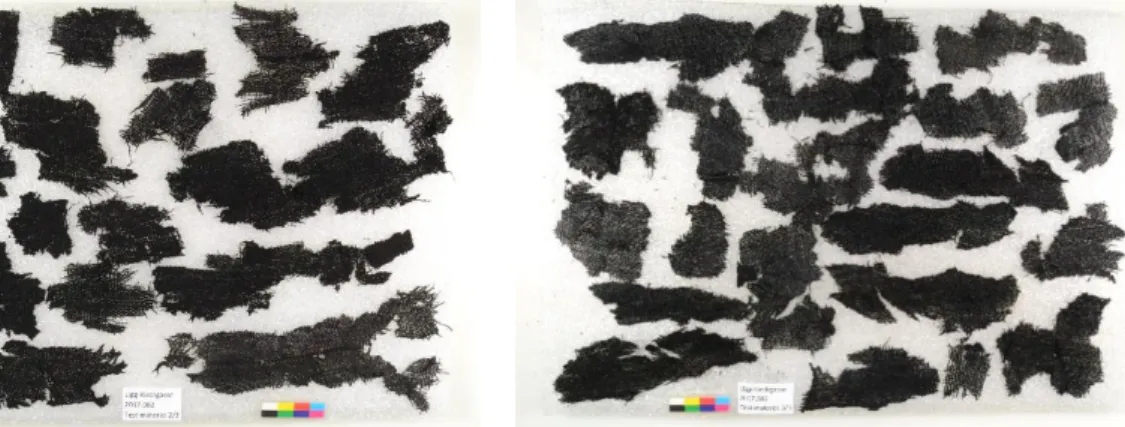
(25) HE-Arc CR, Master of Arts HES-SO in Conservation-restoration Andrea Ramirez Calderon, Conservation of charred archaeological textiles, 16.07.2018. One of the most common types of weaves used during the early Middle Ages is the tabby weave (also called plain weave), where weft threads regularly pass over and under each warp thread. In the case of linen fabrics, they were often washed and bleached after weaving to achieve a white colour68. 69. . Figure 5 Reconstruction of a horizontal treadle loom. ©C. van Hees. 3.2 Characterisation of the textiles Seventy-five. samples. founded. in. Elgg,. Kirchgasse 1 were separated of the ensemble of textiles for research purposes. Of those 75 samples, 72 are flat textiles and 3 remain attached to some layers of soil. They were delivered to the Swiss national Museum in three boxes (Figure 6, 7 and 8). Figure 6 Charred archaeological textiles from Elgg, Kirchgasse 1. Test material from the box 2/3 ©HE-Arc. Figure 7 Charred archaeological textiles from Elgg, Kirchgasse 1. Test material from the box 2/3 ©HE-Arc. 68 69. Figure 8 Charred archaeological textiles from Elgg, Kirchgasse 1. Test material from the box 3/3 ©HE-Arc. Brandenburgh, 2016, p. 19-24 Rast-Eicher, 2016. 22.
(26) HE-Arc CR, Master of Arts HES-SO in Conservation-restoration Andrea Ramirez Calderon, Conservation of charred archaeological textiles, 16.07.2018. 3.2.1 Identification of the fibres Fibres from the archaeological textiles have been identified with microscopic techniques. The identification of the fibre is useful to predict the behaviour of a textile, to understand its degradation state, and to plan an appropriate conservation treatment and storage method. To facilitate the characterisation of the samples, an identification number was given to each one70. For the identification of the fibres, the surface appearance and cross-section characteristics were observed. Unfortunately, fibres in poor condition, very dark and degraded, make the identification with a microscope harder because not all distinctive features are preserved. In addition, when plant materials are charred, the rays shrink with carbonisation, so the diameter of fibres can change71. The cross-section features A copper metal plate was selected for the cross-section observation, with a thickness of 0.45mm. Holes with 0,7mm were created to trap the fibres inside. Two fragments of threads were chosen from the samples 3.4 and 3.8, one from each direction of the fabric (Appendix 2). The threads location is visible in the Appendix 2. Polyester threads are pulled through a small perforation in the metal plate, with the charred fibre placed in the middle of the synthetic fibres. The fibre will be trapped inside once the polyester is pulled through the cavity (Figure 9). The remains are cut with a razor blade72. Using light coloured polyester threads will help. Figure 9 Plate Cross-section method procedure ©Goodman M. lo differentiate the black charred fibre. The cross section of the fibre was observed under the optical microscope. 73. (2,5x, 5x, 10x, 20x, and. 50x objectives). The interior central lumen is very small, less than half of the full width of the fibre, and is like a dotted form (Figure 10). The shape of the cross-section varies from five to seven sides, with sharp peaks (Figure 11).. 70. Two numbers separated with a dot compose the identification number. The first digit belongs to the number of the storage box, and the second digit to the sample inside the box (e.g. 2.14 alludes to the samples number 14 from the box number 2). Only three samples have an identification number with a letter (A and B), which indicates that the textile fragment is still attached to layers of soil. The sample B.1 is a broken fragment that belongs to the sample B. 71 Rast-Eicher, 2016, p. 21 72 Rast-Eicher, 2016, p. 67 73 Information about the microscope: Zeiss® (Carl Zeiss, Germany), Axioplan, EL-Einsatz, 451898, 115-230V, 50…60Hz, 200VA. 23.
(27) HE-Arc CR, Master of Arts HES-SO in Conservation-restoration Andrea Ramirez Calderon, Conservation of charred archaeological textiles, 16.07.2018. Diameter of the fibres is around 23µm (Measurements were done through the AxioVision® Rel.4.6 software). OX and YX fibres from both samples presented the same features, so probably they are made of the same material.. Figure 10 Cross section of the fibre from sample 3.4, under the microscope x50 ©HE-Arc. Figure 11 Cross section of the fibre from sample 3.8, under the microscope x20 ©HE-Arc. The transversal features Fibres were observed under the polarised microscope, and prepared on a glass microscope slide. Meltmount® was used as mounting medium, and the glass slide was pre-heated to reduce its viscosity. One thread from the archaeological samples 2.4, 2.19 and 3.3, were selected (Location described on Appendix 3). To allow the identification, the fibres were separated from one another but, because of their charred state, it was not always possible without breaking the fibres. In those cases, the ensemble was observed together (Figure 12). After placing the fibres on the glass slide, a drop of hot Meltmount® was added. The fibres were then covered with a small glass and let them dry.. Figure 12 Group of fibres from sample 3.3 under the polarised microscope x50, bright field ©HE-Arc. Figure 13 Single fibre from sample 2.19 under the polarised microscope x50, bright field ©HE-Arc. Under the microscope, the fibres are smooth lengthwise, long and tubular. The nodes are visible at intervals along the length of the fibres. Cross markings are present and shaped in I, V and X (Figure 13). The interior of some broken fibres was observed and their canal is well-defined and regular in width. No crystals were visible.. 24.
(28) HE-Arc CR, Master of Arts HES-SO in Conservation-restoration Andrea Ramirez Calderon, Conservation of charred archaeological textiles, 16.07.2018. Results and comparison The features observed on the cross-section and the transversal-section are similar to flax (linen) or hemp fibres. The main morphological characteristics are similar, like the cross-section bundles and the longitudinal view74, so the differentiation is scarce in the fibre form. Anyhow, hemp fibres are longer and, in cross-section, hemp is flat, circular, and has an internal lumen bigger than flax75.Flax is polygonal when observed with the cross-section76 and the lumen is smaller (Figure 14). However, because of the shrinkage of the fibres during carbonisation, the observed features could also be identified as hemp.. Figure 14 Longitudinal representation of flax in good condition ©CCI. Finally, the fibres were identified as flax (linen) or hemp. The comparison between the characteristics of modern fibres and. archaeological fibres can be used to reinsure the identification. The modern linen fibre77 was also mounted with Meltmount® and, when compared, both modern and archaeological fibres presented similarities in terms of nodes and cross-markings, as well as the lumen (Figure 15). The difference between carbonised and un-carbonised linen was more apparent when observed under the polarized microscope with the analyser plate. Both fibres were observed with polarized light at maximum brightness and at extinction (Figure 16 and 17). No coloration was visible on the charred fibre at maximum brightness.. Figure 15 Modern flax fibre under polarised microscope x20, transmitted light ©HE-Arc. Figure 16 Modern flax fibre under polarised microscope x20, analyser plate, fibre at maximum brightness ©HE-Arc. Figure 17 Modern flax fibre under polarised microscope x20, analyser plate, fibre at extinction ©HE-Arc. For the complete photographic documentation of the fibres, go to Appendix 4.. 74 75 76 77. Horrocks and Anand 2000, p. 380 Thygesen 2006 Sponner et al. 2005, 179 Pure linen L40® from Lascaux®. 25.
(29) HE-Arc CR, Master of Arts HES-SO in Conservation-restoration Andrea Ramirez Calderon, Conservation of charred archaeological textiles, 16.07.2018. 3.2.2 Characteristics of the fabric and the threads For the characterisation of the fabric, each sample has been observed under the microscope. All samples present a plain weave or tabby weave, which means that the weft threads pass over each warp thread in a regular way. The proportion is one thread of weft and one thread of warp (1:1) (Figure 18). Because of the lack of selvedge on the samples, it is difficult to establish which threads are the warp threads, and which ones are the weft threads. Henceforth, references to them will be made as the vertical (OY) and horizontal (OX) threads. The vertical threads belong to the direction with the highest number of threads per centimetre square78. All fibres have been twisted in the Z- direction to create both vertical and horizontal threads (Figure 19). The angle of torsion, which determines the tightness of the twist79, is between 5 and 30 degrees depending on the sample. It is a primary torsion because there is no combination of threads to create a bigger ensemble.. Figure 18 Example of plain weave (left) and its geometrical representation (right) ©The J. Paul Getty Trust. The dimensions of the samples have been measured with an electronic calibre. The measured dimensions belong to the maximum dimensions of both X- and Y-axes. All samples have different dimension. The biggest sample (2.01) measures 14.19 x 6.2cm, while the smallest sample (1.10) measures 1.98 x 1.8 cm. In the Appendix 5, you will find a table where all morphological characteristics per sample are described. Depending on the sample, the following characteristics may be different: the number of threads per centimetre square, the diameter of the thread, the distance between. Figure 19 Detail of the sample 2.14 under the microscope x1.6, Z-twist visible ©HE-Arc. the threads, and the angle that a vertical thread creates when crossing a horizontal thread. To calculate the number of threads per centimetre square, three areas of the sample have been counted to assure that the number of threads is homogeneous in all parts. A microscopic picture of each sample has been taken with an AxioCam® MRc from Zeiss®, and the image has been treated with the software AxioVision® Rel.4.6 to add and scale, and allow the count (Figure 20, 21 and 22).. 78. Moulhérat, 2011 The angle between the vertical axis of the thread and the slant of the twist. Tight fibres have angles higher than 25 degrees, angles of 10 to 25 are considered medium, and up to 10 degrees are loose (Florian et. al., 1990) 79. 26.
(30) HE-Arc CR, Master of Arts HES-SO in Conservation-restoration Andrea Ramirez Calderon, Conservation of charred archaeological textiles, 16.07.2018. Figure 20 Detail of sample 2.2 under the microscope x0.65 ©HE-Arc. Figure 21 Detail of sample 3.11 under the microscope x0.65 ©HE-Arc. Figure 22 Detail of sample 3.6 under the microscope x0.65 ©HE-Arc. All samples have been classified in six main groups depending on the number of threads per centimetre square80: 37 samples with 17x10(±1) threads/cm², 13 samples with around 20x10(±1) threads/cm², 10 samples with 15x9(±1) threads/cm², 5 samples with 12x17(±1) threads/cm², 3 samples with 21x14(±1) threads/cm², and a last group with random count. This last group is composed of five samples impossible to classify, and two samples so degraded that it is not possible to count their threads. The diameter of the thread is variable in its length81. (Figure. 23).. Yarns. in. the. archaeological samples have diameters that range between 0.25mm to 0.79mm for the OY direction, and between 0.26mm to 0.74mm for the OX direction. The mean value is around 0.50mm for the OY direction and 0.52mm for the OX direction. In most cases, the vertical threads have the same mean diameter as the horizontal threads. Only in specific cases, there is a difference and the vertical threads are thinner than the horizontal threads.. 80. Figure 23 Detail of the sample 1.21 under the microscope x0.65. Vertical threads are thinner than horizontal threads ©HE-Arc. Based on the ISO Standard NF EN ISO 4602 (2011): Reinforcements – Woven fabrics – Determination of. number of yarns per unit length or warp and weft 81. Microphotographs of the samples treated with the software AxioVision© have been used to calculate the diameter of the threads.. 27.
(31) HE-Arc CR, Master of Arts HES-SO in Conservation-restoration Andrea Ramirez Calderon, Conservation of charred archaeological textiles, 16.07.2018. No fibre length or linear density can be calculated from the archaeological samples, because the crimp from the yarn must be removed in advance, and this is not possible when textiles are charred (Figure 24). Three categories were stablished for the distance between threads. An open fabric refers to samples where the distance is higher than 0.3mm and the support below the fabric is perfectly visible. If the distance is between 0.05mm and 0.3mm, the sample will belong to the semi-open fabric type. If there is no space between the threads or the distance is smaller than 0.05mm, it is a closed fabric (Figure 25, 26 and. Figure 24 Example of crimped yarn that after carbonisation keep the form weaved. Detail from the sample 2.17 under the microscope x1 ©HE-Arc. 27).. Figure 25 Sample 3.11. Open fabric ©HE-Arc. Figure 26 Sample 3.18. Semi-open fabric ©HE-Arc. Figure 27 Sample 2.18. Closed fabric ©HE-Arc. Finally, the samples have been classified depending on the angle created when a vertical thread crosses a horizontal one. Perpendicular will denote 90° between OY and OX threads, diagonal will correspond to 45°, and partially diagonal - to an angle between 90° and 45° (Figure 28, 29 and 30).. Figure 28 Detail of sample 3.5 under the microscope x0.65. Perpendicular weave ©HE-Arc. Figure 29 Detail of sample 1.11 under the microscope x0.65. Partially diagonal weave ©HE-Arc. Figure 30 Detail of sample 1.38 under the microscope x0.65. Diagonal weave ©HE-Arc. 28.
(32) HE-Arc CR, Master of Arts HES-SO in Conservation-restoration Andrea Ramirez Calderon, Conservation of charred archaeological textiles, 16.07.2018. 3.2.3 Peculiarities of some samples Specific characteristics have been discernible in some samples. The sample 2.19 presents a seam perfectly preserved with an extra thread used as link (Figure 31), and sample 2.01 has a little fragment of edge still attached to the sample (Figure 32).. Figure 31 Detail of the seam from sample 2.19 under the microscope x0.65 ©HE-Arc. Figure 32 Fragment of selvedge from the sample 2.01 under the microscope x0.65 ©HE-Arc. Samples 1.29, 1.17, 1.22, 1.24, 1.14 are composed of two or more layers of textiles, or present some threads which do not belong to the samples, indicating that the fragment was recovered from a pile of fragments (Figure 33 and 34). Lastly, a few samples are charred fragments with a big layer of soil and charcoal underneath (Figure 35). In two of them, A and B, the layer of soil is thicker than 0.5cm. Sample B.1 is a fragment detached from the sample B. Figure 33 Sample 1.17 with two layers of textile ©HE-Arc. Figure 34 Sample 1.24 with two layers of textile ©HE-Arc. Figure 35 Detail of sample 1.14 with a layer of soil attached to the textile ©HE-Arc. 29.
Figure

+7


Documents relatifs
This potential of halite to carry original, ambient atmospheric oxygen must be clearly documented by the rigorous screening of the rock salt for primary features among them chevrons
compare favorably with the local frequency-wavenumber spectrum of a lower hybrid solitary structure observed by the TOPAZ II..
(a) Observed seasonal (DJF and JJA) surface temperature change in the past century based on local linear trends and the standard deviation about the local 100-year mean temperature,
[ 49 ] Using this model we show that (1) during much of CRYSTAL-FACE, older stratospheric air transported equa- torward around the North American monsoon is the major component of
En plus de t'avoir attaché fermement, je te plonge dans l'obscurité avec un bandeau de cuir lui aussi, et t'intime l'ordre de ne rien dire, sans toutefois aller jusqu'à te
Sämtliche Frakturen waren vollständig geheilt. In einem Fall bestand ein ca. cm durchmessender Konturdefekt in der Trag- zone der Femurkopfkalotte, sodass hier ei- ne
A recent study investigating the effect of genetic polymorphisms in CYP3A4, CYP3A5, and MDR1 on the pharmacokinetics of cyclosporine and tacrolimus also found no evidence supporting
In contrast, lymphatic drainage impairment shown by collecting vessel rupture, dermal backflow and rerouting of lymph flow via collateral vessels were observed after ALND-like
