
Beyond Blue and Red Arrows:
Optimizing Natural Ventilation in Large Buildings by
Wendy Meguro Bachelor of Architecture, 2003 University of Hawaii at Manoa Submitted to the Department of Architecture
in Partial Fulfillment of the Requirements for the Degree of MASTER OF SCIENCE IN ARCHITECTURE STUDIES
at the
MASSACHUSETTS INSTITUTE OF TECHNOLOGY
June 2005
C 2005 Wendy Meguro. All rights reserved.
The author hereby grants to MIT permission to reproduce and distribute publicly paper and electronic copies of this thesis document in whole or in part.
Signature of author: ... C ertified by : ... C ertified by : ... MASSACHUSETTS INSTITUTE OF TECHNOLOGY
JUN
28
2005
LIBRARIES
Departnh'nt of Architecture June 3, 2Q05 Leslie K 4 orford Professor of Building Technology Thesis Co- SupervisorAndrew Scott Associate Professor of Architecture Thesis - Supervisor A c c e p t e d b y : ... .. . . ... . .Accetedby ----. --- - --.. ..\iv;n Beinart. -- ---Professor of Architecture Chairman, Committee on Graduate Students
Leslie K. Norford
Professor of Building Technology Thesis Co-Supervisor
Andrew Scott
Associate Professor of Architecture Thesis Co-Supervisor
Leon R. Glicksman
Professor of Building Technology
& Mechanical Engineering
Thesis Reader
Biographical Note
Wendy Meguro attended Massachusetts Institute of Technology from 2003-2005, prior to which she complete her Bachelor of Architecture at the University of Hawaii at Manoa. While at MIT, she was awarded the 2004 Skidmore, Owings, and Merrill Foundation Building Systems Technology Research Grant in addition to the MIT Rosenburg Traveling Fellowship to further her studies in naturally ventilated buildings. During her time at UH, she was awarded the Henry Adams Medal for most outstanding student, Alpha Rho Chi Medal for leadership, service, and professional merit, and others. Simultaneous to her coursework at MIT, she engaged in three interdisciplinary environmentally-driven design competitions: Pacific Palisades Mountain Hut, Urban Land Institute, and Cradle to Cradle. She had the privilege of working with Walters, Kimura, Motoda Landscape Architects, Kajioka Yamachi Architects, and Dinmore and Cisco Architects while in Hawaii.
Beyond Blue and Red Arrows:
Optimizing Natural Ventilation in Large Buildings by
Wendy Meguro
Submitted to the Department of Architecture on May 19, 2005 in Partial Fulfillment of the
Requirements for the Degree of Master of Science in Architecture Studies
Abstract
Our growing understanding of technology and environment has expanded the
complexities of producing large naturally ventilated buildings. While it may be argued that designing for natural ventilation is a straightforward, intuitive process, somewhere between the simple diagrams and signing off on the building, the designer must be able to verify that the design will be effective -- essentially that people will be comfortable, and that the system is robust. Today, professional experience is the only methodology to understand the broad considerations behind these new structures. Literature reviews and interviews with industry professional illustrate the lack of information available to the academic and practicing audiences describing the series of calculated decisions and challenges surrounding the design of large naturally ventilated buildings. Architecture professionals and students desiring to engage in these recent, innovative practices would
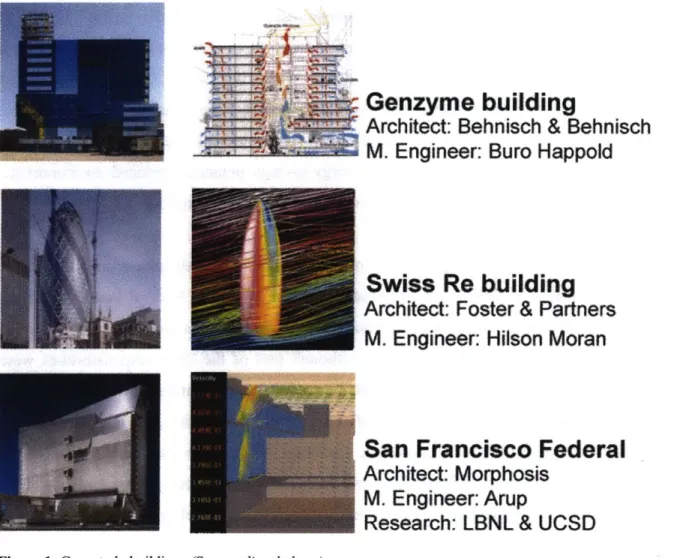
therefore benefit from a resource describing the options available to evaluate a proposed design and optimize a completed building. The thesis examines the strategic decisions in evaluation and monitoring of three case study buildings (Morphosis' San Francisco Federal building, Fosters & Partners' Swiss Re building, and Behnisch & Behnisch's Genzyme building) and derives principles influencing future architecture practice.
Thesis Co-Supervisor: Leslie K. Norford Title: Professor of Building Technology Thesis Co-Supervisor: Andrew Scott Title: Associate Professor of Architecture
Acknowledgements
I would like to thank all of those people who have contributed to, supported, and encouraged the production of this thesis.
This work would not have been possible without the questions, challenges, and encouragement of my co-advisors, Les Norford and Andrew Scott, and reader, Leon Glicksman. Their ability to span the detailed technical issues and the broad "big-picture" issues made them an invaluable resource.
I am grateful for the two sources of funding that facilitated the research: the 2004 Skidmore, Owings, and Merrill Foundation Building Systems Technology Research Grant and the MIT Rosenburg Traveling Fellowship.
I extend my gratitude to the professionals who shared their time, insight, and anecdotes, allowing this thesis to bridge academia and industry. Among these, I would especially like to thank those whom I interviewed in the UK, New York, and Boston as well as the individuals who facilitated the research on the case study buildings.
To my international crew of MIT friends and SMArchS partners in crime, I thank you all for the hours of laughter, critical discussion, exciting travels, and lasting camaraderie. Warmest thanks to Buddy, Hanimal, Jinnay, and Phila for the many memorable adventures and cherished conversations. To MC, thank you for everything, especially your devotion. Also, thank you to my friends in Hawaii and California for cheering me on and teasing me during those long Boston winters.
A special thank you to Dad, Mom, Casey, Grandpa, Grandma, Ojiichan, Obaachan, Kuniko San, the Lyons, and the Reasons for your invaluable encouragement and friendship.
Table of Contents
1. Introduction & B ackground ... 7
1.1 S u m m ary ... . . 7
1 .2 P reface ... 8
1.3 D efinitions of com fort... 10
1.4 Current literature resources for architects... 11
1.4.1 Natural Ventilation in Buildings: A Design Handbook... 12
1.4.2 "Natural Ventilation in non-domestic buildings" ... 15
1.4.3 "Barriers to Natural Ventilation Design of Office Buildings"... 16
1.4.4 LEED: "Indoor Environmental Quality" ... 16
1.4.4 Current academic endeavors ... 18
2. Industry Interview s... 19 2 .1 O v erv iew ... . . 2 0 2 .2 P roposed Study ... . 2 1 2.3 M ethodology ... 22 2 .4 Interview R esults ... 24 2 .4 .1 Q uestion 1:... . 24 2.4 .2 Q uestion 2 :... . 28 2 .5 S u m m ary ... 3 3 2.5.1 Implications for architecture practice ... 34
2.5.2 Future Ideas... . . 34
3A. Case Studies Introduction ... 36
3B. San Francisco Federal Building ... 40
3B.1 Establishing design objectives ... 42
3B.1 Establishing design objectives ... 43
3B.2 Simulation: The role of LBNL, UCSD, and RWDI... 45
3B.2.1 Collaboration with research institutions... 45
3B.2.2 Objectives: Determining building comfort with Energy Plus... 46
3B.2.2.1 Setting up the Energy Plus simulation ... 49
3B.2.2.2 Interpretation of results ... 50
3B.2.2.3 Conclusions of EnergyPlus modeling ... 53
3B.2.3 CFD simulation and UCSD's role... 54
3B.2.3.1 Setting up the CFD simulation... ... 54
3B.2.3.2 Interpretation of CFD results... 55
3B.2.3.3 Conclusions of CFD modeling ... 58
3B.3 Appealing to the client ... 59
3B.3.1 The client brief & establishing objectives... 59
3B.3.2 Developing a solution to the brief... 60
3B.3.3 Making the case to the client... 61
3B.3.4 Navigating the value engineering process... 62
3B.3.5 Concurrent topics relevant to natural ventilation design... 63
4. Swiss Re building ... 68
4.1 Establishing design objectives ... 70
4.2 Client influence & anticipating future tenants... 76
4.3 Sim ulation: The role of Hilson M oran... 78
4.3.1 Fagade design: Ventilation and daylighting considerations... 81
4.4 Post occupancy evaluation... 83
5. G enzym e Building... 86
5.1 Establishing design objectives ... 88
5.1.1 Designing the details... 91
5.2 Client influence... 92
5.2.1 Navigating the value engineering process and construction... 93
5.3 Post occupancy evaluation... 94
5.3.1 Detection of and response to problem s... 95
5.3.2 Prom oting its importance... 97
5.3.3 M anaging Data... 99
5.3.4 Com m unicating with users ... 100
6. Applicability to future projects... 104
6. 1 Structuring the Project Differently... 104
6.1.1 Collaboration with research institutions ... 105
6.1.2 Anticipating additional tim e requirem ents... 107
6.1.3 Exploring funding options ... 109
6.1.4 Garnering Client Support... 110
6.1.5 Conclusions regarding interdisciplinary collaboration... 112
6.1.6 Sharing inform ation to avoid re-inventing the wheel... 115
6.2 N ew architect responsibilities ... 117
6.2.1 Architect as coordinator... 117
6.2.2 Architect as simulation m ediator ... 120
6.2.3 Architect as system s researcher ... 121
6.3 The future of simulation tools... 123
6.4 Future of Post Occupancy Evaluation... 128
6.5 Conclusion ... 130
7. Sources ... 131
8. Table of Figures... 134
1. Introduction & Background
1.1 Summary
Our growing understanding of technology and environment has expanded the complexities of producing large naturally ventilated buildings. While it may be argued that designing for natural ventilation is a straightforward, intuitive process, to optimize the system and avoid liabilities, the designer must be able to verify that the design will be effective -- essentially that people will be comfortable, and that the system is robust. Today, professional experience is the only methodology to understand the broad considerations behind these new structures. Literature reviews and interviews with industry professional illustrate the lack of information available to the academic and practicing audiences describing the series of calculated decisions and challenges surrounding the design of large naturally ventilated buildings. Architecture professionals and students desiring to engage in these recent, innovative practices would therefore benefit from a resource describing the options available to evaluate a proposed design and optimize a completed building. The thesis examines the strategic decisions in evaluation and monitoring of three case study buildings and their implications on future practice.
The conclusions from the case studies and industry interviews provide insight into the future of large building natural ventilation design and green design in general. They suggest the need for [1] architects with an understanding of the overall process from project inception to post occupancy evaluation regarding coordination, time, funding, and people involved; [2] architects with knowledge of environmental simulation programs who can mediate between engineers' calculations and architects' agendas; [3] architects who can operate environmental simulation programs in-house for early design studies; [4] architects adept in researching and comparing the feasibility of environmentally-responsible systems; and [5] architects motivated to publish their experiences for the benefit of future projects.
1.2 Preface
There is a generally unexploited opportunity to employ natural (or hybrid natural and mechanical) ventilation in large (10+ story) buildings in temperate climates. This type of building is more desirable than its mechanically ventilated counterpart because of its potential to reduce its high air-conditioning energy demands, improve indoor air quality,
and increase occupant comfort and control.
The advent of air conditioning permitted the construction of high-rise office buildings on a scale that would have been impossible before these mechanical means. The modern, sealed, glass-clad building typology resulted from a combination of the desire to push structural limitations, and to create large buildings as symbols of prestige and success. The facades of these buildings took on the same appearance, regardless of orientation, climate, or environmental conditions. The inoperable glass curtain walls trapped heat from the sun and electric lights, in addition to preventing fresh air from entering the interior. Instead of re-examining the architectural form to accommodate sun and wind conditions, designers applied massive heating and cooling systems to regulate temperature and air exchange. The U.S. Green Building Council's LEED guide states "operable windows are perhaps the single most desired feature building occupants request in the programming phase of a project," yet most large office buildings are sealed boxes, divorced from the outdoors.' Designers intended to create constant interior conditions, with little fluctuation in temperature or lighting; in other words, the occupants of those large sealed office buildings had little relation to the outside environment. This decision results in several disadvantages compared to spaces with operable windows and natural ventilation including [1] excessive energy use, [2] lack of user control and satisfaction, [3] inferior indoor air quality, [4] undesirable temperatures, and [5]
disconnection from outside.
Today's architect has an awareness of the environment that makes it unacceptable to apply massive mechanical systems when a more clever energy-savvy solution is possible. The U.S. Department of Energy recognizes the environmental and international repercussions of the immense and wasteful energy use today. The DOE states, "Fossil
fuels - coal, oil and natural gas -- currently provide more than 85% of all the energy
consumed in the United States, nearly two-thirds of [the] electricity, and virtually all of [the] transportation fuels""1 and that reliance is expected to increase in the next two decades. The resulting carbon emissions and climate change alongside the desire to decrease dependence on foreign sources of fossil fuels gives motivation to re-examine energy use in the U.S. Energy use in buildings makes up 35% of all energy use in the United States."' To manage energy use, a few strategies may be employed: [1] provide energy from renewable resources, [2] change consumer habits to use less energy, or [3] improve the efficiency of existing systems. This work addresses the latter two by designing the option for natural ventilation that is currently atypical for large buildings. Cooling energy use is second only to lighting energy use in commercial buildings.v In temperate climates, mild weather (at least in fall and spring) offers the opportunity for the building to breathe via natural ventilation. If the potential to significantly decrease energy usage in a large building is evident, why is it the exception instead of the
standard?
While designers rely on rules of thumb and their own experience to design large naturally ventilated buildings, their educated guesses lack the quantitative analysis required to assure comfortable conditions. While it may be argued that designing for natural ventilation is a straightforward, intuitive process, somewhere between the simple diagrams and signing off on the building, the designer must be able to verify that the design will be effective -- essentially that people will be comfortable, and that the system is robust. This is where building simulation tools come into play, facilitating the designer by verifying performance assumptions. Yet discrepancies exist in how and when to use the tools and there are difficulties inherent in the process. For example, building simulation is often avoided because it is time consuming, requires expensive software, and necessitates a skilled, experienced engineer in order to achieve meaningful results. Despite these obstacles, a few leading architectural and engineering firms have employed simulation tools to design a new generation of ecologically-sensitive large buildings.
1.3 Definitions of comfort
One reason architects and engineers hesitate to design for natural ventilation is because they fear the building will not meet stringent standards regarding occupant comfort. The American Society of Heating, Refrigeration, and Air-conditioning Engineers sets forth specific standards, that describe the acceptable range of temperatures for certain spaces such as office buildings. The USGBC LEED guide defines thermal comfort as "a condition of mind experienced by building occupants expressing satisfaction with the thermal environment." But it is also important to recognize that people's comfort zones vary by location, age, and sex. For example, lightly clothed sedentary people report comfort in Britain at 58-70'F, in the US at 69-80'F, and in the tropics at 74-85oF.v Recent research moves beyond the unvarying temperature standards to examine how people physically and psychologically react to temperature swings in naturally ventilated buildings. Research by Brager and de Dear shows that "occupants of naturally ventilated buildings appear tolerant of - and, in fact, prefer - a wider range of temperatures than their counterparts within fully air-conditioned buildings.""' Most notably, the researchers observed that because the occupants in the naturally ventilated buildings did not anticipate a thermally neutral environment, they were more tolerant of temperature swings and made appropriate behavioral changes. In fact, "behavioral adaptations, such as changes in clothing insulation or indoor air speeds, could account for only half the observed variance in thermal preferences... this suggested the rest of the variance was attributable to psychological factors. Chief among these was a relaxation of thermal expectations, possibly because of a combination of high levels of perceived control and a greater diversity of thermal experiences in the building.""" As a result of the insights gained in this research, an 'adaptive model' of ASHRAE comfort standards has recently been adopted for naturally ventilated buildings. Understanding a wider range of acceptable comfort conditions opens the window of opportunity for more large naturally ventilated buildings by lessening the fear of liability that people will be uncomfortable. In comparison with the existing ASHRAE codes, the new adaptive standards will help promote the design of and make a stronger case for natural ventilation. When the comfort conditions are calculated or simulated, the adaptive standards will increase the appropriate amount of time natural ventilation can be used and increase the
corresponding energy savings, making natural ventilation more appealing and sensible than under the current codes.
To demonstrate a different way of approaching the topic of meeting standards for natural ventilation, look at the example of political and climatic conditions in Switzerland. Swiss regulations not only recognize natural ventilation, but encourage its use. "Obtaining a permit to install air conditioning requires that designers show that it is really unavoidable and that there are no other low-energy-consuming alternatives that will produce comfortable ambient conditions inside the building.""" The political will and weather conditions in the US are obviously different from those in Switzerland, but it is relevant to recognize that standards play an important role in hindering or facilitating natural ventilation design.
1.4 Current literature resources for architects
In order to assess the natural ventilation potential of a proposed design, the architect may reference sources such as
* Natural Ventilation in Buildings by Francis Allard, 1998
* Chartered Institution of Building Services Engineers (CIBSE) AMI0
* "Barriers to Natural Ventilation Design of Office Buildings", National Report: Great Britain, Building Research Establishment et. al, 1998
* Leadership in Energy and Environmental Design, US Green Building Council
While each of these resources is useful to the architect, notice that they provide little information on how to analyze the natural ventilation design's effectiveness. A short description of each of these resources will demonstrate how the architect may utilize them and where the gaps in information exist.
1.4.1 Natural Ventilation in Buildings: A Design Handbook by Francis Allard, 1998
The handbook provides a relatively technical guide by condensing well-established diagrams and rules of thumb into one manual. The book is similar to most other resources in that it covers principles most useful in the initial stages of design. When designing a large building for natural ventilation, these simple diagrams may not adequately address the design challenges. Therefore a large building designer should refer to the section on obstacles that often arise in natural ventilation design.
The chapter entitled "Critical Barriers" divides the issues into three categories: [1] During building design -fire regulations, acoustic regulations, type of building use, controls, lack of suitable design tools; [2] During building operation - safety, noise, air pollution, shading, draught, user ignorance; [3] Other barriers: architectural impact, lack of suitable standards, increased risk for designers, fee structure for design. Although Allard notes the "lack of suitable design tools, lack of suitable standards, [and] increased risk for designers" the text lacks clear solutions to these difficulties. Allard states, "Natural ventilation has been an area where reliable tools have been conspicuously scarce," noting the variable wind conditions as the major stumbling block. "The tools that are available require a reasonable degree of user training and a good ability to interpret the results... Thus, most designers will not feel too comfortable using them and may even feel distrustful and confused by the often contradictory recommendations for different wind patterns." Allard concludes with the statement, "This difficulty still has to be overcome with the development of new software packages," offering no practical advice to architects on how to navigate the process of using design tools. Although a few simulation tools are briefly named, there is no explanation of who should use the tools, when they are appropriate, and what the expected outcomes mean for design.
The purposes for evaluating the airflow conditions in a proposed building are adequately described by Allard in the chapter on prediction methods:
Designers wish to know the airflow rate through large openings to size building windows appropriately, while engineers are interested in the distribution of the air velocity in a zone to size ventilation inlets and outlets. Comfort experts wish to know the air velocity values in a zone to calculate heat convection from or to the human body, while air quality experts are interested in the flow rate, the dispersion of contaminants and the ventilation efficiency.
The four types of prediction methods Allard suggests are empirical models, network models, zonal models, and computational fluid dynamics (CFD) models.
1. The empirical model assumes the building is a single zone and determines the bulk air flow rate in the earliest stages of design. This method of analysis does not provide meaningful results for the architect designing a large naturally ventilated building since the building is not usually one large zone.
2. The second method, the network model, represents the interior and exterior conditions as nodes with different pressure values. This method of analysis is un-intuitive and too technically intense to be a desirable for the architect.
3. The zonal model is described as the most applicable for use by architects because of its accuracy and simplicity. The zonal modeling tools currently on the market are geared toward engineers, not architects, and are therefore not a common tool in design. Because Allard's book is from 1998, I assume the current (2005) example of the zonal model is the EnergyPlus simulation used in the San Francisco Federal building. In this model, one floor was modeled as one zone and the chimneys/stacks were modeled as a second zone. A multi-zone modeling tool geared toward architects is under development at Massachusetts Institute of Technology and is discussed in this thesis under the section "The future of
simulation tools."
4. The fourth evaluation method described by Allard is the computational fluid dynamics (CFD) model. From my own experience using CFD simulations in an educational setting, the CFD models' long calculation time and required expertise make them inaccessible to the architect desiring to quickly test a design.
The description and evaluation of Allard's proposed prediction methods demonstrate that they are inaccessible to the architect. Allard does not go further to suggest the next steps in modeling. This thesis will address the need for either a strong collaboration between architect and engineer who can run these simulation programs, or development of modeling tools for architects. The case studies show how modeling played a crucial role in verifying the design's effectiveness, and how it should be applied to future projects. Allard's book also contains a section entitled "Natural and Hybrid Ventilation systems in contemporary non-residential buildings." This is useful because it thoroughly describes the strategies employed by each building, but it does not explain how the designers arrived at those strategies and what was required to overcome the barriers discussed in earlier chapters. Interestingly, there is one case study of an office building (Meletitiki Ltd. in Greece by A.N. Tombazis Assoc.) that discusses how the natural ventilation strategy was executed. It appears that the building's natural ventilation was designed from rules of thumb, and only underwent simulation of night cooling after the building construction was complete as a means to address unanticipated cooling needs. This is counter-intuitive to the usual method of engaging in simulation before, not after, the building construction is complete. This reinforces the notion that a reference on the use of building simulation tools in exemplary projects would help designers decide how to apply them in future projects.
1.4.2 "Natural Ventilation in non-domestic buildings" by Chartered Institution of Building Services Engineers
The next resource an architect might refer to when designing a large naturally ventilated building is Chartered Institution of Building Services Engineers (CIBSE) Applications Manual (AM10) 1997 entitled "Natural Ventilation in Non-domestic Buildings." Produced by CIBSE and the Building Research Establishment, it "provides guidance on natural ventilation that is strategically important to architects, building services engineers, clients, and their advisors." It is a very thorough reference and includes prescriptive guidance on natural ventilation, covering physical components and assemblies, and case studies. This guide prescribes an eight-step process for natural ventilation:
1. Develop design requirements
2. Plan airflow paths
3. Identify building uses and features that might require special attention 4. Determine ventilation requirements
5. Estimate external driving pressures 6. Select types of ventilation devices 7. Size ventilation devices
8. Analyze design
If architects are interested in testing a natural ventilation design, they should refer to the CIBSE guide section on "Description of Design Tools." Discouragingly, they would then find lengthy, unapproachable hand-calculation methods more geared toward engineers than architects. The description of computer and physical modeling methods is thorough and easily understood, but does not put them into a context of architecture or engineering firms. In other words, the time, people, and common difficulties that a designer would want to know before using these methods are not addressed. The case study matrix detailing 23 buildings efficiently summarizes the approaches of each, but does not have a category for the testing methods used. The CIBSE case studies dedicate a paragraph or two to the intent of the computer analysis, but do not detail the complexity, coordination, time, and cost expectations that would be useful to a project manager or architect.
1.4.3 "Barriers to Natural Ventilation Design of Office Buildings"
National Report: Great Britain, Building Research Establishment, Willan Building Services, et.al. 1998.
The study, based on interviews and questionnaires, gauged the perceived barriers to natural ventilation in the UK as part of a larger European study sponsored by NatVent' and the European Commission. The study becomes a springboard for this thesis with its reported barriers and future needs regarding design tools. Conclusions of the study state that
"there was a significant lack of knowledge and experience on special designed natural ventilation... It was clear that guide sources to natural ventilation with working examples was required with more accurate calculations. Desirable new design tools included demonstrable performance of natural ventilation, well documented and monitored case
studies, updated CIBSE [ASHRAE equivalent] guides and more simple and advanced computer program design tools."
1.4.4 LEED: "Indoor Environmental Quality"
The US Green Building Council's reference guide Leadership in Energy and Environmental Design (LEED) informs designers of the breadth of environmental considerations and has changed the way designers approach architecture projects. The LEED rating system should be applauded for bringing green buildings to a visible position in the forefront design today. The LEED rating system is recognized for being forward thinking because it guides designers to think beyond simply meeting codes and apply logical environmental strategies. The first of its kind in the US, (the UK equivalent is BREEAM) the system does have room for improvement. There is a danger that designers will focus on the checklist of credits instead of a holistic environmentally-sound design strategy. The LEED system is an inadequate resource to designers of large naturally ventilated buildings because it does not address natural ventilation strategies, testing methods or operable windows in depth.
NatVent"M 'Overcoring 'echnical Barriers to Low Energy Natural Ventilation in Office Type Buildings in Moderate and Cold Climates' 1999.
Under LEED's "Indoor Environmental Quality" portion there are sections on "Increase Ventilation Effectiveness" and "Controllability of Systems" applicable to natural ventilation design.
"Increase Ventilation Effectiveness" recognizes that "natural ventilation provides a strong connection to the outdoors and has very low operation and maintenance costs." The requirement for this section is as follows:
"For naturally ventilated spaces, provide airflow simulation results including locations of inlets, outlets, and flow patterns. Provide a narrative with graphics describing the sequence of operations of the ventilation system and demonstrate that distribution and flow patterns in all naturally ventilated spaces involve at least 90% of the room or zone area in the direction of air flow for at least 95% of hours of occupancy."
In describing the applicable technologies, the LEED reference is somewhat vague, avoiding detail:
"Natural ventilation schemes must rely on openings in the building envelope to develop beneficial air flow. Incorporate operable windows into architectural design strategies to realize natural ventilation, cross ventilation, and stack effects. These schemes require study of inlet areas and locations as well as airflows.
Elements to incorporate in the building ventilation design scheme include windows, doors, non-powered ventilators, and building infiltration. A computer model can be developed to mimic ventilation processes and determine the best location for these elements."
Note that the computer model is mentioned in reference to locating openings. There are many other capabilities and applications of computer models that could be outlined here or mentioned in the "resources" section.
The LEED section on "Controllability of Systems" intends to "provide a high level of individual occupant control of thermal, ventilation, and lighting systems to support optimum health, productivity, and comfort conditions." The credit involves providing drawings and calculations showing fulfillment of the following requirements:
1. "Provide a minimum of one operable window and one lighting control zone per
2. Provide controls for each individual for airflow, temperature, and lighting for 50% of the non-perimeter, regularly occupied areas."
1.4.4 Current academic endeavors
Two other academic research endeavors address similar topics. First, is an Massachusetts Institute of Technology PhD thesis by Singha Intrachooto entitled Technological
innovation in architecture : effective practices for energy efficient implementation. Intrachooto's thesis uses case studies to examine processes by which design teams achieved energy efficient innovation. Intrachooto's thesis has multiple layers of interesting information and carefully detailed case studies that are useful to architects, mainly around the subject of the dynamics of the design team.
Second is a Norwegian University of Science and Technology 2003 Doktor Ingenior thesis by Tommy Kleiven entitled Natural Ventilation in Buildings: Architectural concepts, consequences and possibilities. Kleiven concentrates on how natural ventilation influences building form. Kleiven's thesis is useful to the architect looking for precedents in "modern" natural ventilation aesthetics - that is the resulting forms of the overall building massing, fagade, roof, and interior spaces. The many buildings and photographs are more aesthetically inspirational than typical two-dimensional, rule-of-thumb natural ventilation diagrams. The thesis is also useful to architects because it includes case studies of a high-rise, medium-rise, and low-rise building, facilitating a relevant comparison to their current project.
My own thesis compliments these two previous works by going into detail about the verification of the natural ventilation ideas during design and questioning how the actual performance compares to the predictions. In other words, the topic included here that is not fully explained in Intrachooto or Kleiven's theses is how the designers used different
2. Industry Interviews
Interviews with industry professionals were supported by the 2004 Skidmore, Owings, and Merrill Foundation Building Systems Technology Research Grant and also the MIT Rosenburg Traveling Fellowship. This chapter consists of the report submitted to SOM in fulfillment of the grant. The interviews provide a better understanding of the state of progressive practices in the architecture industry today and lay the foundation for the case studies. The overview, description of the proposed study, and the methodology are explained first. The interview results are categorized under two subjects: building simulation tools and post-occupancy evaluation.
The section on building simulation tools covers " Computer modeling during schematic design * Computer modeling during design development " Commentary on the usefulness of computer modeling * Other methods of modeling
The section on post-occupancy evaluation " Is post-occupancy evaluation necessary?
* Common reasons for sub-optimal building performance * Opportunities and limitations of existing monitoring programs " Ideas on facilitating post-occupancy evaluations
The summary, implications, and ideas for future work provided a springboard to the case study and analysis work completed after the interviews.
2.1 Overview
The following research endeavor summarizes the findings from a series of interviews were conducted with architects and engineers at leading firms in the UK during the summer of 2004 regarding two issues relevant to designing multi-story buildings employing passive ventilation strategies. The first topic attempts to optimize the dialogue between architects and engineers by defining the constraints and opportunities of building ventilation simulation methods. The second topic addresses the need for post-occupancy evaluation methods to be employed in passively-ventilated buildings while examining the barriers and gathering suggestions on how this process might be facilitated. The scope of this project involves examining the design process itself, referencing specific buildings for the purpose of illustrating broader statements. The buildings discussed range from three to 40 stories high, and utilize a building management system to operate the passive ventilation systems during appropriate times of the year. This research is formatted not only to report how the cutting edge firms are operating today, but also how they evaluate the relevancy of their tools in terms of accuracy and preference in methodology. Although the chapter discusses the design process, the scope does not include re-stating initial parameters for natural ventilation (including appropriate temperatures, humidity, wind speed, and building function), but instead focuses on the methods available to confidently test and compare designs for passive ventilation.
2.2 Proposed Study
Passive ventilation addresses several pertinent issues including the opportunity to decrease energy used on cooling loads, improve indoor air quality, and increase occupancy comfort. The design of large-scale passive ventilation requires careful coordination between the architect and engineer as well as the quantitative confirmation of comfort conditions through the use of building simulation tools. At the present, there is a suboptimal architect/engineer relationship in which the architect lacks simple tools for initial design analysis and usually lacks understanding of the constraints of the engineer's analysis process. A productive dialogue between architect and engineer is necessary to facilitate the exchange of ideas and allow for iterations to optimize design. Few firms have achieved this ideal collaboration on a consistent basis, and my research focuses on dissecting how those firms use simulation tools and building monitoring to inform the design process for passive ventilation. The first topic discussed examines the role of building simulation tools in leading architecture and engineering firms relative to their purpose and influence in various stages of the design process.
The second component of the research addresses the need for post-occupancy evaluation of passively ventilated buildings to determine if they are performing as expected and to apply those findings to future projects. Post-occupancy evaluations are often difficult to arrange or lack funding. The interviews offer the opportunity to evaluate current practice and reflect upon potential improvements to the data collection methods and building performance evaluation techniques.
2.3 Methodology
The information gathered is a series of opinions and stories based on experiences in designing and building passively-ventilated buildings. The interviews generally consisted of an hour to two hours of discussion initiated by questions framing the previously stated issues. All interviews were arranged by email and phone through the initiative of the researcher and the graciousness of the professionals. To facilitate documentation, the discussions were recorded on tape and later transcribed. Those thoughts were then compared, identifying conflicting opinions, patterns in response, and
suggestions for improvement.
The questions stated are intentionally broad. To avoid skewing the interview with the researcher's own hypotheses or biases, the questions are structured to allow the professionals to respond based on those issues most prevalent in their experiences. The initial comments or stories provided a basis for more specific questions. Upon commencement of the research, my objective was to record how leading firms engaged in the process of passive ventilation design and format it into a resource that less experienced designers could reference. After engaging in the discussions, it became clear that opinions and methods for passive ventilation design differed within the profession and therefore could not be assembled into a singular guide. As a result, this research is formatted not only to report how the cutting-edge firms are operating today, but also how they evaluate the relevancy of their tools in terms of accuracy and preference in methodology. This information should facilitate the dialogue between architects and engineers because it basically outlines what to expect from simulation and follow-up when engaging in a multi-story passive ventilation system. This information is also of interest to firms proficient in passive ventilation design as a basis for comparison and instigation of possible improvements.
The people and firms that graciously participated in this survey are as follows. I would also like to take this opportunity to thank them for their generosity in giving their time, expertise, and reference materials to aid the research.
Feilden Clegg Architects
Bill Gething, Partner and RIBA Sustainability Advisor Foster & Partners
Rob Harrison, Project Architect on Swiss Re Hopkins Architects
Gary Clark, Architect Max Fordham LLP
Bart Stevens, Group Leader
Philip Armitage, Partner, Cambridge Office Greg Smith, Mechanical Engineer
Lorna Max, Mechanical Engineer Meredith Davey, Mechanical Engineer Ove Arup & Partners
David Richards, Associate Director of Structural and Building Services Mikkel Kragh, Fagade Engineering
Short & Associates
Quinton Pop, Architect
University of Cambridge, BP Institute Shaun Fitzgerald, Researcher Usable Buildings
Bill Bordass, Co-Founder Adrian Leaman, Co-Founder
2.4 Interview Results 2.4.1 Question 1:
What are the objectives of using building simulation tools during various stages of the design process?
The responses to this question are categorized into four areas: 1. Computer modeling in schematic design 11. Computer modeling in design development
Ill. Commentary on the usefulness of computer modeling
IV. other types of modeling (not computer) used and their value
I. Computer Modeling in Schematic Design
When designing a passively-ventilated building, most of the interviewed architects and engineers identified a few critical points in schematic design. The first is that in order to achieve an energy-efficient, passive design, the architect and engineer must collaborate very early on in the project. Architects need rules of thumb from the engineers, to inform the general massing, orientation, and openings in the building based on environmental cues. Informed decisions are made when the engineers then run quick calculations via spreadsheets or uncomplicated software to compare one design to the next. From the engineer's point of view, the method of testing during initial design stages must be simple and fast ("quick and dirty") so that designs may be quickly altered and tested again. Detailed simulations are undesirable at this stage because of the long turn-around time and expense involved when it is probable that the building design may change significantly.
"I know modeling, and I know when it should come in, but the real problem is budget. It's very costly in terms of man-hours. You don't want to do it unless you really have to. If the building changes then the models have to be done again. Engineers don't want to do complex modeling too early because they know the building will change. So it's a chicken and egg type of situation, where [architects]are always trying to say 'You need to tell us the defining parameters for us to be able to design. ' Sometimes the [engineers] give approximate rule of thumbs, which will set up the design, then we'll test it." - Gary Clark, Hopkins Architects
"The architect needs a very good feel for the rules of thumb to do the rough analysis for ventilation and daylighting. And [Max Fordham engineers] were very good about providing estimates (i.e. you need about
50% wall area for ventilation) but then they were able to back that up with hard calculations soon after the meeting to see whether they were right or wrong... At that time they use many simple spreadsheets, changing one variable at a time to see what happens. " -Bill Gething, Feilden Clegg
"An in-house software is used for energy and thermal analysis (and natural ventilation. ". -David Richards, Associate Director of Structural and Building Services, Ove Arup
II. Computer Modeling in Design Development
In the Design Development stage, once the building is more resolved, full thermal and/or airflow simulations are engaged at least twice, indicated by architect Gary Clark of Hopkins Architects. These simulations are methods to test assumptions about the comfort conditions. The feedback from these models should locate areas that need to be further addressed (areas that are showing undesirable results). This is the stage where a knowledgeable, experienced engineer has the opportunity to influence the design because as he/she runs the simulation, he/she may suggest changes to optimize the form or systems. Once changes have been implemented the models should be run once more to verify the building's performance.
III. Commentary on the Usefulness of Computer Modeling
When assessing the value of thermal and airflow computer simulation techniques for passive ventilation design, three answers emerged. The first addresses the [in]accuracy of the programs; some opinions revealed thermal simulations are useful in comparing one design scheme to the next, but not necessarily accurate in predicting exact temperatures. The opinion that the computer simulation could be inaccurate was based on the professional's experience in which temperature readings in the computer simulations were different from temperature readings taken in the actual building. Secondly, these simulations are useful in locating areas that need to be further addressed (i.e. where the design should be changed). Third, the models should be run once more to confirm the building's performance after changes have been implemented.
In addition, the building simulation results should be presented as a range of performance possibilities based on how the building is operated (influenced by the user's actions). In
other words, while simulation results present the optimal operating condition, the energy and comfort projections should include the realistic possibility that users will mismanage the building. For example, interior partitions or manual override of automated openings
might compromise the building's performance.
"Using simulation as a presentation tool, it's a nice idea to say 'that's what the building is capable of' and show a range of if the client operates it badly." - Gary Clark, Hopkins Architects
The following is an excerpt from a conversation with engineer Bart Stevens at Max Fordham:
BS: "This is an analysis program we've got in house that's a bit better than a spread sheet. It's about half way between a spreadsheet and TAS.
... It gives you a really good
feeling
overall if the building is going to work, or if this design better than that design." - Bart Stevens, MaxFordham
WM: So in this case the in-house software is used as a design tool? BS: Yes, and I think it's much more useful for naturally ventilated buildings because you've got to run so many of them. We ran it 32 times
on the BRE building..." - Bart Stevens, Max Fordham
IV. Non-Computer Modeling Techniques and Their Usefulness
The other types of modeling, such as wind tunnel tests, physical mock-ups, or water bath models, can also be useful in simulating the airflow in a building. The various techniques discussed during the interviews will be mentioned briefly here, in the context of their applicability in the design process. The details of how the techniques work will not be described in depth here because other texts may be easily referenced for the subject. Wind tunnel tests are useful in the ventilation design process to help identify areas to explore further and focus in on with Computational Fluid Dynamics. The wind tunnels are used primarily for urban-scale analysis, as opposed to modeling the interior of a building. One reason for this is because the lack of ability to simulate thermal conditions in a wind tunnel model. The wind tunnel is more useful for structural analysis, and less useful for ventilation design.
Physical mock-ups of sections of the building are used to understand assemblies, test for water and air infiltration, and analyze acoustics. The interviews did not describe exactly how physical mock-ups are used in ventilation design, so some possible applications are speculated here. The fagade might be tested for air tightness, pressure differential across a fagade may be drive air leakage a buoyancy-driven ventilation system. Fagade leakage can also be a problem in a wind-driven ventilation situation as well. In addition, the actuators or sensors for operating windows and their assemblies to the frame could be tested in the physical mock-up.
A handful of research communities are working with water bath models to simulate single-volume building spaces. Based on the interviews, it appears that water bath (saline solution) models are being used only at research institutions such as Imperial College, University of California San Diego, and Cambridge University (BP Institute). Some of Alan Short's professional work in architecture has undertaken collaborations with Cambridge University for water bath modeling.
"Parallel to the computer environmental modeling there is a similar track of physical modeling of parts of the building, from typical bay details to large-scale details, for wind infiltration or acoustic tests." Gary Clark, Hopkins Architects
2.4.2 Question 2:
Is post-occupancy evaluation necessary? If so, how might it be facilitated? The responses to this question are categorized into four areas:
V. Is post-occupancy evaluation necessary?
VI. Common reasons for sub-optimal building performance VII. Opportunities and limitations of existing monitoring programs Vill. Ideas on facilitating post-occupancy evaluations
V. Is post-occupancy evaluation necessary?
The interviews revealed a consensus among both architecture and engineering firms that post-occupancy evaluation is especially relevant and necessary for passively-ventilated buildings. The major barrier to post-occupancy evaluation is the difficulty in allocation of responsibility and securing financial support. The building facilities manager, the building controls company, the engineer, and the architect could all potentially oversee the monitoring process. It is critical that those responsibilities are clearly defined and funding is included in the building contract.
"There are multiple reasons for monitoring. The first is the commissioning of the building, second is a PR tool, and third is to learn for future... But also, [monitoring] does show various things that even computer simulations can't." Greg Smith, Mechanical Engineer, Max Fordham
"Personally, I'm very keen on monitoring because you essentially use it as the commissioning process. Greg Smith, Mechanical Engineer, Max Fordham
"If you don't know whether the things you're specifying work in practice, it's hopeless." - Bill Gething, Feilden Clegg Architects, RIBA Sustainability Advisor
"The clients and facilities managers are getting more interested in [post occupancy evaluation]. Once clients know the cost [of a poorly-operating building] in terms of management, time, lost productivity, and life-cycle of their building components, they are interested in post occupancy research." - Gary Clark, Hopkins Architects
VI. Common reasons for sub-optimal building performance
In the discussions, the three most common reasons for sub-optimal building performance were 1) occupants' unawareness of building operation requirements; 2) physical breakdown of building components; 3) air infiltration because of sub-standard quality of materials or construction.
First, if the occupant does not understand how the building should be operated in different weather conditions, he/she might be counter-productive to the passive ventilation scheme. For example, the occupant might construct interior partitions and unknowingly blocking the airflow. The most obvious solution to this issue is to create a way for the designers to express their intentions to the users, either through written methods or through personnel. Because most building occupants are not inclined to read the Operations and Maintenance manual, there is a need for a different method of communication between the building designers and end users. Some strategies discussed include daily briefings via email or indicator lights to instruct window operation. Even if the facilities manager is familiar with the ventilation strategy and its requirements, periodic assessment of its performance is not usually included in his/her responsibilities. In addition, as staff is replaced, knowledge of the building operation is not usually communicated. Therefore the building design must be both robust (anticipating abuse) and intuitive (should not require specialized knowledge from the user).
Second, in passively-ventilated buildings, the sometimes unprecedented combinations of building assemblies or the complexity of the building management systems (BMS) result in physical breakdown of components. In some cases, the source of the problem is not readily apparent and the designers or facilities managers are only notified when users complain of uncomfortable indoor conditions. This highlights the opportunity for facilities managers to identify and repair problems faster by reviewing and responding to data (such as temperature) collected by the BMS.
Third, air infiltration was identified as a primary reason for poor building energy performance. Usually infiltration was a result of sub-standard material quality or careless construction. The assembly components of windows, sensors, actuators, and BMS, are often produced by separate manufacturers and require builders to have a certain level of expertise and experience to construct and coordinate properly.
"We told the client he must never put up a partition here [blocking cross-ventilation]. And, presto, the client put up a partition here and the natural ventilation didn't work. You should design buildings to be forgiving, so the
client can mess them up, and they'll still work." - - Greg Smith,
Mechanical Engineer, Max Fordham
"There are all sorts of reasons why buildings might not work; either components fail and no one knows how to repair them, or the design doesn't work, or occupants don't understand how the thing's supposed to operate it so they might do something like jam a window open that shouldn't be." - Bill Gething, Feilden Clegg Architects, RIBA
Sustainability Advisor
"One thing that monitoring can show, which is quite interesting, is it can reveal physical breakdowns that would normally go unnoticed. [After
noticing inconsistent BMS data] ... we found a brick stuck in the damper
which wasn't allowing it to close. So I think monitoring is an invaluable tool." Greg Smith, Mechanical Engineer, Max Fordham
"Another problem is when you're commissioning, and you're going to commission during the middle of summer or winter you have to simulate the other seasons. So when you're commissioning you put in all kinds of silly fiddles [i.e. changing set points], to check if it's working. But if you forget to take those fiddles out, which often is what happens, you find the building working ineffectively. And that's where a lot of the problems come from. It's human error." Greg Smith, Mechanical Engineer, Max Fordham
"In terms ofpost occupancy studies that have been done, wind infiltration is one of the top items that [determines] the energy difference between predicted and actual. [In response] the new regulations in the UK, especially BREEAM, ask for a pressure test of the building. -Gary Clark, Hopkins Architects
VII. Opportunities and limitations of existing monitoring programs
Experts in the field of post-occupancy evaluation such as Bill Bordass and Adrian Leaman have documented and evaluated hundreds of buildings through the Usable Buildings Trust. The post occupancy evaluation work done by Adrian Leaman bridges the gap between engineers and social scientists by linking quantitative information on topics like indoor air quality to occupant comfort and productivity. He argues that good building management is just as important as good design. In conversation with them and others, two opportunities to improve existing monitoring frameworks became evident.
First, there was a clear need to assign, in the contract, monitoring responsibility to a specific person or group. In theory, this should not require excessive time or financial resources because the data is already being collected by the BMS, and simply requires a knowledgeable reviewer trained to recognize irregularities.
Second, one building's data is most useful when compared to a database of similar buildings' performances as well as with energy-use targets. While some buildings are monitored and recorded as part of a research grant or owner-funded endeavor, this sort of evaluation is not the industry standard. By making the compilation and comparison of data a standard part of the commissioning process, design firms would benefit by the opportunity to compare their projected goals to the actual building performance; in addition, occupants would benefit from the opportunity to fine-tune the BMS for optimal comfort and energy-savings. Comparing one building's performance to energy-use targets (present and future) provides feedback to design firms, which in turn motivates and informs future buildings.
"If you've got a BMS, you get this data practically for free. The problem is accessing all that data because you 'Yve got such a mass of it." Greg Smith, Mechanical Engineer, Max Fordham
"The post occupancy evaluations are only useful when you can compare the results with other buildings. Then you need a standardized procedure such as Bill Bordass' system with a database of hundreds of buildings in the UK that's linked to a satisfaction survey." -Gary Clark, Hopkins Architects
VIII. Ideas on facilitating post-occupancy evaluations
When asked to speculate on how one might facilitate post-occupancy evaluations, the subjects' responses combined clever creativity with practical industry knowledge. The ideas can be distilled into two prime approaches: 1) increasing public demand and 2) changing the designer's fee structure. By increasing public awareness of the conditions impacting the health and energy-use in a building, demand for "sustainable" buildings and services like post-occupancy evaluations will increase. Secondly, there is a need to rethink the typical relationship where engineering fees are proportional to mechanical-equipment size. Alternatively, one might structure the engineers' fees on a performance basis in such a way that they are rewarded for energy savings.
"The key is to try and get the public on your side. The public will say,
'What green features has this building got?' ... and will hopefully choose
the building with the higher rating." Greg Smith, Mechanical Engineer, Max Fordham
"After one year, the design firm should review data, assess performance, affirm that things like the mechanical actuators and set points are working properly, and review algorithms (i.e. is the night cooling enough?). The facilities manager should have the maintenance of the BMS included in his duties and salary. A certain amount of the capital cost should be dedicated to the review done after one year of operation." -Shaun Fitzgerald, BP Institute
"What you need at an early stage are engineers who are interested in reducing building services. So they need to be employed, not on the basis
of the amount of services they extort, but employed on the basis of the total
cost of the building." -Bill Gething, Feilden Clegg
"It would be great to come to a point where the engineers get paid more for designing less ... you don't want the engineers'fees to be related to the
construction cost of their mechanical kit" - Gary Clark, Hopkins Architects
"In Europe, a directive was passed last year, for energy labeling. It makes energy efficiency a purchasing criteria. All public buildings will
get grades ... It should affect the way the public perceives these buildings
(and presumably a good rating would increase their market value)."
"The only way the client would pay for post occupancy evaluation is to add it to the contract, so it becomes another line item on the construction cost plan. Research bodies might want to do it themselves. At Jubilee Campus, the students have done their own post occupancy evaluation." -Gary Clark, Hopkins Architects
"Tie feedback and post occupancy evaluation into project delivery and follow-through. Include project goals that can be measured after
building." -Bill Bordass, usablebuildings
2.5 Interview Summary
From the interviews, one may infer a series of statements about the architecture and engineering practice today with regards to simulating and monitoring a naturally ventilated building:
a. The architects did no in-house airflow simulation. Early dialogue with engineers to determine initial moves such as orientation, massing, and form of the building is critical if natural ventilation is desired.
b. In the early stages of design, engineers ran many "quick and dirty" calculations to test the impact of different variables. In house software, less complex than a full simulation, was most often used for this application.
c. Full airflow simulations were only used if the building design was innovative or bespoke. The simulations were used for verification of
assumptions and identification of areas that needed modification.
d. Firms confirmed that post-occupancy evaluation is beneficial to building occupants and design firms. Buildings may not be operating optimally because 1) occupants lack of understanding of building operation; 2) building components physically breakdown; or 3) sub-standard quality of materials or construction leads to air infiltration.
e. Monitoring responsibilities need to be clearly defined. Results are most relevant when compared to other buildings and energy-use goals.
f. Post occupancy evaluations might be facilitated by encouraging public demand and changing designer's fee structure.



![[PDF] Support d’Introduction au logiciel pour les nuls | Cours informatique](data:image/gif;base64,R0lGODlhAQABAIAAAP///wAAACH5BAEAAAAALAAAAAABAAEAAAICRAEAOw==)