Publisher’s version / Version de l'éditeur:
Vous avez des questions? Nous pouvons vous aider. Pour communiquer directement avec un auteur, consultez la première page de la revue dans laquelle son article a été publié afin de trouver ses coordonnées. Si vous n’arrivez pas à les repérer, communiquez avec nous à [email protected].
Questions? Contact the NRC Publications Archive team at
[email protected]. If you wish to email the authors directly, please see the first page of the publication for their contact information.
https://publications-cnrc.canada.ca/fra/droits
L’accès à ce site Web et l’utilisation de son contenu sont assujettis aux conditions présentées dans le site
LISEZ CES CONDITIONS ATTENTIVEMENT AVANT D’UTILISER CE SITE WEB.
Fire Study (National Research Council of Canada. Division of Building Research), 1960-10
READ THESE TERMS AND CONDITIONS CAREFULLY BEFORE USING THIS WEBSITE. https://nrc-publications.canada.ca/eng/copyright
NRC Publications Archive Record / Notice des Archives des publications du CNRC : https://nrc-publications.canada.ca/eng/view/object/?id=dc5b6133-60a6-41d0-b6c2-c3fd0422635d https://publications-cnrc.canada.ca/fra/voir/objet/?id=dc5b6133-60a6-41d0-b6c2-c3fd0422635d
NRC Publications Archive
Archives des publications du CNRC
For the publisher’s version, please access the DOI link below./ Pour consulter la version de l’éditeur, utilisez le lien DOI ci-dessous.
https://doi.org/10.4224/40001344
Access and use of this website and the material on it are subject to the Terms and Conditions set forth at
Fire test of a wood partition
-.
NATIONAL RESEARCH COUNCIL
c m m
DIVISION OF BUILDING RESEARCH
FIRE ITEST OF A WOOD PARTITION
by
T. 2. Harmathy
Fire Study No. 3 of t h e
Mvision of Building Research
OrnAWA
FIRE 'PEST OF A WOOD PARTITION
%is r e p o r t describes t h e t e s t conducted on a wood p a r t i t i o n on 13 November 1959. !he t e s t was r e -
quested by t h e Associate' Committee on the National Building Code.
Description of Specimen
!he specimen used f o r the f i r e t e s t was a represent- a t i v e sample of a wood p a r t i t i o n widely used i n B r i t i s h
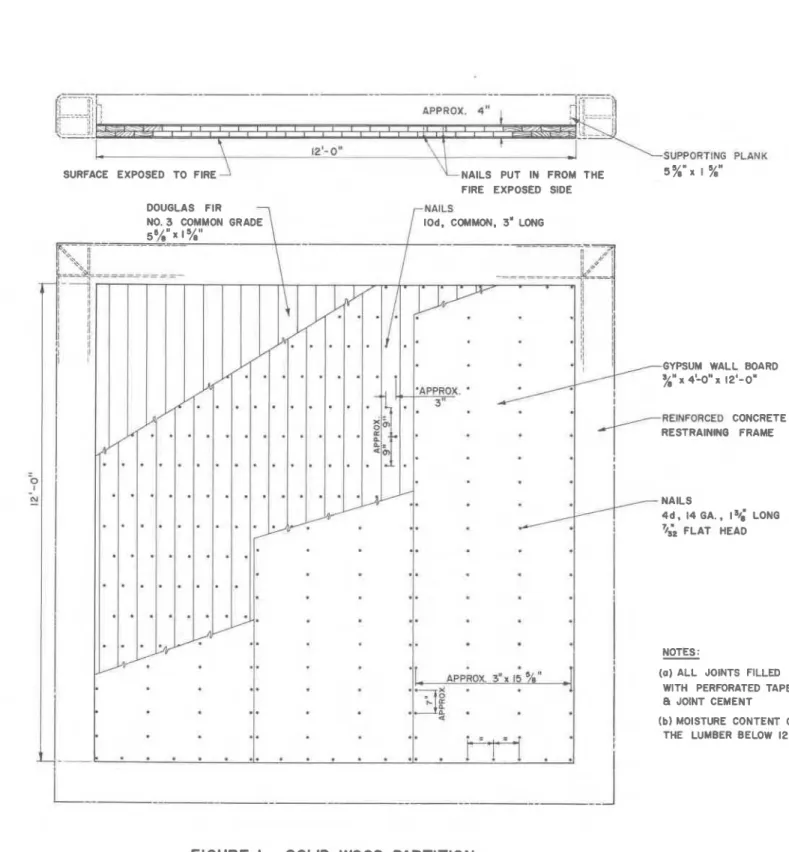
Columbia. D e t a i l s of construction and m a t e r i a l s used i n the wall a r e shown i n Fig. 1. Some a d d i t i o n a l information i s a s follows:
(i ) !be Douglas fir lumber was of 2 i n . by 6 i n . nominal; s i z e and w a s "dressed". It contained 7 per c e n t moisture on t h e day of t h e t e s t .
(ii ) !he gypsum wallboard conformed t o t h e Specification f o r Gypsum Wallboard A 82.27-1950 of t h e Canadian Standards Association ( a l s o t o ASTM C36-54).
llhe q u a l i t y of lumber and t h e staggered arrangement of t h e planks can be seen i n Fig. 2, a photograph taken during t h e oonstruction of t h e specimen. 'Phe specimen was b u i l t i n a r e s t r a i n i n g frame which was made p a r t l y from
concrete, p a r t l y from r e f r a c t o r y c a s t a b l e and reinforced with
10- by 10-in. H sections.
!Po ensure p e r f e c t r e s t r a i n t , t h e specimen was wedged along a l l f o u r edges. Since it was conceivable t h a t , despite t h e wedging, t h e wall might loosen and f a l l away from the
frame during t h e f i r e t e s t , two supporting 2- by 6-in. planks were i n s t a l l e d a l o n g t h e v e r t i c a l edges on t h e un- exposed s i d e , as seen i n Figs. 1, 3, and 4.
' b i m r e 3 shows t h e unexposed s u r f a c e of t h e w a l l p r i o r t o t e s t i n g . It i s seen t h a t t h e specimen was of ordinary good w o r b a n s h i p .
The age of t h e specimen was 38 days a t t h e time of t e s t i n g .
Testing Procedure
m e t e s t was c a r r i e d o u t i n accordance w i t h ASICM S p e c i f i c a t i o n E119-58. The furnace temperature was measured by n i n e symmetrically disposed thermocouples enclosed i n 13/16 i n . O.D. Inconel t u b e s of 0.035 i n . w a l l t h i c k n e s s , The t u b e s were .equipped w i t h carbon s t e e l cap a t t h e t i p .
!be h o t junction of t h e thermocouples was placed approximately 6 i n . away from t h e exposed s u r f a c e of t h e sample. Both t h e i n d i v i d u a l temperatures a t t h e nine p o i n t s of t h e furnace and t h e average of t h e n i n e temperatures were recorded. !he f u e l i n p u t i n t o t h e furnace was c o n t r o l l e d manually i n such
l
a way a s t o keep t h e average temperature s l i g h t l y below t h a tprescribed by t h e standard temperature-time c o r r e l a t i o n . The purpose of t h i s procedure was t o compensate f o r the expected h i g h e r temperatures during t h e f i n a l period o f t h e t e s t when t h e burning of t h e timber would be supplying more h e a t t h a n necessary f o r maintaining t h e r e q u i r e d average Furnace temperature.
'Ihe whole 12- by 1 2 - f t a r e a of t h e specimen w a s exposed t o t h e flames. ! b e combustion chamber w a s s e a l e d a g a i n s t t h e r e i n f o r c i n g frame w i t h two l a y e r s of 3/4 i n . t h i c k 4-in. wide Kaowool s t r i p s (1 )
.
The unexposed s u r f a c e t e m p e r a t u r e was measured by n i n e thermocouples (Nos. 1 t o 9) covered w i t h s t a n d a r d a s b e s t o s pads, 6 i n . s q u a r e and 0.4 i n . i n t h i c k n e s s , s y m m e t r i c a l l y d i s p o s e d , a s shown i n Figs. 3 and 5. I n a d d i t i o n , f o u r thermocouples (Nos. 11 t o 1 4 ) were cemented t o t h e unexposed s u r f a c e as shown i n Pig. 6. !two of t h e s e l a t t e r thermocouples were p l a c e d r i g h t a t t h e edges of t h e specimen, u n d e r n e a t h t h e above-mentioned v e r t i c a l supporting. p l a n k s , i n o r d e r t o s t u d y whether t h e r e would be a tendency f o r t h e p a r t i t i o n t o s e p a r a t e from t h e r e s t r a i n i n g frame due t o a p o s s i b l e s h r i n k a g e d u r i n g t h e t e s t .
Ten thermocouples were i n s t a l l e d w i t h i n t h e specimen, w i t h t h e aim of o b t a i n i n g i n f o r m a t i o n on t h e s p r e a d of
f l a m e s t h r o u g h t h e c o n s t r u c t i o n . These thermocouples (Nos. 1 5 t o 24) were l o c a t e d u n d e r t h e gypsum w a l l b o a r d on b o t h s i d e s of t h e specimen. T h e i r p o s i t i o n i s shown i n t h e g e n e r a l thermocouple l a y o u t drawing (Pig. 5
1.
S i n c e t h i s t y p e of w a l l i s g e n e r a l l y used a s non- l o a d b e a r i n g p a r t i t i o n , no l o a d o t h e r t h a n t h a t caused by t h e edge r e s t r a i n t w a s imposed on t h e specimen d u r i n g t h e t e s t .
A d e t a i l e d d e s c r i p t i o n of t h e f i r e t e s t f a c i l i t i e s of t h e N a t i o n a l Research Council has been p u b l i s h e d ( 2 ) . R e s u l t s
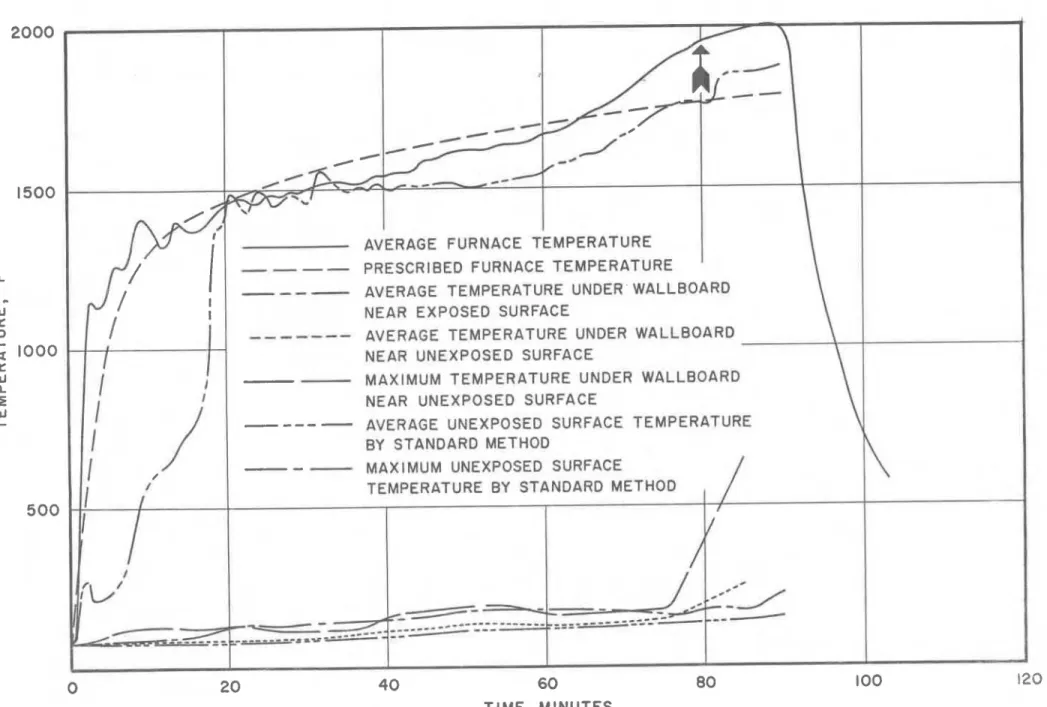
Ilhe v a r i a t i o n of t h e a v e r a g e f u r n a c e t e m p e r a t u r e Is p l o t t e d i n Pig. 7. The t e m p e r a t u r e d i s t r i b u t i o n was n o t v e r y uniform. A f t e r 20 min
,
as t h e b u r n i n g of t h e t i m b e rd s v e l ~ p e d , the iumaae thermocouples i n t h e t o p row recorded 150 t o 200°F h i g h e r , .and t h o s e i n t h e bottom row 1 9 t o
200°F lower temperatures t h a n t h e average. !the d e v i a t i o n was l a r g e s t a t a b o u t 50 min a f t e r t h e s t a r t of t h e t e s t , t h e n g r a d u a l l y decreased.
A t a b o u t 60 min from t h e s t a r t t h e f u e l i n p u t i n t o t h e f u r n a c e was completed s h u t o f f . A f t e r t h i s t i n e t h e h e a t w a s s u p p l i e d by t h e combustion o f t h e lumber a l o n e .
m e a r e a under t h e curve of average f u r n a c e temperature f o r a n 80-minute p e r i o d (which i s t h e e s t i m a t e d time o f f i r e endurance) i s 117,180°F rnin above 68OF base.
mis
i s 1.3 p e r oent l a r g e r t h a n t h a t under t h e s t a n d a r d temperature-time curve f o r t h e same p e r i o d (115,650°F rnin), b u t w e l l w i t h i n t h e a l l o w a b l e*
7.5 per c e n t limits.!he v a r i a t i o n of t h e average and maximum temperatures of t h e unexposed s u r f a c e , a s recorded by t h e thermocouples covered with s t a n d a r d a s b e s t o s pads, i s a l s o p l o t t e d i n Fig. 7. 'Phe temperatures o b t a i n e d by t h e non-standard method (Fig. 6 ) from f o u r o t h e r p o i n t s of t h e unexposed s u r f a c e were of t h e same o r d e r and axe n o t
shown here.
!I!he thermocouples placed under t h e gypsum wallboard n e x t t o t h e exposed s u r f a c e recorded f a i r l y uniform temperature r i s e . Except during t h e s h o r t p e r i o d between 1 7 and 20 min, when t h e temperature r o s e suddenly, t h e maximum d e v i a t i o n from t h e average was always l e s s t h a n 100°P. A f t e r 20 minutes t h e temperature a t t h i s
l o c a t i o n followed t h e v a r i a t i o n of t h e f u r n a c e temperature a t a s l i g h t l y lower l e v e l , as seen i n Fig. 7.
m e r e was a more s i g n i f i c a n t spread i n the temperatures obtained from t h e thermocouples located under t h e gypsum wallboard near the unexposed s u r f a c e , e s p e c i a l l y toward t h e end of t h e t e s t . The average and maximum
temperatures a t this l o c a t i o n a r e shown i n t h e general temperathre-time p l o t (Fig. 7 ) .
The time a t which t h e p a r t i t i o n f a i l e d can be estimated a s 1 hr and 20 min. ( A s w i l l be pointed out l a t e r , t h e exact tfi;le of f a i l u r e is n o t c l e a r . What can be s t a t e d with c e r t a i n t y i s t h a t it is more than 70 rnin and l e s s than 85 min.) The f a i l u r e was due t o formation of s l o t s through which h o t gases could ( i n p r i n c i p l e ) leave t h e furnace.
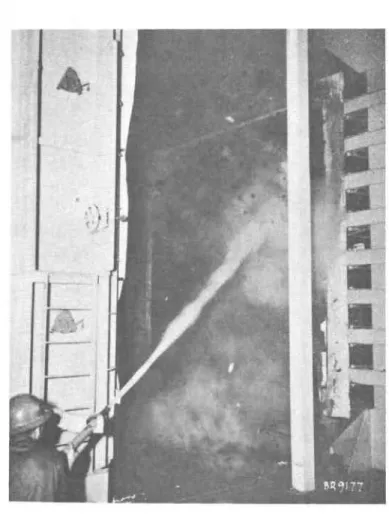
A t 1 h r and 30 min t h e furnace was opened and t h e fire-exposed s i d e of t h e specimen was subjected t o a la-min hose stream t e s t . The water pressure a t t h e base
of t h e nozzle was 30 l b / s q in., a s s p e c i f i e d by ASICDll E119-58. me a p p l i c a t i o n of t h e hose stream i s shown i n Fig. 8. The exposed and unexposed surfaces of t h e p a r t i t i o n a f t e r the t e s t a r e shown i n Figs. 9 and 1 0 respectively.
By a r i g o r o u s i n t e r p r e t a t i o n of ASfPM E119-58 in cases when t h e specimen f a i l s by formation of openings, cracks, o r by collapse, the hose stream t e s t ought t o be c a r r i e d o u t on a duplicate sample a f t e r a f i r e exposure h a l f a s long a s t h e f i r e endurance period ( i n t h e present
case 40 min). However, judging from t h e slight damage caused by t h e hose stream a f t e r a 1 h r 30 rnin f i r e exposure, t h e performance of a s e p a r a t e hose stream t e s t seems d e f i n i t e l y unnecessary.
Discussion
On t h e b a s i s of v i s u a l observation t h e
process of d i s i n t e g r a t i o n of t h e s t r u c t u r e appears t o have been a s follows:
Within
3
min from t h e s t a r t of t h e t e s t t h e paper cover of t h e wallboard caught f i r e and began t o f l a k e off t h e wall. The tapes a t t h e j o i n t s seemed t o be l e s s a f f e c t e d by t h e flames. The beeling of t h e t a p e s was first noticed a t 9 min.After 8 min, h o r i z o n t a l cracks appeared on t h e wallboard. WO minutes l a t e r yellow flame issued from t h e cracks, t h u s i n d i c a t i n g that t h e burning of t h e wood had begun. The cracks gradually opened and t h e
s e p a r a t e pieces of the board began t o buckle away from t h e planks. A t 17 min a l a r g e s e c t i o n , 4 f t by about 6 f t , f e l l o f f . In quick succession o t h e r l a r g e pieces gave way
and by 22 min from t h e start t h e t o p h a l f of t h e wood
construction w a s almost completely covered with flames. !J!he d i s i n t e g r a t i o n of t h e i n n e r wallboard was accompanied by a sharp temperature r i s e on t h e -thermocouples Nos. 20 t o 24, a s seen i n Fig. 7.
!Ihe d e s t r u c t i o n of t h e gypsum wallboard was much slower a t t h e bottom h a l f of t h e wall. Even a f t e r 55 min from t h e s t a r t . a few s c a t t e r e d fragments were s t i l l
c l i n g i n g t o t h e planks.
!.the burning of t h e second l a y e r of planks w a s first noticed a t 1 h r and 19 min, although from t h e
observation of t h e unexposed surface it w a s o l e a r t h a t
through some gaps t h e flames could reach even t h e wallboard of t h e unexposed surface much e a r l i e r . A t 1 hr and 9 min
a dark s p o t appeared n e a r t h e t o p r i g h t c o m e r of t h e
unexposed s u r f a c e , i n d i c a t i n g a l o c a l p e n e t r a t i o n of t h e
flames. The temperature of t h i s s p o t was measured w i t h
a s u r f a c e thermometer a t 1 h r 1 0 min and was found t o be
290°F, l l l ° F lower than t h e a l l o w a b l e l i m i t f o r l o c a l
temperature r i s e ( i n t h i s c a s e 401°F). Cotton waste
was t h e n t a c k e d t o t h e c e n t r e of t h e s p o t . This s p o t
d i d n o t d e t e r i o r a t e a s quickly a s expected, however, and t h e c d t t o n waste remained i n t a c t up t o t h e end of t h e t e s t .
E i g h t t o t e n minutes l a t e r a few more dark
s p o t s appeared, two of which, a t t h e t o p c e n t r e of t h e
w a l l (Fig. 4)
,
c h a r r e d more r a p i d l y t h a n t h e first one,and began t o glow a t 1 h r 25 min.
The s t a t e of t h e unexposed s u r f a c e s h o r t l y before t h e t e r m i n a t i o n of t h e t e s t i s shown i n Fig. 4.
IlZze f a c t t h a t t h e temperature r i s e a t t h e
edges o f t h e specimen was q u i t e normal i n d i c a t e s t h a t t h e
shrinkage i n f i r e of such c o n s t r u c t i o n s i s n o t s i g n i f i c a n t . References
(1) B & W Kkowool. B u l l e t i n No. R-47 of t h e Babcock
and Wilcox Co., R e f r a c t o r i e s Division, New York.
( 2 ) S h o r t e r , G.W. and T.Z. Harmathy. F i r e Research h r n a c e s
a t t h e National Research Council. N a t i o n a l Research
Council, Division of Building Research, O t t a w a .
SUPPORTlNG PLANK
SURFACE EXPOSED TO FIRE 5%. x I 3''
FIRE EXPOSED SIDE
COMMON, 3' LONG
GYPSUM WALL BOARD
REINFORCED CONCRETE RESTRAINING FRAME
4d. 14 GA.
.
la/: LONGNOTES:
(a) ALL JOINTS FILLED WITH PERFORATED TAPE
8 JOINT CEMENT (b) MOISTURE CONTENT OF
THE LUMBER BELOW 12 %
F I G U R E 2 WOOD PARTITION DURIXG CONSTRUCTION
. . - * .
F I G m 4 UNEXPOSED SURl?ACE AT TIiE
T H = THERMOCOUPLE WIRES W
=
WALLC
=
C E M E N TFIGURE
6NON
-
STANDARD UNEXPOSED SURFACE
2000
I
1500
AVERAGE FURNACE TEMPERATURE
L PRESCRIBED FURNACE TEMPERATURE
0
c
-
--
-
AVERAGE TEMPERATURE UNDER WALLBOARDW
a NEAR EXPOSED SURFACE
3
__---
AVERAGE TEMPERATURE UNDER WALLBOARD2
I000 Ia
I
NEAR UNEXPOSED SURFACEW
a I
--
MAXIMUM TEMPERATURE UNDER WALLBOARDI
W NEAR UNEXPOSED SURFACE
+
- - -
-
AVERAGE UNEXPOSED SURFACE TEMPERATUREBY STANDARD METHOD
I
/---
MAXIMUM UNEXPOSED SURFACEI
/ TEMPERATURE BY STANDARD METHOD500 / I
0 20 40 60 80 100 128
T I M E , MINUTES
FIGURE 8 AJ?PLICATION OF HOSE STREAM TEST