HAL Id: hal-02024169
https://hal-amu.archives-ouvertes.fr/hal-02024169
Submitted on 7 Jan 2021
HAL is a multi-disciplinary open access
archive for the deposit and dissemination of
sci-entific research documents, whether they are
pub-lished or not. The documents may come from
teaching and research institutions in France or
abroad, or from public or private research centers.
L’archive ouverte pluridisciplinaire HAL, est
destinée au dépôt et à la diffusion de documents
scientifiques de niveau recherche, publiés ou non,
émanant des établissements d’enseignement et de
recherche français ou étrangers, des laboratoires
publics ou privés.
Deep Into Oceanic N2 Fixation
Mar Benavides, Sophie Bonnet, Ilana Berman-Frank, Lasse Riemann
To cite this version:
Mar Benavides, Sophie Bonnet, Ilana Berman-Frank, Lasse Riemann. Deep Into Oceanic N2 Fixation.
Frontiers in Marine Science, Frontiers Media, 2018, 5, �10.3389/fmars.2018.00108�. �hal-02024169�
doi: 10.3389/fmars.2018.00108
Edited by: Angela Landolfi, GEOMAR Helmholtz Centre for Ocean Research Kiel, Germany Reviewed by: Luisa I. Falcon, Universidad Nacional Autónoma de México, Mexico Arvind Singh, Physical Research Laboratory, India *Correspondence: Mar Benavides [email protected]; [email protected]
Specialty section: This article was submitted to Aquatic Microbiology, a section of the journal Frontiers in Marine Science Received: 06 November 2017 Accepted: 14 March 2018 Published: 06 April 2018 Citation: Benavides M, Bonnet S, Berman-Frank I and Riemann L (2018) Deep Into Oceanic N2Fixation.
Front. Mar. Sci. 5:108. doi: 10.3389/fmars.2018.00108
Deep Into Oceanic N
2
Fixation
Mar Benavides
1,2*, Sophie Bonnet
2, Ilana Berman-Frank
3,4and Lasse Riemann
11Marine Biology Section, Department of Biology, University of Copenhagen, Helsingør, Denmark,2Aix-Marseille Université, Université de Toulon, CNRS, IRD, MIO UM 110, Marseille, France,3Mina and Everard Goodman Faculty of Life Sciences, Bar-Ilan University, Ramat Gan, Israel,4Department of Marine Biology, Charney School of Marine Sciences, University of Haifa, Haifa, Israel
Keywords: nitrogen budget, mesopelagic, non-cyanobacterial diazotrophs, nifH gene, aphotic layer
The biological fixation of dinitrogen (N
2) by marine prokaryotes called diazotrophs is the major
source of nitrogen to the ocean, estimated at ∼106–120 Tg N y
−1(
Gruber, 2004; Gruber
and Galloway, 2008
). This process contributes importantly to sustain primary production and
maintain the global nitrogen inventory. The nitrogen reservoir is further controlled by fixed
nitrogen loss processes including sediment burial, denitrification, and anammox (
Falkowski, 1997
),
which exceed fixed nitrogen gains through N
2fixation, leading to an imbalanced global nitrogen
budget (
Codispoti et al., 2001; Codispoti, 2007; Eugster and Gruber, 2012
). Since the early 1970s,
diazotrophic activity has been attributed to autotrophic cyanobacteria constrained to the sunlit
and oligotrophic layer of the tropical and subtropical oceans (
Zehr, 2011
). Yet substantial evidence
indicates a high diversity and wide distribution of non-cyanobacterial diazotrophs (bacteria and
archaea) in the oceans (
Zehr et al., 1998, 2000; Farnelid et al., 2011; Bombar et al., 2016; Moisander
et al., 2017
). These diazotrophs are potentially not constrained by light as are their cyanobacterial
counterparts, and have been detected in wide-ranging environments such as nutrient-rich, cold,
and/or dark ecosystems including coastal upwelling regions (
Sohm et al., 2011
), temperate coastal
zones (
Bentzon-Tilia et al., 2015
), and the deep ocean (
Hewson et al., 2007; Hamersley et al., 2011
).
Stretching the environmental boundaries, beyond those traditionally thought to constrain N2
fixation, will likely impact current estimates of nitrogen input to the global ocean. Extending the
latitudinal limits from the tropics and subtropics to temperate waters would already represent a
considerable increase in the potentially active N
2fixation area, but spreading this area vertically
to the mesopelagic (200–1,000 m) and bathypelagic (1,000–4,000 m) ocean would be immense.
Aphotic N
2fixation rates are usually low when compared to surface activity (<1 nmol N L
−1d
−1;
see Table 1 in
Moisander et al., 2017
) but the volume of the deep ocean is enormous. Consequently,
studies comprising both photic and aphotic N
2fixation measurements report depth-integrated
aphotic rates representing 40–95% of the whole water column activity (
Bonnet et al., 2013; Rahav
et al., 2013; Benavides et al., 2015
). Hence, aphotic fixation can account for a significant or even
predominant fraction of water column N
2fixation.
With the mere purpose of illustrating the potential budgetary relevance of the aphotic N
2fixation to the global fixed nitrogen input, a back-of-the-envelope calculation can be carried out.
If we consider a scenario for the mesopelagic zone (where the great majority of published aphotic
N
2fixation measurements were obtained from): taking the lower-end range of aphotic N
2fixation
rates available in the literature (0.01–0.1 nmol N L
−1d
−1; Table 1 in
Moisander et al., 2017
), and
the estimated volume of the mesopelagic zone (2.63 × 10
17m
3;
Arístegui et al., 2005
), mesopelagic
N
2fixation would range between 13 and 134 Tg N y
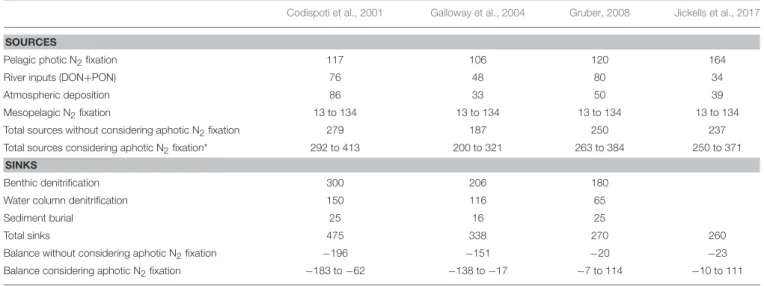
−1. Fixed nitrogen inputs to the ocean
include fluvial inputs, atmospheric deposition and biological N
2fixation, which add up to 187–279
Tg N y
−1(Table 1). Combining denitrification (including sediment burial) and anammox, fixed
nitrogen losses add up to 260–475 Tg N y
−1(Table 1). Adding mesopelagic N
2
fixation to fixed
nitrogen inputs and subtracting losses from gains, we obtain differences ranging from a loss of 183
to a surplus of 114 Tg N y
−1(Table 1). Despite this extrapolation may be questionable given that
Benavides et al. The Importance of Aphotic N2Fixation
TABLE 1 | Global nitrogen budgets and their variability when considering aphotic N2fixation.
Codispoti et al., 2001 Galloway et al., 2004 Gruber, 2008 Jickells et al., 2017 SOURCES
Pelagic photic N2fixation 117 106 120 164
River inputs (DON+PON) 76 48 80 34
Atmospheric deposition 86 33 50 39
Mesopelagic N2fixation 13 to 134 13 to 134 13 to 134 13 to 134
Total sources without considering aphotic N2fixation 279 187 250 237
Total sources considering aphotic N2fixation* 292 to 413 200 to 321 263 to 384 250 to 371
SINKS
Benthic denitrification 300 206 180
Water column denitrification 150 116 65
Sediment burial 25 16 25
Total sinks 475 338 270 260
Balance without considering aphotic N2fixation −196 −151 −20 −23
Balance considering aphotic N2fixation −183 to −62 −138 to −17 −7 to 114 −10 to 111
All fluxes are expressed in Tg N y−1.*The range of aphotic N
2fixation rates considered is 13.45–134.45 Tg N y−1, see the main text.
unknown, it does illustrate that aphotic N
2fixation could be
important to global nitrogen budget considerations, and thus
deep N
2fixation should be further explored. Considering the
stock of fixed nitrogen in the mesopelagic zone (
Gruber, 2008
)
and the range of mesopelagic N
2fixation rates estimated here
(i.e., 13–134 Tg N y
−1), N
2
fixed and eventually remineralized
to nitrate in the mesopelagic zone would turn over in 4 to 43 y.
The currently available dataset (Table 1 from
Moisander
et al., 2017
, this issue) lacks robustness because (i) the number
of measurements is limited and geographically sparse, and
(ii) methodological difficulties are entailed in the detection of
low N
2fixation rates. While aphotic N
2fixation has been
consistently reported in several tropical and temperate waters
(Table 1;
Moisander et al., 2017
, this issue), it is unknown
whether it occurs homogeneously throughout the dark water
column or only in micro-niches where suitable conditions are
found. Such hospitable niches may comprise aggregates, or
organic matter accumulation zones like ecotones, fronts or water
mass boundaries (
Benavides et al., 2015; Bombar et al., 2016
).
Only a few studies have documented nifH gene expression
in aphotic waters (e.g.,
Jayakumar et al., 2012
), and it is
debated whether reported abundances of non-cyanobacterial
diazotrophs can account for measured rates of N
2fixation
when considering published cell specific rates of cultivated
strains (
Turk-Kubo et al., 2014; Bentzon-Tilia et al., 2015
). This
introduces uncertainty to the reliability of measuring especially
low N
2fixation rates (
Gradoville et al., 2017
), and emphasizes the
need for continued refinement of the
15N
2
incorporation method
(
Moisander et al., 2017
).
In this context, it is pertinent to consider the methodological
difficulties encompassed in the detection of low N
2fixation
rates using
15N
2
as a tracer. The precision of N
2fixation rates
may be affected by (i) a slower than theoretically assumed
dissolution of the
15N
2
bubble in seawater (
Mohr et al., 2010;
Großkopf et al., 2012
), (ii) the contamination of
15N
2gas
stocks with nitrogenous species other than N
2(
Dabundo et al.,
2014
), and (iii) failure to measure time zero δ
15N values of the
particulate nitrogen pool. As any other tracer method,
15N
2-based N
2fixation rates are subject to a number of other sources
of error, including variability in incubation and/or filtration
time among replicates, sample particle size and its retention
in filters varying with filter pore size (
Bombar et al., 2018
), as
well as heterogeneous distribution of particles in Niskin bottles
(
Suter et al., 2017
). Moreover, the vast majority of
15N
2-based
published N
2fixation measurements report net rates, whereas
the leakage of
15N-labeled dissolved organic nitrogen and/or
ammonium can be significant in certain cases (e.g.,
Berthelot
et al., 2017
).
Most of the compiled aphotic rates (
Moisander et al.,
2017
, this issue) were measured using the bubble method
(
Montoya et al., 1996
), and should be considered as minimum
estimates, despite the fact that they were performed in cold
waters (typically ∼10
◦C), which enhances gas dissolution and
hence optimizes isotopic equilibrium in seawater samples
enriched with
15N
2gas. Moreover, the majority of the
studies i) used an isotope brand that provides high purity
15
N
2
gas, affecting aphotic N
2fixation rates by <1% when
15N-labeled nitrogen molecules other than N
2
are taken up
(
Benavides et al., 2015
) and/or ii) provided time zero δ
15N
values of the particulate nitrogen pool at each sampling
depth, making their results robust (
Bonnet et al., 2013;
Rahav et al., 2013; Benavides et al., 2015, 2016
). Finally, the
variability between replicates in all terms included in the
N
2fixation calculation equation (as outlined in
Montoya
et al., 1996
) may throw back minimum quantifiable rates
values below estimated aphotic N
2fixation rates (
Gradoville
et al., 2017
). Propagating errors of the data (
Birge, 1940
),
in five out of the nine aphotic N
2fixation studies currently
available, results in minimum quantifiable rates ranging
from 0.01 to 2.7 nmol N L
−1d
−1(Table S1), suggesting
that most of the aphotic N
2fixation rates published are
significant.
The potentially high budgetary significance of aphotic N
2fixation to the global nitrogen budget calls for further studies
that will establish the geographical and temporal distribution
of aphotic N
2fixation and consolidate the volumetric rates
published thus far. In future studies, we encourage researchers
in the field of marine nitrogen cycling to place emphasis on
documenting N
2fixation in the aphotic ocean and identifying
environmental drivers of aphotic N
2fixation: including oxygen,
dissolved organic matter availability and particle colonization
(
Riemann et al., 2010; Benavides et al., 2015; Bombar et al., 2016
).
The availability of more data is essential to facilitate modeling
and assessment of the distribution and magnitude of aphotic N
2fixation in the global ocean (i.e., association with water masses,
ecotones or density fronts). Eventually, a more comprehensive
understanding of the ecophysiology of aphotic N
2fixers and their
contribution to global nitrogen input, will reveal their ecological
importance and may help answer such question as what are the
evolutionary advantages of the energetically-expensive process
of N
2fixation in an environment rich in dissolved inorganic
nitrogen, and how does it affect oceanic carbon sequestration.
AUTHOR CONTRIBUTIONS
MB gathered N
2fixation rates and made the calculations shown
in the tables. MB, IB-F, SB, and LR wrote the article.
ACKNOWLEDGMENTS
MB and LR were supported by grant 6108-00013 from the
Danish Council for independent research and by the BONUS
BLUEPRINT project receiving funding from BONUS (Art
185) funded jointly from the European Union’s Seventh
Programme for research, technological development and
demonstration and from The Danish Council for Strategic
Research (LR).
SUPPLEMENTARY MATERIAL
The Supplementary Material for this article can be found
online at: https://www.frontiersin.org/articles/10.3389/fmars.
2018.00108/full#supplementary-material
Table S1 | Error propagation analysis of aphotic N2 fixation rates from various published and unpublished studies.
REFERENCES
Arístegui, J., Agustí, S., Middelburg, J. J., and Duarte, C. M. (2005). “Respiration in the mesopelagic and bathypelagic zones of the oceans,” in Respiration in Aquatic Ecosystems, eds P. A. Del Giorgio and P. Williams (Oxford: Oxford University Press), 182–206.
Benavides, M. H., Moisander, P., Berthelot, H., Dittmar, T., Grosso, O., and Bonnet, S. (2015). Mesopelagic N2fixation related to organic matter composition in the Solomon and Bismarck Seas (Southwest Pacific). PLoS ONE 10:e0143775. doi: 10.1371/journal.pone.0143775
Benavides, M., Bonnet, S., Hernández, N., Martínez-Pérez, A. M., Nieto-Cid, M., Álvarez-Salgado, X. A., et al. (2016). Basin-wide N2 fixation in the deep waters of the Mediterranean Sea. Glob. Biogeochem. Cycles 30, 952–961. doi: 10.1002/2015GB005326
Bentzon-Tilia, M., Traving, S. J., Mantikci, M., Knudsen-Leerbeck, H., Hansen, J. L. S., Markager, S., et al. (2015). Significant N2 fixation by heterotrophs, photoheterotrophs and heterocystous cyanobacteria in two temperate estuaries. ISME J. 9, 273–285. doi: 10.1038/ismej. 2014.119
Berthelot, H., Benavides, M., Moisander, P. H., Grosso, O., and Bonnet, S. (2017). High-nitrogen fixation rates in the particulate and dissolved pools in the Western Tropical Pacific (Solomon and Bismarck Seas). Geophys. Res. Lett. 44, 8414–8423. doi: 10.1002/2017GL073856
Birge, R. T. (1940). The propagation of errors. Am. Phys. Teacher 7, 351–357. doi: 10.1119/1.1991484
Bombar, D., Paerl, R. W., Anderson, R., and Riemann, L. (2018). Filtration via conventional glass fiber filters in15N
2 tracer assays fails to capture all nitrogen-fixing Prokaryotes. Front. Mar. Sci. 5:6. doi: 10.3389/fmars.2018. 00006
Bombar, D., Paerl, R. W., and Riemann, L. (2016). Marine non-cyanobacterial diazotrophs: moving beyond molecular detection. Trends Microbiol. 24, 916–927. doi: 10.1016/j.tim.2016.07.002
Bonnet, S., Dekaezemacker, J., Turk-Kubo, K. A., Moutin, T., Hamersley, R. M., Grosso, O., et al. (2013). Aphotic N2fixation in the eastern tropical South Pacific Ocean. PLoS ONE 8:e81265. doi: 10.1371/journal.pone.0081265 Codispoti, L. A. (2007). An oceanic fixed nitrogen sink exceeding 400 Tg N y−1
vs the concept of homeostasis in the fixed-nitrogen inventory. Biogeosciences 4, 233–253. doi: 10.5194/bg-4-233-2007
Codispoti, L. A., Brandes, J. A., Christensen, J. P., Devol, A. H., Naqvi, S. W. A., Paerl, H. W., et al. (2001). The oceanic fixed nitrogen and nitrous oxide budgets: moving targets as we enter the anthropocene? Sci. Mar. 65, 85–105. doi: 10.3989/scimar.2001.65s285
Dabundo, R., Lehmann, M. F., Treibergs, L., Tobias, C. R., Altabet, M. A., Moisander, P. H., et al. (2014). The contamination of commercial 15N
2 gas stocks with 15N-labeled nitrate and ammonium and consequences for nitrogen fixation measurements. PLoS ONE 9:e110335. doi: 10.1371/journal.pone.0110335
Eugster, O., and Gruber, N. (2012). A probabilistic estimate of global marine N-fixation and denitrification. Global Biogeochem. Cycles 26:4013. doi: 10.1029/2012GB004300
Falkowski, P. G. (1997). Evolution of the nitrogen cycle and its influence on the biological sequestration of CO2 in the ocean. Nature 387, 272–275. doi: 10.1038/387272a0
Farnelid, H., Andersson, A. F., Bertilsson, S., Al-Soud, W. A., Hansen, L. H., Sørensen, S., et al. (2011). Nitrogenase gene amplicons from global marine surface waters are dominated by genes of non-cyanobacteria. PLoS ONE 6:e19223. doi: 10.1371/journal.pone.0019223
Galloway, J. N., Dentener, F. J., Capone, D. G., Boyer, E. W., Howarth, R. W., Seitzinger, S. P., et al. (2004). Nitrogen cycles: past, present, and future. Biogeochemistry 70, 153–226. doi: 10.1007/s10533-004-0370-0
Gradoville, M. R., Bombar, D., Crump, B. C., Letelier, R. M., Zehr, J. P., and White, A. E. (2017). Diversity and activity of nitrogen-fixing communities across ocean basins. Limnol Oceanogr. 62, 1895–1909. doi: 10.1002/lno.10542
Großkopf, T., Mohr, W., Baustian, T., Schunck, H., Gill, D., Kuypers, M. M. M., et al. (2012). Doubling of marine dinitrogen-fixation rates based on direct measurements. Nature 488, 361–364. doi: 10.1038/nature11338
Gruber, N. (2004). The dynamics of the marine nitrogen cycle and its influence on atmospheric CO2 variations. Ocean Carbon Cycle Clim. 40, 97–148. doi: 10.1007/978-1-4020-2087-2_4
Gruber, N. (2008). “The Marine Nitrogen Cycle: overview and challenges,” in Nitrogen in the Marine Environment, eds D. G. Capone, D. A. Bronk, M. R. Mulholland, and E. J. Carpenter (Academic Press), 1–50.
Gruber, N., and Galloway, J. N. (2008). An Earth-system perspective of the global nitrogen cycle. Nature 451, 293–296. doi: 10.1038/nature06592
Hamersley, M. R., Turk, K. A., Leinweber, A., Gruber, N., Zehr, J. P., Gunderson, T., et al. (2011). Nitrogen fixation within the water column associated with
Benavides et al. The Importance of Aphotic N2Fixation
two hypoxic basins in the Southern California Bight. Aquat. Microb. Ecol. 63, 193–205. doi: 10.3354/ame01494
Hewson, I., Moisander, P. H., Achilles, K. M., Carlson, C. A., Jenkins, B. D., Mondragon, E. A., et al. (2007). Characteristics of diazotrophs in surface to abyssopelagic waters of the Sargasso Sea. Aquat. Microb. Ecol. 46, 15–30. doi: 10.3354/ame046015
Jayakumar, A., Al-Rshaidat, M. M. D., Ward, B. B., and Mulholland, M. R. (2012). Diversity, distribution, and expression of diazotroph nifH genes in oxygen-deficient waters of the Arabian Sea. FEMS Microbiol. Ecol. 82, 597–606. doi: 10.1111/j.1574-6941.2012.01430.x
Jickells, T. D., Buitenhuis, E., Altieri, K., Baker, A. R., Capone, D., Duce, R. A., et al. (2017). A reevaluation of the magnitude and impacts of anthropogenic atmospheric nitrogen inputs on the ocean. Glob. Biogeochem. Cycles 31, 289–305. doi: 10.1002/2016GB005586
Moisander, P. H., Benavides, M., Bonnet, S., Berman-Frank, I., White, A. E., and Riemann, L. (2017). Chasing after non-cyanobacterial nitrogen fixation in marine pelagic environments. Front. Microbiol. 8:1736. doi: 10.3389/fmicb.2017.01736
Mohr, W., Großkopf, T., Wallace, D. W. R., and LaRoche, J. (2010). Methodological underestimation of oceanic nitrogen fixation rates. PLoS ONE 5:e12583. doi: 10.1371/journal.pone.0012583.t001
Montoya, J. P., Voss, M., Kahler, P., and Capone, D. G. (1996). A simple, high-precision, high-sensitivity tracer assay for N2fixation. Appl. Environ. Microbiol. 62, 986–993.
Rahav, E., Bar-Zeev, E., Ohayon, S., Elifantz, H., Belkin, N., Herut, B., et al. (2013). Dinitrogen fixation in aphotic oxygenated marine environments. Front. Microbiol. 4:227. doi: 10.3389/fmicb.2013.00227
Riemann, L., Farnelid, H., and Steward, G. F. (2010). Nitrogenase genes in non-cyanobacterial plankton: prevalence, diversity and regulation in marine waters. Aquat. Microb. Ecol. 61, 235–247. doi: 10.3354/ame01431
Sohm, J. A., Hilton, J. A., Noble, A. E., Zehr, J. P., Saito, M. A., and Webb, E. A. (2011). Nitrogen fixation in the South Atlantic Gyre and the
Benguela Upwelling System. Geophys. Res. Lett. 38, 1–6. doi: 10.1029/2011GL 048315
Suter, E. A., Scranton, M. I., Chow, S., Stinton, D., Medina Faull, L., and Taylor, G. T. (2017), Niskin bottle sample collection aliases microbial community composition and biogeochemical interpretation. Limnol. Oceanogr. 62, 606–617. doi: 10.1002/lno. 10447
Turk-Kubo, K. A., Karamchandani, M., Capone, D. G., and Zehr, J. P. (2014). The paradox of marine heterotrophic nitrogen fixation: abundances of heterotrophic diazotrophs do not account for nitrogen fixation rates in the Eastern Tropical South Pacific. Environ. Microbiol. 16, 3095–3114. doi: 10.1111/1462-2920.12346
Zehr, J. P. (2011). Nitrogen fixation by marine cyanobacteria. Trends Microbiol. 19, 162–173. doi: 10.1016/j.tim.2010.12.004
Zehr, J. P., Carpenter, E., and Villareal, T. A. (2000). New perspectives on nitrogen-fixing microrganisms in tropical and subtropical oceans. Trends Microbiol. 8, 68–73. doi: 10.1016/S0966-842X(99)01670-4
Zehr, J. P., Mellon, M. T., and Zani, S. (1998). New nitrogen-fixing microorganisms detected in oligotrophic oceans by amplification of nitrogenase (nifH) genes. Appl. Environ. Microbiol. 64, 3444–3450.
Conflict of Interest Statement: The authors declare that the research was conducted in the absence of any commercial or financial relationships that could be construed as a potential conflict of interest.
Copyright © 2018 Benavides, Bonnet, Berman-Frank and Riemann. This is an open-access article distributed under the terms of the Creative Commons Attribution License (CC BY). The use, distribution or reproduction in other forums is permitted, provided the original author(s) and the copyright owner are credited and that the original publication in this journal is cited, in accordance with accepted academic practice. No use, distribution or reproduction is permitted which does not comply with these terms.