Publisher’s version / Version de l'éditeur:
ASTM Journal of Testing and Evaluation, 39, 2, pp. 1-32, 2011-03-01
READ THESE TERMS AND CONDITIONS CAREFULLY BEFORE USING THIS WEBSITE.
https://nrc-publications.canada.ca/eng/copyright
Vous avez des questions? Nous pouvons vous aider. Pour communiquer directement avec un auteur, consultez la
première page de la revue dans laquelle son article a été publié afin de trouver ses coordonnées. Si vous n’arrivez pas à les repérer, communiquez avec nous à [email protected].
Questions? Contact the NRC Publications Archive team at
[email protected]. If you wish to email the authors directly, please see the first page of the publication for their contact information.
This publication could be one of several versions: author’s original, accepted manuscript or the publisher’s version. / La version de cette publication peut être l’une des suivantes : la version prépublication de l’auteur, la version acceptée du manuscrit ou la version de l’éditeur.
For the publisher’s version, please access the DOI link below./ Pour consulter la version de l’éditeur, utilisez le lien DOI ci-dessous.
https://doi.org/10.1520/JTE102678
Access and use of this website and the material on it are subject to the Terms and Conditions set forth at Sorption and thermal properties of insulating mortars with expanded and vitrified small ball (EVSB)
Ping, F.; Mukhopadhyaya, P.; Kumaran, M. K.; Shi, C.
https://publications-cnrc.canada.ca/fra/droits
L’accès à ce site Web et l’utilisation de son contenu sont assujettis aux conditions présentées dans le site LISEZ CES CONDITIONS ATTENTIVEMENT AVANT D’UTILISER CE SITE WEB.
NRC Publications Record / Notice d'Archives des publications de CNRC:
https://nrc-publications.canada.ca/eng/view/object/?id=e143b7d3-be9d-4cb6-8af8-dd3aa30a6d4d https://publications-cnrc.canada.ca/fra/voir/objet/?id=e143b7d3-be9d-4cb6-8af8-dd3aa30a6d4d
Sorpt ion a nd t he rm a l prope rt ie s of insula t ing m ort a rs w it h e x pa nde d a nd vit rifie d sm a ll ba ll (EV SB)
N R C C - 5 4 0 0 4
P i n g , F . ; M u k h o p a d h y a y a , P . ; K u m a r a n , M . K . ; S h i , C .
M a r c h 2 0 1 1
A version of this document is published in / Une version de ce document se trouve dans:
ASTM Journal of Testing and Evaluation, 39, (2), pp. 1-32, March 01, 2011
The material in this document is covered by the provisions of the Copyright Act, by Canadian laws, policies, regulations and international agreements. Such provisions serve to identify the information source and, in specific instances, to prohibit reproduction of materials without written permission. For more information visit http://laws.justice.gc.ca/en/showtdm/cs/C-42
Les renseignements dans ce document sont protégés par la Loi sur le droit d'auteur, par les lois, les politiques et les règlements du Canada et des accords internationaux. Ces dispositions permettent d'identifier la source de l'information et, dans certains cas, d'interdire la copie de documents sans permission écrite. Pour obtenir de plus amples renseignements : http://lois.justice.gc.ca/fr/showtdm/cs/C-42
with Expanded and Vitrified Small Ball (EVSB)
Ping Fang1*, Phalguni Mukhopadhyaya2, Kumar Kumaran2, Caijun Shi1, ABSTRACT: Expanded vitrified small hollow ball (EVSB), made from a special type of perlite mineral is one of the recently developed materials in China. It is widely used as a cementitious thermal insulating mortar for building envelope construction in hot-humid areas of southern China. However, EVSB is a porous material sensitive to environmental moisture. The thermal insulating property of the EVSB mortar is dependent on its moisture transport and storage characteristics. In this study, hygroscopic sorption properties of EVSB mortars have been investigated, in comparison with those of normal expanded perlite particle (NEPP) mortars. The BET specific surface area and the BJH pore size distribution, as well as the SEM micro-morphologies of the mortars were assessed. It was observed that EVSB mortars had lower moisture sorption capacity than NEPP mortars when the relative humidity (RH) was higher than 70% because of its lower total pore volume. The addition of water-repellent admixtures in the mortar decreased the moisture sorption capacity of EVSB mortars but still maintains the same physisorption isothermal characteristics. It is also evident that the thermal conductivity values of both NEPP and EVSB mortars increased rapidly when RH is above 90%. However, the increase rate of thermal conductivity of NEPP mortars was apparently higher than that of EVSB mortars. It is hoped that finding from this study will help to develop a better understanding of the in-situ thermal performance of EVSB mortar used for the building envelope construction in hot and humid areas of southern China.KEYWORDS: expanded vitrified small hollow balls, expanded perlite particles, thermal insulating mortar, hygroscopic sorption properties, pore structure characteristics.
1
Key Laboratory of Building Safety and Energy Efficiency (Ministry of Education), Department of Civil Engineering, Hunan University, Changsha, Hunan Province, China, 410082
1
Institute for Research in Construction, NRC Canada, Ottawa, Ontario, K1A 0R6, Canada Fang Ping1* Corresponding Author, [email protected], Tel & Fax: +86-731-8882-3937
Introduction
Lightweight aggregates, such as expanded perlite and pumice, are often used in cement mortars or concretes in China and other counties in Asia and Middle East [1-9]. The lightweight inert cenospheres, produced in coal-fired power plants, are also ideal lightweight aggregates because of their hollow-sphere structures comprised largely of silica and alumina and filled with inert air and/or gases [10]. However, its production is very limited. Expanded perlite and pumice, due to their open pore structures, have higher moisture sorption capacity while exposed to a high relative humidity (RH) environment. As a result, thermal insulation capacity of these open pore materials is reduced significantly [10]. It has been observed that this phenomenon can be averted only with the expensive hydrophobic treatment of the lightweight aggregates, especially at high relative humidity (RH) environment [11].
Expanded vitrified small ball (EVSB) is a recently developed hollow spherical material, which can be used for the manufacturing of lightweight thermal insulating mortars. It is made from a special kind of perlite mineral, available in the Henan province of China, processed at a higher temperature than that for the expanded perlite. Due to higher processing temperature and strict temperature control at various stages in a furnace, the perlite melts and forms a thin layer on the open porous structure of the expanded perlite, thus forms a partially closed porous EVSB.
EVSB is now widely used as a lightweight aggregate in thermal insulating cement mortars for exterior building envelope construction in hot and humid areas of southern China where the climatic relative humility is about 80% or higher throughout the year. In such extreme hot and humid climate the thermal insulating effectiveness of EVSB mortar is greatly dependent on its hygrothermal properties. Hence, this study investigates the 2
hygroscopic sorption-desorption and thermal properties of EVSB mortars in order to develop an understanding on the in-situ thermal performance of EVSB mortars used in building construction.
Experimental Program
The constituent materials for mortar mixes, curing conditions and test methods for material characterizations are outlined in the following paragraphs.
Constituent Materials for Mortars
The three primary components of mortar mixes are cementitious ingredients, lightweight aggregates, and admixtures.
Cementitious ingredients
Portland cement, fly ash and silica fume are three basic cementitious ingredients used in this study. Silica fume was added to the mortar mix to reduce the porosity and increase the strength of the mortar matrix. The chemical compositions and physical properties of three basic cementitious ingredients are shown in Tables 1 and 2, respectively.
Lightweight aggregates
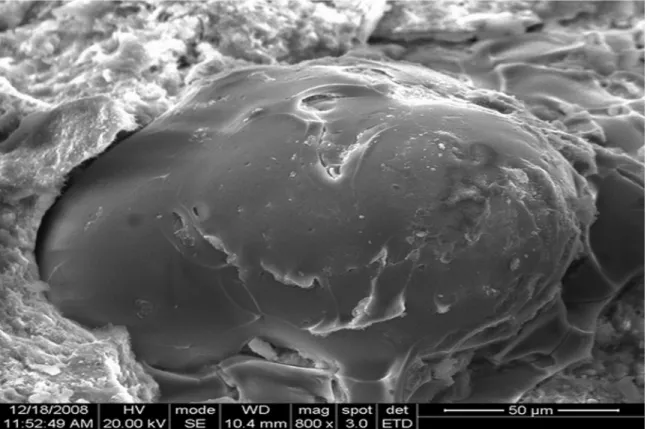
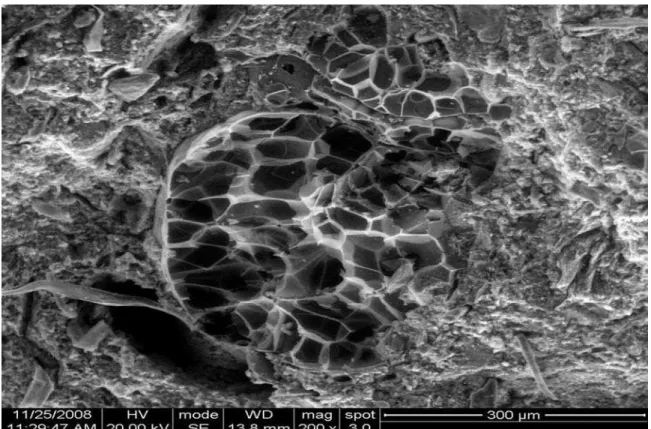
Two types of lightweight aggregate have been used in this study and they are expanded vitrified small ball (EVSB), and normal expanded perlite particles (NEPP). The chemical composition of EVSB is very similar to NEPP as shown in Table 1. As shown in scanning electron microscope (SEM) pictures in Figures 1 and 2, the majority pores in EVSB are closed unlike NEPP.
The hygroscopic sorption characteristics of NEPP and EVSB are given in Figure 3. The particle size distribution and physical characteristics of the lightweight aggregates (NEPP and EVSB) are shown in Tables 3 and 4, respectively.
Admixtures
Four different admixtures were used in this study to enhance specific characteristics of the mortars as shown in Table 5.
Mortar Mixes
The mortar mixes were divided into two groups (I and II), as shown in Table 6. In the first group (two mixes), the mixes were virtually the same except two different aggregates (NEPP or EVSB) were used. In the second group (four mixes with EVSB aggregates), different quantities of water-repellents were added. All constituents of the EVSB and NEPP mortars were dry-mixed and then mixed with water for 3 to 4 minutes in a mortar mixer at a rotary speed of 105 RPM. The amount of water in the mortar mix was determined based on the bonding characteristics of the mortar with concrete block as outlined in the draft Chinese National Standards of Construction Mortar (see http://www.sureblock.com/english/product.asp?product_id=300045, date: 04 August 2010). Mixed mortars were coated onto the vertical surface of a concrete block first and then the block was given a 180º rotation. The mortar would fall off the block if the mortar is too dry or too wet.
Molding
Mortars for the determination of dry density and thermal conductivity were poured into steel molds, with glass bottom plate, and were compacted by putty knife. Mortars for the determination of compressive strength were prepared and cast in the same way but into steel molds with steel bottom plate.
Curing Condition
Specimens were cured in a moist environment at 23°C temperature, 95% relative humidity (RH) for 7 days, and then moved to a relative dry environment maintained at 23°C, 45% - 75% RH for 21 days.
Test Methods
Following test methods and equipment were used for the determination of dry density, compressive strength, sorption isotherms, thermal conductivity and microstructure of the mortars under investigation.
Dry density
The dry densities of the mortars were determined according to the Chinese Standard JG158 - 2004, External Thermal Insulating Rendering Systems Made of Mortar with
Mineral Binder and Using Expanded Polystyrene Granule as Aggregate. The size of test specimens was 300 mm × 300 mm × 30 mm. The specimens were dried in an oven at 65°C for 7 days to constant mass before they were tested.
Compressive strength
The compressive strengths of the mortars were determined according to the Chinese Standard JG158 – 2004, External Thermal Insulating Rendering Systems Made of Mortar
with Mineral Binder and Using Expanded Polystyrene Granule as Aggregate. The size of
test specimens was 70.7 mm × 70.7 mm × 70.7 mm. The specimens were dried in an oven 5
at 65°C for 24 hours before they were tested.
Water absorption and float volume
The water absorption and float volume properties are determined according to the Chinese Standard JC/T1042-2007, Expanded Vitrified Small Hollow Ball. Brief descriptions of the test procedures are outlined below.
A. Water absorption in volume
(1) Heat 5000ml volume expanded vitrified small hollow ball sample at 105±5°C to constant mass and then move it to desiccators to cool down to room temperature.
(2) Put 1000ml volume sample taken from the above 5000ml volume sample into a dry beaker and weigh the mass. Pour water into the beaker slowly and uniformly with stirring the sample until all the expanded vitrified small hollow balls are wet to show water film on the surface.
(3) Weigh the wet sample and the beaker together. (4) Calculate the water absorption in volume. X= V M M ρ 0 1− ×100% [1]
Where X = water absorption (in volume), %;
M1 = mass of sample and beaker before absorption, g; M0 = mass of sample and beaker after absorption, g; ρ = density of water, 1g/cm3;
V = volume of sample, 1000ml; B. Float volume
(1) Heat 5000ml volume expanded vitrified small hollow ball sample at 105±5°C to constant mass and then move it into desiccators to cool down to room temperature.
(2) Put 500 ml volume sample into a beaker. Pour water into the beaker to let the sample delaminate obviously. Stir gently and then keep the sample in this beaker with cap for 7 days. There should be a few times stirring in the 7 days.
(3) Take out all of the deposit sample and heated at 105±5°C to constant mass and moved to desiccators to cool down to room temperature, test its volume.
(4) Calculate the Float volume L= 0 1 0 V V V − ×100% [2] Where L = Float volume, %;
V0 = 500ml sample volume, ml; V1 = deposit sample volume, ml;
Sorption/desorption isotherm
The sorption and desorption isotherms for the mortars were determined according to the ASTM Standard C1498-04a, Standard Test Method for Hygroscopic Sorption Isotherm of
Building Materials. The equilibrium moisture content for sorption/desorption isotherms were determined in successive stages of increasing/decreasing relative humidity. The specimens were about 3 to 5 mm in both length and width, and 2 to 3 mm in thickness. The specimens were dried in an oven at 65°C for 7 days to constant mass and then they were placed in controlled environmental enclosures, maintained at 23°C to 25°C temperature and steady relative humidity (RH) conditions. The RH of the environmental enclosure was controlled by saturated salt solutions (Table 7), for the EVSB and NEPP
particles/powders, and by automated conditioning unit, for insulating mortars. The increasing sequence of RH in the environmental chamber was 32.8%, 57.6%, 75.3%, 84.3% and 97.3%. After the specimens achieved constant mass at 97.3% RH, the decreasing sequence of RH was 97.3%, 84.3%, 75.3%, 57.6% and 32.8%.
The samples were weighed until constant mass was achieved (difference less than 0.01% for two consecutive measurements with 48 hours time step). Then, the moisture content u was calculated according to Eq. [3]:
u = 0 0 m m mn − [3] where:
mn is the mass of the sample at equilibrium, and
m0 is the mass of the dry sample.
Thermal conductivity
The thermal properties of the mortars were determined according to the ASTM Standard C 518 – 04, Standard Test Method for Steady-State Thermal Transmission Properties by
Means of the Heat Flow Meter Apparatus. The size of test specimen was 300 mm × 300
mm × 30 mm. The specimens were dried in an oven at 65°C for 7 days to constant mass before they were tested.
Microstructure characterization
FEI QUANTA200 environmental Scanning Electron Microscope was used to examine the
surface of the materials. BECKMAN SA3100 pore size and BET surface area analyzers were used to characterize the surface area (BET), pore size distribution (BJH) and total pore volume of the materials.
Thermal Conductivity of Moist Materials
Calculation Procedure
The basic equation for heat transport through moist building materials will invariably contain a hypothetical quantity called the ‘thermal conductivity of moist material’. Thermal conductivity of moist material is the ratio between the density of heat flow rate and the thermal gradient in the direction of the flow, with ‘zero’ moisture flow in any direction. The moisture content should remain unaffected by the heat flow is a hypothetical assumption for the traditional heat flow measurement techniques. Hence, thermal conductivity of moist material is not directly measurable. However, it exists in all calculations that involve heat transport through moist materials. The best one can do is to estimate a local value from the knowledge of:
(1) Thermal conductivity of the dry material, (2) Thermal conductivity of water, and (3) Local moisture content at a given instance.
The following paragraphs outline a procedure for estimating the local thermal conductivity of a moist building material.
Axioms
(1) Any dry building material is regarded as a binary system of the two components: (i) a solid matrix, and (ii) air.
(2) Any moist building material though contains the three components: (i) a solid matrix, (ii) air, and (iii) moisture.
It is regarded as a binary system composed of: (i) a solid matrix, and (ii) air + moisture.
where, (air+moisture) is a hypothetical ‘one-fluid’ formed out of the air and the moisture (vapour as well as condensed) inside the pores of building materials.
(3) The thermal conductivity, λ, of a binary system is approximated by the combining rule [12]: [4] λ φ λ= 1 + 2φ φ λ +φ λ 2 1 1 2 12 2 2 2 where,
λ1 = thermal conductivity of component 1; λ2 = thermal conductivity of component 2; φ1 = volume fraction of component 1; φ2 = volume fraction of component 2;
λ12 = the mean thermal conductivity of the two components calculated as:
λ12 = 2/{1/λ1+ 1/λ2} [5]
Only two directly measurable physical quantities are needed for estimating the thermal conductivity of the moist material and these are:
(1) The apparent thermal conductivity of the dry building material (for example, as given by ASTM Standard C177, Standard Test Method for Steady-State Heat Flux Measurements and Thermal Transmission Properties by Means of the Guarded-Hot-Plate Apparatus or C518, Standard Test Method for Steady-State Thermal Transmission Properties by Means of the Heat Flow Meter Apparatus. (2) The maximum moisture content (capillary saturated) of the building material,
from which the porosity is calculated. This is necessary in Eq. [4] to arrive at the thermal conductivity of solid matrix (see Appendix I). If maximum moisture content is not measured, the porosity has to be calculated based on the dry
In this study, the apparent thermal conductivity of the dry insulating mortar was directly measured but the maximum moisture content was derived from the porosity.
Experimental Validation
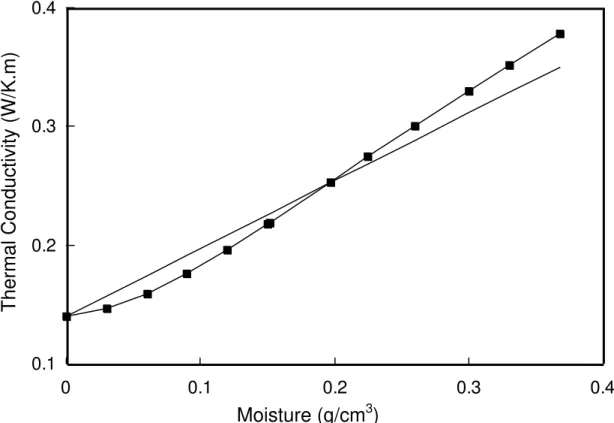
Researchers around the world find it extremely difficult to device an experimental method that can measure directly the moist thermal conductivity of construction materials [13]. However, many attempts were made in the past to directly measure the thermal conductivity of moist materials. It is doubtful whether any one of the measurements strictly met the condition of “zero” moisture flux. However, a set of measurements reported by Ashworth and Ashworth [14] has minimized the effect of moisture transport. Results obtained from lightweight concrete (383 kg m-3) are reported for the full range of moisture content, from dry to full saturation. Figure 4 compares the results with that calculated according to the equations presented in this paper.
Results and Discussion
The physical and hygrothermal properties of the EVSB and NEPP mortars are presented and discussed in the following paragraphs.
Thermal and Physical Properties
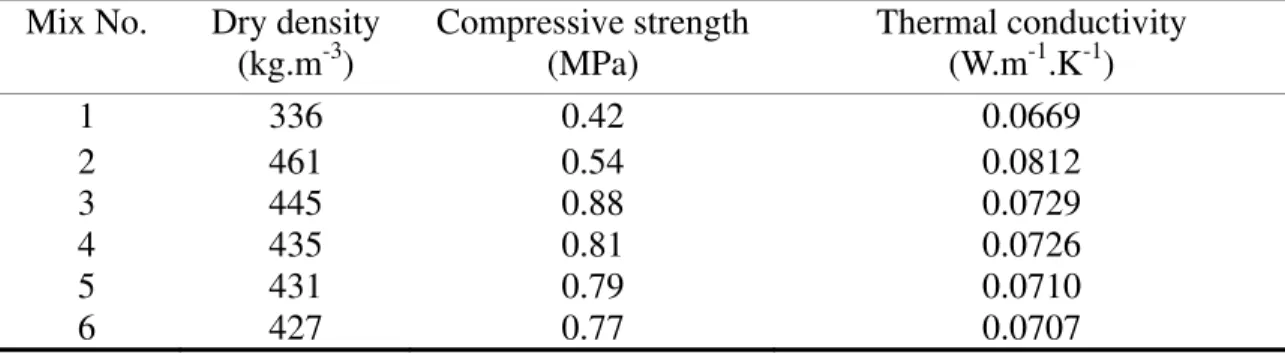
The thermal and physical properties of insulating mortars are shown in Table 8. The thermal conductivity value of the EVSB mortar is higher than the NEPP mortar. This is primarily due to the higher density of the EVSB mortar. The addition of water-repellent agent, silica fume and fly ash in the EVSB mortar reduced its density and thermal
conductivity. However, it is also evident from the results in Table 8 that compressive strength of the EVSB mortar increases significantly with the addition of water-repellent agent, silica fume and fly ash as admixtures.
Sorption/Desorption Characteristics
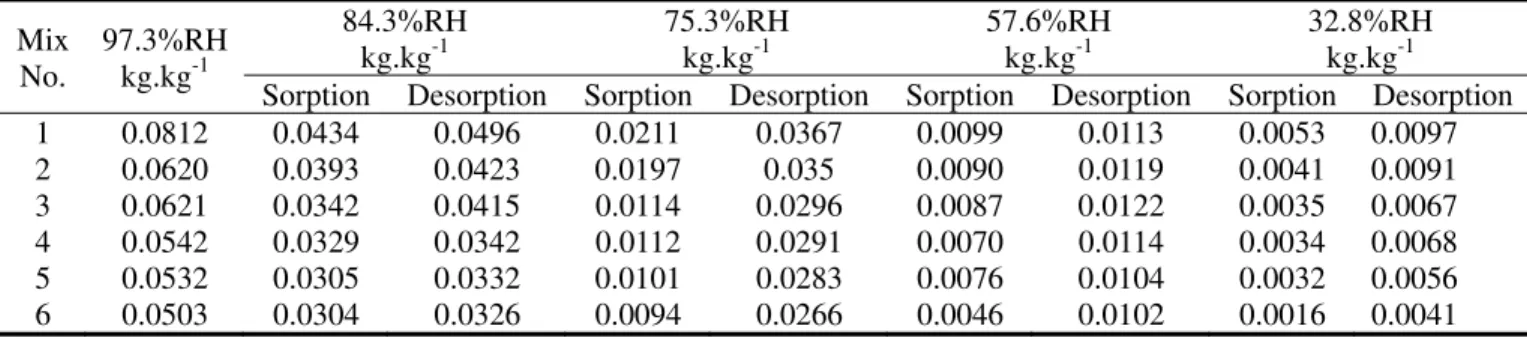
The equilibrium moisture content at sorption and desorption are shown in Table 9.
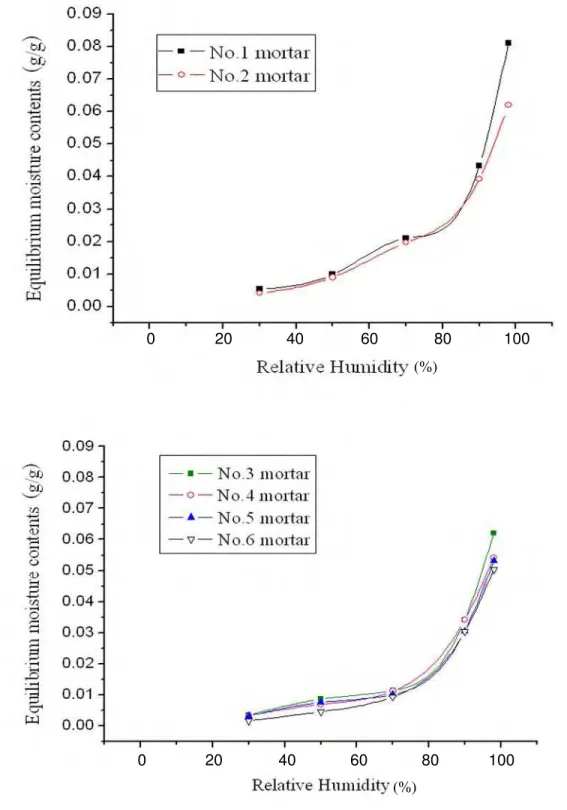
Figures 5a and 5b show the plots of sorption isotherms only. The moisture sorption
characteristic of the EVSB mortar is similar to that of the NEPP mortar (Figure 5a). They belong to Type Ⅳ physisorption isotherms in the IUPAC classification [15]. There is very little difference between these two sorption curves when the relative humidity is below 70%. But EVSB mortar has lower equilibrium moisture content than NEPP mortar when the relative humidity is higher than 70%.
The addition of water-repellent agent into the mortars did not influence the type of the physisorption isotherms. All EVSB mortars with water-repellent agent belong to Type Ⅳ physisorption isotherms in the IUPAC classification [15]. They have almost the same equilibrium moisture content when the relative humidity is below 70%, but in general, the increasing quantity of water-repellent agent reduces the equilibrium moisture content when the relative humidity is higher
Microstructure of Mortars
The porous structure and characteristics of materials have important influence on its sorption-desorption properties. The sorption-desorption isotherms can be regarded as the ‘hygro-structural’ identity card of the materials [16].
Scanning electron microscope (SEM) images of the mortars show that there are a lot of orbicular EVSB in the EVSB mortar (Figure 6) and numerous open pores in the NEPP mortar (Figure 7). It must also be pointed out that there also exist similar 12
micro-morphologies (i.e. open pores) in the EVSB mortar as those in Figure 7 because of the broken EVSB.
According to the theory of adsorption, moisture is adsorbed on the surface of the capillary pores and particles first, and then accumulates in the capillary pores. Therefore, the presence of a large number of micropores and higher specific surface area would lead to higher moisture content at low humidity level. At the same time, existence of higher total pore volume leads to higher moisture content at high humidity level.
EVSB mortars have more specific surface area than NEPP mortars, as EVSB particles are smaller than NEPP particles, but has slightly less total pore volume and similar micropores (see mix No. 1 and 2 in Table 10). The equilibrium moisture content at lower relative humidity levels are almost similar for the EVSB and NEPP mortar (Figure 5a). But with less total pore volume, EVSB mortar has lower equilibrium moisture content than NEPP mortar at higher relative humidity.
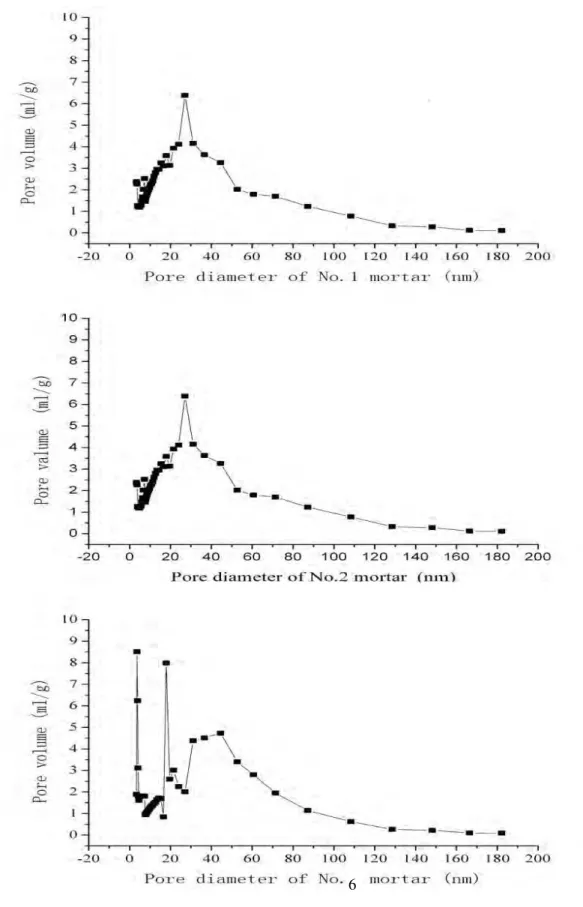
EVSB mortars with silica fume, fly ash and water-repellent agent have more specific surface area and total pore volume, as well as micropores than those of EVSB mortar without the addition admixtures (see mix No. 2 and 6 in Table 10, Figure 8). This is because of the influence of silica fume and fly ash, especially the former. The hydration products of these two kinds of mineral admixtures react with Ca(OH)2, produced by hydration of portland cement, filled the macropores in the mortar and produced more C-S-H gel pores whose size varies from 0.5-2.5 nm [17]. This results in the decrease of macropores and the increase of micropores (Figure 8). If there is no water-repellent agent in it, this kind of EVSB mortar should have more equilibrium moisture content at all range of relative humidity levels than the EVSB mortar without silica fume and fly ash.
The addition of water-repellent admixtures in the mortar mix decreased the moisture sorption capacity of EVSB mortars.
Thermal Conductivity of Moist Mortars
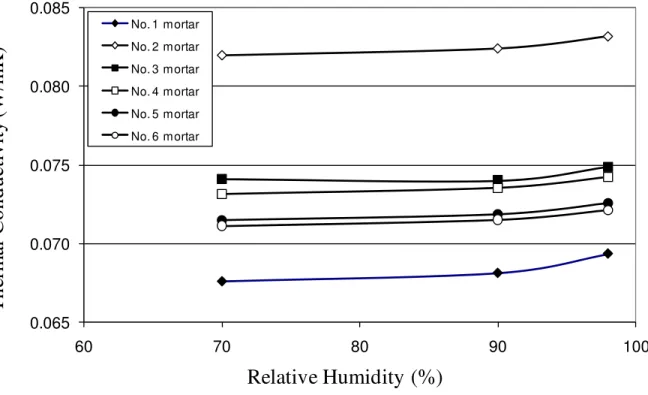
The calculated thermal conductivities of the insulating mortars as a function of relative humidity (from 70% to 98%) are shown in Figure 9. It is very evident from this plot that thermal conductivity of the insulating mortar increases with the relative humidity but the rate of this increment is much higher at relative humidity greater than 90%. Both EVSB and NEPP mortars show similar trends but the rate of increment of thermal conductivity with the increase of relative humidity for the NEPP mortar is marginally higher than the EVSB mortars. It is also evident from Figure 9 that addition of water-repellent agent, silica fume and fly ash in the EVSB mortars reduce the rate of thermal conductivity increment with the increase of relative humidity.
Conclusions
In general, this study clearly indicates that EVSB mortar with water repellent admixture has similar thermal insulating properties like those of NEPP mortars and hence can be used as a cementitious thermal insulating mortar in hot and humid areas of southern China. More specific observations from this study are summarized below.
1. In a qualitative sense, Expanded and Vitrified Small Ball (EVSB) mortars have similar moisture sorption characteristics as Normal Expanded Perlite Particles (NEPP) mortars.
2. Moisture sorption properties of EVSB and NEPP mortars are almost the same when the relative humidity is below 70%.
3. EVSB mortars have lower equilibrium moisture content than NEEP mortars when the relative humidity is higher than 70%. The difference between equilibrium moisture content of these two mortars becomes higher with the increase of relative humidity.
4. Water-repellent agent influences the equilibrium moisture content of EVSB mortars when the relative humidity is higher than 70%. The equilibrium moisture content of the EVSB mortar reduces further with the addition of water repellent agent.
5. The thermal conductivity of both NEPP and EVSB mortars increases rapidly when relative humidity above 90%. However, the rate of increase is apparently higher in the NEPP mortar than the EVSB mortars.
6. Addition of water-repellent agent, silica fume and fly ash in the EVSB mortar reduces the rate of thermal conductivity increment with the increase of relative humidity.
7. EVSB mortar has more specific surface area than NEPP mortar, while they have slightly lesser total pore volume and micropores.
8. EVSB mortar with silica fume, fly ash and water-repellent agent has more specific surface area and total pore volume, as well as micro-pores than those of EVSB mortar without the admixtures.
Appendix I – Calculation of Moist Thermal Conductivity
From Table 8 for Mix No. 1, the dry thermal conductivity is 0.0669 W. m-1. K-1 and dry density is 336 kg.m-3.
The maximum moisture content is not measured and the porosity is calculated from the measured dry density with the assumption that the solid matrix density is approximately 2500 kg.m-3.
The porosity is approximately given by ≈ (2500-336)/2500 ≈ 0.86 Therefore the maximum moisture content is 860 kg/m3.
The thermal conductivity of dry air is 0.026 W.m-1.K-1.
In order to satisfy Eq. [4] an iterative solution gives the thermal conductivity of the solid matrix to be 1.801 W.m-1.K-1.
The measured equilibrium moisture content at 90% RH (see Figure 5a) is 0.0465 kg.kg-1 or 15.6 kg.m-3.
The volume fraction of water in the pores is = 15.6/860 = 0.0182 and the same for air is = (1-0.0182) = 0.982
The thermal conductivity of water is 0.61 W.m-1.K-1
The mean thermal conductivity for one fluid (water+air) is 0.0499 W.m-1.K-1, from Eq. [5].
Now from Eq. [4] the thermal conductivity of moist material at 90% RH is = 0.068 W.m-1.K-1.
Please take note that the volume fractions for the solid matrix and the hypothetical one fluid (water+air) are same as the initial volume fractions for solid matrix and air respectively.
Acknowledgements
This work was supported by the Ministry of House and Urban-Rural Development of Peoples Republic of China and National Research Council Canada.
References
1. Demirboga, R., and Gül, R. (2003). “The effects of expanded perlite aggregate, silica fume and fly ash on the thermal conductivity of lightweight concrete.” Cement and
Concrete Research, 33, 723–727.
2. Uysal, H., Demirboga, R., Sahin, R., and Gül, R. (2004). “The effects of different cement dosages, slumps, and pumice aggregate ratios on the thermal conductivity and density of concrete.” Cement and Concrete Research, 34, 845–848.
3. Demirboğa, R. and Gül, R. (2003).“Thermal conductivity and compressive strength of expanded perlite aggregate concrete with mineral admixtures.” Energy & Buildings, 35 1155–1159.
4. Gündüz, L. and Ugur, I. (2005). “The effects of different fine and coarse pumice aggregate/cement ratios on the structural concrete properties without using any admixtures.” Cement and Concrete Research, 35, 1859–1864.
5. Choi, Y. W., Kim, Y. J., Shin, H. C. and Moon, H. Y. (2006). “An experimental research on the fluidity and mechanical properties of high-strength lightweight self-compacting concrete.” Cement and Concrete Research, 36, 1595– 1602. 6. Demirboğa, R., Örüng, İ. and Gül, R. (2001). “Effects of expanded perlite aggregate and mineral admixtures on the compressive strength of low-density concretes.” Cement
and Concrete Research, 31, 1627–1632.
7. Chi, J.M., Huang R., Yang C.C. and Chang J.J. (2003). “Effect of aggregate properties on the strength and stiffness of lightweight concrete.” Cement and Concrete
Composites, 25, 197–205.
8. Hossain, A. and Khandaker, M. (2004). “Properties of volcanic pumice based cement
and lightweight concrete.” Cement and Concrete Research, 34, 283–292. 9. Suleiman, B. M. (2006). “Moisture effect on thermal conductivity of some major elements of a typical Libyan house envelope.” J. Phys. D: Appl. Phys., 39, 547–551. 10. Blanco, F., García, P., Mateos, P. and Ayala, J. (2000). “Characteristics and properties of lightweight concrete manufactured with cenospheres.” Cement and
Concrete Research, 30, 1715-1722.
11. Frattolillo, A., Giovinco, G., Mascolo, M.C. and Vitale, A. (2005). “Effects of hydrophobic treatment on thermophysical properties of lightweight mortars.”
Experimental Thermal and Fluid Science, 30, 27–35. 12. Li, C. C. (1976). AIChE Journal, 22, 927.
13. Hokoi, S. and Kumaran M. K. (1993) “Experimental and Analytical Investigations of Simultaneous Heat and Moisture Transport through Glass Fiber Insulation”, Journal of
Thermal Insulation and Building Envelopes, January, 263-292.
14. Ashworth, T. and Ashworth, E. (1991) “Thermal Conductivity of Several Concretes as a Function of Moisture”, Insulation Materials: Testing and Applications, 2nd
Volume, ASTM STP 1116, R. S. Graves and D. C. Wysocki, Eds., American society for Testing and
Materials, Philadelphia, USA, 415-429.
15. International Union of Pure and Applied Chemistry, (1986). “Reporting physisorption data for Gas/solid systems with special reference to the determination of surface area and porosity.” Pure and Applied Chemistry, 57 (No. 4), 603-619.
16. Baroghel-Bouny, V. (2007). “Water vapour sorption experiments on hardened cementitious materials Part I: Essential tool for analysis of hygral behaviour and its relation to pore structure.” Cement and Concrete Research, 37, 414-437.
17. Mehta, P. K. and Monteiro, P. J.M. (2006). “Concrete-Microstructure, Properties, and Materials.” McGraw-Hill, 3th edition, 30-32.
Table 1. Chemical Composition of Constituent Materials (%) Chemical compositions Cement Fly ash Silica fume EVSB NEPP
Silica (SiO2) 23.00 53.00 97.25 73.00 74.20
Alumina (Al2O3) 7.40 23.00 - 13.31 12.56
Ferric oxide (Fe2O3) 2.80 4.00 - 0.54 0.82
Calcium oxide (CaO) 54.50 2.50 - 1.00 1.21 Magnesium oxide (MgO) 4.40 1.20 - 0.14 0.12
Sulphate (SO3) 2.00 0.80 - - -
Table 2. Mechanical and Physical Properties of Cementitious Materials Properties Cement Fly ash Silica fume
Specific gravity (g/cm3) 3.14 2.62 2.1
Initial Setting time (min.) 130 - -
Final Setting time (min.) 360 - -
Compressive strength (MPa) 3 days 28 days
33.8 59.8
- -
Table 3. Grading of Lightweight Aggregates
Sieve size (mm) Grading of lightweight aggregates - retained (%)
EVSB NEPP 5.000 0.00 0.00 2.500 0.00 31.0 1.250 9.70 25.7 0.630 62.2 16.4 0.315 15.2 4.50 0.160 4.80 3.80 <0.16 8.10 18.6
Table 4. Physical Properties of Lightweight Aggregates
EVSB NEPP Bulk density (kg.m-3) 130.0 100.0 Water absorption (1h) (%wt) 240.2 444.2 Thermal conductivity (W.m-1.K-1) 0.072 0.053 Float volume (%) 85.00 - Closed pores (%) 80.00 - 20
Table 5. Admixtures Used in Mortar Mix
No. Admixture Remarks - Purpose
1 Wacker VINNAPAS® 5100
Dispersible polymer powder for increased
adhesion.
2 Elotex® SEAL80
Water-repellent agent.
3 Samsung MECELLOSE®
Cellulose ether for viscosity enhancement.
4 Naphthalene Formaldehyde Condensate Super-plasticizer for improved rheology.
Table 6. Mix Ratios of Thermal Insulation Mortars Group Mix No. Lightweight aggregates (kg/m3) Dispersible polymer powder (kg/m3) Cellulose ether (kg/m3) Water-repellent agent (kg/m3) Cement (kg/m3) Fly ash (kg/m3) Silica fume (kg/m3) I 1 NEPP 100 4 0.4 0 100 0 0 2 EVSB 130 4 0.4 0 100 0 0 II 3 EVSB 130 4 0.4 0.2 80 15 5 4 EVSB 130 4 0.4 0.8 80 15 5 5 EVSB 130 4 0.4 1.4 80 15 5 6 EVSB 130 4 0.4 2.0 80 15 5
Table 7. Relative Humidity of Different Saturated Salt Solutions (25°C) Saturated salt solution Relative humidity (%)
MgCl2.6H2O 32.8±0.2
NaBr 57.6±0.4 NaCl 75.3±0.1 KCl 84.3±0.1
K2SO4 97.3±0.5
Table 8. Properties of Thermal Insulation Mortars Mix No. Dry density
(kg.m-3) Compressive strength (MPa) Thermal conductivity (W.m-1.K-1) 1 336 0.42 0.0669 2 461 0.54 0.0812 3 445 0.88 0.0729 4 435 0.81 0.0726 5 431 0.79 0.0710 6 427 0.77 0.0707 21
Table 9. Equilibrium Moisture Content at 23°C Mix No. 97.3%RH kg.kg-1 84.3%RH kg.kg-1 75.3%RH kg.kg-1 57.6%RH kg.kg-1 32.8%RH kg.kg-1
Sorption Desorption Sorption Desorption Sorption Desorption Sorption Desorption 1 0.0812 0.0434 0.0496 0.0211 0.0367 0.0099 0.0113 0.0053 0.0097 2 0.0620 0.0393 0.0423 0.0197 0.035 0.0090 0.0119 0.0041 0.0091 3 0.0621 0.0342 0.0415 0.0114 0.0296 0.0087 0.0122 0.0035 0.0067 4 0.0542 0.0329 0.0342 0.0112 0.0291 0.0070 0.0114 0.0034 0.0068 5 0.0532 0.0305 0.0332 0.0101 0.0283 0.0076 0.0104 0.0032 0.0056 6 0.0503 0.0304 0.0326 0.0094 0.0266 0.0046 0.0102 0.0016 0.0041 Table 10. Pore Structure Analyses
Mix No. Specific surface area m2/g Total pore volume ml/g
Distribution of the pore diameter (%) Pore diameter (nm) <6 6-8 8-10 10-12 12-16 16-20 20-80 >80 1 10.942 0.0656 3.41 3.17 4.12 5.07 8.00 8.47 52.57 15.20 2 16.985 0.0634 2.73 2.30 3.89 5.12 8.14 8.23 53.78 15.81 6 27.607 0.1307 6.57 2.46 2.40 2.92 4.39 4.80 63.73 12.73 22
Fig. 1. SEM Pictures (a,b) of NEPP Fig. 2. SEM Pictures (a,b) of EVSB
Fig. 3. Hygroscopic Sorption Properties of EVSB & NEPP
Fig. 4. Results on lightweight concrete from Ashworth and Ashworth (straight line) compared with that calculated from the present approach
Fig. 5. (a) Sorption Isotherms of Thermal Insulating Mortars (1, 2); (b) Sorption Isotherms of Thermal Insulating Mortars (3, 4, 5, 6) Fig. 6. SEM Image of EVSB Mortar
Fig. 7. SEM Image of NEPP Mortar
Fig. 8. Distribution of Pore Diameter for Mortars (1, 2, 6) Fig. 9. Thermal Conductivity of Moist NEPP and EVSB Mortars
(a)
(b) Fig. 1. SEM Pictures (a,b) of NEPP
(a)
(b) Fig. 2. SEM Pictures (a,b) of EVSB
30 40 50 60 70 80 90 100 0.00 0.05 0.10 0.15 0.20 0.25
Equilibrium Moisture Conte
nts(
g/g)
Relative Humidity(%)
NEPP
EVSB
Fig. 3. Hygroscopic Sorption Properties of EVSB & NEPP Mortars
0 0.1 0.2 0.3 0.4 0.1 0.2 0.3 0.4 T HE RM A L CO NDUCT IV IT Y , W /K m Thermal Conductivity (W/K.m) MOISTURE, g/cm3 Moisture (g/cm3)
Fig. 4. Results on lightweight concrete from Ashworth and Ashworth (straight line) compared with that calculated from the present approach
0 20 40 60 80 100 (%)
0 20 40 60 80 100
(%)
Fig. 5. (a) Sorption Isotherms of Thermal Insulating Mortars (1, 2), top; (b) Sorption Isotherms of Thermal Insulating Mortars (3, 4, 5, 6), bottom.
Fig. 6. SEM Image of EVSB Mortar
Fig. 7. SEM Image of NEPP Mortar
6
Fig. 8. Distribution of Pore Diameter for Mortars (1, 2, 6)
32 0.065 0.070 0.075 0.080 0.085 60 70 80 90 100