READ THESE TERMS AND CONDITIONS CAREFULLY BEFORE USING THIS WEBSITE.
https://nrc-publications.canada.ca/eng/copyright
Vous avez des questions? Nous pouvons vous aider. Pour communiquer directement avec un auteur, consultez la
première page de la revue dans laquelle son article a été publié afin de trouver ses coordonnées. Si vous n’arrivez pas à les repérer, communiquez avec nous à [email protected].
Questions? Contact the NRC Publications Archive team at
[email protected]. If you wish to email the authors directly, please see the first page of the publication for their contact information.
Archives des publications du CNRC
This publication could be one of several versions: author’s original, accepted manuscript or the publisher’s version. / La version de cette publication peut être l’une des suivantes : la version prépublication de l’auteur, la version acceptée du manuscrit ou la version de l’éditeur.
Access and use of this website and the material on it are subject to the Terms and Conditions set forth at
Cost-effective open-plan environments (COPE): developing a design tool for cost-effective office design
Newsham, G. R.
https://publications-cnrc.canada.ca/fra/droits
L’accès à ce site Web et l’utilisation de son contenu sont assujettis aux conditions présentées dans le site LISEZ CES CONDITIONS ATTENTIVEMENT AVANT D’UTILISER CE SITE WEB.
NRC Publications Record / Notice d'Archives des publications de CNRC: https://nrc-publications.canada.ca/eng/view/object/?id=e47f9351-ceb2-489f-b443-7cec42f20516 https://publications-cnrc.canada.ca/fra/voir/objet/?id=e47f9351-ceb2-489f-b443-7cec42f20516
Cost-effective Open-Plan Environments (COPE)
Developing a design tool for cost-effective office design Dr. Guy Newsham
National Research Council Canada Institute for Research in Construction
The Changing Office Landscape Résumé
Dramatic changes in office design and furnishings are occurring all over North America. These changes have captured the attention of the mainstream media, and many
organisations are considering following the trend. Whether labelled “space
optimisation”, “hotelling”, or “hot desking”, the changes have a basic theme in common: reduced personal workspace for individuals. The reasons for this trend are compelling: • A desire to reduce occupied floor space and its associated costs; and,
• A belief that a physical change can effect an organisational change that will increase productivity.
Professionals in all aspects of the building industry recognise the dangers in this process: remodelling the office landscape also has the potential to degrade the office environment. Anecdotes tell of workers who feel crowded and lack privacy. Reduced indoor air quality, unacceptable thermal conditions, poor lighting quality and elevated noise levels are all reported. Such conditions lead to occupants who
complain, get sick and are in fact less productive, having a detrimental effect on an organisation’s bottom line that far outweighs any cost benefits achieved by the office remodelling.
Increasing Occupant Density: The effect on Indoor Environment and Worker Satisfaction
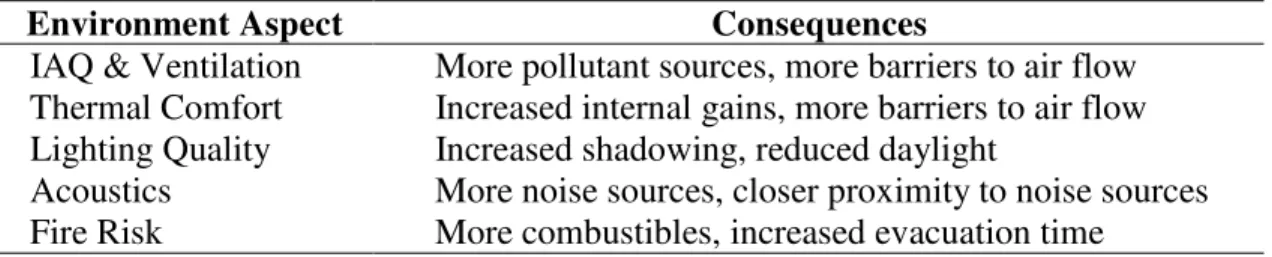
When occupant density is increased, it is likely that some, if not all, aspects of the physical environment will deteriorate, see Table 1. As a consequence of the degradation of the indoor environment, and the well-known psychological effects of crowding and
“If I don’t pay attention to
lighting, if I don’t pay attention to air conditioning, if I don’t pay attention to acoustics - all those things - I could screw up a $60,000 employee, or at least cut his productivity by 2% or 3 %.”
-- Mike Clevenger, Xerox
loss of privacy, occupant satisfaction will suffer. It is commonly accepted that dissatisfied workers are less productive and absent more often. For example, a
University of Illinois study found that workplace characteristics accounted for 34 % of the variance in discretionary withdrawal (“on-site absenteeism”), 31 % of the variance in work satisfaction, and 24 % of the variance in turnover [Oldham & Fried, 1987]. The US Environmental Protection Agency estimates that 60 million working days are lost in the US each year due to problems with the quality of the indoor environment [Paul, 1996].
Table 1. Impact of increasing occupant density on the office environment.
Environment Aspect Consequences
IAQ & Ventilation More pollutant sources, more barriers to air flow Thermal Comfort Increased internal gains, more barriers to air flow Lighting Quality Increased shadowing, reduced daylight
Acoustics More noise sources, closer proximity to noise sources Fire Risk More combustibles, increased evacuation time
Further, researchers in the health sciences, extrapolating from work done in different building types, have good reason to believe that increasing occupant density will lead to increased incidence of respiratory disease [Fisk & Rosenfeld, 1997; Nardell, 1997]. Influenza and more serious diseases such as TB are transmitted via the airborne transport of particles. The common cold, perhaps the most important respiratory disease in terms of lost productivity, is transmitted primarily through physical contact, but airborne transmission has also been implicated. Clearly, having more people in the same space reduces the length of the transmission pathways, leading to a greater chance of catching the disease.
Since salaries and employee training comprise around 90 % of business operating costs, the financial consequences of a dissatisfied workforce will far outweigh any savings associated with reduced office space. Saving money on office accommodation to the detriment occupant satisfaction risks being “penny wise and pound foolish”.
Therefore, the building owner/operator cognisant of true cost-effectiveness should take measures to improve the indoor environment and increase occupant satisfaction. There will, of course, be a cost involved in making these improvements. However, the good news is that according to a recent report from the Lawrence Berkeley National
Laboratory, investments in improving the indoor environment payoff 20 to 50 fold [Fisk & Rosenfeld, 1997].
Challenges
While few would argue with the qualitative argument developed above, there are a number of fundamental challenges in developing a quantitative design tool:
1. We don’t have an extensive knowledge of how office landscape affects the office indoor environment.
indoor environment affect occupant satisfaction.
3. We don’t have coherent cost-benefit analyses of remedial technologies.
The COPE project will address each of these challenges and will embody its findings in a decision-making tool providing for rational, cost-effective officing decisions.
Description of Project Work
The project will proceed through a series of logical steps as outlined below. Each step will be tackled using scholarly
literature reviews, field studies, laboratory evaluations, focussed subject studies, and computer modelling.
1. Derive quantitative scales for each indoor environment aspect, and a method of evaluating an indoor environment against that scale. For example, criteria for acoustic quality might be ambient noise level and speech intelligibility.
2. Quantify the indoor environment consequences of changing occupant density and other office landscape features (e.g., Figure 1). This process will help identify which aspects of the indoor environment are most affected by changes in office landscape, and would thus deserve more attention in later project stages.
3. Evaluate the effect of increasing density on occupant satisfaction. Both the effects of the indoor environment and psychological factors such as privacy and crowding will be considered (e.g., Figure 2). Other outcomes of relevance to the COPE evaluation model, e.g., self-reported productivity and health effects, will be noted, where available. 4. Evaluate remedial technologies to
address the identified negative indoor environment consequences, with the goal of increasing occupant
satisfaction. Technologies will be
compared on their ability to improve the indoor environment and occupant Ambient noise Density Partitions: low high Speech Intellig. Density Worker Satisfac. (with acoustics) Density Worker Satisfac. (with privacy) Density Masking Noise No Masking Noise
Masking Noise No Masking Noise
Cost Density Cost Density Low partitions High partitions Capital Maintenance Energy Capital Maintenance Energy Figure 1. Ambient noise and speech intelligibility
vs. occupant density, partition height and use of masking noise (hypothetical).
Figure 2. Satisfaction with acoustics and privacy vs. occupant density and use of masking noise
(hypothetical).
Figure 3. Various costs associated with the installation of a successful masking noise system
satisfaction, and on their relative costs (e.g., Figures 1, 2 , and 3). Relevant physical interactions will be considered. For example, increasing the outside airflow rate might improve IAQ and thermal comfort but result in higher energy costs and more noise. Would a better diffuser layout allow for lower flow rates with lower noise and decreased energy requirement? How about individual desk fans?
Deliverables - The COPE Evaluation Tool
The principal project deliverable will be the COPE evaluation tool, a tool allowing building owners and operators to make informed choices concerning cost-effective open-plan office strategies. Inputs to the model will be various building characteristics,
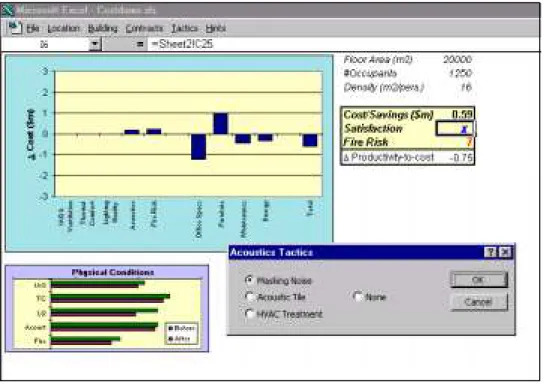
geographical location, local costs, personnel costs, etc. Figure 4 illustrates how the main screen of such a tool might look (all data are hypothetical and for discussion purposes only). At the top left is a bar chart comparing all relevant costs including space rental, furniture, energy, maintenance, and the cost of remedial measures for improving the indoor environment; the panel at the bottom right indicates that masking noise generators are being considered as a method of improving the acoustic environment. At the bottom left is a bar chart predicting the indoor environment and fire risk conditions before and after office redesign (in the example, occupant density has been increased from 19 m2/person to 16 m2/person). At the top right is a panel showing overall predicted savings, and occupant satisfaction – the decision-maker can compare these numbers, together with supporting references on self-reported productivity, health effects, and other information, and decide if the proposed office redesign is truly cost-effective.
Figure 4. Hypothetical main screen for the COPE design tool.
benefits of several officing strategies, as they might be output from the evaluation model.
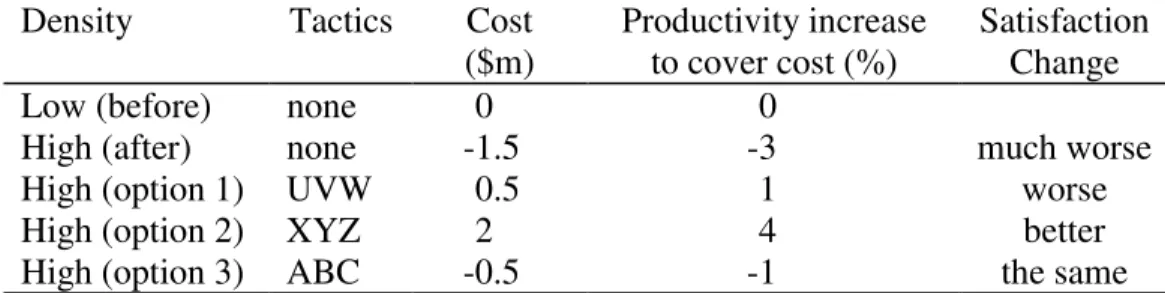
Table 2. Hypothetical output from the COPE evaluation model.
Density Tactics Cost ($m)
Productivity increase to cover cost (%)
Satisfaction Change
Low (before) none 0 0
High (after) none -1.5 -3 much worse
High (option 1) UVW 0.5 1 worse
High (option 2) XYZ 2 4 better
High (option 3) ABC -0.5 -1 the same
On line 2 of Table 2, we see that increasing the density with no remedial attention to the indoor environment will save $1.5 million overall. For the particular personnel costs, productivity could go down by 3 % and there would still be an overall saving. The user must make the final cost/benefit decision based on the prediction that satisfaction will be “much worse” than it was before the change in density. In option 1, the indoor
environment is improved using technologies UVW. There would now be an overall cost of $0.5 million (technologies cost money), requiring a productivity increase of 1 % to recover these costs. But how likely is this if the satisfaction is still “worse”? In option 2, the indoor environment is improved using technologies XYZ. There would now be an overall cost of $2 million, requiring a productivity increase of 4 % to recover these costs, but satisfaction is now “better” than it was before the increase in density. Option 3 looks like a good solution. It achieves a space reduction, saves money overall, and is predicted to have an occupant satisfaction rating no worse than the initial low density case.
Conclusion – The Built Environment Jigsaw Puzzle
The problem of defining the effect of the built environment on organisational
productivity is akin to the challenge of completing a large and complex jigsaw puzzle, in which only a few of the pieces are already in place. To make matters worse, the built environment jigsaw has a number of unique complications. The pieces are not found exclusively in one box but in many, boxes labelled: engineering,
psychology, architecture, and health. Within each of these boxes we find that the pieces are jumbled, some of the pieces are in the wrong box, some of them are just plain wrong, some are duplicated, and some are missing entirely. Previous puzzle-solvers have tended to be narrow in their approach, and have looked only in one of the boxes to try and solve the puzzle. The COPE project, with its truly multidisciplinary approach, will open up all the boxes. COPE will sift through the pieces to find the good pieces and put them in order – the
literature and meta-analyses tasks of the project. Further, COPE will manufacture some of the missing pieces and place them in the puzzle – the original research in the
laboratory and field work tasks of the project.
Will COPE solve the entire puzzle? No. But we expect COPE, by focussing on the worker satisfaction aspect of organisational productivity, to do the equivalent of completing a large fraction of the puzzle’s perimeter. As anyone who enjoys solving jigsaw puzzles knows, getting the perimeter in place is a crucial step towards solving the whole puzzle. Is such a step worthwhile? The entire puzzle – elucidating the impact of the built environment on organisation productivity – is worth around $500 billion to the North American economy, in the value of products sold to improve productivity, and in the productivity payoff to the organisations who invest in an improved built environment. Viewed in such terms, we think the COPE project is well worth the investment.
References
Fisk, W. & Rosenfeld, A. 1997. Improved productivity and health from better indoor environments. Center for Building Science News, Summer, p. 5. Lawrence Berkeley National Laboratory.
Nardell, E. A. 1997. Environmental control of drug resistant tuberculosis in industrial and developing countries. Proceedings of Healthy Buildings/IAQ 97, 1, pp. 301 - 314, Washington DC, USA.
Oldham, G. R. & Fried, Y. 1987. Employee reactions to workspace characteristics.
Journal of Applied Psychology 72 (1), pp. 75 - 80.
Paul, R. 1996. Building healthy and productive offices. http://www.haworth-furn.com/building.htm. Haworth Inc.