HAL Id: halshs-00115625
https://halshs.archives-ouvertes.fr/halshs-00115625
Submitted on 22 Nov 2006
HAL is a multi-disciplinary open access
archive for the deposit and dissemination of sci-entific research documents, whether they are pub-lished or not. The documents may come from teaching and research institutions in France or abroad, or from public or private research centers.
L’archive ouverte pluridisciplinaire HAL, est destinée au dépôt et à la diffusion de documents scientifiques de niveau recherche, publiés ou non, émanant des établissements d’enseignement et de recherche français ou étrangers, des laboratoires publics ou privés.
Decomposing Berge graphs and detecting balanced skew
partitions
Nicolas Trotignon
To cite this version:
Nicolas Trotignon. Decomposing Berge graphs and detecting balanced skew partitions. 2006. �halshs-00115625�
Maison des Sciences Économiques, 106-112 boulevard de L'Hôpital, 75647 Paris Cedex 13
http://mse.univ-paris1.fr/Publicat.htm
Centre d’Economie de la Sorbonne
UMR 8174
Decomposing Berge graphs and
detecting balanced skew partitions
Nicolas T
ROTIGNONDecomposing Berge graphs and detecting balanced skew
partitions
Nicolas Trotignon∗
April 26, 2006
Abstract
A hole in a graph is an induced cycle on at least four vertices. A graph is Berge if it has no odd hole and if its complement has no odd hole. In 2002, Chudnovsky, Robertson, Seymour and Thomas proved a decomposition theorem for Berge graphs saying that every Berge graph either is in a well understood basic class or has some kind of decomposition. Then, Chudnovsky proved stronger theorems. One of them restricts the allowed decompositions to 2-joins and balanced skew partitions.
We prove that the problem of deciding whether a graph has a balanced skew par-tition is NP-hard. We give an O(n9)-time algorithm for the same problem restricted
to Berge graphs. Our algorithm is not constructive: it certifies that a graph has a balanced skew partition if it has one. It relies on a new decomposition theorem for Berge graphs, that is more precise than the previously known theorems and implies them easily. Our theorem also implies that every Berge graph can be decomposed in a first step by using only balanced skew partitions, and in a second step by using only 2-joins. Our proof of this new theorem uses at an essential step one of the theorems of Chudnovsky.
AMS Mathematics Subject Classification: 05C17, 05C75
Key words: perfect graph, Berge graph, 2-join, balanced skew partition, decompo-sition, detection, recognition.
1
Introduction
In this paper graphs are simple and finite. A hole in a graph is an induced cycle of length at least 4. An antihole is the complement of a hole. A graph is said to be Berge if it has no odd hole and no odd antihole. A graph G is said to be perfect if for every induced subgraph G′ the chromatic number of G′ is equal to the maximum
size of a clique of G′. In 1961, Berge [2] conjectured that every Berge graph is
∗Universit´e Paris I Panth´eon-Sorbonne, CERMSEM,
106–112 boulevard de l’Hˆopital, 75647 Paris cedex 13, France [email protected]
This work has been partially supported by ADONET network, a Marie Curie training network of the European Community.
perfect. This was known as the Strong Perfect Graph Conjecture, was the object of much research and was finally proved by Chudnovsky, Robertson, Seymour and Thomas in 2002 [7]. In fact, they proved a stronger result: a decomposition theorem, first conjectured by Conforti, Cornu´ejols and Vuˇskovi´c [11], stating that every Berge graph is either in a well understood basic class of perfect graph, or has a structural fault that cannot occur in a minimum counter-example to Strong Perfect Graph Conjecture. Before stating this decomposition theorem, we need some definitions.
We call path any connected graph with at least a vertex of degree 1 and no vertex of degree greater than 2. A path has at most two vertices of degree 1 that are the ends of the path. If a, b are the ends of a path P we say that P is from a to b. The other vertices are the interior vertices of the path. We denote by v1−· · ·−vn the
path whose edge set is {v1v2, . . . , vn−1vn}. When P is a path, we say that P is a
path of G if P is an induced subgraph of G. If P is a path and if a, b are two vertices of P then we denote by a−P −b the only induced subgraph of P that is path from a to b. The length of a path is the number of its edges. An antipath is the complement of a path. Let G be a graph and let A and B be two subsets of V (G). A path of G is said to be outgoing from A to B if it has an end in A, an end in B, length at least 2, and no interior vertex in A ∪ B.
If X, Y ⊂ V (G) are disjoint, we say that X is complete to Y if every vertex in X is adjacent to every vertex in Y . We also say that (X, Y ) is a complete pair. We say that X is anticomplete to Y if there are no edges between X and Y . We also say that (X, Y ) is an anticomplete pair. We say that a graph G is anticonnected if its complement G is connected.
Skew partitions were first introduced by Chv´atal [8]. A skew partition of a graph G = (V, E) is a partition of V into two sets A and B such that A induces a graph that is not connected, and B induces a graph that is not anticonnected. When A1, A2, B1, B2 are non-empty sets such that (A1, A2) partitions A, (A1, A2)
is an anticomplete pair, (B1, B2) partitions B, and (B1, B2) is a complete pair, we
say that (A1, A2, B1, B2) is a split of the skew partition (A, B). A balanced skew
partition (first defined in [7]) is a skew partition (A, B) with the additional property that every induced path of length at least 2 with ends in B, interior in A and every antipath of length at least 2 with ends in A, interior in B have even length. If (A, B) is a skew partition, we say that B is a skew cutset. If (A, B) is balanced we say that the skew cutset B is balanced. Note that Chudnovsky et al. [7] proved that no minimum counter example to the strong perfect graph conjecture has a balanced skew partition.
We call double split graph (first defined in [7]) any graph G that may be constructed as follows. Let m, n ≥ 2 be integers. Let A = {a1, . . . , am},
B = {b1, . . . , bm}, C = {c1, . . . , cn}, D = {d1, . . . , dn} be four disjoint sets. Let
G have vertex set A ∪ B ∪ C ∪ D and edges in such a way that:
• ai is adjacent to bi for 1 ≤ i ≤ m. There are no edges between {ai, bi} and
{ai′, bi′} for 1 ≤ i < i′ ≤ m;
• cj is non-adjacent to dj for 1 ≤ j ≤ n. There are all four edges between {cj, dj}
• there are exactly two edges between {ai, bi} and {cj, dj} for 1 ≤ i ≤ m,
1 ≤ j ≤ n and these two edges are disjoint.
Note that C ∪ D is a non-balanced skew cutset of G and that G is a double split graph. Note that in a double split graph, vertices in A ∪ B all have degree n + 1 and vertices in C ∪ D all have degree 2n + m − 2. Since n ≥ 2, m ≥ 2 implies 2n−2+m > 1+n, it is clear that given a double split graph it is relevant to consider the matching edges, that have an end in A and an end in B, independently of the choice of the sets A, B, C, D.
A graph is said to be basic if one of G, G is either a bipartite graph, the line-graph of a bipartite graph or a double split graph.
The 2-join was first defined by Cornu´ejols and Cunningham [13]. We say that a partition (X1, X2) of the vertex set is a 2-join when there exist disjoint non-empty
Ai, Bi ⊆ Xi (i = 1, 2) satisfying:
• every vertex of A1 is adjacent to every vertex of A2 and every vertex of B1 is
adjacent to every vertex of B2;
• there are no other edges between X1 and X2.
The sets X1, X2 are the two sides of the 2-join. When sets Ai’s Bi’s are like in
the definition we say that (X1, X2, A1, B1, A2, B2) is a split of (X1, X2). Implicitly,
for i = 1, 2, we will denote by Ci the set Xi\ (Ai∪ Bi).
A 2-join (X1, X2) in a graph G is said to be connected when for i = 1, 2, every
component of G[Xi] meets both Ai and Bi. A 2-join (X1, X2) is said to be substantial
when for i = 1, 2, |Xi| ≥ 3 and Xi is not a path of length 2 with an end in Ai, an
end in Bi and its unique interior vertex in Ci. A 2-join (X1, X2) in a graph G is
said to be proper when it is connected and substantial.
A 2-join is said to be a path 2-join if it has a split (X1, X2, A1, B1, A2, B2) such
that G[X1] is a path with an end in A1, an end in B1 and interior in C1. Implicitly
we will then denote by a1 the unique vertex in A1 and by b1 the unique vertex in
B1. We say that X1 is the path-side of the 2-join. Note that when G is not a hole
then this path-side is unique. A non-path 2-join is a 2-join that is not a path 2-join. The homogeneous pair was first defined by Chv´atal and Sbihi [9]. The definition that we give here is a slight variation used in [7]. An homogeneous pair is a partition of V (G) into six non-empty sets (A, B, C, D, E, F ) such that:
• every vertex in A has a neighbor in B and a non-neighbor in B, and vice versa; • the pairs (C, A), (A, F ), (F, B), (B, D) are complete;
• the pairs (D, A), (A, E), (E, B), (B, C) are anticomplete.
A graph G is path-cobipartite if it is a Berge graph obtained by subdividing an edge between the two cliques that partitions a cobipartite graph. More accurately, a graph is path-cobipartite if its vertex set can be partitioned into three sets A, B, P where A and B are non-empty cliques and P consist of vertices of degree 2, each of which belongs to the interior of a unique path of odd length with one end a
in A, the other one b in B. Moreover, a has neighbors only in A ∪ P and b has neighbors only in B ∪ P . Note that a path-cobipartite graph such that P is empty is the complement of bipartite graph. Note that our path-cobipartite graphs are simply the complement of the path-bipartite graphs defined by Chudnovsky in [5]. For convenience, we prefer to think about them in the complement as we do.
A cutset is a graph G is a set C ⊂ V (G) such that G \ C is disconnected (G \ C means G[V (G) \ C]). A double star in a graph is a subset D of the vertices such that there is an edge ab in G[D] satisfying: D ⊂ N (a) ∪ N (b).
Now we can state the known decomposition theorems of Berge graphs. The first decomposition theorem for Berge graph ever proved is the following:
Theorem 1.1 (Conforti, Cornu´ejols and Vuˇskovi´c, 2001, [12]) Every graph with no odd hole is either basic or has a proper 2-join or has a double star cut-set.
It could be thought that this theorem is useless to prove the Strong Perfect Graph Theorem since there are minimal imperfect graphs that have double star cutsets: the odd antiholes of length at least 7. However, by the Strong Perfect Graph Theorem, we know that the following fact is true: for any minimal non-perfect graph G, one of G, G has no double star cutset. A direct proof of this — of which we have no idea — would yield together with Theorem 1.1 a new proof of the Strong Perfect Graph Theorem.
The following theorem was first conjectured in a slightly different form by Con-forti, Cornu´ejols and Vuˇskovi´c, who proved it in the particular case of square-free graphs [11]. A corollary of it is the Strong Perfect Graph Theorem.
Theorem 1.2 (Chudnovsky, Robertson, Seymour and Thomas, 2002, [7]) Let G be a Berge graph. Then either G is basic or G has an homogeneous pair, or G has a balanced skew partition or one of G, G has a proper 2-join.
The two theorems that we state now are due to Chudnovsky who proved them from scratch, that is without assuming Theorem 1.2. Her proof uses the notion of trigraph. The first theorem shows that homogeneous pairs are not necessary to decompose Berge graphs. Thus it is a result stronger than Theorem 1.2. The second one shows that path 2-joins are not necessary to decompose Berge graphs, but at the price of extending balanced skew partitions to general skew partitions and introducing a new basic class. Note that a third theorem can be obtained by viewing the second one in the complement of G.
Theorem 1.3 (Chudnovsky, 2003, [4, 5]) Let G be a Berge graph. Then either G is basic, or one of G, G has a proper 2-join or G has a balanced skew partition. Theorem 1.4 (Chudnovsky, 2003, [5]) Let G be a Berge graph. Then either G is basic, or one of G, G is path-bipartite, or G has a proper non-path 2-join, or G has a proper 2-join or G has a skew partition.
Main results and Motivation
Our main result is Theorem 2.1, a new decomposition for Berge graph that is a generalisation of Theorems 1.2, 1.3 and 1.4. Note that our proof of Theorem 2.1 is not a new proof of the previously known decomposition theorems for Berge graphs, since it uses at an essential step Theorem 1.3. We also give algorithmic applications. Figueiredo, Klein, Kohayakawa and Reed devised an algorithm that given a graph G computes in polynomial time a skew partition if G has one [14]. But the problem of detecting balanced skew partitions has not been studied so far. Let us call BSPD the decision problem whose input is a graph and whose answer is YES if the graph has a balanced skew partition and NO otherwise. Using a construction due to Bienstock [3], we prove that BSPD is NP-hard (we are not able to prove that BSPD in NP or in CoNP). Using Theorem 2.1 we give an O(n9)-time algorithm for BSPD
restricted to Berge graphs.
In 2002, Chudnovsky, Cornu´ejols, Liu, Seymour and Vuˇskovi´c [6] gave an algo-rithm that recognizes Berge graphs in time O(n9). This algorithm may be used to
prove that, when restricted to Berge graphs, BSPD is in NP. Indeed, a balanced skew partition is a good certificate for BSPD: given a Berge graph and a partition (A, B) of its vertices, one can easily check that (A, B) is a skew partition; to check that it is balanced, it suffices to add a vertex adjacent to every vertex of B, to no vertex of A, and to check that this new graph is still Berge.
Proving that BSPD is in fact in P by a decomposition theorem uses a classical idea, used for instance in [10] to check whether a given graph has or not an even hole. First, solve BSPD for each class of basic graph. This is done in Section 5 in time O(n5). Note that bipartite graphs are the most difficult to handle efficiently.
For them, we use an algorithm due to Reed [18]. For a graph G such that one of G, G has a 2-join, try to break G into smaller blocks in such a way that G has a balanced skew partition if and only if one of the blocks has one, allowing us to recurse. And when a graph is not basic and has no 2-join, simply answer “the graph has a balanced skew partition”, the correct answer because of the decomposition theorem. This blind use of decomposition is not safe from criticism, but this will be discussed later.
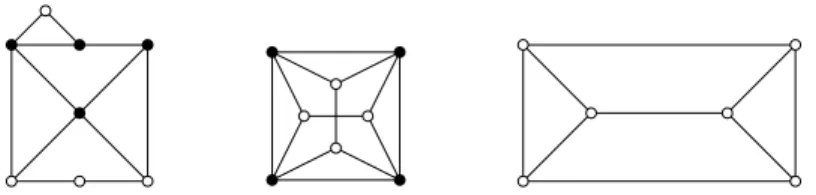
Unfortunately, with the usual notions of 2-join and blocks, this approach does not work. Building the blocks of a 2-join preserves existing balanced skew partitions, but some 2-joins can create balanced skew partitions when building the blocks. In the graph depicted Fig. 1 on the left, we have to simplify somehow the left part of the obvious 2-join to build one of the blocks. The most reasonable way to do so seems to be replacing X1 by a path of length 1. But this creates a skew cutset: the
black vertices on the right. Of course, this graph is bipartite but one can imagine more complicated examples based on the same template and another template exists. These bad 2-joins will be described in more details in Section 2 and called cutting 2-joins. All of them are path 2-joins.
Theorem 2.1 shows that cutting 2-joins are not necessary to decompose Berge graphs. A more general statement is proved, that makes use of a new basic class and of a new kind of decomposition that are quite long to describe. But an interesting corollary can be stated with no new notions. By contracting a path P that is the
Figure 1: Contracting a path creates a skew cutset
side of a proper path 2-join of a graph we mean delete the interior vertices of P , and link the ends of P with a path of length 1 or 2 according to the original parity of the length of P .
Theorem 1.5 Let G be a Berge graph. Then either: • G is basic;
• one of G, G has a non-path proper 2-join;
• G has no balanced skew partition and exactly one of G, G (say G) has at least a proper path 2-join. Moreover, for every proper path 2-join of G, the graph obtained by contracting its path-side has no balanced skew partition;
• G has a balanced skew partition.
The algorithm for detecting balanced skew partitions is now easy to sketch. Since the balanced skew partition is a self-complementary notion, we may switch from the graph to its complement as often as needed. First check whether the input graph is basic, and if so look directly for a balanced skew partition. Else, try to decompose along non-path 2-joins (they preserve the existence of balanced skew partitions). If there are none of them, try to decompose along path 2-joins (possibly, this creates balanced skew partitions but do not destroy them). At the end of this process, one of the leaf of the decomposition tree has a balanced skew partition if and only if the root has one. Note that a balanced skew partition in a leaf may have been created by the contraction of a cutting 2-join since such 2-joins do exist (we are not able to recognize all of them, it seems to be a difficult task). But Theorem 1.5 shows that when such a bad contraction occurs, the graph has anyway a balanced skew cutset somewhere. The proof of correctness and complexity analysis are given in Section 5. Theorem 1.5 gives a structural description of Berge graphs that have no balanced skew partitions: these graphs can be decomposed along 2-joins till reaching basic graphs. This could be used to solve algorithmic problems for the class of Berge graphs with no balanced skew partitions (together with the Berge graphs recognition algorithm [6], our work solves the recognition in O(n9
)). Note that this class has an unusual feature in the field of perfect graphs: it is not closed under taking induced subgraph. Theorem 1.5 also gives a structural information on every Berge graph: it can be decomposed in a first step by using only balanced skew partitions, and in a second step by using only 2-joins, possibly in the complement.
Let us come back to the weak point of our recognition algorithm: when it an-swers “the graph has a balanced skew-partition” using blindly some decomposition theorem. This weakness is the reason why we are not able to find explicitly a bal-anced skew partition when there is one. However, our results shows that an explicit algorithm might exist. The proof of Theorem 1.2 or Theorem 1.3 might contain its main steps and ideas. However, we would like to point out that if someone manage to read algorithmically the proof of Theorem 1.2 or of Theorem 1.3, (s)he will probably end up with an algorithm that given a graph, either finds an odd hole/antihole, or certifies that the graph is basic, or finds some decomposition. If the decomposition found is not a balanced skew partition, the algorithm will probably not certify that there is no balanced skew partition in the graph, and thus BSPD will not be solved entirely. To solve it, one will still have to think about the detection of balanced skew partitions in basic graphs, and in graphs having a 2-join: this is what we are doing here. Thus an effective algorithm might have to use much of the present work.
This paper answers in some respect questions asked by several authors, for in-stance the problem of how 2-joins and balanced skew partitions interact in Berge graphs. See [1] where a section is devoted to open problems about skew partitions. One of them is the fast detection of general skew partitions in Berge graphs. This has been solved for basic graphs by Reed [18], so a decomposition based approach might work. Moreover, at first glance, general skew partitions seem easier than bal-anced skew partitions: in general graphs the first ones are polynomial [14] to detect while the second ones are NP-hard. However, at Subsection 4.3 we explain why our work does not improve the general skew partition detection in Berge graphs, why we are not able to prove Theorem 1.5 with “skew partition” instead of “balanced skew partition”. Rather than a failure, we consider this as a further indication that balanced skew partition is the relevant decomposition for Berge graphs.
Section 2 gives the new definitions necessary to state properly Theorem 2.1, states it, and explain why it is a generalisation of the previously known decomposition theorems for Berge graphs. Section 3 gives some useful technical lemmas and study how 2-joins and balanced skew partitions can overlap in a Berge graph. Section 4 gives the proof of Theorems 2.1 and of its corollary 1.5. Section 5 describes the algorithms announced above. Section 6 proves that BSPD is NP-hard.
2
The decomposition theorem
We call flat path of a graph G any path whose interior vertices all have degree 2 in G and whose ends have no common neighbors outside of the path.
We call path-double split graph any graph obtained from a double split graph G by subdividing matching edges of G into paths of odd length. Note that a double split graph is a path-double split graph. More accurately, a path-double split graph is any graph G that may be constructed as follows. Let m, n ≥ 2 be integers. Let A = {a1, . . . , am}, B = {b1, . . . , bm}, C = {c1, . . . , cn}, D = {d1, . . . , dn} be four
disjoint sets. Let E be another possibly empty set disjoint from A, B, C, D. Let G have vertex set A ∪ B ∪ C ∪ D ∪ E and edges in such a way that:
v lies on a path of odd length from ai to bi;
• for 1 ≤ i ≤ m, there is a unique path of odd length (possibly 1) between ai
and bi whose interior is in E. There are no edges between {ai, bi} and {ai′, bi′} for 1 ≤ i < i′ ≤ m;
• cj is non-adjacent to dj for 1 ≤ j ≤ n. There are all four edges between {cj, dj}
and {cj′, bj′} for 1 ≤ j < j′ ≤ n;
• there are exactly two edges between {ai, bi} and {cj, dj} for 1 ≤ i ≤ m,
1 ≤ j ≤ n and these two edges are disjoint.
Now we turn our attention to types of 2-join whose contraction may create balanced skew partitions:
• A 2-join is said to be cutting of type 1 if it has a split (X1, X2, A1, B1, A2,
B2) such that:
1. (X1, X2) is a path 2-join with path-side X1;
2. G[X2\ A2] is disconnected.
• A 2-join is said to be cutting of type 2 if it has a split (X1, X2, A1, B1, A2,
B2) such that there exist sets A3, B3 satisfying:
1. (X1, X2) is a path 2-join with path-side X1;
2. A3 6= ∅, B36= ∅, A3 ⊂ A2, B3⊂ B2;
3. A3 is complete to B3;
4. every outgoing path from B3∪ {a1} to B3∪ {a1} (resp. from A3∪ {b1}
to A3∪ {b1}) has even length;
5. every antipath with its ends outside of B3∪ {a1} (resp. A3∪ {b1}) and
its interior in B3∪ {a1} (resp. A3∪ {b1}) has even length;
6. G \ (X1∪ A3∪ B3) is disconnected.
• A 2-join is said to be cutting if it is either cutting of type 1 or cutting of type 2. An homogeneous 2-join is a partition of V (G) into six non-empty sets (A, B, C, D, E, F ) such that:
• (A, B, C, D, E, F ) is an homogeneous pair;
• every vertex in E has degree 2 and belongs to a flat path of odd length with an end in C, an end in D and whose interior is in E;
• every flat path outgoing from C to D and whose interior is in E is the path-side of a non-cutting proper 2-join of G.
Theorem 2.1 Let G be a Berge graph. Then either G is basic, or one of G, G is a path-cobipartite graph, or one of G, G is a path-double split graph, or one of G, G has an homogeneous 2-join, or one of G, G has a non-path proper 2-join, or G has a balanced skew partition.
This theorem generalises Theorems 1.2, 1.3 and 1.4: path-cobipartite graphs may be seen either as graphs having a proper path 2-join (Theorems 1.2 and 1.3) or as a new basic class (Theorem 1.4). Path-double split graphs may be seen as graphs having a proper path 2-join (Theorems 1.2 and 1.3) or as graphs having a non-balanced skew partition (Theorem 1.4). And graphs having an homogeneous 2-join may be seen as graphs having an homogeneous pair (Theorems 1.4 and perhaps 1.2) or as graphs having a proper path 2-join (Theorems 1.3 and perhaps 1.2). Formally all these remarks are not always true: it may happen in special cases that path-cobipartite graphs and path-double split graphs have no proper 2-join. But such graphs are established in Lemma 3.4 to be basic or to have a balanced skew partition.
3
Lemmas
The following is a useful characterization of line-graphs of bipartite graphs:
Theorem 3.1 (Harary and Holzmann [16]) G is the line-graph of a bipartite graph if and only if G contains no odd hole, no claw and no diamond as induced subgraphs.
Figure 2: A claw and a diamond The following fact is clear and useful:
Lemma 3.2 If (A, B) is a balanced skew partition of a graph G then (B, A) is a balanced skew partition of G. In particular, a graph G has a balanced skew partition if and only if G has a balanced skew partition.
A star in a graph is a set of vertices B such that there is a vertex x in B, called a center of the star, seeing every vertex of B \ x. Note that a star cutset of size at least 2 is a skew cutset.
Lemma 3.3 Let G be a Berge graph of size at least 4, with at least an edge and that is not the complement of C4. If G has a star cutset then G has a balanced skew
partition
proof — Let B be a star cutset of G. Let us suppose |B| being maximum with
that property. Let A1, A2 be such that A1, A2, B are pairwise disjoint, there are no
Suppose first that B has size 1. Thus up to a symmetry |A1| ≥ 2 since G has
at least 4 vertices. There is no edge between B and A1 for otherwise such an edge
would be a cutset contradicting |B| being maximum. There is no edge in A2 since
such an edge would be a cutset of G. If there is no edge in A1, any edge of G is a
cutset of G. So, there is an edge e in A1. So, |A1| = 2 and B is complete to A2 for
otherwise, e is a cutset of G. So, |A2| = 1 for otherwise, any edge between B and
A2 is a cutset edge of G. Now, we observe that G is the complement of C4.
If B has size at least 2 then B is a skew cutset of G. Let x be a center of B. By maximality of B, every component of G \ B has either size 1 or contains no neighbor of x. Thus, if P is a path that makes the skew cutset B non-balanced, then P ∪ x induces an odd hole of G. If Q is an antipath that makes the skew cutset
B non-balanced, then Q ∪ x induces an odd antihole of G. 2
The following lemma is useful to establish formally that Theorem 2.1 really implies Theorems 1.2, 1.3 and 1.4. But we also need it at several places in the next section.
Lemma 3.4 Let G be a Berge graph. Then:
• If G has a flat path P of length at least 3 then either G is bipartite, or G has a balanced skew partition or P is the path-side of a proper path 2-join of G. • If G is a path-cobipartite graph, a path-double split graph or has an
homo-geneous 2-join, then either G has a proper 2-join or G has a balanced skew partition or G is a bipartite graph, the complement of a bipartite graph, or a double split graph.
proof — Let us prove the first item. Let P be a flat path of G of length at least 3. So (P, V (G) \ P ) is a path 2-join of G. Let (P, X2, {a1}, {b1}, A2, B2) be a split of
this 2-join. If (P, X2) is not proper, then either there is a component of X2 that
does not meet one of A2, B2, or X2 induces a path of length 1 or 2. In the last case,
G is bipartite, and in the first one, we may assume that there is a component C of X2 that does not meet B2. But then, {a1} ∪ (A2\ C) is a star cutset of G that
separates C from B2, and so by Lemma 3.3, G has a balanced skew partition.
The second item follows easily: if G is a path-cobipartite graph, then we may assume that G is not the complement of a bipartite graph. If G is a path-double split graph then we may assume that G is not a double split graph. In both cases, G has a flat path of length at least 3. If G has an homogeneous 2-join then it also has a flat path of length at least 3. In every case, the conclusion follows from the
first item. 2
The following is well known for double split graphs (mentioned in [7]):
Lemma 3.5 A path-double split graph G has exactly one skew partition and this skew partition is not balanced.
proof — Let V (G) be partitioned into sets A, B, C, D, E like in the definition of path-double split graphs. Obviously, (A ∪ B ∪ E, C ∪ D) is a non-balanced skew
partition of G. Every vertex of A∪B ∪E has a non neighbor in every anticomponent of C ∪ D. Hence, every subset of V (G) strictly containing C ∪ D is anticonnected. So, if X 6= C ∪ D is a skew cutset of G, we may assume that X does not contain c1.
So, c1 is in a component of G \ X, and there is a vertex y of G that is in another
component. Up to a symmetry, we have two cases to consider:
First case: y = d1. Hence, every vertex of C ∪ D \ {c1, d1} must be in X. Every
vertex in A ∪ B ∪ E has a non neighbor in every anticomponent of C ∪ D \ {c1, d1}.
So, since X is not anticonnected, we have X = C ∪ D \ {c1, d1}. This contradicts
G \ X being disconnected.
Second case: y is on a path P from a1 to b1 whose interior is in E. Since P
has a vertex adjacent to c1, at least a vertex of P must be in X. If this vertex
u is in E then we may assume up to a symmetry b1 ∈ X since u and c1 must
have a common neighbor in X because X is not anticonnected. Else we may also assume b1 ∈ X. Note that a1 ∈ X, because either a/ 1 and b1 are not adjacent,
and then cannot be both in X because they have no common neighbor; or a1 and
b1 are adjacent and then y = a1 is the only possibility left for y. Hence, X is
a skew cutset that separates a1 from c1. Now, for every 2 ≤ j ≤ n, one of cj,
dj is a common neighbor of a1, c1. Hence, up to a symmetry, we may assume
{c2, . . . , cn} ⊂ X. Every vertex of V (G) \ {b1, c2, . . . , cn} has a non neighbor in
the unique anticomponent of {b1, c2, . . . , cn}. Hence, X = {b1, c2, . . . , cn}. So, X is
anticonnected. This contradicts X being a skew cutset. 2
The following is needed twice in the proof of Theorem 2.1:
Lemma 3.6 Let G be a Berge graph. Suppose that G has a vertex u of degree 3 whose neighborhood induces a stable set. Moreover, G has a stable set {x, y, z} such that x, y, z all have degree at least 3. Then G is not a path-cobipartite graph, not a path-double split graph and G has no non-degenerate homogeneous 2-join.
proof — In a path-cobipartite graph the vertices of degree at least 3 partition into 2 cliques. Since {x, y, z} contradicts this property, G is not a path-cobipartite graph.
In a path-double split graph, every vertex of degree exactly 3 must have an edge in his neighborhood. Since u contradicts this property, G is not a path-double split graph.
If G has a non-degenerate homogeneous 2-join (A, B, C, D, E, F ), then every vertex in F has degree at least 4. Every vertex in A, B has an edge in his neigh-borhood. Every vertex in C has a neighbor in C or F for otherwise, (A, B, C, D, E, F ) is degenerate. Thus, every vertex in C, and by the same way every vertex in D, has an edge in his neighborhood. Every vertex in E has degree 2. Hence, u is in
none of A, B, C, D, E, F , a contradiction. 2
3.1 Paths and antipaths overlapping 2-joins
Here, we state easy facts about 2-joins. Some of them are well known but they need to be stated and proved clearly, especially because most of them are needed for possibly non-proper 2-joins.
Lemma 3.7 Let G be a Berge graph with a connected 2-join (X1, X2). Then all the
paths with an end A1, an end in B1, no interior vertex in A1∪ B1, and all the paths
with an end A2, an end in B2, no interior vertex in A2∪ B2 have same parity.
proof — Note that since (X1, X2) is connected there actually exists in G[X1] a path P1 with an end in A1, an end in B1 and interior in C1. There exists a similar
path in G[X2] from A2 to B2. The paths P1, P2 have same parity because P1∪ P2
induces a hole. Let P be a path from A1 to B1 with no interior vertex in A1∪ B1
(the proof is the same for an a path from A2 to B2). Let P∗ be the interior of P .
Then one of P ∪ P2, P∗∪ P1 induces a hole. Hence, P, P1, P2 have same parity. 2
Lemma 3.8 Let G be a Berge graph with a 2-join (X1, X2). Let i be in {1, 2}. Then
every outgoing path from Ai to Ai (resp. from Bi to Bi) has even length. Every
antipath of length at least 2 whose interior is in Ai (resp. Bi) and whose ends are
outside Ai (resp. Bi) has even length.
proof — Note that we do not suppose (X1, X2) being connected, so Lemma 3.7 does not apply. Let P be an outgoing path from A1 to A1 (the other cases are
similar). If P has a vertex in A2, then P has length 2. Else, P must lie entirely
in X1 except possibly for one vertex in B2. If P lies entirely in X1, then P ∪ {a2}
where a2 is any vertex in A2 induces a hole, so P has even length. If P has a vertex
b2 ∈ B2, then we must have P = a−· · ·−b−b2−b′−· · ·−a′ where a−P −b and b′−P −a′
are paths with an end in A1, an end in B1 and interior in C1. Suppose that P has
odd length. Let a2 be a vertex of A2. Then V (P ) ∪ {a2} induces an odd cycle of G
whose only chord is a2b2. So one of V (a−P −b2) ∪ {a2}, V (a′−P −b2) ∪ {a2} induces
an odd hole of G, a contradiction.
Let Q be an antipath of length at least 2 whose interior is in A1 and whose ends
are outside A1 (the other cases are similar). If Q has length at least 3, then the ends
of Q must have a neighbor in A1 and a non-neighbor in A1. Hence these ends are
in X1. Thus, Q ∪ {a}, where a is any vertex of A2 is an antihole of G. Thus, Q has
even length. 2
Lemma 3.9 Let G be a graph with a 2-join (X1, X2). Let P be a path of G whose
end-vertices are in X2. Then either:
1. There are vertices a ∈ A1, b ∈ B1 such that V (P ) ⊆ X2∪ {a, b}. Moreover, if
a, b are both in V (P ), then they are non-adjacent.
2. P = c−· · ·−a2−a−· · ·−b−b2−· · ·−c′ where: a ∈ A1, b ∈ B1, a2∈ A2, b2∈ B2.
Moreover V (c−P −a2) ⊂ X2, V (b2−P −c′) ⊂ X2, V (a−P −b) ⊂ X1.
proof — If P has no vertex in X1, then for any a ∈ A1, b ∈ B1, the first outcome holds. Else let c, c′ be the end-vertices of P . Starting from c, we may assume that
first vertex of P in X1 is a ∈ A1. Note that a is the only vertex of P in A1. If a has
its two neighbors on P in X2, then P has no other vertex in X1, except possibly a
single vertex b ∈ B1 and the first outcome holds. If a has only one neighbor on P
Let b2 be the neighbor of b in X2 along P . Vertices a2, a, b, b2 show that the second
outcome holds. 2
Lemma 3.10 Let G be a Berge graph with a 2-join (X1, X2). Let P be a path of G
whose end-vertices are in A1 ∪ X2 (resp. B1∪ X2) and whose interior vertices are
not in A1 (resp. B1). Then either:
1. P has even length.
2. There are vertices a ∈ A1, b ∈ B1 such that V (P ) ⊆ X2∪ {a, b}. Moreover, if
a, b are both in V (P ), then they are non-adjacent.
3. P = a−· · ·−b−b2−· · ·−c where: a ∈ A1, b ∈ B1, b2 ∈ B2, c ∈ X2.
Moreover V (a−P −b) ⊂ X1 and V (b2−P −c) ⊂ X2.
(resp. P = b−· · ·−a−a2−· · ·−c where: b ∈ B1, a ∈ A1, a2∈ A2, c ∈ X2.
Moreover V (b−P −a) ⊂ X1 and V (a2−P −c) ⊂ X2.)
proof — Note that we do not suppose (X1, X2) being proper. Suppose that the end-vertices of P are in A1 ∪ X2 (the case when the end-vertices of P are all in
B1∪ X2 is similar).
If P has its two end-vertices in A1, then by Lemma 3.8, P has even length and
Output 1 of the lemma holds.
If P has exactly one end-vertex in A1, let a be this vertex. Let c ∈ X2 be the
other end-vertex of P . Let a′ be the neighbor of a along P . If a′ is in A
2, then we
may apply Lemma 3.9 to a′−P −c: Outcome 2 is impossible and Outcome 1 yields
Outcome 2 of the lemma we are proving now since P has exactly one vertex in A1.
If a′ is not in A
2, then let b be the last vertex of X1 along P and b2 the first vertex
of X2 along P . Outcome 3 of the lemma holds.
If P has no end-vertex in A1 then Lemma 3.9 applies to P . The second outcome
is impossible. The first outcome implies that there is a vertex b ∈ B1 such that
V (P ) ⊆ X2∪ {b} since no interior vertex of P is in A1. So, Outcome 2 of the lemma
we are proving now holds. 2
Lemma 3.11 Let G be a graph with a 2-join (X1, X2). Let Q be an antipath of G
of length at least 4 whose interior vertices are all in X2. Then there is a vertex a in
A1∪ B1 such that V (Q) ⊆ X2∪ {a}.
proof —Let c, c′ be the end-vertices of Q. Note that N (c) ∩ N (c′) ∩ X2 have to be non-empty and that N (c) ∩ X2 must be different of N (c′) ∩ X2, because c, c′ are the
end-vertices of an antipath of length at least 4. No pair of vertices in X1 satisfies
these two properties, so at most one of c, c′ is in V (Q) ∩ X
1. If none of c, c′ are in
X1, then let a be any vertex in A1, else let a be the unique vertex in X1 among c, c′.
Lemma 3.12 Let G be a Berge graph with a 2-join (X1, X2). Let Q be an antipath
of G of length at least 5 whose interior vertices are all in A1∪ X2 (resp. B1∪ X2)
and whose end-vertices are not in A1 (resp. B1). Then either:
1. Q has even length.
2. There is a vertex a ∈ A1∪ B1 such that V (Q) ⊆ X2∪ {a}.
proof — We suppose that the interior vertices of Q are all in A1∪ X2. The case when the interior vertices of Q are all in B1∪ X2 is similar.
If Q has at least 2 vertices in A1, then let a 6= a′ be two of these vertices. Since
the end-vertices of Q are not in A1, a, a′ may be chosen in such a way that there are
vertices c, c′ ∈ A/
1 such that c−a−Q−a′−c′ is an antipath of G. Since c must miss
a while seeing a′, c must be in X1\ A1, and so is c′. But the interior vertices of Q
cannot be in X1\ A1, so c, c′ are in fact the end-vertices of Q. Also, every interior
vertex of Q must be adjacent to at least one of c, c′. If all the interior vertices of
Q are in A1 then by Lemma 3.8, Q has even length. Else, Q must have at least an
interior vertex b ∈ X2. Since b must see at least one of c, c′ we have b ∈ B2, so b
misses both a, a′. Hence a−b−a′ is an induced subgraph of Q and b must see both
c, c′, so c, c′∈ B1. Now we observe that Q = c−a−b−a′−c′, contradicting Q having
length at least 5.
If Q has exactly one vertex a in A1 then by assumption, a is an interior vertex
of Q. Let c, c′ be the ends of Q. Suppose c ∈ X1. Since Q has length at least 5, c
must have a neighbor in the interior Q that is different of a, hence c ∈ B1. Since Q
has length at least 5, a and c must have a common neighbor, that must be c′ since
it must be in X1. Hence c′∈ X1, implying c′ ∈ B1 since c′ must have a neighbor in
X2. Now the non-neighbor of c′ along Q is not a, so it must be a vertex of X2 while
seeing c and missing c′, a contradiction. We proved c ∈ X
2, and similarly c′ ∈ X2.
Hence V (Q) ⊂ X2∪ {a}.
If Q has no vertex in A1 then Lemma 3.11 applies: there is a vertex a ∈ A1∪ B1
such that V (Q) ⊆ X2∪ {a}. 2
3.2 Balanced skew partitions overlapping 2-joins
Let G be a Berge graph and (X1, X2, A1, B1, A2, B2) be a split of a proper 2-join
of G. The blocks of G with respect to (X1, X2) are the two graphs G1, G2 that we
describe now. We obtain G1 by replacing X2 by a flat path P2 from a vertex a2
complete to A1, to a vertex b2 complete to B1. This path has the same parity than
a path from A1 to B1 whose interior is in C1. There is such a path since (X1, X2)
is proper and all such paths have same parity by Lemma 3.7. The length of P is decided as follow: if (X1, X2) is a path 2-join with path-side X2 then P has length 1
or 2, else it has length 3 or 4. The block G2 is obtained similarly by replacing X1
by a flat path.
It is convenient to consider a degenerated kind of 2-join that implies the existence of a balanced skew partition. A 2-join (X1, X2) is said to be degenerate if either:
• there exists i ∈ {1, 2} and a vertex v in Ai (resp. Bi) that has no neighbor in
• one of A1∪ A2, B1∪ B2 is a skew cutset of G;
• the 2-join (X1, X2) is not connected (ie, there exists i ∈ {1, 2} and a component
of Xi that does not meet both Ai, Bi);
• there exists i ∈ {1, 2} and a vertex in Ai that is complete to Bi or a vertex in
Bi that is complete to Ai;
• there exists i ∈ {1, 2} and a vertex in Ci that is complete to Ai∪ Bi.
Lemma 3.13 Let G be a Berge graph and (X1, X2) be a degenerate substantial
2-join of G. Then G has a balanced skew partition and at least one of the blocks G1, G2
of G has a balanced skew partition.
proof — Let us look at the possible reasons why (X1, X2) is degenerate.
If there is a vertex v in A1 that has no neighbor in X1\ A1 then suppose first
|A1| > 1. So (A1 \ {v}) ∪ A2 is a skew cutset separating v from the rest of the
graph. Hence, in G there is a star cutset of center v, and by Lemmas 3.3 and 3.2, G has a balanced skew partition. Hence we may assume A1 = {v}. Since (X1, X2) is
substantial, |X1| ≥ 3. Thus, for any b ∈ B1, {b} ∪ B2 is a star cutset that separates
v from X1\ {b, v} and G has a balanced skew partition by Lemma 3.3. By the same
way, the block G1 has a balanced skew partition. The cases with A2, B1, B2 are
similar.
If A1∪A2is a skew cutset of G then let us check that this skew cutset is balanced
(the case when B1∪ B2 is a skew cutset is similar). Since A1 is complete to A2, any
outgoing path from A1∪ A2 to A1∪ A2 is either outgoing from A1to A1 or outgoing
from A2 to A2. Thus, such a path has even length by Lemma 3.8. If there is an
antipath Q of length at least 5 with its interior in A1∪ A2 and its ends in the rest
of the graph, then it must lie entirely in X1 or X2, say X1 up to symmetry. Thus,
such an antipath has even length by Lemma 3.8. By the same way A1∪ {a2}, where
a2 is the vertex of G1 that represents A2, is a balanced skew cutset of G1
If (X1, X2) is not connected, then let for instance Y be a component of X1 that
does not meet B1. If Y ∩ C1 6= ∅ then A1∪ A2 is a skew cutset of G that separates
Y ∩ C1 from B1. So, by the preceding paragraph, G and G1 have a balanced skew
partition and we may assume that Y ⊂ A1. Hence, every vertex in Y has no
neighbor in X1\ A1. So, by the penultimate paragraph, G and G1 have a balanced
skew partition.
If there is a vertex a ∈ A1that is complete to B1 (the other cases are symmetric)
then suppose first |A1| > 1. Consider a′ 6= a in A1. Hence ({a} ∪ N (a)) \ a′ is a star
cutset of G separating a′ from B2. So, by Lemma 3.3, we may assume A1 = {a}.
If |B1| > 1, consider b 6= b′ in B1. Hence, ({b} ∪ N (b)) \ b′ is a star cutset of G
separating b′ from A
2. So we may assume B1 = {b}. Since (X1, X2) is substantial,
|X1| ≥ 3, and there is a vertex c in V (G) \ (A1∪ B1). Now, {a, b} is a star cutset
separating c from X2. By the same way, G1 has a balanced skew partition.
If there is a vertex c complete to Ai ∪ Bi then we may assume Ci = {c} for
otherwise there is another vertex c′ in C
iand {c} ∪ Ai∪ Biis a star cutset separating
c′from the rest of the graph. By the preceding paragraph, we may assume that there
even length from Ai to Bi. By the penultimate paragraph, we may assume (X1, X2)
connected. Thus by Lemma 3.7, there is no edge between Ai and Bi. If there are
two vertices a 6= a′ ∈ A
i then {a} ∪ N (a) \ {a′} is a star cutset of G separating
a′ from B
3−i. Thus may assume |Ai| = 1, and similarly |Bi| = 1. Thus, Xi is an
outgoing path of length 2 from Ai to Bi contradicting (X1, X2) being substantial.
By the same way, G1 has a balanced skew partition. 2
Lemma 3.14 Let G be a graph with a non-degenerate 2-join (X1, X2). Let i be in
{1, 2}. Then for every vertex v ∈ Xi there is a path Pa = a − · · · − v and a path
Pb = b−· · ·−v such that:
• a ∈ Ai, b ∈ Bi;
• Every interior vertex of Pa, Pb is in Xi\ (Ai∪ Bi).
proof — Note that (X1, X2) is connected since it is not degenerate. Suppose first v ∈ Xi\ (Ai∪ Bi). By the definition of connected 2-joins, the connected component
Xv of v in G[Xi] meets both Ai, Biand there is at least one path from v to a vertex
of Bi in G[Xi]. If every such path of G[Xi] from v to Bi goes through Ai, then Ai
is a cutset of G[Xi] that separates v from Bi. Thus A1∪ A2 is a skew cutset of G,
so (X1, X2) is degenerate, a contradiction. So there is a path Pb as desired, and by
the same way, Pa exists.
If v ∈ Ai, then Pa exists and have length 0: put Pa = v. The vertex v has a
neighbor w in Xi\Ai otherwise (X1, X2) is degenerate. By the preceding paragraph,
there is a path Q from w to b ∈ Bi whose interior vertices lie in Xi\ (Ai∪ Bi). So
Pb exists: consider a shortest path from v to b in G[V (Q) ∪ {b}]. 2
Lemma 3.15 Let G be a Berge graph with a non-degenerate 2-join (X1, X2). Let
F be a balanced skew cutset of G. Then for some i ∈ {1, 2} either: • F ( Xi;
• F ∩ Xi (Xi and one of (F ∩ Xi) ∪ A3−i, (F ∩ Xi) ∪ B3−i is a balanced skew
cutset of G.
proof — We consider three cases:
Case 1: F ∩ A1, F ∩ A2, F ∩ B1, F ∩ B2 are all non-empty.
If there is a vertex a ∈ A1∩ F non-adjacent to a vertex b ∈ B1∩ F then there is
an antipath of length at most 3 between any vertex of F and a, contradicting G[F ] being disconnected. Thus A1 ∩ F is complete to B1∩ F , and similarly A2 ∩ F is
complete to B2∩F . Similarly, we prove F ∩C1 = F ∩C2= ∅. If A1⊂ F then there is
a vertex in B1 that is complete to A1, contradicting (X1, X2) being non-degenerate.
Thus A1\ F 6= ∅, and similarly A2\ F 6= ∅, B1\ F 6= ∅, B2\ F 6= ∅.
Let E1 be the component of G \ F that contains (A1\ F ) ∪ (A2\ F ). Let E2 be
another component of G \ F . Up to a symmetry we assume E2∩ X2 6= ∅. We claim
that F′ = (F ∩ X
2) ∪ A1 is a skew cutset of G that separates E1∩ X2 from E2∩ X2.
and an end in E2∩ X2. If P has no vertex in X1 then P ⊂ G \ F and P contradicts
E1, E2 being components of G \ F . If P has a vertex in X1 then this vertex b is
unique and is in B1 because A1 ⊂ F′. By replacing b by any vertex of B1\ F , we
obtain again a path that contradicts E1, E2 being components of G \ F . Thus F′ is
a skew cutset of G. Note that this skew cutset is included in A1∪ A2∪ B2. Let us
prove that this skew cutset is balanced.
Let P be an outgoing path from F′ to F′. Let us apply Lemma 3.10 to P . If
Outcome 1 of the lemma holds then P has even length. If Outcome 2 of the lemma holds then V (P ) ⊂ X2∪ {a, b}. Let a1 be a vertex of A1∩ F and b1 be a vertex
of B1 \ F such that a1 misses b1. Note that b1 exists for otherwise (X1, X2) is a
degenerate 2-join of G. After possibly replacing a by a1 and b by b1, we obtain an
outgoing path from F to F that has same length than P . Thus, P has even length since F is a balanced skew cutset. If Outcome 3 of the lemma holds then P has one end in A1 and one end in B2 and P is a path from A1 to B1 whose interior is in
C1, plus one edge. Note that there is an edge between A2 and B2 so by Lemma 3.7
every path from A1 to B1 whose interior is in C1 has odd length. Hence in every
case P has even length.
Let Q be an antipath with both ends in G \ F′ and interior in F′. If Q has
length 3 then Q may be seen as an outgoing path from F′ to F′, so we may assume
that Q has length at least 5. By Lemma 3.12 applied to Q, either Q has even length or V (Q) ⊂ X2∪ {a}. If a ∈ A1 let us replace a by a vertex of F ∩ A1 and if a ∈ B1
let us replace a by a vertex of B1\ F . We obtain an antipath that have same length
than Q, that has both ends outside of F and interior in F . Thus Q has even length because F is a balanced skew cutset.
Case 2: one of F ∩ A1, F ∩ A2, F ∩ B1, F ∩ B2 is empty and F ∩ X1, F ∩ X2 are
both non-empty.
We assume up to a symmetry that one of B1∩ F , B2∩ F is empty. Since F ∩ X1
and F ∩ X2 are both non-empty, there is a least an edge between F ∩ X1and F ∩ X2
because G[F ] is disconnected. Thus we know that F ∩ A1 and F ∩ A2 are both
non-empty. If (F ∩ X1) \ A1 and (F ∩ X2) \ A2 are both non-empty then there is a
vertex of F in one of C1, C2 since one of B1∩ F , B2∩ F is empty. Up to a symmetry,
suppose C1∩ F 6= ∅. Then G[F ] is connected since every vertex in it can be linked
to a vertex of C1 by an antipath of length at most 2, a contradiction. Hence one
of (F ∩ X1) \ A1 and (F ∩ X2) \ A2 is empty. Thus we may assume F ⊂ X2∪ A1.
Suppose B2 ⊂ F . Then B2 and F ∩ A1 are in the same component of G[F ], thus
there must be a vertex v in F that is complete to B2∪ (F ∩ A1). So, v is in A2, and
v is complete to B2, contradicting (X1, X2) being non-degenerate. We proved that
there is at least a vertex u in B2\ F . In particular, F ∩ X2 (X2. By Lemma 3.14
there is a path from every vertex of X1\F to u whose interior is in X1\A1, thus there
is a component E1 of G \ F that contains X1\ F and u. There is another component
E2 included in X2. Thus (F ∩ X2) ∪ A1 is a skew cutset of G that separates B1 from
E2. We still have to prove that the skew cutset (F ∩ X2) ∪ A1 is balanced.
Let P be an outgoing path from (F ∩ X2) ∪ A1 to (F ∩ X2) ∪ A1. Let us apply
Lemma 3.10 to P . If Outcome 1 of the lemma holds then P has even length. If Outcome 2 of the lemma holds then V (P ) ⊂ X2∪{a, b}. Let a1 be a vertex of A1∩F
(X1, X2) is a degenerate 2-join of G. After possibly replacing in P a by a1 and b
by b1, we obtain an outgoing path from F to F that has the same length than P .
Thus, P has even length since F is a balanced skew cutset. If Outcome 3 of the lemma holds then P = a−· · ·−b−b2−· · ·−c. Let a1 be in A1∩ F . By Lemma 3.14
there is a path P1 of G[X1] from a1 to a vertex b1 ∈ B1. Moreover, P1 has an end
in A1, an end in B1 and interior in C1. Note that by Lemma 3.7, P1 and a−P −b
have same parity. Thus a1−P1−b1−b2−P −c is an outgoing path from F to F that
has the same parity that P . Thus P has even length.
If Q is an antipath with both ends in G \ ((F ∩ X2) ∪ A1) and its interior in
(F ∩ X2) ∪ A1, we prove that Q has even length like in Case 1.
Case 3: One of F ∩ X1, F ∩ X2 is empty.
Since F ( X2 is an output of the lemma, we may assume up to a symmetry
F = X2 an look for a contradiction. If there is a path of odd length from A2 to B2
whose interior is in C2, then there is by Lemma 3.7 a similar path P from A1 to B1
of odd length. Hence A2 is complete to B2 because a pair of non-adjacent vertices
yields together with P an outgoing path of odd length from F to F , contradicting F being a balanced skew cutset. In particular, there is a vertex of A2 that is complete
to B2, implying (X1, X2) being degenerate, a contradiction. If there is a path of even
length from A2 to B2 whose interior is in C2 then by Lemma 3.7 there are no edges
between A2 and B2. Since X2= F is not anticonnected, there is a vertex in C2 that
is complete to A2∪ B2, implying again (X1, X2) being degenerate, a contradiction.
2
Lemma 3.16 Let G be a Berge graph and (X1, X2) be a proper 2-join of G. If G
has a balanced skew partition then at least one of the blocks of G has a balanced skew partition.
proof —If (X1, X2) is degenerate, then the conclusion holds by Lemma 3.13. From now on, we assume that (X1, X2) is non-degenerate. Suppose that G has a balanced
skew partition (E, F ). By Lemma 3.15 and up to a symmetry either F ( X2, or
(F ∩ X2) ( X2 and A1 ⊂ F , after possibly replacing F by (F ∩ X2) ∪ A1.
If F ( X2 then we claim that F is a balanced skew cutset of G2. Note that
there is at least a component E of G \ F that has some vertex in X2 but no vertex
in A2∪ B2. Else every component of G \ F has neighbors in A1 or B1, and therefore
contains A1∪ B1 because (X1, X2) is connected. This implies G\F being connected,
a contradiction. Thus, F is a skew cutset of G2 that separates E from V (G2) \ X2.
Let P be an outgoing path of G2 from F to F . Note that G2 has an obvious
2-join, (V (G2) \ X2, X2), possibly non-substantial. Let us apply Lemma 3.9 to P .
If Outcome 1 of the Lemma holds then after possibly replacing a by any a1 ∈ A1
and b by any b1 ∈ B1 non-adjacent to a1, P may be viewed as an outgoing of G
from F to F , thus P has even length. Note that b1 may be chosen non-adjacent
to a1 because (X1, X2) is non-degenerate. If Outcome 2 of the lemma holds, then
P = c−· · ·−a2−a1−· · ·−b1−b2−· · ·−c′. Let P′ be any path from A1 to B1 whose
interior is in C1. Then c−· · ·−a2−P′−b2−· · ·−c′ is an outgoing path of G from
F to F that has same parity than P by Lemma 3.7. Thus P has even length. Let Q be an antipath of G2 with its ends out of F and its interior in F . Let us apply
Lemma 3.11 to Q: V (Q) ⊆ X2∪ {a}. Thus, after possibly replacing a by a vertex
in A1∪ B1, Q may be seen as an antipath of G that has same length than Q. Thus
Q has even length.
If (F ∩ X2) ( X2 and A1 ⊂ F then we put F′ = (F ∩ X2) ∪ {a1}. We claim
that F′ is a balanced skew cutset of G2. Exactly as above, we prove that F′ is a
skew cutset of G2 that separates b1 from a component of G \ F that has vertices in
X2 but no vertex in B2. Let P be an outgoing path from F′ to F′. As above we
prove that P has even length by Lemma 3.10. Let Q be an antipath of G2 with its
ends out of F′ and its interior in F′. As above, we prove that Q has even length by
Lemma 3.12. 2
Lemma 3.17 Let G be a Berge graph and (X1, X2) be a non-cutting substantial
2-join of G. Then G has a balanced skew partition if and only if one of the blocks of G has a balanced skew partition.
proof —If G has a balanced skew partition then by Lemma 3.16 one of the blocks of G has a balanced skew partition. If (X1, X2) is degenerate, then the conclusion
holds by Lemma 3.13. From now on, we assume that (X1, X2) is non-degenerate. In
particular, it is connected and proper. Let us suppose that one of G1, G2 (say G2 up
to a symmetry) has a balanced skew cutset F′. We denote by P1 = a1−· · ·−b1 the
path induced by V (G2) \ X2. Note that G2 has an obvious connected path 2-join:
(P1, X2), possibly non-substantial.
(1) Either: • F′(X2;
• F′∩ X
2 (X2 and one of (F′∩ X2) ∪ {a1}, (F ∩ X2) ∪ {b1} is a balanced skew
cutset of G2.
If P1has length 3 or 4, then (P1, X2) is proper. It is non-degenerate because (X1, X2)
is non-degenerate. Let us apply Lemma 3.15. The conclusion F′(X1, is impossible
since then by Lemma 3.14, G2\F′ is connected. Also (F′∩P1)∪A2and (F′∩P1)∪B2
cannot be skew cutsets of G2, because a1, b1 cannot be both in a skew cutset of G2
since they are non adjacent with no common neighbors. Hence, Lemma 3.14 proves that (F′∩ P
1) ∪ A2 and (F′∩ P1) ∪ B2 are not cutsets of G2. Thus (1) is simply the
only possible conclusion of Lemma 3.15.
If P1 has length 2 then P1 = a1− c1− b1. If a1, b1 are both in F′, then F′ =
{a1, c1, b1} because c1 is the only common neighbor of a1, b1 in G2. This means
that G2[X2] = G[X2] is disconnected, implying that (X1, X2) is a cutting 2-join of
type 1, a contradiction. By Lemma 3.14 applied to G2[X2] = G[X2], none of a1, b1
can be the center of a star cutset of G. Hence, c1 ∈ F/ ′. Thus, F ∩ X2(X2 because
any induced subgraph of P1 containing c1 is connected. We proved (1) when P1 has
length 2.
We are left with the case when P1 = a1− b1. If a1, b1 are both in F′ then
F′ ⊂ {a
1, b1} ∪ A2∪ B2. If F′∩ A2 6= ∅ and F′∩ B2 6= ∅ then putting A3 = F′∩ A2
is complete to B3 for otherwise, F′ is anticonnected. The requirements on the parity
of paths and antipaths are satisfied because F′ is a balanced skew cutset. If at least
one of F′∩ A
2 and F′∩ B2 is empty then we see that (X1, X2) is a cutting 2-join
of type 1. Both cases contradict (X1, X2) being non-cutting. Thus we know that at
most one of a1, b1 is in F . Also F′∩ X2 (X2 because every induced subgraph of P1
is connected. This proves (1).
By (1), we may assume that not both a1, b1 are in F′. Up to a symmetry, we
assume b1 ∈ F/ ′. If a1 ∈ F′, put A′1= A1, else put A′1= ∅. Now F = (F′∩ X2) ∪ A′1
is a skew cutset of G that separates a vertex of X2 from X1 \ A′1. The proof that
F is a balanced skew cutset of G is entirely similar to the similar proofs above: we consider an outgoing path of G from F to F . Lemma 3.9 or Lemma 3.10 shows that P has the same parity than an outgoing path of G2 from F′ to F′. We consider an
antipath Q of G of length at least 2 with all its interior vertices in F and with its end-vertices outside of F . Lemma 3.11 or Lemma 3.12 shows that Q has the same parity than a similar antipath with respect to F′ in G
2. 2
Lemma 3.18 Let G be a Berge graph and (X1, X2) be a non-path proper 2-join of
G. Then G has a balanced skew partition if and only if one of the blocks of G has a balanced skew partition.
proof — Clear by Lemma 3.17 since a non-path 2-join is a non-cutting 2-join. 2
3.3 Balanced skew partitions overlapping homogeneous 2-joins
An homogeneous 2-join (A, B, C, D, E, F ) is said to be degenerate if either:
• there is a vertex x ∈ C with no neighbor in E ∪ D or a vertex y ∈ D with no neighbor in E ∪ C;
• there is a vertex x ∈ C such that N (x) ⊂ A ∪ D ∪ E or a vertex y ∈ D such that N (y) ⊂ B ∪ C ∪ E.
Lemma 3.19 Let G be a Berge graph with a degenerate homogeneous 2-join. Then G has a balanced skew partition.
proof — Suppose first that there exists a vertex x ∈ C with no neighbor in E ∪ D (the case with y ∈ D is similar). Then, (A ∪ C ∪ F ) \ {x} is a skew cutset that separates x from the rest of the graph. Thus, G has a star cutset centered at x. By Lemma 3.3, G has a balanced skew partition and by Lemma 3.2 so is G.
Suppose now that there exists x ∈ C such that N (x) ⊂ A ∪ D ∪ E (the case with y ∈ D is similar). Let Dx be the set of those vertices of D that are the ends of a
path from C to D whose interior is in E and starting from x. Note that all such paths have odd length (possibly 1). If a vertex f ∈ F misses d ∈ Dx, then consider
a pair a ∈ A, b ∈ B of non-adjacent vertices. Then {a, b, f } ∪ P , where P is a path from x to d whose interior is in E, induces an odd hole. Thus F is complete to Dx.
Thus, for any f ∈ F , {f } ∪ N (F ) \ B is a star cutset of G that separates x from B.
4
Proof of Theorems 2.1 and 1.5
4.1 Proof of Theorem 2.1
For any graph G, let f (G) be the number of maximal flat paths of length at least 3 in G. Let us consider G, a counter-example to Theorem 2.1 such that f (G) + f (G) is minimal. Since G is a counter-example and since G is Berge, by Theorem 1.3 and up to a complementation of G, we may assume that:
a. G is not basic, none of G, G is a path-cobipartite graph, none of G, G is a path-double split graph, G has no balanced skew partition, none of G, G has a non-path proper 2-join, none of G, G has an homogeneous 2-join;
b. G has a path proper 2-join.
Since G has a path proper 2-join, G has flat path of length at least 3, implying f (G) ≥ 1. We choose such a flat path X1 inclusion-wise maximal. Note that by
Lemma 3.4, (X1, V (G) \ X1) is a proper 2-join of G since G is not basic and has
no balanced skew partition. Let us consider (X1, X2, A1, B1, A2, B2) a split of this
2-join. Note that G[X2] is not a path since G is not bipartite. We denote by a1 the
only vertex in A1 and by b1 the only vertex in B1. We put C1 = X1\ {a1, b1}, and
C2= X2\ (A2∪ B2).
If one of G, G has a degenerate proper 2-join, a degenerate homogeneous 2-join or a star cutset then one of G, G has a balanced skew partition by Lemma 3.13, Lemma 3.19 or Lemma 3.3. So G has a balanced skew partition by Lemma 3.2. This contradicts G being a counter-example. Thus:
c. G and G have no degenerate proper 2-join, no degenerate homogeneous 2-join and no star cutset.
Suppose that a1 has degree 2 in G. Since X1 is the path-side of a path 2-join, this
means that the unique neighbor a of a1 in X2 sees at least a neighbor b ∈ X2 of b1.
Otherwise, X1∪{a} is flat path contradicting X1being maximal. Hence, b is a vertex
of B2 complete to A2 = {a}, implying (X1, X2) being degenerate, a contradiction.
Hence:
d. a1, b1 both have degree at least 3 in G.
Let us study the connectivity of G. If G[X2] is disconnected, then let X2′ be any
component of G[X2]. Since (X1, X2) is proper, the sets A2∩ X2′ and B2∩ X2′ are not
empty. So (V (G) \ X′
2, X2′) is a 2-join of G. Let us suppose that X2′ is not a path of
length 1 or 2 from A2 to B2whose interior is in C2. This implies that (V (G)\X2′, X2′)
is a proper 2-join. So since G is a counter example, we know that (V (G) \ X′ 2, X2′)
is a path 2-join of G. Since X1 is a maximal flat path of G, V (G) \ X2′ cannot be
the path side of this 2-join. Thus G[X′
2] is the path side of this 2-join. Hence we
know that every component of X2 is a path from A2 to B2 whose interior is in C2.
This implies that G is bipartite contradicting G being a counter example. Hence: e. G[X2] is connected.
Since by Property c, (X1, X2) is non-degenerate, the following is a direct consequence
of Lemma 3.14:
f. In G[X2], there exists a path from A2 to B2 whose interior is in C2. Moreover,
for every A′
2 ⊆ A2, B2′ ⊆ B2 the graphs G[A2′ ∪ C2∪ B2∪ {b1}] and G[B2′ ∪
C2∪ A2∪ {a1}] are connected.
The six properties listed above will be referred as the properties of G in the rest of proof. We denote by ε ∈ {0, 1} the parity of the length of the path X1. We now
consider three cases according to the properties of (X1, X2). In each case, we will
consider a graph G′ obtained from G by destroying the path 2-join (X1, X2), and we
will show that G′ is a counter-example that contradicts f (G) + f (G) being minimal.
Case 1: X1 may be chosen in such a way that (X1, X2) is cutting of type 1.
Up to a symmetry we assume that G[X2 \ A2] is disconnected. Let X be a
component of G[X2\ A2]. If X is disjoint from B2 then {a1} ∪ A2 is a star cutset of
G separating X from X2\ X, contradicting the properties of G. Thus X intersects
B2, and by the same proof so is any component of X2\X. Hence, there are two
non-empty sets B3= B2∩ X and B4= B2\ X. Also we put C3 = C2∩ X, C4 = C2\ X.
Possibly, C3, C4 are empty. There are no edges between B3∪ C3 and B4∪ C4.
We consider the graph G′ obtained from G by deleting X
1\ {a1, b1}. Moreover,
we add new vertices: c1, c2, b3, b4. Then we add every possible edge between b3 and
B3, between b4 and B4. We also add edges a1c1, c2b3, c2b4. If ε = 0, we consider for
convenience c1 = c2, so that c1 is always a vertex of G′. Else we consider c1 6= c2
and we add an edge between c1 and c2. Note that in G′, N (b1) = B2. Here are
seven claims about the parity of various kinds of paths and antipaths in G′.
(1) Every path of G′ from B
2 to A2 with no interior vertex in A2∪ B2 has length of
parity ε.
If such a path contains one of a1, b3, b4, c1, c2 then it has length 4 + ε. Else such a
path may be viewed as a path of G from B2 to A2. By Lemma 3.7 it has parity ε.
This proves (1).
(2) Every outgoing path of G′ from B
2 to B2 has even length.
For suppose there is such a path P = b−· · · −b′, b, b′ ∈ B
2. If P goes through b1
then it has length 2. If P goes through b3 and b4 it has length 4. If P goes through
only one of b3, b4 then either P has length 2 or we may assume up to a symmetry
that P = b−b3−c2−c1−a1−a−· · ·−b′ where a ∈ A2. So, a−P −b′ is a path from A2
to B2 whose interior is in C2 and by (1) it has parity ε. So, P has even length. If
P goes through c2 or c1 then it must goes through at least one of b3, b4, and by the
discussion above it must have even length. So we may assume that P goes through none of c1, c2, b1, b3, b4. Hence P may be viewed as a path of G. Thus, P has even
length by Lemma 3.8. In every case, P has even length. This proves (2). (3) Every outgoing path of G′ from A
2 to A2 has even length.
For suppose there is such a path P = a−· · ·−a′, where a, a′∈ A2. If P goes through
a1 then it has length 2. So we may assume that P does not go through a1. Note
If P goes through c2 or through both b3, b4 then we may assume P = a−· · ·−b−
b3−c2−b4−b′−· · ·−a′ where b ∈ B3 and b′ ∈ B4. By (1) b−P −a and a′−P −b′ have
both parity ε. Thus, P has even length. If P goes through B3, b1 and B4 then we
prove that it has even length by the same way. So we may assume that P neither goes through c2 nor through both b3, b4 nor through B3, b1 and B4.
If P goes through exactly one of b3, b4, say b3 up to a symmetry, then just like
above P = a−· · ·−b−b3−b′−· · ·−a′, where both b−P −a and a′−P −b′ are paths
from B2 to A2. So by (1), they both have parity ε. Thus, P has even length. If P
goes through b1 and exactly one of B3, B4, then we prove that it has even length by
the same way. So we may assume that P goes though none of b1, b3, b4.
Now P goes through none of a1, c1, c2, b1, b3, b4, so P may be viewed as an
out-going path of G from A2 to A2. It has even length by Lemma 3.8.
In every case, P has even length. This proves (3).
(4) Every outgoing path of G′ from B3 to B3 (resp. B4 to B4) has even length.
Suppose that there is an outgoing path P = b−· · ·−b′ from B
3 to B3 (the case with
B4 is similar). Note that P may have interior vertices in B4, so (2) does not apply
to P . If P goes through b1 or b3 it has length 2. So we may assume that P does
not go through {b1, b3}. If P has no vertex in A2, then P has no interior vertices in
B4 since B3 and B4 are in distinct components of G \ ({b1, b3} ∪ A2). So (2) applies
and P has even length.
So we may assume that P has at least a vertex in A2. Let us then call B-segment
of P every subpath of P whose end vertices are in B2 and whose interior vertices
are not in B2. Note that P is edgewise partitioned into its B-segment. Similarly,
let us call A-segment of P every subpath of P whose end-vertices are in A2 and
whose interior vertices are not in A2. By (3), every A-segment has even length or
has length 1. An A-segment of length 1 is called an A-edge. Suppose that P has odd length. Let b, b′∈ B
2 be the end-vertices of P . Along P from b to b′, let us call
a the first vertex in A2 after b, and a′ the last vertex in A2 before b′. So b−P −a
and a′−P −b′ are both paths from B2 to A2, and by (1) they have same parity. So
a− P − a′ is a path of odd length that is edgewise partitioned into its A-segment,
and that contains all the A-segments of P . Thus P has an odd number of A-edges. Since P is edgewise partitioned into into its B-segments, there is a B-segment P′
of P with an odd number of A-edges. Let β, β′ be the end-vertices of P′. Along
P′ from β to β′, let us call α the first vertex in A
2 after β, and α′ the last vertex
in A2 before β′. So P′′= α−P′−α′ is a path that is edgewise partitioned into its
A-segment with an odd number of A-edge. Thus P′′ has odd length. Since β−P −α
and α′−P −β′ are both paths from B
2 to A2, they have same parity by (1). Finally,
P′ is of odd length, outgoing from B2 to B2, and contradicts (2). Thus P has even
length. This proves (4).
(5) Every antipath of G′ with length at least 2, with its end vertices in V (G′) \ A 2,
and all its interior vertices in A2 has even length.
Let Q be such an antipath. We may assume that Q has length at least 3. So each end-vertex of Q must have a neighbor in A2 and a non-neighbor in A2. So none of