Publisher’s version / Version de l'éditeur:
Fuel, 65, 5, pp. 740-742, 1986
READ THESE TERMS AND CONDITIONS CAREFULLY BEFORE USING THIS WEBSITE. https://nrc-publications.canada.ca/eng/copyright
Vous avez des questions? Nous pouvons vous aider. Pour communiquer directement avec un auteur, consultez la première page de la revue dans laquelle son article a été publié afin de trouver ses coordonnées. Si vous n’arrivez pas à les repérer, communiquez avec nous à [email protected].
Questions? Contact the NRC Publications Archive team at
[email protected]. If you wish to email the authors directly, please see the first page of the publication for their contact information.
NRC Publications Archive
Archives des publications du CNRC
This publication could be one of several versions: author’s original, accepted manuscript or the publisher’s version. / La version de cette publication peut être l’une des suivantes : la version prépublication de l’auteur, la version acceptée du manuscrit ou la version de l’éditeur.
Access and use of this website and the material on it are subject to the Terms and Conditions set forth at
On the interaction between pyridine and coal as studied by CP/MAS
15N n.m.r.
Ripmeester, John A.; Hawkins, Ron E.; MacPhee, J. Anthony; Nandi,
Biswanath N.
https://publications-cnrc.canada.ca/fra/droits
L’accès à ce site Web et l’utilisation de son contenu sont assujettis aux conditions présentées dans le site LISEZ CES CONDITIONS ATTENTIVEMENT AVANT D’UTILISER CE SITE WEB.
NRC Publications Record / Notice d'Archives des publications de CNRC:
https://nrc-publications.canada.ca/eng/view/object/?id=01e70387-966a-46d4-bd60-6943139a6763
https://publications-cnrc.canada.ca/fra/voir/objet/?id=01e70387-966a-46d4-bd60-6943139a6763
On the interaction
between
pyridine and coal as studied by CP/MAS
15N
n.m.r.
John A. Ripmeester, Ron E. Hawkins, J. Anthony MacPhed and Biswanath N. Nandi*
Division of Chemistry, National Research Council of Canada, Ottawa, Ontario KlA OR9, Canada *Energy Research Labs, Canada Centre for Mineral and Energy Technology, Department of Energy, Mines and Resources, Ottawa, Ontario KIA OGl, Canada
(Received 70 December 1985)
The interaction between pyridine-“N and both fresh and oxidized coal was studied by means of CP/MAS
15Nn.m.r. In fresh bituminous coal, pyridine interacts only weakly through physical adsorption and
hydrogen-bonded complex formation. On the other hand, in oxidized bituminous coal and fresh
subbituminous coal the presence of both pyridinium ions and physically sorbed pyridine was observed. The
occurrence of proton transfer to pyridine suggests that strongly acidic functions are generated during coal
oxidation.
(Keywords: pyridine; coal; CP/MAS “N n.m.r.)
The interaction of good coal solvents
such as pyridine’, with the coal matrix
presents a complex problem which has
attracted considerable attention’ m6.
Recently, n.m.r. techniques have been
used in several ways to study such
interactionsZm4. One approach has been
to use magnetic nuclei in the solvent
molecules as probes to monitor solvent
molecular motion3s4. For instance
2Hn.m.r. spectra of deuterated benzene
and pyridine sorbed in coal show
evidence of both severely restricted and
freely rotating molecules3. Also,
13C n.m.r. spectra of pyridine and aniline
soaked coals show that most solvent
molecules are involved in rapid
anisotropic molecular motion with only
weak magnetic coupling between coal
protons and solvent protons4. On the
other hand, examination of the coal
matrix by ‘Hn.m.r. in the presence of
deuterated pyridine has shown that in the
swollen coal the matrix constituents have
increased mobility, and that as a
consequence of the swelling process
proton-radical interactions are reduced2.
In order to further elucidate the
interactions between coal and pyridine,
the authors have examined the “N n.m.r.
spectrum of coal containing small
quantities of pyridine-’ 5N. Because acid-
base interactions cause larger charge-
density changes around nitrogen than
carbon, and because of the large chemical shift range of nitrogen’, 15N n.m.r. can be
expected to be more sensitive than
’ 3C n.m.r. This has been demonstrated
using both high resolution’ and solid
state’~ l1 “N n.m.r. techniques for py-
ridine on catalytically active solids.
EXPERIMENTAL
Recent work has shown that bituminous coal such as Illinois No. 6 strongly sorbs
% loo% w/w of pyridine6. In the
experiments reported here, 250mg of
powdered coal were heated under
vacuum at 110°C for 4 h. About 25 ~1 of pyridine- “N was distilled onto the coal
0016-2361/86/05074(r03$3.00
((‘, 1986 Butterworth & Co. (Publishers) Ltd.
740 FUEL, 1986, Vol 65, May
sample which was then sealed, the sample hvA coal, Illinois No. 6 coal and
all the while remaining under vacuum. In Whitewood subbituminous C coal (see
order to ensure a uniform distribution of Table 1). Fresh refers to the state of the
pyridine in the sample, the sealed coal ‘as received’. Physical and chemical
ampoule was placed in an oven at testing (rheological properties, chemical
r 100°C for at least 8 h. For certain analysis, F.T.-i.r., etc.) indicated that these
samples, the amount of pyridine used was samples had not been subjected to
doubled, and the time of heating was detectable weathering after mining. The
increased to 3 days. For the n.m.r. oxidized samples were prepared by
experiments, the coal samples were exposing crushed samples (3OOpm) to a
removed from the ampoules and packed stream of air in a drying oven for various
in Delrin spinners in a dry atmosphere. periods of time.
15Nn.m.r. spectra were obtained at
18.25 MHz on a Bruker CXP 180/90
n.m.r. spectrometer. For most spectra,
CP/MAS conditions were used12-‘4 with
rf amplitudes of 32 kHz, and spinning
rates of 2 3 kHz. Cross-polarization
times of l&lOms were used with recycle times of 2 s. A sweep width of 20 kHz was used to collect 300 point free induction
decays which were zero-filled to 4K
before Fourier transformation. Between
5000 and 10000 scans were required for adequate signal to noise ratios.
RESULTS AND DISCUSSION
Powder patterns were obtained for
static samples by using the pulse scheme
of Rance and Byrd” with dipolar
decoupling. ’ 5N n.m.r. shifts are reported
with respect to the NO; line of solid
NH,NO,. Coal samples studied include
both fresh and oxidized samples of Devco
The CP/MAS “N n.m.r. spectrum of
pyridinee15N sorbed in fresh Illinois
No. 6 coals is shown in Figure la. There is
a single, broad line at 73.7ppm, with a
width of z 10 ppm. Doubling the amount
of pyridine, or increasing the time of
heating from 8 h to 3 days did not change
the spectrum markedly. Neat pyridine
has its resonance at 58 ppm, whereas the
aqueous pyridine line occurs at 80 ppm’.
In other solvents, including alcohols,
ethers, etc., the nitrogen n.m.r. line falls between about 56 and 88 ppm’. Therefore the 73.7 ppm line for pyridine in coal may
be attributed to pyridine molecules
physically sorbed in the coal pores. The width of the line suggests that there is a
distribution of chemical environments
Table 1 Analysis of coal samples
Illinois No. 6 Devco Whitewood
Ash Volatile matter Fixed carbon Carbon Hydrogen Sulphur Nitrogen
Oxygen (by difference)
Oxidized Oxidized
Fresh a b Fresh c Fresh
wt% wt% wt% wt% wt% wt% 11.0 10.8 9.9 1.3 1.1 7.7 37.1 35.1 34.7 33.9 32.6 35.9 51.9 54.1 55.4 64.8 66.3 56.3 71.8 68.9 67.1 85.6 83.6 67.9 5.1 4.4 4.1 5.4 5.4 4.7 2.6 2.4 2.3 0.7 0.7 0.1 1.7 1.6 1.6 2.2 1.9 0.8 7.8 11.9 15.0 4.8 7.3 18.8 a 24 h at 105°C b 96 h at 105°C c 192 h at 105°C
Short Communications
/ I I I I I1 I -100 0 100 *oo 300 400
6/ PPm(NO; I
Figure 1 15N n.m.r. spectrum of pyridine 15N sorbed on Illinois No. 6 coal: a,with magic angle spinning; stars mark spinning sidebands; b, static powder pattern
and the range of chemical shift values
covers relatively weak interactions of
pyridine-“N with a variety of chemical
functionalities. Stronger interactions
such as with Lewis or Bronsted acids are absent.
Examination of the 15N powder
pattern for this sample (Figure Ib) reveals that it cannot be characterized by a single
set of shielding parameters. The
extremities of the pattern suggest values
of + 360 and - 98 ppm for czl and (T,,
respectively. From the average shift of
73.7 ppm, a value for oYY of - 41 ppm can
be obtained. These values, which are
maxima, compare with eigid lattice
values for pyridine-“N of -313, -94
and 469 ppm for bXX, aYY and o,16. The difference between these and the values observed for pyridine-’ 5N in coal can be
attributed to anisotropic molecular
rotation, as the pyridine interacts only
weakly with the coal and the rigid lattice values for free and sorbed pyridine should
be similar. The 6, out of plane
component changes rather less than the
in-plane components, suggesting a
greater degree of in-plane motional
averaging. Of course, different degrees of
motional averaging will give a distri-
bution of averaged shielding parameters. Hence there is much more intensity in the
powder pattern near the average shift
value than expected for a powder pattern
with the shielding parameters suggested
by its extreme values”.
The other bituminous coal examined,
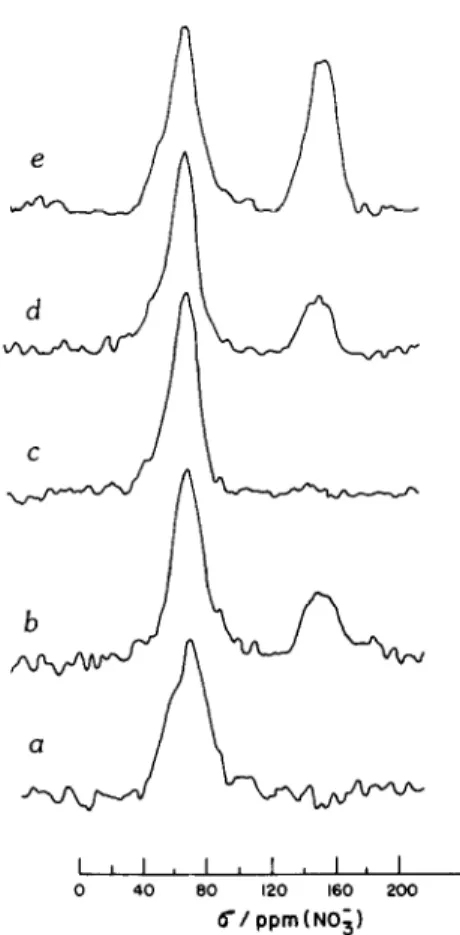
Devco coal, also shows a single line for its sorbed pyridine (Figure 2~). On the other hand, for pyridine in subbituminous coal,
two lines are evident. One occurs at
% 74 ppm, as for the other coals and again can be attributed to sorbed pyridine. The
second line occurs at 158ppm, and this
line must be assigned to the pyridinium
ion, which in solution absorbs between
161 and 183 ppm’.
For comparison purposes, 15N spectra
were also measured for several pyri-
dinium salts enriched to % loO/, in
pyridine-15N. In the case of pyridinium
nitrate, the shielding tensor was general, with ~~~ = 44, cyY = 96 and gZZ = 360 ppm,
which leads to a Cr of 167 ppm. For
pyridinium iodide, where in-plane
motional averaging occursl*, the shield-
ing tensor was axially symmetric, with
zyxwvutsrqponmlkjihgfedcbaZYXWVUTSRQPONMLKJIHGFEDCBA
% _rp e nd Eukr)= 86 p p rn, o (p ra Ue l)=354 p p rn so that 5 = 175 ppm.
The observation of pyridinium ions
implies that a proton has been transferred
completely, so that the proton donor
must be a sufficiently strong acidic
moiety. The degree of proton transfer in
pyridine-acid systems depends on a
number offactors, including the acid pK,, the dielectric constant of the solvent and
the relative concentrations’ 9m21. For
instance, in benzene solution, the degree
of proton transfer was estimated to be
z 50% for acids with pK, values of
2 1.2”. On the other hand, in pure solid
pyridine-acid adducts, the degree of
proton transfer was complete for acids
with pK, values less than z 1.5’l. The
behaviour of surface bound acid
functions is rather less certain. The results
obtained for pure, simple systems do
suggest that proton transfer to pyridine should occur only for acidic groups with
pK, values rather less than 4, e.g.
carboxylic acid functions on condensed
aromatic ring systems, or on aromatic
rings with other oxygen containing
substituents.
15N n.m.r. spectra were also examined
for pyridine sorbed on oxidized coal.
zyxwvutsrqponmlkjihgfedcbaZYXWVUTSRQPONMLKJIHGFEDCBA
Figure 2c, d and e show spectra for fresh Illinois No. 6coal and coal samples which
were oxidized for 24 h and 96 h
respectively. The oxidized coal samples
show intensity at 150 ppm which increases with time of oxidation. This implies that
air oxidation at elevated temperature
produces a significant quantity of strong carboxylic acid functions. The behaviour
of pyridine-15N treated Devcocoal, both
fresh and oxidized, was completely
parallel to that observed for the Illinois No. 6 coal.
The details of the oxidation process as
it occurs in coals suitable for
metallurgical coking has been the subject
of a number of recent studies22-27.
Although there is some evidence that
fresh Illinois No. 6 coal does not contain
carboxylic acid functions2*, most (but
not all studies22-27 agree that such groups are produced during oxidation of coking
coals. On the other hand, there is
evidence for carboxylic acid functions in
fresh coals of lower rank2*-“. All these
findings are in agreement with the results
presented here.
As the relative 15N n.m.r. line
intensities for sorbed pyridine and the
pyridinium ion are virtually independent
of cross-po larization times between 1 and
5 ms, the intensities (after taking into
account spinning sidebands) can be used
to give a quantitative estimate of the
carboxylic acid groups ionized by
pyridine. The fresh Whitewood sub-
bituminous coal had 0.25 mM/g of such groups, the fresh Illinois No. 6 or Devco
I I I I I I I I 11 I
0 40 80 120 160 200
C/ppm(NO;)
Figure 2 CP/MAS 15N n.m.r. spectrum of pyridine-15N sorbed on coal samples: a, Devco coal; b, Whitewood coal; c, Illinois No. 6 coal-fresh sample; d, Illinois No. 6
coal oxidized 24 h; e, Illinois No. 6 coal oxidized 96 h
bituminous coals had none. Air oxidation
produced 0.22mM/g, after 24 h, or
0.48 mM/g after 96 h for the Illinois No. 6 coal, with similar results for the Devco
coal. From acid titration measurements
the concentration of acid groups with a
pK,< 4 has been estimated to be
1.4 mM/g for Rawhide subbituminous
coal, and 1 mM/g for Illinois No. 6 coal’*. These results are in general agreement with our 15N n.m.r. results considering that pyridine is protonated only by strong acids with pK, 6 z 2. In conclusion, these results suggest that “N n.m.r. of sorbed pyridinee’ 5N is quite a sensitive probe for strong surface acid groups in coal.
REFERENCES
1 Dryden, I. G. C. Fuel 1951, 30, 39 2 Barton, W. A., Lynch, L. J. and
Webster, D. S. Fuel 1984, 63, 1262 3 Silbernagel, B. G., Ebert, L. B.,
Schlosberg, R. H. and Long, R. B. Adc. Chem. Series 1981. 192. 23
4 Vasallo, A. M. and Wilson, M. A. Fuel 1984, 63, 571
5 Collins,C. J., Hagaman, E. W., Jones, R. M. and Raaen, V. F. Fuel 1981.60.359
6 Chambers, R. R. and McKamey, D. Fuel 1984.63. 868
I Witanowski, M., Stefaniak, L. and Webb, G. A. Ann. Rep. NM R Spectr. 1981, llB, 1
8 Michel, D., Germanus, A., Pfeifer, H. J. ChemSoc., Farad. Trans.1 1982,78,237
Short Communications 9 10 11 12 13 14 15
Dawson, W. H., Kaiser, S. W., Ellis, P. 0. and Inners, R. R. 1. Phys. C/rem. 1982, 86, 867
Ripmeester, J. A. J. Am Chem. Sot. 1983, 105, 2925
Maciel, G. E., Haw, J. F., Chuang, I. S., Hawkins, B. L., Early, T. A., McKay, D. R. and Petrakis, L. J. Am. Chem. Sot. 1983, 105, 5529
Pines, A., Gibby, M. G. and Waugh, J. S. J. Chem. Phys. 1973, 50, 569 Schaefer, J. and Steiskal, E. 0. J. Am.
Chem. Sot. 1976, 98, 1031
Schaefer. J.. Steiskal. E. 0. and McKav. R. A. Bi&hem.dBiodhys. Res. Commun. 1979, 88, 274
Rance, M. and Byrd, R. A. J. Magn.
20 21 22
Reson. 1983, 52, 221
Schweitzer, D. and Spiess, H. W. J.
Magn. Reson. 1974, 15, 529
Ratcliffe, C. 1. and Ripmeester, J. A. J.
Phys. Chem., in press
Ripmeester, J. A. Can. J. Chem. 1976.54,
3677
Odinokov, S. E., Mashkovsky, A. A., Glazunov, V. P., Iogansen, A. V. and Rassadin, B. V. Spectrochim, Acta 1976,
32A, 1355
Sobczyk, L. and Pawelka, 2. J. Gem.
Sot. Faruduy I 1974, 70, 832
Johnson, S. L. and Rumon, K. A. J.
Phys. Chem. 1965,69, 75
Painter, P. C., Snyder, R. W., Pearson, D. E. and Koenig, J. Fuel 1980,59,282
Regional
News
23 24 25 26 27 28 29Snyder, R. W., Painter, P. C., Havens, J. R. and Koenig, J. L. Appl. Spectroscopy
1983,37,497
Havens, J. R., Koenig, J. L., Kuehn, D., Rhoads, C., Davis, A. and Painter, P. C. Fuel 1983,62, 936
Liotta, R., Brons, G. and Isaacs, J. Fuel 1983, 62, 787
Rhoads, C. A., Sentfle, J. T., Coleman, M. M., Davis, A. and Painter, P. C. Fuel 1983, 62, 1387
Bouwman, R. and Freriks, I. L. C. Fuel 1980, 59, 315
Dutta, P. K. and Holland, R. J. Fuel 1983, 62, 733
Yoshida, T., Tokuhashi, K., Nauta, H., Hasegawa, Y. and Maekawa, Y. Fuel 1984, 63, 282
Fuel and energy research
in Australia
There is an abundance of fuel and energy
resources in Australia, but nonetheless
there are many pressing problems due to the nature and location of our fuels, and
the needs of our domestic and export
markets. Our indigenous reserves of
natural oil are likely to supply some 60%
of our liquid fuel needs up to 2000.
Thereafter, pressing needs for new
discoveries of oil, or for the establishment of synthetic liquid fuel industries, will be
felt. On the other hand, we have
substantial reserves of natural gas, mainly
located on the North-west shelf (off the
northern coast of Western Australia)
some 3000 km from the major energy
markets of Victoria, New South Wales,
and Queensland. Oil shale is another
resource of large magnitude, with readily recoverable material capable of supplying at least 100 years of Australia’s liquid fuel need at current usage rates. Coal is a major resource, used to generate 80% of our electricity and to provide coke for the
metallurgical industry. Coal is also an
important export, Australia currently
being the world’s largest exporter of coal. In spite of the heavy demand, Australia
uses ~0.1% per annum of its known
reserves of coal.
Australia also makes significant use of biomass as a fuel, hydropower, and solar energy. There is also scope for the use of wind and tidal power, and the major deposits of uranium ore are well known. Fuel and energy research in Australia is
influenced to a great extent by the
resource and demand situation outlined
above. The need to ensure continuity in
liquid fuel supplies has prompted much
research into the production of synthetic oil. Over the past ten years this research
has been principally concerned with the
use of coal and oil shale as feedstocks.
Major research, both of a fundamental
742 FUEL, 1986, Vol 65, May
and process development nature, into
hydrogenation, pyrolysis and synthesis
processes has been carried out: much of
this work is now complete. For example
the Australian Coal Industry Research
Laboratories (ACIRL) have finished their
PDU studies of coal hydrogenation, and
the CSIRO has completed its pilot-plant
development of flash pyrolysis. However
the BHP Company Ltd is continuing its
work on coal hydrogenation, and CSIRO
industry studies on oil shale retorting and
oil upgrading continue to be well-
supported, as does research on synthesis
reactions. In this latter area industrial,
government and university researchers
are active.
As noted above natural gas is plentiful,
but remotely located. Therefore new
research is under way on means of
converting methane to liquid fuels, either
by reformation and synthesis, or by new
methods employing partial oxidation or
pyrolysis to produce intermediates that
are readily compressed and transported,
and readily converted to liquid fuels.
Research on coal now has two
principal foci: reduced costs and
increased effectiveness in mining, pre-
paration, and transportation, especially
with export markets in view; and
improvements in combustion behaviour
in power plant, with particular emphasis
on the behaviour of the ash. University,
government and industrial laboratories
are active in coal utilization research,
with combustion for power generation as
one of the main concerns. Combustion
test pilot plants have been operated for
many years by the CSIRO and the State
Electricity Commission of Victoria, and
recently the Electricity Trust of South
Australia and ACIRL have built test
combustors. The principle aim in the
eastern states of Australia is to
characterize the local bituminous coals
for market and to solve operational
problems, in order to strengthen local and
export sales opportunities. In Victoria,
South Australia and Western Australia
research emphasis is on the problems of
local use of coals which may produce corrosive and fouling ashes.
Other important energy research
includes advanced methods of oil
exploration, safety in mines, and
environmental control associated with
fuel preparation and use. An indication of the range of research in hand can be got from the distribution of funds released at
the end of 1985 to support selected
applied research topics, under the
National Energy Research, Development
and Demonstration Program (NE-
RDDP). The funds are:
Research area lO’%A
Coal mine safety and
productivity 2.9
Coal mine site technology 3.8
Fuel resources assessment 1.1
Coal utilization
(carbonization and
combustion) 1.3
Synthetic liquid fuels 3.9
Solar, wind and nuclear 3.2
Energy conservation 1.9
Economic, social and
environmental issues 1.2
In the present short account it is not
possible to note all matters ofsignificance. However a good account of coal research
in Australia can be found in various
papers presented at the 1985 In-
ternational Conference on Coal Science,
Sydney. More general coverage of energy
research is given by the annual
Compendia of Australian Energy Re-
search, Development and Demonstration
Projects published by the Com-
monwealth of Australia, Department of
Resources and Energy, Canberra.
I. IX Smith
CSIRO Division of Fossil Fuels PO Box 136, North Ryde, NSW 2113