
Accepted by: Andrew Scott Associate Professor of Architecture Chairman, Committee for Graduate Students
Iofessor of Architecture, Emeritus Thesis Advisor
,J3ASAUSETTS INSIThI OF TFCHNQLOGY
MAR 2
6
1997
LIBRARIESThesis committee:
Imre Halasz
Professor of Architecture, Emeritus Thesis Advisor
Fernando Domeyko
Associate Professor of Architecture, MIT Thesis reader
Annie Pedret Phd student, MIT Thesis reader
I
would like to thank:Denise Hagenberg, my fiance, for her "long distance" sup-port. I'm coming home!
My parents for always allowing me the freedom to pursue,
and being there when I need help.
Imre, Maurice, and Fernando for your commitment to teaching, thank you for helping me on the road you already walk.
Thesis studio "6", Steve Bull, Daniel Sandomire, Alberto Cabre, and Fred Gutierrez.
3
specifications of book:
Font: Times 10 point Layout: Framemaker V5 Computer: Sun SPARCstation 5
<athena.mit.edu>. Paper: Acid-free Hammermill Laser Print 32#
This thesis is dedicated to Jesus Christ:
Table of Contents
02 Acknowledgements 08 Abstract
12 Introduction
14 List of Guest Reviewers
16
Presentation of Common Ground
December 16, 1996 92 Continuing thoughts 94 Bibliograghy 96 Illustration Credits 98 Notes 7
Common Ground
A place of worship with supporting workshopsWilliam Neil Scholtens
Submitted to the Department of Architecture on February, 1997 in Partial Fulfillment of the Requirements for the degree of Master of Architecture
Abstract
Imre Halasz
Professor of Architecture, Emeritus Thesis Supervisor
Fernando Domeyko
Professor of Architecture Thesis Reader
Annie Pedret
MIT Dept. of Architecture, PhD Student Thesis Reader
He
is an accountant, and works downtown, she is a prac-ticing pediatrician in an adjacent suburb, their children are enrolled in a private school, a mere 45 minute bus ridefrom
their soon to be "home ". While performing arela-tively menial, midmorning, carpentry task, my mind began to consider this family. Realizing that their family deci-sion, for the most part, was a norm in the area, I soon felt troubled.
This thesis explores the church as a (re)emerging place by inestigating three questions.
%4
How can architecture help establish the church as a unifying anchor in a township whose residents repre-sent differing Christian denominational backgrounds?
rl
M AM
How can traditional settlement patterns in the midwest of America be used to inform attitudes and present day strategies to recapture building that is in harmony with the open landscape?
Can the church be activated as a place of personal and comunal belonging by providing additional mid-week facilities, previously provided by the school system?
The site is in Lemont Township, a suburb southwest of Chicago. The proposed construction has projected a form and environment for the contemporary township. The pro-posal will provide a non-denominational worship room in
the Christian tradition, workshops for art, music and addi-tional cultural training, and outside places for concerts, gathering, and worship.
That same evening, I took a walk. Passing house after house- the neighborhood a silent collection of isolated units, each living its own separate life, I came to this real-ization: we are a nation of strangers.
~~1i II*
11
---Introduction
I
have chosen to document the project as a final presen-tion. The text is a transcription from cassette tape of the actual words spoken on December 16, 1996. The images which parallel the text are those image I used to present the project at the final presentation. There are five reasons that I chose to write the book in the manner the thesis was presented to guest reviewers in N51- Lyons X.-I felt this form of documenting the thesis was truest to the
project. This book does not present the thesis as final project, rather it is left as an open conversation.
-"During a thesis, the question is clarified", John Habraken. I have found this to be true. The question this thesis asks became most clear through the final presenta-tion. I felt this was important to include. The book becomes a continuity of the design process.
-I became interested in oral history from ex New Yorker writer Joseph Mitchell with his writing of Joe Gould (known on the streets of New York City as "professor seagull"). The most beneficial aspect of an oral history is that all events that occured and all comments of the people involved come together to (re)form the event on the page. I believe this is advantageous in the setting of a the-sis document for it leaves the reader free to form a per-sonal position on this "history" in the making. There is never selective editing of events or comments which leave the reader at a disadvantage for not all events were
included. I prefer a "just the facts ma'am" approach. Thank you very much.
-I was inspired by the Behnisch & Partners publication "A
Walk through the Exhibition" by Hatje. This monograph documents the exhibition designed by Andreas Uebele, and colleague, Peter Jertschewske in collaberation with Gunter Behnisch. The book demonstrates the particular character of the practice, its kind of architecture, way of working and atmosphere. This is what I aspired to as well. -And finally, this book is for 2/3 of my committee who were not present at the final review. I felt it was imporant for these people to have the opportunity to see, and "hear" explained, the resolution of many questions they have helped me develop. So this book is for you, it is the most accurate documentation of not only the developed design, but also an accurate record of the critiques of the guest reviewers which I felt were thoughtful, constructive, and challenged the project to new levels.
facing page:
photograph of the final presentation in
N-51, Lyon's X: drawings and
Guest Reviewers
Dimitris Antonokakis Principle Atelier 66, Athens, Greece; Visiting Professor of Architecture, MIT
Julian Bonder
Architect and Professor, Buenos Aires Miriam Gusevich
LOEB Fellow, GSD, Harvard
Henry Plummer
University of Illinois, Urbana-Champaign
Larry Speck 15
Dean, University of Texas, Austin
this page:
fig.1 guest reviewers at final presentation. Photograph by Jesse Wu, 1996
Hello, my name is Bill Scholtens, I'd like to begin by reading some initial thoughts that appear in the abstract and then move on to show some slides which will illustrate the thoughts from the abstract. During the slide presenta-tion I would also like to explain the site- its topology and vicinity.
What I am about to read was written about a year ago in the Chicago area while working for a residential framing contractor.
"The month of January brought many awakenings. He is an accountant and works downtown, she is a practicing pediatrician in an adjacent suburban, their children are enrolled in a private school, a mere 45 minute bus ride from their soon to be "home". While performing a rela-tively menial, mid-morning, carpentry task, my mind began to consider this family. Realizing that their family decision for the most part, a norm in the area, I soon felt troubled.
This thesis explores the church as a (re)emerging place by investigating three questions.
1) How can architecture help establish the church as a uni-fying anchor in a township whose residents represent dif-fering Christian denominational back grounds?
2) How can traditional settlement patterns in the midwest of America be used to inform attitudes and present day strategies to recapture building that is in harmony with an open, undefined landscape?
3) Can the church be activated as a place of personal and
communal belonging by providing additional mid-week community activities, previously provided by the school
system.
The site is lemont township, a suburb southwest of Chi-cago. The proposed construction has projected a form and environment for this contemporary township. The pro-posal will provide a non-denominational worship room in the Christian tradition, workshops for art, music, and addi-tional cultural training, and outside places for concerts, worship and gathering.
That same evening I took a walk. Passing house after house, the neighborhood a silent collection of isolated units, each living its own separate life I came to this real-ization: we are a nation of strangers.
Presentation of
Common Ground
<slide 3>
I'd like to show you a few slides to help locate you all to the area.
Along with the slides I would like to reference this map here on the wall of the overall area the project sits to help you visualize the image of the slide with the location on the site the photograph was taken.
<lights go down, slide projector turned on> <slide 1>
All of the slides were taken within a mile of the site. They are images driving west down 13 1st street to the site of the project.
... <slide 2>
What you are looking at here is once was farmland which was sold off lot by lot to developers who in turn are build-ing very large custom residences with immediate
adjacen-cies to unsold, remaining open farm land which too is soon 17 to be developed.
facing page: slide 1
this page: top left, slide 2
middle left, slide 3
<slide 4>
These are upper middle class fami-lies, the houses are in the $400,000 to 800,000 price range. They are three to four level...monsters, densely packed, one next to the other.
<slide 5>
What this slide begins to show is an observation I have made of farms (vernacular building) in the middlewest of America. What this slide is showing is a view into a farm looking north. And what farmers do first in developing land is they establish protection from the strong prevailing west wind. It is a strategy used by all farmers in this area.
This is a view looking northwest of the farmer's open fields, the area where the wind speed is accelerated. Farmers screen the wind in many ways, using most what is readily available. I have seen trees used as in this exam-ple, both coniferous and deciduous, wood fences, stone walls. The materials vary- what is consistent in all is the fact that the edge is a landscape size move.
<slide 6>
19
facing page: figure 2: Upon a Quiet Landscape, the Photographs of Frank Sadorus.
Plate 19 "Sunlight and Shadow"
this page: middle, slide 5
<slide 7>
These next few slides are intended to familiarize every one with the area. Again, these pictures were taken east of the site, driving west along 131st street. This is Saganaskee slough east of the site less than a mile. What you'll find in this area is not deep water, rather alot of more shallow ponds and sloughs.
<slide 8>
This is a photograph showing heavy equipment, and ser-vice vehicles. This photograph struck me as appropriate because it indicates the currency of the development in the area- these slides were taken over the Thanksgiving holi-day. this open farmed land appears to have been just pur-chased and quickly work is being done to ready the land for more "custom" homes. The vehicles shown here will prepare the ground for water, sewer, electricity, and gas, all of which go in the ground prior to construction.
In the background shown with the white buildings, and green roofs is a golf course. Orland Park is "The Golf Center of the World". As you can imagine the adaptive reuse of farmland to golfing is made relatively easily in the area- there are a lot of golf courses in the area.
<slide 9> similar shot here.
21
facing page: slide 7
this page: middle top; slide 8 middle bottom; slide 9
<slide 10>
The next few slides focus on a barn structure east of the site.
What I have observed and appreci-ated most of such vernacular archi-tecture is the directness in the building process. There is always a clear articulation of materials and
the way the building is put together. The builder of this barn had a clear design intent for building a barn appropriate for this site and climate. <slide1 1>
The building is organized north to south with large openings occurring on the sheltered east side, this is a direct response to the prevailing 22 west wind.
<slide 12>
The board to board siding nailed to the heavy timber frame is a simple, quick and elegant solution to shel-tering the area from the elements.
Driving rain is addressed by 1 x 2 boards placed over the lap of the siding boards.
This frame and skin rests on a four foot high concrete knee-wall foundation, an appropriate solution for protect-ing the wood from sittprotect-ing under the level of driftprotect-ing of pil-ing snow. The high concrete also protects the more fragile wood from the level of bumps and dings which happen to a work building everyday.
This anonymous building is intelligent, it responds to the needs of the farmer most efficiently. Without concern for style or current trends in architecture, rather this building was generated by need, function, and economy.
<slide 14>
This barn for the reasons I've stated is timeless and beautiful.
It is this attitude toward building and materiality that I have aspired to in the design of this place for worship.
23 facing page:
slide 10
this page:
left; 13
middle right; slide 11 middle bottom; slide 12
24 FD It is related to...what um...some of the wind, habitate,
how they habitate. This condition. Maybe you could talk more.
Yes, right. I'll talk more about that with the project. As stated that barn was east of the site maybe about 1/2 a mile.
25 <slide 15>
Now the following (remainder of) slides are taken of the
slide 14 site for the project. This is a slide of the stream which
binds the east and south edge of the site. This particular
this page: view is the furthest north (131st) and looks south.
4 --p
Chicago
r4
26
<presentation is directed to two maps on wall> The site is in Lemont township, a new community 20 miles southwest of the city of Chicago. The site for the project occurs at the meeting of two major transportation (roads) geometries. The first geometry is Archer Avenue, a road that twists, and bends and for the most part grew in a southwest direction straight out of Chicago following the Cal-Sag water way. This man-dredged canal essentially connects the Great Lakes to the Mississippi River and onto the Gulf of Mexico. The road bends and traffic slows in this vicinity of the site to negotiate a series of watersheds
which run perpendicular (n-s) to the road. It is at this point where the two geometries meet. 131st street is on the car-tesian grid laid out by our friend Thomas Jefferson, most all of the midwest is still bought and sold under this sys-tem of land division.
facing page: figure 3: satelite photograh of Chicago and surrounding area. Satelite photo-graph property of Rand McNally Map Inc. 1994
this page:
figure 4: site map of Cal Sag Canal, with neighboring downtown Lemont. Map purchased from U.S. Geological survey, Champaign, Illinois 61820 !V-1 k IP R, S R I 1 1, WR I W,119 _ T E 9'
x-R "7a
two
14age
old ek- %K Y A V_ V 4 Gd L;I--% -s-L C Ic A. 117 L; N 0. CIA t r C, _r ... . ... " Y11 31 12-r CO UNTV ST_ 4plaktz 1tv a ... ... Q, T lot 41 N. _N _R K -0) %Ar 10 iz 2728
<slide 16>
The site for the project is here, organized along this stream which opens up to a larger body of water, which I will show you shortly.
This slide again is trying capture what kind of stream this is and give you all an image...sort of bring you to this place that has really inspired the design decisions. The stream winds and bends along the way. In the background and to the right is the site with its south facing slope. <slide 18>
This is an image of the stream making its way under 131st street- as you can see oaks line the area. There is a 16' difference in section from the water level to the top of the road.
The foreground of this image begins to communicate the natural character of the water as it flows deeper into the site. The stream begins to descend and as it does so, a series of these white-water patches develop as the water tumbles over the native limestone. As you walk further into the site, away from the noise of the road, the area resonates with he soft sounding of water- a physical
feature of the site that heavily influenced the siting of the worship room on this large site.
facing page Site plan of Common Ground. The
"mother" stream running north to south
along the south and east edge of the site is
shaded.
this page:
top left; slide 16
middle; slide 17
29 <slide 17>
And again this is an image of the stream making its way under the tunnel of 131st street...the east-west
road that runs in to Archer Avenue.
/ .1<
*: *~ .
t
K
facng page: early sketches of the forces on the site. The site has a series of water-sheds, carry-ing rainwater down the slope of the hill in a north-south direction, to the mother
stream. This physical fact was first detected from the U.S. Geological Survey.
<slide 18>
The slide is showing something I detected first on the site map drawing and when I returned to the sight was pleased to find the snow revealed this fact on the land. What you are looking at is what I see as a small but critical fact for this page:
right; slide 18
understanding the particular essence of this site. The "main" stream is flowing in the background and in the foreground of this image is one of a series of flowage ways which flow in to the main stream.
This direction of flow or movement native to the site is one that I have intensified with the forms of the buildings.
32
This slide shows more of the dynamic character of the stream as it makes its way through the site. A stream that was very winding and curved, straightens out a bit and heads down to more open land with the pond. The stream makes a slight bend and it is particularly here that the reso-nance of the water fills the site.
<slide 20>
A slide showing first the carved nature of the south and east banks of the stream and secondly showing a neighbor-ing residence, a view allowed only by the season.
<slide 21>
A view showing the pooling of the stream beyond and in the foreground the stream now very narrow and cut deep into the land. The land covered here not by large hovering oaks and other trees but of wild grasses.
33
facing page:
slide 19
this page: middle top; slide 20 middle bottom; slide 21
<slide 22>
Towards the lower part of the site the lands become more prairie-like...the trees you see in the background of the image. This is the site of the worship room. A place screened from the noise of the road, is filled with he sound and sight of water.
The building is sited here and will be talked about more in a little while has been designed by taking major clues from the existing site conditions. There has been an attempt
facing page: made to let the building intercede in a way between the slide 21 landscape of the trees beyond, and the field in the fore. A
connection, a continuity of these two different landscape
this page: experiences.
section showing transformation of oak trees to prairie grasses
<slide 23>
This is a slide showing the open water pooled by the crossing of the main stream and a large run-off link. The grasses appear in the foreground the trees beyond.
<slide 24>
This is a slide that has been very important in my thinking about how a member of the community might experience this land while sitting in one of my buildings. The worship
room allows for views of the land-scape beyond. This attempt to con-tinue the experiences of the landscape to the interior has been of major importance. 37 facing page: slide 23 slide 24 44re:
<slide 25>
Now working back up the site and getting closer to the dis-cussion of how this building sits on this place. This is a slide showing an existing access road to the site which I have chosen to make the main vehicular entrance to this place. The access is from 131st street- in a moment I will show you this access on the drawings and on the model. <slide 26>
Another view showing the way in. The red car in the
dis-tance... here... is driving on Archer Avenue.
<slide 27>
And finally this is something that was of particular interest to the project that I did not notice until my third visit to the site. It is a slide of the existing house at the top of the
slope adjacent to Archer Avenue. The image here shows this owner with an old windmill which assumable pumped water from a well.
Ideas of how man has worked with wind and water in the area have pre-cedent. And the wind being both a friend and foe has been influential in the design of the project.
facing page: middle top; slide 26 middle bottom; slide 27
this page left top; slide 28 (final slide) middle; figure 5: Upon a Quiet Landscape, the Photographs of Frank Sadorus, plate 57, "Wind and Ice".
<end of slide presentation, lights go up,>
So with that as an introduction. I'd like to continue the presentation starting with the access to the place from
131st street as I have just showed in the slides, and intro-duce this environment I have tried to establish in the com-munity of Lemont.
This is the access route coming from the north which then bends and heads west across the top of the site to the park-ing area here.
<points to drawing on wall and model>
7-7
3
" -1 4-_ -7 -
--overall ground plan, workst N-S direction, worship sp a facing page: -site plan this page: ops building ace orienting* long stream. - --- 7 *~7IIJ -41
The turn heading west to the park-ing area gives you a view of the life of the place. Through the screen of the oak trees, there is visual access to the north wall of the church, and to the east exposure of the work-shops ...as you can see here in this photograph.
<points to photo>
'4' ', ' ' ' ' '
.4 .
43
model photograph looking south from the access road.
early sketches showing development of the access road- drawing not included in presentation. facing page:
The building is organized along a series of these rough-fin-ished concrete walls. A wall system that extends beyond the territory of the building. They serve, or were placed as
a direct response to the prevailing strong west winds in the
midwest. The walls create an environment on the inside of the complex (east of walls) which is sheltered, calm, and protected for life to inhabit within. This act of orienting one to the place- orienting man in the landscape is a con-tinuation of a traditional midwest strategy for settling on open land and sustaining life.
<directs attention to site section, and model>
below; section through site- cut from Archer Avenue to the sloping bank across the stream.
I'd like next to talk about the "avenue" or easy access" that I have established which bring the users from the parking area through the edge (concrete walls) and to the common ground within. It is from here the workshops can be accessed by moving to the left or to the right, or one could continue through to the worship room.
What I have done...as you can see the site is sloping...the slope is 7 degrees. The strategy for organization and movement was that the building would move primarily in the north-south direction (against the contours) the reason being so that I could have a natural section along the spines of the buildings. From there, with that established, people move with the contours of the hill, perpendicular and through the buildings. This decision was made because I wanted an easy access to all buildings-for all people. Definitely an intention when matched with the sloping site required special consideration and sensitivity.
47
facing page: studies showing the early developments of
the "avenue", image not shown at
It has been important to me how people will come to this place- this experience of movement through the site.
Understanding that Lemont Township is a suburb and as idealistic as I wished to be saying that people would walk to this place from their nearby homes, that would never happen, people in the suburbs drive everywhere they go. So the experience of going from the car seat to the church seat or the workshop seat.. .and this connection, has been designed very carefully with events or objects along the
way.
The first event that I've established initially from the park-ing area is a diagonal view corridor. There is a visual con-nection to the stream and the pond through the wall from the parking area. This was accomplished by a simple shift
in the wall planes around the entry as you see here: one wall pushes back, another pulls forward relative to the ref-erence plane and with this the entry is made and a diagonal connection made, linking 2 polar opposites, the parking up the hill, and the water below and beyond. <The connection is not a line rather an experiential link made by the user.>
49
this page: photograph of model, view looking to the south-east toward the stream.
The second event, or object is this here...
<points>
...structure that comes out to meet. It is a large wind chime. It is the first object one encounters when walking from the parking area and acts as an acoustic buffer...a kind of preparatory thing. The chimes are activated by the winds. This is a variable element, and this describes this elements second duty. The concrete frame along with sup-porting the chimes house three large wooden sliding doors, which can be closed in the winter to block the cold strong winter wind from entering the complex. In the summer, the doors can be opened to allow the summer breezes to ventilate the avenue of movement and the out-door open-air space. The piece, as stated, acknowledges the wind, and develops a statement I've tried to make: that the wind is both friend and foe. It is something you need to protect yourself from, but on many occasions is nice outdoor experience, a mystery of sorts that is intensified
by the chimes.
<walk and point to photographs of the model>
This experience is trying to dig deep into what is this land about,
what are some fundamental facts of the land that can reveal an essence about this place...these people. The landscape of an area and its particu-lars of climate influence and form a culture. This is something I believe
very strongly and have made every attempt at addressing this building (thesis) that is site respondent and appropriate for the people.
facing page: 51
design development sketch of the concrete frame. Hung from the frame are large, operable,wooden "barn" doors, and also a wind chime.
model photograph showing the manual operation of the large wooden doors. Opening them allows the summer breeze to ventilate the "avenue"
hZ r4.A
....-.-.-.-
..
'I
The next element (third) in the series is the raised access level of the workshops for the community under which benches are provided for sitting in the shade.
The decision to include this element (overhead pass) was contemplated for the past four to six weeks of the project. A criticism at the content review was that the space under such a "bridge" was not pleasant, and why not just elimi-nate it.
Well, I chose to include the "bridge" for three reasons. First was most pragmatic. I felt it was important to the life of the workshops that they function as a continuous as pos-sible with the raised access level, people are allowed to move in both directions: on the ground for arriving and departing in the direction of the contours, while people in A the south shops could access the north shops without
hav-ing to go down and then up stairs.
53
model photograph showing the doors closed.
this page: three diagrams supporting the decision to include raised access level.
Secondly the access level reference the slope of the hill. The floor level and its relationship with the sloping ground level is apparent from the outdoor space and also this ref-erence created usable section to the building (+ 20').
The third reason was a bit less pragmatic and deals with he image of this place. I felt, considering the higher level of education the client brought to the project, a gate-way was appropriate. Most of the parents in the area have been col-lege educated and are familiar with a campus-like setting, and this is similar to the environment here that I am pro-posing.
this section through the workshops shows raised access level, an external walk-way 18' above the ground connecting north and south workshops.
-A-c-r
r
Before I continue with the other object along the avenue,
I'd like to stop at this building and talk briefly about my
intentions for it. I have referred to them earlier as work-shops.
It is here that midweek activities for the community would occur. The thesis asks the question can the church (re)emerge as a place in a community where people come together? Well I asked myself, How can that happen? A church will obviously draw pope for part of one day of the week but what else...what else? What I have done is pro-vided workshops that can begin to address needs for the community.
The schools due to budget cuts no longer provide art or music programs sufficient in the area. Such an activity could occur here as a mid-week, after school activ-ity...um...painting classes, pottery, drawing & sketching down by the stream. And music, piano lessons, an orches-tra, a brass band, outdoor music performances on the lawn. Voting for the town, a place where you go for flu-shots. The goal was to design large spaces and small spaces with maximum flexibility so the spaces could be used in a vari-ety of ways. To design for the unexpected.
I have also provided a place for large gathering to occur for exhibition of the student work, and for music recitals and performances in this room on the top of the hill
which is internally accessed by all the workshops. Along | with being a place which activates the community mid-week, this area would also be used on Sunday for sunday school rooms and Bible studies.
I will come back to more of this in a bit. I feel it is
impor-tant that I finish the walk along the avenue on the way to the church.
So I'll continue now with the worship room...
(reviewers getting up and standing around the model) ummm...
<unintelligible>
57
a transverse section through the north workshops, and multi-purpose room. Pri-mary material used is engineered wood.
<point to model>
site section showing the performance/exhi-bition space, and an elevation of the church- view walking east along "avenue".
60
Just to continue with this walk here.
Getting to the entrance, the final object on the path is this tower. A tower housing an external stair to the balcony in the landscape ...adjacent to the lawn. A concrete structure that continues through to the interior of the worship room providing a balcony at an upper level. This is shown on the large section here.
<point to drawing>
So I would like to talk about the worship space: the inter-nal space that is created, and language of building that is being developed here.
In trying to design a place of worship for this community. The members come from a variety of different church backgrounds. And so one of the questions I asked myself was: How can this building talk about that? A diverse community and a proposal that the church can function as a gathering place.
61
facing page: scection through worship space, looking north to the "avenue" reference level. Upper level balcony, accessed by external stair in tower, has two faces. Participates in the outdoor open air space as well as the worship space.
What has given the most information, and has provided me a way to "talk" about this dynamic group of people in the context of architecture, and most inspirational in finding something common among the people and of the religions is first of all the quality of light in the space. Light is a common denominator, and recognized as a sign of divinity in all religions. I was pleased to find this piece of writing
by Christian Norberg-Schultz, he says,
'The study of light.. is something more than a mere inves-tigation of illumination. Light and things belong togethe; and every place has its light. Light, things and places can only be understood in their mutual relationship. The phe-nomenology of things and places is also the phenomenol-ogy of the sky. The sky is the origin of light, and the earth its manifestation. Therefore light is the unifying ground of the world'.
And not just that light is important but how is the light has been my mission. And what has fueled this thought and proposed worship space is this image here.
This image, is from a book titled, Upon a Quiet Land-scape, The Photographs of Frank Sadorus. This image was taken in the area of the site...probably about 40 miles south in the central Illinois Kankakee River valley in 1909. What I see here, or better what is appealing to me is... MG I can not see. It is too high. Can you read me the caption you wrote?
Oh yeah. The caption reads, 'This extended family in cen-tral Illinois has taken to the shade of the poplars. The pleasant afternoon is one to be enjoyed in the landscape. The light is diffused, with patches of direct light and shadow in adjacent open areas. Views beyond the imme-diate "sanctuary" through the screen of the trees. A gentle breeze, and the sweet smell of the grasses contribute to this natural space for worship and fellowship.
And what was inspiring to me among many things is the natural or informal way that the family has gathered. There is a quality of place here that the family gravitated toward in the this open landscape. And this was of much inspiration to me.
63
figure 6: Image for the worship space in Lemont. Photo from book, Upon a Quiet
Landscape. the Photographs of Frank Sadorus. Plate 61 "The Sadorus Family".
I wished to capture the fundamental experience of the light which surrounds this family gathered together.
The experience can be identified as diffused light, even and gentle light composed of extreme lights and extreme dark. And under the canopy of the tree branches, there is a sense of a space being created for gathering to happen a ceiling of sorts but not a flat, monotonous ceiling, rather what is perceived as we all have experienced is a sense of section above this"ceiling"...of depth in the canopy above. Layers of light created by the branches above which pene-trate to the gathering space below.
Despite its depth this ceiling remains light and
airy.. .dematerialized... in a way there is not a sense of the extreme weight above.
So I have abstracted these qualities of this gathering place and wished to create them in this worship space. I have applied these qualities, and designed for this quality of gathering for worship space for many different people in the community.
64
I believe that of all the difference in backgrounds the
peo-ple have, what they have in common is not only a shared spirit, but a shared sense of space & light that is particular to this area. I wanted the worship room to be an extension
this page: longitudinal section through the worship space, looking east. Roof structure devel-ops a language of light scodevel-ops and diffus-ing pannels, this an attempt at creatdiffus-ing a depth to the roof.
So I would like to talk about the design of the roof of the worship space- for me this is what the space is all about. Allow me for a moment to explain how this is being done. The form and the architectural language for me is only "a means to an end"-the end, and most important is the
inter-nal experience of the room.
I've tried to create a large section or depth to the roof, so much that the section of the roof is of the same dimension as the room from the floor to the bottom of this concrete beam.
<point to section>
Spanning between the concrete are five large (100" deep) engineered wood beams. To make this beam seem weight-less, airy and not create such a feeling of compression, there are a series of light scoops flooding the beams and interior with natural light. To diffuse any and all direct light from entering the space past the ceiling...
I've brought here a lamp to show the intended light effect in the roof.
HP Bill, could you show us the light in the model? <take roof off model and hold against the lamp for the reviewers>
I have introduced a system of reflecting panels, which
"hold the light" in the ceiling. This effect illuminates the depth of the space in the ceiling and creates again layer of light above the worship space which fall gently to the floor.
See the way the roof opens up. Light is scooped down and reflected
back up, this illumination cre-ates....well sort of an infinity to the height of the space, it would be hard
to determine how high it is to the underside of this scoop.
67
this page: model photograph; roof study investigat-ing the architectural strategy for "hold-ing" the light in the depth of the roof structure.
.. ... ........ ... ... ... ... .. ... ... ... .... ... ...
To be quite honest of the motivation. Chicago gets pretty warm in the summer, and one of the worst church experi-ences for me is having to, for an hour, sit in a hot, stuffy sanctuary. The panels for me help create the temperature of the space by controlling the light.
LS Are they birch slats? No birch plywood.
I have worked hard to develop the way this light could be
"built" or "earned" in the space. It was important to me that the roof be "believable" as an idea both conceptually and tectonically (poetry of joints).
HP What are the panels made of..?
The panels would be smooth birch plywood panels hung from a steel frame.
continual studies of varying light effects produced by the roof- scoops and panels, as eliminate all direct light in the space.
this page: diagram showing natural light intentions
Yes, the panels are opaque. The principle behind the pan-els was to deflect the hot direct south sun...
to hold the light...
facing
page: HP Are they opaque?70
MG Why did you open the roof to the south if that is
where the hot sun comes from? The heat...
I opened the roof to the south as to not design the space for a specific time of the day. And with south light the room would receive light from morning till evening. Where as orienting the roof in any other direction would create a time of the day the room would be most desirable. So that was the logic behind it, and I thought that I would be able to control the light with the panels.
MG It gets very hot in Chicago, I have been there. Yes, I know it does, I've lived there my whole life, the cli-mate, however, is not tropical, and from my experiences and observations, the light is controllable in the few hot weeks of the summer.
MG I have been to Chicago many times in the summer and it gets very hot and humid...(nervous laugh) <pause in conversation>
71
facing page:
model photograph of the south west cor-ner of the church. Roof scoops open to the south to allow intended lighting effect to be active from morning to evening.
In addition to the roof, and the light strategy, I would also like to talk about two other intentions that give form to this room of non-denominational worship. They have a little more to do with the organization of the room, and the movement through.
First I'll explain the main access to the worship space. Continuing along the avenue you enter a compressed space- the so-called entry- with a 12' ceiling height. Peo-ple walk to their right and enter directly into the worship room at an upper level.. .this level an extension of the ave-nue, which now becomes a balcony for the worship floor below. A member could choose to remain in the balcony, or take a large stair down to the floor. This stair moves you down and out of the structure temporarily. The land-ing gives a screened view of both the outdoor space and view of the avenue you arrived on.
Then a turn is made and you finish the decent (-10') to the level of the main worship space.. .which because of the slope of the hill...is again on grade (not a basement). Grab
upper left; diagram of labrinth access from the "avenue" to the worship space. middle; enlarged drawing of the worhip space.
*sC~*'*
73
-r-S
enlarged section of small m meeting spaces adjacent to t porate w
I wished to create small spaces adjacent to that of the large space. These spaces are small group meeting rooms or chapels is another word. They are located under this bal-cony level as you can see in this photograph of the model, and are screened from the activities of the open air outdoor space. These spaces open up to the large space. It is between these chapels that the worship space can be entered secondarily.
A scenario imagined which would activate the outdoor space is that this grassy area could become a place where people meet, talk, or sit on the ground before the service, when the service was to begin you could simply enter the
space from the side, and not go up the hill, go in the
church, down the stairs, and back to the level you just came from.
.... I felt it was important to try to bring back spaces for
med-itation and group meeting in the worship area- particularly for such a diverse congregation. The program I wrote out for the intended use of these spaces was this:
A quiet place for people to meet, a place in a worshipful setting that confidential talks could occur with the clergy
facing page: (possibly new member inquiries), a place to read, a place
editation and for prayer. I felt it important that in this building of
wor-he large cor- ship I try to promote both personal meditation, and large orship space.
more corporate worship, this is fundamental to the
Chris-this page: tian faith. These rooms as seen in the section...have more an intimate feel.
agram o movng roI t e out UoL open-air space, past the meditation
spaces, to the worship space.
To the west is a wood screen, giving privacy to the place from the out-door space, and within are windows that could open to create the
experience of being slightly touch
by the sun and by the wind. The
ceiling of the space is lower, more intimate, bound by the level of the balcony. The rooms open directly to the large space but doors are
pro-vided to close the rooms for acous-tic privacy, and each room has a
slightly different size, and level: they cascade down and into the
slope of the hill, a contrast to the solid unforgiving level of the main worship space.
<unintelligible>
<unintelligible short reply tot>
~~1~
interir nhoto ra h nf, ar
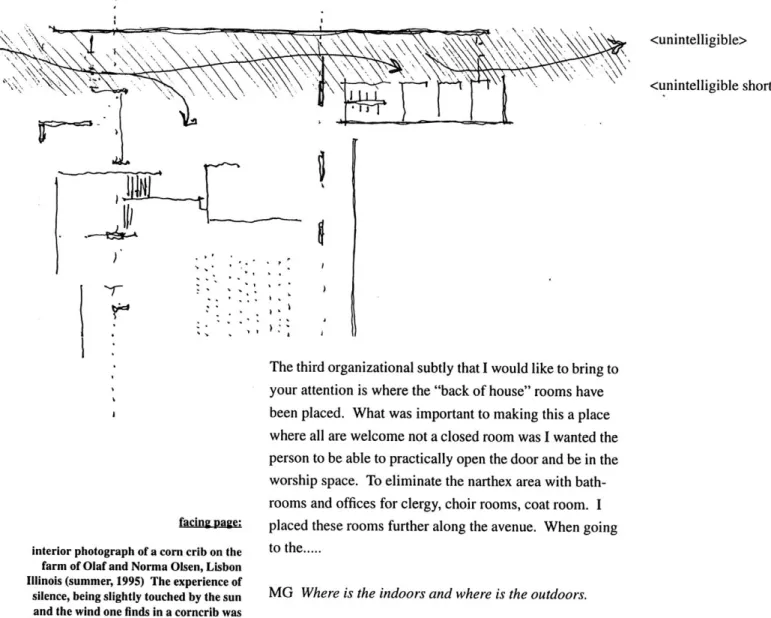
The third organizational subtly that I would like to bring to your attention is where the "back of house" rooms have
been placed. What was important to making this a place where all are welcome not a closed room was I wanted the person to be able to practically open the door and be in the worship space. To eliminate the narthex area with bath-rooms and offices for clergy, choir bath-rooms, coat room. I facin Rage placed these rooms further along the avenue. When going
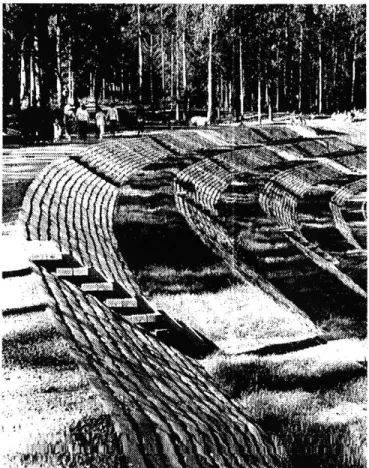
e to the... farm of Olaf and Norma Olsen, Lisbon
Illinois (summer, 1995) The experience of silence, being slightly touched by the sun and the wind one finds in a corncrib was of much inspiration
this page: diagram of the coninuity of the "avenue" to the back of house area, and through to
the landscape.
MG Where is the indoors and where is the outdoors. These are the doors to the worship space, this is the out-doors...
\ LS What is the material quality of the open outdoor space, would it be stepped, or paved?
My intention for the area was that it be grass, a large slop-ing lawn with a few shade trees. The area be for sittslop-ing, gathering for outdoor worship or concerts, overlooking the pond beyond. I have intended to plant a row of trees directly behind the platform area to better contain the open space. It is bound by the south shops to the west, the wor-ship space the east, the avenue to the north, and the screen of trees to the south.
MG Is this area open too, or does it have trees?
<point to land west of the walls>
I apologize the model is unclear in that sense, there is a collection of wild grasses and small oak trees in that area. MG In this area?
Yes.
79
facing page: model photograph; view from the river looking north to the outdoor open-air
space.
this page:
figure 7: image of outdoor space in Fin-land, designed by Siren. Not shown at
Another aspiration for the worship space...along the line of existing site conditions ...was that the room be as open as possible, incorporate the landscape experiences and allow them to be integral with the interior experience. That the worship space, which is primarily a contained space, be an open expansion of the landscape. The first manifestation of this is the back wall of the space behind the alter. This area has a row of glass doors which allow for views of the screen of wild grasses to the stream. They also open to ventilate the worship floor in the spring, summer and fall.
this page: diagram of the mediating role of the church on the site. The canopy of the oaks
is extended through the roof, the grasses a
experiencial continuity on the floor level of the space.
site section through worship space
Excuse me here,
<make way through the standing reviewers> I need to talk about this drawing here.
As mentioned in the slide presentation, the existing land-scape is one of oaks and then wild grasses. the worship room sited on this edge tries to again incorporate this site fact and act as a mediator between the two. The canopy of the oak grove is extended in to the roof and ceiling of the space, and the worship space opens at the human level (glass doors) to act as an extension of the grasses right in to the worship space. The space attempts to mediate the landscape...sort of capture this other dynamic.. .blur the edge of...
(1?
(~;i:~
ii
(r~i)
~ '~'!74f
7~
b:
~l~
k7~4!2i ~
~this page:
-5E
83
E--
-image of five site sections on one sheet as it appeared at the presentation. They are cut
MG Could you talk about how these two building are
con-nected.
How they are connected?
MG... What is the program you intend?
The program is more for midweek community activities. After school music and art facilities for kids of the
neigh-borhood would be here, voting, community health care. Basically I have a cry for this community. It is an upper
middle class area, the parents are wealthy and want their children to have other training in the arts. The schools
have cut these programs from their budget.
The thesis asks the question, can the church, if it answers to these needs and provides such facilities be a place where community members would come during the week.. .trying to make the church more of an open organi-84 zation. It is my experience through living in the area and talking to people that the few "community centers" in the Chicago-land area fail simply because they don't meet the needs of the community. I have projected a form and envi-ronment that addresses just this.
What I intend is for this to be a place where maybe not
everyone goes to the church. It is a campus where mem-bers of the community come, and interact on a more day to day social level. Parents dropping off and picking up kids... So the spaces I have designed for are flexible, the workshops can be open or subdivided, the room can open to the halls for expanded needs.. .roofs open to the east to allow east lighten to the art areas.
<reviewers take their seats>
LS You have something of an irony in um.. .you have a lot
of little points which one could quib with, but in general the design is really accomplished. I think its an exciting building in the landscape. The poetic way people move through it. I think there's a real rethinking of spatial vol-umes, the buildings appear well thought, and there are dif-ferent uses of religious space shown
here...materials... there is a careful consideration of the overall composition. I don't believe for one moment, how-ever, that this building addresses the issue of community in this site. Anchor churches, new churches are located in communities... where people can walk to them... neighbor-hood churches that merge with communities. I could imagine this church more in a neighborhood.
4ZI-7; 4 k
The area is growing and being developed so rapidly (as shown in the slides), that this whole area will be.. .accross the street here is a subdivision that grew in one and a half years.. .overnight.
LS Although what it says is all about being away from.
What is says is all about being in the woods, in nature. I mean the idea of a church being in the woods was a for-eign notion until very recently. And its beautiful, this notion of spirituality in the woods and away from the hus-tle and bushus-tle of life, or even away from the life of the neighborhood. But I think one of the first moves you did that loses this sense of community is by putting it on an open virgin piece of land, and the second thing is your site plan and how you've pulled these two buildings apart. So that
if
I happen to be at a recital, I probably wouldn'tcome in contact with someone in the lower workshops, probably wouldn't come in contact with someone in the lower workshops, probably not come in contact with the choir; probably not come in to contact with somebody who came to visit one of the chapels. There is a few missed suburban notions in the siting, that might not allow for informal interaction. But once again, the idea of being separate, being in a wonderful spot, by myself, I really don't think though it's about interaction.
In response to your comment, what I tried to do first was I completed a series of organizational strategies in drawing of how the workshops might interact with he more "sacred" facilities on this site. I asked the question, what is the relationship between these two aspects of the
project. and what I have chosen is to not create a building "center", with all internalized access between the pieces, but rather to "connect" them with he movement through the site- creating what I have called the Common Ground-this easy access or avenue as referred to earlier. The avenue becomes the heart of the program because it is
the major connection from this area here to this area here, the protected outside space.
<point to the parking and outdoor space>
It is along this route that all people travel on, the landscape become the point for the informal interaction. From this point, you gather and then go to the specific place.
So, I've used the landscape as the solution. For me the thesis became not about creation a center or complex on the site. To be quite honest, the natural qualities of the site really moved me, it was powerful, and began to control the solutions. I felt compelled to build in the land
scape- incorporating the oak grove, the tall grasses, the stream, the pond, sun, wind.
85
i.~
HP What is it about the site that most inspired you... was it
the wind...the idea of water..the sun?
That's hard to answer, I believe the intention was not to singularize elements of the site, but to try to enhance the polysensory experience that exists, address the wind, the
sun.
<unintelligible>
HP Is the water important to you?
Ah, yes the water has been very important to me through the whole project.
HP Because then I could see the place engaging the water much more aggressively.
Earlier in the design stages of the project I had a scheme that organized itself along the stream, and at one point the building crossed the stream. I decided to back the building away from the water, not disturb the stream, this allowed the existing path that parallels the stream to remain usable.
.4'..'
tl
oS
.... ...
this page:
earlier proposal for the project, hard-line sketch with color pencil
lz:
87
MG There has been much talk about the siting of the
building and question have been raised about the commu-nity sense of the building...how the building backs off and wants to be alone. Well, I like the solution very much, there is much sensitivity to the design and the building feels very comfortable, I think you made a mistake by not
earlier on stating that the building is a landscape solution.
You talk about the winds, have responded to that and with
the architecture solution. It begins to show that these are the influences of the building, and give the building a sense.
What I see here is more of a landscape, or rural proposal for building in the suburbs. Today what is seen most is
more urban models of building trying to be suburban. The second thing which is more unfortunate is that this area here is also a clearing and that takes away
from
your open space. The notion that this is the landscape, and this is the clearing would bring the place together in a more power-ful way. Giving a quality to the space, the air isbrighte:..whatever
But what I see is more of a rural solution to community. That gives the notion that this community is part of the earth, and more of a village sense to the place. The one thing that I am curious about when looking at your site plan is, do you know where the flood plain is?
I'm not aware of exactly where the flood plain is, but, what
I've done is a series of studies which are not on the wall. 88
In those studies I have looked at the houses in the area along this stream, following the water, and measured how close most houses were built to the edge of the water. The norm was 60'-75' from the edge of the water. And consid-ering the sloping hill and the way the hill continues to slope, and the relative distances of the slopes to the hill, this is not the area that would flood, rather the land south of the stream would be and is the flood area. There was a tension that I realized between the building edge and the water and I can say with confidence that considering the site of the building on the hill, observing the local tissue of distance from the water, and the fact that the land more south is flat- I feel confident in the position of the building relative to the flood plain issues.
NJ (Nancy Jones) Excuse me all, I don't know if this is good news or bad news for you Bill, but we have about 10 minutes left.
That's good news. <all laugh>
LS I don't think its a problem, and one of the things I'd
like to do in the remaining minutes is talk about the reveal-ing of the light which is a very, very sophisticated attempt at dealing with the light in the way you talked. What I'm
interested in is the way you've chosen to reflect, I have to say, I'm a little bothered by the hardness of them, they seem to create a vast darkness. I mean if you would have
I don't think you do yourself anyfavors with them. -you've already done a lot to deflect the light, and I'm not really sure they do a lotfor you, but if you do use them, I don't
think they're those flat black surfaces. For instance, on a winter day when there is a lower penetration of the sun, you wouldn't want them there at all... it would be very nice.
HP Yes, I would say the same and the photographs show that a lot of light is blocked out by the opaque panels. I don't really even think you need them at all.. .you've already created a thickness to the ceiling that the light is filtered through.
MG I am still worried about the south exposure, and
per-haps the roof is over designed.
through looking at other church buildings, what happens, or what the architectural strategy is for directing the focus of the congregation is not the orientation of the building or seating, but rather it is the direction of the light, and the view or focus follows this direction. So that is why the orientation is such.
What I started with was relatively non-directional space and brought direction to the space by the direction of the light and outside view. The original intent of the space was to just provide this more natural quality of light in the space, no pews, but chairs that could be organized in a variety of ways...the notion that gathering should be more informal, as in the landscape under the trees.
<unintelligible> Over-designed?
That is not what I said MG Yes, more complicated with the panels and all, and I
think the question is still the orientation because, the building from the outside, say when arriving from the parking you would expect the church to face this way, when I look at the plan, Ifind out that in fact you turned everything this way, the inside spaces faces here. And given the kind of orientation the way most Christian reli-gions face east, I was wondering why that is why you faced the room this way. That is my question.
The orientation of the alter in the space was something that was particularly challenging, and the decision was not made in accordance of an iconographic "rule". Rather,
FD With the light the fact is the building should look as a monotheistic ritual, you talk about the light so what look like is happening is it is polytheistic. Because in fact here you have many gods here, every god has it's own canal of light, and I think first there is difficulty in this way for the community. The problem is the lack of integration of the building and the patio, and....produce canals, I think the project suffer from a lack of walls in this direction (E-W).
They would penetrate the landscape and the inside. In the
is direction that start to activate this tiny, tiny patio that needs more work. What it is, is a lack of architectural ele-ments that produce a reading that space being in common


![Elucidation of a key position for acyltransfer activity in[i] Candida parapsilosis[/i] lipase/acyltransferase (CpLIP2) and in [i]pseudozyma Antarctica[/i] lipase a (CAL-a) by rational design](data:image/gif;base64,R0lGODlhAQABAIAAAP///wAAACH5BAEAAAAALAAAAAABAAEAAAICRAEAOw==)