Publisher’s version / Version de l'éditeur:
Canadian Journal of Civil Engineering, 12, 3, pp. 617-623, 1985-09
READ THESE TERMS AND CONDITIONS CAREFULLY BEFORE USING THIS WEBSITE. https://nrc-publications.canada.ca/eng/copyright
Vous avez des questions? Nous pouvons vous aider. Pour communiquer directement avec un auteur, consultez la première page de la revue dans laquelle son article a été publié afin de trouver ses coordonnées. Si vous n’arrivez pas à les repérer, communiquez avec nous à [email protected].
Questions? Contact the NRC Publications Archive team at
[email protected]. If you wish to email the authors directly, please see the first page of the publication for their contact information.
NRC Publications Archive
Archives des publications du CNRC
This publication could be one of several versions: author’s original, accepted manuscript or the publisher’s version. / La version de cette publication peut être l’une des suivantes : la version prépublication de l’auteur, la version acceptée du manuscrit ou la version de l’éditeur.
Access and use of this website and the material on it are subject to the Terms and Conditions set forth at
Vibration criteria for assembly occupancies
Allen, D. E.; Rainer, J. H.; Pernica, G.
https://publications-cnrc.canada.ca/fra/droits
L’accès à ce site Web et l’utilisation de son contenu sont assujettis aux conditions présentées dans le site LISEZ CES CONDITIONS ATTENTIVEMENT AVANT D’UTILISER CE SITE WEB.
NRC Publications Record / Notice d'Archives des publications de CNRC:
https://nrc-publications.canada.ca/eng/view/object/?id=17a563a7-911a-4955-8c5f-8511a7e16cf0 https://publications-cnrc.canada.ca/fra/voir/objet/?id=17a563a7-911a-4955-8c5f-8511a7e16cf0
National Research Conseil national
I+
Council Canada de recherches CanadaS
er
T
HI
N21
d
-
no.
1 3 1 0 ' C O 2BLDG
VIBRATION CRITERIA FOR ASSEMBLY OCCUPANCIES
by D. E. Allen, J. H. Rainer and G. Pernica
Reprinted from
Canadian Journal of Civil Engineering Vol. 12 No. 3 September 1985 p. 617-623
DBR Paper No. 131 0
Division of Building Research
L
Vibration criteria for assembly occupancies
D. E. ALLEN, J. H. RAINER, AND G. PERNICA
Division of Building Research, National Research Council of Canada, Ottawa, Ont., Canada K I A OR6
Received December 17, 1984 Revised manuscript accepted April 17, 1985
A design procedure based on user acceptability of vibration is presented for floor structures that are subjected to rhythmic activities such as dancing and jumping exercises. The procedure is applied to different occupancies and floor constructions
.
using available information on dynamic loading; the results are summarized as a table of minimum natural frequencies. Theprocedure is contained in the Supplement to the National Building Code of Canada 1985.
L'article prksente une mtthode de calcul qui, a partir d'un niveau de vibrations choisi, vtrifie les planchers devant servir
a
des activitts rythmiques telles que la danse et les sauts. La mtthode est appliquee a diffkrents cas d'utilisation et de construction de planchers en se servant des informations disponibles sur le chargement dynamique. Les rksultats sont rkunis dans un tableau de frequences naturelles minimales. La mtthode est incluse dans le supplkment du Code national du bltiment du Canada de 1985.[Traduit par la revue]
Can. J. Civ. Eng. 12, 617-623 (1985)
Introduction
As floor spans of buildings have gradually increased, the natural frequencies of floor structures have de- creased to the point where they approach or equal the forcing frequencies of rhythmic activities such as danc- ing, exercising, and audience participation. The large vibrations that have sometimes resulted have annoyed occupants and owners alike and occasionally have been of concern for reasons of safety (Bachmann 1984; Mat- thews et al. 1982; New Civil Engineer International 1981; Pernica 1983; Rainer 1984; Rainer and Allen 1973; Vannoy and Heins 1979). To counteract this, the Commentary on the National Building Code of Canada (NBC) has, since 1970, recommended a minimum nat- ural frequency of 5 Hz for floor structures subjected to rhythmic activites; in 1975 it recommended 10 Hz for very repetitive activities such as dancing. The incidence of vibration problems has, nevertheless, increased. The 1985 NBC will introduce a new clause requiring a dynamic analysis when the fundamental natural fre- quency of a floor structure that may be subjected ro rhythmic activities is less than 6 Hz. Guidance will be given in Commentary A, Chapter 4, of the Supplement to the National Building Code of Canada (1985).
The NBC requirement for a dynamic analysis when the natural frequency is less than 6 Hz is primarily
. related to safety, i.e., to overloading or fatigue. Floor vibration, however, is much more likely to annoy peo- ple than to cause either overloading or fatigue. There- NOTE: Written discussion of this paper is welcomed and will be received by the Editor until December 3 1, 1985 (ad- dress inside front cover).
fore the 1985 NBC Commentary contains a design pro- cedure to ensure that vibration of floor structures is acceptable to most users. This paper provides additional information on the design procedure.
Derivation of design criterion
Activities that can cause significant dynamic loads include dancing, jumping, marching, running, and foot stamping. The force variations with time for these ac- tivities have not yet been well defined, but in the main they consist of regular pulses resembling full or trun- cated sinusoids at the rhythmic frequency, f, equal to the beat of music or some other timing device. Devi- ations from pure sine waves appear as higher harmonics or multiples of the rhythmic frequency, f. If w, =
weight of people on the floor, the forcing function, P(t), will be given by the sum of the static component,
w,, and a dynamic component, F(t), represented as follows:
= w,[l
+
5
a, sin ( h n f t+
+")n= I
I
where a, is the dynamic load factor corresponding to the nth harmonic for the activity, and
+.
is the phase angle. It may be seen that a, is the Fourier coefficient of the normalized dynamic loading function. In the derivation that follows only the fundamental compon- ent, n = 1, is used, since this is generally the dominant component of the dynamic loading function. Higher harmonics can, however, be treated similarly, as will be discussed. Thus618 CAN. J. CIV. EN( 3. VOL. 12, 1985
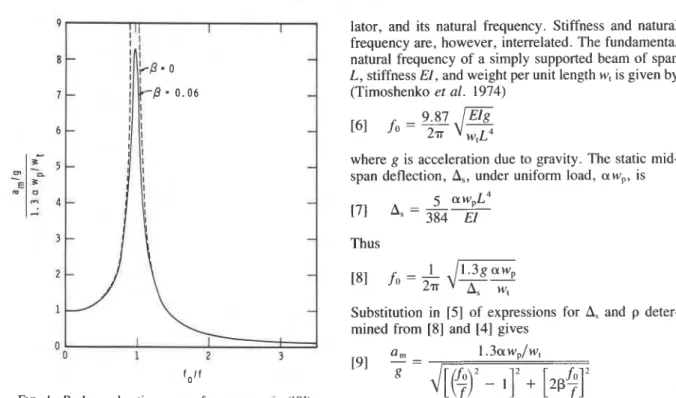
FIG. 1 . Peak acceleration versus frequency ratio (191).
[2] F ( t ) = aw, sin 2nft
For determining dynamic response to the sinusoidal loading of [2] the floor structure can be modelled by means of an equivalent single-degree-of-freedom beam oscillator. The maximum dynamic deflection, Ad, of such an oscillator under steady-state response is given by
[3] Ad = pA, = pawp/k
where k is the stiffness of the beam oscillator, A, is the static deflection due to the dynamic component of load, a w,, and
is the dynamic amplification or response factor (Tim- oshenko et al. 1974). In [4], f is the forcing frequency, fo the natural frequency, and
P
the damping ratio of the beam oscillator. Under resonance conditions (f = fo) the response becomes very large after building up over a number of cycles.The peak acceleration, a,, is determined from [3] as follows:
[5] a, =
I IT
f
)'Ad = (27~ f )'pa,Thus, the peak acceleration can be determined by means of [3]-[5] from the dynamic component of loading, forcing frequency, stiffness of the beam oscil-
lator, and its natural frequency. Stiffness and natural frequency are, however, interrelated. The fundamental natural frequency of a simply supported beam of span L, stiffness El, and weight per unit length w, is given by (Timoshenko et al. 1974)
where g is acceleration due to gravity. The static mid- span deflection, A,, under uniform load, aw,, is
Thus
1 1.3g aw,
181 f o =
dZT
Substitution in [5] of expressions for A, and p deter- mined from [8] and [4] gives
a , - 1.3a wP/w,
[9l
7
-\i[($j2
- I]'+
[2P$I2Equation [9] can be used to estimate peak acceleration and hence to evaluate a floor structure subjected to sinusoidal loading. Figure 1 shows how peak acceler- ation from [9] varies with frequency ratio, and that outside a band surrounding the resonance condition, fo
= f, [9] can be approximated by assuming
P
= 0. Inversion of [9] then leads to a minimum frequency ratio above resonance that provides the following crite- rion for design:where a. is a limiting acceleration.
The derivation of [9] and [lo] has been carried out for simply supported beam-like floor construction. A simi- lar derivation applies to other configurations such as cantilevers, simply supported plates, and fixed-end beams or plates. If [6] and [7] are replaced by appropri- ate formulae for these configurations, then the constant 1.3 in [8]- [lo] for simply supported beams is 1.3 for fixed-end beams, 1.5 for fixed cantilevers, and 1.6 for a square plate simply supported or fixed; all other parameters remain the same. Equations [9] and [lo] therefore apply reasonably well for most floor systems. By means of [8], [lo] can be expressed in terms of a limitation on static deflection, A,, rather than natural frequency. This is done in the Supplement to the National Building Code (1985), but [lo] is preferred for the following reasons: (1) As will be discussed, the major safety-and-serviceability-related problem is one of resonance between the source of excitation and the
ALLEN ET AL.
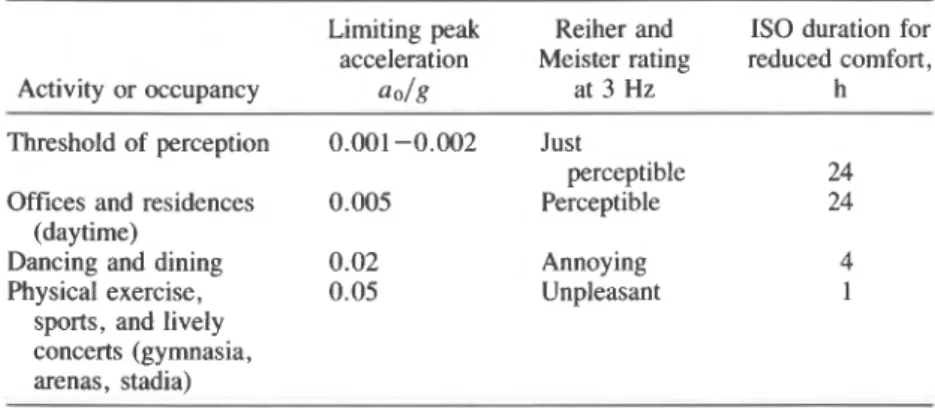
TABLE 1 . Suggested vibration limits for activities on floors: 1.5-8 Hz
- --
Limiting peak Reiher and IS0 duration for acceleration Meister rating reduced comfort,
Activity or occupancy ao/g at 3 Hz h
Threshold of perception 0.001 -0.002 Just
perceptible 24 Offices and residences 0.005 Perceptible 24
(day time)
Dancing and dining 0.02 Annoying 4
Physical exercise, 0.05 Unpleasant 1
sports, and lively concerts (gymnasia, arenas, stadia)
0 0.5 1.0 1.5 2.0 2.5
TIME, s
( a ) TIME RECORD LOW PASS-FILTERED A T 9 H z
0
0 1 2 3 4 5 6 7 0
F R E Q U E N C Y , H z
( b ) FOURIER AMPLITUDE SPECTRUM I
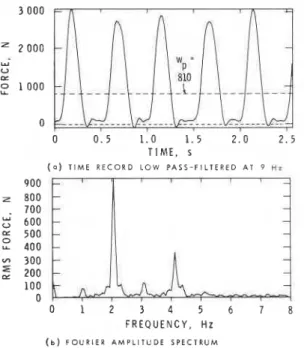
Frc. 2. Floor forces produced by eight people jumping: (a) time record low pass-filtered at 9 Hz, (b) Fourier amplitude spectrum.
floor, so that it is important for the designer to deter- mine the natural frequency of the floor. (2) A static calculation of As under uniform load, a w , , for beams continuous over supports can be seriously in error; a continuous beam of equal spans on pin supports, for example, should be treated as simply supported because the vibration nodes are at the supports.
The application of [lo] for design, as well as the estimation of its parameters, will be discussed.
I
Estimation of limiting accelerationUser reaction and tolerance to vibrations vary with the individual, activity, duration, and surroundings. The threshold of perception in the 1.5 - 8 Hz frequency
range is an acceleration of the order of 0.001 -0.002 g (Reiher and Meister 1931; International Organization for Standardization 1978). Intermittent vibrations of up to 0.005 g have been found tolerable in offices and residences during the daytime (Allen and Rainer 1976). Accelerations of 0.02 g have been found acceptable or tolerable for people sitting or standing around a dance floor (Matthews et al. 1982), but would be un- acceptable in a home or office environment. For lively concerts or sporting events 0.05 g is suggested as the tolerance limit for spectators who are not directly par- ticipating in the activity. Suggested limiting values are summarized in Table 1, together with a descriptive label corresponding to the Reiher and Meister (1931) scale and the I S 0 rating in hours for "reduced comfort" (International Organization for Standardization 1978). Because of the subjective nature of human reaction (a few people like floor vibration; others get used to it), a limiting acceleration is difficult to establish accurately.
Estimation of dynamic load parameters Experience with field measurements indicates that the significant range of rhythmic frequency, f, is 1.5-3.5 Hz. Beyond 3 Hz it becomes difficult for a large group to maintain a coordinated rhythm.
The dynamic load factor, a, can be determined di- rectly from force records, but so far only a few values are available. Some force records and their Fourier spectra, obtained from dynamic tests on a large plat- form at the Division of Building Research, National Research Council of Canada, are shown in Figs. 2-4. For eight people exercising by jumping (Fig. 2) the time record shows a nearly flat portion at the bottom of the record corresponding to zero load, when the partici- pants lose contact with the floor. The corresponding Fourier spectrum in Fig. 2b shows that higher har- monics of the rhythmic frequency of the jumping exercise are present. The dynamic load factor was de- termined to be 1.4 for the first harmonic at 2.1 Hz and
620 CAN. J CIV. ENG. VOL. 12, 1985 0 0 . 5 1 . 0 1 . 5 2 . 0 2 . 5 T I M E , s ( a ) T I M E R E C O R D L O W P A S S - F I L T E R E D A T 9 H r 0 0 . 5 1 . 0 1 . 5 2.0 2 . 5 T I M E , s ( a ) T I M E R E C O R D L O W P A S S - F I L T E R E D AT 9 H z V, 3 0 0 m I ,I 200 5 P: 1 0 0 0 1 0 0 0 0 0 1 2 3 4 5 6 7 8 0 1 2 3 4 5 6 7 8 F R E Q U E N C Y , H z F R E Q U E N C Y . H z ( b ) F O U R I E R A M P L I T U D E S P E C T R U M ( b ) F O U R I E R A M P L I T U D E S P E C T R U M
FIG. 3. Floor forces produced by one person jumping: ( a ) FIG. 4. Floor forces produced by eight people running time record low pass-filtered at 9 Hz, ( b ) Fourier amplitude slowly: ( a ) time record low pass-filtered at 9 Hz, ( b ) Fourier
spectrum. amplitude spectrum.
0.6 for the second harmonic at 4.2 Hz. Figure 3 shows similar results for one person jumping for exercise at 2.1 Hz, where the dynamic load factor was determined to be 1.5 for the first harmonic and 0.5 for the second; additional harmonic components occur at multiples of half the rhythmic frequency owing to a slightly larger force at every second cycle of the exercise.
Figure 4 shows results for eight people on the test platform, slowly running in step with a footfall fre- quency of 2.3 Hz. It indicates a more regular sinusoidal response and a virtual absence of higher harmonics in the spectrum of Fig. 36. For this activity, a was deter- mined to be 1.0 for the first harmonic and 0.1 for the second.
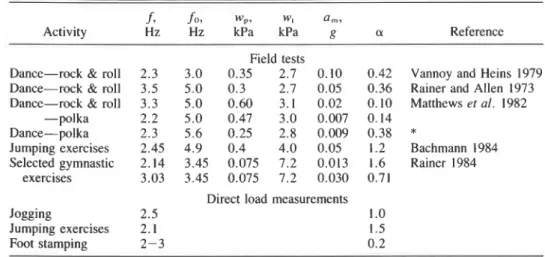
The dynamic load factor, a, can also be estimated from field measurements on actual floors by means of [9] if the physical parameters and distribution of dy- namic loads are known; a few examples of calculated values of a from field measurements are presented in Table 2. Equation [9] relates to response at the forcing frequency only, so that other measured frequency components had to be removed by filtering. In a number of cases the magnitude and distribution of the load, w,, had to be estimated or extrapolated, so that calculated values of a are somewhat approximate. Nevertheless, as may be seen in Table 2, they are in general agreement with the few values of a that were measured directly. Resonance cases were not included because of the large uncertainty in estimating dynamic
amplification.
On the basis of these results, suggested values off,
w,, and a suitable for design purposes are given in Table 3. To account for higher harmonics from jumping exercises, Table 3 includes a dynamic load factor of 0.25 for forcing frequencies up to 6 Hz. The vibrations from the first harmonic (e.g., f = 3 Hz) and the second harmonic (e.g., f = 6 Hz) should be combined, but because of the scarcity of loading information and the adoption of conservative assumptions for Table 3, it is recommended that each case be treated separately and the governing one chosen. It is expected that more information will become available from research now in progress.
Design procedure for assembly occupancies
The following procedure is proposed for checking the design of floors for assembly occupancies subject to coordinated rhythmic activities. It may be necessary to check more than one type of activity and loading case. (1) Determine the type of activity, estimate the densi- ty of occupancy, and obtain the distributed weight of participants, w,; see Table 3 for guidance. When only a portion of the span is occupied by the activity (e.g., a designated dance area), the load w, may be estimated by taking the total load on the partially loaded span and distributing it uniformly over the full span. A more accurate method of determining w, is to calculate the uniform loading that produces the same centre span
ALLEN ET AL.
TABLE 2. Dynamic load factor, a , from field tests and direct load measurements
f , f o , w,, w , a,,
Activity Hz Hz kPa kPa g a Reference
Dance-rock & roll Dance-rock & roll Dance-rock & roll
-polka Dance-polka Jumping exercises Selected gymnastic exercises Jogging Jumping exercises Foot stamping Field tests 3.0 0.35 2.7 0.10 5.0 0.3 2.7 0.05 5.0 0.60 3.1 0.02 5.0 0.47 3.0 0.007 5.6 0.25 2.8 0.009 4.9 0.4 4.0 0.05 3.45 0.075 7.2 0.013 3.45 0.075 7.2 0.030
Direct load measurements
0.42 Vannoy and Heins 1979
0.36 Rainer and Allen 1973 0.10 Matthews et al. 1982 0.14 0.38
*
1.2 Bachmann 1984 I .6 Rainer 1984 0.7 1*G. A . Trusler, private communication.
TABLE 3. Suggested design parameters for rhythmic events
Forcing Weight of Dynamic load
frequency participants* factort Dynamic load
Activity f , Hz w,, kPa a a w , , kPa
Dancing 1.5-3 0.6 (2.5 m2/couple) 0.5 0.3
Lively concert or 1.5-3 1.5 (0.5 m2/person) 0.25 0.4
sports event
Jumping exercises 1.5-3 0.4 (2 m2/person) 1.5 0.6
(second harmonic) 3-6 0.4 (2 m2/person) 0.25 0.1
*Density of participants is for commonly encountered conditions. For special events the density of participants can be greater.
?Values of a are based on commonly encountered events involving a minimum of about 20 participants. Values of a should be increased for well-coordinated events (e.g., jump dances) or for fewer than 20 participants.
deflection as the actual partial loading.
(2) Choose an appropriate forcing frequency, f, and dynamic load factor, a; see Table 3 or other appropriate sources. For jumping exercises, both the first harmonic (1;-3 Hz) and second harmonic (3-6 Hz) should be considered.
(3) Choose an acceptable limiting acceleration, a,, at the centre of the floor; see Table 1 or choose other appropriate limits. When the perceived location of vi- bration is not at the centre of the span, this can be taken into account by multiplying the acceleration criterion,
a,,, by l/sin (.rrx/L) wherex is the location of perceived vibration and L is the span length.
(4) Estimate the total floor load, w , (i.e., dead load
'
+
w,), and determine the lowest acceptable funda- mental frequency of the floor from [lo]. For jumping exercises, pick the higher frequency for the two cases considered.
(5) Determine the fundamental natural frequency, f,,
of the floor structure. In calculating f, the designer
should include the weight of participants, furniture, etc., in addition to that of the floor structure itself.
(6) If the criterion eq. [lo] is not satisifed, indicating unsatisfactory performance, options include stiffening the structure, relocating the activity, controlling the activity (i.e., f and aw,), and, in consultation with the owner, accepting a higher limiting acceleration.
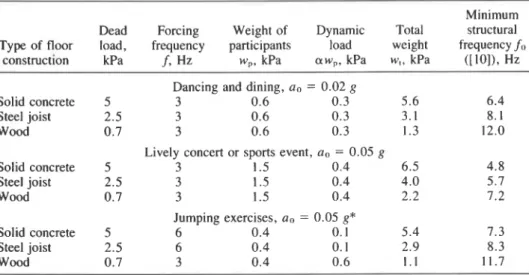
The design criterion, [lo], has been applied to typical cases in Table 4 and the results are summarized in Table 5. The minimum fundamental frequencies, f,, calculated for human reaction range from 5 Hz, for heavy floors, to 12 Hz, for light floors. These fre- quencies are often greater than 6 Hz, below which the NBC requires a dynamic analysis. This occurs because the NBC requirement is related primarily to safety and no serious safety-related problems are known to have occurred for floors with fundamental frequencies higher than 6 Hz. Cases that do not satisfy the mini- mum frequencies of Table 5 should be evaluated more carefully.
CAN. J. CIV. ENG. VOL. 12, 1985
TABLE 4. Application of vibration criterion to different activities and floor constructions Minimum Dead Forcing Weight of Dynamic Total structural Type of floor load, frequency participants load weight frequency f,,
construction kPa f, Hz w,, kPa a w , , kPa w,, kPa ([lo]), Hz Dancing and dining, an = 0.02 g
Solid concrete 5 3 0.6 0.3 5.6 6.4
Steel joist 2.5 3 0.6 0.3 3.1 8.1
Wood 0.7 3 0.6 0.3 1.3 12.0
Lively concert or sports event, a, = 0.05 g
Solid concrete 5 3 1.5 0.4 6.5 4.8 Steel joist 2.5 3 1.5 0.4 4.0 5.7 Wood 0.7 3 1.5 0.4 2.2 7.2 Jumping exercises, an = 0.05 g* Solid concrete 5 6 0.4 0.1 5.4 7.3 Steel joist 2.5 6 0.4 0.1 2.9 8.3 Wood 0.7 3 0.4 0.6 1.1 11.7
*Criterion is applied to two cases (f = 3 Hz and f = 6 Hz in Table 3) and the governing case selected.
TABLE 5. Minimum recommended natural floor D
frequencies for serviceability (based on Table 4)
5
Minimum natural frequency for type of occupancy, Hz Type of floor Dance floors,* Stadia, construction gymnasiat arenast
Solid concrete 7 5
Steel joist -
concrete slab 9 6
Wood 12 8
*Limiting peak acceleration 0.02 g.
TLimiting peak acceleration 0.05 g.
Resonance considerations
When the rhythmic frequency, f, of the dynamic loading function coincides with or is near a natural frequency of the floor, a condition of resonance exists, and large vibration amplitudes will result. Such a coin- cidence of frequencies is particularly severe for the fundamental mode of vibration since all points on the floor have the same phase as the loading function. For a fully loaded floor, resonance at higher modes of vi- bration will not be so severe because out-of-phase com- ponents of higher mode shapes are counteracted by the loading function. If the floor is only partially loaded, however, and this loading pattern coincides substantially with portions of the mode shape having the same phase, then large amplifications can also be expected. This possibility should be considered for higher modes of a floor structure with a very low fun- damental frequency that is less than the rhythmic frequency.
LL
FREQUENCY, Hz
FIG. 5. Fourier amplitude spectrum of floor acceleration, a, during jumping exercise (Rainer 1984).
A condition of resonance can also exist if a higher harmonic of the rhythmic frequency coincides with a natural frequency of the floor. As was previously stated, the situation is generally most severe for the fundamental mode of vibration. Even a small dynamic component with forcing frequency equal to a natural frequency can cause significant response, since dynam- ic amplifications of 10 or more can occur at resonance (see Fig. 1). For a gymnasium floor subjected to a jumping exercise (Bachmann 1984) a large resonance
response with accelerations up to 0.5 g occurred at
,
4.9 Hz, which is equal to twice the rhythmic frequency.This compares with accelerations of 0.05 g for the com- ponent of floor vibration at the rhythmic frequency of
i
2.45 Hz (see reference to "Bachmann 1984," Table 2). Figure 5 shows the spectrum of floor motion obtained from field measurements during rhythmic exercises (Rainer 1984). The response at the rhythmic frequency 2.3 Hz was smaller than that at 3.5 Hz (the fundamentalALLEN ET AL. 623
The harmonic loading at 3.5 Hz probably results from uneven forces similar to those that occur in Fig. 3.
Summary and conclusions
A design procedure based on user acceptability of vibration is presented for floor structures subjected to
-
rhythmic activities. The method can be applied for dy- namic loads produced by dancing, physical exercises, and audience participation at concerts and sporting.
events. Values for dynamic load parameters and accel- eration limits are suggested for various activities, based I on available information. Using these suggested values, application of the design procedure results in a set of minimum natural frequencies for different occupancies and floor constructions (Table 5). The minimum fre- quencies are generally higher than 6 Hz, below which a dynamic analysis is required by the 1985 NBC, for reasons of safety. Cases that do not satisfy the mini- mum frequencies of Table 5 should be evaluated more carefully.I
AcknowledgementsThe authors are grateful to Professor H. Bachmann of the Swiss Federal Institute of Technology for his com- ments on the proposed design procedure. This paper is a contribution from the Division of Building Research, National Research Council of Canada, and is published with the approval of the Director of the Division.
ALLEN, D. E., and RAINER, J. H. 1976. Vibration criteria for long-span floors. Canadian Journal of Civil Engineering, 3(2), pp. 165-173.
BACHMANN, H. 1984. Vibrations of building structures caused by human activities, case study of a gymnasium. National Research Council of Canada, Ottawa, Ont., Technical Translation 2077.
INTERNATIONAL ORGANIZATION FOR ~TANDARDIZATION. 1978. Guide for the evaluation of human exposure to whole-body vibration. I S 0 Standard 2631, Geneva, Switzerland. MATTHEWS, C. M., MONTGOMERY, C. J., and MURRAY,
D. W. 1982. Designing floor systems for dynamic re- sponse. Structural Engineering Report 106, University of Alberta, Edmonton, Alta.
NEW CIVIL ENGINEER INTERNATIONAL. 1981. Pop concert shock for loading code. May, p. 18.
PERNICA, G. 1983. Dynamic live loads at a rock concert. Canadian Journal of Civil Engineering, 10(2), pp. 185-191.
RAINER, J. H. 1984. Dynamic response of a gymnasium floor. National Research Council of Canada, Division of Building Research, Ottawa, Ont., BRN 213.
RAINER, J. H., and ALLEN, D. E. 1973. Vibration charac- teristics of a dance floor. National Research Council of Canada, Division of Building Research, Ottawa, Ont., TN 576.
REIHER, H., and MEISTER, F. J. 193 1. The effect of vibration on people. (In German.) Forschung (VDI-Berlin), 2(1 I), pp. 38 1-386 (Translation-Report No. F-TS-616-RE, Headquarters Air Materiel Command, Wright Field, OH,
1946).
SUPPLEMENT TO THE NATIONAL BUILDING CODE OF CANADA. 1985. National Research Council of Canada, Associate Committee on the National Building Code, Ottawa, Ont. TIMOSHENKO, S., YOUNG, D. H., and WEAVER, W. 1974.
Vibration problems in engineering. 4th ed., John Wiley & Sons, New York, NY, 521 p.
VANNOY, D. W., and HEINS, C. P. 1979. Dynamic response of a noncomposite metal deck floor system. American Concrete Institute, Detroit, MI, SP-60.
List of symbols
a , maximum acceleration under a sinusoidal loading
function
a, limiting acceleration
f rhythmic frequency of activity, Hz
f, fundamental natural frequency of floor structure, Hz
g acceleration due to gravity k beam stiffness
nf nth harmonic of rhythmic frequency
w, weight per unit area of participants in a rhythmic
activity, kPa
w , total weight per unit area of structure, participants,
etc., kPa
or dynamic load factor assuming a sinusoidal loading function, see [2]
rr,
dynamic load factor for nth harmonic of the load- ing function, see [ I ]A, static deflection due to a load aw,
p dynamic response factor, see [4]