HAL Id: hal-00002037
https://hal.archives-ouvertes.fr/hal-00002037
Preprint submitted on 19 Oct 2004HAL is a multi-disciplinary open access
archive for the deposit and dissemination of sci-entific research documents, whether they are pub-lished or not. The documents may come from teaching and research institutions in France or abroad, or from public or private research centers.
L’archive ouverte pluridisciplinaire HAL, est destinée au dépôt et à la diffusion de documents scientifiques de niveau recherche, publiés ou non, émanant des établissements d’enseignement et de recherche français ou étrangers, des laboratoires publics ou privés.
SPOT: a New Monte Carlo Solver for Fast Alpha
Particles
Mireille Schneider, Lars-Göran Eriksson, Vincent Basiuk, Frédéric Imbeaux
To cite this version:
Mireille Schneider, Lars-Göran Eriksson, Vincent Basiuk, Frédéric Imbeaux. SPOT: a New Monte Carlo Solver for Fast Alpha Particles. 2004. �hal-00002037�
SPOT: a New Monte Carlo Solver for
Fast Alpha Particles
M. Schneider, L.-G. Eriksson, V. Basiuk and F. Imbeaux
Association EURATOM-CEA, CEA/DSM/DRFC, CEA-Cadarache, F-13108 St. Paul lez Durance, France
Abstract
The predictive transport code CRONOS [1] has been augmented by an orbit following Monte Carlo code, SPOT (Simulation of Particle Orbits in a Tokamak). The SPOT code simulates the dynamics of non-thermal particles, and takes into account effects of finite orbit width and collisional transport of fast ions. Recent developments indicate that it might be difficult to avoid, at least transiently, current holes in a reactor. They occur already on existing tokamaks during advanced tokamak scenarios. For this reason the SPOT code has been used to study the alpha particle behaviour in the presence of current holes for both JET and ITER relevant parameters.
1
Introduction
The orbit width of a 3.5 MeV alpha particle in an ITER plasma is typically of the order 40-50 cm for monotonic current profiles, i.e. around 20% of the plasma radius. Thus, accurate simulations of the alpha particle heating should take into account finite orbit width effects. Moreover, it has recently been realised that current holes, i.e. a central plasma region with virtually zero current density, are likely to appear at least transiently in reactor plas-mas. For this reason, it has become essential to consider fast ion orbit effects and their impact on the dynamics of such ions in fusion plasmas. To address this problem the SPOT code (Simulation of Particle Orbits in a Tokamak) has been developed. The main aim with this development was to integrate
SPOT with the transport code CRONOS [1]. The combined package should allow for self-consistent simulations of the thermal plasma evolution and the alpha particle dynamics.
Finite orbit width effects lead, in addition to a general broadening of the heating and pressure profiles, to anisotropies in the fast ion pressure and to finite currents driven by the energetic ions. This is the case even when the fast ion source is isotropic. These effects are particularly pronounced in plasmas with current holes. In this paper, we present the first results from SPOT on the impact of current holes on the alpha particle behaviour. Most recent work on current holes and alpha particles has concentrated on the confinement of the latter [2]. In this paper we also consider the fast ion pressure and driven current profiles, and present results for both JET and ITER equilibria.
2
The SPOT code
SPOT is an orbit following Monte Carlo code that calculates guiding centre orbits of fast ions in arbitrary toroidally axi-symmetric equilibria. Colli-sions between the fast ions and the bulk plasma are taken into account by periodically applying Monte Carlo operators, see e.g. [3], along the simu-lated orbits. If the orbits for each particle were to be followed for the actual number of poloidal revolutions during a time characteristic of a Tokamak discharge, the computing time would be almost prohibitive. However, ow-ing to the axi-symmetry, the unperturbed particle orbits are closed in the poloidal plane. Furthermore, the perturbations caused by the collisions dur-ing a sdur-ingle poloidal revolution are normally small. Indeed the collision time (∼ 0.1s) is usually much longer than the poloidal bounce time (∼ 10−6s). Consequently, almost identical orbits are followed over and over again. One can take advantage of this by accelerating the collisions [4, 5], a procedure whereby a simulated poloidal orbit represents many revolutions in reality. In practice this means that the time step used in the Monte Carlo opera-tors, ∆tM C is taken to be the one used to advance the orbit one step, δt, multiplied with an acceleration factor, NACC, i.e. ∆tM C = δtNACC. Ac-celeration factors of the order 100-1000 can typically be applied, but they must be reduced in the region near the trapped-passing boundary in order to not artificially reduce orbit losses caused by collisions [4].
The SPOT code also uses a weighting scheme to reduce the computing time. In a typical alpha particle distribution function, the number of par-ticles at low to moderate energies (up to say 100-200 keV) greatly exceeds
those in the MeV range. Yet it is the particles in the MeV range that car-ries most of the power transfered to the bulk plasma and therefore are the most significant ones. In order to boost their number and to improve on the statistical properties of the evaluated distribution of Monte Carlo particles, different weights are applied to particles above and below a threshold en-ergy (typically 200 keV). The weight, wl, attributed to particles below the threshold is higher than that, wf, applied on particles with energies above it, usually wl/wf is of the order 10 -100. In order to handle particles that crosses the threshold two actions are taken: (i) a ”Russian roulette” algo-rithm is used when a particle crosses the threshold from above, a random number between 0 and 1 is generated and if it is less than wf/wl the par-ticle is kept and its weight is changed to wl, if not the particle is removed from the calculation; (ii) a particle that crosses the threshold from below is duplicated by adding wl/wf− 1 particles to the simulation. This procedure ensures that the statistical properties of the sample of Monte Carlo parti-cles remains correct while the number of important high energy partiparti-cles is boosted.
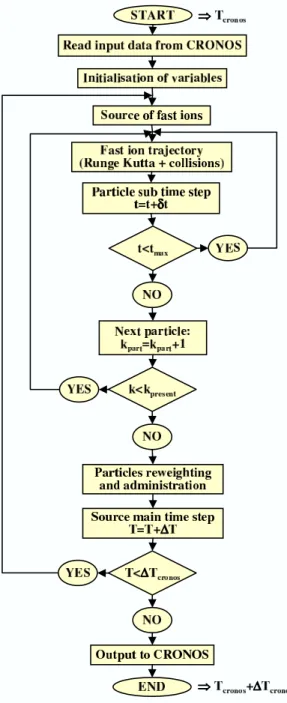
The SPOT code uses the output from the CRONOS transport code (2D-equilibrium, temperature, density profiles etc.). At the beginning of each new time step the CRONOS data are read into SPOT, and the distribution of Monte Carlo particles is advanced one time step along the lines described above. The SPOT code then evaluates a number of physically important quantities, like the alpha particle heating profile of the thermal plasma, fast ion pressure profile and the current profiles driven by the fast ions. These quantities are then fed back to the CRONOS code, which uses them to advance the thermal plasma transport equations and the equilibrium to the next time step. The procedure is repeated until the end of the simulation. The interaction between SPOT and CRONOS as well as the main steps of the procedure in the SPOT code are illustrated in the flow chart, Fig.1.
3
Topology of alpha orbits in the presence of
cur-rent holes
Typical orbits of 3.5 MeV alpha particles intersecting a current hole are illustrated in Fig.2 for an ITER configuration. Owing to the absence of a current density, and thus a poloidal magnetic field, only the grad-B and curvature drifts play a role for the poloidal projection of the orbit in a current hole. Consequently, the particle follows an iso-B line during its drift through the currentless region. This has several consequences. First,
particles that are born in the current hole with toroidal velocities in the co-current direction are always on co-co-current passing orbits. This is a simple consequence of the conservation of the toroidal angular momentum Pφ = −mRvφ+ zeψ/2π, where vφ is defined such that it is positive in the co-current direction and the poloidal flux, ψ, is taken to be zero in the co-current hole, but otherwise positive. Thus, a particle starting with a positive vφ in the current hole can only increase its vφ as it enters the region of a finite current, i.e. it can never be trapped. Another important property is that particles born in the current hole at the same point on passing orbits but with vφ in opposite directions will follow each other in the poloidal plane until they encounter the region with finite current density; at that point the orbit with vφ< 0 turns towards the high field side while the other continues towards the low field side. Thus, significant asymmetries in velocity space can be expected for any given point in or near the current hole.
6 8 −3 −2 −1 0 1 2 3 R (m) Z (m) 6 8 −3 −2 −1 0 1 2 3 R (m) Z (m) 6 8 −3 −2 −1 0 1 2 3 R (m) Z (m) 6 8 −3 −2 −1 0 1 2 3 R (m) Z (m)
Figure 2: Orbit topology of 3.5 MeV alpha particles inside an ITER current hole. From left to right: barely trapped, trapped, co-passing and counter-passing orbits.
4
Alpha particle losses in the presence of JET
cur-rent holes
The influence of current holes on alpha particle confinement has been sim-ulated for a typical JET configuration. In the present study, the alpha particle source arises from thermal D-T fusion reactions. This investigation is mainly motivated by recent experiments on JET with trace tritium. The fraction of lost alpha power as a function of the current hole width, as well as the individual contributions from first orbit and collisional losses have
been studied.
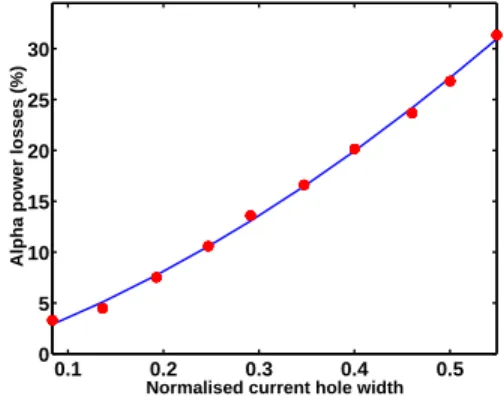
Several current profiles have been imposed, corresponding to the safety factor profiles shown in Fig.3. The total plasma current has been kept constant at 2.2 MA in all cases. The resulting losses are shown in Fig.4 (the current hole size is here defined as the width of the zero-current density region). The power losses due to the reduced confinement can reach around 30% for a current hole width of about 50% in the JET tokamak. The losses are dominated by first orbit losses. The collisional losses, evaluated by considering particles lost after the completion of their first full poloidal orbit, amount to around 10% of the total lost power for a current hole width of around 60%. 0 0.2 0.4 0.6 0.8 1 0 5 10 15 20
Normalized toroidal flux coordinate ρ
Safety factor q
Figure 3: Safety factor profiles obtained for current holes of a typical JET con-figuration. 0.1 0.2 0.3 0.4 0.5 0 5 10 15 20 25 30
Normalised current hole width
Alpha power losses (%)
Figure 4: Power losses versus the cur-rent hole size for JET equilibria.
5
Anisotropy and alpha particle current
genera-tion for ITER equilibria with current holes
Simulations for ITER equlibria show that, in contrast to JET, alpha particle losses are small even in the presence of a wide current hole. Indeed, the alpha particle orbit width, as compared to the machine size, is smaller in ITER than in JET. The losses are of the order of 0.5% for current holes at around 60% of the plasma radius. Thus, direct alpha losses in ITER should be a minor issue. For this reason we here concentrate on possible anisotropies in the alpha particle pressure and the currents driven by the alpha particles. As explained in the section 3, there is reason to believe that non-negligible
anisotropies can occur.
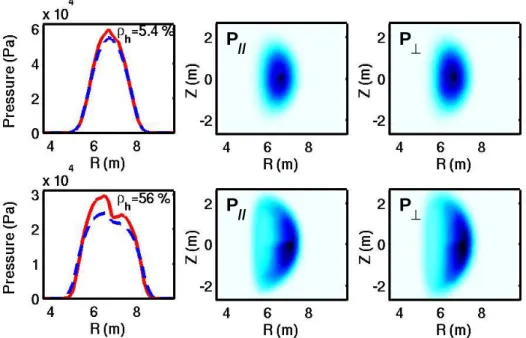
We first consider the alpha particle pressure for ITER parameters yield-ing a fusion power of about 130 MW. The parallel and perpendicular pres-sures in 2D as well as the prespres-sures as a function of the major radius through the midplane are shown in Fig.5. The 1D plot of the pressure shows that the anisotropy is weak for a small current hole whereas it is around 10-20% over a significant part of the plasma cross-section for a 60% hole. The most striking feature is the strong poloidal variation of the pressure in the case of a large current hole.
P
//P
//P
⊥P
⊥Figure 5: 1D parallel (solid line) and perpendicular (dashed line) and 2D pressure profiles of fast alpha particles for a small (top figures) and a large (bottom figures) current hole in ITER.
Any velocity space anisotropy is expected to have a more significant effect on the driven current, which is also born out by the simulations.
Before we proceed to present the simulation results, it is useful to dis-cuss how the alpha particles can drive a finite total current in spite them being born isotropically (which is the case in the simulations). The princi-pal reason is that the toroidal momentum of the alpha particles need not be conserved, instead it is the toroidal momentum of the whole plasma system (the bulk plasma plus the fast ions) that must be conserved. To exem-plify the process involved, we first consider trapped alpha particles born at
their turning point where their parallel velocity is zero, and hence also their toroidal momentum. Due to its orbit width, an alpha particle resides on average on a flux surface different from that of its birth. Furthermore, as is well known, it acquires a precessional drift in the toroidal direction, which is also the origin of the fast ion driven current. In fact the two phenomena are linked, as can easily be seen from the expression for the toroidal angular momentum of a particle: Pφ= −mRvφ+ Zeψ/2π (which is an invariant of the motion). The particle is assumed to be born at its turning point, i.e. Pφ = Zeψbirth/2π, where ψbirth denotes the poloidal flux at the initial flux surface. From the orbit averaged form of the toroidal angular momentum, we obtain Ze < ψbirth− ψ > /2π = − < mRvφ >, i.e. the toroidal pre-cession is proportional to the averaged deviation from the flux surface of birth.
In return, the displacement of alpha particles will lead to a motion of the bulk plasma. Indeed, let us consider an electron initially located at the same point where the alpha particle is born. This electron will remain on the same flux surface (due to its small radial excursion) whereas the alpha particle will on average, as explained above, reside on a different flux surface. Consequently a radial current will be associated with the alpha particle motion away from its point of birth. In order to maintain quasi-neutrality the thermal plasma will have to respond with a radial current in the opposite direction. This will lead to an acceleration, via the ~j × ~B force, of the bulk plasma in the toroidal direction, see e.g. [6]. Consequently, the toroidal momentum acquired by the alpha particles is compensated for by an opposite toroidal momentum carried by the thermal plasma. Moreover, the bulk plasma momentum gives rise to a rotation (electrons and ions traveling with the same velocity), and will therefore not generate any current. Thus, we have shown that the fast alpha particles create a toroidal current due to their precession while the total toroidal momentum of the plasma is conserved.
A similar argument can be applied to all the alpha particles. For in-stance, consider two alpha particles born in the same point in space on passing orbits but with opposite parallel velocities, their average deviations from the flux surface of birth will not be the same and there will again be a radial current associated with their motion. Consequently, there will be a torque on the thermal plasma that compensates for the average toroidal momentum the pair will acquire. Thus, the current driven by the fast ions is a finite orbit width effect and its integral over the plasma cross section is finite because of the shift in the average radial position of the alpha particles as compared to their point of birth.
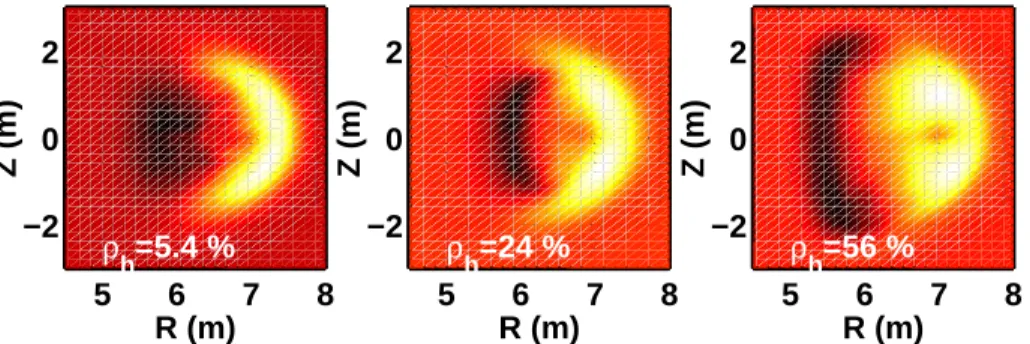
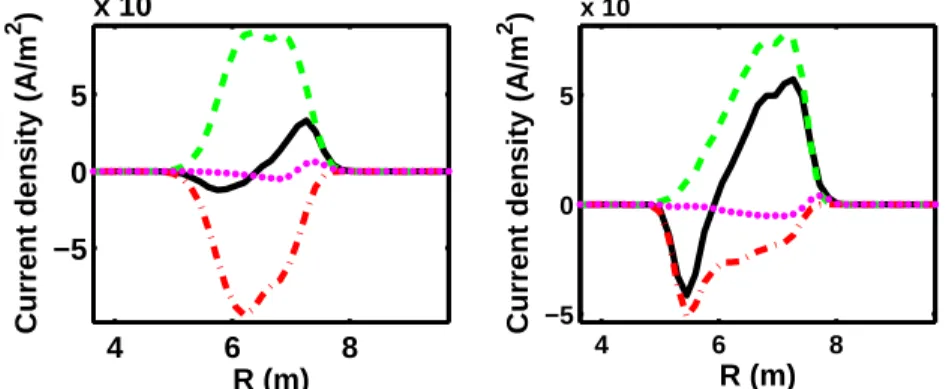
particles for different current hole sizes. The influence of the topology of the orbits typical of the current hole is very clearly seen. Counter-current pass-ing alpha particles provide a negative current density towards the high field region whereas the co-passing ones give rise to a positive current shifted to-wards the low field side, leading again to very significant poloidal variations. Owing to several factors, e.g. the fact that no particle born with vφ > 0 in the current hole is on a trapped orbit, the number of co-passing orbits dom-inates and the total current driven by the alpha particles is positive. This is illustrated in Fig.7, where the contributions to the current from alpha particles with different orbits are displayed together with the total alpha current. For small current holes the asymmetry is small and the current density remains modest. The driven current density increases with the cur-rent hole size, and reaches 60kA/m2
for 56% hole. This can be compared to the maximum current density in the plasma which is about 700kA/m2
. An important point is that the total alpha particle driven current integrated over the whole current hole is positive. If it would have been negative, it is likely that plasma instabilities would have been induced, which in their turn would have expelled the alpha particles from the current hole region. This is indeed probable since the plasma cannot tolerate a negative total current (thermal plus fast ions). However, as the study presented here indicates, the alpha driven current integrated over the whole current hole is positive. This does not necessarily mean that the alpha particles are unaffected by MHD instabilities, but that they are probably better confined than would have been the case for a negative driven current. The non-zero alpha current generated inside the current hole indicates that the current hole is going to be filled in more rapidly than in its absence.
5 6 7 8 −2 0 2 R (m) ρh=5.4 % Z (m) 5 6 7 8 −2 0 2 R (m) ρh=24 % Z (m) 5 6 7 8 −2 0 2 R (m) ρh=56 % Z (m)
Figure 6: Fast alpha particle driven current density profiles for three ITER current holes. The dark (bright) region corresponds to a negative (positive) current.
4 6 8 −5 0 5 x 10⁴ R (m)
Current density (A/m
2 ) 4 6 8 −5 0 5 x 10⁴ R (m)
Current density (A/m
2 )
Figure 7: Total alpha particle driven current density profile (solid line) for a small (left figure) and a wide (right figure) current hole in ITER. The individual contri-butions from alpha particles on co-passing (dashed), counter-passing (dot-dashed) and trapped (dotted) orbits are also displayed.
6
Summary
The effect of a current hole on fusion born alpha particles has been in-vestigated. The confinement of those alpha particles can be significantly degraded in JET plasmas, with losses up to 30% for a current hole of 50% of the minor radius. On the other hand, the losses of alpha particles in ITER are small even for such a large current hole. For ITER the role of the current hole is more to create asymmetries in the velocity space of the alpha parti-cles. These lead to anisotropies in the pressure profile and to a significantly enhanced alpha particle driven current in and around the current hole area.
References
[1] V. Basiuk, et al, Nucl. Fusion 43 (2003) 822-830
[2] V. Yavorskij, et al, Nucl. Fusion 44 (2004) L5-L9 ; K. Tobita, et al, Plasma Phys. Control. Fusion 46 (2004) S95-S105
[3] A. H. Boozer and G. Kuo-Petravic. Phys. Fluids 24, 851, (1981)
[4] R.J. Goldston, D.C. McCune, H.H. Towner, S.L. Davis, et al., J. Com-put. Phys. 43, 61 (1981) .
[5] J.A. Heikkinen, et al., Comp. Phys. Commun. 76, 215 (1993). [6] F.L. Hinton and M. Robertson, Phys. Fluids 27, 1243 (1984).