HAL Id: hal-00317644
https://hal.archives-ouvertes.fr/hal-00317644
Submitted on 23 Sep 2004
HAL is a multi-disciplinary open access
archive for the deposit and dissemination of
sci-entific research documents, whether they are
pub-lished or not. The documents may come from
teaching and research institutions in France or
abroad, or from public or private research centers.
L’archive ouverte pluridisciplinaire HAL, est
destinée au dépôt et à la diffusion de documents
scientifiques de niveau recherche, publiés ou non,
émanant des établissements d’enseignement et de
recherche français ou étrangers, des laboratoires
publics ou privés.
Geomagnetic storm and equatorial spread-F
F. Becker-Guedes, Y. Sahai, P. R. Fagundes, W. L. C. Lima, V. G. Pillat, J.
R. Abalde, J. A. Bittencourt
To cite this version:
F. Becker-Guedes, Y. Sahai, P. R. Fagundes, W. L. C. Lima, V. G. Pillat, et al.. Geomagnetic storm
and equatorial spread-F. Annales Geophysicae, European Geosciences Union, 2004, 22 (9),
pp.3231-3239. �hal-00317644�
Annales Geophysicae (2004) 22: 3231–3239 SRef-ID: 1432-0576/ag/2004-22-3231 © European Geosciences Union 2004
Annales
Geophysicae
Geomagnetic storm and equatorial spread-F
F. Becker-Guedes1, Y. Sahai1, P. R. Fagundes1, W. L. C. Lima2, V. G. Pillat1, J. R. Abalde1, and J. A. Bittencourt3
1Universidade do Vale do Paraiba (UNIVAP), 12244-000 Sao Jose dos Campos, SP, Brazil
2Centro Universitario Luterano de Palmas (CEULP), Universidade Luterana do Brasil (ULBRA), 77054-970 Palmas, TO,
Brazil
3Instituto Nacional de Pesquisas Espacias (INPE), 12201-970 Sao Jose dos Campos, SP, Brazil
Received: 14 November 2003 – Revised: 19 May 2004 – Accepted: 9 June 2004 – Published: 23 September 2004 Part of Special Issue “Equatorial and low latitude aeronomy”
Abstract. In August 2000, a new ionospheric sounding
station was established at Sao Jose dos Campos (23.2◦S, 45.9◦W; dip latitude 17.6◦S), Brazil, by the University of Vale do Paraiba (UNIVAP). Another ionospheric sounding station was established at Palmas (10.2◦S, 48.2◦W; dip lat-itude 5.5◦S), Brazil, in April 2002, by UNIVAP in col-laboration with the Lutheran University Center of Palmas (CEULP), Lutheran University of Brazil (ULBRA). Both the stations are equipped with digital ionosonde of the type known as Canadian Advanced Digital Ionosonde (CADI). In order to study the effects of geomagnetic storms on equato-rial spread-F, we present and discuss three case studies, two from the ionospheric sounding observations at Sao Jose dos Campos (September and November 2000) and one from the simultaneous ionospheric sounding observations at Sao Jose dos Campos and Palmas (July 2003). Salient features from these ionospheric observations are presented and discussed in this paper. It has been observed that sometimes (e.g. 4–5 November 2000) the geomagnetic storm acts as an inhibitor (high strong spread-F season), whereas at other times (e.g. 11–12 July 2003) they act as an initiator (low strong spread-F season), possibly due to corresponding changes in the quiet and disturbed drift patterns during different seasons.
Key words. Ionosphere (equatorial ionosphere; ionospheric
irregularities) – Magnetospheric physics (storms and sub-storms)
1 Introduction
The response of the equatorial ionosphere during geomag-netic storms is one of the prominent issues related to space weather studies. How geomagnetic storms affect the oc-currence characteristics of equatorial spread-F (plasma ir-regularities, with scale sizes varying from less than a me-ter to several hundred kilomeme-ters, associated with the night-time equatorial ionospheric F-region) is an important aspect Correspondence to: F. Becker-Guedes
related to these studies and has important implications for trans-ionospheric communications. Adverse effects of iono-spheric storms on sophisticated and advanced ground-based and space-borne systems are being increasingly observed and, sometimes influence day-to-day human activity. During geomagnetic storms, electric fields in the equatorial region could be affected by two main high-latitude sources viz. the solar wind-magnetosphere dynamo (direct or prompt pene-tration of the magnetospheric convection electric field) (Se-nior and Blanc, 1984; Spiro, 1988) and the ionospheric dis-turbance dynamo (Joule heating at high latitudes) (Blanc and Richmond, 1980).
The class of equatorial spread-F which has been the sub-ject of extensive experimental studies (e.g. Abdu et al., 1998; Fejer et al., 1999; Palmroth et al., 2000; Sahai et al., 2000; Whalen, 2002; Huang et al., 2002), as well as theoretical ones (e.g. Sultan, 1996; Sekar and Kelley, 1998), during the recent years, are known as trans-equatorial plasma bubbles associated with strong range spread-F and have the highest disruptive levels of trans-ionospheric communications. As pointed out by Abdu et al. (1998; see also Whalen, 2002) the spread-F in equatorial ionograms represent bottomside plasma irregularities that either could be associated, or not, with the equatorial plasma bubbles, whereas the spread-F in low-latitude ionograms are indicative of equatorial plasma bubbles or macroscopic bubbles (Whalen, 2002). The equa-torial plasma bubbles are formed in the post-sunset period, at the magnetic equator, due to the Rayleigh-Taylor gravi-tational instability process operational on the steep upward gradient in the bottomside F-region.
The effect of geomagnetic storms on equatorial spread-F and plasma bubbles has been the subject of several investi-gations (e.g. Bowman, 1982; DasGupta et al., 1985; Aarons, 1991; Sahai et al., 1998, 2004; Fejer et al., 1999; Palmroth et al., 2000; Huang et al., 2001; Whalen, 2002). It appears that there is a general consensus that geomagnetic activity tends to suppress the generation of equatorial spread-F in the post-sunset (pre-midnight) period (e.g. Bowman, 1982; Buonsanto, 1999; Palmroth et al., 2000; Kelley et al., 2000), whereas the possibility of observing equatorial spread-F
3232 F. Becker-Guedes et al.: Geomagnetic storm and equatorial spread-F
16
Figure 1
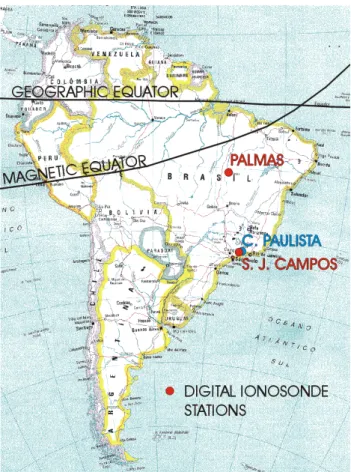
Fig. 1. A map showing the locations of the ionospheric sounding
stations Palmas and Sao Jose dos Campos. Also, the location of Cachoeira Paulista indicated in the paper is shown.
(hereafter referred as ESF) during the post-midnight period increases with geomagnetic activity (e.g. Bowman, 1982; Fe-jer et al., 1999; Palmroth et al., 2000). However, using the ionospheric plasma density measurements on board the De-fense Meteorological Satellite Program (DMSP) flights, or-biting at an altitude of about 800 km, Huang et al. (2001) have reported that, contrary to the general belief, equatorial plasma bubbles (strong spread-F, hereafter referred as EPBs) develop in the evening sector during the early stages of high geomagnetic activity periods and are later suppressed. Also, using a large data base of the OI 630-nm nightglow emis-sion all-sky images from Cachoeira Paulista (22◦S, 45◦W), a low-latitude station in Brazil, Sahai et al. (1998, 2004) have presented many examples of the observations of EPBs in both evening (continuing throughout the night) and morn-ing sectors durmorn-ing geomagnetic disturbances. Therefore, it should be pointed out that during geomagnetic disturbances the occurrence of EPBs is not limited to the morning sector only. Now there are increasing evidences that during geo-magnetic disturbances EPBs are observed during the evening sector as well. Whalen (2002) has reported that the prob-ability of EPB occurrence is a quantitative function of Kp
and season, with suppression that can be represented as a linear function of Kp during the equinox (E) (March, April,
September and October) and summer (D) (December solstice – November to February) months in the western South Amer-ican sector, and by contrast no dependence on Kpduring the
winter (J) (June solstice – May to August) months. However, the occurrence of EBPs during the J months is very rare in the Brazilian sector (e.g. Tsunoda, 1985; Abdu et al., 1992; Sahai et al., 1998).
In the Brazilian sector it is now known that there are dis-tinct strong spread-F (EPBs) seasons (Sahai et al., 1994, 1998, 2004; Abdu et al., 1998), with high occurrence dur-ing the D months, low occurrence durdur-ing the J months, and the equinox E months showing transition characteristics from high to low and vice versa. The observed seasonal depen-dence of the EPBs in the Brazilian sector is associated with the magnetic declination control (about 20◦W) (Tsunoda,
1985; Maruyama, 1988; Abdu et al., 1992).
In August 2000, a new ionospheric sounding station was established at Sao Jose dos Campos (23.2◦S, 45.9◦W; dip latitude 17.6◦S; a low-latitude station hereafter referred as SJC), Brazil, by the University of Vale do Paraiba (UNIVAP). Another ionospheric sounding station was established at Pal-mas (10.2◦S, 48.2◦W; dip latitude 5.5◦S, a near dip equa-tor station hereafter referred as PAL), Brazil, in April 2002, by UNIVAP in collaboration with the Lutheran University Center of Palmas (CEULP), Lutheran University of Brazil (ULBRA). Both stations are equipped with digital ionosonde of the type known as Canadian Advanced Digital Ionosonde (CADI) (Grant et al., 1995; Abalde et al., 2001).
In this paper, we present and discuss three case stud-ies related to ESF occurrence/suppression during geomag-netic disturbances from ionospheric sounding observations in three different seasons, two from the observations at SJC (September 2000 – transition from low to high occurrence rates of EPBs-E month – and November 2000 – high occur-rence rates of EPBs-D month) and one from the simultane-ous ionospheric sounding observations at SJC and PAL (July 2003 – low occurrence rates of EPBs-J month).
2 Results and discussion
The locations of the ionospheric sounding stations, SJC and PAL, are shown in Fig. 1. The two stations are separated by about 1460 km, with PAL close to the magnetic equa-tor and SJC under the crest of the equaequa-torial ionospheric anomaly (in the equatorial and low-latitude regions, the F-layer electron density falls to a minimum over the magnetic equator and passes through maxima at dip latitudes 10◦–20◦
north and south of the magnetic equator). The universal time (UT) for both stations is 3 h ahead of the local time (LT). In this study we present the ionospheric sounding observa-tions obtained at SJC during the periods 14 September to 19 September 2000 (transition from low to high occurrence rates of EPBs-E month) and 2 November to 7 November 2000 (high occurrence rates of EPBs-D month), at both SJC and PAL during the period 10 to 13 July 2003 (low occurrence rates of EPBs-J month). All three periods used in the present
F. Becker-Guedes et al.: Geomagnetic storm and equatorial spread-F 3233
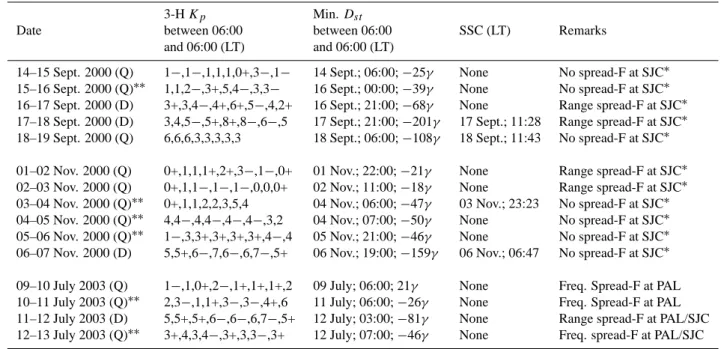
Table 1. Details of magnetic activity.
3-H Kp Min. Dst
Date between 06:00 between 06:00 SSC (LT) Remarks and 06:00 (LT) and 06:00 (LT)
14–15 Sept. 2000 (Q) 1−,1−,1,1,1,0+,3−,1− 14 Sept.; 06:00; −25γ None No spread-F at SJC∗ 15–16 Sept. 2000 (Q)∗∗ 1,1,2−,3+,5,4−,3,3− 16 Sept.; 00:00; −39γ None No spread-F at SJC∗ 16–17 Sept. 2000 (D) 3+,3,4−,4+,6+,5−,4,2+ 16 Sept.; 21:00; −68γ None Range spread-F at SJC∗ 17–18 Sept. 2000 (D) 3,4,5−,5+,8+,8−,6−,5 17 Sept.; 21:00; −201γ 17 Sept.; 11:28 Range spread-F at SJC∗ 18–19 Sept. 2000 (Q) 6,6,6,3,3,3,3,3 18 Sept.; 06:00; −108γ 18 Sept.; 11:43 No spread-F at SJC∗ 01–02 Nov. 2000 (Q) 0+,1,1,1+,2+,3−,1−,0+ 01 Nov.; 22:00; −21γ None Range spread-F at SJC∗ 02–03 Nov. 2000 (Q) 0+,1,1−,1−,1−,0,0,0+ 02 Nov.; 11:00; −18γ None Range spread-F at SJC∗ 03–04 Nov. 2000 (Q)∗∗ 0+,1,1,2,2,3,5,4 04 Nov.; 06:00; −47γ 03 Nov.; 23:23 No spread-F at SJC∗ 04–05 Nov. 2000 (Q)∗∗ 4,4−,4,4−,4−,4−,3,2 04 Nov.; 07:00; −50γ None No spread-F at SJC∗ 05–06 Nov. 2000 (Q)∗∗ 1−,3,3+,3+,3+,3+,4−,4 05 Nov.; 21:00; −46γ None No spread-F at SJC∗ 06–07 Nov. 2000 (D) 5,5+,6−,7,6−,6,7−,5+ 06 Nov.; 19:00; −159γ 06 Nov.; 06:47 No spread-F at SJC∗ 09–10 July 2003 (Q) 1−,1,0+,2−,1+,1+,1+,2 09 July; 06:00; 21γ None Freq. Spread-F at PAL 10–11 July 2003 (Q)∗∗ 2,3−,1,1+,3−,3−,4+,6 11 July; 06:00; −26γ None Freq. Spread-F at PAL 11–12 July 2003 (D) 5,5+,5+,6−,6−,6,7−,5+ 12 July; 03:00; −81γ None Range spread-F at PAL/SJC 12–13 July 2003 (Q)∗∗ 3+,4,3,4−,3+,3,3−,3+ 12 July; 07:00; −46γ None Freq. spread-F at PAL/SJC
∗Only CADI at SJC in operation. ∗∗With some magnetic activity.
study include geomagnetically quiet, disturbed and recovery phases. The observed ionospheric parameters (h0F and foF2)
presented in this study from both stations, SJC and PAL, are values recorded every 15 min (ionospheric sounding is car-ried out every 5 min). Table 1 presents details of magnetic activity during the three periods studied. To classify a night with magnetic disturbance or storm, we have used the crite-rion of Kp≥4 for at least three 3-h periods between 15:00
to 06:00 LT. Q in Table 1 indicates quiet conditions and Q∗∗ indicates that some geomagnetic activity has been associated with this night.
2.1 Spread-F observations during a transition from low to high occurrence rates of EPBs (E month)
Figure 2a shows the Kp (3-h; source website – http://ftp.
gwdg.de/pub/geophys/kp-ap/tab/) , Dst(hourly; source
web-site – http://swdcdb.kugi.kyoto-u.ac.jp/wdc/Sec3.html) and
AE (every 15 min or less; source website – http://swdcdb. kugi.kyoto-u.ac.jp/wdc/Sec3.html) magnetic indices during the period 14–19 September 2000. During this period there were 2 storm-time sudden commencements (SSCs) occurring at 14:28 UT (11:28 LT) on 17 September and 14:43 UT (11:43 LT) on 18 September (SSC-source website – http://ftp.gwdg.de/pub/geophys/kp-ap/tab/).
Figure 2a also shows the variations of h0F (minimum vir-tual height of F-region), foF2 (corresponding to F-region peak electron density) and spread-F (range, frequency or mixed), if present, observed at SJC during the period 14– 19 September 2000. The local nighttime periods (18:00– 06:00 LT) are indicated by the hatched portions in Fig. 2a.
As pointed out by VanZandt et al. (1971), the most direct and easily observable effects of vertical electromagnetic drift dur-ing a geomagnetic storm are changes in the F-region height and presented here by h0F. Also, during a geomagnetic storm,
the F-region electron density (foF2) can both increase (posi-tive ionospheric storm or phase) and decrease (nega(posi-tive iono-spheric storm or phase) compared with the quiet time values (e.g. Danilov and Morozova, 1985). The positive ionospheric storm effects at equatorial and low latitudes are associated with electrodynamic lifting of the F-region, whereas the neg-ative ionospheric storm effects are related to the changes in neutral composition due to travelling atmospheric distur-bances from a high-latitude region (e.g. Prolss and Najita, 1975).
A perusal of Fig. 2a indicates that 14 and 15 Septem-ber are geomagnetically quiet, except for some magnetic ac-tivity around the end of 15 September (between 21:00 to 24:00 UT). The 16 to 18 September period is geomagneti-cally disturbed, but the recovery phase starts on 18 Septem-ber again with some magnetic activity on 19 SeptemSeptem-ber (be-tween 12:00 to 17:00 UT). Since we are investigating the ef-fects of geomagnetic storms on equatorial spread-F, we shall concentrate our studies on the nighttime ionospheric sound-ing observations, mostly between 18:00 LT (21:00 UT) to 06:00 LT (09:00 UT). Figure 2a shows the presence of range spread-F (indicating the presence of EBPs, as mentioned ear-lier) only on the nights of 16–17 and 17–18 September. Both nights are geomagnetically disturbed (Table 1).
During the post-sunset period, on both 16 and 17 Septem-ber, the h0F variations show an uplift of about 60 km
3234 F. Becker-Guedes et al.: Geomagnetic storm and equatorial spread-F
17 Figure 2a
Fig. 2a. The variations of the Kp, Dstand AE geomagnetic indices
and ionospheric parameters h0F and foF2 observed at Sao Jose dos Campos during the period of 14 to 19 September 2000. The peri-ods of spread-F (range R, mixed M and frequency F) are shown by horizontal bars.
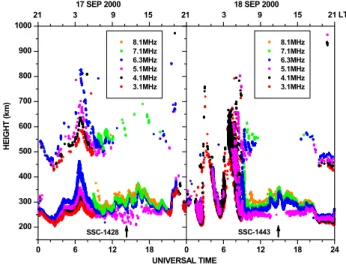
(compared with the quiet days 14 and 15 September) at about 19:00 LT, followed by the generation of range spread-F. The F-region uplift phase on both the late evenings (16 and 17 September) occurs simultaneously with a large in-crease in the AE index (Fig. 2a) and is possibly associated with the prompt penetration of magnetospheric convective electric fields to low latitudes. Also, the variations of foF2 on the night of 16–17 September show an unusual increase (positive phase) accompanying the h0F uplift and the positive phase continues throughout the night, as evident from com-parison with the earlier quiet nights. As mentioned earlier, the positive phase is also associated with the eletrodynamic lifting of the F-region. During the night of 17–18 Septem-ber, after the initial uplifting of the F-region around 19:00 LT, the variations in h0F show strong oscillations with a pe-riod of about 3 h. Figure 2b shows the variations of virtual heights at fixed frequencies on 17 and 18 September, show-ing large increases in the F-region heights durshow-ing the night of 17–18 September, after the SSC at 14:28 UT on 17 Septem-ber and a large enhancement of ring current (|Dst|=200 nT)
around midnight (UT) on 17–18 September. Also, the varia-tions in foF2 show first a positive phase (around the uplifting time) followed by oscillatory behavior. The absence of short
18 0 6 12 18 200 300 400 500 600 700 800 900 1000 SSC-1428 LT 9 8.1MHz 7.1MHz 6.3MHz 5.1MHz 4.1MHz 3.1MHz 8.1MHz 7.1MHz 6.3MHz 5.1MHz 4.1MHz 3.1MHz HEI G HT ( km) 0 6 12 18 24 SSC-1443 UNIVERSAL TIME 21 15 3 9 15 3 21 21 18 SEP 2000 17 SEP 2000 Figure 2b
Fig. 2b. The variations of vertical heights at different fixed
fre-quencies observed at Sao Jose dos Campos on 17 and 18 September 2000.
periods of foF2 values on both 16–17 and 17–18 September is due to the presence of strong spread-F on the ionograms. It appears that the oscillatory part of both the h0F and foF2
variations, on the night of 17–18 September, may be related to the Joule heating at high latitudes that may drive traveling atmospheric disturbances (TADs) and result in changes in the neutral compositions.
It is evident from the present data set from September 2000 (transition from low to high occurrence rates of EPBs-E month) that the geomagnetic disturbances have, in some way, helped in the initiation/generation process of EPBs. 2.2 Spread-F observations during high occurrence rates of
EPBs (D month)
Figure 3 shows the Kp (3-h; source website – http://
ftp.gwdg.de/pub/geophys/kp-ap/tab/), Dst (hourly; source
website – http://swdcdb.kugi.kyoto-u.ac.jp/wdc/Sec3.html) and AE (every 15 min or less; source website – http:// swdcdb.kugi.kyoto-u.ac.jp/wdc/Sec3.html) magnetic indices during the period 2–7 November 2000. During this pe-riod there were 3 storm-time sudden commencements (SSCs) occurring at 02:23 UT (23:23 LT on 3 November) on 4 November, 09:47 UT (06:47 LT) on 6 November and 18:16 UT (15:16 LT) on 7 November (SSC-source website – http://ftp.gwdg.de/pub/geophys/kp-ap/tab/).
Figure 3 indicates that, in general, the period between about 06:00 UT on 4 November, to about 12:00 UT on 7 November, is geomagnetically disturbed. Table 1 shows that the nights of 1–2 and 2–3 November are quiet, 3–4, 4– 5 and 5–6 November have some magnetic activity, whereas 6–7 November is magnetically disturbed. Figure 3 also shows the variations of h0F, foF2 and spread-F, if present, observed at SJC during the period 2–7 November 2000. Dur-ing this period, it is observed that range spread-F is present only on the quiet nights of 1–2 and 2–3 November. On the
F. Becker-Guedes et al.: Geomagnetic storm and equatorial spread-F 3235
19 Figure 3
Fig. 3. Same as Fig. 2a, except for the period of 2 to 7 November
2000.
night of 4–5 November, although the SSC was observed only at 23:23 LT, no spread-F was observed at SJC. This could be possibly due to the day-to-day variability in the genera-tion and evolugenera-tion of equatorial spread-F. However, after the SSC, h0F shows a rapid rise to about 500 km (1h0F of about 300 km) at about 04:00 LT. During the uplift phase of h0F, foF2 shows a strong negative phase and then recovers close to the normal foF2 values. The more interesting part of the data presented from the November ionospheric observations indi-cates the absence of spread-F at SJC between the nights of 4– 5, 5–6 and 6–7 November, during the period of geomagnetic disturbances (Fig. 3), as mentioned earlier. Range spread-F is observed again only on the night of 7–8 November at about 22:30 LT (not covered in Fig. 3) and then the follow-ing several quiet nights show the presence of range spread-F, which is normal for this month. During the disturbed period, foF2, in general, shows negative phase (the effect is much stronger following the SSC on 6 November) compared with the quiet days (2 and 3 November), possibly associated with the neutral compositional changes related to Joule heating at high latitudes and associated equatorward neutral winds. As pointed out by Fejer and Scherliess (1995), in the post-sunset period at Jicamarca, Peru, prompt penetrating electric fields enhance the vertical E×B plasma drift, whereas ionospheric disturbance dynamo electric fields reduce the upward uplift-ing.
20
Figure 4
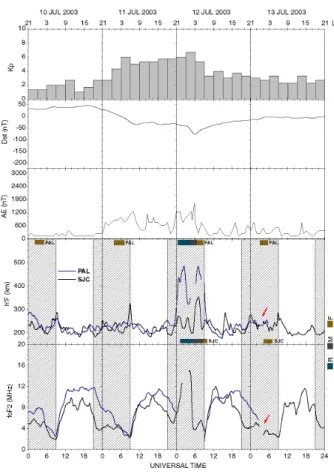
Fig. 4. Same as Fig. 2a, except for the period of 10 to 13 July
2003 and with the ionospheric parameters h0F and foF2 observed at Palmas. The red arrows indicate the period when strong sporadic E at SJC did not permit scalings of the ionograms.
It is evident from the present data set from November 2000 (high occurrence rates of EPBs-D month) that the geomag-netic disturbances have, in some way, helped in the suppres-sion of EPBs.
2.3 Spread-F observations during low occurrence rates of EPBs (J month)
Figure 4 shows the Kp (3-h; source website – http://ftp.
gwdg.de/pub/geophys/kp-ap/tab/), Dst (hourly; source
web-site – http://swdcdb.kugi.kyoto-u.ac.jp/wdc/Sec3.html) and
AE(every hour; at present, 1-min values of the AE index are not available; source website – http://swdcdb.kugi.kyoto-u. ac.jp/wdc/Sec3.html) magnetic indices during the period 10– 13 July 2003. During this period no SSC was observed. Fig-ure 4 shows that 11 and 12 July are geomagnetically dis-turbed days, with 10 July being quiet and 13 July in the re-covery phase.
During this period studied, ionospheric sounding observa-tions from both the staobserva-tions PAL and SJC were available for most of the period (no observations from PAL are available after 06:00 UT on 13 July due to an instrumental problem). Figure 4 also shows the variations of h0F, foF2 and spread-F, if present, observed at PAL (blue) and SJC (black) during the
3236 F. Becker-Guedes et al.: Geomagnetic storm and equatorial spread-F
21
Figure 5
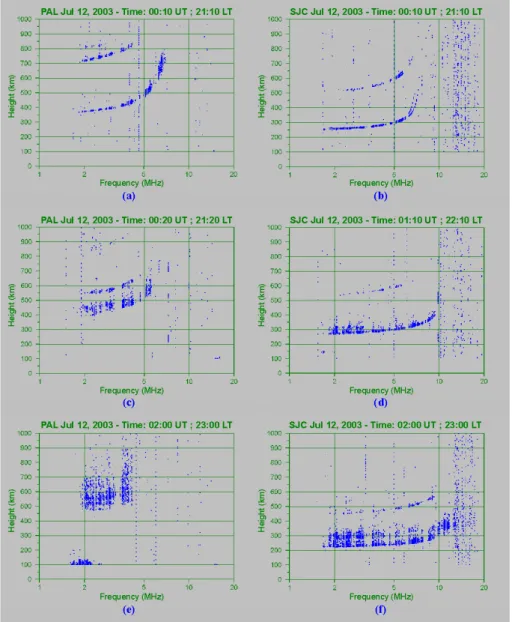
Fig. 5. Examples of ionograms obtained at Palmas and Sao Jose dos Campos on the night of 11–12 July 2003.
period 10–13 July 2003. On the quiet nights of 9–10 and 10– 11 July and again, during the recovery phase night of 12–13 July, frequency spread-F is observed at PAL. On the geomag-netically disturbed night of 11–12 July, it is observed that h0F starts to rise quickly at about 20:00 LT at PAL, attaining an altitude of about 430 km (1h0F of about 200 km) by about
22:00 LT. This is possibly associated with prompt penetration of magnetospheric convective electric fields to the equatorial region and, by 21:15 LT, range spread-F starts during the up-lift phase at PAL. However, the large variations in h0F ob-served at PAL after the initial fast uplift could be due to both the prompt penetration of magnetospheric convective elec-tric fields as well as the disturbance dynamo effect. Figure 4 shows that the time variations of the h0F at PAL and SJC, on the night of 11–12 July, during the geomagnetic disturbed conditions, are fairly different. Figure 5(a, c and e) shows the evolution of spread-F at PAL on this night. Thereafter, spread-F continues until the early morning hours at PAL. The
spread-F on ionograms at PAL is strong and does not per-mit scaling of foF2 at PAL on this night between 21:15 to 06:00 LT. Also, the altitude variations of h0f presented from PAL on the night of 11–12 July are the best estimates consid-ering the strong spread-F on the ionograms. During the short periods, between 01:30 LT to 03:15 LT (due to strong spo-radic E and spread-F) and between 05:00 LT to 06:00 (due to spread-F), on this night (Fig. 4) even scalings of h0F values
have not beeen possible. The ionospheric sounding observa-tions at SJC on the night of 11–12 July (Fig. 4) show a strong increase in foF2 during the uplift phase at PAL. This increase is possibly associated with the strengthening of the equato-rial ionospheric anomaly (during the unusual E×B uplift in the equatorial region, field-aligned diffusion enhance elec-tron densities at low latitudes). After about an hour from the onset of spread-F at PAL, spread-F at SJC is observed (Fig. 4). Figure 5 (b, d and f) shows the evolution of spread-F at SJC on the night of 11–12 July. The variations of h0F at
F. Becker-Guedes et al.: Geomagnetic storm and equatorial spread-F 3237
22
Figure 6
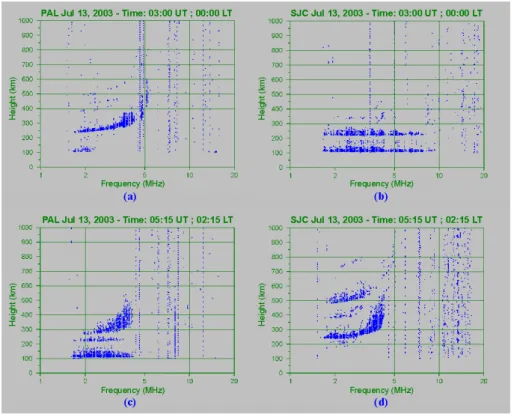
Fig. 6. Examples of ionograms obtained at Palmas and Sao Jose dos Campos on the night of 12–13 July 2003.
SJC on this disturbed night show an oscillatory nature with periods of about 3 h, possibly associated with the traveling atmospheric disturbances (TADs) from the high-latitude re-gion.
It should be mentioned that on the night of 12–13 July, dur-ing the geomagnetic storm recovery phase, no range spread-F was observed. However, on this night, both PAL and SJC show the presence of frequency spread-F, first at PAL and then later at SJC (Fig. 4). The frequency spread-F is associated with the bottomside sinusoidal irregularities in the equatorial F-region (Valladares et al., 1983). However, more interesting observations on the night of 12–13 July re-late to the development of the sporadic E-layer at both sta-tions, SJC and PAL. Although the sporadic E-layer is not the theme of this study, it is worth mentioning the way the spo-radic E-layer developed at both stations. On this night, be-tween 18:30 to 02:15 LT, the sporadic E-layer was observed at SJC. However, during the period of 00:00 to 01:10 LT, sporadic E at SJC was so strong that no F-region trace were observed (shown by red arrows in Fig. 4). The sporadic E-layer was observed later at PAL between 21:15 to 02:30 LT. Strong sporadic E, inhibiting the appearance of the F-layer traces on ionograms was observed at PAL only for a short spell between 01:50 to 02:00 LT. Figure 6 shows a few iono-grams from both PAL and SJC on this night. It appears that the sporadic E-layer first developed at the low-latitude re-gion and then extended to the equatorial rere-gion. Batista and Abdu (1977) have reported magnetic storm associated de-layed sporadic E enhancements due to charged particle
pre-cipitation in the Brazilian geomagnetic anomaly region. The present obsevations are from the same region and indicate the possible expansion of the sporadic E-layer from low latitude to the equatorial region with time. A detailed study of the characteristics of the sporadic E-layer, including this night, will be the subject of another paper.
It is evident from the present data set from July 2003 (low occurrence rates of EPBs-J month) that the geomag-netic disturbances have, in some way, helped in the initia-tion/generation process of EPBs. The 3 case studies from 3 different seasons in the present investigations indicate the geomagnetic control of the generation/suppression of spread-F during different seasons, possibly due to corresponding changes in the quiet and disturbed drift patterns (e.g. Fe-jer et al., 1999). However, it is felt that more case stud-ies during geomagnetic disturbed periods, with simultaneous equatorial and low-latitude ionospheric sounding and ther-mospheric wind observations, will be important for the un-derstanding of high-latitude and low-latitude coupling and for equatorial spread-F studies.
2.4 Conclusions
In the present investigations we have presented three case studies from three different seasons using ionospheric sound-ing observations from equatorial and low-latitude stations in the Brazilian sector. The main results are as follows.
1. During the month of September 2000 (equinox (tran-sition from low to high occurrence rates of EPBs)
3238 F. Becker-Guedes et al.: Geomagnetic storm and equatorial spread-F E month), range spread-F was observed only on two out
of six nights studied from the observations at Sao Jose dos Campos, a low-latitude station. It should be pointed out that both nights with range spread-F were geomag-netically disturbed.
2. During the month of November 2000 (seven nights stud-ied during the summer (high occurrence rates of EPBs) D month of Southern Hemisphere), no range spread-F was observed from the observations at Sao Jose dos Campos, on the four geomagnetically disturbed nights. It should be mentioned that range spread-F was ob-served on the two initial quiet nights. However, on one quiet night no range spread-F was observed, possibly related to the day-to-day variability of the equatorial plasma bubble development. We do not have observa-tions available from an equatorial station in this sector on this night to check if the range spread-F was present in that region (11–12 July).
3. During the month of July 2003 (four nights studied dur-ing the winter (low occurrence rates of EPBs-J month of Southern Hemisphere), simultaneous observations from Palmas (a near equatorial station) and Sao Jose dos Campos show the presence of range spread-F at both the stations only on one night which was geomagnetically disturbed.
4. From the present investigations it appears that possibly during the low equatorial plasma bubbles (EPBs) occur-rence season (winter) and transition season (equinox), geomagnetic activity in some way helps in the initia-tion/generation initiation process of EPBs, whereas dur-ing the normal high EPBs season (summer) it acts as inhibitor. Why this happens warrants further investiga-tions using more case studies from the different seasons.
Acknowledgements. The work was partially supported by funds
from FAPESP, SP, Brazil, through process numbers 1998/09892-0, 2002/01631-5 and 2002/12427-4.
Topical Editor M. Lester thanks M. Palmroth for her help in evaluating this paper.
References
Aarons, J.: The role of the ring current in the generation or inhibi-tion of equatorial F-layer irregularities during magnetic storms, Radio Sci., 26, 1131–1149, 1991.
Abalde, J. R., Fagundes, P. R., Bittencourt, J. A., and Sahai, Y.: Observations of equatorial F-region plasma bubbles using simul-taneous OI 777.4 nm and OI 630.0 nm imaging: New results, J. Geophys. Res., 106, 30 331–30 336, 2001.
Abdu, M. A., Batista, I. S., and Sobral, J. H. A.: A new aspect of magnetic declination control of equatorial spread-F and F-region dynamo, J. Geophys. Res., 97, 14 879–14 904, 1992.
Abdu, M. A., Sobral, J. H. A., Batista, I. S., Rios, V. H., and Medina, C.: Equatorial spread-F occurrences statistics in the American longitudes: Diurnal, seasonal and solar cycle variations, Adv. Space. Res., 22, 851–854, 1998.
Batista, I. S. and Abdu, M. A.: Magnetic storm associated delayed sporadic E enhancements in the Brazilian Geomagnetic anomaly, J. Geophys. Res., 82, 4777–4783, 1977.
Blanc, M. and Richmond, A. D.: The ionospheric disturbance dy-namo, J. Geophys. Res., 85, 1669–1686, 1980.
Bowman, G. G.: Spread-F occurrence in mid- and low-latitude re-gions related to various levels of geomagnetic activity, J. Atmos. Terr. Phys., 44, 585–589, 1982.
Buonsanto, M. J.: Ionospheric storms – A review, Space Sci. Rev., 88, 563–601, 1999.
Danilov, A. D. and Morozova, L. D.: Ionospheric storms in the F2
region, Morphology and Physics (Review), Geomag. Aeron., 25, 593–605, 1985.
DasGupta, A., Maitra, A., and Das, S. K.: Postmidnight equatorial scintillation activity in relation to geomagnetic disturbances, J. Atmos. Terr. Phys., 47, 911–916, 1985.
Fejer, B. G. and Scherliess, L.: Time dependent response of equato-rial ionospheric fields to magnetospheric disturbances, Geophys. Res. Lett., 22, 851–854, 1995.
Fejer, B. G., Scherliess, L., and de Paula, E. R.: Effects of the verti-cal plasma drift velocity on the generation of equatorial spread-F, J. Geophys. Res., 104, 19 859–19 869, 1999.
Grant, I. F., MacDougall, J. W., Ruohoniemi, J. M., Bristow, W. A., Sofko, G. J., Koehler, J. A., Danskin, D., and Andre, D.: Com-parison of plasma flow velocities determined by the ionosonde Doppler drift technique, SuperDARN radars, and patch motion, Radio Sci., 30, 1537–1549, 1995.
Huang, C. Y., Burke, W. J., Machuzak, J. S., Gentile, L. C., and Sultan, P. J.: DMSP observations of equatorial plasma bubbles in the topside ionosphere near solar maximum, J. Geophys. Res., 106, 8131–8142, 2001.
Huang, C. Y., Burke, W. J., Machuzak, J. S., Gentile, L. C., and Sul-tan, P. J.: Equatorial plasma bubbles observed by DMSP satel-lites during a full solar cycle: Toward a global climatology, J. Geophys. Res., 107, 1434, doi:10.1029/2002JA009452, 2002. Kelley, M. C.: In situ ionospheric observations of severe
weather-related gravity waves and associated small-scale plasma struc-ture, J. Geophys. Res., 102, 329–335, 1997.
Kelley, M. C., Garcia, F., Makela, J., Fan, T., Mak, E., Sai, C., and Alcocer, D.: Highly structured tropical airglow and TEC signa-ture during strong geomagnetic activity, Geophys. Res. Lett., 27, 465–468, 2000.
Maruyama, T.: A diagnostic model for equatorial spread F 1. Model description and applications to electric field and neutral wind ef-fects, J. Geophys. Res., 93, 14 611–14 622, 1988.
Palmroth, M., Laakso, H., Fejer, B. G., and Pfaff Jr., R. F.: DE 2 ob-servations of morningside plasma density depletions in the equa-torial ionosphere, J. Geophys. Res., 105, 18 429–18 442, 2000. Prolss, G. W. and Najita, K.: Magnetic storm associated changes in
the electron content at low latitudes, J. Atmos. Terr. Phys., 37, 635–643, 1975.
Sahai, Y., Aarons, J., Mendillo, M., Baumgardner, J., Bittencourt, J. A., and Takahashi, H.: OI 630 nm imaging observations of equatorial plasma depletions at 16◦S dip latitude, J. Atmos. Terr. Phys., 56, 1461–1475, 1994.
Sahai, Y., Fagundes, P. R., Bittencourt, J. A., and Abdu, M. A.: Occurrence of large scale equatorial F-region plasma depletions during geo-magnetic disturbances, J. Atmos. Sol.-Terr. Phys., 60, 1593–1604, 1998.
Sahai, Y., Fagundes, P. R., and Bittencourt, J. A.: Transequatorial F-region ionospheric plasma bubbles: solar cycle effects, J. Atmos. Sol.-Terr. Phys., 62, 1377–1383, 2000.
F. Becker-Guedes et al.: Geomagnetic storm and equatorial spread-F 3239
Sahai, Y., Fagundes, P. R., Abalde, J. R., Pimenta, A. A., Bitten-court, J. A., Otsuka , Y., and Rios, V. H.: Generation of large-scale equatorial F-region plasma depletions during low spread-F season, Ann. Geophys., 22, 15–23, 2004.
Sekar, R. and Kelley, M. C.: On the combined effects of vertical shear and zonal electric field patterns on nonlinear equatorial spread-F evolution, J. Geophys. Res., 103, 20 735–20 747, 1998. Senior, C. and Blanc, M.: On the control of magnetospheric con-vection by the spatial distribution of ionospheric conductivities, J. Geophys. Res., 89, 261–284, 1984.
Spiro, R. W., Wolf, R. A., and Fejer, B. G.: Penetration of high-latitude-electric-field effects to low latitudes during SUNDIAL 1984, Ann. Geophys., 6, 39–50, 1988.
Sultan, P. J.: Linear theory and modeling of the Rayleigh-Taylor in-stability leading to the occurrence of equatorial spread-F, J. Geo-phys. Res., 101, 26 875–26 891, 1996.
Tsunoda, R. T.: Control of the seasonal and longitudinal occurrence of equatorial scintillations by the longitudinal gradient in the in-tegrated E-region Pedersen conductivity, J. Geophys. Res., 90, 447, 1985.
Valladares, C. E., Hanson, W. B., McClure, J. P., and Cragin, B. L.: Bottomside sinusoidal irregularities in the equatorial F-region, J. Geophys. Res., 88, 8025–8042, 1983.
VanZandt, T. E., Peterson, V. L., and Laird, A. R.: Electromagnetic drift of the midlatitude F2-layer during a storm, J. Geophys. Res.,
76, 278–281, 1971.
Whalen, J. A.: Dependence of equatorial bubbles and bot-tomside spread-F on season, magnetic activity, and E×B drift velocity during solar maximum, J. Geophys. Res., 107, doi:10.1029/2001JA000039, 2002.