HAL Id: hal-02116757
https://hal-amu.archives-ouvertes.fr/hal-02116757
Submitted on 1 May 2019
HAL is a multi-disciplinary open access
archive for the deposit and dissemination of
sci-entific research documents, whether they are
pub-lished or not. The documents may come from
teaching and research institutions in France or
abroad, or from public or private research centers.
L’archive ouverte pluridisciplinaire HAL, est
destinée au dépôt et à la diffusion de documents
scientifiques de niveau recherche, publiés ou non,
émanant des établissements d’enseignement et de
recherche français ou étrangers, des laboratoires
publics ou privés.
Sensors & Transducers Humidity Impact Reduction on
WO 3 Gas Microsensor Response Using New Filters
Based on Ionic Liquid
Alexandre Favard, Xueru Yan, Stéphane Anguille, Philippe Moulin, Jean-Luc
Seguin, Khalifa Aguir, Marc Bendahan
To cite this version:
Alexandre Favard, Xueru Yan, Stéphane Anguille, Philippe Moulin, Jean-Luc Seguin, et al.. Sensors
& Transducers Humidity Impact Reduction on WO 3 Gas Microsensor Response Using New Filters
Based on Ionic Liquid. The Third International Conference on Advances in Sensors, Mar 2018, Rome,
Italy. �hal-02116757�
Humidity Impact Reduction on WO
3
Gas Microsensor
Response Using New Filters Based on Ionic Liquid
1
Alexandre FAVARD,
2Xueru YAN,
2Stéphane ANGUILLE,
2Philippe
MOULIN,
1Jean-Luc SEGUIN,
1Khalifa AGUIR,
1Marc BENDAHAN
1
Aix Marseille Univ, Université de Toulon, CNRS, IM2NP, Marseille, France
2Aix Marseille Univ, CNRS, Centrale Marseille, M2P2, Aix en Provence, France
1
Tel.: XXXXXX, fax: XXXXXXX
1E-mail:
Abstract: The detection of gaseous pollutants such as Benzene, Toluene, Ethylbenzene and Xylene (BTEX)
under real conditions requires working in a humid environment. It is well known that the humidity reduces the performances of gas sensors, particularly in terms of sensitivity. Ionic liquids (ILs) are a new class of solvent with attractive properties for the extraction of volatile organic compounds (VOCs) or gases. Moreover, the ILs are particularly interesting because of their recycling ability and without atmospheric pollution. Using a filter based on a mixed ionic liquid ([Bmim][Br]-[Bmim][PF6]), low concentrations of BTEX are detected with a
tungsten trioxide (WO3) thin film (50 nm) deposited by reactive RF magnetron sputtering on a transducer
developed in our laboratory. With this filter upstream, we are able to detect 500 ppb of BTEX gases without a sensor sensitivity decrease with 50 % relative humidity.
Keywords: Gas sensor, humidity removal, tungsten trioxide, ionic liquids based filters.
1. Introduction
Air quality monitoring has become an important health and societal issue, since the European directive 2008/50/EC, particularly. Several toxicological and epidemiological studies have shown that air pollution causes respiratory problems, such as asthma, cardiovascular disease and cancer. Air pollution is estimated to be responsible for several hundred thousand premature deaths per year [1-2]
Benzene, Toluene, Ethylbenzene and Xylenes (BTEX) are among the most harmful polluting gases due to their effect on health even at very low concentrations. BTEX is a useful suite to measure. In typical urban environments, there are a lot of VOCs present. Typical GC-MS analysis can resolve many
BTEX, but (i) some of these may be below detection limits of the analysis and (ii) the measurement is not obtained immediately. So metal oxide gas sensor can detect online very small BTEX concentrations. Moreover, the detection of gaseous pollutants under real conditions requires working in a humid environment. The humidity often limits the performances of metal oxide gas sensors, particularly in terms of sensitivity. All metal oxide gas sensors are subject to interfering effects derived from water molecules that are still present in most of cases due to ambient humidity. Almost all types of metal oxides have a strong tendency to adsorb moisture to their surfaces, which leads to the degradation of the detection performance. [3].
Ionic liquids (ILs) have emerged as a promising green option to replace traditional organic solvents
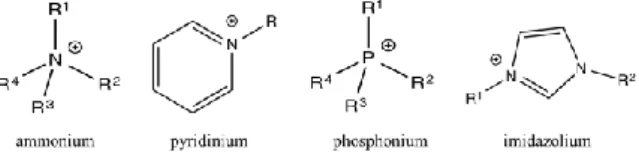
for gas separation in recent years because of their desirable properties like low vapor pressure [4], thermal stability [5], and tunable structures, which endow ILs the advantages of low energy consumption, less loss of absorbents and so on [6-8]. They have proven to be effective polar separation solvents with high selectivity and stability [9, 10]. Thus, these compounds have been successfully applied for heavy metal removal [11, 12], carbon oxide recovery [13, 14], humidity removal [15], and coupled with membrane processes [16, 17]. One of the most important characteristic of ILs is that they can be tailor-made designed for specific applications [18, 19]. IL’s properties can be adjusted via chemical alteration of the cation and/or anion to produce application specific compounds [20]. This result in a large variety of ILs that can be adapted to given process. The mainly cations used in the synthesis of ILs are ammonium, pyridinium, phosphonium and imidazolium. The structures of those cations are shown Figure 1. These cations can be functionalized with alkyl chains (Rn) and they can be associate to
common anions such as halides, BF4-, PF6-, and NTf2-.
Fig. 1. The mainly cations of ILs
The task specific ionic liquids (TSILs) [21] have been developed to enhance the selective solubility or/and recyclability [22]. The imidazolium based ILs can reduce air pollution, also they can increase the recycling and reuse potential [23]. More importantly, imidazolium based ILs show the high absorption capacity of water [24, 25]. 1-butyl-3-methylimidazolium bromide ([Bmim][Br]) was selected as the ionic liquid in this study because it is stable and recyclable [26].
The focus of this work is on the humidity removal which is one of the most important parameter affecting the sensor response. We developed an ILs based humidity removal filter reduces the relative humidity. Moreover, we demonstrated the possibility to detect low BTEX concentration (500 ppb) with 50 % relative humidity, without loss of the sensor sensitivity, using a WO3 gas sensor with this filter
upstream [27]. It is necessary to demonstrate that the ionic liquid only captures the humidity from air and does not affect the sensor response.
In section Ⅱ, we describe the WO3 microsensor,
the test bench and the IL filter. In section Ⅲ, we present and comment experimental results showing the effect of the IL filter on the detection of low BTEX a concentration under 50 % relative humidity.
2. Material and methods
2.1. Microsensor design and sensitive layer
Our device is composed of an integrated Pt heater and Pt electrodes for the measurements, deposited by sputtering on a Si/SiO2 substrate (Figure 2) [28]. Thesensitive layer of tungsten trioxide (50 nm) was deposited on the top of these electrodes, by reactive RF magnetron sputtering. After the sensitive layer’s deposition on the Pt electrodes, the films were annealed at 743 K for 90 minutes in air to stabilize the chemical composition and the crystalline structure.
WO3 is n-type semiconductors with a large gap
and oxygen vacancies. The main charge carriers are free electrons. The conductivity of this oxide depends on the composition of the surrounding gas atmosphere [29]. The physical phenomena for the gas detection are surface reactions between the oxygen ions adsorbed on the surface and the target gas. When the sensitive layers are under air, oxygen molecules come to be chemisorbed on the surface in ion form (𝑂2−, 𝑂−𝑜𝑟 𝑂2−) [30] and electrons will be trapped on the surface of the sensitive layer. Thus, depletion layer will be created and the resistance of the sensitive layer will be changed. After the BTEX exposition, the oxydo/reduction reaction will take place on the surface of the sensitive layers as follows eq (1) [31]:
𝑉𝑂𝐶𝑠 + 𝑂−→ 𝑉𝑂𝐶𝑠 − 𝑂 + 𝑒−,
(1)
The equation (1) shows that an electron is released in the surface of the grain during the reaction, which will lead to the increase of the charge carrier density. This will induce the change of the depletion layer and so the decrease of the sensitive layer resistance allowing the detection of the target gas.
During all our studies, we used an operating temperature of 513 K. The electrical measurements were made under a constant gas flow of 100 sccm.
Fig. 2. Design of the sensor device [32]
2.2. Test bench for electrical characterization
under BTEX gases and humidity
We used a test bench specially designed for the BTEX detection in the presence of different humidity levels (Figure 3). It is composed of a gas dilution and humidification system that generates an output mixture at very low concentrations (1 to 500 ppb) with a variable humidity (0 to 90 %), an integrated test cell and an acquisition system to characterize the electrical responses of the gas micro sensor.
Humidity is generated starting from pressurized liquid water, which is vaporized through a microporous membrane. The water vapor is injected into the dry gas mixture by means of a proportional valve. This valve, controlled by a humidity sensor placed at the humidifier outlet, makes it possible to keep the hygrometry of the mixture constant. The vapor pressure is kept sufficient by heating and regulating the temperature of the vaporization cell. A second humidity sensor is placed at the output of the filter.
Fig. 3. Diagram of the test bench.
2.3. Ionic liquid based filter
To limit the effect of the humidity on the performances of metal oxide gas sensors, it is necessary to develop an ionic liquids based filter that only adsorb the water molecules from atmosphere without capturing the target gas molecules [33]. In this work, we consist of immobilizing ILs into support filter, which allows the amount of active phase needed for a given process to be minimized and greatly facilitates the recovery and reusability of ILs.
The [Bmim][Br] (The structure shows in Figure 4a) has been selected because it is one of the most hygroscopic IL. However, [Bmim][Br] is not a Room Temperature Ionic Liquid (RTIL) and the high melting point of [Bmim][Br] (80 ℃) not allow to use it in a bubbling process. In this case, we mixed 10 % of [Bmim][PF6] (The structure shows in Figure 4b)
into [Bmim][Br] to ensure the mixed ILs can be use in bubbling process. The [Bmim][PF6] is one of RTIL
with hydrophobicity. In addition, it is not interfering with the process of [Bmim][Br] absorption humidity. In order to eliminate the influence of a solid matrix or any other forms of support, the filter is made by bubbling the gas mixture into a glass container filled with mixed ILs (Figure 5).
When the [Bmim][Br] was exposed on the wet air, it was found that it caught water vapors because the anions of IL (Br-) and water molecules form
H-bonding [34].
Fig. 4. The structures of (a) [Bmim][Br] and (b) [Bmim]
[PF6].
Fig. 5. The ionic liquids based filter and bubbling
process.
3. Results and discussion
3.1 Influence of wet air on sensor response to
BETX
Almost all metal oxides have a greater or lesser sensitivity to moisture, which often leads to the degradation of their detection performance. This influence of moisture is well known and is widely described in the literature [35].
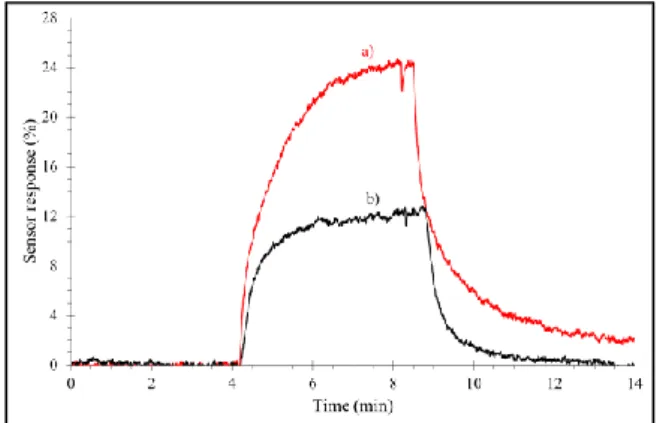
To study the humidity influence on the sensor responses, the sensors were exposed to 500 ppb of BTEX for 4 minutes (Figure 6) under dry air and wet air (50 % RH). The sensor response was calculated using the relation (2):
𝑆𝑒𝑛𝑠𝑜𝑟 𝑟𝑒𝑠𝑝𝑜𝑛𝑠𝑒 (%) = (𝑅𝑎𝑖𝑟−𝑅𝑔𝑎𝑠
𝑅𝑔𝑎𝑠 ) ∗ 100 (2)
where Rair, the sensor resistance in air before gas exposure and Rgas, the sensor resistance in presence of BTEX.
Under dry air, the sensor response to 500 ppb of BTEX is 24 %. The introduction of 50 % of relative humidity in the atmosphere reduces the sensor response to 12 %. The sensor response is divided by 2 under 50 % of relative humidity.
This behavior is well known and has been already reported in the literature. Several hypotheses have been made about this behavior [36]. Firstly, the adsorption of the water molecules leads to a decrease in the chemical adsorption of the oxygen species on the surface of the metal oxide [37]. Secondly, The BTEX molecules compete with the water molecules to react on the same adsorption sites [38]. In both cases, the introduction of relative humidity in the atmosphere leads to a decrease of the sensor response.
The result showed that the sensor is vulnerable to the errors occur due to the presence of humidity. Thus, a humidity removal device is developed in order to minimize the effect of humidity.
Fig. 6. Sensors response under 500 ppb of BTEX, a) Dry
air (0 %), b) wet air (50 %) without IL filter.
3.2. Influence of ionic liquid based filter
In the previous section, it was shown that the effect of humidity of the sensor response. Therefore, a humidity removal filter is used here to practically eliminate the humidity influence on the sensor response. We placed the IL filter upstream to the sensor and we exposed the sensor to 500 ppb of BTEX for 4 minutes (Figure 7) under wet air (50 % RH). As the gas goes through the IL filter, the humidity of the gas is lowered, and hence the humidity effect on the response is eliminated. In figure 7, we can observe that when the IL filter is placed upstream the sensor, the response to 500 ppb of BTEX remains 25 %. Hence, with this filter, we keep the BTEX detection performance of our sensor, even in presence of 50 % of relative humidity in the atmosphere.The main objective of this work being to validate the filter ability to trap water vapor, we first chose to work with a 50 % humidity rate, which is considered as a good reference for gas sensors tests. Now that we have shown the performance of this type of filter, it will be interesting to study, in future experiments, its behavior at higher humidity levels. This will help to understand at which humidity the sensor response significantly declines.
Furthermore, figure 7 shows that the response of the BTEX sensor with the filter inserted into the gas flow is slightly higher and has a larger slope compared to the response under dry air. This behavior is reproducible. It may be related to the high viscosity of the ionic liquid, which causes pressure and flow rate variations at the gas sensor. Further experiments are needed to validate this hypothesis.
Fig. 7. Sensor response under 500 ppb of BTEX, a) Dry air
(0 %), b) wet air (50 %) with IL filter.
4. Conclusion
In this work, we proposed a new solution to protect metal oxide gas sensors from the influence of humidity. We show the possibility to detect low BTEX concentrations under wet air with a WO3 gas
sensor associated with a filter based on an ionic liquid. A low-cost and reliable humidity removal filter is used to eliminate the effect of humidity on a metal oxide gas sensor. The developed filter reduced the level of humidity and stabilized it using environmental friendly compounds. We also demonstrated that the ionic liquid based filter didn’t disturb the BTEX detection. These results show that the proposed humidity removal significantly enhances the performance of the sensor.
Further work is in progress to study the behavior of the IL filter under high level of humidity and to insert the IL into a solid matrix to make a more convenient filter.
Acknowledgements
The authors would like to acknowledge Mr. A. Combes for his technical support throughout this work.
References
[1]. M. Jantunen, E. O. Fernandes, P. Carrer, S. Kephalopoulos. Promoting actions for healthy indoor air (IAIAQ), European Commission Directorate
General for Health and Consumers, 2011.
[2]. Christian Seigneur. Effets sanitaires de la pollution atmosphérique, Cerea Laboratoire commun École des
Ponts Paris Tech / EDF R&D,
http://docplayer.fr/5616961-Emissions-des-polluants-atmospheriques-christian-seigneur-cerea laboratoire-commun-ecole-des-ponts-paristech-edf-r-d.html. [3]. C. Wang, L. Yin, L. Zhang, D. Xiang, R. Gao. Metal
Oxide Gas Sensors: Sensitivity and Influencing Factors, Sensors, Vol. 10, 2010, pp. 2088 - 2106. [4] B.K. Kim, E.J. Lee, Y. Kang, J.J. Lee. Application of
ionic liquids for metal dissolution and extraction,
Journal of Industrial and Engineering Chemistry, Vol.
61, 2018, pp. 388 - 397.
[5] I. Rykowska, J. Ziemblińska, I. Nowak. Modern approaches in dispersive liquid-liquid microextraction (DLLME) based on ionic liquids: A review, Journal of
Molecular Liquids, Vol. 259, 2018, pp. 319 - 339. [6]. Z. Lei, C. Dai, B. Chen. Gas Solubility in Ionic
Liquids, Chemical Reviews, Vol. 114, 2014, pp. 1289
-1326.
[7]. X. Zhang, X. Zhang, H. Dong, Z. Zhao, S. Zhang, Y. Huang. Carbon capture with ionic liquids: overview and progress, Energy & Environmental Science, Vol. 5, 2012, pp. 6668 - 6681.
[8]. D.F. Mohshim, H. Mukhtar, Z. Man. A study on carbon dioxide removal by blending the ionic liquid in membrane synthesis, Separation and Purification
Technology, Vol. 196 , 2018, pp. 20 - 26.
[9]. A. Berthod, M.J. Ruiz-Ángel, S. Carda-Broch. Recent advances on ionic liquid uses in separation techniques,
Journal of Chromatography A, 2017.
[10]. J.P. Hallett, T. Welton. Room-Temperature Ionic Liquids. Solvents for Synthesis and Catalysis,
Chemical Reviews, 2011, pp. 3508 - 3576.
[11]. S. Platzer, M. Kar, R. Leyma, S. Chib, A. Roller, F. Jirsa, R. Krachler, D.R. MacFarlane, W. Kandioller, B.K. Keppler. Task-specific thioglycolate ionic liquids for heavy metal extraction: Synthesis, extraction efficacies and recycling properties, Journal of
Hazardous Materials, Vol. 324, 2017, pp. 241 - 249. [12]. R. Leyma, S. Platzer, F. Jirsa, W. Kandioller, R.
Krachler, B.K. Keppler. Novel thiosalicylate-based ionic liquids for heavy metal extractions, Journal of
Hazardous Materials, Vol. 314, 2016, pp. 164 - 171. [13]. J. Zhu, B. He, J. Huang, C. Li, T. Ren. Effect of
immobilization methods and the pore structure on CO2
separation performance in silica-supported ionic liquids, Microporous and Mesoporous Materials, Vol. 260, 2018, pp. 190 - 200.
[14]. T. Wang, D. Zheng, Y. Ma, J. Guo, Z. He, B. Ma, L. Liu, T. Ren, L. Wang, J. Zhang. Benzyl substituted imidazolium ionic liquids as efficient solvent-free catalysts for the cycloaddition of CO2 with epoxides:
Experimental and Theoretic study, Journal of CO2
Utilization, Vol. 22 , 2017, pp. 44 - 52.
[15] Z. Fan, J. Chen, W. Guo, F. Ma, S. Sun, Q. Zhou. In situ monitoring the moisture absorption of three ionic liquids with different halogen anions by ATR-FTIR
spectroscopy, Journal of Molecular Sturcture, Vol. 1164, 2018, pp. 297 - 302.
[16]. M. Mohammadi, M. Asadollahzadeh, S. Shirazian. Molecular-level understanding of supported ionic liquid membranes for gas separation, Journal of
Molecular Liquids, 2018.
[17]. M. Malankowska, C.F. Martins, H.S. Rho, L.A. Neves, R.M. Tiggelaar, J.G. Crespo, M.P. Pina, R. Mallada, H. Gardeniers, I.M. Coelhoso. Microfluidic devices as gas – Ionic liquid membrane contactors for CO2 removal from anaesthesia gases, Journal of Membrane Science, Vol. 545, 2018, pp. 107 - 115. [18]. S. Marullo, C. Rizzo, N.T. Dintcheva, F. Giannici, F.
D’Anna. Ionic liquids gels: Soft materials for environmental remediation, Journal of Colloid and
Interface Science, Vol. 517, 2018, pp. 182 - 193. [19]. J. Wu, L. Mu, J. Zhu, Y. Chen, X. Yin, X. Feng, X.
Lu, R. Larsson, Y. Shi. Turning the solubility and lubricity of ionic liquids by absorbing CO2, Tribology International, Vol. 121, 2018, pp. 223 - 230.
[20]. H. Wang, J. Wang, S. Zhang, X. Xuan. Structural Effects of Anions and Cations on the Aggregation Behavior of Ionic Liquids in Aqueous Solutions,The
Journal of Physical Chemostry B, 2008, pp. 16682
-16689.
[21] R. Turgis, G. Arrachart, S. Michel, S. Legeai, M. Lejeune, M. Draye, S. Pellet-Rostaing. Ketone functionalized task specific ionic liquids for selective tantalum extraction, Separation and Purification
Technology, Vol. 196, 2018, pp. 174 - 182.
[22] M.S. Raja Shahrom, C.D. Wilfred, A.K.Z. Taha. CO2
capture by task specific ionic liquids (TSILs) and polymerized ionic liquids (PILs and AAPILs), Journal of Molecular Liquids, Vol. 219, 2016, pp. 306 - 312. [23]. D. Zheng, L. Dong, W. Huang, X. Wu, N. Nie. A
review of imidazolium ionic liquids research and development towards working pair of absorption cycle, Renewable and Sustainable Energy Reviews, Vol. 37, 2014, pp. 47 - 68.
[24]. F.D. Francesco, N. Calisi, M. Creatini, B. Melai, P. Salvo, C. Chiappe, Water sorption by anhydrous ionic liquids, Green Chemistry, Vol. 13, 2011, pp. 1712
-1717.
[25]. Z. Ziobrowski, A. Rotkegel. The influence of water content in imidazolium based ILs on carbon dioxide removal efficiency, Separation and Purification
Technology, 2017, pp. 412 - 419.
[26]. P.L.A. Alviz, A. Alvarez. Comparative life cycle assessment of the use of an ionic liquid ([Bmim]Br) versus a volatile organic solvent in the production of acetylsalicylic acid, Journal of Cleaner Production, 2018.
[27]. A. Favard, J-L. Seguin, K. Aguir, X. Yan, S. Anguille, P. Moulin, M. Bendahan. Humidity Impact Reduction on WO3 Gas Microsensor Response Using New Filters
Based on Ionic Liquid, ALLSENSORS 2018 : The
Third International Conference on Advances in Sensors, Actuators, Metering and Sensing, Copyright
(c) IARIA, 2018. ISBN: 978-1-61208-621-7, pp. 35 - 37
[28]. K. Aguir, M. Bendahan. V. Laithier, Heated sensitive layer gas sensor, patent N° FR 13 59494, 2013, international extension in 2016.
[29]. J. Guérin, K. Aguir, M. Bendahan. Modeling of the conduction in a WO3 thin film as ozone sensor,
Sensors and Actuators B, Vol. 119, 2006, pp. 327
-334.
[30]. F. M. H. Li, J. Liu, Y. Sun, Z. Jin, L. Kong, Y. Hu, J. Liu. Synthesis and gas sensing properties of hierarchical meso-macroporous SnO2 for detection of
indoor air pollutants, Sensors and Actuators B, Vol. 166, 2012, pp. 519 - 525.
[31]. Y. Q. H. Wang, H. Chen, Z. Lin, K. Dai. Highly selective n-butanol gas sensor based on mesoporous SnO2 prepared with hydrothermal treatment, Sensors and Actuators B, Vol. 201, 2014, pp. 153 - 159. [32]. P. Warssercheid and T. Welton (Eds.), Ionic Liquid in
Synthesis, WILEY-VCH, 2003.
[33]. S. Anguille, F. Testa, P. Moulin. Device for extraction of pollutants by multichannel tubular membrane, EP 14306002.8, 2016, EP2015/064462.
[34] E.P. Grishina, L.M. Ramenskaya, M.S.Gruwdev, O.V. Kraeva. Water effect on physicochemical properties of 1-butyl-3-methylimidazolium based ionic liquids with inorganic anions, Journal of Molecular Liquids, Vol 177, 2013, pp. 267 - 272.
[35]. G. Korotcenkov, I. Blinov, V. Brinzari, J.R. Stetter. Effect of air humidity on gas response of SnO2 thin
film ozone sensors, Sensors and Actuators B, Vol. 122, 2007, pp. 519 - 526.
[36]. A. Favard, T. Contaret, K. Aguir, A. Dumas, M. Bendahan. Highly Sensitive WO3 Thin Films
Integrated on Microsensor Platforms for ppb BTEX Detection in a Gas Mixture with High Rate of Humidity, Proceeding IEEE Sensor 2017.
[37]. Q. Qi, T. Zhang, X. Zheng, H. Fan, L. Liu, R. Wang, Y. Zeng. Electrical response of Sm2O3-doped SnO2 to
C2H2 and effect of humidity interference, Sensors and Actuators B, Vol. 134, 2008, pp. 36 - 42.
[38]. R. Ionescu, A. Vancu, C. Moise, A. Tomescu, Role of water vapour in the interaction of SnO2 gas sensors
with CO and CH4, Sensors and Actuators B, Vol. 61,