https://doi.org/10.4224/17506223
READ THESE TERMS AND CONDITIONS CAREFULLY BEFORE USING THIS WEBSITE.
https://nrc-publications.canada.ca/eng/copyright
Vous avez des questions? Nous pouvons vous aider. Pour communiquer directement avec un auteur, consultez la
première page de la revue dans laquelle son article a été publié afin de trouver ses coordonnées. Si vous n’arrivez pas à les repérer, communiquez avec nous à [email protected].
Questions? Contact the NRC Publications Archive team at
[email protected]. If you wish to email the authors directly, please see the first page of the publication for their contact information.
NRC Publications Archive
Archives des publications du CNRC
For the publisher’s version, please access the DOI link below./ Pour consulter la version de l’éditeur, utilisez le lien DOI ci-dessous.
Access and use of this website and the material on it are subject to the Terms and Conditions set forth at Forecasting Ice Strength
Sayed, Mohamed; Kubat, Ivana
https://publications-cnrc.canada.ca/fra/droits
L’accès à ce site Web et l’utilisation de son contenu sont assujettis aux conditions présentées dans le site LISEZ CES CONDITIONS ATTENTIVEMENT AVANT D’UTILISER CE SITE WEB.
NRC Publications Record / Notice d'Archives des publications de CNRC:
https://nrc-publications.canada.ca/eng/view/object/?id=61332297-f7f7-411d-a354-1c56272f40ff https://publications-cnrc.canada.ca/fra/voir/objet/?id=61332297-f7f7-411d-a354-1c56272f40ff
Forecasting Ice Strength
Mohamed Sayed and Ivana Kubat Canadian Hydraulics Centre National Research Council of Canada
Ottawa, Ont. K1A 0R6 Canada
Technical Report CHC-TR-062
ABSTRACT
The report summarizes the conclusions of studies addressing the potential for incorporating ice strength in ice forecasts. Recommendations based on those studies are provided. Previous work has examined the formulas developed by Timco and Johnston (2002) to characterize ice strength. The first objective was to develop a product that provides shipping operators of expected ice strength. The second was exploring the feasibility and effectiveness of using the strength formulas as input to forecast models. Inspection of available ice strength records and estimates show that the decay of strength takes place over approximately 3 month period. Changes in strength over a few days are usually insignificant. Therefore, for the first objective, it recommended that a forecast of ice strength is best issued using a stand-alone program. Ice dynamics models would not provide any added value, and should not be used to issue ice strength forecasts. For the second objective, references are made to initial work characterizing the effect of varying the strength on ice drift and deformation. Incorporating ice strength in ice dynamics models, however, would require more investigations consisting of parametric studies to determine the impact on the forecasts, and validation against field observations.
TABLE OF CONTENTS
1.0 INTRODUCTION ... 9
2.0 ICE STRENGTH ... 10
2.1 Ice Strength Characterization... 10
2.2 Ice Strength Characterization in Dynamics Models ... 12
3.0 CONCLUSIONS AND RECOMMENDATIONS ... 12
4.0 ACKNOWLEDGEMENTS ... 13
LIST OF FIGURES
Figure 1: Accumulated warming degree days (AWDD) from Mould Bay air temperatures ... 11 Figure 2: Daily mean air temperature at Alert meteorological station in 2003 ... 11
Forecasting Ice Strength
1.0 INTRODUCTION
Observations from various sources indicate that ice strength decline through the warming months of spring and summer over Arctic and sub-Arctic regions. Early work on the physics of ice established relatively accurate description of temperature influence on the strength of first-year sea ice. Brine volume, which is a measure of temperature and salinity, was traditionally used to develop formulations of ice strength. The literature on that subject is extensive. We simply refer to the paper by Timco and O’Brien (1994) for a starting point. That paper also determines the extent of the decay of the flexural strength of ice from March to May. Another study by Timco and Frederking (1990) estimated the build-up and deterioration of the compressive strength of ice over the ice-season for various locations in the Arctic.
More recently, Johnston and Timco (2002) and Timco and Johnston (2002) carried out a systematic field program to measure the decay (reduction of strength) of ice during spring. The field work focussed on the vicinity of Resolute. Measurements were carried out over a number of seasons. The results produced formulas for determining ice strength in the decay period, from March to May. The results of those measurements were the basis for developing a pilot system by Gauthier et al. (2002) to provide forecasts of ice strength over the spring and summer months.
The observations of ice decay have also prompted investigations in the possibility of incorporating ice strength in ice dynamics models. One aspect was to consider the strength as an output of the models since ice and air temperature are included in the dynamics models. The other aspect concerned including the strength decay formulas in the dynamics. The latter aspect was addressed by Kubat and Frederking (2004). They reviewed formulations describing ice strength and conducted a parametric study by varying strength parameters used in ice dynamics. The study concerned a field of pack ice driven by wind against a land boundary, which may represent conditions along the East Coast of Canada. The outcome establishes the relative significance of each strength parameter on the forecasts. In the absence of data for validation, the results cannot be directly employed in operational use of ice dynamics models.
In another effort to link the decay of ice strength to dynamics model, Frederking (2005) summarized the formulas which may be used to characterize the strength of ice covers. The analysis utilized measurements of ice thickness in the Sverdrup Basin in the vicinity of Lougheed Island, and air temperature records from Mould Bay. The report gives estimates of the variations of ice cover strength over the spring and summer in the Canadian Archipelago.
Page 10 CHC-TR-062 Sayed and Kubat
2.0 ICE STRENGTH
2.1 Ice Strength Characterization
The formulas developed by Johnston and Timco (2002) and Timco and Johnston (2002) are summarized in this section of the report. Those formulas are based on observations from the vicinity of Resolute. The warming of ice cover in that region starts in March. The ice cover strength is related to Accumulated Warming Degree Days (AWDD) as AWDD = Σ (Tmean – Tcutoff) (1)
where Tmean is the mean daily air temperature and Tcutoff is a baseline temperature, above
which warming takes place. The measurements include ice strength and the temperatures of air and ice. Analysis of the data yielded a cut off temperature of – 30o C. The accumulation of warming days starts on April 1st. The following expression for normalized strength was obtained
STnor = 1.0643 exp (-0.001 AWDD) (2)
The expression normalized strength is used to refer to the ratio of the ice strength at a particular date to the strength at the end of March. Since Equations (2) is an empirical expression, other regions of the Arctic may correspond to different parameters.
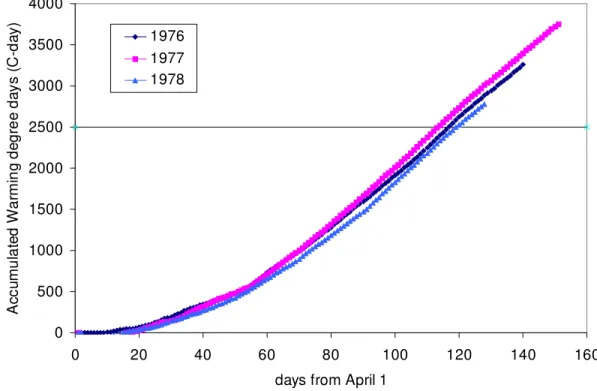
As an example to determine the expected magnitude and speed of ice strength decay, the AWDD is plotted versus time in Figure 1 for the Mould Bay region. The plots use air treasure records from 1976, 1977 and 1978. The values in Figure 1 indicate that by the end of June, ice strength has dropped to less than 3% of the value in March.
Figure 1 also shows that the change in AWDD over a few days is insignificant. We note that short term forecasts typically cover two days. According to Figure 1, the change in ice strength over such durations is negligible. Temperature records from other areas in the Arctic agree with this observation. The 2003 temperature record from Alert is shown in Figure 2 as an example. Calculations of AWDD are not needed to prove that changes over a few days would be negligible.
0 500 1000 1500 2000 2500 3000 3500 0 20 40 60 80 100 120 140 160
days from April 1
Ac c u m u la te d W a rm in g de gr ee da y s ( C -d a y ) 1976 1977 1978
Figure 1: Accumulated warming degree days (AWDD) from Mould Bay air temperatures Alert 2003 -35 -30 -25 -20 -15 -10 -5 0 5 0 10 20 30 40 50 60 70 80 90 100
Days after March 31
Da il y m e a n a ir t e mp ( C )
Page 12 CHC-TR-062 Sayed and Kubat
2.2 Ice Strength Characterization in Dynamics Models
Almost all operational ice dynamics models use Hibler’s (1979) parameterization of ice cover strength. The strength or rheology of the ice cover is assumed to follow a plastic yield criterion. The yield envelope, plotted in the principal stress space, has an elliptical shape. The yield envelope is characterized by a compressive strength P* and the ratio between the major and minor axes of the ellipse, e. Kubat and Frederking (2004) proposed formulas to link those strength parameters to AWDD. They also examined the role of ice properties in the dynamics models by varying the values of P* and e. They obtained solutions for a field of pack ice driven against a land boundary under the action of wind. The results establish the role of the strength parameters on the forecasts of ice thickness, concentration and ridging.
Providing guidelines for incorporating the decay of ice strength in operational forecasts is beyond that study. Validation against field observation is necessary. The results also suggest that the simple case of ice deformation against a straight land boundary may not be a critical situation. A study of ice flow through converging channels by Kubat et al. (2006) shows that the ice yield parameter, e, influences the formation of arches. Therefore, future efforts may best be oriented towards addressing flow in converging channels and validating the forecasts against observations.
The time when the ice pack in a converging channel that is typical for the Canadian Archipelago breaks free was examined.
3.0 CONCLUSIONS AND RECOMMENDATIONS
The preceding discussion has summarized the efforts carried out by the Canadian Hydraulics Centre (CHC) in collaboration with the Canadian Ice Service (CIS) to examine aspects linking ice forecasts to the decay of ice strength over the spring and summer. The work addressed two issues. The first is producing a forecast of ice strength, possibly using ice dynamics models that are used for short-term forecasting. The second issue is the characterizing ice strength within the ice dynamics models.
Examination of air temperature records at various locations in the Arctic and considering the formulas used to characterize ice strength showed that ice dynamics models are not suited for issuing strength forecasts. Changes to ice strength would be insignificant within the durations typical of short-term forecasts. A stand-alone system would be better suited to deliver forecasts of ice strength during the spring and summer seasons.
Efforts to incorporating ice strength in ice dynamics models gave an initial evaluation of the role of strength parameters. The pursuit of that issue requires validation against field observations. Ice flow through converging channels is a case where characterizing ice strength may lead to improved forecasts.
4.0 ACKNOWLEDGEMENTS
The support of the Panel on Energy Research and Development (PERD) is gratefully acknowledged.
5.0 REFERENCES
Gauthier, M-F., De Abreu, R., Timco, G.W. and Johnston, M.E. 2002. Ice Strength Information in The Canadian Arctic: From Science To Operations. Proceedings of the 16th IAHR International Symposium on Ice, pp 203-210, Dunedin, New Zealand.
Hibler, WDIII. 1979. A dynamic thermodynamic sea ice model. Journal of Physical Oceanography, Vol.9 No.4, pp 815-546.
Frederking, R. 2005. A Method for Determining Ice Cover Thickness and Strength in the Canadian Arctic Archipelago, National Research Council of Canada, Canadian Hydraulics Centre, Technical Report CHC-TR-034, May 2005
Johnston, M. and Timco, G.W. 2002. Temperature Changes in First Year Arctic Sea Ice During the Decay Process. Proceedings of the 16th IAHR International Symposium on Ice, Vol., 2, pp 194-202, Dunedin, New Zealand
Kubat, I., Sayed, M., Savage, S.B., and Carrieres, T. 2006. Flow of ice through converging channels. International Journal of Offshore and Polar Engineering, Vol 16, No.4, pp 268-273
Kubat, I and Frederking, R. 2004 Ice Forecasting Model - Parameterization of Ice Cover Properties, National Research Council of Canada, Canadian Hydraulics Centre Technical Report CHC-TR-022, April 2004
Timco, G.W. and Johnston, M.E. 2002. Sea Ice Strength During the Melt Season. Proceedings of the 16th IAHR International Symposium on Ice, Vol. 2, pp 187-193, Dunedin, New Zealand.
Timco, G.W. and O’Brien, S. 1994. Flexural Strength Equation for Sea Ice. Cold Regions Science and Technology, Vol. 22, pp. 285-298.
Timco, G.W. and Frederking, R.M.W. 1990. Compressive Strength of Sea Ice Sheets. Cold Regions Science and Technology, Vol. 17, pp. 227-240.