Publisher’s version / Version de l'éditeur: Astrophysics, 2012-10-15
READ THESE TERMS AND CONDITIONS CAREFULLY BEFORE USING THIS WEBSITE.
https://nrc-publications.canada.ca/eng/copyright
Vous avez des questions? Nous pouvons vous aider. Pour communiquer directement avec un auteur, consultez la première page de la revue dans laquelle son article a été publié afin de trouver ses coordonnées. Si vous n’arrivez pas à les repérer, communiquez avec nous à [email protected].
Questions? Contact the NRC Publications Archive team at
[email protected]. If you wish to email the authors directly, please see the first page of the publication for their contact information.
NRC Publications Archive
Archives des publications du CNRC
This publication could be one of several versions: author’s original, accepted manuscript or the publisher’s version. / La version de cette publication peut être l’une des suivantes : la version prépublication de l’auteur, la version acceptée du manuscrit ou la version de l’éditeur.
Access and use of this website and the material on it are subject to the Terms and Conditions set forth at
Weak magnetic fields in white dwarfs and their direct progenitors?
Jordan, S.; Bagnulo, S.; Landstreet, J.; Fossati, L.; Valyanin, G. G.; Monin,
D.; Wade, G. A.; Werner, K.; O'Toole, S. J.
https://publications-cnrc.canada.ca/fra/droits
L’accès à ce site Web et l’utilisation de son contenu sont assujettis aux conditions présentées dans le site LISEZ CES CONDITIONS ATTENTIVEMENT AVANT D’UTILISER CE SITE WEB.
NRC Publications Record / Notice d'Archives des publications de CNRC:
https://nrc-publications.canada.ca/eng/view/object/?id=71ca0672-5e10-495b-a85a-80538609ed42 https://publications-cnrc.canada.ca/fra/voir/objet/?id=71ca0672-5e10-495b-a85a-80538609ed42
**Author** c
**Copyright Year** Astronomical Society of the Pacific
Low magnetic fields in white dwarfs and their direct progenitors?
S. Jordan,1S. Bagnulo,2, J. Landstreet,2,3, L. Fossati ,4, G.G. Valyanin,5, D.
Monin,6, G.A. Wade,7, K. Werner,8, S.J. O’Toole,9
1Astronomisches Rechen-Institut, Zentrum f¨ur Astronomie der Universit¨at
Heidelberg, M¨onchhofstr. 12-14, D-69120 Heidelberg, Germany,
2Armagh Observatory, College Hill, Armagh BT61 9DG, Northern Ireland,
U.K.,
3Department of Physics and Astronomy, The University of Western Ontario,
London, Ontario, N6A 3K7, Canada
4Argelander-Institut f¨ur Astronomie der Universit¨at Bonn, Auf dem H¨ugel 71,
53121 Bonn, Germany
5Special Astrophysical Observatory, Nizhnij Arkhyz, Zelenchukskiy Region,
Karachai-Cherkessian Republic, Russia 369167
6Dominion Astrophysical Observatory, Herzberg Institute of Astrophysics,
National Research Council of Canada, 5071 West Saanich Road, Victoria, BC V9E 2E7, Canada
7Department of Physics, Royal Military College of Canada, PO Box 17000,
Stn Forces, Kingston, Ontario K7K 7B4, Canada
8Institute for Astronomy and Astrophysics, Kepler Center for Astro and
Particle Physics, Eberhard Karls Universit¨at T¨ubingen, Sand 1, D-72076 T¨ubingen, Germany
9Australian Astronomical Observatory, P.O. Box 296, Epping, NSW 1710,
Australia
Abstract. We have carried out a re-analysis of polarimetric data of central stars of planetary nebulae, hot subdwarfs, and white dwarfs taken with FORS1 (FOcal Reducer and low dispersion Spectrograph) on the VLT (Very Large Telescope), and added a large number of new observations in order to increase the sample. A careful analysis of the observations using only one wavelength calibration for the polarimetrically analysed spectra and for all positions of the retarder plate of the spectrograph is crucial in order to avoid spurious signals. We find that the previous detections of magnetic fields in subdwarfs and central stars could not be confirmed while about 10% of the observed white dwarfs have magnetic fields at the kilogauss level.
1
2 Jordan et al.
1. Introduction
Magnetic fields are found to occur in a wide variety of stars, including pre-main se-quence T Tau stars and Herbig AeBe stars, upper main sese-quence O, B and A stars, rapidly rotating and active lower main sequence stars, AGB stars, white dwarfs, and neutron stars. Main sequence stars with effective temperatures below 7000 K have spa-tially complex magnetic fields and are thought to be generated by current dynamos operating in the outer convective layer. Hotter stars generally reveal fields in only a fraction of any stellar type, and the fields appear simple in structure. Such static fields are usually thought to be fossil fields, frozen into the star by the very high electrical conductivity and originating from earlier stages of the star’s evolution.
Roughly 10% of white dwarfs are found to host fields. Based on modelling the magnetic effects in the optical spectrum, the fields are found to range from tens of kG up to more than 1000 MG, with the majority in the range of 1–100 MG.
K¨ulebi et al. (2009) have analyzed about 150 hydrogen-rich magnetic white dwarfs between 1 MG and 1200 MG. They found that only about 50% of all objects could be described by centred dipoles, while the other half shows clear indications of offset dipoles (or higher-order modes). The analysis was performed by comparing the ob-served flux spectra with models for the radiative transfer in the magnetised atmospheres of white dwarfs using a least-squares method to find the best-fitting field geometry, as-suming magnetic dipoles offset relative to the centre of the star.
While for strong magnetic fields the magnetic field can be deduced by comparing both the flux and polarisation spectra to theoretical models, the regime below about 40 kG can only be accessed by measurements of the circular polarisation with very large telescopes like the VLT. The study of available statistics by Liebert et al. (2003) suggested that the detection rate for field weaker than a few tens of kG may be signif-icantly higher than the frequency of ∼ 10 %, which characterises the overall detection rate of stronger fields (Liebert et al. 2005).
Aznar Cuadrado et al. (2004); Jordan et al. (2007) have detected magnetic fields of a few kG with the help of FORS1 on the VLT in three or four (10%) of the investigated objects. For each stellar observations, they obtained 4-14 integrations with the
quarter-wave plate rotated by 90◦between successive exposures.
The mean line-of-sight magnetic field hBziwas obtained by using the relationship
V(λ) = −geffCZλ2 dI(λ)dλ hBzi(Landstreet 1982), where CZ= e/4πmc2.
The success of these observations led to similar surveys aiming at the detection of kG magnetic fields in the direct progenitors of magnetic white dwarfs, namely central stars of planetary nebulae and hot subdwarfs.
Hot subdwarfs are subluminous objects that dominate the population of faint blue stars in our own galaxy. The spectral type sdB is defined by hydrogen-rich atmospheres with effective temperatures below about 40 000 K (e.g. Heber 1986). The sdO stars on the other hand cover a much larger range of atmospheric compositions with a large spread of hydrogen and helium abundances; their effective temperatures range between 40000 and 90000 K. In the Hertzsprung-Russell diagram they are found on the extreme (blue end of the) horizontal branch. The host subdwarfs are believed to be the progeny of 1-2% of the white dwarfs, the rest coming from the central stars of planetary nebulae. The question of whether there are magnetic fields in central stars of planetary nebulae is of particular importance since there is still no conclusive theory capable of explaining why more than 80 % of known planetary nebulae (PNe) have bipolar
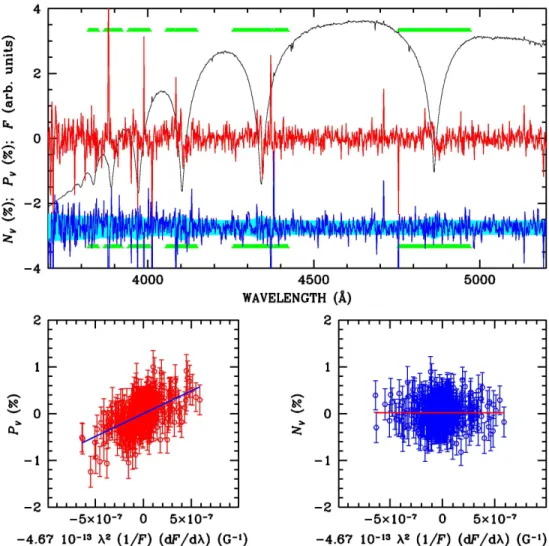
Figure 1. Observations of WD2105-820 obtained with FORS1 on MJD 53 227.209. The top panel shows the observed flux F (black solid line, in arbitrary units), the circular polarisation profile PV = V/I (red solid line centred about 0), and
the null profile NV(blue solid line, offset by −2.75% for display purpose). The null
profile, which is a test for the presence of spurious features, is expected to be cen-tred about zero and scattered according to a Gaussian with σ given by the PV error
bars, which are represented with light blue bars centred about −2.75%. The regions used for field measurement are marked with green bars above and below this spec-trum. The slope of the interpolating lines in the bottom panels provides the mean longitudinal field from PV (left bottom panel) and from the null profile (right bottom
panel), both calculated using only the H Balmer lines. The corresponding hBziand
4 Jordan et al.
and non-spherically symmetric structures (Zuckerman & Aller 1986; Stanghellini et al. 1993; Corradi & Schwarz 1995). An overview of the mechanisms that may shape PNe is given by Balick & Frank (2002). Several of these processes suggest that it is magnetic fields which deflect the outflow of the matter along the magnetic field lines.
Jordan et al. (2005) reported the detection of magnetic fields in at least two PNe, NGC 1360 and LSS 1362 with the same instrumentation used for the white dwarfs. Even more surprising was the fact that O’Toole et al. (2005) found kG magnetic fields in all four investigated hot subdwarf stars.
Recently, the detection of magnetic fields in the central stars of planetary nebu-lae was called into question by Leone et al. (2011), who re-observed NGC 1360 and LSS 1362 with the FORS2 instrument, and concluded that their effective magnetic field is null within an uncertainty of ∼ 100 G (NGC 1360), and ∼ 290 G (LSS 1362). Further-more, both Leone et al. (2011) and Bagnulo et al. (2012) re-analysed the observations previously obtained with FORS1 by Jordan et al. (2005), and were unable to confirm the original detection by Jordan et al.
Bagnulo et al. (2012) analysed polarimetric observations from a large range of spectral types and found that in many cases the results were spurious due to improper calibrations. Bagnulo et al. (2009) have demonstrated that it is very important to use one wavelength calibration taken in one polarisation mode and for one position of the λ/4 retarder plate for all four combinations of polarisation mode and retarder plate orientation. In this case a number of sources of measurement errors are cancelled out to first order. In fact it turned out that separate wavelength calibrations have been used instead so that spurious features leading to false detection of magnetic fields could not be excluded.
For this reason all polarimetric VLT observations of central star of planetary neb-ulae, hot subdwarfs, and white dwarfs were re-reduced with the state-of-the-art ESO FORS pipeline (Izzo et al. 2010) and additional observations from authors of this paper were added to enlarge the samples.
2. Results
2.1. Central stars of planetary nebulae
We determined the magnetic fields from spectropolarimetric observations of ten cen-tral stars of planetary nebulae. The results of the analysis included the four stars in-vestigated by Jordan et al. (2005) while the observations of six stars, plus additional measurements of a star previously observed, were analysed for the first time.
All our determinations of magnetic field in the central planetary nebulae were consistent with null results. Our field measurements have a typical error bar of 150-300 G. Therefore, we had to conclude that the field detections by Jordan et al. (2005) were spurious.
For our sample of ten stars (Abell 36 has been observed in both observational campaigns), we conclude that there is no confirmed case of a magnetic field in the central star of a planetary nebula at a kG level. Magnetic fields of the order to 100-300 G, however, cannot be excluded. Indirect evidence of mG fields in proto-planetary nebulae could still support an influence of magnetic fields on the shape of PNe.
2.2. Hot subdwarfs
After O’Toole et al. (2005) detected field strengths of up to ∼1.5 kG range at varying levels of significance in each of the six targets stars, the question was whether these detections were real or whether the measurements were also spurious due to the appli-cation of a separate wavelength calibration to each of the two polarisation modes and to each of the positions of the λ/4 retarder plate.
Therefore, we also repeated the reduction of these data and added new observa-tions to clarify the question of how common magnetic fields are in subdwarf stars. In total we have analysed a sample of 40 hot subdwarf stars of which 30 have been ob-served with the FORS1 and FORS2 instruments of the ESO VLT. It turned out that there is presently no strong evidence for the occurrence of a magnetic field in any sdB or sdO star, with typical longitudinal field uncertainties of the order of 2-400 G.
The results of this investigation have been published by Landstreet et al. (2012a).
2.3. White dwarfs
The negative outcome of the new investigations of the polarimetric data of central stars of planetary nebulae and hot subdwarfs has also cast doubt on the surveys aiming at the detection of kG magnetic fields in white dwarfs by Aznar Cuadrado et al. (2004); Jordan et al. (2007).
In addition to re-reduction of the Aznar Cuadrado and Jordan data we have anal-ysed new observations of cooler (DA6 – DA8) white dwarfs, all taken with the FORS1 spectrograph.
It turned out that some of the detections by Aznar Cuadrado et al. (2004); Jordan et al. (2007) were confirmed by the new reductions and that longitudinal magnetic fields weaker than 10 kG have been correctly identified in at least three white dwarfs. For one of these three weak-field stars (WD 2359−434), UVES archive data show a ∼ 100 kG mean field modulus. It could of course be that the at the time of the FORS observations the star’s magnetic field axis was nearly perpendicular to the line of sight, or the star’s magnetic field has rather complex structure.
In addition, we have discovered an apparently constant longitudinal magnetic field of ≈ 9.5 kG in the DA6 white dwarf WD 2105−820. This star is the first weak-field white dwarf that has been observed sufficiently to roughly determine the characteristics of its field. The available data are consistent with a simple dipolar morphology with magnetic axis nearly parallel to the rotation axis, and a polar strength of ≃ 56 kG.
In total we have now investigated 20 hot DA stars (generally spectral type DA1
to DA4, Teff ∼> 14000 K) and 15 cool DA stars (spectral type DA5 to DA8; Teff ∼<
14000 K). We detected two magnetic white dwarfs in each of the hot and
lcool samples and conclude that detection rates are about 10 % for the hot sample, and 13 % for the cool sample. The small size of the sample and the small number of detections set a serious limit to accuracy of these frequency estimates. Using the Wilson 95 % confidence limits (Wilson 1927), the overall detection probability lies between 4 and 25%.
The field detection rate in hot WDs could be anywhere between 2.8 and 30 %, while the field detection rate in cool DA WDs lies between 3.7 and 38 %.
Our data are consistent with the hypothesis that weak magnetic fields occur with the same frequency in hot and cool DA WDs. Globally, the detection of four weak magnetic fields from a total sample of 36 WDs makes it quite clear that the probability
6 Jordan et al.
of detecting a ∼ 10 kG field in a WD is comparable to the probability of detecting a magnetic field with strength in the range 100 kG – 500 MG, which is ∼ 10 %.
The results of this investigation have been published by Landstreet et al. (2012b).
3. Conclusion
A re-analysis of the polarimetric measurements of central stars of planetary nebulae and hot subdwarfs as well as the analysis of newer observations have shown that there is no evidence for the occurrence of kilogauss magnetic fields in these objects.
On the other hand magnetic fields of a few kG have been detected in about 10% of all target white dwarfs.
Acknowledgments. We thank the staff of the ESO VLT for carrying out the service
observations and providing support for the visitor mode observations.
References
Aznar Cuadrado, R., Jordan, S., Napiwotzki, R., Schmid, H. M., Solanki, S. K., & Mathys, G. 2004, A&A, 423, 1081. arXiv:astro-ph/0405308
Bagnulo, S., Landolfi, M., Landstreet, J. D., Landi Degl’Innocenti, E., Fossati, L., & Sterzik, M. 2009, PASP, 121, 993
Bagnulo, S., Landstreet, J. D., Fossati, L., & Kochukhov, O. 2012, A&A, 538, A129. 1112. 3969
Balick, B., & Frank, A. 2002, ARA&A, 40, 439
Corradi, R. L. M., & Schwarz, H. E. 1995, A&A, 293, 871 Heber, U. 1986, A&A, 155, 33
Izzo, C., de Bilbao, L., Larsen, J., Bagnulo, S., Freudling, W., Moehler, S., & Ballester, P. 2010, in Society of Photo-Optical Instrumentation Engineers (SPIE) Conference Series, vol. 7737 of Society of Photo-Optical Instrumentation Engineers (SPIE) Conference Series Jordan, S., Aznar Cuadrado, R., Napiwotzki, R., Schmid, H. M., & Solanki, S. K. 2007, A&A,
462, 1097. arXiv:astro-ph/0610875
Jordan, S., Bagnulo, S., Werner, K., & O’Toole, S. J. 2012, A&A, 542, A64. 1204.2697 Jordan, S., Werner, K., & O’Toole, S. J. 2005, A&A, 432, 273. arXiv:astro-ph/0501040 K¨ulebi, B., Jordan, S., Euchner, F., G¨ansicke, B. T., & Hirsch, H. 2009, A&A, 506, 1341.
0907.2372
Landstreet, J. D. 1982, ApJ, 258, 639
Landstreet, J. D., Bagnulo, S., Fossati, L., Jordan, S., & O’Toole, S. J. 2012a, A&A, 541, A100. 1203.6815
Landstreet, J. D., Bagnulo, S., Valyavin, G. G., Fossati, L., Jordan, S., Monin, D., & Wade, G. A. 2012b, A&A, 545, A30. 1208.3650
Leone, F., Mart´ınez Gonz´alez, M. J., Corradi, R. L. M., Privitera, G., & Manso Sainz, R. 2011, ApJ, 731, L33. 1104.1042
Liebert, J., Bergeron, P., & Holberg, J. B. 2003, AJ, 125, 348. arXiv:astro-ph/0210319 Liebert, J., Wickramasinghe, D. T., Schmidt, G. D., Silvestri, N. M., Hawley, S. L., Szkody, P.,
Ferrario, L., Webbink, R. F., Oswalt, T. D., Smith, J. A., & Lemagie, M. P. 2005, AJ, 129, 2376
O’Toole, S. J., Jordan, S., Friedrich, S., & Heber, U. 2005, A&A, 437, 227. arXiv:astro-ph/ 0503243
Stanghellini, L., Corradi, R. L. M., & Schwarz, H. E. 1993, A&A, 279, 521 Wilson, E. B. 1927, J. Am. Stat. Assn., 22, 209