HAL Id: hal-02988801
https://hal.archives-ouvertes.fr/hal-02988801
Submitted on 5 Jan 2021HAL is a multi-disciplinary open access archive for the deposit and dissemination of sci-entific research documents, whether they are pub-lished or not. The documents may come from teaching and research institutions in France or abroad, or from public or private research centers.
L’archive ouverte pluridisciplinaire HAL, est destinée au dépôt et à la diffusion de documents scientifiques de niveau recherche, publiés ou non, émanant des établissements d’enseignement et de recherche français ou étrangers, des laboratoires publics ou privés.
Do rainfall characteristics affect the export of copper,
zinc and synthetic pesticides in surface runoff from
headwater catchments?
Gwenael Imfeld, Fatima Meite, Charline Wiegert, Benoît Guyot, Jérémy
Masbou, Sylvain Payraudeau
To cite this version:
Gwenael Imfeld, Fatima Meite, Charline Wiegert, Benoît Guyot, Jérémy Masbou, et al.. Do rainfall characteristics affect the export of copper, zinc and synthetic pesticides in surface runoff from headwater catchments?. Science of the Total Environment, Elsevier, 2020, 741, pp.140437. �10.1016/j.scitotenv.2020.140437�. �hal-02988801�
Do rainfall characteristics affect the export of copper, zinc and synthetic
1
pesticides in surface runoff from headwater catchments?
2
3 4
Gwenaël Imfeld*, Fatima Meite, Charline Wiegert, Benoît Guyot, Jérémy Masbou,
5
Sylvain Payraudeau
6 7
Laboratory of Hydrology and Geochemistry of Strasbourg (LHyGeS), UMR 7517, Université 8
de Strasbourg/ENGEES, CNRS, 1 Rue Blessig, 67084 Strasbourg Cedex, France 9
10
11 12
*Corresponding author: [email protected] 13
Laboratory of Hydrology and Geochemistry of Strasbourg (LHyGeS), UMR 7517, Université 14
de Strasbourg/ENGEES, CNRS, 1 Rue Blessig, 67084 Strasbourg Cedex, France 15 16 17 18 19 20 21 22
Manuscript for Science of the Total Environment 23
Abstract
24
Rainfall and runoff characteristics may influence off-site export of pesticides into 25
downstream aquatic ecosystems. However, the relationship between rainfall characteristics and 26
pesticide export from small headwater catchments remains elusive due to confounding factors 27
including the application dose and timing and the variation of pesticide stocks in soil. Here we 28
examined the impact of rainfall characteristics on the export of copper (Cu), zinc (Zn) and 12 29
legacy and currently used synthetic pesticides in surface runoff from a headwater vineyard 30
catchment. Cluster analysis of rainfall intensity, depth and duration of 78 events revealed four 31
distinct rainfall categories, i.e., Small, Long, Moderate and Intense (p<0.001). Event mean 32
concentrations of pesticides did not differ among rainfall categories (p>0.05). In contrast, 33
event loads of both dissolved and solid-bound Cu and Zn significantly differed among rainfall 34
categories (p<0.001). Rainfall depth and intensity significantly correlated with both Cu and Zn 35
loads in runoff (ρs = 0.33 to 0.92, p<0.002), and might be the main drivers of Cu and Zn export
36
at the catchment scale. In contrast, rainfall depth, intensity or duration did not influence the 37
loads of synthetic pesticides in runoff, even when weekly variations of pesticide stocks in the 38
soil were accounted for. However, intense rainfall-runoff events, that can fragment soil, may 39
control the export of persistent and hydrophobic legacy pesticides stocks in the soil, such as 40
simazine and tetraconazole. Our results emphasise that rainfall characteristics controlled the 41
off-site export of Cu, Zn and legacy synthetic pesticides in a small headwater catchment, 42
whereas the application timing drove the export of currently used synthetic pesticides in 43
runoff. We anticipate our results to be a preliminary step to forecast the influence of regional 44
rainfall patterns on the export of both metallic and synthetic pesticides by surface runoff from 45
small headwater catchments. 46
Keywords: Rainfall characteristics, pesticide export, surface runoff, headwater catchment, 47
copper and zinc in vineyard 48
49
1. Introduction 50
Surface runoff is a major driver of pesticide transport from agricultural land into aquatic 51
ecosystems. It exports up to 5% of solid-bound and dissolved pesticides during rainfall-runoff 52
events (Herrero-Hernández et al., 2017; Parajulee et al., 2018; Lefrancq et al., 2018). Pesticide 53
export eventually affects drinking water resources and the health of aquatic ecosystems (e.g., 54
Zubrod et al., 2019). Pesticide export by runoff is primarily controlled by the interplay between 55
the dose and timing of pesticide applications, pesticide dissipation in soil and hydrological 56
characteristics of the catchment (Lefrancq et al. 2017; El Azzi et al., 2016; Meite et al., 2018). 57
In addition, climate change can substantially influences both hydro-climatic characteristics and 58
aquatic ecosystems by altering pesticide export from the catchment, as well as the pesticide 59
fraction dissolved in surface runoff or attached to soil particles during soil erosion (Gagnon et 60
al., 2016; Qiu et al., 2019). In this context, understanding the impact of rainfall characteristics 61
on pesticide export from agricultural land becomes crucial to anticipate adaptation strategies to 62
future regional hydro-climatic patterns. 63
Fungicides, which include various forms of copper (Cu) and synthetic molecules, and 64
herbicides are massively used in vineyards several times across the growing season (Komárek 65
et al., 2010). Exports of up to 1% of the yearly-applied fungicide and herbicide amount on 66
vineyard catchments have been observed previously, although export in surface runoff varies 67
across the seasons and years (Louchart et al., 2001; Dousset et al., 2007; Lefrancq et al., 2014; 68
Babcsányi et al., 2016). The dose and timing of application as well as pesticide sorption and 69
degradation in soil mainly determine pesticide export during rainfall-runoff events (Chen et al., 70
2018; Parajulee et al., 2018). In addition, the solid-liquid partitioning of pesticides in soil and 71
runoff controls the proportion of dissolved and solid-bound exports of pesticides (Babcsányi et 72
al., 2016; El Azzi et al., 2016). For instance, Cu, zinc (Zn) and hydrophobic synthetic 73
pesticides sorb on soil organic matter (SOM) and soil minerals, such as carbonates and clays. 74
As a result, Cu and Zn export is associated with dissolved organic matter (DOM) and fine-75
grained soil particles in runoff, and mainly occurs during intense rainfall events (Komárek et 76
al., 2010; Babcsányi et al., 2016; Meite et al., 2018). The relationship between pesticide export 77
and rainfall depth, intensity or duration remains, however, poorly understood in small 78
headwater catchments. 79
Knowledge of the influence of hydrological characteristics on pesticide export from 80
small headwater catchments (<100 km²) remains scarce in comparison to large catchments 81
(>100 km²) (Meite et al. 2018; Lefrancq et al., 2017). The role of small headwater catchments 82
in pesticide export is important since they proportionally receive larger pesticide inputs than 83
downstream areas (Lorenz et al., 2017). Dynamics of pesticide export in small headwater 84
catchments are discontinuous and difficult to predict because they depend on rainfall 85
characteristics, the pesticide application timing and seasonal variations of pesticide stocks in 86
the catchment soil (Leu et al., 2005; Coupe et al., 2012; Lefrancq et al., 2017; Gassmann et al., 87
2015). There are two major difficulties when evaluating the influence of rainfall characteristics 88
on pesticide export while limiting the influence of other confounding variables. First, a 89
sufficiently large dataset of rainfall-runoff characteristics and pesticide loads in a headwater 90
catchment is required to understand pesticide export at the time scale of rainfall-runoff events. 91
Such data sets are generally missing. Secondly, the variability of pesticide stocks in soil can 92
counteract the influence of rainfall characteristics. Hence, pesticide export in runoff should be 93
related to the pesticide stocks in soil to account for the variability of pesticide inputs, 94
accumulation and dissipation when analyzing variables driving pesticide export. 95
In this context, we embarked on a study to examine the influence of rainfall 96
characteristics on pesticide export from a small headwater vineyard catchment (42.7 ha). We 97
hypothesized that distinct rainfall categories, featuring specific characteristics including depth, 98
intensity and duration, result in well-distinct export regimes of inorganic (Cu and Zn) and 99
synthetic (legacy or currently used) pesticides in runoff. The rainfall-runoff events and the 100
variation of pesticide stocks in soil were monitored over two wine-growing seasons (2015 and 101
2016). Four categories of pesticides were selected based on their widespread former and 102
current use, along with the high frequency of their application and detection in soil and runoff 103
in the studied catchment (Babcsányi et al., 2016; Lefrancq et al., 2014; Lefrancq et al., 2013; 104
Maillard and Imfeld, 2014): 105
1. Cu and Zn, since grapevines receive many applications during the growing season of Cu- 106
and Zn-bearing fungicides and amendments. This results in the accumulation of Cu and Zn 107
in soil over years (Komárek et al., 2010; Babcsányi et al., 2016). 108
2. Pre-emergence triazine herbicides, including formulations with active ingredients such as 109
simazine, atrazine and terbuthylazine. These formulations have been banned since the early 110
2000’s in several EU countries. However, they remain of environmental concern due to 111
their persistence in vineyard soil and potential to contaminate water bodies (Grégoire et al., 112
2010; Hildebrandt et al., 2008; Leu et al., 2005). 113
3. Widely-used synthetic fungicides including pyrimethanil, metalaxyl-M, cyprodinil, 114
kresoxim-methyl, tetraconazole, azoxystrobin, dimethomorph, which are used worldwide 115
for vine protection. These fungicides belong to different chemical classes, and thus display 116
a broad-spectrum of physico-chemical properties controlling their transformation in soil 117
and their export in runoff (Komárek et al., 2010; Zubrod et al., 2019). 118
4. Herbicides, such as pendimethalin and pyraflufen-ethyl, which are part of weed control 119
strategies in vineyards worldwide, are commonly found in surface and ground waters 120
(Herrero-Hernández et al., 2017). 121
122 123
2. Materials and methods 124
2.1. Vineyard catchment description 125
The 42.7 ha Hohrain vineyard catchment is situated in the Alsatian foothills (47°57′9 N, 126
07°17′3 E) and representative of northern vineyards (Grégoire et al., 2010; Duplay et al., 2014) 127
(Figure 1). The catchment has a mean slope of 15%, and is mainly occupied by vineyards 128
(59%, 25.3 ha), forests and pasture (29%), grassed strips and ditches (7%), as well as roads and 129
paths (5%). The soil is a calcareous clay loam developed on a loess basement with a bulk 130
density of 1.4 g cm−3. The main soil types are Cambisol (Hypereutric Clayic) and Haplic 131
Cambisol (Calcaric Siltic) (Duplay et al., 2014). Soil minerals consist of calcite, quartz, and 132
minor amounts of feldspars, dolomite and clay minerals (Duplay et al., 2014). Vineyard plots 133
are permanently covered by grass in every second inter-row to limit soil erosion, and grass-free 134
inter-rows are ploughed up to 5 cm depth to enhance water infiltration. The grass cover was 135
implemented three to four years after vine planting. 136
Figure 1. The Hohrain vineyard catchment (47°57′9 N, 07°17′3 E, Alsace, France). Topsoil 138
samples were collected weekly from March to October 2015 and 2016 on the catchment across 139
four transects (in red) to determine monthly average Cu, Zn and weekly synthetic pesticide 140
concentrations. Dose and frequency of pesticide applications were obtained from surveys 141
addressed to wine producers of the grey and the pink plots. The pink plots belong to the 142
Agricultural and Viticulture College of Rouffach, France – EPLEFPA. 143
144
2.2. Vineyard catchment hydrology
145
Rainfall-runoff events generate intermittent flows in the catchment, which remains dry 146
otherwise. Discharge at the outlet of the catchment is driven by Hortonian overland flow. The 147
road network mainly contributes to discharges during rainfall with low intensity (i.e. >6 148
mm·h−1) (Lefrancq et al., 2014), while vineyard plots contribute when rainfall intensity 149
overcomes the saturated hydraulic conductivity (i.e. 58±50 mm·h−1, n = 48) (Tournebize et al., 150
2012). The saturated hydraulic conductivity can decrease by up to one order of magnitude on 151
plots when topsoil sealing appears across the season. Grass strips of 2 to 3 m width at the plot 152
edges limit overland flow on plots (Lefrancq et al., 2014). Fast hydrological response to 153
rainfall events (i.e., 6 to 12 min between rainfall and runoff peaks) and fast recession period 154
(<1 h) with total discharge cessation at the outlet of the catchment indicate the prevalence of 155
Hortonian overland flow. Baseflow is negligible as steep slopes (i.e. 15%) with high vertical 156
saturated hydraulic conductivity prevent downslope lateral flow. 157
158
2.3. Rainfall monitoring 159
Rainfall was monitored at a 6-min resolution by a meteorological station (Meteo 160
France, station n°68287003) located in the catchment (Figure 1). As the hydrological response 161
time to rainfall event is fast, a rain-free period of 2 h between two rainfall events was used to 162
differentiate the events. Annual rainfall averaged 635±118 mm (1998-2016), with 521 and 733 163
mm in 2015 and 2016, respectively. During the vine-growing season from March to October, 164
rainfall averaged 437±91 mm (1998-2016), with 375 and 434 mm in 2015 and 2016, 165
respectively. 166
167
2.4. Survey of pesticide applications 168
Dose and frequency of pesticide applications were obtained from surveys addressed to 169
wine producers of the catchment in 2015 and 2016. Answers from producers covered 75% and 170
74% of the total vineyard area in 2015 and 2016, respectively (Figure 1). Dose and timing of 171
applications were extrapolated for the non-surveyed area to calculate the seasonal Cu, Zn and 172
pesticide applications. Amounts applied in 2015 and 2016 and characteristics of Cu, Zn and the 173
12 synthetic pesticides are provided in Table 1 and in Table S1, respectively. 174
175
2.5. Soil and runoff sampling 176
Topsoil samples (0-1cm) were collected weekly from March to October 2015 and 2016 177
across four transects on the catchment to quantify synthetic pesticides (Figure 1). The top 1 cm 178
of soil was considered as the relevant soil layer for estimating stocks of synthetic pesticides 179
that can be exported by runoff since these pesticides concentrate and dissipate in this layer 180
between soil management operations (Havis et al., 1992; Zhang et al., 1997, 1999). For Cu and 181
Zn, topsoil samples (0-5 cm) were collected monthly from March to October 2015 and 2016 182
across the same transects. The top 5 cm of soil was considered as the relevant soil layer to 183
estimate Cu and Zn stocks in soil. Indeed, Cu and Zn concentrate in this layer and are 184
influenced by yearly soil management practices homogenising topsoil Cu and Zn 185
concentrations (Babcsányi et al., 2016). The weekly (synthetic pesticides) and monthly (Cu and 186
Zn) composite samples (1 kg) were composed of mixed topsoil sub-samples collected each 10 187
m across the four transects. Soil samples were transported in coolers and stored at 4°C until 188
analysis. 189
Automatic runoff measurement and water sampling at the outlet of the catchment 190
(Figure 1) was carried out from March 26th to October 6th 2015 and from March 30th to October 191
10th 2016, as previously described (Maillard and Imfeld, 2014). The procedure of sample 192
collection and storage for pesticide analysis was previously validated (Domange and Grégoire, 193
2006; Grégoire et al., 2010). Water depth was measured using bubbler flow modules 194
(Hydrologic, Sainte-Foy, Québec, Canada) combined with a Venturi channel to monitor 195
discharge runoff, with an uncertainty of ±8%. Flow proportional samples of runoff water (300 196
mL every 6 m3) were collected during each runoff event using a 4010 Hydrologic automatic 197
sampler (Hydrologic, Canada). Runoff water was collected in a 24-bottles sampler alternating 198
pre-cleaned glass bottles for synthetic pesticides and PEHD bottles for Cu and Zn in order to 199
limit sorption. Flow-proportional runoff water samples were thus collected separately for 200
synthetic and metallic pesticide measurements. Water samples were immediately stored in 201
coolers and transported to the laboratory, filtered using a 0.45-µm glass filter membrane, and 202
frozen (20°C) until extraction and pesticide analysis. 203 204 2.6. Chemical analyses 205 2.6.1. Cu and Zn quantification 206
Cu and Zn were quantified in soil, the dissolved phase and the suspended solids of 207
runoff, as described elsewhere (Lucas et al., 2010; Babcsányi et al., 2014). Briefly, solid 208
samples were oven-dried (60°C), sieved (2 mm) and powdered using an agate disk mill (<100 209
µm) prior to total dissolution of Cu and Zn by double distilled nitric acid under laminar fume 210
hood in a clean-room. Filtered runoff water was acidified to pH 2 using double distilled nitric 211
acid. Measurements were carried out using an ICP-AES (ICAP6500, Thermo Fisher 212
Scientific) with geological standards BCR-2 (US Geological survey, Reston, VA, USA) and 213
SCL-7003 (Analytika, Prague, Czech Republic) for quality control (Babcsányi et al., 2014). 214
The total analytical uncertainty was ±5%. Detection (DL) and quantification (QL) limits are 215 provided in Table S2. 216 217 2.6.2. Synthetic pesticides 218
Synthetic pesticides were extracted from soil using a sequential solvent extraction and 219
cleanup procedure as described earlier (Masbou et al., 2018). Runoff water samples were 220
filtered using a 0.45-µm glass filter membrane. Filtered water samples were extracted by solid-221
phase extraction (SPE) using SolEx C18 cartridges (Dionex®, Sunnyvale, CA, USA) and an 222
AutoTrace 280 SPE system (Dionex®) using a protocol adapted from US EPA method 525.2 223
and described previously (Elsayed et al., 2014). Synthetic fungicides and herbicides were 224
quantified by gas chromatography (Trace 1300, Thermo Fisher Scientific, Milan Italy) coupled 225
with a mass spectrometer (ISQTM, Thermo Fisher Scientific), using isotope-labelled internal 226
standards of pesticides. Extraction recoveries, DL and QL from water and soil samples are 227
provided in Table S2. 228
Solid-bound synthetic pesticides were not accounted for in this study because (i) loads 229
of dissolved pesticides predominate in the studied catchment (Maillard and Imfeld, 2014) and 230
are preferentially transported to aquatic ecosystems, (ii) loads of total suspended solids in 231
runoff were modest ( ±σ: 3.1±1.5 g L-1), and (iii) concentrations were too low (<0.004 µg g-1) 232
for quantification of most pesticides. This limited in our case the relevance to evaluate the 233
influence of rainfall characteristics on loads of solid-bound synthetic pesticides. 234
235 236 237
2.7. Data analysis 238
2.7.1. Pesticide stocks in soil 239
The stocks of Cu, Zn and synthetic pesticides in soil of the vineyard catchment were 240
estimated weekly across the investigation periods in 2015 and 2016 based on the average 241
pesticide concentrations in soil and the mass of topsoil (Babcsányi et al., 2016). Pesticide stock 242
estimates were then used to calculate metrics of pesticide export that account for pesticide 243
stocks (see below). All pesticides were detected in the soil at least once during the study 244
period. Cu and Zn were systematically quantified. Synthetic pesticide concentrations were 245
conservatively set at the DL when no pesticide was detected to estimate and account for the 246
maximal weekly stocks in soil. Correspondingly, synthetic pesticide concentrations were set at 247
the QL when pesticides concentrations were below the QL but above the DL. 248
249
2.7.2. Cluster analysis of rainfall events 250
The hydrological data set comprises 78 rainfall-runoff events. The 78 events 251
represented 69% in 2015 and 76% in 2016 of the total rainfall depth that generated runoff 252
during the study period (see Table S3). The 78 rainfall events were categorized based on depth, 253
maximum intensity and duration data using the R software (R Development Core Team, 2008; 254
Version 3.5.3). Values were standardized prior to calculation of the distance between rainfall 255
events based on the Euclidean dissimilarity index (Legendre and Gallagher, 2001). A 256
hierarchical cluster analysis was performed on the resulting dissimilarity matrix using the 257
Ward’s method. The optimal number of clusters was determined using the Spearman's rank 258
correlation applied to the binary distance matrix from clusters (Becker et al., 1988). The 259
obtained clusters correspond to distinct categories of rainfall events, with events in each 260
category featuring similar rainfall characteristics. 261
2.7.3. Metrics of pesticide export 263
Four metrics of pesticide export were calculated to compare the influence of rainfall 264
characteristics on pesticide export from the vineyard catchment. 265
Event Load. The Event Load of Cu, Zn and synthetic pesticides (ELp) was calculated
266
for each event by multiplying the flow-proportional concentration of each pesticide by the 267
corresponding runoff volume: 268
(1)
269
where ELp is the event load for a pesticide p (in [g] for Cu and Zn, and [mg] for synthetic
270
pesticides), Cpi is the concentration of p of the ith sample, and Vi is the corresponding portion of
271
runoff volume [m3]. Dissolved and solid-bound ELp were calculated for Cu and Zn, whereas
272
only dissolved ELp were calculated for synthetic pesticides.
273 274
Event Mean Concentration. The Event Mean Concentration of each pesticide (EMCp) was
275
calculated for each event according to equation 2: 276
(2) 277
where (V) is the total volume of the runoff event. 278
279
Event Export coefficient. The pesticide event export coefficient (EECp, in [%]) was
280
calculated for the synthetic pesticides to account for the weekly variation of pesticide stocks in 281
the vineyard topsoil across the season: 282
(3) 283
where Top soil masswp is the weekly stock of synthetic pesticides in the vineyard soil.
284 i n i pi p C V EL
1 V EL EMCp p wp p p mass soil Top EL EEC 100Cu and Zn exports by runoff were not related to variations of Cu and Zn stocks in the vineyard 285
soil because seasonal applications on the catchment represented less than 3% of the initial 286
stock of Zn and Cu in soil. Hence, minor variations of the monthly stocks of Cu and Zn in 287
topsoil could not be quantified given the uncertainty of Cu and Zn quantification (5%) 288
(Babcsányi et al., 2016). 289
290
Freshly Applied pesticide Normalized Export Coefficient. The Freshly Applied 291
Pesticide Normalized Export Coefficient (FANECp, in [%]) was calculated for each currently
292
used synthetic pesticides to account for the fraction of freshly applied pesticides. The FANEC 293
accounts for the difference between the weekly stock of applied pesticide and the initial 294
background of pesticide in soil: 295
(4) 296
where Topsoil massp background is the initial mass background amount of pesticide p in the
297
soil before pesticide application. 298
299
2.7.4. Statistical analysis of pesticide metrics 300
Non-parametric Kruskall-Wallis and pair-wise Wilcoxon rank sum tests were used to 301
compare the influence of rainfall categories on pesticide export. Rank-based Spearman’s test 302
was used to assess the correlation between rainfall and runoff characteristics and metrics of 303
pesticide export. The Bonferroni correction was used to limit the effect of multiple 304
comparisons by testing each individual hypothesis at a significance level of /m=0.05/4=0.013, 305
with m=4 rainfall categories. 306
307 308
Topsoilmass Topsoilmass background
EL FANEC p wp p p 100
3. Results and discussion 309
3.1. Pesticide applications and stocks in vineyard soil 310
The following pesticides, ordered from the heaviest to the lightest mass, were applied in 311
2015 and 2016: Cu > Zn > dimethomorph > cyprodinil > Pyrimethanil > tetraconazole > 312
pyraflufen-ethyl (Table 1). Cyprodinil and krezoxim-methyl were exclusively applied in 2015, 313
while pyrimethanil was only applied in 2016. Overall, 2.223 and 2.158 kg·ha-1 of vineyard of 314
elemental Cu and 0.116 and 0.349 kg·ha-1 of vineyard of elemental Zn were applied on the 315
catchment in 2015 and 2016, respectively (Table 1). The influence of successive applications 316
of Cu and Zn across the season on the overall stocks at the catchment scale could not be 317
quantified since concentrations in the soil remained constant (12%). Average topsoil Cu and 318
Zn concentrations and masses in the catchment were similar to those observed in 2011 319
(Babcsányi et al., 2016). This indicates that soil stocks of Cu and Zn, did not vary much over 320
the last five years since it built up after several decades of vine management and off-site export 321
remains limited (see below). In contrast, application timing and doses drove topsoil 322
concentrations and masses of synthetic pesticides in soil (Figure 2). 323
Table 1. Pesticide applications, stocks in soil and export in the Hohrain catchment (Rouffach, France; 25.3 hectare of vineyards) from March 26th 324
to October 6th 2015 and from March 30th to October 10th 2016. 325 326 Diss o lv ed Cu Pa rticul a te Cu Diss o lv ed Zn Pa rticul a te Zn S im a zi n e Atr a zin e Te rb u th y la zi n e Py rim eth a n il Meta la x y l-M Cy p ro d in il K re zo x im -m eth y l Te tr a co n a zo le Az o x y str o b in Dim eth o m o rp h P en d im eth a li n Py ra flu fe n -e th y l Applied 2015 [kg: Cu and Zn and g: synthetic pest.] 56.4
*
2.9*
2001 2003 2004
n.a n.a 3163 55.3 11.1 n.a 118.8 n.a 10.6
Applied 2016 [kg: Cu and Zn and g: synthetic pest.] 54.6
*
8.8* 572.3 n.a n.a n.a 142.4 n.a 5406 n.a 0.2
Initial topsoil conc. 2015c [mg·kg-1
drysoil]
154* 112* 0.001b 0.001b 0.07 0.057 0.013 0.03 0.001 b 0.071 0.037 0.021 0.001b 0.001b
Initial topsoil conc. 2016c [mg·kg-1drysoil]
120* 80* 0.003a 0.001b 0.003a 0.004a 0.011 0.002a 0.002a 0.021 0.001b 0.065 0.002a 0.001b Initial topsoil mass 2015c
[kg: Cu and Zn and g: synthetic pest.] 2727
*
1983* 3.6b 4.1b 249.7 203.5 45.5 95.3 1.9 b 252.3 131.2 99.5 1.6b 3.3b
Initial topsoil mass 2016c
[kg: Cu and Zn and g: synthetic pest.] 2125 *
1417* 10.9 a 4.1b 10.0 a 13.6 a 37.2 4.6a 5.7a 74.7 2.7 b 230.2 4.9a 3.3b
Detection frequency in runoff 2015d [%] 100 100 100 100 31 3 3 66 63 22 44 31 22 63 44 3
Detection frequency in runoff 2016e [%] 100 100 100 100 2 0 20 63 54 35 20 78 46 80 28 0
Load 2015d [kg: Cu and Zn and mg: synthetic pest.] 410
-2
1.41 210-2 1.54 46.3 8.0 27.5 473.2 110.9 52.3 72.4 67.5 27.7 2301 205.6 1.2
Load 2016e [kg: Cu and Zn and mg: synthetic pest.] 310
-2 1.63 310-2 1.76 1.97 0 116.7 673.4 1288 58.4 29.9 142.2 58.7 4712 251.7 0
Event Export coefficients (EECp) 2015d
[%] 110
-5-110-2 f 510-6-110-2 f 0-0.42 0-0.20 0-0.84 0-0.05
0-0.09 0-0.03 0-1.18
0-0.03 0-0.54 0-0.70 0-8.07 0-0.04 Event Export coefficients (EECp) 2016e
[%] 510 -6 -410-2 f 510-5-710-2 f 0-0.06 0 0-1.4 0-1.34 0-12.6 0-2.35 0-0.47 0-0.64 0-0.32 0-0.2 0-10.75 0 *Total Cu or Zn
: banned. n.a: not applied, based on the survey covering 75% and 74% of the total vineyard area in 2015 and 2016, respectively. aBased on QL. bBased on DL. cBased on 0-5 cm topsoil layer for Cu and Zn and on 0-1 cm for the synthetic pesticides. dBased on the 32 runoff events monitored in 2015. eBased on the 46 runoff events monitored in 2016. fEECp for total Cu and total Zn was calculated assuming a constant yearly initial topsoil mass.
In total, 3.359 kg (0.133 kg·havineyard-1) and 6.121 kg (0.242 kg·havineyard-1) of the twelve
327
synthetic pesticides were applied on the vineyard catchment in 2015 and 2016, respectively. 328
Cyprodinil (3.163 kg) was the main fungicide used in 2015, while dimethomorph (5.406 kg) 329
mainly contributed to pesticide applications in 2016. Worthy of note, polar pesticides applied 330
on the catchment, i.e. carbendazim, cymoxanil, isoproturon, diuron, isoxaben, oryzalin and 331
flufenoxuron, were systematically below the DL in both soil and runoff samples (data not 332
shown) and thus were not considered in this study. 333
Weekly topsoil concentrations of synthetic fungicides and herbicides greatly varied 334
over the season and ranged from below DL, such as atrazine, simazine, kresoxim-methyl, 335
pendimethalin, pyraflufen-ethyl in 2015 and azoxystrobin and pyraflufen-ethyl in 2016, up to 336
2.57 mg·kg-1 for dimethomorph in 2016. Stocks of legacy herbicides simazine (538±1053 337
mg·ha-1 vineyard) and atrazine (189±94 mg·ha-1 vineyard) remained low across the season or 338
years compared to the other applied synthetic pesticides. This indicates that the legacy pool of 339
triazine herbicides persists in the soil and can be progressively released during rainfall-runoff 340
events. Surprisingly, soil concentrations of the legacy herbicide terbuthylazine in 2015 (banned 341
in 2004) were similar to those of the currently used pesticides. This suggests illegal use of 342
terbuthylazine after 2004 in some vineyard plots. 343
Overall, the weekly stocks of pesticide in soil widely varied across the season 344
depending on the timing of pesticide application and the characteristics of pesticides (Figure 345
2B and Table S1). The herbicide pyraflufen-ethyl was typically applied in early summer, while 346
fungicides were applied from early summer (e.g. tetraconazole and kresoxim-methyl) to mid- 347
and late summer (Figure 2A). Pesticide stocks exceeding 100 g in the catchment topsoil 348
included the following pesticides, ordered from heaviest to lightest amount in soil: 349
tetraconazole > terbuthylazine > pyrimethanil > azoxystrobin in 2015, and dimethomorph in 350
2016 (Table 1). Half-lives of pesticides in soil, estimated based on soil concentrations and 351
sorted here from smallest to largest half-lives, generally were similar or lower compared to 352
reference half-lives (Table S1): pyraflufen-ethyl (< 1 d) < pendimethalin (3 d) < pyrimethanil 353
(8 d) = azoxystrobin (8 d) < dimethomorph (9 d) < metalaxyl-M (14 d) < tetraconazole (27 d) < 354
kesoxim-methyl (50 d) < cyprodinil (92 d). 355
356
357
Figure 2. Applications and stocks of Cu, Zn and synthetic pesticides in the Hohrain catchment 358
(Rouffach, France) in 2015 and 2016. A) Weekly Cu, Zn and synthetic pesticides applications 359
(in grams per hectare of vineyard). B) Weekly stocks of synthetic pesticide and monthly stocks 360
of Cu and Zn in the vineyard soil. F = fungicide, H = herbicide. The error given for pesticide 361
stocks in soil was calculated based on the analytical uncertainty of pesticide measurements 362 0 100 200 300 Zn Cu 1 21 41 61
81 Terbuthylazine Atrazine Simazine
50 200 350 500
Dimethomorph Azoxystrobin Kresoxim-methyl
0.0 0.5 1.0 0.0 0.5 1.0 0 25 50
Cyprodinil Tetraconazole Metalaxyl-M
Sy n th e ti c h e rb ic id e s [g h avin ey a rd -1] Sy n th e ti c fu n gi ci d e s [g h avin e ya rd -1] Tr ia zi n e s [g h avin e ya rd -1] C u an d Z n [k g h avin e ya rd -1] Cu Zn (F) Dimethomorph (F) Kresoxim-methyl (F) Cyprodinil (F) Tetraconazole (H) Pyraflufen-ethyl (F) Pyrimethanil
Cu, Zn, Synthetic pesticides 0 25 50 100
Application [g ha-1]
Apr. May Jun. Jul. Aug. Sept.
A
B
Apr. May Jun. Jul. Aug. Sept.
1 21 41 61 Pyraflufen-ethyl Pendimethalin 1 50
Apr. May Jun. Jul. Aug. Sept.
Apr. May Jun. Jul. Aug. Sept.
Apr. May Jun. Jul. Aug. Sept.
Apr. May Jun. Jul. Aug. Sept. 0 80 60 40 20 2015 2016 0.5 1 0 0.5 Pyrimethanil
To sum up, Cu and Zn stocks in soil did not vary much across the season, although 364
accumulation of Cu and Zn after decades of wine growing can increase the legacy stocks in 365
vineyard catchments (Komárek et al., 2010). In contrast, stocks of currently applied synthetic 366
pesticides varied as a function of the application dose and timing (Figure 2) but also of the 367
dissipation in soil, as previously observed (Moser et al., 2018; Parajulee et al., 2018). Hence, 368
the variation of synthetic pesticide stocks at the catchment scale should be considered to 369
evaluate the influence of rainfall characteristics on pesticide export. 370
371
3.2. Rainfall categories 372
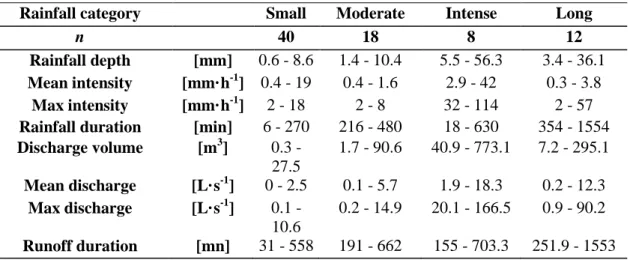
The cluster analysis of the 78 rainfall events created four different rainfall categories 373
(p<0.001; Table 2 and Table S4, Figure 2). Each category has specific rainfall depth, intensity 374
and duration characteristics, hereby referred to as Small (n = 40), Moderate (n = 18), Intense (n 375
= 8) and Long (n = 12) rainfall events. Overall, maximal rainfall intensities, depths and 376
durations, but also runoff volumes, maximum discharges and runoff durations differed among 377
rainfall categories (p<0.001; see Table S4). This confirms that cluster analysis could 378
disentangle distinct categories of rainfall-runoff events. At least two rainfall characteristics 379
systematically differed among rainfall categories. However, no significant difference was 380
found for rainfall depth generated by Long and Intense events, for maximum rainfall intensities 381
of Small and Long as well as for Moderate and Long events, and for rainfall duration of Small 382
and Intense categories (p>0.05) (Table S5). 383
The Small category included short (6 to 270 min), less intense events (mean intensity: 384
3.0±3.9 mm·h-1), with a rainfall depth lower than 8.6 mm (Table 2). The Moderate category 385
included events with similar or higher characteristic values than those of the Small category but 386
with longer rainfall durations (Table 2 and Table S6). Intense rainfalls were characterized by 387
high mean rainfall intensities (16.3±16.2 mm·h-1) and rainfall depths similar to those of Long 388
rainfalls. Long events had longer durations (354 to 1554 min), larger rainfall depth (16.8±9.7 389
mm) and maximum intensities similar to those of Moderate and Intense categories. We tested 390
whether these categories resulted in significantly different export of Cu, Zn and synthetic 391
pesticides in runoff. 392
393
Table 2. Characteristics of Small, Moderate, Intense and Long rainfall and runoff categories 394
(Hohrain catchment, France). Minimum-maximum ranges are provided. 395
Rainfall category Small Moderate Intense Long
n 40 18 8 12
Rainfall depth [mm] 0.6 - 8.6 1.4 - 10.4 5.5 - 56.3 3.4 - 36.1 Mean intensity [mm·h-1] 0.4 - 19 0.4 - 1.6 2.9 - 42 0.3 - 3.8 Max intensity [mm·h-1] 2 - 18 2 - 8 32 - 114 2 - 57 Rainfall duration [min] 6 - 270 216 - 480 18 - 630 354 - 1554 Discharge volume [m3] 0.3 - 27.5 1.7 - 90.6 40.9 - 773.1 7.2 - 295.1 Mean discharge [L·s-1] 0 - 2.5 0.1 - 5.7 1.9 - 18.3 0.2 - 12.3 Max discharge [L·s-1] 0.1 - 10.6 0.2 - 14.9 20.1 - 166.5 0.9 - 90.2 Runoff duration [mn] 31 - 558 191 - 662 155 - 703.3 251.9 - 1553 396
3.3. Cu and Zn export and impact of rainfall characteristics 397
Concentrations of dissolved Cu and Zn in runoff (<0.45 μm particle-size fraction) 398
ranged, respectively, from 9.0 to 70 μg·L-1 ( ±σ: 18.2±18.1 μg·L-1) and from 3.0 to 182 μg·L-1 399
(38.6±51.1 μg·L-1). Event mean concentrations and loads for each rainfall category are 400
displayed in Table S7. These values were one order of magnitude higher than average 401
dissolved concentrations of Cu in rivers worldwide (Vance et al., 2008). While Cu 402
concentrations exceeded the US Environmental Protection Agency (EPA) recommendations 403
for aquatic environments (chronic level: 9 µg·L-1; acute level: 13 µg·L-1, respectively), Zn 404
concentrations generally were below recommended values (chronic level: 120 µg·L-1; acute 405
level: 90 µg·L-1, respectively). Event export coefficients (EECp) of dissolved Cu and Zn range
from 5×10⁻⁶% to <7×10⁻²%, and were lower or in the same range as those of synthetic 407
pesticides (Table 1). 408
Overall, our results indicate that rainfall characteristics influenced the export of total 409
suspended solids (TSS), which in turn governed the export of solid-bound Cu and Zn in runoff 410
(Figure 3, Table S8 and S9). Event loads (ELp) of TSS, Cu and Zn significantly differed among
411
rainfall categories (p<0.001; Figure 4 and Table S8). In particular, ELp of TSS, Cu and Zn
412
differed between Small events and Long or Intense rainfall events (p<0.001; Table S9). Long 413
and Intense runoff events generally resulted in larger soil erosion than Small and Moderate 414
events since greater raindrop energy and/or runoff amount carry larger soil particles 415
(Mohammad et al., 2018). Larger soil erosion resulted in proportionally greater export of solid-416
bound Cu and Zn in runoff because Cu and Zn were predominantly associated with suspended 417
solids. Indeed, the export of solid-bound Cu and Zn (>0.45 μm fraction of runoff) represented 418
98% (Cu) and 95% (Zn) of the total export for the 78 events (Figure 3). The large contribution 419
of solid-bound export of Cu and Zn during Intense or Long storm events has major 420
implications for off-site export towards aquatic ecosystems and runoff management. Buffer 421
areas within the catchment, such as stormwater wetlands or ponds, may help limiting Cu and 422
Zn export in runoff. Indeed, solid-bound Cu and Zn in runoff are more efficiently retained 423
(>80%) in buffer areas than dissolved Cu and Zn (Babcsányi et al., 2014). 424
425
Figure 3. Rainfall, discharge and normalized loads of Cu, Zn and synthetic pesticides exported 426
from the vineyard catchment (Rouffach, France; 25.3 hectares of vineyards). 32 and 46 events 427
were monitored in 2015 and 2016, respectively. The error given for discharge measurements 428
corresponds to the measurement precision (8%). The errors given for the pesticide loads were 429
calculated via error propagation and incorporate errors associated with discharge measurements 430
and pesticide quantification (see Table S2). 431
432
Dissolved Cu and Zn in runoff (<0.45 μm fraction) mainly consist of Cu- and Zn-DOM 433
complexes that can be easily transported into hydrologically connected streams and rivers 434
(Babcsányi et al., 2016). Indeed, mixing of topsoil, soil solution and runoff water during long 435
events and soil fragmentation by raindrop splash during intense events can solubilize and 436
mobilize Cu- and Zn-DOM complexes from the vineyard soil (Jarvis, 2007). This in turn can 437
enhance the transport of lighter aggregate materials during rainfall-runoff events, including Cu- 438 0 20 40 60 R ai n fa ll [m m ]
Small Moderate Intense Long
2015 2016 100 550 1000 R u n o ff [m 3] 0 50 100100
Apr. May Jun. Jul. Aug. Sept. Oct. Apr. May Jun. Jul. 1 26 51 Dissolved Solid-bound 1 26 51 Dissolved Solid-bound 0 1 0 1 0 1 2 3
Atrazine Simazine Terbuthylazine
0.0 2.5 5.0 1
1
Tetraconazole Metalaxyl-M Pyrimethanil 5 55 105 155 205 Dimethomorph Azoxystrobin Kresoxim-methyl Cyprodinil Sy n th e ti c h e rb ic id e s [m g h avi n e ya rd -1] 5 Sy n th e ti c fu n gi ci d e s [m g h avin e ya rd -1] 1 4 7 10 Pyraflufen-ethyl Pendimethalin 0.0 0.5 1.0
Apr. May Jun. Jul. Apr. May Jun. Jul. Aug. Sept. Oct.
0 0.5 2.5 0 50 25 50 25 1 200 150 100 50 Tr ia zi n e s [m g h avin e ya rd -1] Zn [g h avi n e y ar d -1] C u [g h avin e y ar d -1]
and Zn-DOM complexes associated with the clay and silt fractions. Minteq speciation 439
modelling with Nica-Donnan and Stockholm Humic models (data not shown) confirmed Cu 440
and Zn complexation with DOM at pH values above 7 in the dissolved phase of runoff 441
(Thompson and Ellwood, 2014; Vance et al., 2008). ELp of TSS, dissolved and solid-bound Cu
442
and Zn positively correlated with rainfall depth, intensity and duration (ρs=0.33 to 0.92,
443
p<0.002; Figure 3 and Table S10). This is in agreement with the general observation that Cu 444
loss increases with larger rainfall events and vineyard soil erosion (Komárek et al., 2010; 445
Babcsányi et al., 2016; Meite et al., 2018). In the present study, correlations between additional 446
hydrological variables and export of Cu, Zn and synthetic pesticide could be examined. 447
Strong correlations (ρs=0.73 to 0.86, p<0.001; Table S10) between rainfall depth and
448
ELp of TSS and both dissolved and solid-bound Cu and Zn suggest that rainfall depth is a good
449
predictor of Cu and Zn export from vineyard headwater catchments. Primary hydrological 450
signals, such as rainfall depth, may thus prevail over the effect of agricultural practices or dose 451
and timing of application to determine the export of Cu and Zn in runoff. The strong 452
relationship between rainfall depth and Cu and Zn export also underscores the relative 453
homogeneity of Cu and Zn concentrations in the soil across the catchment and over time, as 454
well as rainfall-proportional export of Cu and Zn whenever runoff is generated. 455
Cu and Zn exports followed a typical pattern of chemostatic export. Chemostatic export 456
is characterized by limited seasonal and inter-annual variation in concentrations compared to 457
discharge due to large stocks of Cu and Zn in vineyard soil (Basu et al., 2011). The absence of 458
significant difference between EMCp of Cu and Zn among rainfall categories (p>0.05; Table
459
S8), similar EECp in 2015 and 2016 (Table 1) and the strong positive correlation between
460
seasonal dissolved loads of Cu and Zn and runoff volume (s>0.74, p<0.001, Table S10)
461
altogether suggest the dominance of chemostatic export of Cu and Zn in this vineyard 462
catchment. The legacy sources of Cu and Zn built up after several decades of vine management 463
are thus gradually released back into the dissolved phase of runoff. The depletion of Cu and Zn 464
stocks by successive export during rainfall-runoff event is, however, compensated by Cu and 465
Zn applications. As a result, export of Cu and Zn occurs whenever runoff is generated, while 466
concentrations in runoff are constant or slightly increase over time due to the inter-annual 467
accumulation in soil. For instance, the range of dissolved Cu concentrations was slightly higher 468
in 2015 and 2016 (9.0 to 69.5 µg L-1) compared to 2011 (7.7 to 32.0 µg L-1; Babcsányi et al., 469
2014). 470
The large influence of hydrological properties on Cu and Zn export at the scale of this 471
headwater catchment may help to develop simple predictive tools of Cu and Zn export from 472
vineyard catchments based on hydrologic (Moser et al., 2018) and/or TSS data. From a 473
conceptual viewpoint, anthropic modifications of the vineyard headwater catchment seem to 474
overwhelm the local biophysical systems into a structurally and biogeochemically less complex 475
and more homogeneous system (Basu et al., 2011). Such system might be more predictable in 476
the case of Cu and Zn export. 477
478
3.4. Export of synthetic pesticides and impact of rainfall characteristics 479
The following pesticides were detected in more than 50% of monitored runoff events in 480
2015 and 2016: dimethomorph (63% and 80%) > pyrimethanil (66% and 63%) > metalaxyl-M 481
(63% and 54%). Atrazine and pyraflufen-ethyl were detected in only one runoff event (Table 482
1). Mean concentrations in runoff above 1 μg·L-1 were observed for metalaxyl-M > 483
dimethomorph > pyrimethanil, with EMCp up to 124, 96 and 27 μg·L-1, respectively (data not
484
shown). Event Export coefficients (EECp) of dissolved pesticides ranges from 0% (atrazine and
485
pyraflufen-ethyl in 2016) up to 12.6% for metalaxyl-M in 2016 (Table 1). The highest EECp
486
values were observed in 2016 for metalaxyl-M > pendimethalin > pyrimethanil > 487
terbuthylazine > cyprodinil (Table 1). The export of the 12 synthetic pesticides was higher in 488
2016 (total export in runoff of 7.333×10⁻³ kg) than in 2015 (3.394×10⁻³ kg). This corresponded 489
to larger applied quantities in 2016 (6.121 kg) than in 2015 (3.359 kg). Larger pesticide export 490
in 2016 was also due to larger runoff volume (2026 m3 in 2016 and 1577 m3 in 2015) and more 491
frequent rainfall-runoff events in 2016 than in 2015 (46 sampled events in 2016, and 32 in 492
2015; Figure 3 and Table S3). 493
While rainfall is necessary to export synthetic pesticides offsite, our results indicate that 494
the rainfall characteristics were not as important as the timing of pesticide applications. Indeed, 495
the event export coefficient (EECp) and the freshly applied pesticide normalized export
496
coefficient (FANECp) were calculated to account, respectively, for weekly variations of the
497
total pesticide stock in soil and the fraction of freshly applied pesticides, and did not differed 498
among rainfall categories (p>0.001; Figure 4 and Table S8). Similarly, event loads of synthetic 499
pesticides (ELp) did not significantly differ among rainfall categories (p>0.001). This indicates
500
that normalizing pesticide export by the pesticide stock in soil was not critical in our case to 501
compare pesticide exports since rainfall conditions only had a weak impact on pesticide export. 502
In addition, the ELp and EECp of currently used synthetic pesticides within 50 days following a
503
pesticide application were at least one order of magnitude higher than in the following period 504
(p<0.001; data not shown). In contrast, the pesticide application dose, accounted here from the 505
weekly concentrations of synthetic pesticides in topsoil, did not correlate significantly with ELp
506
or EECp of synthetic pesticides, except for dimethomorph (p<0.001, data not shown).
507
Altogether, this suggests that the application timing, i.e. the period between the application of 508
synthetic pesticides and a rainfall event, rather than the dose itself, determined the export of 509
synthetic pesticide in runoff. However, when a soluble pesticide, such as dimethomorph, is 510
massively applied, thereby increasing the soil stock, both the timing and the dose may 511
influence ELp and EECp.
The absence of significant relationship between rainfall categories and the export of 513
synthetic pesticides suggests that episodic export arising in intermittent pulses predominates 514
over chemostatic export in the studied vineyard catchment (Basu et al., 2011). In episodic 515
export, rainfall-runoff events generate episodic pulses, which generally cease a few months 516
after the initial pesticide application depending on the initial dose of applied pesticide and the 517
rate of pesticide degradation in soil. Episodic exports can be related to the occurrence of 518
pesticides in topsoil after initial pesticide application, and the decrease of exported pesticide 519
loads with increasing time after application (McGrath et al., 2010), in agreement with our 520
study. As a result, larger export events are generally observed when a large rainfall pulse 521
directly follows pesticide application, while hydrological characteristics only have a secondary 522
influence. 523
525
Figure 4. Impact of rainfall categories on pesticide export. A) Cu and Zn event loads (ELp; boxplot with 5%, first quartile, median, third quartile,
526
95% and outliers, colored dots, of the 78 events). B) Event Export Coefficient (EECp) for triazines ( ±2σ and outliers of the 78 events). Freshly
527
Applied Fungicide Normalized Export Coefficient (FANECp) for C) fungicides and D) herbicides ( ±2σ and outliers of the 78 events).
Hence, the confluence of application and intense rainfall determines the process of 529
intermittent exports. This has also been demonstrated with mechanistic models resolving the 530
dynamics of individual wetting and concentration fronts in soil (Harman et al., 2011). 531
However, the low correlation between the export of legacy and currently used synthetic 532
pesticides and rainfall or runoff characteristics (ρs=0.08 to 0.33; Figure 3 and Table S10) limit
533
the potential of developing simple predictive tools based on hydrologic data. Indeed, the 534
seasonal variation of pesticide stocks is mainly controlled by dose and timing of pesticide 535
application but it also depends on the persistence and degradation of pesticides in soil between 536
the rainfall-runoff events. As a result, rainfall stochasticity as well as the temporal and spatial 537
variability of dissipation rates and pathways critically control episodic export. This should be 538
taken into account when using numerical models to predict the export of synthetic pesticides at 539
the catchment scale (Basu et al., 2011; Gassmann et al., 2013; Gassmann et al., 2015). 540
Overall, pesticide EECp or FANECp did not correlated with rainfall depth, maximum
541
intensity and duration (ρs<0.32; Figure 4 and Table S10), confirming the episodic character of
542
synthetic pesticide export. However, positive correlation (ρs>0.29, p<0.009; Table S10)
543
between rainfall intensity and the banned herbicide simazine or the currently used fungicide 544
tetraconazole suggests that rainfall intensity controls the export of more hydrophobic and 545
persistent pesticides from the vineyard catchment. Simazine and tetraconazole share higher 546
persistence, as suggested by their higher DT50 values and Kow values than the other synthetic
547
pesticides of this study (see Table S1). The same export mechanism that mobilize Cu and Zn at 548
the scale of soil aggregates may also mobilize hydrophobic pesticides. The export of simazine 549
and tetraconazole may be driven by soil fragmentation, depending on raindrop splash during 550
intense events, followed by solubilization and mobilization of pesticide-DOM complexes 551
released in surface runoff. Hence, Intense events would generate larger loss of solid-bound 552
pesticides resulting in larger loads, even some months or years after pesticide applications such 553
as for simazine and terbuthylazine. In particular, soil fragmentation during intense rainfalls 554
might be critical to mobilize low-concentration, hydrophobic and persistent synthetic 555
pesticides. In contrast, rainfall depth had a greater impact on the release Cu and Zn, which 556
might be related to the degree and timing of solubilization and mobilization of Cu- and Zn-557
DOM complexes (Herbrich et al., 2017). 558
559
4. Conclusion 560
Although physico-chemical characteristics and the dose and timing of applications are 561
important drivers for Cu, Zn and synthetic pesticides, runoff and rainfall characteristics can 562
also determine pesticide export from land into downstream aquatic ecosystems. We evaluated 563
the impact of different rainfall categories on the export by surface runoff of Cu, Zn, legacy and 564
currently used pesticides in a headwater vineyard catchment during two contrasted wine-565
growing seasons. The results support the hypothesis that rainfall characteristics control the 566
export of TSS, Cu and Zn in small headwater catchments. In contrast, rainfall characteristics 567
had no significant impact on the event mean concentrations and the export of currently used 568
synthetic pesticides, even when exports were normalized by the weekly variation of pesticide 569
stocks in soil. 570
Most importantly, exports of both dissolved and solid-bound Cu and Zn and 571
hydrophobic pesticides, such as simazine and tetraconazole, correlated with rainfall intensity 572
and depth. Intense and large rainfall can thus significantly enhance runoff generation from 573
vineyard plots, topsoil erosion and export of solid-bound pesticides. Together with the 574
expected increase of maximum rainfall intensity in the coming decades (e.g., Qiu et al., 2019), 575
this emphasizes the need to design best management practices to reduce runoff, erosion and 576
associated loads of pollutants. Rainfall characteristics should be considered to improve the 577
apportionment of Cu and Zn applications and to evaluate the seasonal export dynamics of Cu 578
and Zn and legacy pesticides. Further studies are needed to predict the impact of hydro-579
climatic changes on the pesticide export from small agricultural catchments in order to develop 580
management practices, while evaluating the long-term efficacy of legislation governing their 581
use. In particular, such management practices should account for both episodic and chemostatic 582
exports of pesticides to limit pesticide transport from small agricultural catchments into aquatic 583 ecosystems. 584 585 Author information 586
* Corresponding author. e-mail: [email protected] phone: + 33 3 6885 0474 587
588
Author contributions 589
Gwenaël Imfeld and Sylvain Payraudeau: Conceptualization, Methodology, Software, 590
Visualization, Funding acquisition. Gwenaël Imfeld: Project administration, Supervision, 591
Formal analysis, Writing- Original draft preparation. Fatima Meite, Charline Wiegert, 592
Benoît Guyot and Jérémy Masbou: Investigation, Data curation, Writing - Review & 593 Editing. 594 595 Acknowledgments 596
This research has been funded by the Agence de l’Eau Rhin-Meuse (AERM) and the 597
Conseil Interprofessionnel des Vins d’Alsace (CIVA) in the project PACOV. Fatima Meite 598
was supported by a fellowship of the Alsace Region and the AERM. The authors thank the 599
Agricultural and Viticulture College of Rouffach (EPLEFPA Les Sillons de Haute Alsace – 600
Rouffach), the City of Rouffach and the vine producers of the catchment. The authors wish to 601
acknowledge Eric Pernin and Agnès Herrmann for support in sampling, analyses and surveys. 602
We gratefully acknowledge Richard Coupe (USGS) for enabling significant improvement of 603
the manuscript and for useful comments. 604 605 606 607 References 608
Babcsányi, I., Chabaux, F., Granet, M., Meite, F., Payraudeau, S., Duplay, J., Imfeld, G., 609
2016. Copper in soil fractions and runoff in a vineyard catchment: Insights from 610
copper stable isotopes. Sci. Total Environ. 557–558, 154–162.
611
https://doi.org/10.1016/j.scitotenv.2016.03.037 612
Babcsányi, I., Imfeld, G., Granet, M., Chabaux, F., 2014. Copper stable isotopes to trace 613
copper behavior in wetland systems. Environ. Sci. Technol. 48, 5520–5529. 614
https://doi.org/10.1021/es405688v 615
Basu, N.B., Thompson, S.E., Rao, P.S.C., 2011. Hydrologic and biogeochemical functioning 616
of intensively managed catchments: A synthesis of top-down analyses: Managed 617
catchments. Water Resour. Res. 47. https://doi.org/10.1029/2011WR010800 618
Chen, Y., Yu, K., Hassan, M., Xu, C., Zhang, B., Gin, K.Y.-H., He, Y., 2018. Occurrence, 619
distribution and risk assessment of pesticides in a river-reservoir system. Ecotoxicol. 620
Environ. Saf. 166, 320–327. https://doi.org/10.1016/j.ecoenv.2018.09.107 621
Coupe, R.H., Kalkhoff, S.J., Capel, P.D., Grégoire, C., 2012. Fate and transport of glyphosate 622
and aminomethylphosphonic acid in surface waters of agricultural basins. Pest Manag. 623
Sci. 68, 16–30. https://doi.org/10.1002/ps.2212 624
Domange, N., Grégoire, C., 2006. Quality of in situ data about pollutant concentration. TrAC 625
Trends Anal. Chem. 25, 179–189. https://doi.org/10.1016/j.trac.2005.09.002 626
Dousset, S., Jacobson, A.R., Dessogne, J.-B., Guichard, N., Baveye, P.C., Andreux, F., 2007. 627
Facilitated transport of diuron and glyphosate in high copper vineyard soils. Environ. 628
Sci. Technol. 41, 8056–8061. https://doi.org/10.1021/es071664c 629
Duplay, J., Semhi, K., Errais, E., Imfeld, G., Babcsanyi, I., Perrone, T., 2014. Copper, zinc, 630
lead and cadmium bioavailability and retention in vineyard soils (Rouffach, France): 631
The impact of cultural practices. Geoderma 230–231, 318–328.
632
https://doi.org/10.1016/j.geoderma.2014.04.022 633
El Azzi, D., Probst, J.L., Teisserenc, R., Merlina, G., Baqué, D., Julien, F., Payre-Suc, V., 634
Guiresse, M., 2016. Trace Element and Pesticide Dynamics During a Flood Event in 635
the Save Agricultural Watershed: Soil-River Transfer Pathways and Controlling 636
Factors. Water. Air. Soil Pollut. 227, 442. https://doi.org/10.1007/s11270-016-3144-0 637
Elsayed, O.F., Maillard, E., Vuilleumier, S., Nijenhuis, I., Richnow, H.H., Imfeld, G., 2014. 638
Using compound-specific isotope analysis to assess the degradation of 639
chloroacetanilide herbicides in lab-scale wetlands. Chemosphere 99, 89–95. 640
https://doi.org/10.1016/j.chemosphere.2013.10.027 641
Gagnon, P., Sheedy, C., Rousseau, A.N., Bourgeois, G., Chouinard, G., 2016. Integrated 642
assessment of climate change impact on surface runoff contamination by pesticides: 643
Climate change impact on pesticides in surface runoff. Integr. Environ. Assess. 644
Manag. 12, 559–571. https://doi.org/10.1002/ieam.1706 645
Gassmann, M., Olsson, O., Stamm, C., Weiler, M., Kümmerer, K., 2015. Physico-chemical 646
characteristics affect the spatial distribution of pesticide and transformation product 647
loss to an agricultural brook. Sci. Total Environ. 532, 733–743.
648
https://doi.org/10.1016/j.scitotenv.2015.06.068 649
Gassmann, M., Stamm, C., Olsson, O., Lange, J., Kümmerer, K., Weiler, M., 2013. Model-650
based estimation of pesticides and transformation products and their export pathways 651
in a headwater catchment. Hydrol. Earth Syst. Sci. 17, 5213–5228. 652
https://doi.org/10.5194/hess-17-5213-2013 653
Grégoire, C., Payraudeau, S., Domange, N., 2010. Use and fate of 17 pesticides applied on a 654
vineyard catchment. Int. J. Environ. Anal. Chem. 90, 406–420.
655
https://doi.org/10.1080/03067310903131230 656
Harman, C.J., Rao, P.S.C., Basu, N.B., McGrath, G.S., Kumar, P., Sivapalan, M., 2011. 657
Climate, soil, and vegetation controls on the temporal variability of vadose zone 658
transport: climate controls on vadose transport. Water Resour. Res. 47. 659
https://doi.org/10.1029/2010WR010194 660
Havis, R., Smith, R., Adrian, D., 1992. Partitioning solute between infiltration and overland 661
flow. Water Resour. Res. 28.2569-2580.
https://doi-org.scd-rproxy.u-662
strasbg.fr/10.1029/92WR01366 663
Herrero-Hernández, E., Rodríguez-Cruz, M.S., Pose-Juan, E., Sánchez-González, S., 664
Andrades, M.S., Sánchez-Martín, M.J., 2017. Seasonal distribution of herbicide and 665
insecticide residues in the water resources of the vineyard region of La Rioja (Spain). 666
Sci. Total Environ. 609, 161–171. https://doi.org/10.1016/j.scitotenv.2017.07.113 667
Hildebrandt, A., Guillamón, M., Lacorte, S., Tauler, R., Barceló, D., 2008. Impact of 668
pesticides used in agriculture and vineyards to surface and groundwater quality (North 669
Spain). Water Res. 42, 3315–3326. https://doi.org/10.1016/j.watres.2008.04.009 670
Jarvis, N.J., 2007. A review of non-equilibrium water flow and solute transport in soil 671
macropores: principles, controlling factors and consequences for water quality. Eur. J. 672
Soil sci. 58, 523–546. https://doi.org/10.1111/j.1365-2389.2007.00915.x 673
Komárek, M., Čadková, E., Chrastný, V., Bordas, F., Bollinger, J.-C., 2010. Contamination of 674
vineyard soils with fungicides: A review of environmental and toxicological aspects. 675
Environ. Int. 36, 138–151. https://doi.org/10.1016/j.envint.2009.10.005 676