COGNITIVE CORRELATES OF COUNSELLOR TRAINEES' NEEDS AWARENESS
WILLIAM J. WEIKEL Morehead State University, Kentucky LARRY C LOESCH
University of Florida
Abstract
This study examined the relationships between the differences in counsellor trainees' perceived and measured needs levels and their Graduate Record Examination (GRE) scores and grade point averages (GPA). Using definitions from the Personality Research Form (PRF), the counsellor trainees' predicted their needs levels in percentiles. They then completed the PRF following standard procedures. Differences between their perceived and measured needs levels were correlated with their GRE scores and undergraduate and graduate GPAs. GRE scores were generally inversely related to differences in measured and perceived needs levels; higher GRE scores were associated with smaller differences. GPAs were generally not significantly related to prediction
accuracy. Résumé
Cette étude fait l'examen du rapport entre les différences des niveaux des besoins perçus et mesurés chez des stagiaires en consultation, et leurs résultats sur le Graduate Record Examination (GRE) et leur moyenne académique (GPA). Les stagiaires ont prédit le niveau de leurs besoins en rang percentile en utilisant les définitions tirées du Personality Research Form (PRF). Ensuite, ils ont répondu au PRF en suivant la procédure établie. On a établi une corrélation entre les différences de niveaux de leurs besoins perçus et mesurés, et leurs résultats sur le GRE et leur moyenne académique tant au niveau sous-gradué que gradué. On a relevé une relation en sens contraire entre les résultats sur le GRE et les différences obtenues entre les niveaux des besoins perçus et mesurés. Les résultats plus élevés sur le GRE étaient en rapport avec de plus petites différences. Enfin, on a découvert que les moyennes servaient peu comme outil de prédiction.
Many counselling professionals, especially those espousing the more "humanistic" counselling techniques believe that accurate self-awareness is an essential characteristic of effective counsellors. A high degree of self-awareness is seen as enabling counsellors to more easily enter their clients' perceptual fields (Boy & Pine, 1963), exhibit greater congruence between perceptions and behaviors (Stoner & Riese, 1971), and offer higher levels of facilitative conditions (Truax & Carkhuff, 1967). In general, counsellors who possess accurate self-awareness are seen as providing more successful and effective services for their clients than those lacking this aspect of self knowledge (Benjamin, 1974).
Knowledge of personal needs is an aspect of self-awareness particularly important for counsellor
trainees. This knowledge increases their understand-ing of their counsellunderstand-ing behaviors and in turn facilitates the development of effective counselling behaviors and skills. A previous study (Loesch & Weikel, 1976) found that counsellor trainees exhibited wide variations in both self-perceived and measured needs levels and that they were generally inaccurate in identifying their needs levels. Since measures of cognitive abilities (such as Graduate Record Exami-nation scores and grade point averages) are often used for the selection and evaluation of counsellor trainees, this study investigated the relationships between these measures and the differences between counsellor trainees' perceived and measured needs levels.
TRAINEES' NEEDS AWARENESS 129 Instruments
The Personality Research Form (PRF) assesses the major personality needs derived from Murray's needs
theories (Jackson, 1967). Form A of the PRF consists of 300 true-false items yielding percentile scores for 15 different needs. The PRF, as a measure of personality needs, has been found to be psychometri-cally sound with regard to reliability, validity, and freedom from response bias (Crites, 1969; Jackson & Gutherie, 1967; Strieker, 1974).
The Graduate Record Examination (GRE) is a measure of scholastic aptitude usually used for selection of students for graduate school. It yields two standard scores, verbal (V) and quantitative (Q),
each having a mean of 500 and a standard deviation of 100. The GRE has high reliability coefficients and moderately high predictive validity coefficients (Sax, 1974).
Subjects and Procedures
One hundred seven graduate students, enrolled in the counsellor education program leading to the Educational Specialist degree at the University of
Florida, participated in the study. These students were first given written definitions of the 15 PRF scales and a simulated PRF profile sheet. They were instructed to read the definitions carefully and then to
identify, in percentiles, their own needs levels on the simulated profiles. Each student then completed the PRF. Data on the students' GRE scores and grade point averages were obtained from departmental files. PRF percentile scores were obtained through standard scoring and profiling procedures. Differ-ences between their perceived and measured percentiles were correlated with their GRE verbal (GRE-V), quantitative (GRE-Q), and total (GRE-T) scores and their undergraduate (UGPA) and current graduate (GGPA) grade point averages.
Results
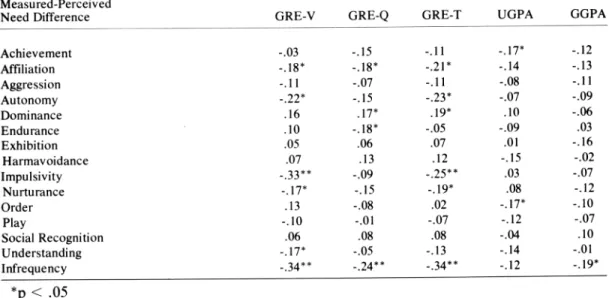
Pearson product moment correlations between the five cognitive measures and the perceived-measured
differences for the 15 PRF scales are presented in Table One. Over two-thirds (54 of 75) of the correlations were negative indicating that there was generally an inverse relationship between the
difference values and the cognitive measure values. That is, the higher the cognitive ability level, the more accurate the prediction of needs level.
Of the 19 statistically significant correlations, 16 were associated with GRE scores. The GRE appears to be a much better indicator of counsellor trainees' abilities to accurately predict their own needs levels (i.e. self- awareness) than grade point averages.
Table One
Correlations between differences in counsellor trainees' (n=107) perceived and measured needs levels percentiles and GRE scores and grade point averages
Measured-Perceived
Need Difference GRE-V GRE-Q GRE-T UGPA GGPA
Achievement -.03 -.15 -.11 -.17* -.12 Affiliation -.18* -.18* -.21* -.14 -.13 Aggression -.11 -.07 -.11 -.08 -.11 Autonomy -.22* -.15 -.23* -.07 -.09 Dominance .16 .17* .19* .10 -.06 Endurance .10 -.18* -.05 -.09 .03 Exhibition .05 .06 .07 .01 -.16 Harmavoidance .07 .13 .12 -.15 -.02 Impulsivity -.33** -.09 -.25** .03 -.07 Nurturance -.17* -.15 -.19* .08 -.12 Order .13 -.08 .02 -.17* -.10 Play -.10 -.01 -.07 -.12 -.07 Social Recognition .06 .08 .08 -.04 .10 Understanding -.17* -.05 -.13 -.14 -.01 Infrequency -.34** -.24** -.34** -.12 -.19* *p < .05 **p <<01
130 WILLIAM J. WEIKEL AND LARRY C LOESCH Discussion
The data from this study suggest that counsellor trainees having higher cognitive ability levels (as
measured by typical indices) generally tend to have higher levels of self-awareness of needs levels. While this conclusion is easy enough to accept, and probably desirable, it perhaps raises more questions than it answers.
The vast majority of significant correlations found in this study were associated with the GRE. Some
interesting speculations arise from this situation. For example, perhaps counsellor trainees with low GRE scores attempted to present themselves in a more favorable light in regard to personality needs. Thus their discrepancies between measured and perceived needs would be accentuated by a social desirability
set in responding to the task. Further research is needed to test this possible explanation of course. It would be interesting to determine if a social desirability set were in operation and to find out if their measured-perceived differences decreased if the set were eliminated.
Test anxiety may have been another factor in the results related to the GRE. Since test anxiety would
generally tend to lower GRE scores and alter PRF responses, it may be that the more test anxious trainees were the ones least able to identify their own needs levels. Again, further research would be necessary to test the accuracy of this conjecture.
Grade point averages appear to be much less accurate indicators of counsellor trainees' abilities to identify their own needs levels. The vast majority of the correlations for grade point averages were negative, indicating a trend similar to that for the GRE, but only a few were statistically significant. There are several possible explanations here too. First, GPAs, particularly those in counsellor education programs, are the composite results of evaluations of a wide variety of human characteristics and abilities. The percentages that cognitive abilities contribute to GPAs are difficult, if not impossible, to determine. Thus GPAs may have been too complex to allow clear correlational patterns to emerge. More
importantly, the training program where this study occurred attempts to foster self-awareness regardless of cognitive ability at entrance into the program. Thus, while GPAs may be reflections of cognitive
abilities, they are not used as criteria for helping students achieve self-awareness. Hence degrees of self-awareness of personality needs would not be expected to be directly related to GPAs.
The relationships between self-awareness and counselling effectiveness are complex and still in the germinal stages of investigation. Similarly, the relationships between GRE scores, GPAs, and counselling effectiveness have not yet been fully determined. Obviously there is a great need for further research in each of these areas. If it could be shown that self-awareness of personality needs is directly related to counselling effectiveness, then the results of this study suggest that the GRE may be one appropriate selection tool for those types of counsellors. Hopefully, future investigations will help to clarify these speculations.
References
Benjamin, A. The helping interview. Boston: Houghton Mifflin, 1974 (2nd edition).
Boy, A. V., & Pine, G. J. Client-centered counseling in the secondary schools. Boston: Houghton Mifflin,
1963.
Crites, J. C Test reviews. Journal of Counseling Psychology, 1969, /6(2), 181-184.
Jackson, D. N. The personality research form manual. Goshen, N.Y.: Research Psychologists Press, 1967.
Jackson, D. N., & Gutherie, G. M. The convergent and discriminant validation of personality research form scores. University of Western Ontario Research Bulletin, 1967.
Loesch, L. C., & Weikel, W. J. Perceived and measured needs levels of counselor education students. Counselor Education and Supervision, 1976, /6(1), 59-65.
Sax, G. Principles of educational measurement and evaluation. Belmont: Wadsworth, 1974.
Stoner, W. G., & Riese, H. C. A study of change in the perception of self and ideal self. Counselor Education and Supervision, 1971,//(2), 115-118. Strieker, L. J. Personality Research Form: Factor
structure and response style involvement. Journal of Consulting and Clinical Psychology, 1974, 42(A), 529-537.
Truax, C. B., & Carkhuff, R. R. Toward effective counseling and psychotherapy. Chicago: Aldine,