Dietary evaluation of a hipparionin horse population from the middle
Miocene of Oaxaca, southeastern Mexico
Victor M. Bravo-Cuevas
1,*y Jaime Priego-Vargas
21 Museo de Paleontología, Área Académica de Biología, Universidad Autónoma del Estado de Hidalgo,
Ciudad Universitaria s/n, Carretera Pachuca-Tulancingo Km. 4.5, 42184 Pachuca, Hidalgo, Mexico.
2 Licenciatura en Biología, Universidad Autónoma del Estado de Hidalgo, Ciudad Universitaria s/n,
Carretera Pachuca-Tulancingo Km. 4.5, 42184 Pachuca, Hidalgo, Mexico. * [email protected]
ABSTRACT
The first paleodietary interpretation of a hipparionin horse population from the middle Miocene El Camarón Formation (late early Barstovian, K-Ar dated 15.0 ± 0.8 to 16.7 ± 0.71 Ma) of Oaxaca, southeastern Mexico is presented. The species is formally referred to Cormohipparion aff. C. quinni and its dietary behavior were evaluated by the extended mesowear analysis method. A cluster analysis compared the Oaxacan species with 23 selected extant species and fossil hipparionins from the Neogene of North America, Europe, and Africa. The mesowear pattern of the Oaxacan hipparionin is comparable to that of the mixed feeder Cormohipparion quinni from the late Barstovian of northern Great Plains. These species display a combination of high relief and round cusps characteristic of a relatively high-abrasion diet. This suggests that the population of C. aff. C. quinni was a mixed feeder that incorporated abrasive food items into the diet (grass and/or extrinsic grit). The results provide evidence for the existence of local grazing habitats in southern tropical North America during the early middle Miocene (ca. 15 Ma), and give additional support that savanna-like habitats were present in high and low latitudes of North America during the mid Miocene (~18–12 Ma).
Key words: hipparionins, mesowear, paleodiet, paleoecology, middle Miocene, Oaxaca, Mexico.
RESUMEN
Se presenta la primera interpretación sobre la dieta de una población de caballos hipparionines cuyo material fósil procede de estratos pertenecientes a la formación El Camarón del Mioceno medio (parte más tardía del Barstoviano temprano, con fechamiento isotópico por K-Ar de 15.0 ± 0.8 a 16.7 ± 0.71 Ma) de Oaxaca, sureste de México. La especie se designa formalmente Cormohipparion aff. C. quinni y sus hábitos dietarios se evaluaron mediante la aplicación del método conocido como mesodesgaste extendido. Para fines de comparación se realizó un análisis de cluster de la población oaxaqueña con 23 especies recientes y poblaciones selectas de hipparionines del Neógeno de Norteamérica, Europa y África. El patrón de mesodesgaste del hipparionine oaxaqueño es semejante al de la especie de hábitos mixtos Cormohipparion quinni del Barstoviano tardío de las Grandes Planicies. Estas especies muestran una combinación de relieve alto con cúspides redondeadas, que es característica de una dieta que incluye material abrasivo. Nuestras observaciones sugieren que la población de C. aff. C. quinni tuvo hábitos
Bravo-Cuevas, V.M., Priego-Vargas, J., 2009, Dietary evaluation of a hipparionin horse population from the middle Miocene of Oaxaca, southeastern
INTRODUCTION The interpretation of ancient dietary regimes in fossil ungulates is an important source of paleobiological infor-mation. It provides evidence on the availability of food resources in a particular area and insight into the resource partitioning of mammalian herbivore communities. The indirect evidence provided is a useful ecological indicator and is of key importance in the interpretation of ancient ter-restrial environments. The methods to assess dietary traits include direct comparison with living animals, the applica-tion of general functional principles (e.g., Rensberger et al., 1984; Fortelius, 1985), carbon isotopic studies of the dental tissue (e.g., MacFadden and Cerling, 1996; Cerling et al., 1997; Cerling and Harris, 1999), and the analysis of dental wear patterns at microscopic and/or macroscopic inspection (e.g., Hayek et al., 1992; Fortelius and Solounias, 2000; Solounias and Semprebon, 2002; Kaiser and Solounias, 2003; Kaiser et al., 2003; Semprebon et al., 2004). In recent years, Fortelius and Solounias (2000) introduced the method of dietary analysis known as mesowear, which is based on relative facet development on the occlusal surface of the teeth. The technique was formerly restricted to investigate the upper second molar, and consisted of a visual evaluation of the molar cusps morphology provid-ing information on both attrition (tooth-on-tooth contact) and abrasion (tooth-on-food contact). Later, Kaiser and Solounias (2003) extended the method for the remaining upper cheek tooth positions, allowing for the investigation of the dietary preferences in fossil populations represented by a small number of individuals. In order to obtain sta-ble dietary classifications and to know ancient dietary regimes, the mesowear methodology has been applied to various extant and/or extinct ungulates (e.g., Fortelius and Solounias, 2000; Croitor and Kaiser, 2002; Franz-Odendaal and Kaiser, 2003; Kaiser and Fortelius, 2003; Kaiser and Franz-Odendaal, 2004). It has been shown that mesowear analysis is a reliable and simple technique used to indicate diet of a particular population. There are many papers concerning the dietary evalua-tion of fossil hipparionin horses from the Neogene of Europe and Africa (e.g., Kaiser et al., 2000, 2003; Franz-Odendaal et al., 2003; Kaiser and Solounias, 2003; Bernor et al., 2004). The hipparionins are a group of three toed horses
that make up a significant element of North American ter-restrial mammalian faunas throughout the Neogene. In the early Miocene (~15–18 Ma), horses experienced an adaptive radiation of taxa that developed high-crowned cheek teeth (MacFadden and Hulbert, 1988; Hulbert and MacFadden, 1991). The acquisition of hypsodonty has classically been considered as an adaptive shift from browsing to grazing in order to exploit the spread of savanna grasses habitats in North America during the Miocene (see Webb, 1977, 1983). Recently, the paleodietary investigation of fossil horses (and several other groups of ungulates) found that the advent of hypsodonty is not necessarily coupled with a grazing be-havior and the expansion of grasslands, providing evidence about the paleocology of hypsodont horses as well as the global changes in climate and ecology that affected them (MacFadden and Cerling, 1994; MacFadden et al., 1999; Passey et al., 2002; Solounias and Semprebon, 2002).
The purpose of this study is to present for the first time the paleodietary preference of a hipparionin population from the middle Miocene of southeastern Mexico, including a comparison of dietary strategies previously reported for other selected hipparionins from the Neogene of temperate North America.
Study area and geologic setting
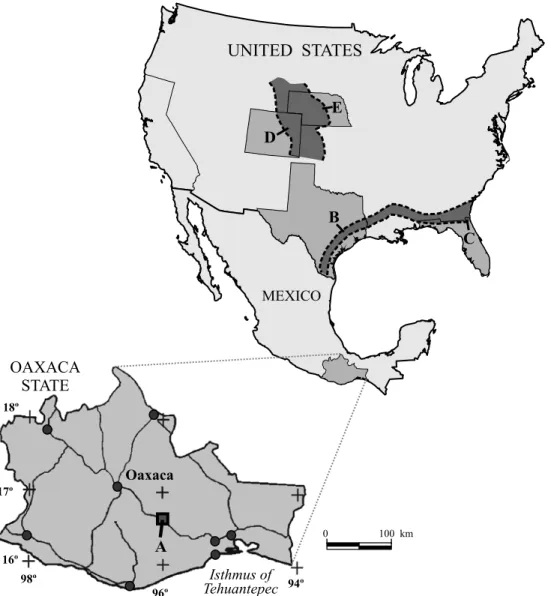
The horse material comes from fossiliferous localities that lie in the Nejapa de Madero area (hereafter Nejapa), northwest of the Isthmus of Tehuantepec, roughly mid-way between the cities of Oaxaca and Tehuantepec, and geographically located between 16°30’–16°40’ N and 95°55’–96°10’ W (Figure 1). The study area is an exposed sedimentary sequence that belongs to the synorogenic, tuffaceous, fluviolacustrine El Camarón Formation (late early Barstovian, K-Ar dated 15.0±0.8 to 16.7±0.71 Ma: Ferrusquía-Villafranca and McDowell, 1991; Ferrusquía-Villafranca, 1992; Tedford
et al., 2004). The strata that yield the fossil horse material
is the lower member. It is dominantly fine grained (clayey, silty to finely sandy) and laminar to thinly bedded. The upper member is coarse grained (sandy, granular to pebbly conglomeratic) and thin- to thickly bedded (Ferrusquía-Villafranca, 2002).
alimentarios mixtos con una ingesta de recursos abrasivos (pastos, polvo y/o arena). La información disponible evidencia que a principios del Mioceno medio (ca. 15 Ma) existieron zonas cubiertas por pastos en lo que ahora es parte de Norteamérica meridional; asimismo, apoya la propuesta de la existencia de biomas de tipo sabana en latitudes altas y bajas de Norteamérica durante el Mioceno medio (~18–12 Ma).
Palabras clave: hipparionines, mesodesgaste, paleodieta, paleoecología, Mioceno medio, Oaxaca, México.
UNITED STATES
MEXICO D E B C Oaxaca Isthmus of Tehuantepec A 98º 96º 94º 16º 17º 18º OAXACA STATE 0 100 km to Cormohipparion aff. C. quinni is more abundant in comparison to that of other horse species known from the Nejapa fauna. The occlusal pattern and horse size of the Oaxacan hipparionin are closest to those of North American Cormohipparion quinni from the late Barstovian of Nebraska and Colorado, Great Plains (Woodburne, 1996). Both spe-cies are similar in having a medium size, crown height of about 45 mm and hipsodonty index of 1.9 (hypsodonty index is defined here as ratio of maximum crown height to maximum crown length of first upper molar), elongate oval protocone, secondary plications on the anterior border of the prefossette, and moderately deep ectoflexid on premolars (see Hulbert, 1988; Woodburne, 1996). A definitive iden-tification at species level, however, is restricted because of the lack of associated cranial diagnostic material. Thus the Oaxacan species is referred as Cormohipparion aff.Cormohipparion quinni. Detailed information on the de-The horse record from the middle Miocene of Oaxaca,
southeastern Mexico
Thirty years of paleontological work carried out in localities of the Nejapa Area on the middle Miocene (Barstovian) El Camarón Formation, have recovered a limited but significant collection of fossil horse material. The sample is chiefly represented by isolated teeth and scarce mandibular and maxillary fragments. The taxonomic analysis of this collection indicates the presence of at least four genera and five species (Jimenéz-Hidalgo et al., 2002; Ferrusquía-Villafranca, 2003). The horse record includes the relict “Merychippus” cf. “M.” primus, the merychip-pine hipparionine grade species “M.” cf. “M.” sejunctus,
Calippus sp., Pliohippus aff. P. pernix, and Cormohipparion
aff. C. quinni (Jiménez-Hidalgo et al., 2002; Ferrusquía-Villafranca, 2003; Tedford et al., 2004; Bravo-Cuevas and Ferrusquía-Villafranca, 2006, 2008). The material referred
Figure 1. Index map that shows the location of the study area Nejapa de Madero (A) and selected areas of the United States with middle Miocene hip-parionin record (B-E). A. Subisthmian region, Oaxaca, southeastern Mexico; B. Gulf Coast, Texan sector; C. Gulf Coast, Floridan sector; D. Northern Great Plains, northeastern Colorado; E. Northern Great Plains, Nebraskan sector.
scription and taxonomic identity of this hipparionin species is presented in Bravo-Cuevas and Ferrusquía-Villafranca (2008).
MATERIAL AND METHODS
The material includes 15 upper cheek teeth recovered from the El Camarón Formation, late early Barstovian of Oaxaca, southeastern Mexico. All specimens are housed in the Colección Nacional de Paleontología at the Instituto de Geología, Universidad Nacional Autónoma de México (IGM). A minimum of 10 dental specimens are needed to give a reasonable scoring of paleodietary preference (cf. Fortelius and Solounias, 2000; Kaiser et al., 2000); given that, the available dental sample is adequate to accomplish an analysis of tooth mesowear. The extended mesowear analysis was used to characterize the dietary behavior of the Oaxacan hipparionin Cormohipparion aff. C. quinni, including a combination of upper tooth positions P4, M1, M2, and M3 (after Kaiser and Solounias, 2003). The con-ventional mesowear variables occlusal relief (OR) and cusp shape (CS) were scored to each upper cheek tooth (Table 1). The OR is described as low (l) or high (h), whereas CS is described as sharp (s), rounded (r) or blunt (b) (after Fortelius and Solounias, 2000). The mesowear analysis is sensitive to wear on the dental enamel of the occlusal surface caused by the effect of tooth-on-tooth and food-on-tooth contact, thus unworn teeth, teeth in very early wear, and teeth in very late and late wear are omitted from the analysis (after Fortelius and Solounias, 2000; Kaiser et al. 2003; Rivals et al., 2007). The wear stage for cheekteeth was performed following Kaiser et al. (2003, p.106), including teeth with entire occlusal surface beginning to wear (pre- and postfossette are still fused with anterior or posterior enamel band) and/or tooth wear less than 70% of maximum crown height (pre- or postfossette are isolated from anterior or posterior enamel band). We used Statistica ’98© Edition software to compute
chi-squared statistics to test for significance of differences observed between individual datasets using the absolute frequencies of mesowear variables (high, sharp, and blunt). Hierarchical cluster analysis with complete linkage (furthest neighbors) was applied. In order to observe frequency dif-ferences in the mesowear signature of selected extant and fossil species, histograms of the mesowear variables %low, %high, %sharp, and %blunt were plotted. In order to compare the population of Cormohipparion aff. C. quinni with other extant ungulates, the mesowear variables were converted into a mesowear score following methods described by Rivals and Semprebon (2006) and Rivals et al. (2007): a combination of high relief and sharp cusps was assigned a score of 0, a combination of high relief and round cusps was assigned a score of 1, a combination of low relief and round cusps was assigned a score of 2, and a combination of low relief and blunt cusps was assigned a score of 3. A mesowear score for C. aff. C quinni was then calculated and compared with data published in Rivals and Semprebon (2006). The mesowear analysis was performed using as a comparative set 23 extant species reported with typical dietary preferences (after Fortelius and Solounias, 2000, tab.1, p. 4-5) and the fossil populations of North American, African and European hipparionins Hippotherium kam- merschmittae from the late Miocene (Turolian) of Dorn-Dürkheim, Germany (Kaiser et al., 2003, 2004); the popu-lations of H. primigenium from Höwenegg (Vallesian), Eppelsheim (Vallesian) (Kaiser, 2003), and Dorn-Dürkheim (Turolian), late Miocene of Germany (Kaiser et al., 2003); “Cormohipparion” sp. from the late Miocene of Ethiopia (Bernor et al., 2004); the populations of ‘Eurygnathohippus’ cf. baardi (Quartzose Sand Member and Pelletal Phosphate Sand Member) from the late Miocene/early Pliocene of Langebaanweg, South Africa (Franz-Odendaal et al., 2003); Merychippus insignis from the middle Miocene (early Barstovian) of Nebraska, United States (Fortelius and Solounias, 2000); Cormohipparion goorisi from the middle Miocene (early Barstovian) of Texas, United States (Fortelius and Solounias, 2000); and Cormohipparion quin-ni from the middle Miocene (late Barstovian) of Nebraska, United States (Fortelius and Solounias, 2000). It is regarded that dietary preference for each species considered other than Cormohipparion aff. C. quinni has been evaluated applying the mesowear analysis. RESULTS In the Oaxacan hipparionin population, occlusal re-lief is 53.3% high. Cusp shape scorings are 86.2% round,
Specimen Tooth OR CS (a) CS (p)
IGM9150 IGM9148 IGM9152 IGM9153 IGM9154 IGM9157 IGM9158 IGM9161 IGM9151 IGM9162 IGM9163 IGM9164 IGM9165 IGM7972 IGM7972 LP4 RP4 RM1 LM1 RM1 LM1 LM2 RM2 LM1 RM2 LM2 LM3 LM3 RP4 RM1 l h h l l l h h l l l h h h h r r r r r r r r s ---r r r r r r r s r b r r r r r r s r r r Table 1. Maxillary cheek teeth attributed to Cormohipparion aff. C. quinni from the middle Miocene of Oaxaca analyzed in present study. OR: oclussal relief (l = low, h = high); CS: cusp shape (s = sharp, r = round, b = blunt); a: anterior; p: posterior. M: upper molar; P: upper premolar.
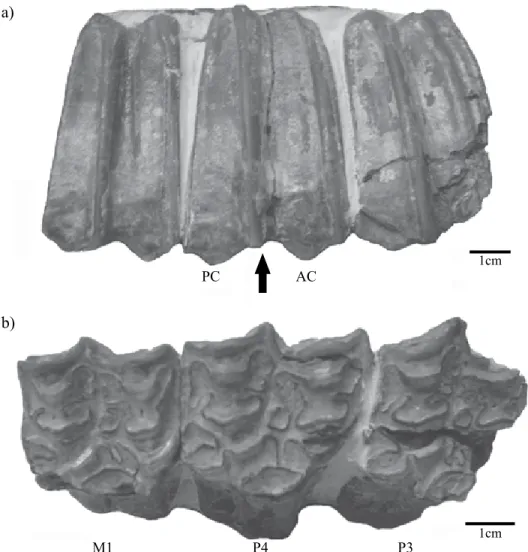
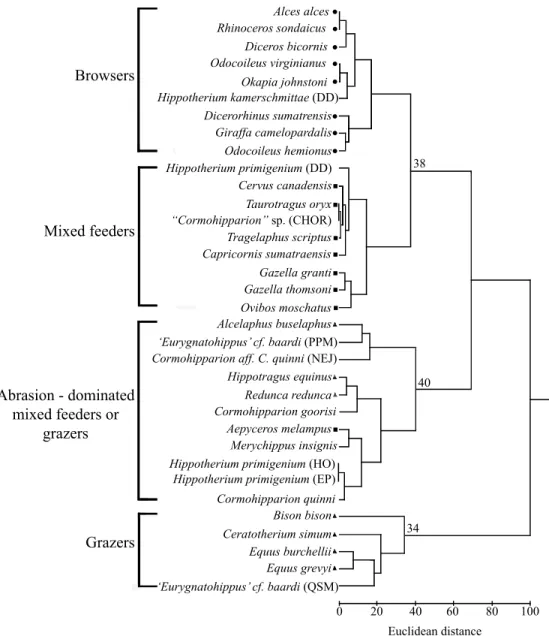
a) b) PC AC P4 M1 P3 1cm 1cm 10.3% sharp and 3.4% blunt (Figure 2, Table 2). There are three main clusters in the hierarchical tree plot based on the selected recent and fossil species and the population under study, one containing browsers and mixed feeders (ED [Euclidean distance] = 38), one containing the abra-sion-dominated grazers (ED = 34), and one that includes the abrasion-dominated mixed feeders or grazers (ED = 40) (Figure 3). The hipparionins are distributed within any of these clusters, as it is described in following paragraph.
The species Hippotherium kammerschmittae is linked with the browser species Odocoileus virginianus (white-tailed deer) and Okapia johnstoni (okapi) (ED = 20). The population of H. primigenium from Dorn-Dürkheim and that of “Cormohipparion” sp. from Chorora are grouped with the mixed feeders Cervus canadensis (wapiti), Taurotragus oryx (eland), Tragelaphus scriptus (bushbuck), and Capricornis sumatrensis (serow) (ED = 16). Cormohipparion aff. C. quinni is linked with the extant grazer Alcelaphus buselap-hus (hartebeest) and the population of ‘Eurygnathohippus’ cf. baardi from Pelletal Phosphate Member (ED = 19). The species C. goorisi is linked with the extant grazer species
Hippotragus equinus (roan antelope) and Redunca redunca
(reedbuck) (ED = 10). The species Merychippus insignis is linked with the mixed feeder Aepyceros melampus (impala), whereas the populations of H. primigenium from Höwenegg and Eppelsheim, and Cormohipparion quinni are grouped Figure 2. Lateral (a) and occlusal (b) views of IGM-7972, a composite right premolar-molar series (P3-M1) of Cormohipparion aff. C. quinni from the late early Barstovian of Oaxaca. Arrow indicates the valley between the anterior cusp (AC) and posterior cusp (PC), showing a high occlusal relief. Note that dental cusps are rounded in the P4. M: upper molar; P: upper premolar. Species N l h s r b %l %h %s %r %b A 15 12 3 3 11 1 46.6 53.3 10.3 86.2 3.4 B 17 0 17 0 17 0 0 100 0 100 0 C 13 1 12 3 10 0 6 94 20 80 0 Table 2. Mesowear variable distribution observed in species of the genus Cormohipparion known from the middle Miocene of North America. A: Cormohipparion aff. C. quinni from the late early Barstovian of south-eastern Mexico. B: Cormohipparion goorisi from the late early to early late Barstovian of Gulf Coastal Plain. C: Cormohipparion quinni from the late Barstovian of Great Plains. N: Sample size; d.f.: degrees of freedom; other abbreviations as in Table 1. A vs. B (h, s, b) x2 = 11. 69, d.f. = 2, P-value = 0.0029 B vs. D (h, s, b) x2 = 4.09, d.f. = 2, P-value = 0.1294
Browsers Mixed feeders Abrasion - dominated mixed feeders or grazers Grazers Alces alces Rhinoceros sondaicus Diceros bicornis Odocoileus virginianus Okapia johnstoni Hippotherium kamerschmittae (DD) Dicerorhinus sumatrensis Giraffa camelopardalis Odocoileus hemionus Hippotherium primigenium (DD) Cervus canadensis Taurotragus oryx “Cormohipparion” sp. (CHOR) Tragelaphus scriptus Capricornis sumatraensis Gazella granti Gazella thomsoni Ovibos moschatus Alcelaphus buselaphus ‘Eurygnatohippus’ cf. baardi (PPM) Cormohipparion aff. C. quinni (NEJ) Hippotragus equinus
Redunca redunca Cormohipparion goorisi
Aepyceros melampus Merychippus insignis Hippotherium primigenium (HO) Hippotherium primigenium (EP) Cormohipparion quinni Bison bison Ceratotherium simum Equus grevyi Equus burchellii ‘Eurygnatohippus’ cf. baardi (QSM) 0 20 40 60 80 100 34 40 38 Euclidean distance Figure 3. Hierarchical cluster diagram based on the reference upper tooth positions P4, M1, M2, and M3 according to the extended mesowear method (Kaiser and Solounias, 2003). Circle: recent browser, square: recent mixed-feeder, triangle: recent grazer. Numbers at branching points indicate distance of main clusters. The mesowear variables are percentage of high occlusal relief, percentage of sharp cusps and percentage of blunt cusps. Clusters are based on a comparative set of 23 extant species (after Fortelius and Solounias, 2000: tab. 1, p. 4-5), selected hipparionin species from the late Neogene of Europe, South Africa and North America (after Fortelius and Solounias; Kaiser et al., 2003; Franz-Odendaal et al., 2003; Bernor et al., 2004) and Cormohipparion aff. C. quinni from the middle Miocene of Oaxaca, southeastern Mexico. CHOR: Chorora, late Miocene of Ethiopia; DD: Dorn-Dürkheim, late Miocene of Germany; EP: Eppelsheim, late Miocene of Germany; HO: Höwenegg, late Miocene of Germany; NEJ: Nejapa, middle Miocene of southeastern Mexico; PPM: Pelletal Phosphate Sand Member, late Miocene/early Pliocene of South Africa; QSM: Quartzose Sand Member, late Miocene/early Pliocene of South Africa. with the former two species (ED = 16). The hipparionin population of ‘Eurygnathohippus’ cf. baardi from Quartzose Sand Member is linked with the abrasion-dominated grazer species Equus burchellii (plains zebra) and E. grevyi (impe-rial zebra) (ED = 18) (Figure 3).
Significant differences between the mesowear vari-ables (high, sharp, and blunt) obtained for Cormohipparion aff. C. quinni, the hipparionin C. goorisi, and the extant grazer Alcelaphus buselaphus were found (x2, P<0.05).
Low levels of significance, however, were found when
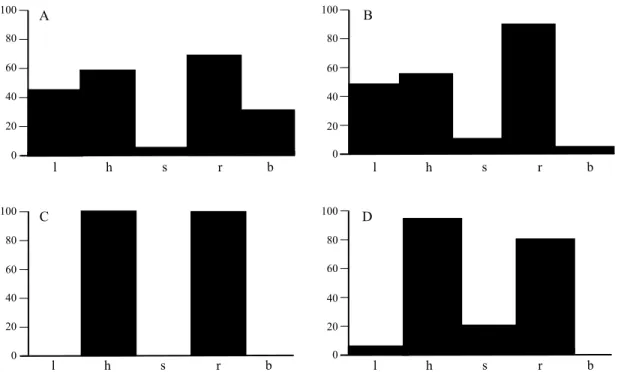
a comparison was made between the Oaxacan hippa-rionin population with C. quinni (P = 0.1294) and the population of ‘Eurygnathohippus’ cf. baardi from Pelletal Phosphate Member. Histograms of the mesowear variables for Cormohipparion aff. C. quinni and C. quinni (Figure 4) show the similarities in their mesowear pattern, by having a combination of relatively high relief and round cusps.
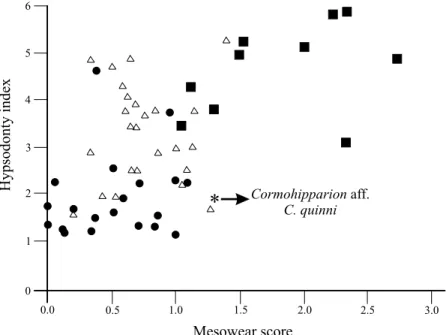
Figure 5 shows a plot of the hypsodonty index versus the mesowear score (hypsodonty indices as reported in Fortelius and Solounias, 2000; mesowear scores from data
extrinsic grit [dust and sand]). A few dental conditions observed in the Oaxacan cheek teeth are related to feeding on abrasive items, including hypsodont cheek teeth (rela-tive molar crown height of 45 mm and hypsodonty index of 1.9), moderate curvature (mean radius of curvature of 55 mm), thick layer of cement (~1.5 mm thick), and moderately plicated enamel fossette borders that implies an increase of resistant dental tissue at the occlusal surface of the teeth (Janis and Fortelius, 1988; Bennett, 1992; MacFadden, 1992). This evidence also supported that the Oaxacan hip-parionin population incorporated abrasive food materials in its diet. The mesowear pattern of Cormohipparion aff. C.
quinni is defined by predominant high relief and rounded
cusp apices (Table 2, Figure 4), and its mesowear score overlaps with the upper extreme for extant mixed feeders and lower extreme for grazers (mesowear score interval of 1–1.5 in Figure 5). Overall differences, however, are observed among extant grazers with extremely blunted mesowear signatures and highest mesowear scores (>2) related to a hyper abrasive grazing diet (upper extreme for grazers in Figure 5). Examples include zebras (Equus burchelli and E. grevyi) and the modern plains bison (Bison bison). The similarities between the mesowear pattern and mesowear score of the Oaxacan hipparionin population and those observed for some highly abrasion-dominated mixed feeders and fresh grass grazers indicate a mixed feeding diet including abrasive items, which in this present study is categorized as graze-dominated mixed feeder. Additionally, evidence shows that hypsodonty (high crowned cheek teeth) in horses and other extinct ungulates reported in Rivals and Semprebon, 2006) for selected extant ungulates and the fossil population considered in present study. The mesowear score for the Oaxacan hipparionin population of Cormohipparion aff. C. quinni (1.3) falls
within the range observed in extant abrasion-dominated mixed feeders and fresh grass grazers, whereas the cal-culated hypsodonty (1.9) places this species with extant mixed feeders with high abrasion mesowear pattern and diets and away from modern extant browser which are rarely hypsodont. DISCUSSION
Dietary behavior of Cormohipparion aff. C. quinni from the middle Miocene of southeastern Mexico
Results of cluster analysis link the population of
Cormohipparion aff. C. quinni with the extant African
antelope Alcelaphus buselaphus (hartebeest), however mesowear pattern of these species is significantly differ-ent (x2, P < 0.05). The mesowear pattern of Alcelaphus
buselaphus (hartebeest), dominated by rounded cusps with
also a significant proportion of blunt cusps (Figure 4), is typical of other extant ungulates with diets that comprised a predominance of abrasive food items (particularly grass), such as Connochaetes taurinis (wildebeest) and Damaliscus
lunatus (topi) (Estes, 1991; Nowak, 1999; Schuette et al.,
1998; Gagnon and Chew, 2000). Therefore, it is likely that the population of Cormohipparion aff. C. quinni may have been engaged in feeding on abrasive foods (grass and/or
Figure 4. Histograms of mesowear variables %low (l), %high (h), % sharp (s), %round (r), and %blunt (b) in Alcelaphus buselaphus (hartebeest) (A), the Oaxacan population of Cormohipparion aff. C. quinni (B) and the late Neogene North American hipparionins C. goorisi (C) and C. quinni (D).
Figure 5. Bivariate plot of mesowear scores against Hypsodonty Index, comparing the Oaxacan hipparionin population of Cormohipparion aff. C. quinni and extant ungulate species with typical dietary preferences as reported by Fortelius and Solounias (2000). Circle: recent browser, triangle: recent mixed-feeder, square: recent grazer. is not necessarily correlated with grazing, a contention previously stated by other authors (see MacFadden and Cerling, 1994; MacFadden et al., 1999; Strömberg, 2006; Rivals and Semprebom, 2006). Thus, dental wear analyses are informative of the diets of extinct and extant species, but they should be cautiously used as sole indicators of ancient terrestrial environments.
Comments on the dietary behavior of selected late Neogene North American hipparionins
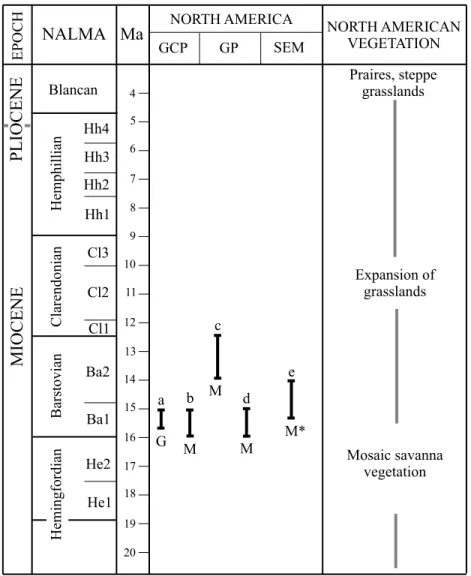
By the Barstovian (12.7–16.0 Ma; Tedford et al., 2004), North American species of Cormohipparion were distributed in the Great Plains, Gulf Coastal Plain, and southeastern Mexico. The record includes C. goorisi from the late early to early late Barstovian (15.0–15.6 Ma) of Texas, Florida, and probably Lousiana (MacFadden and Skinner, 1981; Hulbert and MacFadden, 1991; Schiebout and Ting, 2000); C. aff. C. quinni from the late early Barstovian (15.0–16 Ma) of Oaxaca (Bravo-Cuevas and Ferrusquía-Villafranca, 2008); and C. quinni from the late Barstovian (13.0–14.0 Ma) of Nebraska and Colorado (Woodburne, 1996). The species Cormohipparion goorisi is identified as a grazer (see Fortelius and Solounias, 2000), whereas the population of C. aff. C. quinni is characterized as a graze-dominated mixed feeder. Nevertheless, abrasive food sources were incorporated in their dietary regimes and it would be expected that C. goorisi ingested a greater amount of abrasive items than C. aff. C. quinni. The diet probably consisted of grasses with silica-rich phytoliths, given they make up a major source of abrasives eaten by extant herbivorous mammals (MacNaughton et al. 1985). It should be noted that both species are approximately coeta-neous, but come from localities in different biogeographic regions that at are least 1800 km apart. This suggests the existence of local grazing habitats in areas of temperate North America (Gulf Coastal Plain) and tropical North America (southeastern Mexico) during the early middle Miocene (Figure 6). The species Cormohipparion quinni has been con-sidered an abrasion-dominated mixed feeder (Fortelius and Solounias, 2000). Our observations supported this conten-tion and also provide evidence that C. aff. C. quinni have a comparable mesowear signature and dietary category (Figure 4, Table 2). These species are known from localities in different biogeographic regions and the Oaxacan hip-parionin population antedates the record of C. quinni by at least one million years, its probable closest North American sister species. A mixed feeding strategy is related to ecological sce-narios with a broad spectrum of possible food resources. It is hypothesized that by the middle middle Miocene (late early Barstovian to late Barstovian) were areas of temperate North America (Great Plains) and tropical North America (southeastern Mexico) with variable vegetation in the habitat mosaic and the concomitant availability of diverse food re-sources. Such requirements could best be met in ecosystems where variable amounts of grasses, trees and/or bush cover are resources for different kind of herbivores, as occurs in present-day savannas (Potts and Behrensmeyer, 1992). This explanation agrees with the available information about the ungulate communities, palaeobotanical evidence, and
Figure 6. Comparative chart of observed di-etary behavior in selected late Neogene North American hipparionin species and the Oaxacan population of Cormohipparion aff. C. quinni. The ecological conditions are summarized following Potts and Behrensmeyer (1992) and Retallack (2007). NALMA refers to North American Land Mammal Ages and modified from Tedford et al. (2004). a: Cormohipparion goorisi from the early middle Miocene of Gulf Coastal Plain. b and d: Merychippus insignis from the early middle Miocene of Great Plains. c: C. quinni from the middle middle Miocene of Great Plains. e: C. aff. C. quinni from the early middle Miocene of south-eastern Mexico. Dietary behavior: B: browser; M: mixed feeder; G: grazer. North American regions: GCP: Gulf Coastal Plain; GP: Great Plains; SEM: southeastern Mexico. * Present study. geochemical studies from several fossil localities in temper-ate North America. It indicates that savanna-like habitats with an important grass component were common in North America during the middle Miocene (~18–12 Ma) (see Janis et al., 2004; Strömberg, 2002, 2004; Retallack, 2007). The known Barstovian Oaxacan large herbivore communities (cf. Jiménez-Hidalgo et al. 2002; Ferrusquía-Villafranca, 2003; Tedford et al., 2004), the complex geologic makeup and physiographic features of southeastern Mexico during the middle Miocene (Morán-Zenteno, 1984; Sedlock et al., 1993; Martínez-Serrano et al., 2008), fit confidently into a scenario for the developing of savanna-like habitats also in tropical North America (Ferrusquía-Villafranca, 2003). It would appear from the ecological conditions and the dietary behavior observed in late Neogene North American species of Cormohipparion, that hypsodont hipparionins incorporated into their diets a wide diversity of food re-sources available in savanna-like habitats that developed during the middle Miocene in contrasting ecogeographic scenarios, such as Gulf Coastal Plain, northern Great Plains, and southeastern Mexico (Figure 6). This variability in dietary adaptations is also observed in many Pleistocene ungulates in North America (see Rivals et al., 2007; Rivals and Solounias, 2007). Hence, it is likely that modern ungu-lates have atypical diets in comparison to the fossils. Our results once again confirm the importance and breadth of diet in the evolution of a species.
CONCLUSIONS
The mesowear analysis performed identifies as a graze-dominated mixed feeder the population of Cormohipparion aff. C. quinni, from the middle Miocene (Barstovian) El Camarón Formation of Oaxaca. The dietary behavior that characterizes the Oaxacan hipparionin population suggests the presence of local graze habitats in southern tropical re-gions of North America (specifically southeastern Mexico) during the early middle Miocene. Our observations also provide additional support that during the mid Miocene (~18–12 Ma) savanna-like habitats were present in high- and low-latitudes of North America.
ACKNOWLEDGMENTS We are indebted to Florent-Rivals for critically re-viewing the manuscript and give us access to their published mesowear scores data. Also we thank the anonymous re-viewers whose comments and suggestions greatly improved the manuscript. We thank to Mr. Jose Ruíz who made the map of Figure 1, Biologist Berenice Alemán García in the elaboration and edition of the final version of Figure 3, and to Mrs. Elizabeth O. de Bravo for the preparation of previous draft. At last but no to least we are also grateful to Christopher Fielitz for linguistically editing this article. The senior author express special thanks to Bruce J. MacFadden and Richard C. Hulbert Jr. for their valuable comments about hipparionin horses during my visit to the Florida Museum of Natural History. The visit was partially supported by the 2003 International Student Travel Grant to Study the Vertebrate Paleontology Collection at the Florida Museum of Natural History. REFERENCES Bennett, D.K., 1992, The evolution of the horse, in Evans, J.W. (ed.), Horse breeding and management,: New York, Elsevier Publishing Co., World Animal Science Encyclopedia, v. C7, 1-40. Bernor, R.L., Kaiser, T.M., Nelson, S.V., 2004, The oldest Ethiopian hip- parion (Equinae, Perisodactyla) from Chorora: systematic, pale-odiet and paleoclimate: Courier Forschungsinstitut Senckenberg, 246, 213-226. Bravo-Cuevas, V.M., Ferrusquía -Villafranca, I., 2006, Merychippus (Mammalia, Perissodactyla, Equidae) from the Middle Miocene of the State of Oaxaca, Southeastern Mexico: Geobios, 39, 771–784. Bravo-Cuevas, V.M., Ferrusquía -Villafranca, I., 2008, Cormohipparion (Mammalia, Perissoactyla, Equidae) from the Middle Miocene of Oaxaca, Southeastern Mexico: Journal of Vertebrate Paleontology, 28(1),243-250 Cerling, T.E., Harris, J.M., 1999, Carbon isotope fractionation between diet and bioapatite in ungulate mammals and implications for ecologi-cal and paleontological studies: Oecologia,120, 247–363. Cerling, T.E., Harris, J.M., MacFadden, B.J., Leakey, M.G., Quade, J., Eisenmann, V., Ehlinger, J.R., 1997, Global vegetation change through the Miocene/Pliocene boundary: Nature, 389, 153–158. Croitor, R., Kaiser, T.M., 2002, Functional morphology and diet prefer-ences of fossil deer and paleolandscape reconstruction on early Pleistocene of Ceyssaguet: Verhandlungen der Gesellschaft für Ökologie, 32, 465. Estes, R.D., 1991, The Behavior Guide to African Mammals: Los Angeles, The University of California Press, Berkeley, 611 pp. Ferrusquía-Villafranca, I., 1992, Contribución al conocimiento del
Cenozoico en el Sureste de México y de su relevancia en el entendimiento de la evolución geológica regional, en Actas de las sesiones científicas del III Congreso Geológico de España y VIII Congreso Latinoamericano de Geología: Salamanca, España, Universidad de Salamanca, Facultad de Ciencias, 4, 40–44. Ferrusquía-Villafranca, I., 2002, Contribución al conocimiento geológico
de Oaxaca: el área Nejapa de Madero. México: Universidad Nacional Autónoma de México, Instituto de Geología, Boletín 112, 1–110. Ferrusquía-Villlafranca, I., 2003, Mexico’s Middle Miocene mammalian assemblages: an overview: Bulletin of the American Museum of Natural History, 13, 321–347. Ferrusquía-Villafranca, I., McDowell., F.W., 1991, The Cenozoic sequence of selected areas in Southeastern Mexico, its bearing in under-standing regional basin development there, in Memoria de la II Convención sobre la Evolución Geológica de México, Pachuca, Hidalgo: Universidad Nacional Autónoma de México, Instituto de Geología, 45–50. Fortelius, M., 1985, Ungulate cheek teeth: developmental, functional, and evolutionary interrelations: Acta Zooologica Fennica, 180, 1-76. Fortelius, M., Solounias, N., 2000, Functional characterisation of ungulate molars using abrasion-attrition wear gradient: a new method for reconstructing paleodietas: American Museum Novitates, 3301, 1-36. Franz-Odendaal, T.A., Kaiser, T.M., 2003, Differential mesowear in the maxillary and mandibular cheek dentition of some ruminants (Artiodactyla): Annales Zoologici Fennici, 40, 395-410. Franz-Odendaal, T.A., Kaiser, T.M., Bernor, R.L., 2003, Systematics and diatery evaluation of a fossil equid from South Africa: South African Journal of Science, 99, 453-459. Gagnon, M., Chew, A.E., 2000, Dietary preferences in extant African Bovidae: Journal of Mammalogy, 81, 490-511. Hayek, L.A.C., Bernor, R.L., Solounias, N., Steigerwald, P., 1992, Preliminary studies of hipparionine horse diet as measured by tooth microwear, in Forstén, A., Fortelius, M., Werdelin, L. (eds.), Björn Kurtén – A Memorial Volume: Annales Zoologici Fennici, 28, 187-200.
Hulbert, R.C.Jr., 1988, Cormohipparion and Hipparion (Mammalia, Perisodactyla, Equidae) from the Late Neogene of Florida: Bulletin of the Florida Museum of Natural History, 33, 229–338. Hulbert, R.C.Jr., MacFadden, B.J., 1991, Morphological transformation and cladogenesis at the base of the adaptive radiation of Miocene hypsodont horses: American Museum Novitates, 3000, 1–61. Janis, C.M., Fortelius, M., 1988, On the means whereby mammals achieve increased functional durability of their dentitions, with special reference to limiting factors: Biological Review, 63, 197-230. Janis, C.M., Damuth, J., Theodor, J.M., 2004, The species richness of Miocene browsers and implications from habitat type and primary productivity in the North American grassland biome: Palaeogeography, Palaeoclimatology, Palaeoecology, 207, 371–398.
Jiménez-Hidalgo, E., Ferrusquía-Villafranca, J., Bravo-Cuevas, V.M., 2002, El registro mastofaunístico miocénico de México y sus implica- ciones paleobiológicas, en Montellano-Ballesteros, M., Arroyo-Cabrales, J. (eds.), Avances en los Estudios Paleomastozoológicos: México, D.F., Instituto Nacional de Antropología e Historia, 47–58. Kaiser, T.M., 2003, The dietary regimes of two contemporaneous popula-tions of Hippotherium primigenium (Perissodactyla, Equidae) from the Vallesian (Upper Miocene) of Southern Germany: Palaeogeography, Palaeoclimatology, Palaeoecology, 19, 381-402. Kaiser, T.M., Fortelius, M., 2003, Differential mesowear in occluding upper and lower molars – Opening mesowear analysis fro lower molars and premolars in hypsodont equids: Journal of Morphology, 258(1), 67-83. Kaiser, T.M., Franz-Odendaal, T.A., 2004, A mixed feeding Equus spe-cies from the Middle Pleistocene of South Africa: Quaternary Research, 62, 316-323. Kaiser, T.M., Solounias, N., 2003, Extending the tooth mesowear method to extinct and extant equids: Geodiversitas, 25(2), 321-345. Kaiser, T.M., Solounias, N., Fortelius, M., Bernor, R.L., Schrenk, F., 2000, Tooth mesowear analysis of Hippotherium primigenium from the Vallesian Dinotheriensande (Germany) – A blind test study: Carolinea, 58, 103-114. Kaiser, T.M., Bernor, R.L., Franzen, J.L., Scott, R., Solounias, N., 2003, New interpretations of the systematic and palaeoecology of the Dorn-Dürkheim 1 Hipparions (Late Miocene, Turolian age [MN11]), Rheinhessen Germany: Senckenbergiana Lethaea, 83(1/2), 103-133. Kaiser, T.M., Bernor, R.L., Franzen, J.L., Scott, R., Solounias, N., 2004,
Hippotherium kamemerschmittae n. sp. instead of Hippotherium kamemerschmitti Kaiser, Bernor, Franzen, Scott & Solounias 2003: Senckenbergiana Lethaea, 84(1/2), 383-384. MacFadden, B.J., 1992, Fossil Horses. Systematics, paleobiology and evolution of the Family Equidae: Cambridge University Press, 369 pp. MacFadden, B.J., Cerling, T.E., 1994, Fossil horses, carbon isotopes and global change: Trends in Ecology and Evolution, 9, 481-485. MacFadden, B.J., Cerling, T.E., 1996, Mammalian herbivore communities, ancient feeding ecology, and carbon isotopes: a 10 million-year sequence from the Neogene of Florida: Journal of Vertebrate Paleontology, 16, 103-115. MacFadden, B.J., Hulbert, R.C. Jr., 1988, Explosive speciation at the base of the adaptive radiation of Miocene grazing horses: Nature, 336, 466-468. MacFadden, B.J., Skinner, M.F., 1981, Earliest Holarctic hipparion Cormohipparion goorisi n. sp. (Mammalia, Equidae) from the Barstovian (medial Miocene) Texas Gulf Coastal Plain: Journal of Paleontology, 55, 619–627. MacFadden, B.J., Solounias, N., Cerling, T.E., 1999, Ancient diets, ecol-ogy and extinction of 5-million-year-old horses from Florida: Science, 283, 824-827. MacNaughton, S.J., Tarrants, J.L., MacNaughton, M.M., Davis, R.H., 1985, Silica as a defense against herbivory and a growth promotor in African grasses: Ecology, 66, 528–535. Martínez-Serrano, R.G., Solís-Pichardo, G., Flores-Márquez, L., Macías- Romo, C., Delgado-Durán, J., 2008, Geochemical and Sr-Nd iso-topic characterization of the Miocene volcanic events in the Sierra Madre del Sur, central and southeastern Oaxaca, Mexico: Revista Mexicana de Ciencias Geológicas, 25(1), 2008, p. 1-20. Morán- Zenteno, D.J., 1984, Geología de la República Mexicana: México,
D.F, Instituto Nacional de Estadística, Geografía e Informática (INEGI), Universidad Nacional Autónoma de México (UNAM), 87 pp. Nowak, R., 1999, Walker´s Mammals of the World: Baltimore, USA, The Johns Hopkins University Press, 1936 pp. Passey, B.J., Cerling, T.E., Perkins, M.E., Voorhies, M.R., Harris, J.M., Tucker, S.T., 2002, Environmental change in the Great Plains: an isotopic record from fossil horses: The Journal of Geology, 110, 123-140. Potts, R., Behrensmeyer, A.K. (rapporteurs), in collaboration with Taggart, R.E., Spaulding, W.G.,. Harris, J.A, Valkenburg, B.V., Martin, L.D., Damuth, J. D., Foley R., 1992, Late Cenozoic terrestrial eco-systems, in Behrensmeyer, A.K., Damuth, J.D., DiMichele, W.A., Potts, R., Sues, H.-D., Wing, J.L. (eds.), Terrestrial Ecosystems Through Time. Evolutionary Paleoecology of Terrestrial Plants and Animals: Chicago, University of Chicago Press, 419–519. Rensberger, J.M., Forsten, A., Fortelius, M., 1984, Functional evolution of the cheek tooth pattern and chewing direction in Tertiary horses: Paleobiology, 47, 515-528. Retallack, G.J., 2007, Cenozoic paleoclimate on land in North America: Journal of Geology, 115, 271-294. Rivals, F., Semprebon, G.M., 2006, A comparison of the dietary habits of a large sample of the pleistocene pronghorn Stockoceros onusro-sagris from the Papago Springs Cave in Arizona to the modern Antilocapra Americana: Journal of Vertebrate Paleontology, 26(2), 495-500. Rivals, F., Solounias, N., 2007, Differences in Tooth Microwear of Populations of Caribou (Rangifer tarandus, Ruminantia, Mammalia) and Implications to Ecology, Migration, Glaciations and Dental Evolution: Journal of Mammalian Evolution, 14, 182–192. Rivals, F., Mihlbachler, M.C., Solounias, N., 2007, Effect of ontogenetic-age distribution in fossil samples on the interpretation of ungulate paleodiets using the mesowear method: Journal of Vertebrate Paleontology, 27(3), 763-767. Schiebout, J.A., Ting, S., 2000, Paleofaunal survey, collecting, process-ing, and documentation at locations in the Castor Creek Member, Miocene Fleming Formation, Fort Polk, Louisiana.: Lousiana, Louisiana State University, Report to the Corps of Engineers, Fort Worth District, Texas, 95 pp. Schuette, J., Leslie, D.Jr., Lochmiller, R., Jenks, J., 1998, Diets of hartebeest and Roan Antelope in Burkina Faso: Support of the long-faced hypothesis: Journal of Mammalogy, 79(2), 426-436.
Sedlock, R.L., Ortega-Gutiérrez, F., Speed, R.C., 1993, Tectonostratigraphic terranes and tectonic evolution of Mexico: Geological Society of America, Special Paper 278, 1-153.
Semprebon, G.M., Godfrey, L.R., Solounias, N., Sutherland, M.R., Jungers, W.L., 2004, Can low magnification stereomicroscopy reveal diet?: Journal of Human Evolution, 47, 115-144. Solounias, N., Semprebon, G., 2002, Advances in the reconstruction of ungulate ecomorphology with application to early fossil equids: American Museum Novitates, 3366, 1-52. Strömberg, C.A.E., 2002, The origin and spread of grass-dominated ecosystems in the late Tertiary of North America: preliminary results concerning the evolution of hypsodonty: Palaeogeography, Palaeoclimatology, Palaeoecology, 177, 59-75. Strömberg, C.A.E., 2004, Using phytolith assemblages to reconstruct the origin and spread of grass-dominated habitats in the great plains of North America during the late Eocene to early Miocene: Palaeogeography, Palaeoclimatology, Palaeoecology, 207, 239-275. Strömberg, C.A.E., 2006, Evolution of hypsodonty in equids: testing a hypothesis of adaptation: Paleobiology, 32(2), 236-258. Tedford, R.H., Albright, L.B., Barnosky, A.D. III,. Ferrusquía-Villafranca, I., Hunt, R.M.Jr., Storer, J.E., Swisher, C.C.III, Voorhies, M.R., Webb, S.D., Whistler, D.P., 2004, Mammalian Biochronology of the Arikareean through Hemphillian interval (Late Oligocene through Early Pliocene Epochs), in Woodburne, M.O. (ed.), Late Cretaceous and Cenozoic mammals of North America: New York, Columbia University Press, 169–231. Webb, S.D., 1977, A history of savanna vertebrates in the New World: Part I. North America: Annual Review of Ecology and Systematics, 8, 355-380. Webb, S.D., 1983, The rise and fall of the Late Miocene ungulate fauna in North America, in Nitecki, M.N. (ed.), Coevolution: Chicago, IL,University of Chicago Press, 267-306. Woodburne, M., 1996, Reappraisal of the Cormohipparion from the Valentine Formation, Nebraska: American Museum Novitates, 3163, 1-56. Manuscript received: January 21, 2008 Corrected manuscript received: January 21, 2009 Manuscript accepted: February 3, 2009