HAL Id: hal-01260669
https://hal.inria.fr/hal-01260669
Submitted on 22 Jan 2016
HAL is a multi-disciplinary open access
archive for the deposit and dissemination of
sci-entific research documents, whether they are
pub-lished or not. The documents may come from
teaching and research institutions in France or
abroad, or from public or private research centers.
L’archive ouverte pluridisciplinaire HAL, est
destinée au dépôt et à la diffusion de documents
scientifiques de niveau recherche, publiés ou non,
émanant des établissements d’enseignement et de
recherche français ou étrangers, des laboratoires
publics ou privés.
Arnaud Carayol, Axel Haddad, Olivier Serre
To cite this version:
Arnaud Carayol, Axel Haddad, Olivier Serre. Randomisation in Automata on Infinite Trees. ACM
Transactions on Computational Logic, Association for Computing Machinery, 2014, 15 (3), pp.24.
�10.1145/2629336�. �hal-01260669�
ARNAUD CARAYOL
LIGM (CNRS & Université Paris Est) and
AXEL HADDAD
LIAFA (CNRS & Université Paris Diderot - Paris 7) & LIGM (CNRS & Université Paris Est)
and
OLIVIER SERRE
LIAFA (CNRS & Université Paris Diderot - Paris 7)
We study finite automata running over infinite binary trees. A run of such an automaton over an input tree is a tree labeled by control states of the automaton: the labelling is built in a top-down fashion and should be consistent with the transitions of the automaton. A branch in a run is accepting if the ω-word obtained by reading the states along the branch satisfies some acceptance condition (typically an ω-regular condition such as a Büchi or a parity condition). Finally, a tree is accepted by the automaton if there exists a run over this tree in which every branch is accepting.
In this paper, we consider two relaxations of this definition introducing a qualitative aspect. First, we relax the notion of accepting run by allowing a negligible set (in the sense of measure theory) of non-accepting branches. In this qualitative setting, a tree is accepted by the automaton if there exists a run over this tree in which almost every branch is accepting. This leads to a new class of tree languages, qualitative tree languages. This class enjoys many good properties: closure under union and intersection (but not under complement), emptiness is decidable in polynomial time. A dual class, positive tree languages, is defined by requiring that an accepting run contains a non-negligeable set of branches.
The second relaxation, is to replace the existential quantification (a tree is accepted if there exists some accepting run over the input tree) by a probabilistic quantification (a tree is accepted if almost every run over the input tree is accepting). For the run, we may use either classical acceptance or qualitative acceptance. In particular, for the latter, we exhibit a tight connection with partial observation Markov decision processes. Moreover, if we additionally restrict to the Büchi condition, we show that it leads to a class of probabilistic automata on infinite trees enjoying a decidable emptiness problem. To our knowledge, this is the first positive result for a class of probabilistic automaton over infinite trees.
Categories and Subject Descriptors: F.4.3 [Mathematical Logic and Formal Languages]: Formal Languages—Classes defined by grammars or automata; Decision problems; F.1.1 [Com-putation by Abstract Devices]: Models of Com[Com-putation—Automata
General Terms: Theory, Automata, Games
Additional Key Words and Phrases: Finite Automata on Infinite Trees, Measure Theory, (Partial Observation) Markov Decision Processes, Probabilistic Automata
1. INTRODUCTION
Roughly speaking a finite automaton on infinite trees is a finite memory machine that takes as input an infinite node-labelled binary tree and processes it in a
top-down fashion as follows. It starts at the root of the tree in its initial state, and picks (possibly nondeterministically) two successor states, one per son, according to the current control state, the letter at the current node and the transition relation. Then the computation proceeds in parallel from both sons, and so on. Hence a run of the automaton on an input tree is a labelling of this tree by control states of the automaton, that should satisfy the local constrains imposed by the transition relation. A branch in a run is accepting if the ω-word obtained by reading the states along the branch satisfies some acceptance condition (typically an ω-regular condition such as a Büchi or a parity condition). Finally, a tree is accepted by the automaton if there exists a run over this tree in which every branch is accepting. An ω-regular tree language is a tree language accepted by some tree automaton equipped with a parity condition.
Finite automata on infinite trees were originally introduced by Rabin in [Rabin 1969] to prove the decidability of the monadic second order logic (MSOL) over the full binary tree. Indeed, Rabin proved that for any MSOL formula, one can construct a tree automaton that accepts a non empty language if and only if the original formula holds at the root of the full binary tree. These automata were also successfully used by Rabin in [Rabin 1972] to solve Church’s synthesis problem [Church 1962], which ask for constructing a circuit based on a formal specifica-tion (typically a expressed in monadic second order logic) describing the desired input/output behaviour. His approach was to represent the set of all possible be-haviour of a circuit by an infinite tree (directions are used to code the input while node labels along a branch code the output) and to reduce the synthesis problem to emptiness of a tree automaton accepting all those trees coding circuits satisfying the specification.
Since then, automata on infinite trees and their variants have been intensively studied and found many applications, in particular in logic. Connections between automata on infinite trees and logic are discussed in the excellent surveys [Thomas 1997; Vardi and Wilke 2007].
A fundamental result of Rabin is that ω-regular tree languages form a Boolean algebra [Rabin 1969]. The hard part in this proof is the complementation, and since the publication of this result in 1969, it has been a challenging problem to simplify the proof. A much simpler one was obtained in [Gurevich and Harrington 1982] making use of two-player games on graphs for checking membership of a tree in the language accepted by the automaton: the first player (called Automaton) builds a run on the input tree while the second player (called Pathfinder ) tries to exhibit a rejecting branch in the run. Beyond this result, the tight connection between automata and games is one of the main tools in automata theory (see e.g. [Grädel et al. 2002; Löding 2011]).
In this article, we consider variations of the classical model of tree automata over infinite trees. These variations involve, in two different ways, probabilities and preserve the fruitful connection with game theory.
In the first part of this paper, we consider a relaxed notion of an accepting run. While the usual definition requires for a run to be accepting that all branches in it satisfy the acceptance condition, we allow a negligible set of non-accepting branches. In this qualitative setting, a tree is accepted by the automaton if there
exists a run over this tree in which almost every (in the usual sense from measure theory) branch is accepting. With the parity condition, this leads to a new class of tree languages that we call qualitative tree languages. We show that this class enjoys many desirable properties: closure under union and intersection (but not under complement), emptiness is decidable in polynomial time (contrasting with the fact that no polynomial algorithm is known for the emptiness test of standard parity tree automata). We also prove that there exists a strong connection between automata accepting qualitative tree languages and Markov decision processes, which play here a similar role as two-player games for usual tree automata. We also discuss the positive setting, where a run is accepting if the set of accepting branches in it has a strictly positive measure.
The idea of allowing a certain amount of rejecting branches in a run was already considered in [Beauquier et al. 1991; Beauquier and Niwiński 1995], where it was required that the number of accepting branches in a run belong to a specified set of cardinals Γ. In particular, they proved that if Γ consists of all cardinals greater than some γ, then one obtains a regular tree language. Qualitative tree languages as defined in this article are not captured by the work of [Beauquier and Niwiński 1995]. Indeed, our classes are incomparable with regular tree languages.
In the second part of this paper, we investigate probabilistic automata on infinite trees. Acceptance by an automaton is based on existential quantification: an input is accepted if there exists an accepting run over it. Probabilistic automata are an alternative way to define acceptance. On finite words they have been introduced by Rabin in [Rabin 1963]. Compared with the standard setting, the non-deterministic guesses are replaced by random choices (according to some probabilistic distribution depending on the control state and the input letter). Hence, the set of transitions is replaced by a probability distribution over the set of all transitions which induces a probability measure on the set of runs of the automaton and acceptation is defined using a threshold 0 ă λ ă 1 on the probability of a run to be accepting. In contrast to the non-deterministic setting, the emptiness problem for probabilistic automata on finite words is undecidable [Paz 1971].
The probabilistic model was recently extended to infinite words in [Baier and Größer 2005] by Baier and Größer1 and studied in more details in [Baier et al. 2008; Chadha et al. 2009; Chatterjee et al. 2009]. In addition to the threshold criterion, two additional semantics were considered : almost-sure and probable which respectively corresponds to a probability 1 or ą 0 for a run to be accepting2. Surprisingly the class of languages defined by Büchi automata with the probable semantics is closed under complement, which implies that it coincides with the class of languages defined by co-Büchi automata with the almost-sure semantics3. The
1A previous attempt by Reisz[Reisz 1999] should be mentioned but this approach does not make real use of probabilities as in this setting an input word is accepted if after some time the behaviour in the run becomes deterministic.
2In the finite word case, the almost-sure and probable acceptance are trivial as the set of runs for a given word is finite.
3Indeed, let L be accepted by a Büchi automaton with the probable acceptance. As one can complement, there is a Büchi automaton with the probable semantics A such that L is the language accepted by A. If one sees A as a co-Buchi automaton B (final states becoming the forbidden ones) with an almost-sure semantics, B accepts a word if and only if A does not. Hence, B recognises
emptiness problem for Büchi automata with the almost-sure semantics as well as for co-Büchi automata with the probable semantics are decidable. However the emptiness problem for Büchi automata with the probable semantics as well as for co-Büchi automata with the almost-sure semantics are undecidable. Of course, emptiness is undecidable when considering a threshold semantics. See [Baier et al. 2012] for a very rich overview of this topic.
In this paper, we consider probabilistic automata on infinite trees. We first focus on the almost-sure semantics, i.e. a tree is accepted if almost every run over it is accepting, and later discuss the probable semantics, i.e. a tree is accepted if the set of accepting runs on it has a (strictly) positive measure. Of course each semantics can be used in combination with the acceptance criteria on runs: the classical one (all branches are accepting), the qualitative one (almost all branches are accepting) and the positive one (there is a non negligible set of accepting branches). For all these combinations, we establish that the definition makes sense (i.e. we prove measurability of the set of accepting runs).
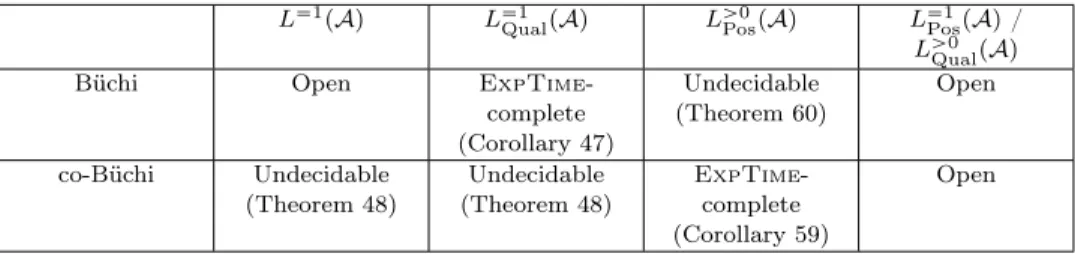
For the qualitative criterion on runs combined with the almost-sure semantics, as well as for the probable criterion on runs combined with the positive semantics, we prove that there exists a strong connection with partial observation Markov decision processes. This condition is independent of the acceptance condition on branches (Büchi, co-Büchi, parity. . . ). In particular, for the Büchi (resp. co-Büchi) acceptance condition on branches, probabilistic automata on infinite trees with the qualitative criterion on runs combined with the almost-sure semantics (resp. with the positive criterion on runs combined with the probable semantics) enjoy a decidable emptiness problem. To our knowledge, this is the first positive result for a class of probabilistic automata over infinite trees. On the negative side, we derive from undecidability results on probabilistic automata on infinite words similar results for probabilistic automata on infinite trees. Note that whilst being immediate for the classical criterion on runs such a reduction is not as simple for the qualitative and positive criteria.
The paper is organised as follows. In Section 2 we introduce general notations and definitions. In Section 3 we define the class of qualitative tree languages, present their properties (closure properties, decidability properties) and their tight connec-tions with Markov decision processes, and establish that they are incomparable with regular tree languages. We also discuss possible variants of the model (leading the notion of positive tree languages). In Section 4 we focus on the probabilistic model. We first justify the validity of the definition and give some examples. Then we pro-vide connections with partial observation Markov decision processes from which we derive positive results for the emptiness problem on a subclass. Finally we discuss variants of the probabilistic model. Section 5 summarises the contributions of the paper.
the complement of L, namely L.
2. DEFINITIONS 2.1 Words and Trees
An alphabet A is a finite set of letters. In the sequel A˚ denotes the set of finite
words over A, and Aωthe set of infinite words over A. The empty word is written ε; the length of a word u is denoted by |u|. Let u be a finite word and v be a (possibly infinite) word. Then u ¨ v denotes the concatenation of u and v; the word u is a prefix of v, denoted u Ď v, if there exists a word w such that v “ u ¨ w. We denote by u Ă v the fact that u is a strict prefix of v (i.e. u Ď v and u “ v). For some word u and some integer k ě 0, we denote by uk the word obtained by
concatenating k copies of u (with the convention that u0
“ ε).
In this paper we consider full binary node-labelled trees. An A-labelled tree t is a mapping from t0, 1u˚ to A. In this context, an element u P t0, 1u˚ is called a
node, and the node u ¨ 0 (resp. u ¨ 1) is the left son (resp. right son) of u. The node ε is called the root. We shall refer to |u| as the depth of u. The letter tpuq is called the label of u in t.
A branch is an infinite word π P t0, 1uω. We write Br “ t0, 1uω for the set
of all branches. A node u belongs to a branch π if u is a prefix of π. For an A-labelled tree t and a branch π “ π0π1¨ ¨ ¨ we define the label of π as the ω-word
tpπq “ tpεqtpπ0qtpπ0π1qtpπ0π1π2q ¨ ¨ ¨ . The cone going through a node u is the set
Conepuq “ u ¨ t0, 1uω. A sub-cone of a cone Conepuq is a cone Conepvq with u Ď v. Given a tree t and a node u, the subtree of t rooted at u denoted trus is the tree defined by truspvq “ tpu ¨ vq. A tree t is said to be regular if it contains only finitely many different subtrees, i.e. the set ttrus | u P t0, 1u˚u is finite.
We assume that the reader is familiar with basic notions of measure theory and from probability theory and we use [Bauer 2001; 1996] as references for all known results related to this field. Let FBr be the σ-algebra generated by the set of
cones (i.e. the smallest set of subsets of t0, 1uω containing the cones and closed under countable union and complementation). Let µ be the unique probability measure on FBr such that for all u P t0, 1u˚, µpConepuqq “ 2´|u|. The existence
and uniqueness of µ are guaranteed by Carathéodory’s extension theorem [Bauer 2001, Theorem 5.6, p. 24]. For all 0 ă p ă 1, a probability measure µp is similarly
defined by taking µppConepuqq “ p|u|0p1 ´ pq|u|1 where |u|0 and |u|1 respectively
designate the number of occurrences of 0 and 1 in u. In particular, the measure µ corresponds to µ1{2.
2.2 Tree Automata and Regular Tree Languages
A tree automaton A is a tuple xA, Q, qini, ∆, Accy where A is the input alphabet,
Q is the finite set of states, qiniP Q is the initial state, ∆ Ď Q ˆ A ˆ pQ ˆ Qq
is the transition relation and Acc Ď Qω is the acceptance condition. In the following, we use the notation q Ñ pqa 0, q1q as a shorthand for pq, a, pq0, q1qq P ∆.
An automaton is deterministic if q Ñ pqa 0, q1q and q a
Ñ pq01, q11q implies q0 “ q01
and q1
1“ q11. An automaton is complete if, for all q P Q and a P A there is at least
one pair pq0, q1q P Q2 such that q a
Ñ pq0, q1q.
Given an A-labelled tree t, a run of A over t is a Q-labelled tree ρ such that the root is labelled by the initial state, i.e. ρpεq “ qini; for all nodes u, pρpuq, tpuq, ρpu ¨
A branch π P t0, 1uω is accepting in the run ρ if ρpπq P Acc. A run ρ is
accepting if all its branches are accepting. Finally, a tree t is accepted if there exists an accepting run of A over t. The set of all trees accepted by A is denoted LpAq.
We consider the following classical acceptance conditions:
—A reachability condition is given by a subset F Ď Q of final states by letting ReachpF q “ Q˚F Qω, i.e. a branch is accepting if it contains a final state.
—A Büchi condition is given by a subset F Ď Q of final states by letting BuchipF q “ pQ˚F qω, i.e. a branch is accepting if it contains infinitely many final states.
—A co-Büchi condition is given by a subset F Ď Q of forbidden states by letting coBuchipF q “ Q˚pQzF qω, i.e. a branch is accepting it contains finitely many
forbidden states.
—A parity condition is given by a colouring mapping Col : Q Ñ N by letting P arity “ tq0q1q2¨ ¨ ¨ | lim infpColpqiqqi is evenu, i.e. a branch is accepting if the
smallest colour appearing infinitely often is even.
All these conditions are examples of ω-regular acceptance conditions, i.e. Acc is regular set of ω-words [Perrin and Pin 2004].
Remark 1. The parity condition is expressive enough to capture the general case of an arbitrary ω-regular condition. Indeed it is well known that Acc is accepted by a deterministic parity word automaton. By taking the synchronised product of this automaton with the tree automaton, we obtain a parity tree automaton accepting the same language (see e.g. [Perrin and Pin 2004]).
When it is clear from the context, we may replace, in the description of A, Acc by F (for a reachability, Büchi or co-Büchi condition) or Col (for a parity condition), and we shall refer to the automaton as a reachability (resp. Büchi, co-Büchi, parity) tree automaton. A set L of trees is a regular language if there exists a parity tree automaton A such that L “ LpAq. The class of regular tree languages is robust, as illustrated by the following statement.
Theorem 2. [Rabin 1969],[Emerson et al. 1993] The class of regular tree lan-guages is a Boolean algebra.
A regular tree language is non-empty if and only if it contains a regular tree. Test-ing the emptiness of a regular tree language (defined by a given parity automaton) is in NP X coNP.
2.3 Markov Decision Process
2.3.1 Perfect Information Setting. A probability distribution over a count-able set X is a mapping d : X Ñ r0, 1s such thatř
xPXdpxq “ 1. In the sequel we
denote by DpXq the set of probability distributions over X. In this paper, all prob-abilities will be rational numbers, which will be described in binary when dealing with encoding.
An arena is a tuple G “ xS, sini, Σ, ζy where S is a countable set of states, sini is
an initial state, Σ is a finite set of actions and ζ : S ˆ Σ Ñ DpSq is the transition (total) function.
A play in such an arena proceeds as follows. It starts in state siniand Éloïse picks
an action σ, and a successor state is chosen according to the probability distribution ζpsini, σq. Then Éloïse chooses a new action and the state is updated and so on
forever. Hence a play is an infinite sequence s0s1s2¨ ¨ ¨ P Sω such that s0 “ sini
and for every i ě 0, there exists a σ P Σ with ζpsi, σqpsi`1q ą 0. In the sequel we
refer to a prefix of a play as a partial play and we denote by Plays the set of all plays.
A (pure) strategy4for Éloïse is a function ϕ : S˚Ñ Σ assigning to every partial
play an action. Of special interest are those strategies that do not require memory: a strategy ϕ is memoryless if ϕpλ ¨ sq “ ϕpλ1¨ sq for all partial play λ, λ1 and
all states s (i.e. ϕ only depends on the current state). A play λ “ s0s1s2¨ ¨ ¨ is
consistent with a strategy ϕ if ζpsi, ϕpv0¨ ¨ ¨ viqqpsi`1q ą 0, for all i ě 0.
Now, for any partial play λ, the cylinder for λ is the set Cylpλq “ λSωXPlays. Let FP be the σ-algebra generated by the set of cylinders. Then, pPlays, FPq is a
measurable space.
A strategy ϕ induces a probability space over pPlays, FPq as follows: one defines
a measure µϕ on cylinders and then uniquely extends it to a probability measure
on FP using the Carathéodory’s unique extension theorem. For this, we first define
inductively µϕon cylinders:
—as all plays start from sini, we let µϕpCylpsiniqq “ 1;
—for any partial play λ ending in some state s, we let µϕpCylpλ ¨ s1qq “ µϕpCylpλqq ¨
ζps, ϕpλqqps1q.
We also denote by µϕ the unique extension of µϕ to a probability measure on F .
Then pPlays, FP, µϕq is a probability space.
An objective is a measurable set O Ď Plays: a play is winning if it belongs to O. A Markov decision process (MDP, aka one-and-half-player game) is a pair G “ pG, Oq where G is an arena and O is an objective. In the sequel we should focus on ω-regular objectives (which are easily seen to be measurable), whose definitions are the same as for the acceptance condition on tree automata (the only differences is that we may have an infinite set of states and that we restrict ourselves to the set Plays).
A strategy ϕ is almost-surely winning (resp. positively winning) if µϕpOq “
1 (resp. µϕpOq ą 0). If such a strategy exists, we say that Éloïse
almost-surely wins (resp. positively wins) G. The value of G is defined as ValpGq “ supϕµϕpOq, and a strategy ϕ is optimal if ValpGq “ µϕpOq.
When the set of actions Σ is reduced to one element, the MDP pG, Oq is called a Markov chain and we omit the unique action from all the definitions. The set Plays is called the set of traces of the Markov chain and is denoted Traces. We write µG the probability measure associated with the unique strategy. We say that
the Markov chain almost-surely fulfils its objective if µGpOq “ 1.
MDPs over finite arenas enjoy many good properties.
Theorem 3. [Courcoubetis and Yannakakis 1990; Chatterjee et al. 2004] Let G be an MDP over a finite arena with a parity objective. Then, one can decide
4We do not consider here randomised strategies as in the setting of this paper they are useless. Note that for finite MDP, optimal strategies — when exists — can always be chosen to be pure.
in polynomial time whether Éloïse almost-surely ( resp. positively) wins. Moreover, Éloïse always has an optimal memoryless strategy.
2.3.2 Imperfect Information Setting. Now we consider the case where Éloïse has imperfect information about the current state. For this, we consider an equivalence relation „ over S. We let rss„ be the equivalence class of s for „ and S{„ be the
set of equivalence classes of „ over S.
The intuitive meaning of „ is that two states s1„ s2cannot be distinguished by
Éloïse. We easily extend „ to partial plays: s0s1¨ ¨ ¨ sn „ s10s11¨ ¨ ¨ s1n if and only if
si„ s1ifor all i “ 0, ¨ ¨ ¨ , n. As two equivalent plays λ1„ λ2cannot be distinguished
by Éloïse she should therefore behave the same in both of them.
Hence, we should only consider so-called observation-based strategies. An ob-servation-based (pure) strategy is a function ϕ : pS{„q˚ Ñ Σ, i.e., to choose
her next action, Éloïse considers the sequence of observations she got so far5. In
particular, an observation-based strategy ϕ is such that ϕpλq “ ϕpλ1q whenever
λ „ λ1. In this context, a memoryless strategy is a function from S{
„Ñ DpΣq,
i.e. it only depend on the current equivalence class.
A partial observation Markov decision process (POMDP, aka one-and-half-player imperfect information game) is a triple pG, „, Oq where G is an arena, „ is an equivalence relation over states and O is an objective. We say that Éloïse almost-surely wins (resp. positively wins) G if she has an almost-surely (resp. positively) winning observation-based strategy. Finally the value of G is defined as ValpGq “ supϕµϕpOq where ϕ ranges over observation-based strategies;
optimality is defined as previously.
The following decidability results are known for POMDP:
Theorem 4. [Baier et al. 2008] In a POMDP with a Büchi ( resp. co-Büchi) objective, deciding whether Éloïse almost-surely ( resp. positively) wins is ExpTime-complete. Moreover if Éloïse has an almost-surely ( resp. positively) winning strat-egy, she has an almost-surely ( resp. positively) winning strategy with finite memory. In a POMDP with a co-Büchi ( resp. Büchi) objective, it is undecidable whether Éloïse almost-surely ( resp. positively) wins.
Remark 5. The results in Theorem 3 and 4 do not depend on the encoding of probability distributions, as the only relevant information is which probabilities are non zero.
3. QUALITATIVE TREE LANGUAGES
3.1 Definitions
In the classical definition, a run of a tree automaton A is accepting if all its branches satisfy the acceptance condition. In this article, we introduce a more relaxed notion of acceptation: a run is qualitatively accepting if almost every (in the sense of the measure µ) branch in it is accepting. More formally, consider a tree automaton A with an ω-regular acceptance condition Acc. A run ρ of A is qualitatively accepting if the set AccBrpρq “ tπ P t0, 1uω | ρpπq P Accu has measure 1, i.e. µpAccBrpρqq “ 1. Note that, thanks to Proposition 6 below, the set AccBrpρq
5By abuse of notation, we shall write ϕps0
¨ ¨ ¨ snq to mean ϕprs0s„¨ ¨ ¨ rsns„q
is indeed measurable. A tree t is qualitatively accepted by A if there exists a qualitatively accepting run of A over t and the set of all trees qualitatively accepted by A is denoted LQualpAq. Finally, a qualitative tree language is a set L of trees
such that there exists a parity automaton A such that LQualpAq “ L.
Proposition 6. Let A be a tree automaton equipped with an ω-regular accep-tance condition, and let ρ be a run of A. The set AccBrpρq is measurable.
Proof. Below is a simple ad-hoc proof of Proposition 6. Nevertheless, one should notice that Corollary 37 (see Section 4.1.2) directly implies Proposition 6.
The reachability case (with final states F ) is obvious as the set AccBrpρq is the (countable) union of all cones Cpuq with ρpuq P F .
We focus now on the co-Büchi case (with forbidden states F ). Recall that a branch is accepting if and only if there is a node after which there are only states in QzF . We claim that AccBrpρq “ ď uPt0,1u˚ pCpuqz ď uĎv,ρpvqPF Cpvqq
Let b P AccBrpρq and let u be a node after which all node labels in b be-longs to QzF . Then b P Cpuq and for all v Ě u, ρpvq R F : hence, b bebe-longs to CpuqzŤ
uĎv,ρpvqPFCpvq. Now, let b R AccBrpρq: b contains infinitely many
occur-rences of forbidden states. Therefore, for all node u in b there is another node v below u on b that is labelled by a state in F , meaning that b P Ť
uĎv,ρpvqPFCpvq.
Equivalently, b R CpuqzŤuĎv,ρpvqPFCpvq. Therefore the set AccBrpρq is measurable. The parity conditions follows from the previous case as one can express them as a Boolean combination of co-Büchi conditions. The general case of an arbitrary ω-regular condition is obtained as follows. First, one considers a deterministic parity word automaton recognising Acc, and then takes the synchronised product of this automaton with the tree automaton. This leads to a parity tree automaton accept-ing the same language and whose runs are in bijection with the ones of the original automaton. Moreover as this bijection preserves the set of accepting branches one can conclude from the parity case.
Example 7. Let Labe the language of ta, bu-labelled trees whose set of branches
containing at least one a has measure 1. This language is recognised by the follow-ing reachability deterministic automaton A “ xta, bu, tqini, qfu, qini, ∆, tqfuy where:
∆ “ tqini b
Ñ pqini, qiniq, qini a
Ñ pqf, qfq, qf a
Ñ pqf, qfq, qf b
Ñ pqini, qiniqu.
If one considers A as a Büchi automaton, the accepted language consists of those trees whose set of branches containing infinitely many a has measure 1.
Example 8. Let L1be the language of trees t such that in almost every branch,
there is a node u labelled by a such that the subtree trus has only a on its leftmost branch. This language is recognised by the non-deterministic reachability automaton A “ xA, Q, qw, ∆, tqaccuy with A “ ta, bu, Q “ tqw, ql, qacc, qreju, and ∆ contains
the following transitions: qw Ñ pq˚ w, qwq, qw Ñ pqa l, qaccq, ql Ñ pqa l, qaccq, ql Ñb
pqrej, qrejq, qacc ˚
Ñ pqacc, qaccq, qrej ˚
Ñ pqrej, qrejq (here ˚ is a shorthand for an
Using the second transition, the automaton can guess that the node u (labeled by a) has a leftmost branch containing only a. This assumption is checked by sending on the leftmost branch the state ql and the accepting state qacc on all other branches.
As long as the nodes are labelled by a state ql is propagated to the left son. If
all nodes on the leftmost branch starting at u are labelled by a, this branch will be rejecting, but this does not affect the measure as there are only countably many such branches). If a node v labelled by b is encountered in state qlthe non-accepting state
qrej is propagated on all branches. This last scenario cannot occur in an accepting
run as these cones of rejecting branches have a strictly positive measure. Hence the automaton is penalised for wrong guesses.
For the same reasons as for regular tree languages (cf. Remark 1), the parity con-dition is expressive enough to capture any ω-regular concon-ditions: for any automaton A with an ω-regular acceptance condition, there exists a parity automaton B such that LQualpAq “ LQualpBq.
Thanks to the following proposition, we can only focus on complete automata. Proposition 9. For any tree automaton A with an ω-regular acceptance condi-tion, there exists a complete tree automaton B with the same acceptance condition and such that LQualpAq “ LQualpBq.
Proof. Let A “ xA, Q, qini, ∆, Accy be a possibly incomplete automaton. Define
a complete automaton B “ xA, Q1“ Q Z tq
reju, qini, ∆1, Accy, where the set ∆1 is ∆
augmented with tqÑ pqa rej, qrejq | E q a
Ñ pq0, q1q P ∆u Y tqrej a
Ñ pqrej, qrejq | a P Au;
i.e. we add a transition to the sink state qrej whenever a transition is missing.
Note that as the acceptance condition is unchanged, a branch going through qrej is rejecting. In particular, as qrej is a sink state, a run that contains qrej as a
rejecting cone, hence is rejecting (as the measure of the rejecting cone is strictly positive). Therefore, the only accepting runs of B are actually runs that only uses transitions in A, hence are runs of A. Therefore LQualpAq “ LQualpBq.
Unsurprisingly determinism is a restriction.
Proposition 10. There is a qualitative tree language that cannot be qualitatively accepted by any deterministic automaton.
Proof. Let La be the qualitative language (see Example 7) of ta, bu-labelled
trees whose set of branches containing at least one a has measure 1. Consider now the language L1
a“ tt | tr0s P La or tr1s P Lau. Clearly L1ais qualitative (it suffices
to guess one subtree and check that it belongs to Lawhile accepting without any
further consideration the other subtree). By contradiction assume that there is a deterministic automaton A that qualitatively accepts L1
a. Indeed, consider the two
trees ta,b and tb,a defined as follows: ta,bpεq “ tb,apεq “ b, the left subtree of the
root of ta,b (resp. tb,a) has only a’s (resp. b’s) and the right subtree of the root
of ta,b (resp. tb,a) has only b’s (resp. a’s). Both ta,b and tb,a belongs to L1a. The
run of A1 on t
a,b start with the same transition at the root, and therefore one can
combine them and get a run for the tree tbwhose nodes are all labeled by b, which
leads a contradiction as tbR L1a.
3.2 On the Choice of Measure µ
The choice of the measure µ though natural is arbitrary. Considering the measure µpfor some 0 ă p ă 12 would not affect the results obtained in this article (provided
that definitions of the games are modified accordingly). However note that changing the measure does change the accepted language for a given automaton.
Proposition 11. Let 0 ă p ă q ă 1 be two reals. Let A be the (determin-istic and complete) automaton of Example 7. Then, there is a tree t such that µppAccpA, tqq “ 0 and µqpAccpA, tqq “ 1, where AccpA, tq denotes the set of
accept-ing branches for the unique run of A over t.
Proof. First recall that A accepts those trees whose set of branches containing infinitely many a has measure 1.
We define the ta, bu-labeled tree t by letting for all u P t0, 1u˚ tpuq “ a if and
only if µppConepuqq ď µqpConepuqq.
Let ε be the maximum among p, q, 1 ´ p, 1 ´ q.
Following the proof of Kakutani’s theorem [Kakutani 1948] as presented in [Much-nik et al. 1998] and [Bienvenu 2008], we consider the measure µrfor r “
p ` q
2 .
We first establish that for all w P t0, 1u˚,
µrpConepwqq2ě µppConepwqqµqpConepwqqα|w|
where α “ 1 `pp ´ qq
2
4ε2 (note that α ą 1). Indeed,
µrpConepwqq2 “ ˆ pp ` qq2 4 ˙|w|0˜ pp1 ´ pq ` p1 ´ qqq2 4 ¸|w|1 “ p|w|0q|w|0 ˆ 1 ` pp ´ qq 2 4pq ˙|w|0 p1 ´ pq|w|1 p1 ´ qq|w|1 ˜ 1 `pp1 ´ pq ´ p1 ´ qqq 2 4p1 ´ pqp1 ´ qq ¸|w|1 “ p|w|0q|w|0 ˆ 1 ` pp ´ qq 2 4pq ˙|w|0 p1 ´ pq|w|1 p1 ´ qq|w|1 ˆ 1 ` pp ´ qq 2 4p1 ´ pqp1 ´ qq ˙|w|1 ě p|w|0q|w|0α|w|0p1 ´ pq|w|1p1 ´ qq|w|1α|w|1 “ µppConepwqqµqpConepwqqα|w|
Let Kn be the set of words w P t0, 1un such that µppConepwqq ď µqpConepwqq
and let Cn be the disjoint union of all Conepwq for all w P Kn.
For all w P Kn we have µrpConepwqq ě µppConepwqqαn{2, and for all w R Kn we
have µrpConepwqq ě µqpConepwqqαn{2.
Hence, µppCnq “ ř wPKnµppConepwqq ď α´n{2řwPK nµrpConepwqq ď α´n{2
Similarly, µqpCnq “ 1 ´ µqpCnq “ 1 ´řwRK n, wPt0,1unµqpConepwqq ě 1 ´ α´n{2řwRK n, wPt0,1unµrpConepwqq ě 1 ´ α´n{2 By definition of A, we have AccpA, tq “ č kě0 ď něk Cn.
For k ě 1, we let Dk denote the setŤněkCn.
As for all k ě 1, µppDkq ď ř někα´ n 2 ď α´k2 1 ´ α´12 , we have limkÑ8µppDkq “ 0
(recall that α ą 1). Moreover for all k ě 0, µqpDkq “ 1 (as α ą 1 and as for all
n ě k, µqpDkq ě µqpCnq ě 1 ´ α´n{2).
As the sequence of sets pDkqkě0 is decreasing for the inclusion, we have thanks
to [Bauer 2001, Theorem 3.2, p. 10] that:
" µppAccpA, tqq “ limkÑ8µppDkq “ 0
µqpAccpA, tqq “ limkÑ8µqpDkq “ 1
A more general definition is to associate with any letter a in the alphabet a pair pp0 a, p 1 aq P r0, 1s 2 with p0 a` p 1
a “ 1 and then to define the measure of a cone
in a tree t by letting µpConepu1¨ ¨ ¨ unqq “ putpεq1 putpu2
1q. . . p
un
tpu1¨¨¨un´1q. Intuitively,
the node label determines the respective weights of the left and right sons in the definition of the measure. In particular the measure µp is the one obtained by
letting pp0x, p 1
xq “ pp, 1 ´ pq for all letters x in the alphabet.
Again, with such a measure the results obtained in this article (provided that definitions of the games are modified accordingly) remains correct.
Remark 12. Following Proposition 11, a natural question is whether the class of qualitative tree languages is the same for each distribution µp with 0 ă p ă 1.
And the same for the above variant with probability values p0
a, p1a for all letters in
the alphabet. From the statement of Proposition 11 we conjecture that the answer to these questions is no but we leave it open.
3.3 Pumping Lemma
Let t be a tree and u P t0, 1u˚be a node. A pair ∆ “ pt, uq is called a pointed tree.
With a pointed tree ∆1“ pt1, u1q and a tree t2, we associate a new tree, ∆1¨ t2, by
plugging t2in t1 instead of the subtree rooted at u1. Formally, ∆1¨ t2puq “ t1puq if
u1is not a prefix of u and ∆1¨ t2puq “ t2pu1q if u “ u1u1 for some u1P t0, 1u˚. We
can also define the product of two pointed trees ∆1 “ pt1, u1q and ∆2 “ pt2, u2q
by letting ∆1¨ ∆2“ p∆1¨ t2, u1¨ u2q. Finally, with a pointed tree ∆ “ pt, uq, we
associate a tree ∆ω by taking an ω-iteration of the product: ∆ωpvq “ tpv1q where v1 is the shortest word s.t. v “ ukv1 for some k ě 0.
Qualitative tree languages enjoy a pumping lemma (see Figure 13 for an illustra-tion), which contrasts with regular tree languages. Intuitively, pumping does not change acceptance for the qualitative semantics as it may only introduce a set of
rejecting branches of measure zero (while for the classical semantics introducing a rejecting branch would make the run rejecting).
Lemma 13. Let A be an n-states parity automaton, t be a tree in LQualpAq and
u be a node of depth greater that n. Then there exists three pointed trees ∆1, ∆2
and ∆3 such that t “ ∆1¨ ∆2¨ ∆3¨ trus and ∆1¨ ∆ω2 P LQualpAq.
t “ ∆1¨ ∆2¨ ∆3¨ trus ∆1 ∆2 ∆3 trus q q u ∆1.∆ω 2 ∆1 ∆2 ∆2 ∆2 q q q q
Fig. 1. Pumping Lemma
Proof. Let ρ be an accepting run of A over t. Since u has depth greater than the number of states, there are two nodes u1 and u2 such that u1 Ď u2 Ď u and
ρpu1q “ ρpu2q “ q for some state q. We now decompose t as t “ ∆1¨ ∆2¨ ∆3¨ trus
with ∆1 “ pt, u1q, ∆2 “ ptru1s, u2q and ∆3 “ ptru2s, uq. We decompose ρ in a
similar way, by letting ρ “ Θ1¨ Θ2¨ Θ3¨ ρrus with Θ1 “ pρ, u1q, Θ2 “ pρru1s, u2q
and Θ3 “ pρru2s, uq. Note that Θ1¨ Θω2 is a run of A over ∆1¨ ∆ω2. A branch in
Θ1¨ Θω2 can be rejecting for three reasons: it is a rejecting branch in ρzρru1s; or it is
a branch in some of the copies of ρru1szρru2s; or it is the newly created branch u1vω
where v is the word such that u2“ u1¨ v. As ρ is accepting, the measure of each of
these three sets of rejecting branches is 0 (for the second set, it is a finite union of sets of measure 0). Therefore Θ1¨ Θω2 is accepting, hence ∆1¨ ∆ω2 P LQualpAq.
3.4 Closure Properties
We now investigate the closure properties of qualitative tree languages under Boolean operations.
Proposition 14. Qualitative tree languages are closed under union and inter-section.
Proof. The union is for free thanks to non-determinism of the automata model. For the intersection of two languages, LQualpA1q and LQualpA2q, we consider the
usual product automaton whose states set is the Cartesian product of the states set of A1 and of A2, and that simulates A1 (resp. A2) on its first (resp. second)
component. Hence runs of the product automaton are in bijection with pairs of runs of A1 and A2. The (ω-regular) acceptance condition requires that the acceptance
condition of A1(resp. A2) is fulfilled on the first (resp. second) component. Hence
the set of accepting branches in a run of the product automaton is the intersection of the set of accepting branches in the corresponding runs of A1 and A2. Hence,
it has measure 1 if and only if both sets have measure 1, i.e. a run is accepting if and only if both corresponding runs in A1and A2 are accepting.
Unsurprisingly, qualitative tree languages are not closed under complement. This is a simple consequence of the pumping lemma.
Proposition 15. Qualitative tree languages are not closed under complement. Proof. Let Labe the set of ta, bu-labelled trees whose set of branches
contain-ing an a has measure 1. Clearly, La is a qualitative tree language. However, we
will show that its complement La does not satisfy the pumping lemma, hence is
not qualitative. By contradiction assume that La “ LQualpAq for some n-state
automaton A. Now define a tree t by letting u “ 0n and tpvq “ b if v P trus and
tpvq “ a otherwise. Hence in t a tree is labelled by a b if and only if it belongs to the subtree rooted at u, and therefore the branches in Conepuq contains finitely many a, implying that t P La. Now, if one uses Lemma 13 for t and u, the tree
∆1¨ ∆ω2 (as in the statement of Lemma 13) is the tree whose nodes are all labelled
by a, i.e. ∆1¨ ∆ω2 R La, leading a contradiction.
3.5 Emptiness Problem
It is well known that tree automata (as acceptors of regular languages) and two-player (perfect information) game are closely related [Gurevich and Harrington 1982; Grädel et al. 2002]. In particular, the emptiness problem for regular tree languages and the problem of deciding the winner in a parity game on a finite graph are polynomially equivalent. From the proof of this result also follows that a regular tree language is non-empty if and only if it contains a regular tree.
We show that a similar connection exists between tree automata as acceptors of qualitative tree languages and MDP. For this, fix a parity tree automaton A “ xA, Q, qini, ∆, Coly and a tree t. Consider the arena, depicted in Figure 2, GA,t“
xS, sini, Σ, ζy where S “ Q ˆ t0, 1u˚Y tKu, sini “ pqini, εq, Σ “ ∆ and ζ is defined
as follows. First we let dK be the distribution defined by dKpsq “ 1 if s “ K and
dKpsq “ 0 otherwise, and, for all q0, q1 P Q and u P t0, 1u˚, we let dq0,q1,u be the
distribution such that dq0,q1,upq0, u0q “ dq0,q1,upq1, u1q “ 1{2 and dq0,q1,upsq “ 0
q, u K q0, u0 q1, u1 δ P ∆ δ P ∆ ˚ 1 2 1 2 for δ “ pq, tpuq, q0, q1q
for δ “ pq1, a, q0, q1q with q1‰ q or a ‰ tpuq
Fig. 2. The arena GA,tof the acceptance game.
for all other s P S. Then we let ζppq, uq, pq1, a, q
0, q1qq “ dK if q ‰ q1 or a ‰ tpuq,
ζppq, uq, pq, tpuq, q0, q1qq “ dq0,q1,u and ζpK, σq “ dK for all σ P ∆. Finally, we
define a colouring function ρ by letting ρppq, uqq “ Colpqq and ρpKq “ 1, and we call GA,t“ pGA,t, Oρq the MDP equipped with the parity objective Oρ defined by
ρ.
Then, the following holds:
Theorem 16. The tree t belongs to LQualpAq if and only if Éloïse almost-surely
wins in GA,t.
Proof. In GA,t, a partial play that does not visit K is a sequence of the form
pq0, u0qpq1, u1q ¨ ¨ ¨ pqk, ukq where for all i, ui`1“ uixifor some xi“ 0, 1. Now, with
any strategy ϕ of Éloïse we can associate a strategy ϕ1 of Éloïse that is defined
only on those partial plays that are compatible with it (meaning that if in some partial play λ Éloïse does not respect ϕ1then ϕ1pλq is undefined) and coincide with
ϕ when defined; it is easily seen that ϕ and ϕ1 leads the same plays and define the
same probability measure. This means that one can only focus on such strategies for Éloïse. We should also only focus on strategies that never reach K, i.e. it always chooses an action of the form pq, tpuq, q0, q1q if the current state is pq, uq.
Now, one can remark that for any node u there is a unique partial play λ where Éloïse respects ϕ1 and that ends in a state of the form pq, uq for some q such that
ϕ1 is defined on λ. Therefore, an equivalent way to see ϕ1 is as a Q-labelled tree,
that should additionally verify the local properties imposed by ∆, namely the tree should be a run of A over t. It should also be clear that the set of plays where Éloïse respects ϕ1 is the set of branches in the run associated with ϕ1 and that this map
preserves the measure (in particular the set of winning plays has the same measure as the set of accepting branches in the run), meaning that a strategy with value ξ is mapped to a run whose set of accepting branches has measure ξ and vice-versa. As this map, from strategies to runs is bijective, this concludes the proof: a tree t belongs to LQualpAq if and only if there is an accepting run of A over t if and only
if there is an almost surely winning strategy for Éloïse in GA,t.
Consider the (finite) arena GA “ xS, sini, Σ, ζy, depicted in Figure 3, where
S “ Q ˆ t0, 1u Y tqini, Ku, sini “ qini, Σ “ ∆ and ζ is defined as follows. First
we let dK be the distribution defined by dKpsq “ 1 if s “ K and dKpsq “ 0
otherwise, and, for all q0, q1 P Q, we let dq0,q1 be the distribution such that
dq0,q1ppq0, 0qq “ dq0,q1ppq1, 1qq “ 1{2 and dq0,q1psq “ 0 for all other s P S. Then we
let ζppq, iq, pq, a, q0, q1qq “ dq0,q1, ζppq, iq, pq
1, a, q
q, i K q0, 0 q1, 1 δ P ∆ δ P ∆ ˚ 1 2 1 2 for δ “ pq, a, q0, q1q for δ “ pq1, a, q0, q1q with q1‰ q
Fig. 3. The arena GAof the emptiness game.
dq0,q1, ζpqini, pq, a, q0, q1qq “ dK if q ‰ qini, and ζpK, σq “ dK for all σ P ∆. Finally,
we define a colouring function ρ by letting ρppq, iqq “ Colpqq and ρpKq “ 1, and we call GA“ pGA, Oρq the MDP equipped with the parity objective Oρ defined by ρ.
Then, the following hold:
Theorem 17. The language LQualpAq is non empty if and only if Éloïse
almost-surely wins in GA from qini.
Proof. Following the same lines as for the proof of Theorem 16 it is easily seen that strategies that avoid state K are in bijection with pairs of pt, ρq where t is an A-labeled tree and ρ is a run of A over t. Moreover this map preserves the measure, meaning that a strategy with value ξ is mapped to a pair pt, ρq such that the set of accepting branches in ρ has measure ξ. In particular, Éloïse almost surely wins in GAif and only if there is a tree t that is qualitatively accepted by A.
Corollary 18. Let A be a parity tree automaton. Then one can decide whether LQualpAq “ H in polynomial time. Moreover, if LQualpAq “ H, it contains a
regular tree, and such a tree can be constructed in polynomial time.
Proof. Emptiness in polynomial time follows from theorems 17 and 3. Now, if Éloïse has an almost surely strategy, then she has a memoryless one (Theorem 3). Then the tree and the run associated with this strategy are regular, the run is qualitatively accepting. As one can compute (when exists) an almost surely winning positional strategy, one can also compute (when exists) in polynomial time a regular tree in LQualpAq.
Remark 19. Motivated by a decision problem for qualitative tree language we designed a polynomial reduction of the emptiness problem to the problem of deciding almost-surely winning in a finite MDP.
As already mentioned, a similar connection exists between tree automata (as ac-ceptors of regular tree languages) and two-player (perfect information) games (see e.g. [Gurevich and Harrington 1982; Grädel et al. 2002]). Indeed, the emptiness problem for regular tree languages and the problem of deciding the winner in a parity game on a finite graph are polynomially equivalent.
Hence, one may ask whether conversely the problem of deciding almost-surely winning in a finite MDP can be polynomially reduced to the emptiness problem for qualitative tree languages. It is indeed possible and the proof is very similar to the one from a two-player game to a regular tree language. We briefly sketch the proof below.
First note that one can, up to coding, restrict its attention to finite MDP with only two actions and such that from any state and any action there are always two possible successors that can both be reached with same probability 1{2. Then one designs a deterministic tree automaton whose states are identified with the ones of the MDP, whose input alphabet is identified with the set of actions of the MDP, and whose transition function mimics the one of the MDP. Then one concludes by noting that there is a bijection between trees and strategies and that this bijection is such that the measure of the accepting branches in the (unique) run of the automaton on a tree equals the value of the corresponding strategy in the MDP.
3.6 Regular Tree Languages and Qualitative Tree Languages are Incomparable In this section, we prove that regular tree languages and qualitative tree languages are incomparable.
Proposition 20. There is a regular tree language that is not qualitative. Proof. Consider the regular tree language L of those ta, bu-labelled trees that contains at least one node labeled by b. By contradiction, assume that L “ LQualpAq for some n-state automaton A and let t P L be the tree defined by
tpuq “ b if u “ 0n and tpuq “ a otherwise. Apply Lemma 1 to t and u: the tree
∆1¨ ∆ω2 (using the notations of Lemma 13) is the tree whose nodes are all labelled
by a, thus ∆1¨ ∆ω2 R L, leading to a contradiction.
Theorem 21. There is a qualitative tree language that is not regular.
Proof. Let Labe the language of trees whose set of branches containing at least
one a has measure 1. This language is qualitative as noticed in Example 7. In the sequel, we prove that Lais not regular.
We first prove that, for any regular tree t, if there is no cone in t whose branches only contain the letter b, then t P La. Let t be a regular tree, we can assume w.l.o.g.
that if there is a node labelled by a then all its descendants are labeled by a. Then the property “there is no cone in t whose branches only contain b” is the same as “every subtree contains a subtree made only of a”. Let X1, . . . , Xnbe the n different
subtrees of t, and for all i, let µi be the measure of the set of branches containing
a in Xi (we call it the value of Xi). We can assume w.l.o.g. that @i µ1 ď µi. If
Xi1 and Xi2 are the two sons of X1, we know that µ1 “
µi1`µi2
2 . Since µ1 ď µi
for i “ i1, i2, µi1 “ µi2 “ µ1. Hence we can prove by induction that for all Xi
of minimal value, all the subtrees of Xi have minimal value too. Since there is a
subtree of a (of value 1) in X1, µ1“ 1 hence for all i, µi“ 1, hence the value of t
is 1, hence t P La.
We assume by contradiction that Lais regular. The closure properties of regular
tree languages implies that the following language L is also regular:
L “ t ˇˇ t R La^ “there is no cone in t whose branches only contain b” (
Using our previous characterisation of regular trees in La it follows that L does
not contain any regular tree, hence L is empty (Theorem 2). Then, to raise a contradiction, we build a (non-regular) tree t0P L.
For every node u P t0, 1u˚, we let n
u be the integer whose binary representation
u
a depth 0 Ñ
depth |u| Ñ
depth nu` 1 Ñ
Fig. 4. The tree t0
that v “ u.0nu`1´|u| then t
0pvq “ a, otherwise t0pvq “ b (see Figure 4). We now
establish that t0 R La. First note that the set of branches in t0 that contains at
least one a is obtained by taking the union of those cones Cpuq such that t0puq “ a.
Then remark that, for every level `, there is one and only one node u of depth ` labelled by a (except for ` “ 0, 1 where there are no such u). Thus we can bound the measure µ of the set of branches in t0that contains at least one a:
µ ď `8 ÿ `“2 2´` “ 1 2
This proves that t0R La. Moreover, it follows from the definition, that for every
node u, there is a branch (the leftmost one) in the cone Cpuq that contains an a, hence t0P L, which contradicts the fact that L is empty.
3.7 The Value of a Tree May not be Reached
So far we defined qualitative acceptance of a tree by the existence of a run whose set of accepting branches has measure 1. We can refine this notion by defining the value of a tree as follows. For a tree automaton A, and a tree t we let
ValAptq “ sup
ρtrun of A over t
µpAccBrpρtqq
In particular LQualpAq is the set of trees t whose value is 1 and is reached for some
run (i.e. the sup is a max). The following result proves that the value may not be reached by some run.
Theorem 22. There is a reachability automaton A and a tree t such that ValAptq “
1 but t R LQualpAq.
Proof. Let A “ xA, Q, qw, ∆, tqaccuy with A “ ta, bu, Q “ tqw, ql, qacc, qreju,
and ∆ contains the following transitions: qw ˚ Ñ pqw, qwq, qw ˚ Ñ pql, qaccq, ql a Ñ pqacc, qlq, ql b
Ñ pqrej, qrejq (here ˚ is a shorthand for an arbitrary letter). Intuitively,
the automaton can wait in state qw as long as it wants. It can at some point use
the second transition: this leads to accept (all branches in) the subtree rooted at
the left son, as well as those subtrees rooted in the branch going left and then right forever as long as this branch does not contain a node labelled b, in which case the subtree rooted at this node is rejected.
Define h : t0, 1u˚ Ñ t0, 1u˚ by letting hpuq “ u.0.1|u|, for all u P t0, 1u˚. Now,
consider the tree t defined by tpuq “ b if u belongs to hpt0, 1u˚q — the image of
the set t0, 1u˚ by h — and tpuq “ a otherwise.
We claim that any run ρt of A on t is such that µpAccBrpρtqq ă 1. Indeed,
either the only transition used in ρtis qw ˚
Ñ pqw, qwq and therefore all branches are
rejecting. Otherwise the transition qwÑ pq˚ l, qaccq is used at least once. Then pick
u a node of minimal depth where this transition is used: the cone Conephpuqq is rejecting and therefore µpAccBrpρtqq ď 1 ´ 2|hpuq|ă 1.
Now, for all integer i ě 1, consider the run ρitwhere the transition qw ˚
Ñ pqw, qwq
is used for all nodes at depth ă i, and the transition qwÑ pq˚ l, qaccq is used for all
nodes at depth i (then there is no more freedom in defining for the rest of the run). Then for all node u at depth i, the branches in Conephpuqq are rejecting and those in ConepuqzConephpuqq are accepting. Therefore µpAccBrpρtqq “ 1 ´ 2iˆ 2´pi`1`iq“
2´pi`1q. Thus, sup ρi
tµpAccBrpρtqq “ 1, implying that ValAptq “ 1.
Actually, the proof of Theorem 16 directly leads the following.
Corollary 23. Let A be a parity tree automaton and let t be a tree. Then ValAptq “ ValpGA,tq.
3.8 Positive Tree Languages
So far, we favoured the almost-sure acceptance condition (i.e. requiring the measure to be equal to 1) over the positive one (i.e. requiring the measure to be strictly positive). However, the decidability results on MDP stated in Theorem 3 still hold if we replace the almost-sure acceptance by the positive acceptance [Courcoubetis and Yannakakis 1990; Chatterjee et al. 2004]. We now discuss the impact when considering positive acceptance instead of almost-sure acceptance, and motivate our choice to focus on almost-sure acceptance.
We say that a run ρ of a tree automaton A is positively accepting if the measure of its set of accepting branches is (strictly) positive, i.e. µpAccBrpρqq ą 0. A tree t is positively accepted if there exists a positively accepting run of A over t, and we denote by LPospAq the set of all trees positively accepted by A. Finally, a positive
tree language is a language L of trees such that there exists a parity automaton A with LPospAq “ L.
Note that, contrarily to the qualitative semantics, we can no longer assume that our automata are complete. In particular, the naive idea of adding a sink state does not work, as it would have new runs that may be accepting (going to the sink state yields a rejecting cone, but this may not affect the positivity of the measure of the set of accepting branches).
Example 24. Consider the language Lą0a of ta, bu-labeled trees that have a
non-negligible set of branches containing infinitely many a’s. This language is positively accepted by a deterministic Büchi tree automaton (that goes in a final state whenever an a is read and in a non-final state otherwise) and hence is a positive tree language.
Remark 25. The complement of a language qualitatively accepted by a deter-ministic tree automaton A is positively accepted by a deterdeter-ministic tree automaton B. Indeed, it suffices to define B starting from A and dualise its acceptance condi-tion (namely increment the value of the colouring funccondi-tion by 1).
Let us now give two examples of languages that are not positive tree languages. For this we introduce the language La^a of ta, bu-labelled trees containing an a in
both their left and right subtrees that is formally defined as La^a “ tt | Du, v P
t0, 1u˚ s.t. tp0uq “ tp1vq “ au.
Proposition 26. The language Laof ta, bu-labelled trees whose set of branches
containing an a has measure 1 and the language La^a of ta, bu-labelled trees
con-taining an a in both their left and right subtrees are not positive tree languages. Proof. The proofs for both languages rely on the same family of counter-examples. For every n ě 0, let tn be the tree defined by tnpuq “ b for |u| ď n and
tnpuq “ a otherwise and let tb be the tree such that tbpuq “ b for all u P t0, 1u˚.
We are going to show that if tn`2 is positively accepted by a parity automaton
A with n states then A also accepts either the tree t0
n`2obtained by replacing the
left subtree of tn`2by tb or the tree t1n`2 obtained by replacing the right subtree
of tn`2 by tb.
This property will allow us to conclude as for all n ě 0, tn belongs to Labut t0n
and t1n do not, La is not a positive language. The same arguments work for La^a.
Let ρ be a positively accepting run of A on tn`2. Without loss of generality, we
can assume that the set of accepting branches in the right subtree has a strictly positive measure. We are going to show that A admits a run ρ1 (not necessarily a
positively accepting one) on tb starting from ρp0q. By replacing the left subtree of ρ by ρ1, we then obtain a positively accepting run for A on t1
n`2.
For all i ě 1, consider the set Qi “ tρp0uq | u P t0, 1u˚ and 0 ď |u| ď i ´ 1u of
those states appearing in the left subtree of ρ at depth at most i. As the sequence of the Qiis increasing, we have Qn “ Qn`1. For all q P Qn, there exists a least one
transition δq of A of the form pq, b, q1, q2q with q1 and q2P Qn (recall that in tn`2
the first n ` 2 levels only contains b’s). By using the transition δq when in state
q and starting from state q0, we easily construct a run of A on tbstarting in state
ρp0q.
Proposition 27. The classes of positive and qualitative tree languages are in-comparable.
Proof. Let Labe the qualitative language of those ta, bu-labelled trees whose
set of branches containing an a has measure 1. We proved in Proposition 15 that its complement La is not qualitative. But La is a positive tree languages, as it is the
complement of a language qualitatively accepted by a deterministic tree automaton (see Remark 25).
Conversely we have seen in Proposition 26 the qualitative language La is not
positive.
Remark 28. A natural open question is whether a tree language which is both positively and qualitatively accepted is always regular.
As it is the case for qualitative languages, the positive languages are incomparable with the regular languages.
Proposition 29. The class of positive tree languages is incomparable with the class of regular languages.
Proof. The language La^a of ta, bu-labelled trees containing an a in both their
left and right subtrees is an example of a regular language that is not positive tree language (cf. Proposition 26).
We are now going to show that the positive tree language Lą0
a of ta, bu-labeled
trees that have a non-negligible set of branches containing infinitely many a’s (cf. Example 24) is not a regular language.
Toward a contradiction, we assume that Lą0
a is accepted by a parity tree
automa-ton A “ xA, Q, qini, ∆, Coly (with the standard acceptance condition for runs).
For every i ě 1, we let ri be the (finite) tree whose domain consists of all words
of length at most i and in which only 0i is labeled by a and all other nodes are
labelled by b. We denote by |ri| “ i the height of ri. The probability pri to visit
an a-labelled node in ri when starting from the root is
1
2i. We let T denote the set
tri | i ě 1u of all such trees.
To every sequence s “ ptiqiě0of trees in T , we associate an infinite ta, bu-labelled
tree ts which is intuitively obtained as follows: start with t1 and glue to every leaf
a copy of t2, to every leaf glue a copy of t3 and so on. Formally tspuq “ a if u is of
the form v0|ti| with |v| “ř
jăi|tj| and tspuq “ b otherwise.
By Borel-Cantelli’s lemma [Bauer 1996, Lemma 11.1 - p. 70], the tree tsbelongs
to Lą0
a if and only if
ř
iě0pri“ ` 8.
We extend the notion of runs for A to finite trees. A run of A on finite tree t : t0, 1uďnÞÑ ta, bu is a finite tree ρ : t0, 1uďnÞÑ Q such that for all u P t0, 1uăn,
pρpuq, tpaq, ρpu0q, ρpu1qq belongs to ∆. We can summarise the run ρ by a finite information called the profile of the run and denoted Profpρq. The profile Profpρq of ρ is defined as:
Profpρq “ pρpεq, Rq where R “ tpm, ρpuqq | u P t0, 1un and m “ inf
vĎuColpvqu.
By extension, the profile of a finite tree t, denoted Profptq, is the set tProfpρq | ρ run of A on tu of all possible profiles of runs of A on t.
This notion induces an equivalence relation on finite trees denoted ”A which
intuitively equates trees that cannot be distinguished by A. Formally for all finite tree t and t1, t ”
At1 if and only if Profptq “ Profpt1q.
The following claim is straightforward.
Claim 30. Let s “ ptiqiě1 and s1“ pt1iqiě1 be two sequences of finite trees in T .
If for all i ě 1, ti”At1i then A accepts ts if and only if A accepts ts1.
Now, note that there are only finitely many different possible profiles hence, there exists an infinite sequence s “ prijqjě0of trees with the same profile and such
that the sequence pijqjě0 is strictly increasing. As the pijqjě0 sequence is strictly
increasing it implies that řjě0prij ă `8, hence the tree ts does not belong to
Lą0
a . Now consider the constant sequence s 1
“ ri0, ri0, . . . : one has
ř
hence ts1 belongs to Lą0a . This leads a contradiction with A accepting Lą0a as A
behaves the same on both ts and ts1,i.e. A accepts tsif and only if A accepts ts1.
The most notable difference between positive and qualitative tree languages is that positive tree languages are not closed under intersection.
Proposition 31. The class of positive tree languages is closed under union but neither under intersection nor complementation.
Proof. The closure under union is immediate thanks to non-determinism. The non-closure under complementation will be a consequence of the closure under union and the non closure under intersection. However, one can also derive it directly by considering the language La: we have shown in the proof of Proposition 26 that
this language is not positive while its complement is positive.
We now prove the non-closure under intersection. Consider the language L0(resp.
L1) of those trees t containing a non-negligible set of branches containing an a in
the left (resp. right) subtree of the root. Both languages are positively accepted by a deterministic reachability automaton. But we have seen in Proposition 26 that their intersection La^a is not a positive tree language.
However, positive tree languages enjoy all decidability properties of qualitative languages presented in Section 3.5.
Theorem 32. The tree t belongs to LPospAq if and only if Éloïse positively wins
in GA,t.
Proof. The proof is identical to that of Theorem 16.
Theorem 33. The language LPospAq is non empty if and only if Éloïse positively
wins in GA from qini.
Proof. The proof is identical to that of Theorem 17.
Corollary 34. Let A be a parity tree automaton. Then one can decide whether LPospAq “ H in polynomial time. Moreover, if LPospAq “ H, it contains a regular
tree, and such a tree can be constructed in polynomial time.
Proof. As the properties expressed in Theorem 3 of MDP with almost-sure winning condition also hold for the positive winning condition, we can use the same proof as for Corollary 18.
4. BEYOND NON-DETERMINISTIC AUTOMATA: THE PROBABILISTIC SETTING
Following [Rabin 1963] for finite words and [Baier and Größer 2005; Baier et al. 2008; Baier et al. 2012] for infinite words we investigate probabilistic automata on infinite trees. That is the set of transitions of an automaton is replaced by a probability distribution over the set of all transitions which induces a probability measure on the set of runs of the automaton. Now, a tree is accepted if almost every run over the input tree is accepting. For the run, we may use either the classical or the qualitative acceptance criterion.
4.1 Definitions
4.1.1 Probabilistic Tree Automata. A probabilistic tree automaton A is a tuple xA, Q, qini, δ, Accy where A is the input alphabet, Q is a finite set of states,
qini P Q is the initial state, Acc Ď Qω is the acceptance condition and δ is
a mapping from Q ˆ A ˆ Q ˆ Q to r0, 1s such that for all q P Q and a P A, ř
q0,q1PQδpq, a, q0, q1q “ 1. Intuitively, the value δpq, a, q0, q1q is the probability for
a transition q Ñ pqa 0, q1q to be used by the automaton when it is in state q and
reads the symbol a.
This probability distribution on the transitions induces a probability measure on the set of runs of A. In this setting, a run of A is simply a Q-labeled tree whose root is labeled by the initial state qini. We denote by RunspAq (or simply Runs if A
is clear from the context) the set of all runs of A. We denote by AccRunspAq the set of accepting runs of A and by QualAccRunspAq the set of qualitatively accepting runs of A.
In the sequel, we will show that, for a given tree t the sets AccRunspAq and QualAccRunspAq are measurable (Proposition 38), and this will allows us to define almost-sure acceptance of a tree by a probabilistic automaton.
4.1.2 Measurability of AccRunspAq and QualAccRunspAq. We first define a σ-algebra for RunspAq. A partial run is a partial function λ : t0, 1u˚ Ñ Q with
λpεq “ qini and such that Dompλq is finite, non-empty, prefix-closed and proper,
i.e. such that for all w P t0, 1u˚, w0 P Dompλq iff w1 P Dompλq. If λ is a partial
run, we denote by Innerpλq the set tw P Dompλq | w0 P Dompλq and w1 P Dompλqu of non-leaf nodes. The cylinder associated to λ, denoted Cylpλq, is the set of runs consistent with λ, i.e.
Cylpλq “ tρ P Runs | @w P Dompλq, ρpwq “ λpwqu
Let FRbe the σ-algebra generated by the cylinders. By Carathéodory’s extension
theorem, there exists a unique probability measure µt on the measurable space
pRuns, FRq such for all partial run λ : t0, 1u˚Ñ Q,
µtpCylApλqq “
ź
wPInnerpλq
δpλpwq, tpwq, λpw0q, λpw1qq
Note that both µt and pRuns, FRq depend on t. Also note that the definition
of µtdoes not make sense without the properness condition in the definition of a
partial run.
Remark 35. A balanced partial run λ is a mapping from t0, 1un to Q for some n ě 0 with λpεq “ qini. Hence it is a special kind of partial play in the previous
sense. It is straightforward to note that the σ-algebra generated by balanced partial play is FR. Moreover one has
µtpCylApλqq “
ź
wPt0,1uďn´1
δpλpwq, tpwq, λpw0q, λpw1qq
Let A be an automaton and define the mapping fA: Runs ˆ Br Ñ r0, 1s
associat-ing to a pair pρ, πq P Runs ˆ Br the value 1 if ρpπq belongs to Acc and 0 otherwise. The following lemma proves that fAis integrable.
Lemma 36. Let A be a probabilistic tree automaton with an ω-regular acceptance condition and let t be a tree. The mapping fA is integrable in the product space
pRunspAq, FR, µtq b pBr, FBr, µq.
Proof. The product space pRuns, FRq b pBr, FBrq is generated by the sets
Conepwq ˆ Cylpλq for all w P t0, 1u˚ and all partial run λ (cf. [Bauer 2001,
Theo-rem 22.1 - p. 132]).Thanks to Remark 35 we can restrict our attention to balanced partial runs.
According to [Bauer 2001, Theorem 9.1 - p. 50], it is enough to show that AccPairspAq “ tpρ, πq | ρpπq P Accu is measurable in the product space.
We first establish the result for a Büchi acceptance condition. For that, we let A “ xA, Q, qini, δ, F y be probabilistic tree automaton with a Büchi acceptance
condition.
For u P t0, 1u˚, we introduce the set R
uof all pairs pρ, πq P Runs ˆ Br such that
π admits u as a prefix and ρpvq R F for all u Ĺ v Ď π. The set AccPairspAq is the complement of the countable unionŤ
uPt0,1u˚Ru. Hence, it is enough to show Ru
is measurable for all u P t0, 1u˚.
Let us fix a node u P t0, 1u˚. For all n ą |u|, let C
n be the union all sets
Cylpλq ˆ Conepwq where λ : t0, 1un Ñ Q is a partial run and w P t0, 1unĽu is a word such that λpvq R F for all u Ĺ v Ď w. We claim that the set Ru is equal
to Şną|u|Cn and hence is measurable. The direct inclusion, Ru Ď
Ş
ną|u|Cn, is
obvious. For the converse one, let pρ, πq be inŞ
ną|u|Cn. For all n ą |u|, the node
wnP t0, 1un witnessing that pρ, πq belongs to Cn is indeed the unique node of π of
depth n. As n can be arbitrary large, it follows that every node v in π of depth ą |u| is such ρpvq R F , which exactly means that pρ, πq P Ru.
The case of the parity conditions follows from the previous case as one can express them as a Boolean combination of Büchi conditions.
The general case of an arbitrary ω-regular condition is obtained as follows. First, one considers a deterministic parity word automaton recognising Acc, and then takes the synchronised product of this automaton with the tree automaton. This leads to a parity tree automaton accepting the same language and whose runs are in bijection with the ones of the original automaton. Moreover as this bijection preserves the set of accepting branches, one can conclude from the parity case.
Note that the previous lemma implies that the set of accepting branches in a run of a tree automaton with an ω-regular acceptance condition is measurable in pBr, FBrq. This leads an alternative proof of Proposition 6.
Corollary 37. Let A be a tree automaton equipped with an ω-regular accep-tance condition, and let ρ be a run of A over some tree t. Then the set AccBrpρq of accepting branches in t is measurable.
Proof. Let A be a tree automaton with an ω-regular acceptance condition, t be a tree and ρ be a run of A on t. The set AccBrpρq is equal to tλ P Br | ρpλq P Accu. As by the proof of Lemma 36, AccPairspAq is measurable in the product space, AccBrpρq is also measurable (cf. [Bauer 2001, Lemma 23.1 - p. 135]).
We are now ready to establish the measurability of the sets AccRunspAq and QualAccRunspAq.