HAL Id: hal-02011592
https://hal.univ-lorraine.fr/hal-02011592
Submitted on 8 Feb 2019
HAL is a multi-disciplinary open access
archive for the deposit and dissemination of
sci-entific research documents, whether they are
pub-lished or not. The documents may come from
teaching and research institutions in France or
abroad, or from public or private research centers.
L’archive ouverte pluridisciplinaire HAL, est
destinée au dépôt et à la diffusion de documents
scientifiques de niveau recherche, publiés ou non,
émanant des établissements d’enseignement et de
recherche français ou étrangers, des laboratoires
publics ou privés.
Engineered Gd-Co based multilayer stack to enhanced
magneto-caloric effect and relative cooling power
M Tadout, C.-H Lambert, O Hadri, A Mounkachi, M Benyoussef, M
Hamedoun, S Benaissa, Stéphane Mangin
To cite this version:
M Tadout, C.-H Lambert, O Hadri, A Mounkachi, M Benyoussef, et al.. Engineered Gd-Co based
multilayer stack to enhanced magneto-caloric effect and relative cooling power. Journal of Applied
Physics, American Institute of Physics, 2018, 123, pp.053902. �10.1063/1.5004712�. �hal-02011592�
J. Appl. Phys. 123, 053902 (2018); https://doi.org/10.1063/1.5004712 123, 053902 © 2018 Author(s).
Engineered Gd-Co based multilayer stack
to enhanced magneto-caloric effect and
relative cooling power
Cite as: J. Appl. Phys. 123, 053902 (2018); https://doi.org/10.1063/1.5004712
Submitted: 14 September 2017 . Accepted: 17 January 2018 . Published Online: 02 February 2018 M. Tadout, C.-H. Lambert, M. S. El Hadri , O. Mounkachi, A. Benyoussef, M. Hamedoun, M. Benaissa, and S. Mangin
ARTICLES YOU MAY BE INTERESTED IN
Advanced materials for magnetic cooling: Fundamentals and practical aspects
Applied Physics Reviews 4, 021305 (2017); https://doi.org/10.1063/1.4983612 Material-based figure of merit for caloric materials
Journal of Applied Physics 123, 034902 (2018); https://doi.org/10.1063/1.5004173 Effect of Gd substitution on the structural, magnetic, and magnetocaloric properties of HoCrO3
Engineered Gd-Co based multilayer stack to enhanced magneto-caloric
effect and relative cooling power
M.Tadout,1,2C.-H.Lambert,3M. S.El Hadri,3O.Mounkachi,2A.Benyoussef,1,2 M.Hamedoun,2M.Benaissa,1and S.Mangin3
1
Laboratory of Condensed Matter and Interdisciplinary Sciences (LaMScI), Faculty of Science, Mohammed V University, B.P. 1014 Rabat, Morocco
2Materials Nanomaterials Center, MAScIR Foundation, B.P. 10100, Rabat, Morocco
3Institut Jean Lamour, UMR CNRS 7198, Universit!e de Lorraine, BP 70239, F-54506 Vandoeuvre-le`s-Nancy, France
(Received 14 September 2017; accepted 17 January 2018; published online 2 February 2018) Magnetic refrigeration based on the magneto-caloric effect is one of the best alternatives to compete with vapor-compression technology. The viability of a magnetic refrigeration system for magnetic cooling can be tested by exploiting the materials in various forms, ranging from bulk to nanostruc-tured materials. In order to achieve a wide refrigerating temperature range in magnetic refrigeration, we study in this paper a 100 nm-thick Gd-Co alloys-based multilayer stack. The stack is made of four individual Gd-Co alloy layers with different values of concentration and Curie temperature (TC). A
magnetic entropy change associated with the second-order magnetic phase transition was determined from the magnetic isotherms. Moreover, the relative cooling power (RCP) of the studied Gd-Co-based multilayer is enhanced compared to the one of bulk Gd, and reaches a value of 200 J/kg. Such an enhancement of the RCP is not due to an enhanced maximum variation of entropy, but this is due to a much broader magnetic entropy peak. This study demonstrates the potential of nanostructured Gd-Co multilayer stack for magnetic cooling applications.Published by AIP Publishing.
https://doi.org/10.1063/1.5004712
I. INTRODUCTION
Recently, magnetic refrigeration based on the magneto-caloric effect (MCE) of magnetic materials possesses the potential to substitute conventional gas compression refrigera-tion, and has been a topic of great interest for minimizing environmental impact.1 The basic requirement for magnetic refrigeration materials is a large isothermal magnetic entropy change (!DSM). However, several features are required for
the application in magnetic refrigeration, such as the Curie temperature (TC) in the vicinity of the working temperature, a
large magnetic entropy change over the entire temperature range of range of the cycle, an almost zero magnetic hystere-sis, a reasonable thermal conductivity coupled with large elec-trical resistance, and a large adiabatic temperature change.2 Therefore, the relative cooling power (RCP) is indeed consid-ered to be the most important factor for assessing the useful-ness of a magnetic refrigerant material.3
During the last decade, MCE has been investigated in a very wide spectrum of materials that include elemental met-als,4 rare earth intermetallics,5 manganese oxide materials,6 Mn alloys,7 lanthanides and Heusler compounds,8 bulk Gd alloys,9and thin films.10However, investigating MCE in mate-rials at nanoscale remains a novel endeavor and an open chal-lenge. Indeed, recent studies on La0.7Ca0.3MnO3compounds
in various forms, ranging from bulk and nanoparticles to thin films, showed that reducing the dimensionality of the LCMO compound tend to broaden and shift the paramagnetic-ferromagnetic transition to lower temperatures, while decreas-ing theMsand the magnitude of !DSM.11 Other studies on
Gd-based structures demonstrated that the MCE also depends on the size and dimension.12,13 Indeed, it appears that the
combination of interfaces, defects, and lower size can explain the enhancement of MCE for low dimension samples. For instance, a maximum of entropy was observed in Gd/W multi-layer.14 A more recent study by Lambertet al. showed that
MCE can be tuned by changing the concentration of 100 nm-thick Gd-Tb alloys and multilayers.15 Moreover, a recent publication has shown that the Gd5Si2.7Ge1.3thin film exhibits
a large magnetic entropy change (!DSM¼ 8.83 J kg!1K–1
for!DM ¼ 50 kOe) and present a broader magnetic response in comparison with its bulk counterpart.16 In this paper, we
report on the successful enhancement of the RCP value through the engineering of Gd-Co alloys based multilayer stack. II. SAMPLE STRUCTURE
The studied sample is a 100 nm-thick Gd-Co alloys-based multilayer stack, namely Ta(3 nm)/[Gd1!xCox/Gd1!yCoy/.]
(100 nm)/Ta(3 nm). The studied sample is grown on a glass substrate at room temperature (RT) using sputtering deposition with base pressure lower than 10–7Torr and an Ar pressure fixed at 3.0 mTorr. The composition gradients were achieved by adjusting the deposition rates from the two independent magnetron guns. Sputtering rates for Gd and Co targets at 50 W and 100 W were 0.719 A˚ /s and 0.456 A˚/s, respectively, as determined by low-angle X-ray reflectivity measurements. The schematic of the sample structure is illustrated in Fig.1. Indeed, the sample is made of four 25 nm-thick Gd-Co alloy layers, while the composition of each layer is different and varies linearly fromx¼ 0.44 for the first layer (bottom layer) to x¼ 0.60 for the fifth layer (top layer). A 3 nm-thick Ta buffer layer was used, whereas another 3 nm-thick Ta cap-ping layer was used to prevent sample oxidation. Magnetic
0021-8979/2018/123(5)/053902/4/$30.00 123, 053902-1 Published by AIP Publishing.
measurements were carried out by a Quantum Design Squid Vibrating Sample Magnetometer.
III. RESULTS AND DISCUSSION
Figure2shows the temperature dependence of magneti-zationM under an applied magnetic field of 500 Oe for the studied Gd-Co-based multilayer stack sample. A typical para-magnetic to ferropara-magnetic phase transition can be observed atTC. In order to estimate theTC, we have used the inflection
point method as described by Moreno-Ramirez et al.17
Following this, a value ofTC¼ 230 K can be determined from
the minimum of the derivative of the magnetization dM dT as
shown in the inset of Fig.2.
The MCE in the studied Gd-Co-based multilayer stack was calculated from the isothermal magnetic entropy change (!DSM) deduced from the magnetization versus magnetic
field measurements performed at different temperature below and aboveTCand in magnetic fields up to 20 kOe. Figure3
shows the temperature dependence ofM obtained by sweep-ing the magnetic field from 0 toHmaxusing a sweeping speed
of 250 Oe/s, withHmax¼ 10, 15 and 20 kOe, and for a
tem-perature ranging from 60 to 400 K. The isothermal magnetic entropy change!DSMis equal to 1.55 J kg!1K–1for a
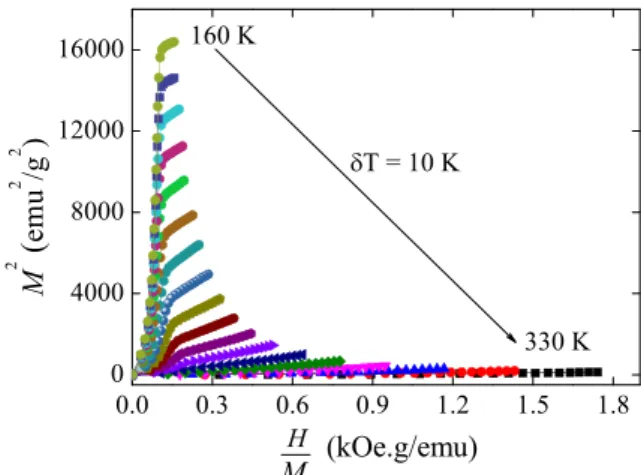
mag-netic field swept from 0 to 20 kOe. Figure4shows the Arrott plots derived fromM (H) show a positive slops around TC.
According to the Banerjee criterion,18this finding confirms that the measured paramagnetic-ferromagnetic transition is a second-order transition.
Furthermore, we compared the values of!DSMobtained
for the studied Gd-Co alloy-based multilayer stack with those obtained for a single 100 thick Gd layer and for 100 nm-thick Gd1!xCoxalloy layers withx¼ 0.44, 0.48, 0.52 and 0.56
(see Fig.5). The values of!DSMare obtained from the field
dependence of the magnetization using the Maxwell relation DSMðT; DHÞ ¼ ðH 0 @M @T " # H dH: (1)
The maximum value of !DSM is lower for the studied
multilayer compared to the single Gd layer as well as the sin-gle Gd-Co alloy layers. However, the peak is much broader than for any of the single alloy layers. Note that the magnetic entropy is changed is not the only parameter to characterize the potential of a magnetic refrigerant. Indeed, the relative
FIG. 1. Sketch of the studied Gd-Co alloys based multilayer stack. The sample is made of four 25 nm-thick Gd1!xCox, where Co concentrationx increases linearly from 0.44 for the first layer (bottom layer) to 0.60 for the fourth layer (top layer).
FIG. 2. Temperature dependence of the magnetization under a magnetic field of 500 Oe for the studied Gd-Co-based multilayer stack. The inset shows the evolution ofdM
dTas a function of temperature.
FIG. 3. Magnetic isotherms of the studied Gd-Co based multilayer studied as a function of the applied magnetic field from 0 to 20 kOe with a sweeping rate of 250 Oe/s.
FIG. 4. Arrott plots showing the evolution ofM2as a function ofH Mfor the studied Gd-Co-based multilayer and for different values of temperatureT.
cooling power can also prove important.3The RCP quantifies the amount of heat that can be transferred between the hot and the cold ends. For the point of view of applications, a large RCP over a wide temperature range coupled with a substantial MCE is desirable. The values of RCP can be calculated as
RCP¼ !DSmax
M dTFWHM; (2)
withdTFWHM is the full width at half maximum and!DSmaxM
is the maximum of magnetic entropy change.19
From a technological point of view, it is important to obtain a large magnetic entropy change and a high RCP for a moderate magnetic field of 20 kOe. The measured RCP value for the Gd-Co alloys-based multilayer stack is 200 J/kg. This RCP value is slightly smaller than that reported for Gd5Si2Ge2,9 FeRh polycrystalline alloy,20 epitaxial MnAs,21
and Gd48Co52 amorphous ribbons22 for the same magnetic
field change of 20 kOe. At the same time, the measured RCP value for the studied Gd-Co based multilayer is higher than that observed in manganite thin films, such as La0.67Sr0.33
MnO3,23 La0.67Ba0.33Ti0.02Mn0.98O3,24 or La0.7Sr0.3MnO3 on
SrRuO3 super-lattices,25 Gd/W multilayered films,26 and
Gd62Co38amorphous ribbons.27We summarize in TableIthe
main performances related to the MCE of the above-presented materials as well as some others reported in the literature. IV. CONCLUSION
In summary, we have engineered a Gd-Co-based multi-layer stack sample to enhanced magneto-caloric properties. We have verified that the multilayer undergoes a second-order transition at the Curie temperature. The value of!DSM
and RCP for the studied Gd-Co alloys-based multilayer is compared to the one obtained for single Gd-Co alloy layers. The maximum!DSMfor the multilayer reach 1.54 J kg!1K–1
for a magnetic field change from 0 to 20 kOe which is lower
than for any of the single Gd-Co alloy layers. However, the !DSMpeak is much broader for the multilayer and the RCP
value can reach 200 J/kg. Such enhancement of the RCP dem-onstrates the potential of Gd-Co based multilayers for mag-netic refrigeration applications.
ACKNOWLEDGMENTS
We would like to thank S. Suire, C.-S. Chang, and T. Hauet for technical assistance with magnetometry measurements. This work was supported by the MESRSFC in the Framework of the national program PPR under Contract No. PPR/2015/57 and by the PHC Toubkal/17/49 project.
1K. A. Gschneidner, Jr. and V. K. Pecharsky, J. Appl. Phys. 85, 5365 (1999).
2G. L. Liu, D. A. Zhao, H. Y. Bai, W. H. Wang, and M. X. Pan,J. Phys. D: Appl. Phys.49, 055004 (2016).
3K. A. Gschneidner, Jr., V. K. Pecharsky, and A. O. Tsokol,Rep. Prog. Phys.68, 1479–1539 (2005).
4S. Dan’kov, A. M. Tishin, V. K. Pecharsky, and K. A. Gschneidner, Jr., Phys. Rev. B57, 3478 (1998).
5A. Y. Dong, B. G. Shen, J. Chen, J. Shen, H. W. Zhang, and J. R. Sun, J. Appl. Phys.105, 053908 (2009).
6
E. E. Bruck, O. Tegus, D. T. Cam Thanh, N. T. Trung, and K. H. J. Buschow,Int. J. Refrig.31, 763 (2008).
7
H. Wada and Y. Tanabe,Appl. Phys. Lett.79, 3302 (2001).
8V. Franco, J. S. Blazquez, B. Ingale, and A. Conde,Annu. Rev. Mater. Res.42, 305 (2012).
9V. K. Pecharsky and K. A. Gschneidner, Jr.,Phys. Rev. Lett.78, 4494 (1997).
10A. V. Svalov, V. O. Vas’kovskiy, A. Larranaga, and G. V. Kurlyandskaya, EPJ Web Conf.40, 8005 (2013).
11
P. Lampen, N. S. Bingham, M. H. Phan, H. Kim, M. Osofsky, A. Pique, T. L. Phan, S. C. Yu, and H. Srikanth, Appl. Phys. Lett.102(6), 062414 (2013).
12A. V. Svalov, V. O. Vas’kovskiy, J. M. Barandiaran, K. G. Balymov, I. Orue, and G. V. Kurlyandskaya,Phys. Status Solidi A208, 2273–2276 (2011). 13S. P. Mathew and S. N. Kaul,Appl. Phys. Lett.98, 172505 (2011). 14B. J. Kirby, J. W. Lau, D. V. Williams, C. A. Bauer, and C. W. Miller,
J. Appl. Phys.109, 063905 (2011). FIG. 5. Temperature dependence of the magnetic entropy change!DSM
(a) for the studied Gd-Co-based multilayer while sweeping the magnetic field from 0 toHMaxwithHMax¼ 10 kOe, 15 kOe and 20 kOe, (b) for the studied Gd-Co multilayer, a 100 nm-thick Gd layer, and four 100 nm-thick Gd1!xCoxsingle alloy layers withx¼ 0.44, 0.48, 0.52 and 0.56.
TABLE I. Overview of the main performances related to the magneto-caloric effect for the studied Gd-Co alloys-based multilayer stack and for other materials reported from the literature.16,23–31
Materials !DSM (J kg!1K–1) RCP (J/kg) TC (K) DH (T) References Gd/W (40 nm) 1.41 52 275 1 26 Gd5Si2.7Ge1.3(788 nm) 3.7 75 190 2 16 Gd (30 nm) 1.6 70 285 1 28 MnAs (70 nm) 4 125 300 2 29 [Gd/Tb](100 nm) 1.97 175 252 2 15 La0.56Sr0.44MnO3(31 nm) 0.3 10 70 1 30 La0.67Ba0.33Ti0.02Mn0.98O3 (95 nm) 0.99 49 286 1 24 Ni-Mn-Ga (400 nm) 1.7 … 346 1 31
[La0.67Sr0.33MnO3/SrTiO3] (20 nm)
1.1 15 321 1 23
[La0.7Sr0.33MnO3/SrRuO3] (8 nm) 2.35 125 325 2 25 Gd62Co38amorphous ribbons 2.8 81.4 193 1 27 (Gd44Co56)/(Gd48Co52)/ (Gd52Co48)/(Gd56Co44) (100 nm) 1.54 200 230 2 This paper
15C. H. Lambert, M. S. El Hadri, M. Hamedoun, A. Benyoussef, O. Mounkachi, and S. Mangin,J. Magn. Magn. Mater.433, 1–3 (2017). 16
R. L. Hadimani, J. H. B. Silva, A. M. Pereira, D. L. Schlagel, T. A. Lograsso, Y. Ren, X. Zhang, D. C. Jiles, and J. P. Arajo,Appl. Phys. Lett.
106, 032402 (2015). 17
L. M. Moreno-Ramirez, J. S. Blazquez, V. Franco, A. Conde, M. Marsilius, V. Budinsky, and G. Herzer,IEEE Magn. Lett.7, 6102004 (2016). 18B. K. Banerjee,Phys. Lett.12, 16 (1964).
19M. Balli, D. Fruchart, D. Gignoux, S. Miraglia, E. K. Hlil, and P. Wolfers, J. Magn. Magn. Mater.316, 558–561 (2007).
20M. Manekar and S. B. Roy,J. Phys. D: Appl. Phys.41, 192004 (2008). 21D. H. Mosca, F. Vidal, and V. H. Etgens,Phys. Rev. Lett.101, 125503
(2008).
22Z. W. Wang, P. Yu, Y. T. Cui, and L. Xia,J. Alloys Compd.658, 598 (2016).
23V. S. Kumar, R. Chukka, Z. Chen, P. Yang, and L. Chen,AIP Adv.3, 52127 (2013).
24M. Oumezzine, A.-C. Galca, I. Pasuk, C. Chirila, A. Leca, V. Kuncser, L. C. Tanase, A. Kumcser, C. Ghica, and M. Oumezzine,Dalton Trans.45, 15034–15040 (2016).
25Q. Zhang, S. Thota, F. Guillou, P. Padhan, V. Hardy, A. Wahl, and W. Prellier,J. Phys.: Condens. Matter23(5), 052201 (2011).
26
C. W. Miller, D. V. Williams, N. S. Bingham, and H. Srikanth,J. Appl. Phys.107, 09A903 (2010).
27C. L. Zhang, D. H. Wanga, Z. D. Han, H. C. Xuan, B. X. Gu, and Y. W. Du,J. Appl. Phys.105, 013912 (2009).
28
H. F. Kirby, D. D. Belyea, J. T. Willman, and C. W. Miller,J. Vac. Sci. Technol. A31, 031506 (2013).
29D. T. Morelli, A. M. Mance, J. V. Mantese, and A. L. Micheli,J. Appl. Phys.79, 373 (1996).
30D. D. Belyea, T. S. Santos, and C. W. Miller,J. Appl. Phys.111, 07A935 (2012).
31V. Recarte, J. I. Perez-Landazabal, V. Sanchez-Alarcos, V. A. Chernenko, and M. Ohtsuka,Appl. Phys. Lett.95, 141908 (2009).