HAL Id: pasteur-00498910
https://hal-riip.archives-ouvertes.fr/pasteur-00498910
Submitted on 9 Jul 2010
HAL is a multi-disciplinary open access
archive for the deposit and dissemination of
sci-entific research documents, whether they are
pub-lished or not. The documents may come from
teaching and research institutions in France or
abroad, or from public or private research centers.
L’archive ouverte pluridisciplinaire HAL, est
destinée au dépôt et à la diffusion de documents
scientifiques de niveau recherche, publiés ou non,
émanant des établissements d’enseignement et de
recherche français ou étrangers, des laboratoires
publics ou privés.
Arbitrarily primed PCR to type Vibrio spp. pathogenic
for shrimp.
Cyrille Goarant, Fabrice Merien, Franck Berthe, Isabelle Mermoud, Philippe
Perolat
To cite this version:
Cyrille Goarant, Fabrice Merien, Franck Berthe, Isabelle Mermoud, Philippe Perolat. Arbitrarily
primed PCR to type Vibrio spp. pathogenic for shrimp.. Applied and Environmental Microbiology,
American Society for Microbiology, 1999, 65 (3), pp.1145-1151. �pasteur-00498910�
Copyright © 1999, American Society for Microbiology. All Rights Reserved.
Arbitrarily Primed PCR To Type Vibrio spp.
Pathogenic for Shrimp
CYRILLE GOARANT,1FABRICE MERIEN,2FRANCK BERTHE,3ISABELLE MERMOUD,4
ANDPHILIPPE PEROLAT2*
Laboratoire de Recherche Aquacole IFREMER en Nouvelle-Cale´donie, Station d’Aquaculture de Saint Vincent, 98846 Noume´a Cedex,1and Laboratoire des Leptospires, Institut Pasteur de Nouvelle-Cale´donie,2and CIRAD/EMVT, Programme Elevage,498845 Noume´a Cedex, New Caledonia, and Laboratoire Biologie et Ecologie des Inverte´bre´s
Marins, IFREMER Station de La Tremblade, Ronce les Bains, 17390 La Tremblade, France3 Received 9 February 1998/Accepted 4 January 1999
A molecular typing study on Vibrio strains implicated in shrimp disease outbreaks in New Caledonia and Japan was conducted by using AP-PCR (arbitrarily primed PCR). It allowed rapid identification of isolates at the genospecies level and studies of infraspecific population structures of epidemiological interest. Clusters identified within the species Vibrio penaeicida were related to their area of origin, allowing discrimination between Japanese and New Caledonian isolates, as well as between those from two different bays in New Caledonia separated by only 50 km. Other subclusters of New Caledonian V. penaeicida isolates could be identified, but it was not possible to link those differences to accurate epidemiological features. This contri-bution of AP-PCR to the study of vibriosis in penaeid shrimps demonstrates its high discriminating power and the relevance of the epidemiological information provided. This approach would contribute to better knowledge of the ecology of Vibrio spp. and their implication in shrimp disease in aquaculture.
Vibriosis is a major disease problem in shrimp aquaculture, causing high mortality and severe economic loss in all produc-ing countries (5, 17, 21). Vibrio spp. are most often considered opportunistic pathogens in shrimp, but primary disease caused by highly virulent strains has also been reported (9, 13, 27). On the basis of phenotypic data, the major species causing vibriosis in shrimp are Vibrio alginolyticus, V. anguillarum, V. harveyi, and V. parahaemolyticus (14, 17, 18).
In New Caledonia (South Pacific), shrimp aquaculture is based on the complete cycle of Penaeus stylirostris in a semi-intensive farming system in earthen ponds. Located between latitudes 19°S and 23°S, New Caledonia has a tropical oceanic climate with a hot season from mid-November to mid-April. The average minimum and maximum morning water temper-atures in shrimp ponds are 20.5°C in July and 28.2°C in Feb-ruary. Since 1993, shrimp farms have been affected by a dis-ease, named syndrome 93, causing mass mortality with a significant decrease in yields and survival rates. Mortality epi-sodes frequently occur during the southern winter, from mid-May to mid-September. Moribund prawns display a wide spectrum of clinical signs, including disoriented swimming, lethargy, weakness, and abnormal coloration of the body and appendages. High numbers of bacteria belonging to the genus Vibrio are systematically isolated from diseased shrimp hemo-lymph, revealing bacterial septicemia (20). Based on pheno-typic and genopheno-typic studies (ribotyping and DNA-DNA hybrid-ization) (6), the species involved in syndrome 93 belong to the genospecies V. alginolyticus, V. harveyi, V. nigripulchritudo, and V. penaeicida. Since 1994, V. penaeicida and V. nigripulchritudo were the most frequently isolated, and their high pathogenicity was demonstrated in an in vivo experimental infection system in P. stylirostris (11).
Phenotype-based identification of marine bacteria relies on
time-consuming techniques that have limited discriminating power (1, 2). The current genomic approaches used for the identification and the typing of Vibrio strains, such as DNA-DNA hybridization and ribotyping (1, 13, 23), are useful for taxonomic studies and identification to the subspecies level. However, reliable tools for strain differentiation are essential for studying epidemiology and pathogenicity. Arbitrarily primed PCR (AP-PCR) generates fingerprints that can be used to compare microorganisms at the species level and within a spe-cies with high discriminating power (30, 31). This method, which has successfully been applied to numerous bacterial spe-cies and strains (19, 24, 25, 32), is very reliable, does not require any previous knowledge of DNA sequences in the genome to be analyzed, and needs much less DNA than cur-rent molecular genotyping methods. The purpose of this study was to characterize and differentiate the Vibrio isolates in-volved in syndrome 93 by using fingerprints obtained with AP-PCR with regard to their geographic origins and the zootechnical practices used at the corresponding shrimp farms.
MATERIALS AND METHODS
Bacterial strains.Both reference strains and wild-type isolates were cultured in accordance with standard procedures (1).
(i) Reference strains.Four type strains, from the Collection of the Pasteur Institute (Paris, France), representing the major species previously identified in syndrome 93 mortality outbreaks were included in this study (Table 1): V. penaeicida KH-1T (which was isolated from Penaeus japonicus in Japan), V.
alginolyticus CIP 103336T(5 ATCC 17749), V. harveyi CIP 103192T(5 ATCC
14126), and V. nigripulchritudo CIP 103192T(5 ATCC 27043).
(ii) Wild-type isolates.Fifty-three field isolates from New Caledonia were selected as representative of the strains involved in outbreaks of vibriosis (syn-drome 93) from January 1994 to June 1995 (Table 1). Forty-five were isolated from diseased shrimp during three mortality peaks that occurred between March and June 1995 in four different shrimp farms (Fig. 1). The eight remaining strains are representative of previous outbreaks. In order to compare pathogenic V. penaeicida isolates from New Caledonia with others field strains, three Japanese V. penaeicida strains (KO-1, KT-1, and PD-A) isolated from diseased P. japoni-cus shrimp were included in the studied set. New Caledonian field strains were isolated from hemolymph of diseased shrimp with vibriosis as the only or major morphotype. A single strain was conserved for each individual shrimp. All of the strains were isolated on Marine Agar 2216E (Difco Laboratories, Detroit, Mich.), except strain F14 (TCBS Agar; Difco). Identification to the species level
* Corresponding author. Present address: Institute Pasteur, BP 61, 98845 Noume´a, New Caledonia. Phone: 687 27 02 80. Fax: 687 27 33 90. E-mail: [email protected].
was done by using phenotyping tests (Biotype 100, Api System; BioMe´rieux, Marcy l’Etoile, France). In addition, selected strains (Table 1) were subjected to DNA-DNA hybridization and ribotyping in a parallel taxonomic study (6).
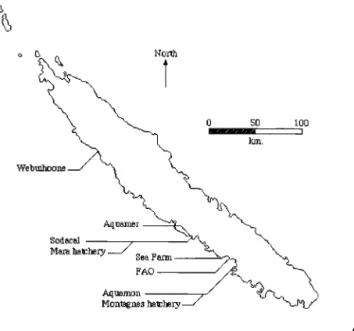
Geographical and zootechnical data.The shrimp farms included in the study are located on the southwest coast of New Caledonia (Fig. 1). Aquamon (AQ isolates), FAO (F isolates), and Sea Farm (SF isolates) are located on Saint Vincent Bay. Sodacal (SO isolates) and Aquamer (AM isolates) are located on Moindou Bay, 50 km north of Saint Vincent Bay. Webuihoone (W isolates) is located 150 km north of Moindou Bay. Aquamer is located at the Moindou estuary; there is evidence that it recycles some of the outlet water from Sodacal, as well as its own. Postlarvae stocked in the ponds originate from two separate hatcheries. Aquamer and Sodacal usually stock postlarvae from the Mara hatch-ery, located close to Sodacal on Moindou Bay, whereas Aquamon, FAO, and Sea Farm usually stock postlarvae from the Montagnes hatchery, located near Aqua-mon on Saint Vincent Bay, but there are many transfers of postlarvae between
FIG. 1. Schematic map of New Caledonia showing the locations of the shrimp farms and hatcheries discussed in this report.
TABLE 1. Vibrio sp. reference strains and field isolates used in the present study
Organism or source and isolate
name, isolation date,aand origin Identification
Reference strains
V. alginolyticus CIP 103336Tb
V. harveyi CIP 103192T
V. nigripulchritudo CIP 103195T
V. penaeicida KH-1T
Japanese field strains
V. penaeicida KO-1, 1986, Japan V. penaeicida KT-1, 1986, Japan V. penaeicida PD-A, 1986, Japan
New Caledonian field strains Aquamon farm
AQ61,cMarch 1994, NCd...V. alginolyticuse
AQ66,fMarch 1994, NC ...V. alginolyticuse
AQ102, June 1995, NC ...V. penaeicida AQ103, June 1995, NC ...V. penaeicida AQ104, June 1995, NC ...V. penaeicida AQ105, June 1995, NC ...V. penaeicida AQ106, June 1995, NC ...V. penaeicida AQ107, June 1995, NC ...V. penaeicida AQ109, June 1995, NC ...V. penaeicida AQ110, June 1995, NC ...V. penaeicidae
AQ111, June 1995, NC ...V. penaeicida AQ112, June 1995, NC ...V. penaeicidae
AQ113, June 1995, NC ...V. harveyi AQ114, June 1995, NC ...Not identified Aquamer farm
AM23, October 1994, NC...V. penaeicidae
AM101, May 1995, NC ...V. penaeicida AM102, May 1995, NC ...V. nigripulchritudo AM107, May 1995, NC ...V. penaeicida AM108, May 1995, NC ...V. penaeicida AM109, May 1995, NC ...V. nigripulchritudo AM111, May 1995, NC ...V. penaeicida AM112, May 1995, NC ...V. penaeicida AM113, May 1995, NC ...V. penaeicida AM114, May 1995, NC ...V. nigripulchritudo AM115, May 1995, NC ...V. nigripulchritudo AM116, May 1995, NC ...V. penaeicida FAO farm F1, May 1995, NC...V. penaeicidae F2, May 1995, NC...V. penaeicida F5, May 1995, NC...V. penaeicida F6, May 1995, NC...V. penaeicida F11, May 1995, NC...V. penaeicida F14,gMay 1995, NC ...V. penaeicidae F15, May 1995, NC...V. penaeicida F24, May 1995, NC...V. penaeicida F25, May 1995, NC...V. penaeicida Sea Farm SF5, January 1994, NC...V. alginolyticuse SF100, March 1995, NC...V. penaeicidae SF101, March 1995, NC...V. penaeicida SF113, March 1995, NC...V. penaeicida SF116, March 1995, NC...V. penaeicida SF121, March 1995, NC...V. penaeicida SF122, March 1995, NC...V. penaeicida SF125, March 1995, NC...V. penaeicidae SF126, March 1995, NC...V. penaeicida SF127, March 1995, NC...V. penaeicida Continued TABLE 1—Continued Organism or source and isolate
name, isolation date,aand origin Identification
SF140, May 1995, NC ...V. penaeicidae
SF143, March 1995, NC...V. penaeicidae
Sodacal farm
SO27,hOctober 1994, NC...V. nigripulchritudoe
SO38, May 1995, NC...V. nigripulchritudoe
SO65, May 1995, NC...V. nigripulchritudoe
Webuihoone farm
W1,hApril 1994, NC ...Not identified
W9, April 1994, NC...Not identified W11, April 1994, NC...V. harveyie
aThe isolation date corresponds to the date of isolation from the field for field strains.
bT indicates type strain.
cUnderlined strains were isolated on marine agar from diseased cultured P. stylirostris hemolymph containing more than 100 CFU of the monomorphous bacterial strain per drop of hemolymph.
dNC, strain isolated on marine agar 2216E (Difco Laboratories) from cultured P. stylirostris hemolymph in New Caledonia.
eStrain previously identified by DNA-DNA hybridization and ribotyping (6). fIsolated in marine broth from diseased cultured P. stylirostris hemolymph. gIsolated on TCBS agar from diseased cultured P. stylirostris hemolymph. hMajor strain isolated on marine agar from apparently healthy cultured P. stylirostris hemolymph.
these two bays. A preliminary field survey did not find either V. penaeicida or V. nigripulchritudo strains in any postlarval stock.
Extraction of bacterial genomic DNAs.Vibrio strains were cultured in tryptic soy broth (BioMe´rieux) supplemented with 2% NaCl (Sigma Chemical Co., St. Louis, Mo.) at 30°C with continuous shaking until the stationary phase of growth was reached. DNAs were extracted and purified by two different methods. (i) Cultures (50 ml) were harvested by centrifugation at 10,0003 g for 10 min. The resultant pellets were lysed with a 1% sodium dodecyl sulfate (SDS)–1-mgz ml21
proteinase K solution, and the bacterial nucleic acids were extracted by a phenol-chloroform-isoamyl alcohol (25:24:1, vol/vol/vol) mixture as described by Bren-ner et al. (4). Extracted DNAs were resuspended in 13 Tris-EDTA buffer. (ii) DNAs were also extracted by using silica particles and guanidinium isothiocya-nate lysis buffer in accordance with the 2-h method described by Boom et al. (3) from small culture aliquots (3 to 5 ml).
AP-PCR.Fingerprinting was performed as described previously (30), with minor modifications. Primers KF (59-CACACGCACACGGAAGAA-39), KN (59-CCTTGCGCGCATGTACATGG-39), RSP (59-GGAAACAGCTATGACC ATGA-39), KZ (59-CCCATGTGTACGCGTGTGGG-39), KpnR (59-CCAAGT CGACATGGCACRTGTATACATAYGTAAC-39), KG (59-CACACGCACAC GGAAGAA-39), and SP (59-TTGTAAAACGACGGCCAG-39) were purchased from Genset (Paris, France). Fifty-microliter reaction mixtures were prepared with 100 ng of DNA–13 Taq polymerase buffer (100 mM Tris [pH 8.3, 20°C], 500 mM KCl)–MgCl2–0.2 mM each deoxynucleoside triphosphate (Boehringer,
Mannheim, Germany)–1mM single oligonucleotide primer–5 mCi of [32P]dCTP
(3,000 Ci/mmol; Amersham International, Amersham, England)–1.25 U of Taq polymerase (Amersham).
Amplification reactions were cycled twice in a 96-well GeneAmp 9600 ther-mocycler (Perkin-Elmer) through a low-stringency temperature profile and then 40 times through a high-stringency temperature profile as previously described (24). Five microliters of each reaction mixture was combined with 15ml of 98% formamide dye and heated to 68°C for 15 min; 5ml of each sample was loaded onto a 4% acrylamide–50% urea sequencing gel with 13 TBE (90 mM Tris-borate, 2 mM EDTA), and electrophoresis was performed at 400 V overnight until the xylene cyanol tracking dye was approximately 10 cm from the bottom. pUCBM21 DNA digested by HpaII plus pUCBM21 DNA digested by DraI and HindIII (Boehringer), pBR328 DNA digested by BglI and HinfI (Boehringer), and pBR322 DNA digested by MspI (New England Biolabs) were used as molecular size markers. The gel was autoradiographied for 24 to 72 h on Kodak X-Omat X-ray film. Amplicon molecular size was determined by interpolation of the distances of migration (12) of molecular size markers and AP-PCR products. In accordance with Welsh and McClelland (30), only major bands were consid-ered in the analysis as share-derived characters, and this allowed the construction of a key for type grouping of the strains according to the amplicons produced with a given primer (see Table 2).
In order to select primers producing more polymorphism, a first screening of AP-PCR products without [32P]dCTP was performed by using electrophoresis on
a 2% agarose gel (NuSieve 3:1, FMC, Rockland, Maine) with 0.53 TBE buffer (3 V/cm for 16 h), followed by ethidium bromide staining.
RESULTS
Primer selection.On the basis of the fingerprints observed on agarose gel, three (RSP, KF, and SP) of the seven primers tested were selected for accurate study with acrylamide-urea sequencing gel.
DNA extraction techniques and reliability.The fingerprints obtained by AP-PCR using the two different techniques of DNA extraction were identical. The only differences, sporadi-cally observed, were due to insufficient quantities of genomic DNA in the amplification mixture, i.e., 50 instead of 100 ng. These variations affected only a few bands in the fingerprints (data not shown). Therefore, concentrations of genomic DNA extracts were carefully monitored by spectrophotometric de-termination at 260 nm.
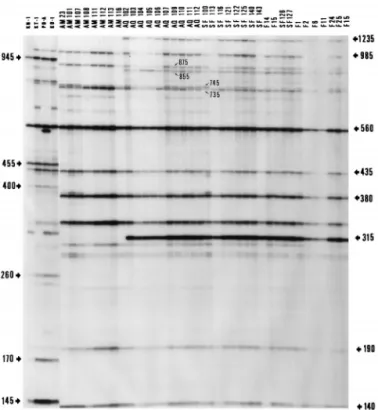
Species identification.On the basis of the AP-PCR finger-prints, 54 of the 57 field isolates were identified as belonging to one of the four species for which a reference strain was in-cluded in the studied set (Table 1). Examples are shown in Fig. 2 to 4. The remaining three New Caledonian strains (AQ114, W9, and W1) produced fingerprints unrelated to the AP-PCR patterns of the four type strains included in this study, were characterized by the complete absence of any species-specific amplicon, and, consequently, were not identified. For these three strains, phenotypic tests previously performed were in-conclusive. Some highly conserved amplicons were found to be
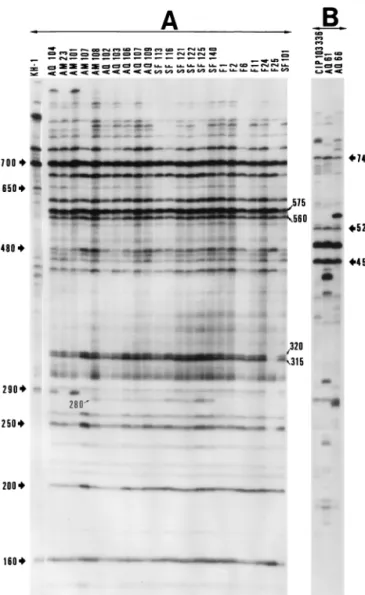
genospecies specific. (i) With primer SP, V. penaeicida was characterized by 335-, 435-, 560-, and 985-bp fragments, V. nigripulchritudo was characterized by 225-, 440-, 565-, 940-, and 1,240-bp fragments, V. harveyi was characterized by 165-, 310-, 365-, 510-, 745-, and 970-bp fragments, and V. alginolyticus was characterized by 230-, 595-, and 745-bp fragments (Fig. 2). (ii) With primer RSP, V. penaeicida was characterized by 160-, 210-, 215-, 405-, 770-, and 860-bp fragments, V. nigripulchritudo was characterized by 355-, 650-, 675-, and 940-bp fragments, V. harveyi was characterized by 150-, 195-, 205-, 270-, 295-, 355-, 365-, 450-, and 540-bp fragments, and V. alginolyticus was char-acterized by 225-, 275-, 450-, 480-, 525-, and 745-bp fragments (Fig. 3). (iii) With primer KF, V. penaeicida was characterized by 170-, 220-, 360-, and 725-bp fragments, V. nigripulchritudo was characterized by 215-, 250-, 400-, and 825-bp fragments, V. harveyi was characterized by 300-, 475-, and 1,065-bp frag-ments, and V. alginolyticus was characterized by 545-, 645-, and 735-bp fragments (Fig. 4).
The New Caledonian Vibrio isolates were distributed among the four genospecies as following: isolates AQ61, AQ66, and SF5 were identified as V. alginolyticus, isolates AQ113 and W11 were identified as V. harveyi, and isolates AM102, AM109, AM114, AM115, SO27, SO38, and SO65 were iden-tified as V. nigripulchritudo. The remaining 38 isolates were identified as V. penaeicida (as detailed in Table 1). The three Japanese isolates were confirmed to belong to V. penaeicida.
Intraspecies differences among V. penaeicida strains. Com-parative results are summarized in Table 2. Japanese V. penaei-cida isolates could be discriminated from ones from New Cale-donia by using each of the three primers. With primer SP, Japanese V. penaeicida strains were characterized by 145-, 170-, 260-, 400-, 455-, 870-, and 945-bp fragments and New
FIG. 2. AP-PCR fingerprints of selected V. penaeicida strains produced with primer SP. Shown is an autoradiogram of a denaturing 5% acrylamide gel with TBE. The data for isolates in the upper part are given in Table 1. Molecular sizes (in base pairs) determined as described in Materials and Methods are given on the sides.
Caledonian ones were characterized by 140-, 190-, 280-, 285-, 380-, 735-, 745-, and 875-bp fragments (Fig. 2). With primer RSP, Japanese V. penaeicida strains were characterized by 185-, 280-, and 650-bp fragments and New Caledonian ones were characterized by 200-, 250-, 315-, 320-, 480-, 560-, 575-, 695-, and 700-bp fragments (Fig. 3). With primer KF, Japanese V. penaeicida strains were characterized by 210- and 760-bp fragments and New Caledonian ones were characterized by 340-, 400-, 790-, and 1,490-bp fragments (Fig. 4).
It was also possible to discriminate between the V. penaei-cida isolates from New Caledonia. With primer SP, New Cale-donian V. penaeicida was discriminated by 315-, 795-, 855-, and 1,235-bp fragments; fingerprints of the strains originating from Aquamer were missing these fragments (Fig. 2). With primer RSP, New Caledonian V. penaeicida was discriminated by a 280-bp fragment; fingerprints of the strains originating from FAO, Aquamer, and SF101 were missing these fragments (Fig. 3). Lastly, with primer KF, the additional presence of a 1,650-bp fragment allowed the individualization of FAO iso-lates and of 3 (SF101, SF126, and SF127) of the 11 Sea Farm
isolates. This discrimination with primer KF was also possible by using the agarose gel-ethidium bromide technique.
DISCUSSION
Few researchers have used molecular biology tools for epi-demiological studies on aquaculture-pathogenic marine Vibrio sp. isolates. Their genomic diversity was first investigated by using ribotyping (2, 22, 29) or plasmid profiling (10, 22, 26, 29). However, if ribotyping is useful for taxonomic studies or sub-typing, its discriminating power can be limited for studying population structures. Plasmid profiling can provide interest-ing results for Vibrio isolates, but the data obtained with this approach are limited to the extrachromosomal genome (15). Lastly, AP-PCR was recently demonstrated as useful for fast
FIG. 3. Autoradiogram of AP-PCR fingerprints of V. penaeicida (A) and V. alginolyticus (B) produced with primer RSP. The lane assignments for isolates are given in Table 1. Molecular sizes (in base pairs) determined as described in Materials and Methods are given on the sides.
FIG. 4. Autoradiogram of AP-PCR fingerprints of selected V. penaeicida field isolates produced with primer KF. The data for isolates in the upper part are given in Table 1. Molecular sizes (in base pairs) determined as described in Materials and Methods are given on the sides.
identification of species and strains of Vibrio (19) and another arbitrary amplification method, random amplification of poly-morphic DNA (33), was shown to be efficient for the differen-tiation of the two biotypes of V. vulnificus (2). Arbitrary am-plification of DNA, which allows analysis of the whole genome, is considered a powerful approach for the study of DNA
poly-morphism and is usable for the comparison of genomes from eukaryotes (31) or bacteria (25, 32). In this case, AP-PCR can be used for species identification and provides information on intraspecific differences usable for molecular epidemiology studies (25, 32).
Analysis of AP-PCR fingerprints allowed us to categorize a significant set of Vibrio field isolates. The epidemiological ap-proach of our study is original in that 35 of 53 field isolates were included on the sole basis of their isolation in high num-bers in moribund-shrimp hemolymph during syndrome 93 mortality episodes without any previous analysis of these strains; the 18 others were previously studied by ribotyping (Table 1) (6). AP-PCR allowed identification to the genospe-cies level when fingerprints of field isolates were compared with those provided by reference strains of genospecies. In addition, complete agreement between AP-PCR and ribotyp-ing data was observed. Fifty of the 53 field isolates were iden-tified as belonging to one of the four genospecies included in the study. The three Japanese isolates exhibited AP-PCR fin-gerprints which were characteristic of V. penaeicida.
All isolates originating from the three mortality peaks that occurred in 1995 were identified as V. penaeicida or V. nigripul-chritudo, except two strains (one V. harveyi and one not iden-tifiable). This observation confirms the major epidemiological role of these two genospecies in the pathogenesis of syndrome 93 and demonstrates that several Vibrio species and strains were implicated in the pathogenesis of this syndrome, indicat-ing the importance of environmental factors and zootechnical practices. Although V. penaeicida was first described (13) in a shrimp vibriosis in Japan, this is the first report on the possible pathological role of V. nigripulchritudo in marine aquaculture. The earlier role of V. alginolyticus and V. harveyi in the pathol-ogy could have been surpassed by the more pathogenic strains of V. penaeicida and V. nigripulchritudo (11). This hypothesis could explain the change in the infection pattern of Vibrio species involved in the outbreaks, with a major role of V. alginolyticus and V. harveyi in the initial episodes (1993 and 1994) followed in 1995 by the increasing impact of strains of V. penaeicida and V. nigripulchritudo.
The present study, conducted with a significant number of V. penaeicida isolates, shows the heterogeneity of these strains according to their geographical origins, since AP-PCR finger-printing allows clustering of isolates. At a first level, the dis-crimination between isolates originating from Japan and those from New Caledonia was readily possible whatever the primer used. At a second level, on the basis of the presence or absence of some fragments, the SP fingerprints of the V. penaeicida strains isolated in New Caledonia were heterogeneous, with two distinct clusters. Similar results were observed with RSP and KF fingerprints. These two clusters were regarded as topo-types located 50 km apart on Saint Vincent Bay and Moindou Bay, as there was a perfect correlation between the geograph-ical area of origin and a particular fingerprint. These two bays are quite different in ecology, so these two topotypes could have been selected during ecological adaptation to these two respective environments. Moindou Bay is relatively closed, with an important mangrove area, and is probably strongly influenced by aquaculture activities, whereas Saint Vincent Bay is a wide and open bay with few mangrove areas. Within the Saint Vincent Bay topotype, further discrimination was possible that could not be attributed to any geographical, chro-nological, ecological, or zootechnical differences. However, these investigations would be deepened by phenotypic and virulence studies using representative strains from each cluster. Conversely, the V. nigripulchritudo fingerprints were homoge-neous whatever the primers used, but these data have to be TABLE 2. Distribution of V. penaeicida field isolates according to
the presence or absence of specific AP-PCR products obtained with primers SP, RSP, and KFa
Isolate (origin)b Presence of fragment or fragment cluster:
Ac Bd Ce Df Eg KO-1 (J) 1 2 2 2 2 PD-A (J) 1 2 2 2 2 KT-1 (J) 1 2 2 2 2 AM23 (NC) 2 1 2 2 2 AM101 (NC) 2 1 2 2 2 AM107 (NC) 2 1 2 2 2 AM108 (NC) 2 1 2 2 2 AM111 (NC) 2 1 2 2 2 AM112 (NC) 2 1 2 2 2 AM113 (NC) 2 1 2 2 2 AM116 (NC) 2 1 2 2 2 AQ102 (NC) 2 1 1 1 2 AQ103 (NC) 2 1 1 1 2 AQ104 (NC) 2 1 1 1 2 AQ105 (NC) 2 1 1 1 2 AQ106 (NC) 2 1 1 1 2 AQ107 (NC) 2 1 1 1 2 AQ109 (NC) 2 1 1 1 2 AQ110 (NC) 2 1 1 1 2 AQ111 (NC) 2 1 1 1 2 AQ112 (NC) 2 1 1 1 2 SF126 (NC) 2 1 1 1 1 SF127 (NC) 2 1 1 1 1 SF100 (NC) 2 1 1 1 2 SF113 (NC) 2 1 1 1 2 SF116 (NC) 2 1 1 1 2 SF121 (NC) 2 1 1 1 2 SF122 (NC) 2 1 1 1 2 SF125 (NC) 2 1 1 1 2 SF140 (NC) 2 1 1 1 2 SF143 (NC) 2 1 1 1 2 SF101 (NC) 2 1 1 2 1 F1 (NC) 2 1 1 2 1 F2 (NC) 2 1 1 2 1 F5 (NC) 2 1 1 2 1 F6 (NC) 2 1 1 2 1 F11 (NC) 2 1 1 2 1 F14 (NC) 2 1 1 2 1 F15 (NC) 2 1 1 2 1 F24 (NC) 2 1 1 2 1 F25 (NC) 2 1 1 2 1
aThe data for the isolates in the left column are given in Table 1. bJ, Japan; NC, New Caledonia.
cIncludes 145-, 170-, 260-, 400-, 455-, and 945-bp fragments obtained with
primer SP, 290- and 650-bp fragments obtained with primer RSP, and 210- and 760-bp fragments obtained with primer KF.
dIncludes 140-, 190-, 280-, 285-, 380-, 735-, 745-, and 875-bp fragments
ob-tained with primer SP, 200-, 250-, 315-, 320-, 480-, 560-, 575-, 695-, and 700-bp fragments obtained with primer RSP, and 340-, 400-, 790-, and 1,490-bp frag-ments obtained with primer KF.
eIncludes 315-, 795-, 855-, and 1,235-bp fragments obtained with primer SP. fA 280-bp fragment obtained with primer RSP.
confirmed by studying a more comprehensive set of field iso-lates in order to investigate possible heterogeneity. The results of the present study demonstrate the practical value of this PCR-based strategy in studying marine Vibrio isolates for mo-lecular epidemiology purposes. This approach may be applied to the analysis of other marine Vibrio strains, especially in aquaculture-pathogenic Vibrio species.
All isolates identified as V. nigripulchritudo originated from Sodacal and Aquamer, both of which are located on Moindou Bay. Therefore, it seems that pathogenic V. nigripulchritudo strains were absent from Saint Vincent Bay at the time of the survey. Despite numerous postlarval transfers between these two bays, there has been neither any contamination by patho-genic V. nigripulchritudo in Saint Vincent Bay nor any exchange of V. penaeicida topotypes between these two bays, confirming the absence of these pathogenic strains in postlarval stocks. At the time of the survey, both species and derived clusters could be considered geographically restricted. Considering the topo-types and the long persistence of V. penaeicida strains in sea-water (9), it can be assumed that shrimp ponds were contam-inated by the intake water pumped from the bays and that vibriosis must thus be considered a waterborne disease.
This should be confirmed by further ecological studies, but zoosanitary measures should already be taken to avoid possible dissemination of the pathogens. Therefore, shrimp farmers were advised against transfer of live shrimp between the dif-ferent farms and hatcheries on the difdif-ferent bays. If transfer is necessary, the animals should be treated with antibiotics at the time of transfer, and the water used for the transfer should be sterilized by, as an example, chlorination-dechlorination meth-ods.
Our results demonstrate the practical value of AP-PCR for studying marine Vibrio isolates for molecular epidemiology purposes. This approach may be applied to the analysis of other marine Vibrio species involved in mariculture pathology. The development of species-specific nonradioactive DNA probes derived from the highly conserved amplicons produced by AP-PCR (16) would simplify identification at the species or subspecies level. In addition, our field results emphasize the importance and the similarity of the respective virulence of V. penaeicida and V. nigripulchritudo isolates for P. stylirostris, concurrently demonstrated by experimental infection studies (11). As virulence plasmids have been reported in V. anguilla-rum, the agent of vibriosis in fish (7, 8, 28), a study aiming to correlate virulence with the plasmid profiles of V. penaeicida and V. nigripulchritudo isolates is currently in progress in our laboratory.
ACKNOWLEDGMENTS
Thanks are due to Vincent Pomare`de for technical assistance, to Eric Boglio for editorial advice, and the Territorial Laboratory of Veterinary Diagnosis of New Caledonia for maintaining and supplying the Vibrio field isolate collection.
This work was partly supported by grants from the South and North Provinces of New Caledonia. V. penaeicida KH-1Tand the three
Jap-anese field isolates were kindly provided by K. Muroga (Faculty of Applied Biological Science, Hiroshima University, Higashi-Hiroshima, Japan). F.M. and P.P. were supported by the International Network of Pasteur Institutes (General Delegation, Institute Pasteur, Paris, France).
REFERENCES
1. Austin, B., M. Alsina, D. A. Austin, A. R. Blanch, F. Grimont, P. A. D.
Grimont, J. Joffre, S. Koblavi, J. L. Larsen, K. Pedersen, T. Tiainen, L. Verdonck, and J. Swings.1995. Identification and typing of Vibrio anguilla-rum: a comparison of different methods. Syst. Appl. Microbiol. 18:285–302. 2. Aznar, R., W. Ludwig, and K.-H. Schleifer. 1993. Ribotyping and randomly
amplified polymorphic DNA analysis of Vibrio vulnificus biotypes. Syst. Appl. Microbiol. 16:303–309.
3. Boom, R., C. J. A. Sol, M. M. M. Salimans, C. L. Jansen, P. M. E.
Wertheim-van Dillen, and J. Wertheim-van der Noordaa.1990. Rapid and simple method for purification of nucleic acids. J. Clin. Microbiol. 28:495–503.
4. Brenner, D. J., A. C. McWhorter, J. K. Leete Knuston, and A. G. Steigerwalt. 1982. Escherichia vulneris: a new species of Enterobacteriaceae associated with human wounds. J. Clin. Microbiol. 15:1133–1140.
5. Brock, J. A., and B. LeaMaster. 1992. A look at the principal bacterial, fungal and parasitic diseases of farmed shrimp, p. 212–226. In J. Wyban (ed.), Proceedings of the Special Session on Shrimp Farming. World Aquaculture Society, Baton Rouge, La.
6. Costa, R., I. Mermoud, S. Koblavi, B. Morlet, P. Haffner, F. Berthe, M.
Legroumellec, and P. A. D. Grimont.1998. Isolation and characterization of bacteria associated with Penaeus stylirostris disease (syndrome 93) in New Caledonia. Aquaculture 164:297–309.
7. Crosa, J. H., L. L. Hodges, and M. H. Schiewe. 1980. Curing of plasmids is correlated with an attenuation of virulence in the marine fish pathogen Vibrio anguillarum. Infect. Immun. 27:897–902.
8. Crosa, J. H., M. H. Schiewe, and S. Falkow. 1977. Evidence for plasmid contribution to virulence of the fish pathogen Vibrio anguillarum. Infect. Immun. 18:509–513.
9. De La Pen˜a, L. D., K. Momomaya, T. Nakai, and K. Muroga. 1992. Detec-tion of the causative agent of vibriosis in kuruma prawn, Penaeus japonicus. Fish Pathol. 244:223–228.
10. Giles, J. S., H. Hariharan, and S. B. Heaney. 1995. The plasmid profiles of fish pathogenic isolates of Aeromonas salmonicida, Vibrio anguillarum, and Vibrio ordalii from the Atlantic and Pacific coasts of Canada. Can. J. Micro-biol. 41:209–216.
11. Goarant, C., and D. Saulnier. 1997. Unpublished data.
12. Grimont, F., and P. A. D. Grimont. 1987. Ribosomal ribonucleic acid gene restriction patterns as potential taxonomic tools. Ann. Inst. Pasteur/Micro-biol. (Paris) 137B:165–175.
13. Ishimaru, K., M. Akagawa-Matsushita, and K. Muroga. 1995. Vibrio penaei-cida sp. nov., a pathogen of kuruma prawns (Penaeus japonicus). Int. J. Syst. Bacteriol. 45:134–138.
14. Jiravanichpaisal, P., T. Miyazaki, and C. Limsuwan. 1994. Histopathology, biochemistry and pathogenicity of Vibrio harveyi infecting black tiger prawn Penaeus monodon. J. Aquat. Anim. Health 6:27–35.
15. Larsen, J. L., and J. E. Olsen. 1991. Occurrence of plasmids in Danish isolates of Vibrio anguillarum serovars O1 and O2 and association of plasmids with phenotypic characteristics. Appl. Environ. Microbiol. 57:2158–2163. 16. Letocart, M., G. Baranton, and P. Perolat. 1997. Rapid identification of
pathogenic Leptospira species (Leptospira interrogans, L. borgpetersenii, and L. kirschneri) with species-specific DNA probes produced by arbitrarily primed PCR. J. Clin. Microbiol. 35:248–253.
17. Lightner, D. V. 1988. Vibrio disease of penaeid shrimp, p. 42–47. In C. J. Sindermann and D. V. Lightner (ed.), Disease diagnosis and control in North American marine aquaculture. Elsevier, Amsterdam, The Nether-lands.
18. Lightner, D. V. (ed.). 1996. A handbook of pathology and diagnostic proce-dures for diseases of penaeid shrimps. World Aquaculture Society, Baton Rouge, La.
19. Martinez, L., S. Espelid, A. Johansen, J. Welsh, and M. McClelland. 1994. Fast identification of species and strains of Vibrio by amplification of poly-morphic DNA. J. Fish Dis. 17:297–302.
20. Mermoud, I., R. Costa, O. Ferre´, C. Goarant, and P. Haffner. 1998. “Syn-drome 93” in New Caledonian outdoor rearing ponds of Penaeus stylirostris: history and description of three major outbreaks. Aquaculture 164:297–309. 21. Mohney, L. L., and D. V. Lightner. 1994. An epizootic of vibriosis in Ecua-dorian pond-reared Penaeus vannamei Boone (Crustacea: Decapoda). J. World Aquacult. Soc. 25:116–125.
22. Olsen, J. E., and J. L. Larsen. 1993. Ribotypes and plasmid contents of Vibrio anguillarum strains in relation to serovar. Appl. Environ. Microbiol.
59:3863–3870.
23. Pedersen, K., G. Ceschia, and J. L. Larsen. 1994. Ribotypes of Vibrio an-guillarum O1 from Italy and Greece. Curr. Microbiol. 28:97–99.
24. Perolat, P., F. Merien, W. A. Ellis, and G. Baranton. 1994. Characterization of Leptospira isolates from serovar hardjo by ribotyping, arbitrarily primed PCR, and mapped restriction site polymorphisms. J. Clin. Microbiol. 32: 1949–1957.
25. Ralph, D., M. McClelland, J. Welsh, G. Baranton, and P. Perolat. 1993. Leptospira species categorized by arbitrarily primed polymerase chain reac-tion (PCR) and by mapped restricreac-tion polymorphisms in PCR-amplified rRNA genes. J. Bacteriol. 175:973–981.
26. Sorum, H., A. B. Hvaal, M. Heum, F. L. Daae, and R. Wiik. 1990. Plasmid profiling of Vibrio salmonicida for epidemiological studies of cold water vibriosis in Atlantic salmon (Salmo salar) and cod (Gadus morhua). Appl. Environ. Microbiol. 56:1033–1037.
27. Takahashi, Y., Y. Shimomaya, and K. Momomaya. 1985. Pathogenicity and characteristics of Vibrio sp. isolated from cultured kuruma prawns Penaeus japonicus Bate. Bull. Jpn. Soc. Sci. Fish. 51:721–730.
28. Tiainen, T., J. L. Larsen, and S. Pelkonen. 1994. Characterization of Vibrio anguillarum strains isolated from diseased fish in Finland. Acta Vet. Scand.
35:355–362.
29. Tiainen, T., K. Pedersen, and J. L. Larsen. 1995. Ribotyping and plasmid profiling of Vibrio anguillarum serovar O2 and Vibrio ordalii. J. Appl. Bac-teriol. 79:384–392.
30. Welsh, J., and M. McClelland. 1990. Fingerprinting genomes using PCR with arbitrary primers. Nucleic Acids Res. 18:7213–7218.
31. Welsh, J., C. Petersen, and M. McClelland. 1991. Polymorphisms generated
by arbitrarily primed PCR in the mouse: applications to strain identification and genetic mapping. Nucleic Acids Res. 19:303–306.
32. Welsh, J., C. Pretzman, D. Postic, I. Saint Girons, G. Baranton, and M.
McClelland.1992. Genomic fingerprinting by arbitrarily primed polymerase chain reaction resolves Borrelia burgdorferi into three distinct phyletic groups. Int. J. Syst. Bacteriol. 42:370–377.
33. Williams, J. G. K., A. R. Kubelik, K. J. Livak, J. A. Rafalski, and S. V.
Tingey.1990. DNA polymorphisms amplified by arbitrary primers are useful as genetic markers. Nucleic Acids Res. 18:6531–6535.