IFEB 5 1962
LEIRARr
COLOR CENTER DEVELOPMENTIN NATURAL QUARTZ
by
CHARLES J. RITTER
SUBMITTED IN PARTIAL FULFILLMENT OF THE REQUIREMENTS FOR THE
DEGREE OF MASTER OF SCIENCE the MASSACHUSETTS INSTITUTE OF TECHNOLOGY February, 1962 Signature of Author ... ...
Department of $Geology and # sice. February, 1962 Certified by
Thesis Supervisor Accepted by
Table of Contents I Acknowledgement s 1. II Abstract 2. III Introduction 3. IV Procedure 14. V Crystallographic Orientation 15.
VI Zoning in Natural Quartz 16.
VII Natural Darkening 20.
VIII Sources of Error 22.
IX Presentation of Results 29.
X Discussion of experimental
Results 38.
XI Comparison of Experimental Results
with Other Work 41.
XII Conclusions 42.
XIII Recommendations for Future Work 44.
XIV References 45.
I. Acknowledgements
The author wishes to express his deep and most sincere appreciation to Professor William H. Dennen for his suggestion of the thesis problem; for his direction, kindness, patience, and encouragement during the course of the work; for the spectrochemical analyses; and for the wonderful drawings of the data graphs.
Thanks are also extended to: Professor William H. Pinson, Jr. for his interest, his helpful suggestions, and his instruction on the use of the flame photometer; to Mr. Eugene Perry for his interest, his helpful suggestions, and his
instruction on the use of the X-ray unit; to Dr. Alvin J. Cohen of the Mellon Institute of Pittsburgh, Pennsylvania for his kindness extended during an interview and for the sample of synthetic quartz: to Dr. A.V. Sankaran of the Department of Atomic Energy of India for his interest and his helpful
suggestions; to Miss Ann Wilfert of American Science and Engineering Inc. for her aid in taking the photographs; to
Mr. David Towell and Mr. Berhnardt Wdensch for their suggestions and assistance; and to Miss Deborah Jope for typing the
II. Abstract
During this investigation, the rate and magnitude of color center development, caused by X-ray irradiation, was
measured for samples of quartz from various geologic environments. One hundred twenty-two (122) specimens of quartz from fifty-eight (58) different rock samples comprising seven types of natural quartz were examined. The following procedure was followed on all specimens: (1) amount of light transmitted through a given area on a quartz specimen was measured on a microphotometer, (2) the specimen was irradiated for 15 minutes and remeasured, (3) a per centofdifference between the photometer readings ( per cent of "blackening") was determined. The sequence of irradiation for
15 minutes followed by measurement was repeated until the specimen
reached a state of constant blackening (was saturated).
It is believed by many investigators, that the color centers are dependent on the presence of impurity atoms which are either substitutionally (such as Al) or interstitially (such as
Al, Na, Li ) located in the quartz structure. Differential thermal analyses have shown that the impurity content in quartz is
direct-ly proportional to the temperature of formation of the quartz, and
that the inversion temperature is inversely proportional to the amount of impurities,
During this investigation it was found that natural quartz samples of different geologic origins are affected to
different degrees and at different rates by X -ray irradiation, and that these differences can be detected and quantitatively
measured.
R hyolitic (high temperature forming) quartz develops the greatest blackening of all types of quartz tested, and vein quartz (low temperature forming) develops practically no blacken" ing. Intermediate amounts of blackening correlate with intermediate temperatures of formation.
Granitic quartz specimens blackened at the X "ray satu" ration point, from 0% to 65%, but most specimens blackened from
3%
to 25%.
There appears to be at least two different types of
pegmatitic quartz: one which develops per cent of blackening versus time curves similar in form to those of granitic quartz and another which has uniquely shaped curves. Most gneissic quartz appear to
develop little or no blackening. Quartz specimens from schists develop even less blackening than those from gneisses. Most vein quartz develop no blackening,
G rowth zoning as found in some natural quaftz crystals and crystallographic directional zoning as found in some synthetic quartz crystals appears to be rare in natural quartz.
It is believed that the measurement of color center
development in natural quartz samples can be useful in interpreting geologic events.
THBSIS SUPERVISOR: W illiam H. Dennen
Associate Professor of Geology 2.
III. Introduction
The purpose of this investigation is to study color center development in quartz from various geologic environ-ments by X-ray irradiation,to measure the rate and magnitude of this development, and to determine the usefulness of such measurements in interpreting geologic events.
Considerable work has been done on both synthetic and natural quartz by mineralogists, physicists, and chemists to determine its physical, chemical, and electrical properties. Most of the natural quartz samples examined have been well
formed crystals from low temperature veins, hot springs, and pegmatite bodies. Relatively little work has been done on quartz samples from the other geologic environments.
One of the most extensive studies of natural quartz was performed by Keith and Tuttle (1952). They found that the
inversion temperature of quartz varies inversely with the
temperature of formation. Phenocrysts of quartz from rhyolites, most likely formedat high temperature, were found to have
inversion temperatur-s below the transition temperature of the standard pure quartz (573+ 0.10C. for Minas Gerais, Brazil crystal). Synthetic quartz samples grown at low temperature had inversion temperatures higher than the reference quartz.
It was suggested by Keith and Tuttle, that inversions probably begin around centers of local strain, such as might be found
around inclusions, which "trigger" the inversion. The presence
3.
of the impurity would strain the structure so that it would be
closer to the alternate form than pure quartz. Thus, less heat and a lower temperature will cause inversion in the contaminated quartz.
Buerger (1954) found that upon injection of foreign elements into a pure chemical structure of a mineral, a
derivative structure ("stuffed derivative") can occur. If the substitutional atoms are of smaller valences than those being substituted, electroneutrality must be preserved by the addition of other atoms to the structure to balance off the
charge. Only those atoms of appropriate atomic radii and charge can be accomodated. According to Buerger, "quartz has voids of limited sizes which are too small for K or Na, but large enough for Li, Be, or B. Eucryptite, Li(Sig04), and Li(AlS1206) are known derivatives of quartz."
Keith and Tuttle found that quartz grown in the presence of lithium and aluminum has the temperature of
inversion lowered as the temperature of growth is increased. The lower the temperature of growth, the higher the inversion.
It is interesting to note, however, that the inversion temperatures
of quartz grown at different temperatures in the presence of
germanium are raised, and the lower the temperature of growth the higher the inversion, Germanium has the same +4 valence as silicon and, therefore, does not need additional ions to
accompany it for electroneutrality. Higher inversion temperatures
and more sluggish inversion show that Ge+4 can substitute for Si+4 to a greater degree in--,,<quartz than in r) quartz. On the other hand, the lowering of the inversion temperature
caused by lithium and aluminum suggest that near the inversion
those elements can be incorporated in larger amounts in
quartz than in7 quartz. Tuttle definitely believes that the differences of inversion temperature as well as the extreme slowness of inversion of some samples is due primarily to solid solution.
It appears that the elements Na and K along with Li, are able to introduce themselves into the structure of relatively high temperature quartz. Analyses made by a number of investi-gators have shown this to be so. Tuttle and Keith found that the greatest concentration of all three alkalis was found in a sample which had the lowest and most sluggist inversion and thus had been formed at a relatively high temperature. The concentrations of alkalis found by them was:
Li - 100-1,000 ppm. Na - 10-500 "
K - 5-50
Two analyses made by Oohen and Sumner (1958) on a Brush Synthetic quartz and on smok~y quartz are as follows:
Synthetic Smokey
K not found not found
Li 3 ppm 3 ppm
Na 30 " 30 "
In 1953 a study on quartz was made by Frondel and Hurlbut at Harvard University. Two quartzes analyzed for trace elements are as follows:
Colorless Quartz Smokey Quartz
(Arkansas) (Brazil)
Na
4
ppm NoneLi 5 " 4 ppm
K 2" None
In an analysis of a large crystal of quartz made in the Cabot Spectrographic Laboratory and the M.I.T. Geochemical Laboratory, the following results were obtained:
Emission Spectrograph Flame Photometer
Na 35 ppm
45
ppm (average of 2 samples)K not determined 7 "
Li 9 " not determined In other analyses made by Cohen and Hodge (1958) on Clevite synthetic crystals, Cohen found differential introduction of contaminants into synthetic quartz in different crystallographic directions, so that in different zones adjacent to the mutually perpendicular crystallographic axes, different values for the amounts of the various contaminants were found. According to Cohen, trace quantities of aluminum are incorporated
inter-stitially in the regions of the Z(c crystallographic axis) growth: in addition, when large quantities of aluminum are present during growth, substitution for silicon may occur. Lithium and sodium ions follow the same order of concentration in different zones as the aluminum ion.
It is believed, therefore, that the impurities can be interstitial, substitutional, or both. By X-ray measurement of the unit cell, it has been found that interstitial impurities mainly increase the "a" crystallographic dimension, whereas
substitutional impurities cause expansion of both axes. Keith (1955) points out that fairly wide channels run parallel to the optic axis in the quartz structure. These may account for
parameters. Impurity atoms would, therefore, set up greater stress in the plane normal to the optic axis. It stands to reason, therefore, that impurities found in quartz tend to increase the crystalographic parameters regardless of whether the impurities are accomodated interstit± ally or substituttonally
(as a solid solution).
It appears that the amount of solid solution is in-fluenced by the temperature of growth and therefore the in-version temperature, which is controlled by the amount and kind of impurity atomsacan be used as an indication of the relative temperature of formation of samples of quartz which have grown
in similar chemical environments but not as an indication of the temperature of formation for rocks of widely different
chemical composition. Keith and Tuttle state that the inversion is a sensitive indicator of changing conditions of quartz growth within given limits such as one vein or one intrusive body or
within a group of rocks of very similar bulk chemical composition. Cohen (1956) explains that color centers in quartz are associated with impurity atoms or with voids in the structure. In the case of an anisotropic center the impurity atoms are electropositive and replace silicon atoms in the structure.(are substitutional) The electroneutrality is preserved by the addition of charge balancing ions into interstital positionsin the structure. According to Cohen the anisotropic color center is caused by the interaction of an unpaired electron on an
oxygen (or possibly in an anion vacancy) with an aluminum ion
7.
replacing a tetrahedral silicon in the quartz structure. The interaction of the electric field set up by the oxygen and
aluminum electrons and the electric field of the incoming light would cause differential absorption of some wave lengths of light and thus cause the color center.
Griffiths, Owen, and Ward (1954) have found that smokty quartz has a paramagnetic resonance spectrum, whose in-tensity is proportional to the inin-tensity of the optical absorption which they state is dependent on the impurity content. O'Brien
(1955) agrees with this and explains the phenomenon in the
following manner : Before irradiation the chemical structure of quartz would probably be like this:
JA~
I
I
0 C
(This position could also be occupied by hydrogen and other positive ions.)
After irradiation, however, she did not find any sign of the positive ion in the resonance spectrum, and the new
o
c!
(NAfe
O
O
2.
O'Brien explains, " in these diagrams the lines represent ordinary covalent bonds containing one electron from each atom, and the arrows represent dative bonds in which both electrons are provided by the atom at the tail of the arrow. It can be seen at once that in the first diagram all the electrons are paired,
so that no resonance spectrum would be expected. In the
second diagram the oxygen han one bond too few, and therefore has one unpaired electron. Thus this structure is compatable with the observation of the resonance spectrum in irradiated specimens only.
It is not clear what happens to the electron that is removed by irradiation, nor why it is restored by heating. The positive ion is probably small enough to migrate away through the lattice once the negative charge is removed from the neigh-borhood of the aluminum."
Absorption spectra maxima for a number of natural and synthetic quartz samples have been reported by a number of
people ( Cohen, Jour, of Chem. Phy., 1956 ).
On a sample of bleached smokey quartz from Dinky Lakes, California, using polarized light, Cohen found one band to be
centered at 480m /nand the other in the vicinity of 625m/ for the -. -ray direction while the ~'-ray absorption curves showed only one maxima-centered at 480mf/ .
Similar maxima were found in a Bell synthetic quartz. Cohen found that there is greater absorption of light in the -e -ray than in the 6r'-ray direction, and absorption became greater in both directions after exposure to X-irradiation -- the degree of absorption being dependent on the time of exposure. He also found that the absorption coefficient of the saturated (with X-irradiation) 460mfi color center of a number of natural and
synthetic quartzes varies directly with the aluminum content. He further states, "This impurity (aluminum) must be located
substitutionally in the quartz lattice since the anisotropy of the color centers is exactly oriented with the axes of the quartz structure."
A study of the effect of gamma irradiation on natural
quartz was performed by Hayase (1961) using a 2,000 Curie cobalt 60 gamma ray source. He found that quartz from ex-trusive igneous rocks were darkened to a greater degree than quartz from granite and that quartz from hydrothermal veins, gneiss and crystalline schist were relatively little effected
by gamma irradiation.
As has been mentioned, zoning has been discovered in synthetic quartz crystals, and it has also been found in some natural crystals. This zoning is readily brought out by irradiation. The question arises, however, as how extensive
zoning is in natural quartzes. It is granted that large, low temperature crystals as found in zoned pegmatites contain
zoning showing concentric layering caused by cessation and re-growth of the crystal under different conditions of temperature, pressure, and composition. Keith and Tuttle found that in
observing the inversion temperature of a large, clear Mi-nas Gerais quartz .rystal two pinaks occurred on the differential thermal curve. These peaks were found to be related to two
zones in the crystal which after irradiation by X-rays developed color banding that permitted separation into two fractions.
Spectrochemical analysis showed no data for the alkalis, but the higher percentage of Fe, Mg and Al in the core zone of the crystal indicated that it had grown at higher temperature than the outer zone.
Two inversion temperatures were not found, or at least not to the same degree, in quartzes from granites, rhyolites, unzoned pegmatites, veins, and limestone quartz. It would appear, therefore, that zoning does not take place to a marked degree in these quartzes.
Much of the theory of color center development has
already been discussed. The principles on which the measurements made in this investigation are based, however, are shown in the
following expressions:
1. 3tt)= 2O) e -kd (Lambert-Bouger Law)
= Intensity of the incident beam of radiation (Polychromatic light in our case)
A) = Intensity of the transmitted beam of radiation
d = Distance which radiation travels through absorbi medium (specimen thickness in our case)
' = A constant for a given substance Two factors influence the value of k: 2.7~ = /N
P
= Coefficient of absorption of quartz with ideal structure and chemically pure,N Number of color centers of a given quartz specimen.
There are a number of factors which influence,/ such as micro and macro imperfections including fracturing, inclusions, polish, etc. The factors which influence N have been discussed,
By definition:
3. T = It
Io
T = Transmittance (A measure of the light transmitted through a specimen.)
Since relative and not absolute velues are being measured in this investigation, and since T(b)is constant and
can be considered to be unity, the following expressions are obtained:
4. T = t), and (from expression 3) 5. T =
e kd
(from expression 1)For unirradiated quartz the expression for the transmittance ('1O) is :
6. T() =
e
~Xd12.
For irradiated quartz the expression for the gransmittance '(2) is:
?.
TOz
e
-pNdIf ,/ was constant for all specimens of quartz of constant thickness, then T(1) would be constant, and a direct measure of the relative magnitude of N could be obtained by
measuring 'V),
f./
, however, is not constant for reasons already stated.A "normalized" value of T was determined, therefore,
by calculating a percent of difference between T42) and TCi); the relative values for which were measured on a microphoto-meter.
IV. Procedure
During the course of this investigation 122 speci-mens of quartz from 58 different rock samples comprising
7
types of natural quartz -- granitic, rhyolitic, pegmatitic, gneissic, schistose, and vein quartz -- and one synthetic
frorm quartz specimen were examined. Each specimen ranged -we& 1/4 to 1.2 inch square in surface area, and was cut and polished to .020+ 0.002 inches.
Theoamount of light transmitted through a grain of quartz was measured by a Hilger nonrecording microphotometer. Irradiation was done by a Phillips Norelco X-ray fluoresence unit. The following procedure was followed on all specimens:
(1) amount of transmitted light was measured, (2) specimen was
irradiated for 15 minutes and remeasured on the microphotometer, (3) a per cent of difference between the microphotometer
readings(% of "blackening") was determined. The-sequence of irradiation for 15 minutes followed by measurement was
re-peated until the specimen reached a state of constant blackening--was saturated. A cumulative irradiation of 15 to 105 minutes
was required depending on the type of quartz. It is to be noted here, that although a thorough study of the matter was not made, fading of the darkening due to irradiation appears to be very slow. No special precautions were taken to guard the specimens from light exposure, and per cent of blackening values remained practically constant over a period of several days after irradiation,
V. Crystallographic Orientation
An attempt was made to determine the difference in per cent of blackening in specimens cut perpendicular to and parallel with the "c" crystallographic axis. Large crystals with well-developed faces of smokey quartz and banded quartz
containing alternate milky and clear growth zones were examined. Several specimens cut at each orientation were run. All speci-mens were irradiated for 15 minutes. T he following data were
obtained.
TABLE 1
Smokey Quartz Banded Quartz
%
Blackening of Specimens%
Blackening of Specimens Cut Cut Parallel to "C" Axis Parallel to "C" Axis(a)
30.1%
(a) 11.2%
(b) 38.8% (b) 9.0%
(c) 35.6%
(c) 7.9%
% Blackening of Specimens
%
of Blackening of Specimens Cut Perpendicular to "C" Axis C ut Perpendicular to "C" Axis(a) 42% (a)
5.9%
(b) 46%
(b
4.5%
(c) 7.1%
Theoretically, since there is greater absorption of light parallel to the "c" axis, a specimen cut perpendicular to the "c" axis should develop more blackening than one cut parallel to the "c" axis for the same irradiation. This is found in the smokey quartz crystal, but the reverse is found in the banded quartz crystal. The reason for this is not known.
It does appear, however, that considering the level of precision that has been attained by the method of analysis used, the difference in blackening of a specimen cut
perpen-dicular to the "c" axis is not significantly different from one cut parallel with the "c" axis.
VI. Zoning in Natural Quartz
Cohen
(1958,
1960) pointed out the nature of zoning in synthetic quartz. (see introduction) During the course of this investigation, zoning was developed by X-irradiation in two well formed quartz crystals, one from Hot Springs, Arkansas, and the other a Herkimer Diamond (Figures 1, 2). The zoning appears to be growth zoning and does not resemble the crystallographic directional zoning that is developed upon irradiating synthetic crystals.A specimen of the same y-bar synthetic quartz that
Cohen used was prepared, heated to eliminate the darkening due to previous irradiation, measured, and irradiated in the usual
photonneroqraph
fashion. The results of this experiment and a-sketeh-of the crystal are shown in Table 2 and Figure 3.
TABLE 2 Emission Analysis
According to Cohen Blackening Blackening Blackening Blackening Impurity Content per
after after after after million silicon atoms Zone
15
Min. 30 Min. 45 Min. 60Min(,i)
l
LiXs~
4.5
5.4
6.3
6.5
225
Z6
Xf+ 9.Z 12.3 16.3 16.3 225 26
Z(1) 0 0 0 0 <2 Trace ?
Z(2) 0 0 0 0 24 Trace?
Section
cut
perpendicular to
"o"
axis.
Section out parallel with "o" axis.
(Roundness of darkened area
due to shape of holder.)
Crystal quartz from Hot. Springs, Arkansas.
Figure 1
Section out perpendicular to
"NO
axis
Section cut parallel with
"el
axis
Herkimer Diamond
Figure 2
-I
Randomly oriented specimen of Pegmatite quartz
#4.
(Mask on specimen holder one-half inch in diameter.)Section of Clevite(Clevite Research Center C leveland,Ohio)Y-obar No. 4-13 crysta cut perpendicular to the "Y" axis.The "Z" axis(c crystallographic) passes through the "Z" zone. D arkening showing fine structure is plainly vis-ible in the X + zone,and faint but visible
f
in the X zone a
Figure 3
In 122. specimens of natural quartz examined, growth zoning was observed only in the two crystals mentioned before, and radial crystallographic zoning was noted only in the single synthetic quartz examined.
VII. Natural Darkening
Hayase (1961) states that it is necessary to bleach all quartz samples of any natural darkening before they can be irradiated and then compared for relative degrees of darkness. He suggests that quartz can be bleached by heating it to 6000 0.
for five minutes. This was done with several specimens which had been irradiated, but although they appeared to be lighter in color, they were photometrically more opaque after heating than before. Perhaps minute facturing or inversion twinning took place when the quartz was taken over and then brought back through the inversion temperature of 573* C. It was found that darkened quartz could be adequately bleached by heating it at 4000 0. for ten minutes.
The order of magnitude of natural blackening was in-vestigated by the following experiment. A randomly oriented slice was cut from a sample of smokey quartz (pegmatite quartz
#10), and the slice was then broken into specimens A and B . Specimen A was irradiated and measured in the usual manner, and a plot of per cent of blackening versus time df irradiation was made. Specimen B was heated at 4000 0, for two ten minute periods, and all visible smokiness disappeared (Figure 4.).
DECOLORIZATION
[Y
HEATING
SMOKY
PEGMATITIC
QUARTZ NO.10)
SPEC.
Po
20
TIME IN MINUTES
Figure
4
21.30-
2
0- LU-uIJ uLJSpecimen B was then irradiated, measured, and its blackening curve plotted (Figure
5.).
This curve has the same shape asthat for specimen A, but it is displaced upward by 12%, of black-ening. Specimen A was then bleached by heating and found to be 22.4% brighter than it had been before it was irradiated. T his value compares favorably with the 22.1% 0 brightening"
of specimen B caused by its initial bleaching. Specimen B was bleached again; both A and B were irradiated again, and they
both followed the same upper curve that specimen B had followed the first time it was irradiated. Figure 5. represents a
"hysteresis" type of plot of the data.
VIII.Sources of Error
Those factors which were considered as possible
sources of error are the following: crystallographic orienta-tion, variation of- in the transmittance equation, and zoning
(already discussed); specimen thickness, ability to measure the same spot on a specimen, and uniformity of intensity of the X-ray beam.
It appears that the importance of thickness varies with the quartz sample. Generally however, as was mentioned in the introduction, the greater the value of-. (the lesser the
importance of " d " or thickness. In order to determine the effect of specimen thickness on blackening the following was done: Measurements were made on seven specimens of granite quartz #13, two specimens of pegmatite quartz
#5
and two speci-mens of rhyolite quartz #1. The results of this investigationare shown in Table 3,
22, L
Figure 5
LACKENING-DE(OLOWlZATION CYCLE
5MOKY
DE6MATITI(
QUATZ NO.10
70-604
Lu c40 LUJz
~30
SDECOLOk/ZAT/ON
BY
5PEC/MENS A
4-
B
30
D.R ADIATION
IN N45
/EAT/VN6
ILS INU I E + HEATING(N
MINUTES 15 0 23.20
iv
P- ITABLE
3
Sample Thickness (Inches)
%
Blackening After15 Minutes Irradiation Granite #13 .027 39.0 .027 30.0 .025 30.0 .025 20.0 .020 18.0 .020 21.0 .021 16.0
.015
7.4
.016 6.7 Pegmatite#5
.015 22.0 .020 32.0 Pegmatite#4
.014 28.0 .020 24.5 Rhyolite #1 .010 10.6 .020 58.0The depth of penetration of the X-ray beam is
important in considerations of optimum thickness for samples. To study the penetration of the X-ray beam, a slab of a
smokey quartz crystal .020 inches thick was cut parallel to the "c" axis. A traverse was made with the microphotometer across the specimen. It was irradiated on the edge and reread. The results are shown in Figure 6. It can be seen that a
thickness of .020 inches gives the best signal-background ratio. On the basis of this information and that presented in Table 3., it was decided to cut all specimens as close as practicable to
.020 inches.
X PAY PENETPATION INTO QUARTZ
15 MINUTE IRPRADIATION
OP CAL 8ACXGROU1ND
\.0
O 0-2. 0.4 0-6 0.8
DITANCE FQOM IPPADIATED 5URFACE IN MM.
Figure
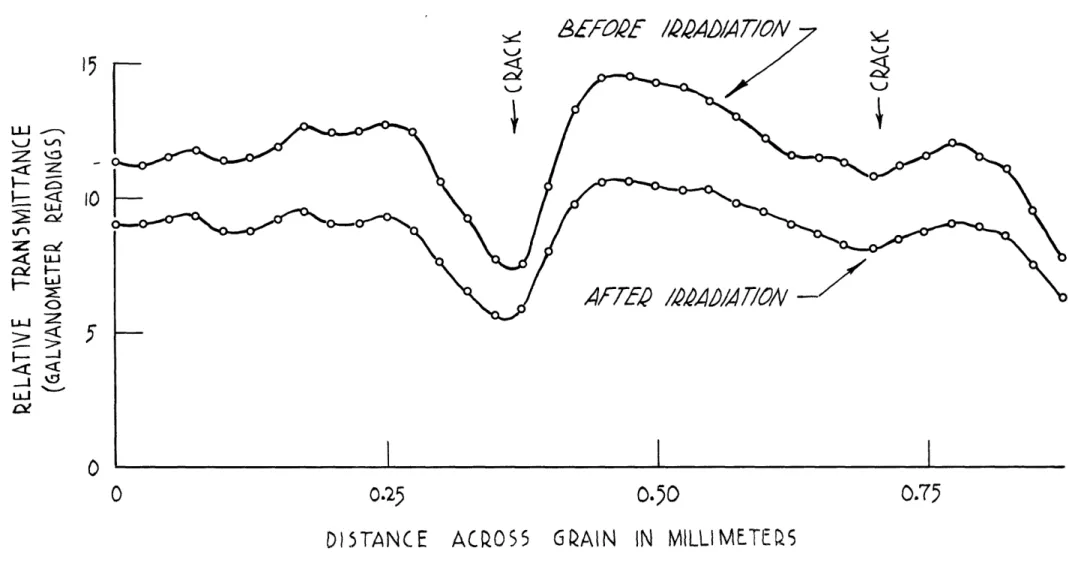
The error introduced by not reading values of trans-mittance for the same spot on a specimen on successive readings was reduced by photometry of a relatively large area in order that minor displacements would not make significant contri-butions. To test the precision with which the photometer could be reset a traverse was made across a quartz grain in a speci-men of granite. This specispeci-men was then irradiated for 15 min-utes and reread. Plots of the two curves are shown in Figure 7.
T he two low spots in the curves are due to cracks in the quartz crystal. It was determined that an error of 2% was introduced in the photometer readings.
The uniformity of intensity of the X-ray beam over the irradiated area was proven by exposing a piece of cover glass, which was found to transmit light uniformly over its entire area, and finding a uniform blackening over the exposed area. The uniformity of the X-ray beam is also brought out by the curves in Figure 7.
In spite of the relatively crude way in which the measurements were made, reasonable precision was attained. To determine the level of precision, three specimens each of
six granites, and two specimens each of three pegmatites were run.. (Table 4,).
DNOTOMETW(
T.AVU6S. t\U0O$
LUOT
Z
G6DAIN
FP.OM
GD1ANITE
Nt3M1E 8
/1Q"AIA77OW
ci
A14
fFL4/,4,4
e9NA
0.25
0.50
D)
5 TA
NC E
ACV055 G AIN IN MILLIME.TCM
S
Figure 7 ILl C) LU :2 -LJ ne -Z
TABLE 4 Sample Number Granite #4 Granite #9 Granite #13 Granite #2 Granite #14
%
of Blackening of Specimens at Saturation Thickness Constant .020 inches 4135
41 12 21 26 18.0 21.0 16.0 16 19 20 15
11 Variation in%
of Blackening Between Highest and Lowest Values 14 10 Granite #11 Pegmatite #1 (3 specimens) Variation in%
of Blackening between Highest and Lowest Values After 15 min. of irradiation 2 After 90 min. of irradiation 14 Peg. #10 (2 samples after Heating) Peg. #4 3.5 (2 samples .014 inches thick .020 inches thick 28,After 15 min. Peg.
#5
10 (2 samples .015 inches thick .020 inches thick After 90 min.6
IX. Presentation of Results
Data for samples are shown in plots of per cent of blackening versus time of irradiation:
Figure 8 Granitic and Rhyolitic Quartz Figure 9 Pegmatitic Quartz
Table 5 Gneissic and Schistose (Metamorphic) Quartz Table 6 Vein Quartz
Figure 10 Representative curves of All Types of Quartz Figures 11,
12 Geologic field data from two locations:
(1) a pegmatite dike cutting a gneiss
on Route 117 near Harvard, Mass. (Fig. 11.) (2) pegmatite dikes intruding Bolton Schist
in Strickland Quarry, Conn. (Fig. 12.)
29,
BLACKENING CURVE5
FoR
RHYOLTIC
&-
GRANITIC
QUAQTZ
#12 #7 #/ #5 #/O */3 I
I
--- p 0*8 '1 mma go - ~ m ax m~ U m -*e
G,4AN/T/C
QUAQTZ
o
/HYOIF/C
QUAdTZ
#13 #9go
V- - -- -o ol-9
to .0 a o. -do awe;0/45
60
IRRADIATION TIME IN MNUTE5
Figure 8 30. U z
z
z
L" -eZa
75
90
BLACKENING
CURVE5 FOP
PE6MATITIC QUARTZ
30
60
IRRADIATION
TIME IN MINUTE3
Figure 9(a)
31,*
50
U-1
u-i
z
uJ
co
40
30
20
|0
#12
(h)
#6
#7
90
BLACKENIN6
CUPVE5 FOR.
PEGMATITIC QLUAPTZ
Figure 9(b)
IRRADIATION
TIME
IN MlNUTE5
32.
70
60
50
z
ZuJ
z
z
U
#3
#9
40
30
20
10
TABLE
5
METAMORPHIC QUARTZES%
BLACKENING AT SATURATION 1.34.0
21.0 6.5 05.4
4.1 28.0TOTAL TIME OF IRRADIATION TO REACH SATURATION POINT
15 min. 15 30 30 15 15 30 " :33. SAMPLE Gneiss #7 #8
#9
#10 #11#5
#3
#6
Schist#6
#5
#1#7
#4
TABLE 6
VEIN QUARTZES
%
BLACKENING AT SATURATION28.0
TOTAL TIME OF IRRADIATION TO REACH SATURATION POINT
15 min.
:34*
SAMPLE #1#3
#4#5
#6
#7 #8
-~1~.---REPRE5ENTATIVE
BLACKENIN6 CUPVES
Z
z
U LUJz
(3z
40
30
20
10
RNY'OL/ TE# 7 PEGA4A T/TE # /0 0-- PEGMA/TE #2 0 o--- GRA/TE #2 0 --- E/V55 #9 5CH16 r*7 d- VE/NA'c c'30
45
60
0
0
Z
95
75
90
IRRADIATION
TIME IN M)NUTE5
Figure 10
1QRADIATION
BLACKEMING OF QLUARTZIN A PEGMATITE DIKE
ROUTE
17 NEAR HARVARD, MASS.
D----
-O----O--O---0-2
0
I' I' I' I ~ It Ii I *e
' I I I I I I I I J 'D15TANCE
IN FEET
36.
50-
40-
30-20-0
L.J I: 2: c 0 1 Figure 11IRQADIATION BLACKENING OF
QUATZ
IN DE6MATITE
DIKE5 AND
BOLTON SCHIST
5TRICKLAND
~-QY., CONN.
20
D15TANCE
IN
Figure 12 37.50-
40- 30- 20-\
0-L 0'0' / / / / / / / / / / /30
FEET
40X. Discussion of Experimental Results
The data obtained from study of a limited number of granite and rhyolite samples may be epitomized as follows:
(1) five out of seven rhyolitic quartz samples show blackening (at the saturation point) of over 45%, (2) only two out of eleven granitic quartz samples show blackening over 45%, and eight of the granite samples fall below 25%, (3) the highest blackening at saturation attained by any of the quartz samples irradiated was 76% for rhyolite quartz #12.
Many more samples will have to be run in order to determine the exact relationship between these two rock types.
All of the granite samples followed essentially the same shape
curve with the saturation point usually being reached at the end of 30 minutes of irradiation. The rhyolite curves are quite similar to those for the granites but are displaced
upward. Because of the limited number of granite and rhyolite samples examined, no correlation could be made between per cent of blackening and geologic origin.
Two differently shaped curves were found for
pegmatitic quartz. Unfortunately the geologic nature of many of the samples is not known, that is, whether a particular pegmatite sample is from a simple or complex pegmatite. Four of the ten pegmatitic quartz samples examined have blackening curves similar to those for granitic quartz. The other six samples, however, developed a characteristicly shaped curve,
which was not shown by any other type of quartz. Most of the pegmatities examined developed a blackening after 15 minutes of irradiation of 19.5% to 33%. The exceptions to
this are quartz from pegmatite #7 and from pegmatites nos. 11 and 12 (Figure 11, 12.) which were found in relatively narrow dikes.
Eight samples of pegmatite quartz from pegmatite
#11 were taken across an intrusive dike into a schist
country rock. The pegmatite is comprised of quartz, feldspar, muscovite and a few red garnets. All of the samples examined
showed hil darkening with the exception of #11 (g) which developed 36% blackening at saturation.
Eight samples of pegmatite quartz #12 were taken across contacts between intrusive dikes and a schist country rock in the Strickland Quarry, Connecticut. A distinct and possible gradational drop in blackening was noticed in those
samples taken in the pegmatite near the contact as compared with those taken some distance away from the contact.
Of the eight gneissic quartz samples examined, only one (gneiss quartz #10) showed a blackening at saturation of
samples
over 6.5% . Of the five schistose quartz/%xamined, four
developed no blackening at all. The one sample that did
(schist quartz
#5)
came from a high metamorphic grade kyanite schist.Of the eight vein quartzes (Table 6.) examined, only one (vein quartz #4), which contained graphite, showed any blackening
A limited number of spectra chemical analyses made in the Cabot Spectrographic Laboratory at M.I.T. shows the following relationships:
Relative Al Content,
%
of blackening(1. greatest) at saturation 1. Granitic Quartz #8 65
2.
#5
56
3.
#114
4.
#14 6 5. Vein #1 06.
"s
#5
0
40.XI. Comparison of Experimental Results With Other Work
The higher degree of blackening of rhyolitic quartz as compared with granitic quartz compares favorably with the work of Keith and Tuttle (1952) and Hayase (1961). Keith and Tuttle (1952) found that "the inversion temperatures of quartz from simple pegmatites fall in a comparatively narrow tempera-ture range whereas the range of inversion temperatempera-tures of quartz from zoned pegmatites is nearly as great as that of all other
types of quartz combined." As was mentioned before, two different
curves were developed by quartz samples from pegmatites, but unfortunately, it is not known which if either curve is characteristic of which type of pegmatite quartz.
"Granite Type" curves were developed for the samples (pegmatite quartz #12) taken in the Strickland Quarry,
Connecticut, (Figure 12,). The pegmatite in this area is com-plex, containing granite, albite, muscovite, tourmaline, and other minerals. Two of the samples (pegmatite quartzes
#'s
12 (a) and 12d developed blackening of 19.3% and 30.2%,
respectively, both of which fall into the range of blackening at the end of 15 minutes irradiation developed by most of
the other pegmatite samples. Both of these samples were taken some distance from the contact with the schist country rock.
The low per cent of blackening developed in schists, gneisses, and vein quartzes agrees with Hayase's findings. Keith and Tuttle found vein quartzes to have relatively high inversion temperatures indicating low amounts of (chemical ?) imperfections.
XII. Conclusions
1. Natural quartzes of different geologic origin are affected to different degrees and at different rates by
x-irradiation. These differences can be detected and quantitatively measured.
A. Rhyolitic quartz develops the greatest blackening of all types tested.
B. There are two different types of pegmatitic quartz:
(1) which develops blackening curves similar in
form to those of granitic quartz
(2) another which has uniquely shaped curves
C. Most gneissic quartz appears to develop little or no blackening.
D. Quartz samples from schists develop even less blackening than those from gneisses
E. Most vein quartz develops no blackening. 2. Zoning is rare in natural quartz.
3. The degree of blackening, in general, appears to be
related to the temperature of formation of the quartz.
A. Rhyolitic quartz, which crystallizes at a relatively
high temperature, shows the greatest blackening. B. Vein quartz, which crystallizes at a relatively
low temperature, in most cases, showed no blackening.
C. Intermediate amounts of blackening correlate with
intermediate temperatures of formation, 42.
D. In the intrusive pegmatite dikew examined it was
found that there was an increase in blackening away from the contact with the country rock.
XIII. Recommendations for Future Work
1. Ascertain the variability of blackening of quartz from
the same geologic body.
2. Determine whether quartz from different bodies of the same rock type can be distinguished.
3. Refine the ability to distinguish quartz from different rock types.
4. Experimental techniques should be refined.
a. Specimens should be crystallographically oriented and examined by a petrographic microscope.
b. A smaller area should be examined - a photo cell could be mounted in the eye piece of the microscope for light measurements.
5.
More spectrochemical analyses should be made.6. Absorption spectra should be obtained for all natural quartz types.
1. Discrepancy could be due to variation in blackening in zonesor variation in *"ray beam intensity over a relatively large area. It is within normal precision for this type of analysis,
References
Buerger, M.J., 1954. The Stuffed Derivatives of the Silicate Structure: Am. Mineralogist, vol. 39, p. 600.
Cohen, A.J., 1956.
Cohen, A.J., 1956.
Cohen, A.J., Sumner
Cohen, A.J., Hodge,
Cohen, A.J., 1960.
Dennen, W.H., 1959.
Color Centers in the C4 -Quartz
Called
Amethy8t! Am. Mineralogist, vol. 41, pp. 874-891. Anisotropic Color Centers in cX -Quartz. Part 1. Smokey Quartz: Jour. of Chem. Phys., vol. 25,
pp. 908-914.
G.G., 1958. Relationship Among Impurity
Contents, Color Centers, and Lattice Constants in Quartz: Am. Mineralogist, vol. 45, p. 58.
E.S,, 1958. Zonal Specificity and Nonspecificity of Certain Impurities During Growth of Snythetic
CC-Quartz: Jour. Phys. Chem. Solids,
vol. 7, p. 361.
Substitutional and Interstitial Aluminum
Impurity in Quartz, Structure and Color Center' Interrelationships: Int. Jour. of the Phys. and Chem. of Solids, vol. 13, pp. 321-325.
Principles of Mineralogy, The Roland Press Company, New York, pp. 105-110, 121.
References I
Frondel, C., Hurlbut, C.S. Final Report: Signal Corps Contract
D.A. 36-039 050 - 15350 Harvard University
Cambridge, Massachusetts
Griffiths, Owen and Ward, 1954. Defects in Crystalline Solids: Report of 1954 Bristol Conference, Nature, vol. 173, p. 439.
Hayase, I., 1961. Gamma Irradiation Effect on Quartz. (1): Bull. of the Inst. of Chem. R es., Kyoto University, vol. 39, pp. 133"137.
Keith, M.L., Tuttle, 0.F., 1952. Significance of Variation in the High-Low- Inversion of Quartz: Am.
Jour. of Science, Bowen vol. Part 1, pp. 202-252.
Keith, H.D., 1955. Lattice Spacings in Clear Crystalline Quartz
and Their Variability: Am. Mineralogist, vol. 4D,
p. 530.
Mason, B., 1958. Principles of Geochemistry, pp. 97-101. John Wiley and Sons, Inc., New York.
O'Brien, M.C.M., 1955. The Structure of the Colour Centres in Smoky Quartz: Proc. Roy. Soc. (London), vol. A231, p. 404.
Tuttle, O.F., 1949. The Variable Inversion Temperature of Quartz as a Possible Geologic Thermometer: Am.
Mineralogist, vol. 34, p. 723.
References
Vedeneeva, N.E., Rudnetskaya, E.S., 1952. Particularities of the Spectrum of Smoky Quartz as an Indication of the Structure of Its Color Centers: Doklady Akad. Nauk. S*.S-R-, vol. 87, p. 361* Chem. Abstracts, vol 47 (1953), p. 6259.
Willard, H. Furman, N.H. and Bricker, C.E., 1956. Elements of
Quantitative Analysis - Theory and Practice:
pp. 485-'486.
Appendix A. Instrument Used:
1. Photometer - a Hilger nonrecording microphotometer 2. X-ray Unit - a Phillips Norelco X-ray fluroesence unit
with a tungsten target FA-60 tubeoperated at 50 kilovolts and 40 milliampres.
B. Preparation of Quartz Specimens:
1. Each slice of quartz (specimen) from an individual rock
piece (sample) was cut approximately .030 inches thick.
2. It was then ground on an iron lap using carborundum
abrasive size 202; further ground on a copper lap using size FF: and then polished on the copper lap using size
303 abrasive.
3. All specimens prepared were .020 t .002 inches thick.
C. Measurement of Specimens on Microphotometer:
1. Entrance slit of instrument was opened to 6.0 mil.
2. All measurements were made in a darkened room.
3. If possible, a mark (L) was put on the quartz grain in a specimen and readings were made after alignment was made with the slit.
4. If the above procedure was not possible, the straightest edge of a grain was aligned with the slit and traverses were made horizontally and vertically across the grain to
determine the brightest spot.
D. Exposure of Specimens on X-ray machine:
1. A mask with a round hole one-half inch in diameter was
placed in the specimen holder.
2. Mylar plastic was placed over the mask to hold the specimen. It was determined that the mylar decreased the effectiveness of the X-ray beam by 4%.
E. Description and Geographic Location of Samples
Sample Description and Sample
location I. Granitic 2 4
5
7
8 9 11 13 14 16 17 QuartzGranodiorite - Lincoln Placer Co., California
Rocklin, California
Porphyritic granite - Southorn Slope of Pikes Peak, Colorado
Grey granite - Aberdeen, Gunnison Co., Colorado
Aummit of Pikes Peak, Colorado
Biotite granite - Ute Pass, Hamilton, Colorado
Granite Porphry Frotet Lake Area Chibougamau, P.Q.
Quincy Granite - Quincy, Mass. Red granite - Frotet Lake Area,
Chibougaman, P.Q.
"Blue-ryed" Quartz granite, Llano, Texas
Granite (aplite) - Cuts Peabody
Granite Batholith, Lawrence, Mass.
II. Pegmatitic Quartz
Smoky quartz - New England
Contains amazonite - Boston, Mass. Tourmaline pegmatite - Mt. Apatite,
Maine
Feldspar Quarry, South Glastonbury, Conn.
Green and Pink Tourmaline pegmatite Mt. Rubellite, Maine
Sample Description and Sample location
7
Pegmatite developed ingranodiorite-Bonner County, Idaho
9 Graphic Granite - Hale Quarry, Conn.
10 Smoky quartz - New England?
11 Garnet bearing pegmatite intruding biotite, quartz gneiss
-Harvard, Mass.
12 Quartz feldspar, muscovite tourmaline
pegmatite - Strickland, Quarry, Conn.
III. Vein Quartz
Vein quartz in greenstone -Chibougaman, P.Q.
2 Vein quartn - Tear Lake, Chibougaman, P.Q.
3
Vein quartz - in schist nearMontpelier, Vt.
4 Quartz veins containing
graphite-cutsschist - Johnsonburgh, N.Y.
5 Clear crystal quartr(contains no
aluminum or alkali elements). Location unknown
6 Vein quartz in slate - near Lyndon,
Vt.
7 Vein quartz - Squantum, Mass.
8 Vein quartz
(?)
contains wolframite-location unknown
IV. Schistose Quartz
1 Quartz Hornblende schist - North of Chipman Mi"e, Mass.
Sample Description and Sample location
4 Chrome Mica Schist - location
unknown
5
Kyanite Schist - New England6 Manhattan Schist - New York City
,7 Chlorite, Muscovite - schist-New England ?
V. Gneissic Quartz
3 Gneissoid Granite - Bedford, Mass,
5 Biotite Gneiss, Marlboro Formation
-Lincoln, Mass,
6 Injection (neiss
(migmatite) - Guiges Lake Area, Chibouaaman, P.Q.
7 Light grey fine grained, quartz
muscovite biotite gneiss -New England (?)
8 Pre-Cambrian (Grenville) para-gneiss,
containing garnet layers -Lk. Muskoka, Gravenhurst, Ont.
9 Banded Gneiss - Quobben Reservoir,
New E ngland
10 Banded Gneiss, with bands of biotite
mixed with quartz, feldspar, muscovite layers - New England Gneiss - Schist ? - New England
VI. Rhyolitic Quartz
1 Rhyolite - Castle Rock, Colorado
7 Light grey Rhyolite with
phenocrysts of quartz, hornblende and feldspar - New England (?)
Sample Description and Sample location
8 Rhyolite with brown ground mass
with phenocrysts of quartz and feldspar.
9 Rhyolite porphry - (?), Nevada
10 Rhyrolite prophry - near Spikarna, Alno, Sweden
12 Extrusive rock - on highway between
Bozen and Carezzo, South Tyrol, Italy
13 Quartz porphry - Meissen, Germany
VII. Crystal Quartz
a. Low temperature limestone crystals
-Herkimer, N.Y.
b. Hot springs crystal - Hot Springs, Arkansas
c. Smoky Quartz - New England
d. Crystal showing alternate growth bands of clear and milky quartz
-New England
VIII. Synthetic Quartz - Clevite Crystal No. 4-13