arXiv:hep-ex/0702030v1 20 Feb 2007
Combined D0 Measurements Constraining the CP-violating Phase and Width
Difference in the B
0s
System
V.M. Abazov,35 B. Abbott,75 M. Abolins,65 B.S. Acharya,28 M. Adams,51 T. Adams,49 E. Aguilo,5 S.H. Ahn,30 M. Ahsan,59 G.D. Alexeev,35 G. Alkhazov,39A. Alton,64,∗ G. Alverson,63 G.A. Alves,2 M. Anastasoaie,34 L.S. Ancu,34 T. Andeen,53 S. Anderson,45B. Andrieu,16 M.S. Anzelc,53 Y. Arnoud,13 M. Arov,52A. Askew,49 B. ˚Asman,40A.C.S. Assis Jesus,3O. Atramentov,49 C. Autermann,20 C. Avila,7C. Ay,23 F. Badaud,12A. Baden,61
L. Bagby,52 B. Baldin,50 D.V. Bandurin,59 P. Banerjee,28 S. Banerjee,28 E. Barberis,63A.-F. Barfuss,14 P. Bargassa,80 P. Baringer,58 C. Barnes,43 J. Barreto,2 J.F. Bartlett,50 U. Bassler,16 D. Bauer,43 S. Beale,5 A. Bean,58 M. Begalli,3 M. Begel,71 C. Belanger-Champagne,40L. Bellantoni,50 A. Bellavance,67 J.A. Benitez,65
S.B. Beri,26 G. Bernardi,16 R. Bernhard,22 L. Berntzon,14 I. Bertram,42 M. Besan¸con,17 R. Beuselinck,43 V.A. Bezzubov,38 P.C. Bhat,50 V. Bhatnagar,26 M. Binder,24 C. Biscarat,19 I. Blackler,43G. Blazey,52 F. Blekman,43 S. Blessing,49 D. Bloch,18K. Bloom,67 A. Boehnlein,50 D. Boline,62 T.A. Bolton,59 G. Borissov,42
K. Bos,33 T. Bose,77 A. Brandt,78 R. Brock,65 G. Brooijmans,70 A. Bross,50D. Brown,78 N.J. Buchanan,49 D. Buchholz,53 M. Buehler,81 V. Buescher,22S. Burdin,50 S. Burke,45T.H. Burnett,82 E. Busato,16C.P. Buszello,43
J.M. Butler,62 P. Calfayan,24S. Calvet,14 J. Cammin,71 S. Caron,33W. Carvalho,3B.C.K. Casey,77N.M. Cason,55 H. Castilla-Valdez,32 S. Chakrabarti,17 D. Chakraborty,52K. Chan,5 K.M. Chan,71 A. Chandra,48 F. Charles,18 E. Cheu,45 F. Chevallier,13 D.K. Cho,62S. Choi,31B. Choudhary,27L. Christofek,77T. Christoudias,43D. Claes,67
B. Cl´ement,18 C. Cl´ement,40 Y. Coadou,5 M. Cooke,80 W.E. Cooper,50 M. Corcoran,80 F. Couderc,17 M.-C. Cousinou,14 B. Cox,44S. Cr´ep´e-Renaudin,13D. Cutts,77 M. ´Cwiok,29H. da Motta,2 A. Das,62 B. Davies,42
G. Davies,43 K. De,78 P. de Jong,33 S.J. de Jong,34 E. De La Cruz-Burelo,64 C. De Oliveira Martins,3 J.D. Degenhardt,64 F. D´eliot,17M. Demarteau,50 R. Demina,71 D. Denisov,50 S.P. Denisov,38 S. Desai,50 H.T. Diehl,50 M. Diesburg,50 M. Doidge,42 A. Dominguez,67 H. Dong,72 L.V. Dudko,37 L. Duflot,15S.R. Dugad,28
D. Duggan,49 A. Duperrin,14 J. Dyer,65A. Dyshkant,52 M. Eads,67D. Edmunds,65J. Ellison,48 V.D. Elvira,50 Y. Enari,77 S. Eno,61 P. Ermolov,37H. Evans,54 A. Evdokimov,36V.N. Evdokimov,38 A.V. Ferapontov,59 T. Ferbel,71 F. Fiedler,24F. Filthaut,34 W. Fisher,50 H.E. Fisk,50 M. Ford,44M. Fortner,52 H. Fox,22 S. Fu,50 S. Fuess,50 T. Gadfort,82C.F. Galea,34E. Gallas,50E. Galyaev,55C. Garcia,71 A. Garcia-Bellido,82 V. Gavrilov,36 P. Gay,12 W. Geist,18D. Gel´e,18C.E. Gerber,51Y. Gershtein,49D. Gillberg,5G. Ginther,71N. Gollub,40B. G´omez,7
A. Goussiou,55 P.D. Grannis,72 H. Greenlee,50 Z.D. Greenwood,60E.M. Gregores,4G. Grenier,19 Ph. Gris,12 J.-F. Grivaz,15 A. Grohsjean,24 S. Gr¨unendahl,50 M.W. Gr¨unewald,29 F. Guo,72 J. Guo,72 G. Gutierrez,50 P. Gutierrez,75A. Haas,70 N.J. Hadley,61P. Haefner,24 S. Hagopian,49J. Haley,68 I. Hall,75 R.E. Hall,47 L. Han,6 K. Hanagaki,50 P. Hansson,40K. Harder,44A. Harel,71 R. Harrington,63 J.M. Hauptman,57R. Hauser,65 J. Hays,43
T. Hebbeker,20 D. Hedin,52 J.G. Hegeman,33 J.M. Heinmiller,51 A.P. Heinson,48 U. Heintz,62 C. Hensel,58 K. Herner,72 G. Hesketh,63 M.D. Hildreth,55 R. Hirosky,81J.D. Hobbs,72B. Hoeneisen,11 H. Hoeth,25M. Hohlfeld,15 S.J. Hong,30R. Hooper,77 P. Houben,33Y. Hu,72 Z. Hubacek,9 V. Hynek,8 I. Iashvili,69R. Illingworth,50A.S. Ito,50 S. Jabeen,62 M. Jaffr´e,15S. Jain,75 K. Jakobs,22 C. Jarvis,61A. Jenkins,43 R. Jesik,43K. Johns,45 C. Johnson,70
M. Johnson,50A. Jonckheere,50P. Jonsson,43 A. Juste,50D. K¨afer,20S. Kahn,73 E. Kajfasz,14 A.M. Kalinin,35 J.M. Kalk,60 J.R. Kalk,65S. Kappler,20D. Karmanov,37J. Kasper,62 P. Kasper,50 I. Katsanos,70D. Kau,49 R. Kaur,26 R. Kehoe,79 S. Kermiche,14 N. Khalatyan,62 A. Khanov,76 A. Kharchilava,69Y.M. Kharzheev,35 D. Khatidze,70H. Kim,31 T.J. Kim,30 M.H. Kirby,34 B. Klima,50 J.M. Kohli,26 J.-P. Konrath,22 M. Kopal,75 V.M. Korablev,38J. Kotcher,73B. Kothari,70 A. Koubarovsky,37 A.V. Kozelov,38D. Krop,54A. Kryemadhi,81 T. Kuhl,23A. Kumar,69S. Kunori,61A. Kupco,10T. Kurˇca,19 J. Kvita,8D. Lam,55 S. Lammers,70G. Landsberg,77
J. Lazoflores,49 P. Lebrun,19W.M. Lee,50A. Leflat,37F. Lehner,41V. Lesne,12 J. Leveque,45P. Lewis,43J. Li,78 L. Li,48 Q.Z. Li,50S.M. Lietti,4J.G.R. Lima,52 D. Lincoln,50J. Linnemann,65V.V. Lipaev,38 R. Lipton,50 Z. Liu,5
L. Lobo,43A. Lobodenko,39M. Lokajicek,10A. Lounis,18P. Love,42H.J. Lubatti,82 M. Lynker,55 A.L. Lyon,50 A.K.A. Maciel,2R.J. Madaras,46P. M¨attig,25 C. Magass,20 A. Magerkurth,64 N. Makovec,15 P.K. Mal,55 H.B. Malbouisson,3 S. Malik,67 V.L. Malyshev,35 H.S. Mao,50 Y. Maravin,59 B. Martin,13 R. McCarthy,72 A. Melnitchouk,66 A. Mendes,14 L. Mendoza,7P.G. Mercadante,4 M. Merkin,37 K.W. Merritt,50 A. Meyer,20 J. Meyer,21M. Michaut,17H. Miettinen,80T. Millet,19J. Mitrevski,70 J. Molina,3 R.K. Mommsen,44N.K. Mondal,28
E. Nagy,14 M. Naimuddin,50 M. Narain,77 N.A. Naumann,34 H.A. Neal,64 J.P. Negret,7 P. Neustroev,39 H. Nilsen,22 C. Noeding,22 A. Nomerotski,50 S.F. Novaes,4 T. Nunnemann,24 V. O’Dell,50 D.C. O’Neil,5 G. Obrant,39 C. Ochando,15V. Oguri,3 N. Oliveira,3D. Onoprienko,59N. Oshima,50J. Osta,55 R. Otec,9G.J. Otero y Garz´on,51
M. Owen,44P. Padley,80M. Pangilinan,62 N. Parashar,56S.-J. Park,71 S.K. Park,30 J. Parsons,70R. Partridge,77 N. Parua,72 A. Patwa,73G. Pawloski,80 P.M. Perea,48K. Peters,44Y. Peters,25 P. P´etroff,15 M. Petteni,43 R. Piegaia,1J. Piper,65M.-A. Pleier,21P.L.M. Podesta-Lerma,32,§V.M. Podstavkov,50Y. Pogorelov,55M.-E. Pol,2
A. Pompoˇs,75B.G. Pope,65A.V. Popov,38C. Potter,5W.L. Prado da Silva,3 H.B. Prosper,49 S. Protopopescu,73 J. Qian,64 A. Quadt,21 B. Quinn,66 M.S. Rangel,2K.J. Rani,28 K. Ranjan,27 P.N. Ratoff,42 P. Renkel,79
S. Reucroft,63 M. Rijssenbeek,72 I. Ripp-Baudot,18 F. Rizatdinova,76 S. Robinson,43 R.F. Rodrigues,3 C. Royon,17P. Rubinov,50 R. Ruchti,55 G. Sajot,13 A. S´anchez-Hern´andez,32 M.P. Sanders,16 A. Santoro,3 G. Savage,50 L. Sawyer,60 T. Scanlon,43 D. Schaile,24 R.D. Schamberger,72 Y. Scheglov,39H. Schellman,53 P. Schieferdecker,24C. Schmitt,25 C. Schwanenberger,44A. Schwartzman,68 R. Schwienhorst,65 J. Sekaric,49
S. Sengupta,49 H. Severini,75 E. Shabalina,51 M. Shamim,59 V. Shary,17 A.A. Shchukin,38 R.K. Shivpuri,27 D. Shpakov,50 V. Siccardi,18 R.A. Sidwell,59 V. Simak,9 V. Sirotenko,50 P. Skubic,75 P. Slattery,71D. Smirnov,55
R.P. Smith,50 G.R. Snow,67 J. Snow,74 S. Snyder,73 S. S¨oldner-Rembold,44 L. Sonnenschein,16A. Sopczak,42 M. Sosebee,78 K. Soustruznik,8 M. Souza,2 B. Spurlock,78 J. Stark,13J. Steele,60 V. Stolin,36 A. Stone,51 D.A. Stoyanova,38 J. Strandberg,64 S. Strandberg,40 M.A. Strang,69 M. Strauss,75 R. Str¨ohmer,24 D. Strom,53
M. Strovink,46 L. Stutte,50 S. Sumowidagdo,49 P. Svoisky,55 A. Sznajder,3 M. Talby,14 P. Tamburello,45 W. Taylor,5P. Telford,44 J. Temple,45B. Tiller,24 F. Tissandier,12M. Titov,22 V.V. Tokmenin,35 M. Tomoto,50
T. Toole,61 I. Torchiani,22 T. Trefzger,23S. Trincaz-Duvoid,16 D. Tsybychev,72 B. Tuchming,17 C. Tully,68 P.M. Tuts,70 R. Unalan,65L. Uvarov,39 S. Uvarov,39 S. Uzunyan,52B. Vachon,5 P.J. van den Berg,33B. van Eijk,35
R. Van Kooten,54 W.M. van Leeuwen,33 N. Varelas,51 E.W. Varnes,45 A. Vartapetian,78 I.A. Vasilyev,38 M. Vaupel,25 P. Verdier,19 L.S. Vertogradov,35M. Verzocchi,50F. Villeneuve-Seguier,43 P. Vint,43 J.-R. Vlimant,16
E. Von Toerne,59 M. Voutilainen,67,‡ M. Vreeswijk,33H.D. Wahl,49L. Wang,61M.H.L.S Wang,50 J. Warchol,55 G. Watts,82 M. Wayne,55 G. Weber,23 M. Weber,50 H. Weerts,65 A. Wenger,22,# N. Wermes,21 M. Wetstein,61
A. White,78 D. Wicke,25 G.W. Wilson,58 S.J. Wimpenny,48 M. Wobisch,50 D.R. Wood,63 T.R. Wyatt,44 Y. Xie,77 S. Yacoob,53 R. Yamada,50 M. Yan,61 T. Yasuda,50 Y.A. Yatsunenko,35 K. Yip,73 H.D. Yoo,77 S.W. Youn,53 C. Yu,13 J. Yu,78 A. Yurkewicz,72 A. Zatserklyaniy,52C. Zeitnitz,25 D. Zhang,50 T. Zhao,82
B. Zhou,64 J. Zhu,72 M. Zielinski,71 D. Zieminska,54 A. Zieminski,54 V. Zutshi,52 and E.G. Zverev37 (DØ Collaboration)
1Universidad de Buenos Aires, Buenos Aires, Argentina 2LAFEX, Centro Brasileiro de Pesquisas F´ısicas, Rio de Janeiro, Brazil
3Universidade do Estado do Rio de Janeiro, Rio de Janeiro, Brazil 4Instituto de F´ısica Te´orica, Universidade Estadual Paulista, S˜ao Paulo, Brazil
5University of Alberta, Edmonton, Alberta, Canada, Simon Fraser University, Burnaby, British Columbia, Canada,
York University, Toronto, Ontario, Canada, and McGill University, Montreal, Quebec, Canada
6University of Science and Technology of China, Hefei, People’s Republic of China 7Universidad de los Andes, Bogot´a, Colombia
8Center for Particle Physics, Charles University, Prague, Czech Republic 9Czech Technical University, Prague, Czech Republic
10Center for Particle Physics, Institute of Physics, Academy of Sciences of the Czech Republic, Prague, Czech Republic 11Universidad San Francisco de Quito, Quito, Ecuador
12Laboratoire de Physique Corpusculaire, IN2P3-CNRS, Universit´e Blaise Pascal, Clermont-Ferrand, France 13Laboratoire de Physique Subatomique et de Cosmologie, IN2P3-CNRS, Universite de Grenoble 1, Grenoble, France
14CPPM, IN2P3-CNRS, Universit´e de la M´editerran´ee, Marseille, France
15Laboratoire de l’Acc´el´erateur Lin´eaire, IN2P3-CNRS et Universit´e Paris-Sud, Orsay, France 16LPNHE, IN2P3-CNRS, Universit´es Paris VI and VII, Paris, France
17DAPNIA/Service de Physique des Particules, CEA, Saclay, France
18IPHC, IN2P3-CNRS, Universit´e Louis Pasteur, Strasbourg, France, and Universit´e de Haute Alsace, Mulhouse, France 19IPNL, Universit´e Lyon 1, CNRS/IN2P3, Villeurbanne, France and Universit´e de Lyon, Lyon, France
20III. Physikalisches Institut A, RWTH Aachen, Aachen, Germany 21Physikalisches Institut, Universit¨at Bonn, Bonn, Germany 22Physikalisches Institut, Universit¨at Freiburg, Freiburg, Germany
23Institut f¨ur Physik, Universit¨at Mainz, Mainz, Germany 24Ludwig-Maximilians-Universit¨at M¨unchen, M¨unchen, Germany 25Fachbereich Physik, University of Wuppertal, Wuppertal, Germany
27Delhi University, Delhi, India
28Tata Institute of Fundamental Research, Mumbai, India 29University College Dublin, Dublin, Ireland 30Korea Detector Laboratory, Korea University, Seoul, Korea
31SungKyunKwan University, Suwon, Korea 32CINVESTAV, Mexico City, Mexico
33FOM-Institute NIKHEF and University of Amsterdam/NIKHEF, Amsterdam, The Netherlands 34Radboud University Nijmegen/NIKHEF, Nijmegen, The Netherlands
35Joint Institute for Nuclear Research, Dubna, Russia 36Institute for Theoretical and Experimental Physics, Moscow, Russia
37Moscow State University, Moscow, Russia 38Institute for High Energy Physics, Protvino, Russia 39Petersburg Nuclear Physics Institute, St. Petersburg, Russia
40Lund University, Lund, Sweden, Royal Institute of Technology and Stockholm University, Stockholm, Sweden, and
Uppsala University, Uppsala, Sweden
41Physik Institut der Universit¨at Z¨urich, Z¨urich, Switzerland 42Lancaster University, Lancaster, United Kingdom
43Imperial College, London, United Kingdom 44University of Manchester, Manchester, United Kingdom
45University of Arizona, Tucson, Arizona 85721, USA
46Lawrence Berkeley National Laboratory and University of California, Berkeley, California 94720, USA 47California State University, Fresno, California 93740, USA
48University of California, Riverside, California 92521, USA 49Florida State University, Tallahassee, Florida 32306, USA 50Fermi National Accelerator Laboratory, Batavia, Illinois 60510, USA
51University of Illinois at Chicago, Chicago, Illinois 60607, USA 52Northern Illinois University, DeKalb, Illinois 60115, USA
53Northwestern University, Evanston, Illinois 60208, USA 54Indiana University, Bloomington, Indiana 47405, USA 55University of Notre Dame, Notre Dame, Indiana 46556, USA
56Purdue University Calumet, Hammond, Indiana 46323, USA 57Iowa State University, Ames, Iowa 50011, USA 58University of Kansas, Lawrence, Kansas 66045, USA 59Kansas State University, Manhattan, Kansas 66506, USA 60Louisiana Tech University, Ruston, Louisiana 71272, USA 61University of Maryland, College Park, Maryland 20742, USA
62Boston University, Boston, Massachusetts 02215, USA 63Northeastern University, Boston, Massachusetts 02115, USA
64University of Michigan, Ann Arbor, Michigan 48109, USA 65Michigan State University, East Lansing, Michigan 48824, USA
66University of Mississippi, University, Mississippi 38677, USA 67University of Nebraska, Lincoln, Nebraska 68588, USA 68Princeton University, Princeton, New Jersey 08544, USA 69State University of New York, Buffalo, New York 14260, USA
70Columbia University, New York, New York 10027, USA 71University of Rochester, Rochester, New York 14627, USA 72State University of New York, Stony Brook, New York 11794, USA
73Brookhaven National Laboratory, Upton, New York 11973, USA 74Langston University, Langston, Oklahoma 73050, USA 75University of Oklahoma, Norman, Oklahoma 73019, USA 76Oklahoma State University, Stillwater, Oklahoma 74078, USA
77Brown University, Providence, Rhode Island 02912, USA 78University of Texas, Arlington, Texas 76019, USA 79Southern Methodist University, Dallas, Texas 75275, USA
80Rice University, Houston, Texas 77005, USA 81University of Virginia, Charlottesville, Virginia 22901, USA
82University of Washington, Seattle, Washington 98195, USA
(Dated: February 20, 2007)
We combine the D0 measurement of the width difference between the light and heavy B0 s mass
eigenstates and of the CP-violating mixing phase determined from the time-dependent angular distributions in the B0
s → J/ψφ decays along with the charge asymmetry in semileptonic decays
flavor-specific B0
s lifetime, we obtain ∆Γs ≡ (ΓL− ΓH) = 0.13 ± 0.09 ps−1 and φs= −0.70+0.47 −0.39.
The data sample corresponds to an integrated luminosity of 1.1 fb−1 accumulated with the D0
detector at the Fermilab Tevatron Collider.
PACS numbers: 13.25.Hw, 11.30.Er
One of the great challenges for elementary particle physics is to trace all possible sources of the violation of CP symmetry. In the standard model (SM) of parti-cle physics, CP symmetry is violated through the CKM mechanism [1]. Although the SM picture of CP viola-tion has so far been confirmed by all laboratory mea-surements, it has an unsolved problem: the level of CP violation in the SM is too small to produce the observed baryon number density in the universe [2]. Sources of CP violation beyond the CKM mechanism must, therefore, exist to account for the deficit. One source of CP viola-tion arises in the mixing of doublets of neutral mesons. CP violation in K0 mesons, composed of a down quark and a strange quark, was discovered 40 years ago [3]. The B0
smesons are similar quark-antiquark bound states, with the down quark replaced by a bottom quark.
In the SM, the light (L) and heavy (H) mass eigen-states of the mixed B0
s system are expected to have size-able mass and decay width differences: ∆Ms≡ MH−ML and ∆Γs ≡ ΓL − ΓH. The two mass eigenstates are expected to be almost pure CP eigenstates. The CP-violating mixing phase is predicted [4] to be φs= (4.2 ± 1.4) × 10−3. New phenomena may alter φ
sleading to a reduction of the observed ∆Γscompared to the SM pre-diction [4] ∆ΓSM
s : ∆Γs= ∆ΓSMs × | cos φs|. While Bs0– ¯
B0
s oscillations have been detected [5] and the mass dif-ference has recently been measured to high precision [6], the CP-violating phase remains unknown. The D0 ex-periment [7] at the Fermilab Tevatron Collider has con-ducted a series of studies [8, 9, 10, 11] of B0
s mesons produced in proton-antiproton (p¯p) interactions. This Letter utilises these results to obtain the best estimate of the CP-violating phase in the B0
s system. In Ref. [8], we studied the decay sequence B0
s → J/ψφ, J/ψ → µ+µ−, φ → K+K−. From a fit to the time-dependent angular distribution of the decay products, we obtained the mean lifetime, τs = 1/Γs (where Γs ≡ (ΓH + ΓL)/2), ∆Γs, and the first direct constraint on φs. As discussed in Ref. [8], there is a 4-fold ambiguity in the result for φs: ±φs and ±(π − φs). The sign of sin φs is reversed with the simultaneous reversal of the signs of the cosines of the CP-conserving strong phases δ1and δ2. (We adopted the amplitude definition and sign convention of Ref. [12]). The possible solutions are
|φs| = 0.79 ± 0.56 (stat)+0.01−0.14(syst), ∆Γs = 0.17 ± 0.08 (stat) ± 0.02 (syst) ps−1;
|φs| = 2.35 ± 0.56 (stat)+0.14−0.01(syst),
∆Γs = −0.17 ± 0.08 (stat) ± 0.02 (syst) ps−1;
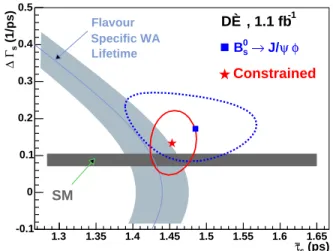
(1) The first two solutions are consistent with the SM pre-diction [4]. (ps) s τ 1.3 1.35 1.4 1.45 1.5 1.55 1.6 1.65 (1/ps) s Γ ∆ -0.1 0 0.1 0.2 0.3 0.4 0.5 φ ψ J/ → 0 s B SM Flavour DØ , 1.1 fb-1 Constrained Specific WA Lifetime
FIG. 1: The error ellipse (∆ ln(L) = 0.5) in the plane ∆Γs
versus τsfor the fit to the B0s → J/ψφ data (dashed blue line)
and for the fit with the constraint from the two D0 measure-ments of the charge asymmetry in semileptonic B0
sdecay, and
from the world average flavor-specific lifetime (solid red line). Also shown is a one-σ band representing the world average re-sult [14] for τfsand a one-σ band representing the theoretical
prediction ∆ΓSM
s = 0.088 ± 0.017 ps−1 [4]. [color online]
Flavor-specific decays of B0
s mesons provide indepen-dent constraints on the parameters of the system. An ef-fective mean lifetime, resulting from a single-exponential fit to the decay time distribution, τfs= 1/Γfs, is related to the physics parameters Γsand ∆Γsthrough the equa-tion Γfs = Γs− (∆Γs)2/2Γs + O(∆Γs)3/Γ
2
s [13]. We use the world-average value, τfs= 1/Γfs= 1.440 ± 0.036 ps [14], from a fit including the recent D0 measurement, τfs= 1/Γfs= 1.398 ± 0.044 (stat)+0.028−0.025(syst) ps [9].
Independently, we obtained another constraint on the parameters of the B0
s system from the measurements of the semileptonic charge asymmetry induced by B0
s mix-ing. In general, the semileptonic charge asymmetry is defined as [15]: AqSL= N ( ¯B 0 q → ℓ+X) − N (Bq0→ ℓ−X) N ( ¯B0 q → ℓ+X) + N (Bq0→ ℓ−X) . (2)
It is related to the CP phase φq by [16]:
AqSL= ∆Γq ∆Mq
In Ref. [10], we measured the same-sign dimuon charge asymmetry defined as:
AµµSL =N (b¯b → µ
+µ+X) − N (b¯b → µ−µ−X) N (b¯b → µ+µ+X) + N (b¯b → µ−µ−X). (4)
Both B0
dand Bs0contribute to this quantity [17], and the result of Ref. [10] is given as:
Ad SL + fsZs fdZd As SL= = −0.0092 ± 0.0044 (stat) ± 0.0032 (syst); (5) Zq = 1 1 − y2 q − 1 1 + x2 q ; xq = ∆Mq/Γq; yq = ∆Γq/(2Γq); where Ad
SLand AsSLare the charge asymmetries of the B 0 d and B0
s semileptonic decays, and fd and fsare the pro-duction rates of B0
d and B 0
s mesons in the hadronization of the b quark, respectively. In deriving relation (5), it is assumed that there is no direct CP violation in semilep-tonic B decays and that the semilepsemilep-tonic width of all B mesons is the same. Using the world-average values [15] fd= 0.398±0.012, fs= 0.103±0.014, xd= 0.776±0.008, and Zd= 0.376 ± 0.006 we obtain:
fsZs fdZd
= 0.70 ± 0.07 (syst) ± 0.10 (PDG). (6)
The value of Zs was computed using the measured val-ues of ∆Γs [8], τs [8], and ∆Ms [6]: Zs = 1.015+0.018−0.010. We have tested that propagating the Zs dependence on ∆Γs has negligible effect on the final results. The sys-tematic uncertainty arises mainly from a conservative es-timate of a possible variation in the reconstruction effi-ciency of muons from semileptonic decays of different B mesons [18].
The asymmetry Ad
SL has been measured at B facto-ries where only B0
d and B± mesons are produced. The average value of Ad
SL is [14]: AdSL = −0.0047 ± 0.0046. Combining this value and (5,6), and adding statistical and systematic uncertainties in quadrature, we obtain:
AsSL = −0.0064 ± 0.0101. (7)
In Ref. [11], we measured As
SL directly by using all events with at least one muon that were consistent with the sequential decay B0
s → µνDs with Ds → φπ. The result of this measurement is:
As
SL= +0.0245 ± 0.0193 (stat) ± 0.0035 (syst). (8) The measurements (7) and (8) are nearly independent since the fraction of dimuon final states in the sam-ple of semileptonic B0
s decays used in Ref. [11] is only about 10% [19], and the fraction of semileptonic decays B0
s → µνDswith Ds→ φπ in the dimuon sample used in
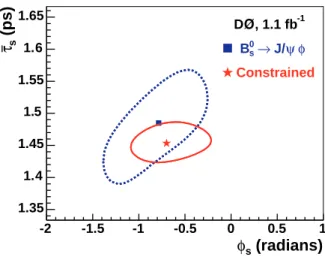
(radians) s φ -2 -1.5 -1 -0.5 0 0.5 1 (ps)s τ 1.35 1.4 1.45 1.5 1.55 1.6 1.65 φ ψ J/ → 0 s B -1 D , 1.1 fb Constrained
FIG. 2: The error ellipse (∆ ln(L) = 0.5) in the plane (τs,
φs) for the fit to the Bs0→ J/ψφ data (dashed blue line) and
for the fit with the constraint from the two D0 measurements of the charge asymmetry in semileptonic B0
s decay, and from
the world average flavor-specific lifetime (solid red line).[color online] (radians) s φ -3 -2 -1 0 1 2 3 (1/ps) s Γ ∆ -0.5 -0.4 -0.3 -0.2 -0.1 -0 0.1 0.2 0.3 0.4 0.5 φ ψ J/ → 0 s B -1 DØ , 1.1 fb Constrained Combined semileptonic asymmetry charge band )| s φ |cos( × SM s Γ ∆ = Γ ∆ SM
FIG. 3: The error ellipse (∆ ln(L) = 0.5) in the plane (∆Γs,
φs) for the fit to the Bs0→ J/ψφ data (dashed blue line)
and for the fit with the constraint from the two D0 mea-surements of the charge asymmetry in semileptonic B0
s decay,
and from the world average flavor-specific lifetime (solid red line). The central values for all four solutions of the uncon-strained fit are indicated by blue squares. Also shown is the band representing the relation ∆Γs= ∆Γ
SM
s × | cos φs|, with
∆ΓSM
s = 0.088 ± 0.017 ps−1 [4] (dark shade), and the area
corresponding to Eq. 10 (light shade) . [color online]
Ref. [10] is less than 1%. Also, the systematic uncertain-ties of the two measurements are uncorrelated. The main source of systematic uncertainty in (7) is the correction due to K±decays, while in the case of the measurement (8) it is the fitting procedure.
Their combination gives the best estimate of the charge asymmetry in semileptonic B0
s decays:
AsSL= 0.0001 ± 0.0090. (9) Using relation (3) and the result ∆Ms= 17.8 ± 0.1 ps−1
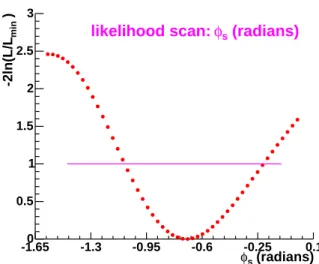
from the CDF experiment [6], we obtain: ∆Γs· tan φs= AsSL· ∆Ms= 0.02 ± 0.16 ps−1. (10) (radians) s φ -1.65 -1.3 -0.95 -0.6 -0.25 0.1 ) min -2ln(L/L 0 0.5 1 1.5 2 2.5 3 (radians) s φ likelihood scan:
FIG. 4: The likelihood scan versus φs for the constrained fit
(see text).
We have repeated the fit to the B0
s→ J/ψφ data, in-cluding the constraints from Eq. 10, and from the world-average measurement of τfs discussed earlier. To illus-trate the fit results and the impact of the constraints, in Figs. 1 – 3 we present likelihood contours in three planes, ∆Γs versus τs, τs versus φs, and ∆Γs versus φs, respectively. The contours indicate error ellipses, ∆ ln(L) = 0.5, corresponding to the confidence level of 39%. The 4-fold ambiguity remains unresolved. The like-lihood profile as a function of φs for the first solution listed in Eq. 1 is shown in Fig. 4. The extracted value of φsdeviates from zero by 1.2 standard deviations.
In summary, for the solution with φs < 0, cos δ1 > 0 and cos δ2 < 0, we find the decay width difference and the CP-violating phase in the B0
s system to be: ∆Γs = 0.13 ± 0.09 ps−1,
φs = −0.70+0.47−0.39. (11)
The measurement uncertainty is dominated by the lim-ited statistics. The systematic uncertainties include a variation of the background model in the analysis of the decay B0
s → J/ψφ, detector acceptance, and sensitivity to the details of the track and vertex reconstruction. The results are consistent with the SM predictions [4].
We thank the staffs at Fermilab and collaborating in-stitutions, and acknowledge support from the DOE and NSF (USA); CEA and CNRS/IN2P3 (France); FASI,
Rosatom and RFBR (Russia); CAPES, CNPq, FAPERJ, FAPESP and FUNDUNESP (Brazil); DAE and DST (India); Colciencias (Colombia); CONACyT (Mexico); KRF and KOSEF (Korea); CONICET and UBACyT (Argentina); FOM (The Netherlands); PPARC (United Kingdom); MSMT (Czech Republic); CRC Program, CFI, NSERC and WestGrid Project (Canada); BMBF and DFG (Germany); SFI (Ireland); The Swedish Re-search Council (Sweden); ReRe-search Corporation; Alexan-der von Humboldt Foundation; and the Marie Curie Pro-gram.
[1] M. Kobayashi and T. Maskawa, Prog. Theor. Phys., 49, 652 (1973).
[2] P. Huet and E. Sather, Phys. Rev. D 51, 379 (1995). [3] J.H. Christenson, J.W. Cronin, V.L. Fitch and R. Turlay,
Phys. Rev. Lett. 13, 138 (1964).
[4] A. Lenz, and U. Nierste, hep-ph/0612167.
[5] D0 Collaboration, V.M. Abazov et al., Phys. Rev. Lett. 97, 021802 (2006).
[6] CDF Collaboration, A. Abulencia et al., Phys. Rev. Lett. 97, 242003 (2006);
[7] D0 Collaboration, V.M. Abazov et al., Nucl. Instrum. Methods Phys. Res. A 565, 463 (2006).
[8] D0 Collaboration, V.M. Abazov et al., submitted to Phys. Rev. Lett., hep-ex/0701012.
[9] D0 Collaboration, V.M. Abazov et al., Phys. Rev. Lett., 97, 241801 (2006).
[10] D0 Collaboration, V.M. Abazov et al., Phys. Rev. D 74, 092001 (2006).
[11] D0 Collaboration, V.M. Abazov et al., submitted to Phys. Rev. Lett., hep-ex/0701007.
[12] A.S. Dighe, I. Dunietz, and R. Fleischer, Phys. Lett. B 433, 147 (1998); K. Anikeev et al., “B physics at the Tevatron: Run II and beyond,” FERMILAB-Pub-01/197, hep-ph/0201071, p. 375.
[13] K. Anikeev et al., “B physics at the Tevatron: Run II and beyond,” FERMILAB-Pub-01/197, hep-ph/0201071, p. 360.
[14] E. Barberio et al. [Heavy Flavor Averaging Group (HFAG)], “Averages of b-hadron properties as of fall 2006,” in preparation.
[15] W. M. Yao et al. (Particle Data Group), J. Phys. G 33, 1 (2006).
[16] M. Beneke, G. Buchalla, A. Lenz and U. Nierste, Phys. Lett. B 576, 173 (2003).
[17] Y. Grossman, Y. Nir, and G. Raz, “Constraining the Phase of Bs – BsMixing”, hep-ph/0605028v2.
[18] D0 Collaboration, V.M. Abazov et al., Phys. Rev. Lett. 94, 182001 (2005).
[19] D0 Collaboration, V.M. Abazov et al., Phys. Rev. D 74, 112002 (2006).