Publisher’s version / Version de l'éditeur:
Journal of the Electrochemical Society, 156, 1, pp. A60-A65, 2009
READ THESE TERMS AND CONDITIONS CAREFULLY BEFORE USING THIS WEBSITE. https://nrc-publications.canada.ca/eng/copyright
Vous avez des questions? Nous pouvons vous aider. Pour communiquer directement avec un auteur, consultez la première page de la revue dans laquelle son article a été publié afin de trouver ses coordonnées. Si vous n’arrivez pas à les repérer, communiquez avec nous à [email protected].
Questions? Contact the NRC Publications Archive team at
[email protected]. If you wish to email the authors directly, please see the first page of the publication for their contact information.
NRC Publications Archive
Archives des publications du CNRC
This publication could be one of several versions: author’s original, accepted manuscript or the publisher’s version. / La version de cette publication peut être l’une des suivantes : la version prépublication de l’auteur, la version acceptée du manuscrit ou la version de l’éditeur.
For the publisher’s version, please access the DOI link below./ Pour consulter la version de l’éditeur, utilisez le lien DOI ci-dessous.
https://doi.org/10.1149/1.3023084
Access and use of this website and the material on it are subject to the Terms and Conditions set forth at
High-voltage electrolytes based on adiponitrole for Li-ion batteries
Abu-Lebdeh, Yaser; Davidson, Isobel
https://publications-cnrc.canada.ca/fra/droits
L’accès à ce site Web et l’utilisation de son contenu sont assujettis aux conditions présentées dans le site LISEZ CES CONDITIONS ATTENTIVEMENT AVANT D’UTILISER CE SITE WEB.
NRC Publications Record / Notice d'Archives des publications de CNRC:
https://nrc-publications.canada.ca/eng/view/object/?id=74e531a4-e26e-4a2b-90f5-17061355d213
https://publications-cnrc.canada.ca/fra/voir/objet/?id=74e531a4-e26e-4a2b-90f5-17061355d213
High-Voltage Electrolytes Based on Adiponitrile for Li-Ion
Batteries
Yaser Abu-Lebdeh
*
,zand Isobel Davidson*
National Research Council Canada, Ottawa, Ontario K1A 0R6, Canada
Adiponitrile, CN关CH2兴4CN, ADN, was evaluated as both a solvent and cosolvent in safer and more electrochemically stable electrolytes suitable for high energy and power density Li-ion batteries. An electrochemical investigation of its electrolyte solution with the Li共CF3SO2兲2N, LiTFSI, salt showed a wide electrochemical window of 6 V vs Li+/Li. The high melting point and the
incompatibility of ADN with graphite anode required the use of ethylene carbonate 共EC兲 as a cosolvent. The resultant EC:ADN electrolyte solutions showed ionic conductivities reaching 3.4 mS/cm, viscosities of 9.2 cP, and an improved resistance to alu-minum corrosion up to 4.4 V, all at 20°C. Li-ion batteries incorporating graphite/LiCoO2 electrodes were assembled using
EC:ADN electrolyte mixture containing 1 M LiTFSI and 0.1 M LiBOB as a cosalt, and discharge capacities of 108 mAh/g with very good capacity retention were obtained. AC impedance spectra of the batteries recorded as a function of charging and cycling indicated the presence of a stable solid electrolyte interface.
© 2008 The Electrochemical Society. 关DOI: 10.1149/1.3023084兴 All rights reserved.
Manuscript submitted August 26, 2008; revised manuscript received October 17, 2008. Published November 21, 2008.
Li-ion battery technology is the front-runner for application in the electric vehicle 共EV兲, and its hybrid EV 共HEV兲 and plug-in hybrid 共PHEV兲 homologs.1,2This application is more demanding on the battery and requires an enhancement of its specifications particu-larly, increasing the power/energy densities and cycle life, and most importantly, enhancing its safety under normal and abusive operat-ing conditions and of course loweroperat-ing manufacturoperat-ing cost.3,4 One way to increase the energy density of the battery is to use cathode materials operating at high voltages ⬃5 V, that unfortunately cur-rent electrolytes based on organic carbonates cannot typically sus-tain. The carbonate-based electrolyte systems 关e.g., ethylene carbon-ate 共EC兲, dimethyl carboncarbon-ate 共DMC兲, diethyl carboncarbon-ate 共DEC兲兴 function well in a Li-ion battery by virtue of their ability to form a stable solid electrolyte interface 共SEI兲 on battery electrodes, as in the case in the 3.7 V commercial battery that utilizes graphite/LiCoO2 electrodes. Moreover, the use of higher voltage
cathode materials that can support battery redox reactions as high as 4.7 V vs Li+/Li is possible, depending on the right choice of cathode
and electrolyte 共e.g., LiNi0.5Mn1.5O4 with EC:DEC兲, but it was
found that the battery performance cannot be sustained on prolonged cycling at such high potentials.5Furthermore, the carbonate system cannot be used with cathode materials working at higher redox po-tentials 共e.g., LiNiPO4⬃ 5.2 V兲,
6
and is not safe under abusive conditions. One of the main issues being the solvents’ low boiling and flash points and autoignition temperatures, and the salt’s 共LiPF6兲 low thermal stability and sensitivity to hydrolysis, all
det-rimental to the battery’s components, function, and safety.
High-voltage electrolytes based on solvents bearing the sulfone functional group, −SO2-, were reported by Xu and Angell7,8 and
Sun and Angell.9 Wide electrochemical windows extending over 5–5.9 V were found for synthetic sulfones with various molecular structures. Unfortunately, high melting points and issues concerning compatibility with graphite 共the ability to form a stable SEI兲 were found to be serious problems with the sulfone electrolyte system and therefore hampered their use as single solvents. Mixtures of two structurally different sulfone solvents 共ones that are compatible with graphite, such as the fluorinated alkyls, and ones with low melting points, such as the oligoethers兲 and sulfone/carbonate electrolyte system were prepared, and although they have yet to be tested thor-oughly in Li-ion batteries, the preliminary results on the fluorinated alkyls/carbonate system gave moderately good capacities in the ini-tial battery cycles.8 Also, mixtures of sulfone and ester solvents were recently investigated in moderate- and high-voltage Li metal
batteries, but poor cyclability was reported, the improvement of which was possible in the presence of organic additives.10
The use of organic solvents based on the nitrile functional group, −C v N, has been mainly limited to the simplest of all nitrile mol-ecules, acetonitrile, which has been widely used in electrolytes for various electrochemical applications, including the Li/SO2battery,
but its anodic stability in the presence of some lithium salts is lim-ited to 3.8 V. Moreover, other nitriles have been recently used in lithium metal and lithium-ion batteries utilizing succinonitrile with the Li4Ti5O12 anode
11
or lithium metal anode12 and 3-methoxypropionitrile with the Li4Ti5O12 anode.13 However, we
are not aware of any reports of batteries involving the use of graph-ite as an anode due to its expected incompatibility with aliphatic nitrile monosolvents or disolvents.
In a study on liquid electrolytes for electrical double-layer ca-pacitors, Ue et al.14,15demonstrated that electrolytes of tetraalkylam-monium salts in dinitrile solvents, CN共CH2兲nCN, such as
glutaroni-trile 共GLN兲 共n = 3兲 and adiponiglutaroni-trile 共ADN兲 共n = 4兲 exhibit resistance to electrochemical oxidation extending to 5 V vs satu-rated calomel electrode 共⬃8.3 vs Li+/Li兲. This extra stability is higher than that of all aprotic solvents, including those based on the sulfone family.16-18
Besides the extra anodic stability, ADN and GLN show the best thermal 共high boiling point and flash point兲 and physical 共high di-electric constant and low viscosity兲 properties of all solvents in the dinitrile family. We conducted work on the characteristics and per-formance of lithium electrolytes based on the two solvents, but herein we report on the electrolyte system based on ADN. Li-ion batteries incorporating 1 M LiTFSI in ADN along with graphite as an anode were tested. The lower intercalation/deintercalation volt-age of Li+ ion in graphite 共0.2–0.3 V兲 than that of Li
4Ti5O12
共1.5 V兲, despite the latter being more compatible with nitrile sol-vents, in general, including ADN, renders the fabrication of higher voltage batteries and, therefore, it is used in this work and as will be reported the nitrile/graphite interface can be stabilized by the use of EC and LiBOB.
We report here on the physical and electrochemical characteris-tics of lithium electrolyte solutions based on ADN alone or com-bined with ethylene carbonate, and their performance in Li-ion bat-teries incorporating conventional electrodes with graphite as anode.
Experimental
The electrolytes were prepared by dissolving the appropriate amount of the LiTFSI 共lithium bis-trifluoromethanesulfonyl imide兲 salt 共3 M兲 or LiBOB 共lithium bis共oxalato兲borate兲 共Chemmetal兲 into the solvent 共Adiponitrile, Fluka兲 or solvent mixtures 共ethylene car-bonate, Aldrich兲 in the appropriate volume ratios. The electrolyte solutions were mixed well, and if necessary, heated until complete
*Electrochemical Society Active Member.
z
dissolution. Conductivity measurements were performed using the ac impedance spectroscopy technique for which the electrolyte so-lutions were poured into a two-platinum-electrode conductivity cell with a cell constant of 0.96. The frequency was swept between 1 KHz and 1 Hz using a Solatron frequency analyzer 共model no. 1260兲 and the temperature was varied between −20 and 80°C, al-lowing 20 min for thermal equilibration between measurements. Cy-clic voltammograms were realized with a platinum microelectrode 共Ø 25 m兲 for the electrochemical window measurements or with an aluminum wire 共Ø 0.58 mm兲 for corrosion studies, and a silver wire was used as a counter and pseudo reference electrode. The true potential was established with butyl-ferrocene 共Aldrich兲 and was found at ⬃3.2 V vs Li+/Li. The scan rate was 10 mV/s, and all
measurements were conducted at ambient temperature.
Battery investigations were carried out with coin-type 共size 2325兲 cells. Cathode and anode materials were prepared by mixing 85:5:5:5 共w/w兲 ratios of active material, carbon black, super S, and poly共vinylidenefluoride兲 in N-methyl pyrrolidinone binder, respec-tively. The resulting paste was applied to an aluminum 共LiCoO2,
SEIMI Chemical Co. Ltd.兲 or copper 共MCMB, Osaka Gas Co.兲 foil current-collector and then was dried, first at 80°C and then at 150°C under vacuum for two days. A Celgard separator 共30 m thickness兲 was placed between electrodes and soaked wet with the electrolyte. The cells were assembled in an Ar-filled dry box at room tempera-ture. Cell performance was evaluated by galvanostatic experiments carried out on a multichannel Arbin battery cycler. The cells were first charged and then discharged at a constant current density 共C/12兲 between 2.5 and 4.1 V. Differential scanning calorimetric analysis was performed using a TA Instruments 2920. All the samples were sealed in aluminum pans inside an Argon-filled glove box and then scanned from −100 to 150°C at 10°C min−1 rate. Viscosity
mea-surements were conducted using a Cannon viscometer 共E455, 100兲. All experiments and handling of chemicals were performed in an Ar-filled glove box.
Results and Discussion
Electrochemical stability of the electrolytes.— Adiponitrile is a colorless, moderately viscous 共6 cP兲 liquid with a dielectric constant 共⑀兲 of 30. Electrolyte solutions of ADN and the lithium salt of the noncoordinating imide anion bis共trifluoromethanesulfonyl兲imide 共TFSI兲, LiTFSI, were prepared and the salt dissolved readily over all concentrations. The 1 M electrolyte solution was used to record the cyclic voltammetry 共CV兲 scan on a Pt microelectrode 共25 m兲 and is shown in Fig. 1. The scan indicates that there is an electrochemi-cal window of 6.2 V within which there are no apparent oxidation peak currents, which is much higher than what is reported for carbonate,4 sulfone,7 and ionic liquid19 electrolyte systems. The limit on the oxidation potential of the cyclic voltammogram is not due to the nitrile oxidation but rather to that of the imide anion, which is known to be less stable compared to other delocalized anions, such as PF6−,
20
the use of which is limited by the poor solu-bility of LiPF6in adiponitrile.
The extraordinary anodic stability of adiponitrile can be ex-plained in terms of the unique molecular structure of the nitrile group,21because it has a triple bond of 1 and two perpendicular bonds between the C and N atoms, which results in a very strong bond 共⬃854 KJ/mol兲 that have tightly bound electrons locked in low-energy-level highest-occupied molecular orbitals, rendering their transfer to the Fermi level of metal electrodes difficult.22 Fur-thermore, the presence of four methylene groups that are electron donating to the two nitrile groups adds more stability to ADN.
Because of the high melting point of adiponitrile 共5°C兲, which limits its use in batteries operating at lower temperatures, there is a need to use a cosolvent, the choice of which involved screening a wide variety of carbonate and other nitrile solvents. We have chosen EC due to its high dielectric constant, low viscosity in the molten state, very good thermal properties almost comparable to adiponi-trile, and its excellent performance in Li-ion batteries using graphite
as an anode due to its ability to form a compact, functioning SEI. This is very important in our case because it is well known that aliphatic nitrile solvents are prone to ease of reduction in the pres-ence of graphite and the SEI formed by the reduction product of EC will help protect the nitrile component of the electrolyte.23The so-lution mixture of the two solvents 共1:1 by volume兲 with LiTFSI 共1 M兲 was prepared, and its electrochemical stability was evaluated and the CV scan, also in Fig. 1, showed similar electrochemical stability to the single ADN electrolyte.
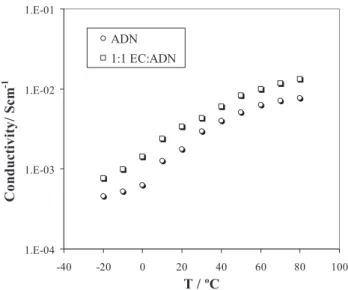
Conductivity and viscosity of the electrolytes.— The conductiv-ity of electrolyte solutions of 1 M LiTFSI in ADN alone and with EC as a cosolvent were measured using an ac impedance spectros-copy technique between −20 and 80°C, and the results are shown in Fig. 2. The conductivity of the ADN electrolyte increased from 0.4 mS/cm at −20°C to 1.7 mS/cm at 20°C and reached 8.0 mS/cm at 80°C. When EC was mixed with ADN in 1:1 by volume ratio, a significant increase in the conductivity was observed even at low
-1.E-03 -5.E-04 0.E+00 5.E-04 1.E-03 -1 0 1 2 3 4 5 6 7
E/ V vs. Li
+/Li
I/
mA
cm
-2 ADN EC:ADNFigure 1. CV scans of 1 M LiTFSI electrolyte solutions of ADN and
EC:ADN 共1:1 by volume兲 recorded on a Pt electrode 共25 m兲 at a scan rate of 10 mV/s. 1.E-04 1.E-03 1.E-02 1.E-01 -40 -20 0 20 40 60 80 100 T / ºC C o n d u c ti vi ty / S c m -1 . ADN 1:1 EC:ADN
Figure 2.Conductivity as a function of temperature of 1 M LiTFSI
electro-lyte solutions in ADN and its EC solutions.
A61
temperatures. It increased from 0.6 mS/cm at −20°C to 3.6 mS/cm at 20°C and reached 12.3 mS/cm at 80°C. The effect of adding the high dielectric constant EC 共89.6兲 on the bulk conductivity lies in its ability to increase the number of dissociated ions “Li+, TFSI−, or
others” in the solvent mixture by increasing its dielectric constant to values presumably higher than that of ADN, and in enhancing the mobility of those ions by decreasing the viscosity of the solvent mixture, as shown below, and hence, the increase in the bulk con-ductivity of the solvent mixture electrolytes compared to the single ADN electrolyte.
Figure 3 shows the conductivity of ADN and EC:ADN electro-lytes as a function of LiTFSI concentration. The curve exhibits a typical behavior with the conductivity increasing gradually at low concentrations due to the increase in the number of charge carriers, going through a maximum in conductivity, in this case at ⬃1 M. At the high-concentration end, the conductivity decreased as a result of the formation of a more congested, compact environment around the ionic charge carriers that translates into the formation of the less mobile or neutral ion pairs and also an overall increase in viscosity. The viscosity of the electrolytes was measured as a function of concentration and is also shown in Fig. 3. The viscosity of the ADN solvent was found to be 5.8 cP, a value that increased to 17.3 cP by the addition of LiTFSI 共1 M兲 and even higher to 29.1 cP for the 1.5 M solution explaining partly the decrease in the high-concentration end of the conductivity. We also separately investi-gated the effect of EC on the viscosity of ADN and its electrolytes and found that the viscosity of ADN decreased from 5.8 to 2.9 cP upon the addition of EC in 1:1 by volume. The addition of the LiTFSI salt to the mixture has shown a drastic increase in their viscosity, as it increased to 9.2 cP for the 1 M concentration and to 15.3 cP for the more concentrated 1.5 M solution, which implies the presence of strong solvent-solvent and different types of ion-solvent interactions, resulting in structural changes in the solvated ions en-vironment and more restrictions on their mobility. We can see from the lower viscosity/higher conductivity of the EC:ADN solvent mix-ture compared to single ADN electrolytes that EC, which is a solid at room temperature but when molten has a viscosity of 2 cP, has a diluting effect on the bulk viscosity, which decreased from 17.3 to 9.2 cP, resulting in an increase in the mobility of ions whose number has also been increased because of the EC addition, making electrolyte mixtures with superior conductivities.
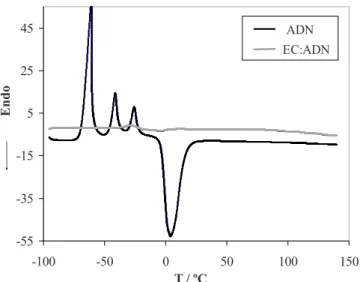
DSC scans of the electrolytes.— Figure 4 shows the differential scanning calorimetry 共DSC兲 curves of ADN and EC:ADN 共1:1 by
volume兲. It can be observed that the ADN shows an endothermic peak at 5°C corresponding to melting and three exothermic peaks at low temperatures that might be attributed to crystallization of salt/ solvent complexes formed with different compositions. The affinity of the nitrile group to metal ions is well known, and previous reports on complex formation between lithium salts with acetonitrile or suc-cinonitrile proved the existence of compounds of four cyano groups coordinating a Li cation, such as Li共CH3CN兲4
+X−24 or
Li共CNCH2CH2CN兲2 +
X−12 complexes. Most importantly, the 1:1 curve showed no peaks in the temperature range between −100 and 150°C, implying a complete dissolution between EC and ADN and a greater thermal stability when compared to carbonate-based elec-trolytes.
Battery performance.— Li-ion batteries using conventional elec-trodes, mesocarbon microbead 共MCMB兲 graphite and LiCoO2, were
assembled and tested in order to evaluate the performance of the electrolytes, and the results are shown in Fig. 5a. Batteries using 1 M LITFSI in ADN alone showed an initial discharge capacity of 43 mAh/g that deteriorated gradually to have no capacity at all by the 40th cycle. This behavior is expected as described earlier in the text due to the incompatibility of ADN and graphite. LiBOB is a lithium battery electrolyte salt widely touted for its ability to form a good solid electrolyte interface. When LiBOB was added as a cosalt 共0.1 M兲 to the electrolyte 共we found that it has a limited solubility of 0.17 M in ADN兲, the initial discharge capacity was increased to 103 mAh/g, but on cycling the battery lost 80% of its capacity very rapidly in the first 10 cycles, then stabilized at the same capacity up until the 50th cycle. When EC was used as a cosolvent 共1:1 by volume兲, without any addition of LiBOB, the battery showed an initial capacity of 108 mAh/g that decreased gradually with 10% loss of capacity by the 20th cycle, and on cycling further, it de-creased significantly reaching low values of 48.7 mAh/g by the 50th cycle.
Finally, when EC was added in 1:1 by volume to ADN using the mixed salt electrolyte 共1 M LiTFSI, 0.1 M LiBOB兲, the battery ex-hibited excellent performance by showing an initial discharge capac-ity of 108 mAh/g that, on cycling the battery further, showed very good capacity retention 共90%兲 up to the 50th cycle. The necessity of having both EC 共can be reduced at 0.7 V vs Li+/Li兲 and LiBOB 共its
BOB anion can be reduced at 1.5 V vs Li+/Li兲 at the same time in
the electrolyte, and their role in the formation of a compact, stable “functioning” SEI has been previously demonstrated by Xu et al. who showed that the use of LiBOB alone does not result in a func-tioning SEI, especially at high temperatures, and that its reduction
1.E-04 1.E-03 1.E-02 1.E-01 1.E+00 0 0.5 1 1.5 2 Concentration / M C o n d u ct ivi ty / S cm -1 . 0 10 20 30 40 V is co si ty / cP
Figure 3.Conductivity and viscosity 共filled兲 as a function of concentration
of LiTFSI in ADN 共squares兲, EC:ADN 共circles兲 solutions.
-55 -35 -15 5 25 45 -100 -50 0 50 100 150 T / ºC E n d o . EC:ADN ADN
Figure 4. 共Color online兲 DSC scans of 1 M LiTFSI electrolyte solutions of
product and that of EC allow for the formation of a functional, multicomponent SEI leading to a good battery performance.25
Figure 5b shows the discharge capacity of the batteries at room temperature as a function of discharge current 共or C rate兲 for the battery using the electrolyte composed of 1:1 共EC:ADN by volume兲, 1 M LiTFSI, and 0.1 M LiBOB. An increase in the C rate results in a gradual decrease in the discharge capacity of the batteries while it shows little effect on the discharge capacity after going through 50 cycles. The most profound decrease in the capacity 共45% loss兲 was observed at the highest-tested discharge rate 共C兲, which could be attributed to the higher viscosity 共lower conductivity兲 of the elec-trolytes and possibly a more resistive interface compared to the car-bonate system.
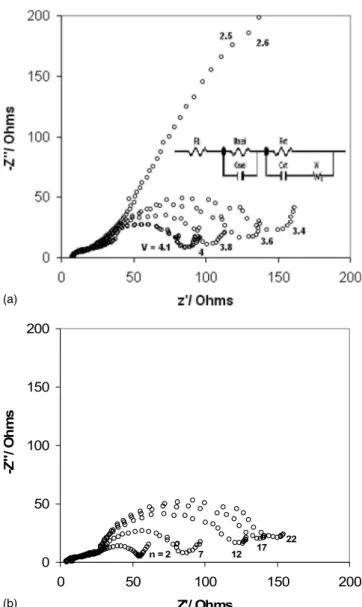
AC impedance spectroscopy of the batteries.— AC impedance measurements were performed on the batteries with highest capaci-ties and best capacity retention, which is the one with the 1:1 共EC: ADN by volume兲, 1 M LiTFSI, 0.1 M LiBOB electrolyte as a func-tion of cycle number and state of charge. A typical spectrum of the battery shows a bulk 共electrolyte, separator, electrodes, and current collectors兲 resistance 共Rb兲 at the highest frequencies, two
over-lapped semicircles in the high- and middle-frequency regions, and an inclined line at the low-frequency region, all of which can be fitted using an equivalent circuit as the one shown in Fig. 6. The first of the semicircles corresponds to the SEI, the film formed on the electrodes/electrolyte interface 共RSEI兲 and its capacitance 共CSEI兲,
while the second corresponds to the charge transfer resistance 共Rct兲
and its related double-layer capacitance 共Cct兲. The inclined line
cor-responds to the diffusion process of Li+ ions across the electrode/
electrolyte interface.
Figure 6 also shows the spectra of a Li-ion battery utilizing the EC:ADN electrolyte 共1:1 by volume, 1 M LiTFSI, 0.1 M LiBOB兲 recorded at different voltages, between the discharged state at 2.5 V and the charged stage at 4.1 V during the seventh cycle. It can be seen from Fig. 6 that during the charging process the Rband RSEI
resistance values, measured to be 8 and 9 ⍀, respectively, are inde-pendent of the state of charge of the battery, a behavior similar to what is reported for carbonate-based solvents with a functional, stable SEI having high conductivity/diffusivity for Li ions.26The Rct
decreased significantly from a very high value estimated to be ⬎3000 ⍀, due to the delithiation of the graphite anode, at 2.5 V to 126 ⍀ at 3.4 V and further to 71 ⍀ at 4.1 V. Moreover, during the first charging cycle, the battery showed an overlapped
Figure 5. 共a兲 Effect of electrolyte components on the cycling performance of
ADN-based electrolytes at C/12 in MCMB/LiCoO2batteries. 共b兲 Specific capacity as a function of discharge current 共C-Rate兲 for a MCMB/共1 M LiTFSI. 0.1 M LiBOB兲 EC:ADN 共1:1 by volume兲/LiCoO2battery.
0 50 100 150 200 0 50 100 150 200 Z'/ Ohms -Z '' / O h m s n = 2 7 12 17 22 (b) (b) (a)
Figure 6.AC impedance spectra of a MCMB/共1 M LiTFSI. 0.1 M LiBOB兲
EC:ADN 共1:1 by volume兲/LiCoO2battery. 共a兲 Impedance spectra of the bat-tery during the seventh cycle as a function of the state of charge. 共b兲 Imped-ance spectra of the battery as a function of cycle number.
A63
semicircle with RSEI+ctvalue of 150 ⍀ that decreased on the second
cycle to 50 ⍀, corresponding to the formation of the SEI.
The impedance spectra was also monitored during the cycling process, where measurements were taken each cycle at the charged 共4.1 V兲 and discharged 共2.5 V兲 stages and are presented in Fig. 6. A similar behavior was obtained during cycling of the battery except for the first and second cycles. Rb and RSEI were the same and
stayed invariable, and Rctincreased gradually from 37 ⍀ at the
sec-ond cycle to 123 ⍀ at the 22nd cycle. This increase in Rct, which
can be related to the electrode kinetics and is therefore responsible for the capacity loss during cycling, could be related to passive layer formation or structural changes on the LiCoO2 during the charge/
discharge cycling of the battery.27 The spectra of the discharging process showed Rb and RSEIwith similar values and invariability,
but Rctwas too high to be measured with accuracy.
Stability against aluminum corrosion.— It is well known that the LiTFSI salt, a good lithium-salt alternative to LiPF6, causes
severe corrosion to the Al current collector commonly used in lithium batteries at potentials of ⬎3.7 V vs Li+/Li.28 In order to
investigate this behavior in ADN-based electrolytes, an electro-chemical cell was assembled using an Al wire as working electrode and an Ag wire as a reference and counter electrodes. The cell showed an open-circuit potential 共OCP兲 of 2.2 V vs Li+/Li and
2.51 V vs Li+/Li for ADN and EC:AND electrolytes, respectively. These values are much more positive than what was reported for LiTFSI electrolyte solutions in EC:DMC 共1.63 V vs Li+/Li兲 or an
ionic liquid 共2.05 V vs Li+/Li兲,29indicating a better ability of ADN
to passivate the Al surface, which was corroborated by the fact that the OCP became even more positive, reaching 2.73 V vs Li+/Li for
ADN and 2.91 V vs Li+/Li for EC:ADN in 3 h.
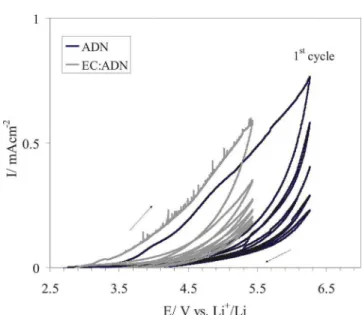
Figure 7 shows the CV recorded for ADN and 1:1 EC:ADN electrolytes where it can be seen that during the first cycle the two electrolytes showed a similar behavior that is different from the typical hysteresis loop characteristic of a pitting corrosion. Instead, the electrolytes showed a gradual increase in the current in the for-ward scan that decreased in the reverse scan to lower values indica-tive of the formation of a protecindica-tive layer that might have formed from any combination of Al+3 and TFSI− ions depositing on the
surface29 or its passivation by the nitrile groups through the lone pair electrons on the nitrogen atom, similar to what is observed in other nitriles like acetonitrile/LiTFSI electrolyte.22Moreover, by the fifth cycle the two electrolytes show an excellent passivating
behav-ior with currents dropping to very insignificant values above 4.3 and 4.5 V vs Li+/Li for ADN and EC:ADN, respectively.
General Remarks on the Toxicity of Nitriles When Used as Solvents
The toxicity of nitrile-containing compounds lies in their ease of releasing the highly toxic CN− cyanide ion that can happen easily
during the hydrolysis of inorganic compounds like metal cyanides 共e.g., HCN, KCN兲.21However, this does not take place in organic nitriles because their hydrolysis 共under certain conditions兲 leads to the formation of the corresponding carboxelates or aldehydes, and their reduction product is most likely their corresponding amines.30 This reflects in the LD50value of ADN, which is 155 mg/Kg that is
31 times less toxic than KCN 共LD50⬃ 5兲. However, reductive
de-cyanation can take place in the presence of very aggressive reagents like LiAlH4, or alkali metals, but in most cases the released cyanide
anion is involved in further reactions. This is evident in the case of a Li/SO2battery, where acetonitrile is used along with LiBr as an
electrolyte, and despite the passivating film that is formed on lithium metal by the reduction of SO2protecting acetonitrile from the metal
surface, the formation of a nonpolymeric, organic nitrile-containing compound was suggested.31
Conclusions
Lithium electrolytes based on adiponitrile were prepared and tested in Li-ion batteries. Adiponitrile was chosen for its high anodic and thermal stability. Its use as a single solvent in the batteries using graphite as an anode produced poor performance, and therefore, the effects of additions of a cosolvent and a cosalt were evaluated. Quite good capacity and cycling behavior was achieved with a 1 M LiTFSI, 0.1 M LiBOB, EC:ADN 共1:1兲 electrolyte composition in a cell incorporating a graphite anode and a LiCoO2 cathode. This
opens the door to the assembly of safer batteries with conventional electrodes or higher energy/power batteries with cathodes with higher potentials and/or capacity.
Acknowledgments
The authors thank the co-op undergraduate students V. Ng, S. Vanderlip, and M. Wong for their help in the experimental part of the work.
National Research Council of Canada assisted in meeting the publication costs of this article.
References
1. J.-M. Tarascon and M. Armand, Nature (London), 414, 359 共2001兲. 2. M. Armand and J.-M. Tarascon, Nature (London), 451, 652 共2008兲.
3. U.S. Department of Energy annual progress report, Energy storage research and development 共2007兲.
4. W. van Schalkwijk and B. Scrosati, Editors, Advances in Lithium-Ion Batteries, Kluwer Academic/Plenum, New York 共2002兲.
5. M. Kunduraciz and G. G. Amatucci, J. Electrochem. Soc., 153, A1345 共2006兲. 6. J. Wolfenstine and J. Allen, J. Power Sources, 142, 389 共2005兲.
7. K. Xu and C. A. Angell, J. Electrochem. Soc., 145, L70 共1998兲. 8. K. Xu and C. A. Angell, J. Electrochem. Soc., 149, A920 共2002兲. 9. X. G. Sun and C. A. Angell, Electrochem. Commun., 7, 261 共2005兲.
10. Y. Watanabe, S. Kinoshita, S. Wada, K. Hoshino, H. Morimoto, and S. Tobishima,
J. Power Sources, 179, 770 共2008兲.
11. A. Abouimrane, Y. Abu-Lebdeh, P. J. Alarco, and M. Armand, J. Electrochem.
Soc., 151, A1028 共2004兲.
12. A. Abouimrane, P. S. Whitfield, S. Niketic, and I. J. Davidson, J. Power Sources,
174, 883 共2007兲.
13. D. Di Censo, I. Exnar, and M. Graetzel, Electrochem. Commun., 7, 1000 共2005兲. 14. M. Ue, K. Ido, and S. Mori, J. Electrochem. Soc., 141, 2989 共1994兲.
15. M. Ue, M. Takeda, M. Takehara, and S. Mori, J. Electrochem. Soc., 144, 2684 共1997兲.
16. Y. Abu-Lebdeh and I. Davidson, presented at PHEV2007, Winnipeg, Nov. 1–2, 2007.
17. Y. Abu-Lebdeh and I. Davidson, presented at Plug-in 2008, San Jose, July 22–24, 2008.
18. Y. Abu-Lebdeh, A. Co, and I. Davidson, presented at IMLB 14, Tianjin, June 22–28, 2008.
19. B. Garcia, S. Lavallée, G. Perron, C. Michot, and M. Armand, Electrochim. Acta,
49, 4583 共2004兲.
20. H. Sakata, F. Kita, S. Sinomoto, A. Kawakami, H. Kamizori, T. Sonoda, H. Na-gashima, J. Nie, N. Pavlenko, and Y. Yagupolskii, J. Power Sources, 90, 27 共2000兲.
Figure 7. 共Color online兲 CV of an Al wire in 1 M LiTFSI electrolyte
21. Z. Rappoport, The Chemistry of the Cyano Group, Interscience, New York 共1970兲. 22. D. Di Censo, Ph.D. Thesis, EPFL, Lausanne 共2005兲.
23. P. J. Alarco, Y. Abu-Lebdeh, A. Abouimrane, and M. Armand, Nature Mater. 3, 476 共2004兲.
24. W. P. Kilroy, J. Solution Chem., 6, 487 共1977兲.
25. K. Xu, Z. U. Lee, S. Zhang, J. L. Allen, and T. R. Jow, Electrochem. Solid-State
Lett., 7, A273 共2004兲.
26. S. S. Zhang, K. Xu, and T. R. Jow, Electrochim. Acta, 51, 1636 共2006兲.
27. P. J. Bouwman, Ph.D. Thesis, University of Twente, Enschede, The Netherlands 共2002兲.
28. L. Péter and J. Arai, J. Appl. Electrochem., 29, 1053 共1999兲. 29. B. Garcia and M. Armand, J. Power Sources, 132, 206 共2004兲.
30. M. B. Smith and J. March, March’s Advanced Organic Chemistry: Reactions,
Mechanisms, and Structure, 5th ed., John Wiley & Sons, Hoboken, NJ 共2001兲. 31. M. Rupich, L. Pitts, and K. Abraham, J. Electrochem. Soc., 129, 1857 共1982兲.
A65