Vous avez des questions? Nous pouvons vous aider. Pour communiquer directement avec un auteur, consultez la
première page de la revue dans laquelle son article a été publié afin de trouver ses coordonnées. Si vous n’arrivez pas à les repérer, communiquez avec nous à [email protected].
Questions? Contact the NRC Publications Archive team at
[email protected]. If you wish to email the authors directly, please see the first page of the publication for their contact information.
https://publications-cnrc.canada.ca/fra/droits
L’accès à ce site Web et l’utilisation de son contenu sont assujettis aux conditions présentées dans le site LISEZ CES CONDITIONS ATTENTIVEMENT AVANT D’UTILISER CE SITE WEB.
READ THESE TERMS AND CONDITIONS CAREFULLY BEFORE USING THIS WEBSITE. https://nrc-publications.canada.ca/eng/copyright
NRC Publications Archive Record / Notice des Archives des publications du CNRC : https://nrc-publications.canada.ca/eng/view/object/?id=9cb2e256-ef7d-40ad-a19f-fd9417db8410 https://publications-cnrc.canada.ca/fra/voir/objet/?id=9cb2e256-ef7d-40ad-a19f-fd9417db8410
NRC Publications Archive
Archives des publications du CNRC
This publication could be one of several versions: author’s original, accepted manuscript or the publisher’s version. / La version de cette publication peut être l’une des suivantes : la version prépublication de l’auteur, la version acceptée du manuscrit ou la version de l’éditeur.
Access and use of this website and the material on it are subject to the Terms and Conditions set forth at Calcium hydroxide in cement matrices: physico-mechanical and physico-chemical contributions
Calcium hydroxide in cement matrices: physico-mechanical and physico-chemical contributions
Beaudoin, J.J.
A version of this paper is published in / Une version de ce document se trouve dans : Calcium Hydroxide in Concrete in Materials Science of Concrete, Special Volume,
November 2000, pp. 131-142
www.nrc.ca/irc/ircpubs NRCC-44493
CALCIUM HYDROXIDE IN CEMENT MATRICES – PHYSICO-MECHANICAL AND PHYSICO-CHEMICAL CONTRIBUTIONS
J.J. Beaudoin
Institute for Research in Construction National Research Council
Montreal Road, Bldg. M-20 Ottawa, Ontario K1A 0R6 Canada
ABSTRACT
Calcium hydroxide (CH) represents a significant volume of the products formed from the cement-water reaction. The extent to which the CH phase contributes to the engineering integrity and volume stability of cement-based binders is however moot. Evidence in support of the view that calcium hydroxide has a significant role in determining the mechanical performance and volume stability of cementitious materials is presented.
The elastic properties and fracture behavior of CH and CH – C-S-H mixtures are described. Volume stability of CH is described with reference to water sorption isotherms (CH) and length change measurements in various solvents and salt solutions.
A dissolution-based expansion mechanism in which CH plays a major role is described for the behavior of cement binders in aggressive media. INTRODUCTION
Hydrated Portland cement paste contains two major constituents – calcium silicate hydrate and calcium hydroxide. The latter can be present in amounts up to 26% by volume. The principal binding phase, calcium silicate hydrate (C-S-H) has been extensively studied. The properties and behavior of calcium hydroxide (either as a pure phase or in mixtures of cementitious solids) have been investigated to a much lesser extent. The importance of the role of calcium hydroxide (CH) in the development of the mechanical, physical and chemical behaviors of cementitious systems has often been understated and can be considered moot1. This has been a result of
difficulties associated with the separation of C-S-H and CH (in hydrated paste) without affecting the integrity of the composite system.
The role of CH (in typical cement-based materials) with respect to descriptors of mechanical performance and durability is treated in this paper. The experimental evidence (obtained at the National Research Council, Canada) describing the physico-mechanical and physico-chemical contributions of CH in cement binders is collated and discussed.
The contribution of CH is elucidated using the following approach. Reference to sorption phenomena (with water as adsorbate) and extension mechanisms are made to validate the use of compacted specimens as representative solid bodies.
Compacted systems comprised of CH and CH/C-S-H mixtures are used as model systems to determine the potential contribution of CH to mechanical behavior and volume change stability in various chemical environments. This is a precursor to discussion of solvent exchange phenomena of CH compacts in methanol and isopropanol. This is followed by the presentation of length change (volume instability) behavior of CH in aggressive salt solutions.
The microstructure and properties of paste systems including undisturbed CH-depleted pastes are also described to provide evidence of a significant role for CH in the systems investigated.
SORPTION PHENOMENA
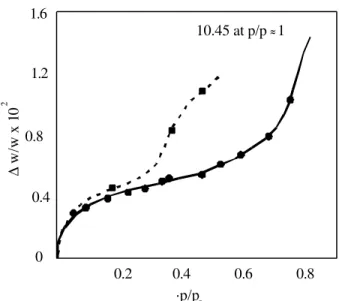
Sorption isotherms (eg. length change) in addition to providing surface-chemical data contain information pertaining to the elastic response of the sample2. The isotherm for CH compacts exhibits large primary and secondary hysteresis (Figure 1). Length change on second adsorption is reduced and the desorption curve is co-incident with the adsorption curve. There is large irreversible shrinkage on desorption. The length change – mass change curve (not shown) is linear up to p/po = 0.35. This is similar to
that observed for hydrated portland cement paste. The length change on wetting is often referred to as the Bangham effect. It is due to the reduction of the solid surface energy resulting from the physical interaction of the surfaces with water molecules. The length change is directly proportional to the free energy change.
1.6 1.2 0.8 0.4 0 0.2 0.4 0.6 0.8 2 ∆ w /w x 1 0 O ·p/p 10.45 at p/p 1˜˜
Figure 1 Sorption isotherm of water on Ca(OH)2 (adapted from reference 2).
• • adsorption desorption
The change in free energy on adsorption (∆F) can be determined from the Gibbs adsorption relation. A linear relation between length change and ∆F exists up to p/po = 0.40. The proportionality constant (λ) is related to the
modulus of elasticity of the material through the relation E = ρσ/λ where E is the elastic modulus of the solid, ρ is the density and σ the surface area. The value of E calculated from sorption experiments is about 3.8 GPa. E values obtained from mechanical measurement of porous compacts (33% porosity) range from 3.4 GPa to 4.7 GPa. The values are of similar magnitude. Hydrated portland cement compacts gave values of 5.9 to 19.0 GPa depending on porosity values.
It is argued that adsorption – length change characteristics of CH at relative pressures of water vapor up to 0.40 are similar to those of other inert adsorbents. The Gibbs adsorption and Bangham equations can be invoked to explain behavior. Irreversible shrinkage that occurs during sorption – desorption cycling can be explained by dissolution at points of contact and ionic diffusion away from these sites. On desorption (especially at low humidities) crystallites are pulled together into the holes (created by dissolution processes) by van der Waal’s forces. The menisci force may have a role at higher relative vapor pressures. Secondary hysteresis observed in the isotherms is attributed to trapping of water in pockets created by the action of van der Waal’s forces.
CHEMICAL INTERACTIONS Carbonation
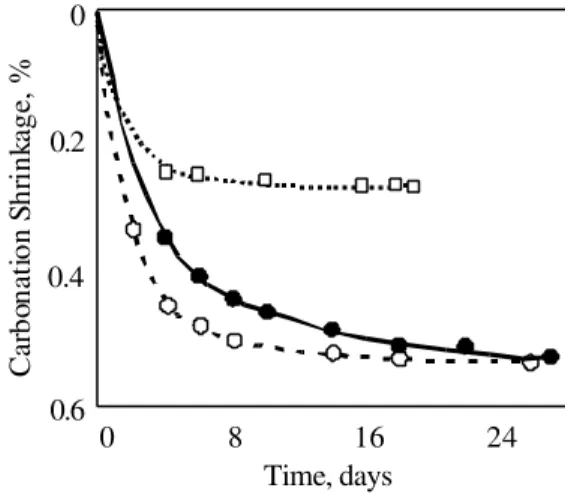
Shrinkage of CH (lime) compacts results from exposure to carbon dioxide3. Experiments on compacts of bottle-hydrated cement show that carbonation of the ‘combined-lime’ is at least as rapid and extensive as the carbonation of the ‘free lime’ (Figure 2). Swenson and Sereda postulated that carbonation of the free lime occurs via a through solution process at points of contact where the material is most strained and solubility is the greatest. The reaction results in a local buildup of water. The carbonated product coats the surfaces and retards the reaction allowing moisture to diffuse away. Cycles of induced drying occur as a result of this transport causing the coating to crack and the cycle to repeat. Carbonation shrinkage of the C-S-H is considered to be related to the dehydration and polymerisation of the hydrous silica product of carbonation.
C ar b on at io n S h ri n ka g e, % 0 0.2 0.4 0.6 0 8 16 24 Time, days
Figure 2 Carbonation shrinkages of cement paste and compacts of hydrated cement and lime. Approximately equal porosity 100% CO2 at 50% RH
(adapted from reference 3). ? Bottle-hydrated cement compacted at 70,000 lb • Cement paste, water/cement ratio 0.45 ? Calcium hydroxide compacted at 50,000 lb.
The carbonation process is a classic example of the contribution of both the CH and C-S-H phase to the volume stability of practical binders.
Solvent Exchange
The solvent exchange process has been considered as an alternative drying procedure for porous cement systems as most conventional drying
procedures significantly affect the microstructure. Solvent exchange methods are believed to ‘preserve’ the microstructure to some extent. It has been shown by the author and coworkers that CH compacts exhibit similar tendencies to C-S-H when exposed to methanol and isopropanol4.
A brief discussion of the length change of CH compacts exposed to water, methanol and isopropanol serves to illustrate further the dual role of C-S-H and CH in hydrated cement systems. Compacts of CH immersed in water expand as previously indicated. Expansion is attributed to the Bangham effect (up to a mass change of 0.70% and length change of 0.10%) and solution/precipitation at points of contact involving diffusion to and recrystallization at other sites.
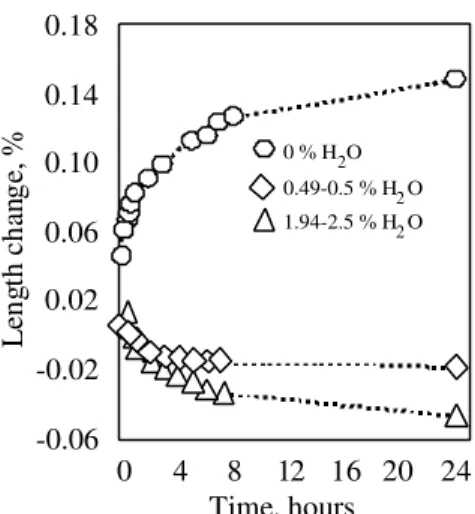
Most of the expansion of dry CH in isopropanol is probably due to the Bangham effect as a value of about 0.12% would be expected. Calcium hydroxide is insoluble in isopropanol and a dissolution/precipitation mechanism for length change is not considered tenable. Length change of partially saturated CH compacts immersed in isopropanol is significantly different. There is an immediate expansion followed by a rapid and progressive contraction (Figure 3). This may be due to some surface interaction between isopropanol and CH. This cannot be explained by the Bangham effect as the surface free energy balance would favor a reduced length change. The progressive contraction can be explained as a shrinkage resulting from a bulk removal of water by isopropanol where the rate of removal exceeds the rate of replacement.
0.18 0.14 0.10 0.06 0.02 -0.02 -0.06 0 4 8 12 16 20 24 Time, hours L en gt h c h an g e, % 0 % H O2 0.49-0.5 % H O2 1.94-2.5 % H O2
Figure 3 Length change of Ca(OH)2 compacts of varying water content
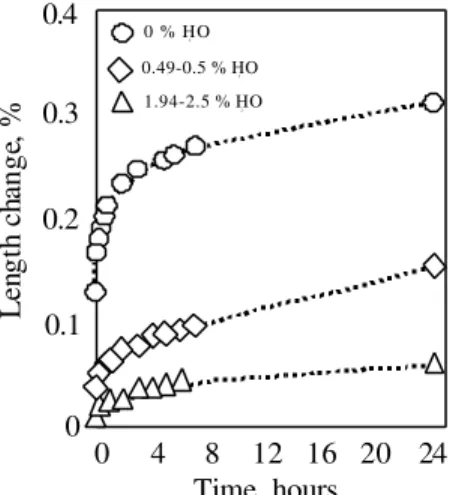
The CH compacts (dry or partially saturated) undergo expansion during solvent replacement with methanol (Figure 4). It suggested that this is due to a combination of the Bangham effect and some type of chemical interaction. It would appear (for the partially saturated CH compacts) that the expansive nature of the chemical interaction overrides any tendency for contraction due to solvent replacement action or changes in free energy due to the replacement of water with solvent molecules at the solid surface. The similarities in the basic trends of the length change – time curves for the methanol and isopropanol exchanged CH and cement paste systems (expansion and contraction) are striking and reinforce the view that CH in hydrated cements contributes in a major way to volume change stability.
0.4 0.1 0 0.2 0.3 0 % HO2 0.49-0.5 % HO2 1.94-2.5 % HO2 0 4 8 12 16 20 24 Time, hours L en g th c ha n g e, %
Figure 4 Length change of Ca(OH)2 compacts of varying water content
immersed in methanol.
Volume Stability in Salt Solutions
The length change behavior of compacted CH specimens in various salt solutions including MgCl2 and MgSO4 suggests that the formation of new
crystalline phases in cement systems may not be (in itself) an à priori condition for expansion5. Evidence for this is provided in the following brief discussion.
The CH compacts expanded in all the test solutions (including saturated lime solution) confirming that in the majority of cases the dissolution of this important component of hydrated cement systems is intrinsically expansive (Table I).
Solution Expansion, % MgCl2 0.80 NaCl 0.48 MgSO4 0.05 Distilled Water 0.52 Lime Water 0.30 NH4NO3 0.85
* Concentration of salt solutions (180 g/l); lime water is a saturated solution The order of expansion was not in the order of respective solubilities. Immersion in the MgSO4 solution gave the lowest expansion in spite of
having the highest solubility with respect to calcium hydroxide dissolution. This can be explained by the possibility of competing forces between the dissolution of the calcium hydroxide (expansive) and the coating of calcium hydroxide particle surfaces with reaction products e.g. brucite and gypsum (contractive). This process is rate of dissolution and concentration dependent. It also likely depends on the nature of the precipitate. Hence the net length change effect varies with the solution type and results in larger observed expansions for immersion in MgCl2 solution. It is clear that
crystalline hydration products (in hydrated cement systems) such as calcium hydroxide are sources of potential expansion when immersed in chloride and sulfate solutions. The crystals of CH are in an initial state of strain which is released upon dissolution6. The results provide additional evidence of the importance of CH in assessing the durability of cement-based materials. CH Depletion in Distilled Water and Partially Saturated Lime Solutions
Leaching of free Ca(OH)2 (in distilled water) from saturated hydrated
portland cement results in a slight expansion. Leaching interlayer and structural Ca(OH)2 results in a slight contraction7. During drying of leached
paste a large shrinkage occurs between 11% RH and final drying. This shrinkage increases significantly with the amount of Ca(OH)2 removed by
leaching. The large shrinkage after removal of 17% calcium hydroxide indicates that some CH was removed from between the sheets while free calcium hydroxide was being removed. This is consistent with the explanation that removal of Ca++ ions from between C-S-H sheets results in greater collapse of the sheet and a larger amount of water re-entry on rewetting. These simple experiments underlie the importance of CH in providing structural stability to cement binders.
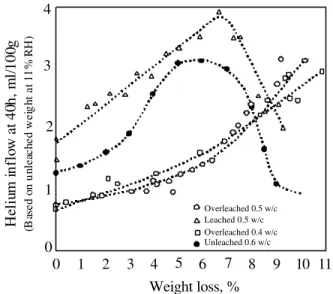
The effect of leaching (in partially saturated lime solutions) and overleaching on the microstructure of C-S-H can be seen in figure 58. The
term overleaching refers to the removal of calcium hydroxide from the C-S-H itself subsequent to the removal of all the free calcium hydroxide from the cement paste. The specimens were subjected to an excess pressure of helium in a vacuum cell. The leached and unleached specimens show somewhat similar results, both demonstrating an abrupt decrease of helium flow (at a pressure of 0.20 MPa) at about 7% mass loss indicative of a collapse of structure. The curves for the overleached samples show that helium flow increases continuously as water is removed.
H el iu m i n fl ow a t 4 0h , m l/ 1 0 0g (B as e d o n u n le ac h e d w e ig h t a t 1 1 % R H ) 0 1 2 3 4 0 1 2 3 4 5 6 7 8 9 10 11 Weight loss, %
(Based on unleached weight at 11% RH)
Overleached 0.5 w/c Leached 0.5 w/c Overleached 0.4 w/c Unleached 0.6 w/c
Figure 5 Helium inflow at 40h as a function of weight loss for leached cement paste (adapted from reference 7).
PHYSICO-MECHANICAL BEHAVIOR
Fracture and Strength of C-S-H and CH Compacts
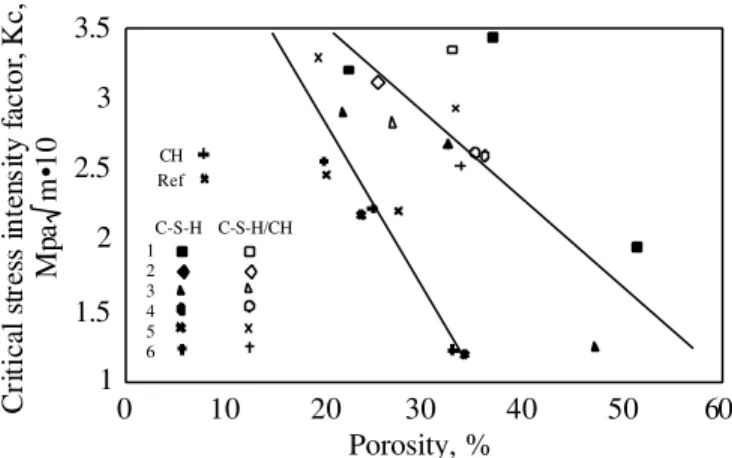
The C-S-H or C-S-H/CH mixtures were made in the form of thin plates (double-torsion geometry) for crack growth studies9. The porosity dependence of the critial stress intensity factor, Kc is illustrated in Figure 6.
The data for all the C-S-H and C-S-H/CH specimens appear to be best described by a linear relationship independent of C/S ratio (0.68-1.49). The data for the pure CH is also described by a linear relationship.
C ri ti ca l st re ss i n te ns it y f ac to r, K c, M pa m •10 Porosity, % 0 10 20 30 40 50 60 1 1.5 2 2.5 3 3.5 C-S-H C-S-H/CH 1 2 3 4 5 6 Ref CH
Figure 6 Critical stress intensity factor, Kc vs porosity for compacted
specimens of synthetic C-S-H, C-S-H/CH mixtures and CH (adapted from reference 9).
The Kc values for CH are lower than those for the C-S-H systems at
equivalent porosity values. This is consistent with observations that Kc
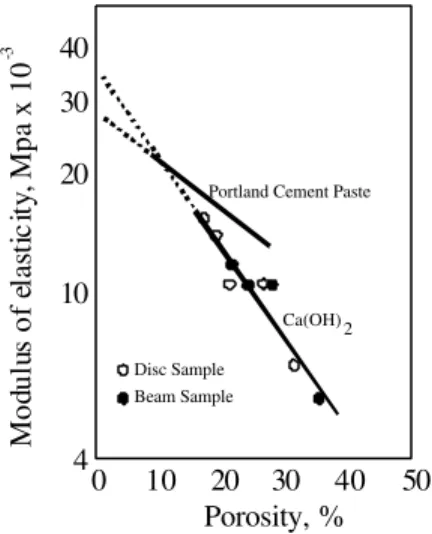
values of CH are lower than those of hydrated cement paste at the same porosity (Figure 7)10. Values of modulus of elasticity of portland cement paste and CH compacts are plotted in Figure 8. It is evident that values of modulus of elasticity for CH compacts are of the same order of magnitude as the values for portland cement paste. Flexural strength data for CH compacts range from 5.89 MPa (porosity = 34%) to 14.20 MPa (porosity = 21.0%). The values for CH compacts are of a magnitude similar to those for portland cement paste over a similar porosity range (i.e. 3.00 – 10.00 MPa; porosity = 17.0 – 30.0%). 0 20 40 60 10 20 30 40 11% RH 1st Drying Wetting Cement Paste Porosity, % Ca(OH)2 K c, M N ·m x 10 -1 .5 2 S tr es s in te n si ty f ac to r,
Figure 7 Critical stress intensity factor vs porosity for Ca(OH)2 compacts
4 10 20 30 40 0 10 20 30 40 50 Porosity, %
Portland Cement Paste
Disc Sample Beam Sample Ca(OH)2 M od u lu s o f el as ti c it y, M p a x 1 0 -3
Figure 8 Modulus of elasticity of Ca(OH)2 compacts and portland cement
paste vs porosity (adapted from reference 10). CONCLUDING REMARKS
Similarities in the physico-chemical and physico-mechanical behavior between phase pure CH and hydrated cement paste (comprised largely of C-S-H and CH) suggest that both principal components play a significant role in determining engineering behavior. This is evident from estimates of modulus of elasticity of CH compacts based on both sorption phenomena and mechanical measurements. The similarities extend to volume change measurements associated with carbonation, solvent exchange and chemical phenomena in salt solutions. The latter provide an indication that the dissolution of CH crystals can be associated with expansive interactions in cement-based materials. This is confirmed through length change measurements during leaching experiments conducted on cement paste. The volume stability of the paste is affected by the leaching process (especially overleaching) as removal of lime from between the C-S-H sheets increases the potential for structural collapse and shrinkage.
The flexural strength and fracture parameter values of paste, C-S-H, CH and mixtures of C-S-H and CH are of a similar order of magnitude. This underlies the theme that consideration should be given to the mechanical and chemical stability of both principal phases in the design of durable concrete structures.
REFERENCES
1
J. Marchand, J.J. Beaudoin and M. Pigeon, “Influence of Calcium Hydroxide Dissolution on the Engineering Properties of Cement-Based Materials” in Materials Science of Concrete, Edited by J. Marchand and J. Skalny, The American Ceramic Society, Westerville Ohio, 2000.
2
V.S. Ramachandran and R.F. Feldman, “Length Change Characteristics of Ca(OH)2 Compacts on Exposure to Water Vapour”, Journal of Applied
Chemistry, 17, 328-32 (1967).
3
E.G. Swenson and P.J. Sereda, “Mechanism of the Carbonatation Shrinkage of Lime and Hydrated Cement"” Journal of Applied Chemistry, 18, 111-17 (1968).
4
J.J. Beaudoin, P. Gu, J. Marchand, B. Tamtsia, R.E. Myers and Z. Liu, “Solvent Replacement Studies of Hydrated Portland Cement Systems: The Role of Calcium Hydroxide”, Advanced Cement Based Materials, 8, 56-65 (1998).
5
J.J. Beaudoin, S. Catinaud and J. Marchand, “Volume Stability of Calcium Hydroxide in Aggressive Solutions”, Cement and Concrete Research (in press).
6
J.E. Gillott and P.J. Sereda, “Strain in Crystals Detected by X-ray”, Nature, 209 [5018] 34-36 (1966).
7
R.F. Feldman and V.S. Ramachandran, “Length Changes in Calcium Hydroxide-Depleted Portland Cement Pastes”, Il Cemento, 86 [2] 87-96 (1989).
8
R.F. Feldman and V.S. Ramachandran, “Microstructure of Calcium Hydroxide-Depleted Portland Cement Paste 1: Density and Helium Flow Measurements”, Cement and Concrete Research, 12 [2] 179-89 (1982.
9
J.J. Beaudoin, P. Gu and R.E. Myers, “The Fracture of H and C-S-H/CH Mixtures”, Cement and Concrete Research, 28 [3] 341-47 (1998).
10
J.J. Beaudoin, “Comparison of Mechanical Properties of Compacted Calcium Hydroxide and Portland Cement Paste Systems”, Cement and Concrete Research, 13 [3] 319-24 (1983).