CONSTRAINTS TO MICRO AND SMALL ENTERPRISE GROWTH IN UGANDA: IMPLICATIONS FOR DEVELOPMENT
By Alice H. Kang
S.B. Management
S.B. Urban Studies and Planning Massachusetts Institute of Technology, 1998.
Submitted to the Department of Urban Studies and Planning in Partial Fulfillment of the Requirements for the Degree of
MASTER IN CITY PLANNING at the
MASSACHUSETTS INSTITUTE OF TECHNOLOGY
June 1999 MASSACHUSETTS INSTITUTE
OF TECHNOLOGY
@Alice H. Kang
JUL 1
9
1999
All rights reserved
The author hereby grants to MIT permission to reproduce and to distribute
LIBRARIES
paper and electronic copies of this thesis document in whole or in part.Signature of the Author ...
Alice H. Kang Department of Urban Studies and Planning May 20, 1999
C ertified b y ... ...
Jennifer Davis Assistant Professor, Department of Urban Studies and Planning Thesis Supervisor
A ccep ted by ...
Paul Smoke Chair, Master in City Planning Committee Associate Professor, Department of Urban Studies and Planning
CONSTRAINTS TO MICRO AND SMALL ENTERPRISE GROWTH IN UGANDA: IMPLICATIONS FOR DEVELOPMENT
By
Alice H. Kang
Submitted to the Department of Urban Studies and Planning on May 20, 1999 in Partial Fulfillment of the Requirements for the
Degree in Master of City Planning
ABSTRACT
The rapid proliferation of micro and small enterprises (MSEs) has become an increasingly important factor for economic growth in less developed countries. In Uganda, the micro and small enterprise sector has been particularly successful in providing employment
opportunities for rural populations. As a result, the Government of Uganda has
implemented policy initiatives designed to encourage their sustained development. In order to evaluate some of the policies that have been drafted by the government, survey work was carried out in two secondary towns of Uganda, Wobulenzi and Lugazi, in order to better characterize the enabling environment of MSEs and to study the effects of better water infrastructure provision on firm productivity.
The empirical evidence obtained suggests that individuals are able to easily enter into the
MSE sector but that firms are highly constrained once established, and therefore, unable to
grow. Some of the most significant obstacles to growth for the MSEs surveyed are the taxation system, the limited access to financing and an unreliable electricity supply. It has also been found that the provision of piped water infrastructure in Wobulenzi has had a significant effect on the productivity of these micro and small enterprises. However, much must still be learned about these MSEs and their constraints to growth in order for
government intervention to prove to be successful. Thesis Supervisor: Jennifer Davis
Acknowledgements
I am deeply grateful to Professor Jennifer Davis for providing me with the opportunity to
travel to and conduct field work in Uganda. I would also like to thank her for her continued support and advice throughout this process. Professor David Laws has also been of great support from the very beginning and has also given me continued encouragement
throughout. Additionally, my conversations with Mel King over the last four years have always been of inspiration to me. For that, I am incredibly grateful.
The work we conducted would not have been successful without the dedication, hard work and friendship of the team of eight enumerators in Uganda: David, Rose, Jane, Jackie, Barbara, May, Richard and Ivan.
Table of Contents
A b stra c t ... 2
A cknow ledgem ents... 3
List of Tables ... 6
List of Figures... 9
Chapter 1. Introduction ... 10
1.1 Structural A djustm ent in Sub-Saharan A frica... 10
1.2 Structural A djustm ent in U ganda... 11
1.3 Micro and Small Enterprises in the Developing World... ... 14
1.4 M icro and Sm all Enterprises in U ganda... 16
Chapter 2. Wobulenzi, Lugazi and the Methodology ... ... ... 19
2.1 W obulenzi... 19
2.2 Lugazi ... 20
2.3 Survey D esign, Pre-testing and Im plem entation... 21
Chapter 3. Micro and Small Enterprise Characteristics in Wobulenzi and Lugazi ... 23
3.1 M SE Costs, Revenues and Profits ... 29
3.2 D iscussion ... 31
Chapter 4. Constraints to G row th... 32
4.1. G eneral Findings ... 32
4.2. Taxation ... 34
4.3. Financing... 36
4.4. Infrastructure... 38
Chapter 5. The Rural Towns W ater and Sanitation Programme... 41
5.1 Evaluating the Rural Towns Water and Sanitation Programme ... 41
5.2 The W ater Supply in W obulenzi and Lugazi... 42
5.3 Water Usage in Wobulenzi Prior to the Rural Towns and Sanitation Project... 44
5.4 Costs of Production ... 46
5.6 Increased Price of Product... 53
5.7 W illingness to Pay: Lugazi... 53
5.8 W illingness to Pay: Wobulenzi ... 56
5.9 D iscussion... 57
Chapter 6. Discussion and Recommendations... 59
6.1 C onstraints to G row th ... 59
6.2 The Rural Towns Water and Sanitation Programme ... 61
6.3 R ecom m endations ... 61
A ppendix O ne... 63
A ppendix Tw o... 65
List of Tables
Table 1.1. Composition of Merchandise Exports: Shares of Total Exports ... ... 13
Table 1.2. Structure of the Economy: Percent of GD P... 14
Table 1.3. Increase in population, labor force and employment in small enterprises in Bostwana, Kenya, Malawi, Swaziland and Zimbabwe (1981-1990) ... ... 15
Table 1.4. Increase in Small Enterprise Employment: New Start-ups vs. E xpan sion s (1981-1990)... 16
Table 3.1. Percentage of Firms Surveyed of Indicated Business Type ... 24
Table 3.2. Employee Characteristics ... ... 24
Table 3.3. H ours and D ays of O peration... 25
Table 3.4. Percentage of Respondents of Indicated Position... 25
Table 3.5. Respondents' Education and Experience ... 25
T ab le 3 .6 . A ge o f F irm s ... 2 6 Table 3.7. Percentage of respondents with Indicated Principal Reason for Starting Business ... 27
Table 3.8. Total Number of Paid and Unpaid W orkers... 27
Table 3.9. Percentage of Respondents who have Made any Capital Investments in their Firm in the Previous Year... 27
Table 3.10. Percentage of Respondents who Plan to Expand their B usinesses in the N ext Y ear ... 28
Table 3.11. Of those Respondents who Plan to Expand their Business, the W ay in which They Plan to D o So... ... 28
Table 3.12. Wobulenzi: Revenue and Capitalization ... 29
Table 3.13. Lugazi: Revenue and Capitalization... 30
Table 3.14. Wobulenzi: Total Expenditures per Firm based on A verage Expenditures per Category... 30
Table 3.15. Lugazi: Total Expenditures per Firm based on A verage Expenditures per Category... 30
T ab le 3 .16. M o n th ly P ro fits... 3 1 T able 4.1. B usiness R egistration ... 36
Table 4.2. Percentage of Respondents who would be able to Obtain a Loan for 300,000 shillings (U S$ 244)... 37
T ab le 4 .3 . L an d R ig h ts... 3 8
Table 5.1. Potential Impacts of Improved Water Supply on MSEs... 41
Table 5.2. Principal Source of Water for Business... 43
Table 5.3. Wobulenzi: Percentage of Firms Using Indicated Water Source ... 43
Table 5.4. Lugazi: Percentage of Firms Using Indicated Water Source... 44
Table 5.5. Percentage of Respondents that use Water for Indicated Purposes ... 44
Table 5.6. Wobulenzi: Respondents who Used Indicated W ater Source Prior to the RT W SP ... 45
Table 5.7. Wobulenzi: Firms that Used Vendors Prior to the RTWSP... 45
Table 5.8. Wobulenzi: Amount of Water Obtained per Day ... 47
Table. 5.9. Lugazi: Amount of Water Obtained per Day... ... 47
Table 5.10. W obulenzi: Cost of W ater per Jerrican... 47
Table 5.11. Lugazi: Cost of W ater per Jerrican... ... 47
Table 5.12. Wobulenzi: Water Usage of Firms Whose Previous Water Source was Vendors ... 48
Table 5.13. Percentage of Respondents that Store W ater... 49
Table 5.14. Of those Respondents that Store Water, the Amount Currently Stored... 49
Table 5.15. Container Used to Store Water ... ... 49
Table 5.16. Cost of Tank or Large Container of those who Store Water ... 49
Table 5.17. Wobulenzi: Percentage of Respondents who Treat Water ... ... 50
Table 5.18. Lugazi: Percentage of Respondents who Treat Water... ... 50
Table 5.19. Percentage of Respondents who have had to Shut Down their Firm because of a Lack of Water ... 51
Table 5.20. Of those Respondents who have had to Shut Down their Firm, the Number of Days they were Required to do so ... . ... 51
Table 5.21. Percentage of Respondents who Plan to Expand Their B usiness in the N ext Y ear... 52
Table 5.22. Of those Respondents who Plan to Expand, H ow T hey Plan to E xpand ... 52
Table 5.23. Percentage of Respondents Who Indicated that the RTWSP has directly Affected their firms by the Indicated Impacts... ... 52
Table 5.24. Lugazi: Percentage of Owners Willing and Able to Pay 250,000 shillings
(US$ 203) for a Private Water Connection... ... ... 54
Table 5.25. Lugazi: Percentage of Renters Willing and Able to Pay for the Use of a Private C onnection at the Indicated Prices... 54 TABLE 5.26. Lugazi: Percentage of All Respondents who would Be Willing to Use a
IK iosk at the Indicated Prices... 55
Table 5.27. Lugazi: Of those who Indicated that they Would Use Both a Kiosk and a Private Connection, the System they Would Prefer ... .... 55
Table 5.28. Wobulenzi: Percentage of Owners Willing and Able to Obtain a Private
C onnection at the Indicated Prices... 56
Table 5.29. Wobulenzi: Percentage of Renters Willing to Obtain a Private Connection
for Indicated M onthly C harge ... 57
Table 5.30. Wobulenzi: Satisfaction with Current Water Source... 57
List of Figures
Figure 3.1. Number of Firms with Indicated Business Age ... ... 26
Figure 3.2. Lugazi: Respondents' Economic Outlook for Business ... 28
Figure 3.3. Wobulenzi: Respondents' Economic Outlook for Business ... 29
Figure 4.1. Standardized Rankings of Constraints to Growth Factors ... 33
Chapter One: Introduction
Sub-Saharan Africa (SSA) continues to be one of the greatest development challenges in the world. Decades of reform have encouraged growth but it has been limited and poverty is still pervasive; Africa is as poor now as it was 20 years ago. Human development continues to be a challenge; 25 out of the 48 SSA countries have adult literacy rates below 40% and 15 countries still enroll less than half of their children in primary school. 240 million citizens, 40% of the SSA population, live on less than $1 a day. Economic growth has been slow; in
1997, the annual growth rate was estimated at around 4.6% compared to 4.8% in 1996 and 3.3% in 1995. With the highest rate of population increase in the world (2.8% per year), the
situation is acute and the challenge continues to be discovering why previous attempts for development have been unsuccessful and to define new strategies for successful
development (World Bank, 1998b).
About 70% of Africa's poor live in rural areas, and the rural population will continue to outnumber the urban population for nearly three decades to come. While agriculture continues to be an engine of growth in rural areas, its past performance has been
disappointing with growth being exceeded by an expanding population. Agriculture accounts
for 35% of the region's GNP, 40% of exports and 70% of employment (World Bank,
1998b). As a result, governments and international aid organizations have looked towards
strategies for economic development that could work in partnership with agricultural production. Although in the past large-scale industrial growth has been encouraged, more recently there has been growing attention paid to micro and small enterprise (MSE) development. This chapter presents a history of structural adjustment in SSA, and specifically in Uganda. It also gives evidence of MSE growth and effectiveness. Finally, it presents the issues that are explored in this paper.
1.1. Structural Adjustment in Sub-Saharan Africa
Under the guidance of and in partnership with the World Bank and the International
Monetary Fund, SSA countries have implemented ambitious and drastic policy and structural reforms in order to restructure the economic framework upon which growth would be based. By 1990, most SSA countries had structural adjustment programs in place. This
widespread participation in adjustment programs was a based on the assumption that before any type of economic development could be sustained, a stable macroeconomic framework was needed (World Bank, 1998c).
The main objectives of these adjustment programs are to:
1. Create a long-term equilibrium where indigenous resources and investments can
be better allocated and used more efficiently.
2. Encourage overall higher rates of savings, investments and learning in firms so as to provide a stable ground from which growth can be sustainably encouraged (Biggs, 1996).
These objectives are to be achieved by lowering inflation; establishing competitive exchange rates and market-determined interest rates; reducing budget deficits; introducing trade liberalization; reducing taxation on imports and exports; and abolishing price controls. The strategies used to achieve these goals have varied widely from country to country but in general, progress has been slow. Overall, economic growth has averaged just 3.3% since
1962, only slightly above the 2.8% population growth for the region (World Bank 1998a).
1.2. Structural Adjustment in Uganda
After independence in 1962, Uganda was considered to be one of the most promising countries in SSA. Self-sufficient in food and agriculturally strong, Uganda also had a healthy manufacturing sector. In both agriculture and manufacturing, export earnings were financing imports and the country's exports exceeded imports (positive current account).Uganda also had an extremely reputable health service system with widespread immunization programs
and vaccinations centers. This promising growth, however, was dramatically reversed when
Idi Amin assumed power in 1971.
Amin's eight-year dictatorship proved devastating for the country both economically and socially. An estimated 500,000 Ugandans lost their lives and as many as one million were displaced from their homes. 200,000 were estimated to have fled the country to live in exile. This outmigration resulted in a tremendous loss of skilled labor and was accompanied by dramatic economic decline. Between 1970 and 1980, Uganda's GDP declined by 25%,
become increasingly dependent on bank borrowing and, as a result, average annual inflation rates often exceeded 70% (World Bank, 1993).
Political and civil strife continued after Amin was overthrown in 1979 by the Apollo Milton Obote regime and did not abate until 1986 when the National Resistance Movement (NRM), led by Yoweri Museveni, assumed power. However, the legacy left by 15 years of economic mismanagement had made Uganda one of the poorest countries in the world. Real gross domestic product (GDP) per capita was 42 percent below its level in 1970; the public revenue base had collapsed; hyperinflation persisted; and government expenditures, exports and investment had all fallen to below 10 percent of GDP (World Bank, 1999). The health and education system had disintegrated over the years and physical infrastructure had completely crumbled. The challenges facing President Museveni were formidable.
In order to provide macroeconomic stability and a basis from which to encourage economic recovery, Uganda initiated an ambitious structural adjustment program in 1987. With the strong support of multi-lateral and bi-lateral aid agencies, Uganda implemented a strategy focused on achieving:
1. Financial stability and low inflation
2. A balanced current account
3. Increased capacity utilization of existing industries 4. Infrastructure rehabilitation and
5. Increased productive capacity
6. Improved pricing policies and producer incentives
7. Efficiency in the public sector and improved resource allocation (World Bank 1998a)
These overarching goals translated into policy measures that included:
1. The introduction of a new currency coupled with a 30% tax on currency and
bank deposits held by the public
2. A 77% devaluation of the Ugandan Shilling in foreign currency terms
3. Increases in producer prices of traditional export crops
Over the last ten years, the policy measures have been coupled with strategies to facilitate growth of the agricultural and industrial sectors.
The focus on agrculture was crucial because of its historical importance and because it accounts for some 80% (1992) of the nation's employment. Agriculture was seen as having
the potential to supply food to regional markets, to provide the raw materials for an industrial sector and most importantly, to encourage exports and generally act as the main instrument for country-wide economic growth (World Bank, 1993). To encourage the development of the agricultural sector, therefore, the government adopted numerous policies focused on increased research and development, infrastructure, privatization of agricultural enterprises, international market access, and land ownership (IMF, 1997).
Agriculture will likely continue to play an importance role in the nation's economy. Uganda is favored with fertile land and a good climate. Nonetheless, the ability of the traditional crops to attract foreign exchange has decreased substantially over the years (Table 1.1). Despite fluctuating world prices and competition from non-traditional agricultural exports
(NTAE), the government continues to emphasize traditional cash crops for export revenues
and as a main factor in economic growth (World Bank, 1996).
At the same time, there has also been an increasing focus on the development of the industrial sector. While still quite small relative to the agricultural sector (Table 1.2), the Ugandan government has made concerted efforts to encourage private investment in manufacturing so as to not only spur an export market but also to prompt a transformation of the economy.
Table 1.1. COMPOSITION OF MERCHANDISE EXPORTS: SHARES OF TOTAL EXPORTS
(percent)
Traded Agriculture' Non-Traded Agriculture2 Manufactured Goods1989 90.9 7.6 1.3
1990 80.3 18.3 1.3
1991 72.1 21.6 1.3
1992 74.2 23.7 2.1
1993 67.5 28.3 4.3
1
Coffee, tea, tobacco and cotton2 Less Traditional Exports
Table 1.2. STRUCTURE OF THE ECONOMY: PERCENT OF GDP 1976 1986 1996 1997 Agriculture 73.3 56.6 45.5 43.8 Industry 7.5 10.2 16.0 17.3 Manufacturing 6.1 6.4 7.8 8.2 Services 19.2 33.2 38.5 38.9
Source: The World Bank, 1999b.
The results of these reforms have been hailed by the World Bank and the IMF as great successes. Real GDP growth has averaged 6.4 percent over the past decade and has been steadily increasing (it was 8 percent in 1994/5-1996/7, and underlying inflation was 5 percent). In fact, Uganda had the 6th fastest growing economy in the world in 1998 (World Bank 1998a). Nonethless, 46% of the population still lives in poverty (World Bank, 1998c).
Uganda's emphasis on creating a stable and prosperous agricultural and industrial sector is not without precedent. As the past development of many newly-industrialized countries has shown, strong government support of particular sectors can help them become engines of growth that catalyze rapid economic development. However, as the above discussion shows, growth dependent on the agricultural sector is not secure. Fluctuating world prices and low levels of private and foreign investment have spurred the government to look towards other mechanisms for growth, in particular -the support and development of micro and small
enterprises (MSEs).
1.3. Micro and Small Enterprises in the Developing World
Over the last several years, growing evidence suggests that MSEs can contribute significantly to economic growth and poverty alleviation in Sub-Saharan Africa or less developed
countries. MSEs have characteristics that provide a good fit with the needs of developing countries, among them:
1. self-employment opportunities for the poor
2. use of labor-intensive, rather than capital intensive, technologies
3. opportunities for indigenous peoples rather than the need for foreign human
investment
4. opportunity for indigenous peoples to develop skills
By addressing the above needs, MSEs provide an opportunity to those not engaged in
agriculture and large-scale industry for significant income generation. At the same time
MSES can draw those within agriculture and industry into more skilled and productive
activities. By being based in a liberalized market economy, MSEs also help to shift
development from large scale industries widely dependent on direct foreign investment and significantly vulnerable to world prices to more micro-managed and equitable development. Essentially, the literature suggests that the bottom-up development strategy offered by MSEs can promote poverty alleviation by providing employment and stimulating small-scale
economic development by building upon existing capabilities (Biggs, 1996).
Growth in the MSE sector has been exceptional in many developing countries, particularly in South and East African countries. In a study of five African countries -Bostwana, Kenya, Malawi, Swaziland and Zimbabwe -Mead (1994) shows that 40% of the increase in
employment within these countries can be attributed to small enterprises (Table 1.3).
Additionally, 75-80% of the employment growth in the sector can be attributed to new MSE start-ups. However, the expansion of existing businesses in the sector appears to be relatively small; only 23% of businesses were able to add one or more people to their workforce over the same 10-year period (Table 1.4) (Mead 1994). This implies that the barriers to entry into
MSE activities are few but the ability of businesses to grow is severely limited. What, then,
are the constraints to MSE growth and what are the implications for policy makers?
Table 1.3. INCREASE IN POPULATION, LABOR FORCE AND EMPLOYMENT IN SMALL ENTERPRISES IN BOSTWANA, KENYA, MALAWI, SWAZILAND AND ZIMBABWE (1981-1990)
Five-Country Aggregate
(in thousands)
Increase in population of working age 6,736
Increase in labor force 4,859
Increase in employment is small enterprises 2,094
Table 1.4. INCREASE IN SM ALL ENTERPRISE EMPLOYMENT: NEW START-UPS VS. EXPANSIONS
(1981-1990)
Five-Country Aggregate
(in thousands)
Employment creation through new start-ups 1,618
Employment creation through expansion of existing enterprises 476
Total employment creation in small enterprises 2,094
Percentage (row 2/row 3) 23%
Source: MEAD, 1994.
1.4. Micro and Small Enterprises in Uganda
Similar to some of the previously mentioned countries, MSEs play an important role in Uganda: 90% of total non-farm private sector workers, approximately 1.5 million people, are employed in about 800,000 MSEs. Over the last five years, the sector has witnessed 20% annual growth (MSEPU, 1998). As a result, the Ugandan government has taken an active role in promoting MSE activities. In particular, in June 1996, Uganda established an MSE Policy Unit (MSEPU) within the Sectoral Planning Department of the Ministry of Planning and Economic Development (MPED). The creation of the unit was based on the
government's belief that it must create an enabling environment that encourages and helps to sustain growth in the private sector.
The MPED is charged with:
1. Facilitating policy formulation, reform and co-ordination in favor of MSEs.
2. Providing an instrument through which cooperation and coordination of MSE activities can be better facilitated.
3. Promoting financial services, access to training and technology, trade and investment and rural development related to MSEs.
4. Creating a database for monitoring progress and assessing impact of government policies on MSEs.
5. Creating awareness of private sector development and MSEs in particular
(MSEPU, 1998).
Most significantly, the MSEPU drafted a formal MSE policy document with the cooperation of private sector representatives, entrepreneurs and government agency staff in April 1998.
This policy document reflects the official position and goals of the Ugandan government with respect to MSE promotion.
The policy document asserts that the main constraints to growth are as follows:
1. Lack of savings and credit facilities
2. Lack of access to training and extension facilities related to technology dissemination and enterprise management
3. Inadequate information on business opportunities, services, new technologies and
government policies
4. Unfavorable legislation and government rules and regulations
5. Lack of efficient organization and common interest groups
6. Failure to cater to the well-being of the MSE sector at the national level 7. Poor physical infrastructure facilities.
Various policy initiatives have been identified to address most of the above constraints:
1. Promoting an "enabling environment" for businesses: the legal and regulatory
framework; research, sub-contracting and marketing; district and national
development planning; co-ordination and organization; infrastructure development 2. Financial service delivery
3. Training, advice and extension services 4. Technology development and transfer
5. Information dissemination
6. Cross-cutting issues: HIV/Aids, Gender
Although a variety of issues are in the policy document, emphasis is placed on access to financial services (e.g., loans), and information and technology dissemination.
The government should be lauded in its recognition of and action taken to support MSEs, however, insufficient information about constraints to firm growth remains a challenge. Without such knowledge it is particularly difficult to evaluate the MSE policy
recommendations in terms of their relevance to the "felt needs" of firms. The work presented here aims to improve that knowledge and serve as a benchmark for future research to see in what ways policy actions have affected the MSE environment. This
research is an attempt to address the MSEPU policy focused on infrastructure and to create a greater understanding of what factors MSEs feel to be the most constraining to their growth. The focus is on the relative importance of certain factors and, in particular, water provision.
The basis of the work presented is a comparative analysis conducted on the effects of the provision of piped water infrastructure on MSEs. As Wobulenzi was recently the recipient of
a piped water system, we have been able to compare water usage by firms in Wobulenzi and Lugazi and within Wobulenzi before and after the project. This analysis furthers our
understanding about constraints to MSE growth generally, and also provides evidence regarding the effects of particular infrastructure investments on the economic performance of MSEs. In doing so, we have been able to evaluate the policies adopted by the
Government of Uganda (GoU) and suggest areas where further government action appears warranted.
In January 1999, MSEs in two secondary towns in Uganda, Wobulenzi and Lugazi, were surveyed about their enabling environment, costs and revenues. More specifically, we obtained information from firm owners and/or managers about what they felt to be their constraints to growth. These included taxes, regulations, access to credit, electricity,
transportation, water and land. The data have been analyzed to assess which factors are most constraining.
This paper is organized into six chapters. Following this introduction, the second chapter gives a brief overview of the two towns surveyed, Wobulenzi and Lugazi, and a description of the study methodology and survey work conducted. The third chapter presents the characteristics of the MSEs surveyed. The fourth chapter presents the results and evaluation of the constraints analysis. The results of the comparative analysis of water usage is
presented in the fifth chapter and final conclusions and recommendations are made in the sixth chapter.
Chapter Two: Wobulenzi, Lugazi and the Methodology
This chapter will present an overview of the secondary towns of Wobulenzi and Lugazi, Uganda. It will also present the survey design, pre-testing and implementation.
2.1. Wobulenzi
Wobulenzi is a town of approximately 10,000 residents, located 48 km north of Kampala in the Luwero district. The major highway between Kampala and the Northern Region of Uganda runs through the center of the town and renders Wobulenzi the trading center of
the Luwero district. The town is divided into the West, Central and East parishes. Most of the modern trading development is in the Central zone although much commerce happens throughout the parishes.
The main economic activities of the town include coffee cultivation and processing, maize processing and gin production. The center of town is mixed commercial-residential consisting of two lodging houses, two petrol stations many retail shops and restaurants. There is also a small marketplace, post office and a taxi park. Wobulenzi has both electricity
and telephone service.
The land in Wobulenzi was once owned by several private landlords; currently, however, much of the land has been divided into plots and sold freehold to individuals. The Socio-economic survey conducted by the Small Towns Water and Sanitation Project indicates that
60% of the residents in Wobulenzi live in homes that they own. About 40% of the residents
has a households have between 4 and 7 people and about 77% of all residents are married. The main occupations of the household heads are commerce/trade (48.3%), employees of
others (18.6%), and farming (13.4%). 84.7% of the residents have a household monthly
income of under 100,000 shillings per month.
The water situation in Wobulenzi has changed dramatically in the last two years. Installation of a piped water system was completed in 1998 under the auspices of the Rural Towns Water and Sanitation Programme (RTWSP) of the Government of Uganda. Prior to the project, residents primarily depended on seven boreholes (two of which belong to schools),
two protected springs, one piped system in the Luzzi zone and a number of unprotected sources (swamps and wells). The new water system provides water sold at kiosks in 31 different locations. Businesses and households can also obtain private water connections. About 20 households and businesses currently have private water connections.
The Government of Uganda obtained funds from the World Bank to implement a
nationwide RTWSP whose objective was to provide improved water and sanitation facilities specifically to meet the needs of the communities. Wobulenzi was identified in 1994 as one of the 11 towns in the nation to participate in the program. The construction of the project began in 1997 and was designed to accommodate a population of 17,333 people. The project
cost was estimated, in 1994, to be approximately US$ 1,500,000.
The source of water for the piped system is untreated groundwater, which is pumped by electricity-powered pumps by the Water Authority (WA). The WA is responsible for managing the kiosk system where attendants sell the water at specified hours everyday. The price per jerrican is 25 shillings. The WA is also responsible for installing private connections to households and businesses. The costs of a private connection are approximately 250,000 shillings (US$ 203) with associated monthly usage costs. Owners of private connections are allowed to sell water to other residents without further payment to the WA.
There is no sewage collection system in Wobulenzi. Most residents have conventional latrines (75.10%) or traditional pit latrines (16.3%).
2.2. Lugazi
Lugazi is located 43 kilometers east of Kampala in the Mukono District. The main highway between Kampala and Jinja runs directly through the center of the town. There are
approximately 20,000 residents with an average population density of 800 persons per square kilometer. The topography of the area is hilly and the climate tropical. Annual rainfall is approximately 1400 mm.
The main economic activities in the area are the cultivation and processing of tea and sugar cane. There is a mixed commercial-residential town center of a few square blocks, which includes a central marketplace, a few lodging houses, petrol stations, garages, and restaurants. Lugazi also has a bank, post office, health clinic, and railway station. Lugazi also has
electricity and telephone service.
Most of the property in Lugazi is either owned by or leased from just two large families, Mehta and Kulubya, who control the town's large sugar cane and tea plantations,
respectively. Roughly one third of Lugazi's population lives in rent-free housing within labor camps managed by these plantations. Of the remaining two-thirds, only 14 percent live in owner-occupied housing. Forty two percent live in private, rented housing. Less than half of households have electricity for lighting. Ninety-one percent of the population cook either with firewood (38 percent) or charcoal (53 percent). Twenty five percent of the population
of Lugazi is illiterate (Uganda, 1991).
Water supply, as well as other services, are provided to households in the plantation labor camps free of charge by the owners. In the rest of Lugazi, the majority of residents in fetch water themselves from springs (56% do so in dry season, 38% rainy season). Another 410% obtain their water from vendors in the dry season and 29% do so in the rainy season at a cost of 125 shillings per 20-liter jerrican. The remaining population obtains their water from handpumps, boreholes or rainwater; there is no piped water system. Nor is there a sewage collection system; a majority rely on some form of pit latrine.
2.3. Survey Design, Pre-testing and Implementation
The research described in this thesis was conducted over a three-week period in Uganda during January 1999. Seven university-educated men and women from Kampala were hired to serve as enumerators for the study. During the first week, firm level surveys were
developed and pre-tested for each of the communities studied. The enumerators participated actively in survey development, revision and translation and also received intensive training in survey administration. Role plays and survey pre-testing in suburbs around Kampala were used both to refine the survey instrument and to home enumerator's skills.
During the second week, the team traveled to Wobulenzi where a total of 184 firm surveys were completed. Local representatives assisted enumerators by facilitating introductions with local businesses and encouraging firm owners to cooperate with requests for interviews. Enumerators completed an average of 7 surveys per day for 5 days, and were refused interviews by 4% of potential respondents. Enumerators were instructed to attempt an interview with firm owners but were allowed to interview senior managers in the event that an owner was unavailable.
During the final week of field work, the study followed a similar approach in Lugazi. The enumerators were divided among the districts of the town and instructed to approach every business for an interview. There were six enumerators that interviewed an average of 8 firms per day for four days for a total of 176 surveys. Approximately 5% of potential respondents
refused to provide interviews.
A similar sampling strategy was used in both towns: Each enumerator was assigned a
particular commercial area and was instructed to interview every enterprise within its borders. The team thus moved through the main commercial districts of both towns in a progressive pattern, with the aim of 100% coverage.
Chapter Three: Micro and Small Enterprise Characteristics in Wobulenzi and Lugazi We have identified MSEs as an important sector insofar as they are being looked at as new tools for economic growth in Uganda. In order to better understand what these MSEs are and how they operate, this section will focus on identifying the general characteristics of the MSEs that were surveyed and more importantly, it will focus on the unique characteristics of MSEs that have made them targets of policy reform. This chapter will first present the background characteristics of the MSEs surveyed and then further explore the various factors that are unique to MSEs as an economic sector in the developing world and that are
shared by the firms surveyed; more specifically, the use of labor intensive rather than capital intensive technologies, equitable opportunities, ease of entry, self-employment opportunities
and the barrriers to growth.
Wobulenzi and Lugazi are two small secondary towns both located on major highways. Many of the MSEs have located along the sides of the highways in order to attract travelers as well as residents of the town. This location choice may also be because of their need for access to transportation services.
The majority of the MSEs surveyed are retail establishments selling dry goods and foodstuffs (Table 3.1). The variety of retail establishments is wide-ranging and many are quite
specialized; some shops sell stationary, imported clothing, furniture, spare parts for bicycles, passion fruit juice, maize, or packaged foods. Many of the firms are also service
establishments such as beauty salons, battery charging shops and various repair shops. There are also a few restaurants and lodges. The restaurants are usually small, in terms of
capitalization, but the one or two lodges within each town are usually quite larger than the other firms. Wholesale businesses are a very small percentage of the firms surveyed as are petrol stations. In Lugazi, there were a number of clinics and pharmacies surveyed but much fewer in Wobulenzi. These firms usually provide rudimentary health care services and drugs.
Table 3.1. PERCENTAGE OF FIRMS SURVEYED OF INDICATED BUSINESS TYPE
Lugazi
Retail: Dry Goods 29.3 32.6
Retail/Wholesale: Dry Goods 1.6 2.2
Wholesale: Dry Goods 1.1 1.1
Retail: Foodstuffs 29.3 28.1 Retail/Wholesale: Foodstuffs 1.6 3.4 Wholesale: Foodstuffs 0.5 0.6 Services 21.7 11.8 Clinic/Pharmacy 1.6 8.4 Restaurant/Lodge 12.5 10.1 Petrol Station 0.5 1.7
The MSEs in our sample are typically firms with few employees but long business hours. The median number of workers in both towns is two, with more than 70% of firms surveyed having 2 workers or less (Table 3.2). However, these firms are often open for business for an average of 13 hours per day, seven days a week (Table 3.3). These businesses tend to be quite small, in terms of turnover and physical size, so there is less of need for more workers. Also, many are also attached to households (34.1% in Wobulenzi and 20.3% in Lugazi). The
owners and managers, therefore, tend to stay at the firm throughout the day. These firms are also more labor-intensive than capital-intensive. Firm expenditures on equipment in Lugazi is only 1.2% of total annual average firm expenditures and in Wobulenzi, 2.5%. These costs rank lower than most other firm expenditures and indicate the lesser need for technologies as opposed to labor which is 21.2% of costs in Lugazi and 8.3% of costs in Wobulenzi.
Table 3.2. EMPLOYEE CHARACTERISTICS
Wobulenzi Lugazi
Average Number of Workers 1.9 2.2
Median Number of Workers 2.0 2.0
Percentage with 1 Worker 46.7 38.8
... 2 Workers 37.5 38.2 .3 Workers 6.0 11.8 ... 4 Workers 3.8 5.0 .5 Workers 4.9 0.6 .6 Workers 1.1 1.7 .7 or more Workers 0.0 3.9 Wobulenzi I
Table 3.3. HOURS AND DAYS OF OPERATION
Wobulenzi Lugazi
Average Number of Days Open 6.6 6.6
Average Number of Hours per Day 12.6 12.5
Median Number of Days Open 7.0 7.0
Median Number of Hours per Day 12.5 12.0
MSEs are often identified as providing more equitable opportunities for women. In the firms surveyed, this has proven to be true. In Wobulenzi, 65.2% of the survey respondents were the owner or co-owner (Table 3.4). Of these, 54% were female. Of the respondents
that were managers (23.90%o), 66% were female. In Lugazi, of the 53.4% of the respondents that were the owner or co-owner, 4 3% were female and 53% of the managers were female.
This is a very strong indication in support of MSEs and their ability to be an opportunity for both men and women to generate income. Additionally, over 9 0% of the respondents in
both towns attended some type of school. However, most have only completed secondary school (Table 3.5). These characteristics reinforce the idea that MSEs are an equitable opportunity for individuals with a variety of socioeconomic and demographic characteristics.
Table 3.4. PERCENTAGE OF RESPONDENTS OF INDICATED POSITION
Wobulenzi Lu azi
Owner/Co-Owner 65.2 53.4
Owner's Wife 10.9 9.6
Manager 23.9 36.5
Table 3.5. RESPONDENTS' EDUCATION AND EXPERIENCE
Wobulenzi Lugazi
% Attended School 97.0 95.0
% Completed Up to Primary 30.0 36.0
% Completed Up to Secondary 56.0 46.0
% Completed College/University 10.0 17.0
% Completed Vocational School 4.0 4.0
% With No Schooling 3.0 5.0
Average Number of Years of Business-Related 6.3 5.6
Experience
The increasing importance of MSEs as income generating activities for rural populations is often proven by looking at their growth in recent years. In Wobulenzi and Lugazi, the number of firms that have been started in recent years is striking. As Figure 3.1 shows, the majority of firms surveyed were started within the last five years. The median age of a firm in
Wobulenzi is 3 years whereas in Lugazi it is 2 years (Table 3.6). The rapid proliferation of these firms is indicative of the positive environment for MSE start-up and is reinforced by the reasons these firms were started. When owners were asked why they started their business, 64.5% of the owners in Wobulenzi said that it was because they saw a profitable opportunity and 76.7% indicated so in Lugazi (Table 3.7). Although some respondents indicated that they were not able to find jobs, the option of opening a firm was available to them, reinforcing the belief that the barriers to entry into the MSE sector are few, even when other employment opportunities may not exist.
Figure 3.1 NUMBER OF FIRMS WITH INDICATED BUSINESS AGE 120
100
-
80-6Wobulenzi60
40 ELugazi 20-0 0 -2.5 2.5 -5 5-7.5 7.5-10 10-12.5 12.5 -15 15 -17.5 17.5 -20 20 -22.5 22.5 - 25 25 - 27.5 27.5+Firm Age in Years
Table 3.6. AGE OF FIRMS
(ears)
Wobulenzi Lugazi
Average 4.9 3.6
Median 3.0 2.0
Stand. Dev 6.2 4.8
Table 3.7. PERCENTAGE OF RESPONDENTS WITH INDICATED PRINCIPAL REASON FOR STARTING BUSINESS
Wobulenzi Lugazi
Profitable Opportunity 64.5 76.7
Opportunity to Work for Myself 16.7 16.7
Relatives/Friends in Business 5.1 3.3
However, even with the recent growth in the number of MSEs in the last five years within these two towns, the number of these same firms that have been able to expand their businesses is relatively small. In order to measure individual firm growth, several survey questions were analyzed. One is the change in the number of employees in these firms. In Wobulenzi, the median number of employees (paid and unpaid) at firm start-up was 1 and now it is 2. In Lugazi, the total number of employees has remained consistent with a median of 2 employees per firm (Table 3.8). The little or no change in the number of firm employees
suggests that, in fact, firms have not been able to grow. Another demonstration of firm growth is the firms' past ability to make capital investments. Only 27% of firms in both Lugazi and Wobulenzi were able to make such investments in the past year (Table 3.9).
Table 3.8. TOTAL NUMBER OF PAID AND UNPAID WORKERS
Lugazi Wobulenzi
At Start-Up Currently At Start-Up Currently
Mean 2.1 2.2 1.8 1.9
Median 2.0 2.0 1.0 2.0
Table 3.9. PERCENTAGE OF RESPONDENTS WHO HAVE MADE ANY
CAPITAL INVESTMENTS IN THEIR FIRM IN THE PREVIOUS YEAR
Wobulenzi Lugazi
No 72.7 72.8
Yes 27.3 27.2
However, the perception of survey respondents about their potential for future growth is positive. Of the respondents, 54.5% in Wobulenzi indicated that they were planning to expand their businesses within the next 12 months and 52.6% indicated so in Lugazi (Table
3.10). Although it is questionable as to whether or not they will be able to make such
expansions, there is an indication that a majority of the respondents are confident about the ability of the firm to grow. Most plan to expand their businesses by expanding or increasing the production of goods and some indicate stronger types of expansion in their intentions to hire more workers or open another location (Table 3.11) Furthermore, these firms have indicated a positive economic outlook for their businesses. In Lugazi, 64% of the
respondents said that their firm's economic outlook was positive and 70% indicated so in Wobulenzi (Figures 3.2 and 3.3).
Table 3.10. PERCENTAGE OF RESPONDENTS WHO PLAN TO EXPAND THEIR BUSINESSES IN THE NEXT YEAR
Wobulenzi Lugazi
No 45.5 47.4
Yes 54.5 52.6
Table 3.11. OF THOSE RESPONDENTS WHO PLAN TO EXPAND THEIR BUSINESS,
THE WAY IN WHICH THEY PLAN TO Do So.
(multiple responses allowed, percentage of respondents)
Wobulenzi Lugazi
Open another location 16.7 13.0
Hire more workers 12.9 6.6
Increase production (more of existing products) 63.8 56.0
Expand production (new products) 14.9 23.1
Figure 3.2. LUGAZI: RESPONDENTS' ECONOMIC OUTLOOK FOR BUSINESS
Excellent
Fair 47%
Figure 3.3. WOBULENZI: RESPONDENTS' ECONOMIC OUTLOOK FOR BUSINESS
3.1. MSE Costs, Revenues and Profits
The reported costs and revenues of the firms surveyed vary widely. Many respondents had difficulty in providing an accurate estimate of their monthly revenues, primarily because firms in the towns often do not maintain written accounts. Firm owners were asked about the costs, revenues and level of capitalization in several different ways; a summary of this information is provided in Tables 3.12 and 3.13.
When looking at the median revenues, sales and capitalization levels of firms in Lugazi and Wobulenzi, they are quite similar. The median monthly revenues of firms in Wobulenzi is
US$ 292.68. Weekly sales based on the top three grossing products is US$ 227.64 and the
capitalization costs are US$ 1138.21 (Table 3.12). In Lugazi, the median monthly revenues are slightly higher at US$ 341.46 and weekly sales are US$ 243.90. The median capitalization level is lower at US$ 813.01 (Table 3.13).
Table 3.12. WOBULENZI: REVENUE AND CAPITALIZATION
(in dollars)
Monthly Revenues Weekly Sales Capitalization
Mean 1088.29 14027.88 2364.23 Median 292.68 227.64 1138.21 Excellent Very bad 1% 4% \ . Good 27% Fair 42%
Table 3.13. LUGAZI: REVENUE AND CAPITALIZATION (in dollars)
Monthly Revenues Weekly Sales Capitalization
Mean 1324.13 1784.49 3421.24
Median 341.46 243.90 813.01
Although these numbers are quite similar, it is interesting to see the differences in expenditures between firms in both towns. The majority of the firms' costs are those
associated with obtaining goods for resale. In Lugazi, 89.9% of total average costs per firm is associated with goods for re-sale. In Wobulenzi, 79.1% of total average costs per firm are for goods for re-sale. When calculating the costs per firm without goods for resale, we find that
firm expenditures do vary considerably between the towns (Tables 3.14 and 3.15).1 We find that in Wobulenzi, most costs are associated with equipment, raw materials, packing materials, outside services and other fees. In Lugazi, utilities (telephone, electricity,
transportation and water) are the highest percentage of firm costs. Lugazi firms also spend a higher percentage of total expenditures on paying fees (both formal and informal) than the firms surveyed in Wobulenzi.
Table 3.14. WOBULENZI: TOTAL
EXPENDITURES PER FIRAM BASED ON AVERAGE EXPENDITURES PER CATEGORY
Percentage
Credit 0.5
Fees (formal and informal) 5.1
Rent 18.0
Other Expenses* 18.6
Labor 24.1
Utilities 33.7
*Equipment, raw materials, packing materials, outside services, and other costs.
Table 3.15. LUGAZI: TOTAL
EXPENDITURES PER FIRM BASED ON AVERAGE EXPENDITURES PER CATEGORY
Percentage
Fees (formal and informal) 2.5
Credit 4.4
Labor 9.1
Utilities 11.8
Rent 27.9
Other Expenses* 44.4
*Equipment, raw materials, packing materials, outside services, and other costs.
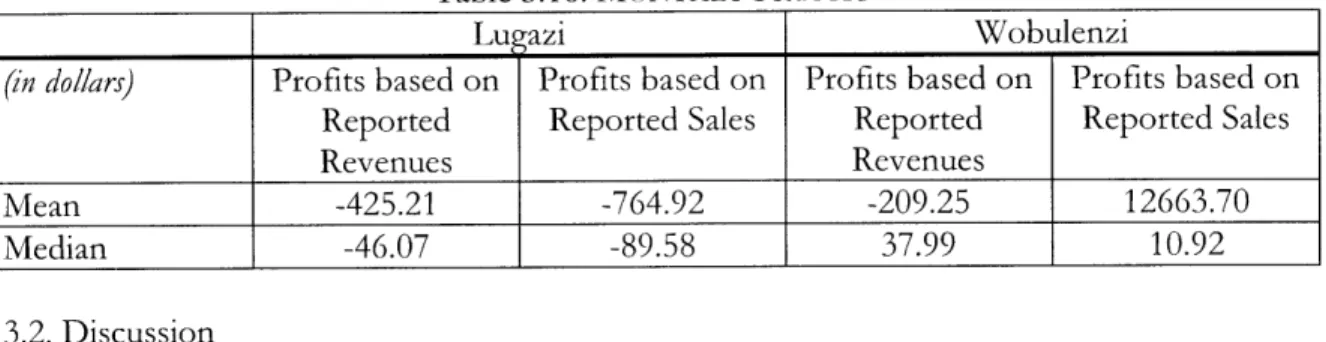
Similarly, when comparing the firms' profits, we find a wind variation in the responses and the resulting numbers between towns. Wobulenzi displays more positive profitability although the margins remain small. Lugazi, however, consistently shows negative
profitability. Given the somewhat higher revenue and sales figures for the firms in Lugazi, the associated expenditures per firm are higher in Lugazi than in Wobulenzi and is reflected in the lower profits (Table 3.16).
Table 3.16. MONTHLY PROFITS
Lugazi Wobulenzi
(in dollars) Profits based on Profits based on Profits based on Profits based on
Reported Reported Sales Reported Reported Sales
Revenues Revenues
Mean -425.21 -764.92 -209.25 12663.70
Median -46.07 -89.58 37.99 10.92
3.2. Discussion
The characteristics of the MSEs surveyed in Wobulenzi and Lugazi are quite similar to those described in other developing country communities in the literature. These characteristics -the use of labor-intensive, ra-ther than capital-intensive, technologies, equitable opportunities, ease of entry, and self-employment opportunities - are what have made MSEs an
opportunity for economic expansion and therefore a target of the Ugandan government for financial and institutional support. However, in order to continue to encourage MSEs' role as an increasingly important economic sector, more must be understood about why, despite ease of entry, individual firm growth has been limited.
Chapter Four: Constraints to Growth
The characteristics of the MSEs surveyed in Wobulenzi and Lugazi are consistent with the distinctions of MSEs targeted by Structural Adjustment Programs in developing countries. One important similarity is that firms in these towns appear to start-up easily but encounter obstacles to long-term survival and growth. In order to continue to encourage the sustained growth of MSEs, policy interventions should thus be focused on nurturing existing MSEs rather than on easing barriers to entry in the sector. To better understand what policy reforms could help existing MSEs, the firms surveyed in Wobulenzi and Lugazi were asked to rank 14 different factors as to their role as an obstacle to growth and/or productivity on a
scale from 1-to-5 (with 1 being a "very big obstacle" and 5 being "not an obstacle at all"). Figure 4.1 presents a summary of responses standardized by firm in order to account for the differences in respondents' perception of the 1-to-5 ranking system (The raw data obtained can be found Appendix 1.).2 The data suggest that taxes, electricity, and inflation/price instability are the largest obstacles to growth for firms in both towns. Among the least constraining factors are the availability of qualified workers and inputs/raw materials (Figure 4.1). This section presents a summary of firms' perceived obstacles to growth and explores several constraints that (1) have been targeted by the MSEPU and (2) are considered significant factors by the firms.
2 Standardized numbers reflect each firm's rankings in standard deviation units relative to that firm's mean rank
(Standardized Value = (x-j)/G). Essentially, standardization allows us to indicate the relative distance of a constraint ranking from the average scores of the constraint and then evaluate it against the standard deviation positive numbers indicate rankings greater than a firm's mean value; as the value 5 was given to factors that posed little or no constraint for firms, increasing values decreasing levels of constraint. Similarly, negative values reflect higher- than-average rankings and indicate greater perceived constraint for firms.
Figure 4.1. STANDARDIZED RANKINGS OF CONSTRAINTS TO GROWTH FACTORS
Level of Taxes Billed
Insufficient Demand Quality of Electric Service
Inflation
Cost of Electric Service Lack of Financing Tax Regulations
Insufficient Waste Disposal U Lugazi
Lack of Access to Land ObUlenZi
Cost of Water Supply Quality of Roads Cost of Transportation Quality of Water Supply Lack of Inputs Shortage of Qualified Workers
-1 -0.8 -0.6 -0.4 -0.2 0 0.2 0.4 0.6 0.8 1
Standardized Ranking
4.1. General Findings
In both Wobulenzi and Lugazi, a shortage of qualified workers was not found to be a significant constraint to growth or productivity. As the size of these businesses is relatively small, the need for many employees is limited. Also, few businesses have the need for specialized skills-for most, unskilled or semi-skilled labor is sufficient. We found that many of these businesses were managed and tended to by the owner or one other employee. As such, there is limited need for outside workers. One exception is in the service industry; respondents in this category felt a shortage of qualified workers to be more constraining than other businesses. This may be explained by the necessary degree of skill required to perform services such as hair cutting and repair work.
In Wobulenzi, the clinics and pharmacies found a lack of skilled labor to be quite
constraining relative to the other business types. Again, this may be attributed to the general characteristics of the business type, which we would assume requires more skills. However, this does not seem to be the case in Lugazi. The clinics and pharmacies in both towns give contradictory results throughout our analysis. There are only three samples of clinics and pharmacies in Wobulenzi and it seems as though their perceptions of constraints vary greatly
from the clinics and pharmacies of Lugazi. Additionally, the nature of the clinic and pharmacy imply different firm needs. As such, the findings for the clinics and pharmacies must be interpreted cautiously.
Firms in both towns find waste disposal a relatively small constraint as compared to other factors. Similarly, Shortage of inputs and raw materials are fairly small obstacles in both towns; less than 13% of firms in each town found it to be a very big obstacle.
Some of the more significant obstacles to growth for these firms reflect the limited
economic environment in which they operate. In both towns, over 45% of the respondents indicated that insufficient demand was a very big obstacle to their productivity and growth. Additionally, inflation and price instability are also important perceived obstacles to growth in both towns. The uncertainty of prices and fluctuating exchange rates make it difficult for firms to plan investment decisions. Over 40% of respondents in both towns found it to be a very large obstacle.
4.2. Taxation
The largest reported constraint for firms in both Wobulenzi and Lugazi is the level of taxes billed to the enterprises. Over 45% of respondents in both towns reported taxation to be a
great constraint to firm growth. The standardized scores suggest equivalent concern over taxes in both towns. The percentage of a typical MSE's costs that can be attributed to taxes and other formal fees (e.g., licenses), however, is quite small. In Lugazi, formal fees and taxes
are only .47% of total average costs; in Wobulenzi they are .38% of total average costs.' The
implied annual tax rates for firms are on the order of 0.47% in Wobulenzi and 0.86% in Lugazi (based on reported revenues). These tax rates are emphasize the differences in tax rates between towns and also the notably small rates themselves.
The Uganda Revenue Authority (URA) has only been recently established. Therefore, the taxation process may still be relatively weak in terms of its operations. However, the way in which taxes are collected varies from business to business with little information
I
If we remove the goods resold category, we find that taxes and formal fees are 4.67% in Lugazi and 1.82% in Wobulenzi of total average costs per firm. Again, this is a small percentage of total expenditures per firm.dissemination in terms of the level of taxation businesses can expect and the timing of the collection. As such, many businesses feel as though the government is treating them unfairly. This perception in many ways is not unfounded. Evidence from our fieldwork suggests that taxes are often collected by URA authorities who arrive unannounced at businesses, and who then select a rather arbitrary amount of tax based on a rapid assessment of the firm's physical characteristics. It is the nature of this taxation system, then, that promotes
resentment and general distrust by MSE operators. It also explains the high degree to which businesses find taxation to be a limiting factor. Variation in scores between business types is quite small and is reflective of the above explanation. Given the small amount of taxes paid,
the perception of an unfair taxation system may be biasing these businesses into believing that taxes are a substantial amount of their costs and therefore, a large constraint. Much of this may be attributed to the arbitrary taxation system discussed above and may be alleviated through a more transparent taxation system.
Tax regulations and bureaucracy seem to be less of a constraint for businesses in both towns. However, we did find that more respondents responded negatively to tax regulations in Lugazi than Wobulenzi. This dissatisfaction may have something to do with the relatively higher levels of local taxation in Lugazi.
The MSEPU recognizes the need for a better taxation system. They have proposed making the taxation process more transparent and streamlined, as well as providing better training for URA officers. These are important actions and should directly address the main problems we have been able to assess from respondents. The GoU can also gain much by improving the taxation process. Given the small amount of taxes they have been collecting,
by making the process much more stringent and regulated, they gain revenues from the
MSEs that may be then used to support other initiatives designed to help MSEs. By not necessarily increasing the levels at which taxes are collected but by providing better information and making the collection system more formal and based on firms' revenues, the government may be able to gain significant levels of revenue, perhaps without further alienating the firm owners. If the tax collection system is indeed as arbitrary as it is percieved, this information could also help inform senior GoU officials about the
performance of URA agents. If the tax collection system is not improved, stronger intervention may be needed in the future if the URA tries to collect higher taxes.
This, however, also highlights the need for firms to operate in a formal business
environment. Perhaps the main reason the URA must collect taxes in this manner is because firms do not keep formal records of their revenues and expenditures. It would seem unwise for the URA, then, to collect taxes based on the firm owners' own estimate of revenues without sufficient evidence attesting to the numbers. Without formal bookkeeping methods,
URA officials may only be able to trust their own assessment of an individual firm's
revenues. Therefore, it is important for firms to learn and adopt conventional bookkeeping practices.
Additionally, although all firms are supposed to register with the town council, only 28% of the firms surveyed in Wobulenzi and 26.3% in Lugazi have formal business registration (Table 4.1). Formal business registration, however, could be greatly beneficial for both the GoU and firms. If firms are formally registered, the GoU can better monitor the MSE environment, implement a more efficient taxation system and be better able to manage programs targeted to MSEs. Additionally, the GoU could make formal registration tied to other MSE targeted policies such as making it necessary to obtain loans.
Table 4.1. BUSINESS REGISTRATION
(percentage
of respondents) Wobulenzi Lugazi Unregistered 67.6 70.9 Registered 28 26.3 Don't know 4.3 2.8 3.3. FinancingAccess to financing is another important limitation for MSEs. Loan institutions rarely exist in and around these secondary towns and, given the little capital firms have to use as collateral,