Publisher’s version / Version de l'éditeur:
Sensors and Actuators B: Chemical, 140, 2, pp. 402-406, 2009-05-05
READ THESE TERMS AND CONDITIONS CAREFULLY BEFORE USING THIS WEBSITE. https://nrc-publications.canada.ca/eng/copyright
Vous avez des questions? Nous pouvons vous aider. Pour communiquer directement avec un auteur, consultez la
première page de la revue dans laquelle son article a été publié afin de trouver ses coordonnées. Si vous n’arrivez pas à les repérer, communiquez avec nous à [email protected].
Questions? Contact the NRC Publications Archive team at
[email protected]. If you wish to email the authors directly, please see the first page of the publication for their contact information.
NRC Publications Archive
Archives des publications du CNRC
This publication could be one of several versions: author’s original, accepted manuscript or the publisher’s version. / La version de cette publication peut être l’une des suivantes : la version prépublication de l’auteur, la version acceptée du manuscrit ou la version de l’éditeur.
For the publisher’s version, please access the DOI link below./ Pour consulter la version de l’éditeur, utilisez le lien DOI ci-dessous.
https://doi.org/10.1016/j.snb.2009.04.041
Access and use of this website and the material on it are subject to the Terms and Conditions set forth at
Using a PEDOT:PSS modified electrode for detecting nitric oxide gas
Lin, Chia-Yu; Chen, Jian-Ging; Hu, Chih-Wei; Tunney, James T.; Ho,
Kuo-Chuan
https://publications-cnrc.canada.ca/fra/droits
L’accès à ce site Web et l’utilisation de son contenu sont assujettis aux conditions présentées dans le site LISEZ CES CONDITIONS ATTENTIVEMENT AVANT D’UTILISER CE SITE WEB.
NRC Publications Record / Notice d'Archives des publications de CNRC:
https://nrc-publications.canada.ca/eng/view/object/?id=bd05be2c-3745-405e-addd-63ef0b6bb797
https://publications-cnrc.canada.ca/fra/voir/objet/?id=bd05be2c-3745-405e-addd-63ef0b6bb797
Contents lists available atScienceDirect
Sensors and Actuators B: Chemical
j o u r n a l h o m e p a g e :w w w . e l s e v i e r . c o m / l o c a t e / s n b
Using a PEDOT:PSS modified electrode for detecting nitric oxide gas
Chia-Yu Lin
a, Jian-Ging Chen
a, Chih-Wei Hu
b, James J. Tunney
c, Kuo-Chuan Ho
a,b,∗aDepartment of Chemical Engineering, National Taiwan University, Taipei 10617, Taiwan, ROC bInstitute of Polymer Science and Engineering, National Taiwan University, Taipei 10617, Taiwan, ROC
cInstitute for Chemical Process and Environmental Technology, National Research Council of Canada, Ottawa K1A 0R6, Canada
a r t i c l e
i n f o
Article history:
Received 24 September 2008 Received in revised form 12 April 2009 Accepted 24 April 2009
Available online 5 May 2009
Keywords: PEDOT:PSS Conducting polymer Chemiresistor Nitric oxide Gas sensor
a b s t r a c t
PEDOT:PSS thick films, prepared by the drop-coated method, were used in this study for sensing nitric oxide (NO) gas. The thickness of PSS film was controlled by dropping different volumes of PEDOT-PSS solution to improve the response of PEDOT-PEDOT-PSS film. Due to its porous structure, the thicker the PEDOT-PSS film is, the higher the noticeable surface area. Thus, a larger response is found. However, since the concentration of NO gas used was low (10 ppm), the effect of the surface area was not noticeable when the thickness of the film was greater than 5 m. In the range of 2.5–10 ppm NO, the relationship between the response of the PEDOT-PSS film and the NO concentration was linear. The limit of detection (S/N = 3), response time (t95), and recovery time (t95) were about 350 ppb, 527 s, and 1780 s, respectively.
The response of PEDOT-PSS film to 10 ppm NO gas was dramatically affected by the presence of either O2
or CO. The standard deviation, with respect to the sensitivity of the NO gas sensor based on PEDOT:PSS film, was 2.2%. The sensitivity of the sensor remained at about 74.5% that of a fresh one.
© 2009 Elsevier B.V. All rights reserved.
1. Introduction
Nitric oxide (NO) is one of the toxic air pollutants generated from every combustion process. This compound plays an impor-tant role in the atmospheric reactions that create the ozone (O3), the
major component of smog, and acid rain[1]. According to regula-tions of the Occupational Safety and Health Administration (OSHA), the permissible exposure limit is set at 25 ppm (TWA).
Several techniques, including electrochemical methods, gas phase chemiluminescence[2], fluorescence[3], conductometry[4], and electron magnetic resonance spectroscopy[5], have been pro-posed for the detection of NO gas. Among them, metal oxide gas sensors, based on the principle of conductometry, attract much attention due to real-time measurement in the gas phase, the small size, easy fabrication, and low cost. However, to achieve higher sensitivity to the analytes, the normal operation temperature of the metal oxide based gas sensor is rather high (>300◦C), which
requires high-energy consumption.
Recently, conducting polymers, such as polythiophene, polyani-line, and polypyrrole, have become an attractive class of materials for gas sensing applications [6–9]. They can be easily synthe-sized by a simple synthesis procedure, and especially, they can detect the analyte gases with satisfactory sensitivity at room
tem-∗ Corresponding author at: Department of Chemical Engineering, National Taiwan University, Taipei 10617, Taiwan. Tel.: +886 2 2366 0739; fax: +886 2 2362 3040.
E-mail address:[email protected](K.-C. Ho).
perature. Poly(3,4-ethylenedioxythiophene) (PEDOT) is one of the most promising conducting polymers due to its high conductiv-ity and excellent environmental stabilconductiv-ity [10]. Although PEDOT itself cannot be easily cast into film due to its insoluble prop-erty, PEDOT doped with poly(styrene-sulfonate) can be dispersed well in the aqueous solution, which facilitates the film fabri-cation. Prinstine PEDOT or doped PEDOT has been used as the sensing material for the detection of HCl [11], NH3 [12], NO2
[13], and alcohols[14]and some volatile organic compounds[15]. However, to our knowledge, the NO sensing characteristics of the PEDOT:PSS film based gas sensor have never been reported yet.
In this study, a simple drop-coated method was employed to pre-pare PEDOT:PSS film. The effects of the film thickness, the working temperature, NO concentration and the presence of some potential interfering gases on the sensing response of the PEDOT:PSS to NO gas were investigated.
2. Experimental
2.1. Preparation of the PEDOT:PSS thick film
An aqueous suspension of the PEDOT:PSS (Baytron®P VP
Al 4083, H.C. Starck GmbH & Co. KG) was purchased from Bayer and used as received. The concentration of the PEDOT:PSS suspension was 1.3–1.7 wt%. To prepare the PEDOT-PSS film-modified electrodes, a specific volume of PEDOT:PSS solution was drop-coated onto an Al2O3 substrate with screen-printed
0925-4005/$ – see front matter © 2009 Elsevier B.V. All rights reserved. doi:10.1016/j.snb.2009.04.041
interdigitated gold electrodes, and then vacuum dried at 70◦C
overnight.
The film thickness was determined by a Field Emission Scanning Electron Microscopy (FESEM, JEOL JSM-6700F, Japan).
2.2. Gas sensing experiment
The gas sensing measurements were carried out in a closed glass chamber. The sensing film, facing against the gas inlet at a flow rate of 250 ml/min, was placed in the sensing chamber. To allevi-ate the baseline drift, the sensing films were exposed to ultrapure N2(ShenYi Gas Co., Taiwan, 99.9995%) overnight before data
col-lection. The transient resistance responses of the PEDOT-PSS film to 10 ppm NO gas, at different working temperatures, tuned by mixing 50 ppm NO (ShenYi Gas Co., Taiwan, 99.99%) with ultrapure N2gas
stream from a tank through a flow meter, were obtained by apply-ing a 1.0 V DC across both terminals of the electrodes. The current responses were recorded by a potentiostat (CHI 440) and converted into resistance according to Ohmic law. The response, S, is defined by the following equation
S =(RgR− RN2)
N2
× 100% (1)
where RN2 and Rgare the resistances of the film in N2gas and in
test gas, respectively. The calibration curve of NO concentration was constructed after collecting the responses of the PEDOT:PSS film to various NO concentrations ranging from 10 to 2.5 ppm.
To test the interferences of O2, CO, and NO2, PEDOT-PSS films
were exposed to the gas mixtures of O2 (21%) and NO (10 ppm),
NO2(10 ppm) and NO (10 ppm), and CO (10 ppm) and NO (10 ppm)
until the responses became stable. The purities of both CO and NO2
gases were 99.9% (ShenYi Gas Co.). The films were then exposed to ultrapure N2gas until the responses were recovered.
3. Results and discussions
3.1. Temperature effect
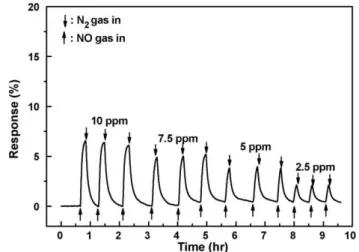
Fig. 1shows the general responses of the PEDOT:PSS thick film (∼4.5 m) to 10 ppm NO gas at room temperature. It was found that the response decreased at the beginning cycles and stabilized after five cycles of exposure to NO gas. Some possible interfering gases, such as water vapor, O2, and CO2, could adsorb in the PEDOT:PSS
film, and thus the initial responses were affected. Therefore, a cleaning procedure for the PEDOT:PSS film is necessary before the sensing test.
Fig. 1. Transit responses of the PEDOT:PSS film to 10 ppm NO gas at room tempera-ture. The film thickness of the PEDOT:PSS film: ∼4.5 m.
Fig. 2. Temperature dependence of the normalized response of the PEDOT:PSS film to 10 ppm NO gas. The film thickness of the PEDOT:PSS film: ∼4.5 m.
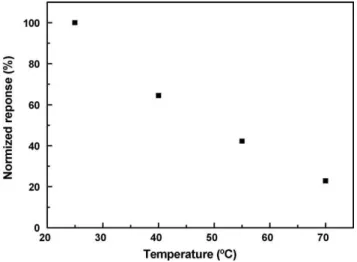
Unlike the gas sensors based on metal oxide, the gas sen-sors based on PEDOT-PSS thick film usually operate at rather low temperatures. In this study, the optimal working temperature for the detection of NO gas was found to be room temperature (see
Fig. 2). Since the interaction between PEDOT:PSS film and NO gas is exothermic, the activation energy of the desorption is larger than that of the adsorption. Although the increase in temperature favors both the adsorption and the desorption processes, higher temper-ature should favor the process with a higher activation energy. This explains the results revealed inFig. 2that the decrease in response at higher temperatures is resulted from the higher desorption rate of NO gas.
Several sensing mechanisms have been proposed for the con-ducting polymer systems, including the redox reactions between the polymer and the analyte, partially charge transfer between the polymer and the analyte, and polymer swelling[16]. In this study, due to the chemical nature of NO gas, the observed increase in the sensor resistance could be attributed to the redox reaction or the charge transfer. NO gas is known to be a highly active and electron-donating free radical [17], and therefore, upon electron transfer from NO to the partially positive charged sulfur site on the back-bone of the p-type PEDOT:PSS, the charge carrier concentration on the polymer backbone decreases, resulting in the increase in the resistance of the PEDOT:PSS film.
Fig. 3. The top-view of SEM image for the PEDOT:PSS film with a film thickness of 4.5 m.
C.-Y. Lin et al. / Sensors and Actuators B 140 (2009) 402–406
Fig. 4. The responses of the PEDOT:PSS films with different thickness, controlled by dropping different volumes of the PEDOT:PSS solution, to 10 ppm NO gas at room temperature.
3.2. Thickness effect
The SEM picture is shown inFig. 3, indicating the nanoporous nature of a PEDOT:PSS film. Due to its porous structure, the sur-face area for NO gas adsorption would increase as the thickness of PEDOT-PSS film is increased. Therefore, the sensor response would be improved if the thickness of PEDOT:PSS film is optimized.Fig. 4
shows the responses of the PEDOT-PSS films, with different thick-nesses, to 10 ppm NO gas at room temperature. It should be noted that the average values of the thickness of the PEDOT:PSS film were determined by SEM measuring at least three spots on the same substrate. As seen, the sensor response increases as the thickness of the PEDOT-PSS film increased from 2.3 to 5.0 m, and became saturated at a thickness greater than 5.0 m. The available surface area was larger at higher film thicknesses, but the concentration of NO gas (10 ppm) used here might be so low that the effect of the surface area was not noticed. Indeed, at higher NO concentrations (>40 ppm), as shown inFig. 5, the film thickness (or the surface area) plays an important role on the sensor response. Therefore, for detection of rather low NO concentrations (<10 ppm), we chose PEDOT:PSS film with a thickness of 5 m for later experiments.
3.3. Gas characteristic of the PEDOT:PSS film
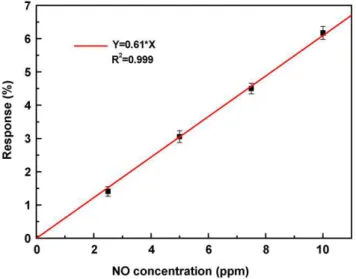
The responses of the PEDOT-PSS film as a function of NO gas con-centration are shown inFig. 6. All responses increased linearly with
Fig. 5. The responses of the PEDOT:PSS films with thicknesses of 5 and 6 m against various NO concentrations ranging from 10 to 80 ppm.
Fig. 6. The responses of the PEDOT:PSS film to various NO gas concentrations. The inset shows the calibration curve. The film thickness of the PEDOT:PSS film: ∼5 m.
the increase in the concentration of NO. The sensitivity, defined as the response divided by the concentration (in 1/ppm) of the gas sensor based on the PEDOT-PSS film is about 0.65%/ppm. The limit of detection, based on the signal-to-noise ratio of 3 (S/N = 3), for PEDOT-PSS film was found to be about 350 ppb. The response time (t95) and recovery time (t95) were calculated to be 527 and 1780 s,
respectively, which were comparable to other gas sensors based on the PEDOT thick films[14], and were large compared to that based on the PEDOT-PSS nanowires[18]. It could be inferred that the improved response by the increase in the film thickness would slow down the response and recovery of the sensor.
To simulate the environmental air quality monitoring, 21% O2,
10 ppm NO2and CO gases were selected as the interfering species.
As shown inFig. 7, the sensor resistance increased as it was exposed to these analyte gases. Besides, the response of PEDOT-PSS film to 10 ppm NO gas was affected dramatically in the presence of 21% O2
or CO gas. It was noticed that the sensor responses to “NO + O2” and
“NO + CO” were higher than the superposition of “NO” and “O2”, and
“NO” + “CO”, respectively. According to the analytical gas report pro-vided by the gas supplier, both air and carbon monoxide tanks have very small amounts of impurities, for example, H2O (3–5 ppm) and
CO2(<1 ppm), which could cause some side reactions upon mixing
with NO gas. Thus, the products generated by the side reaction may cause additional signal when interacting with the PEDOT:PSS film. On the other hand, NO2had minor effects on the sensor responses
Fig. 7. The responses of the PEDOT:PSS film to 21% O2, and 10 ppm NO, NO and CO
gas alone, and mixtures of 10 ppm NO and 21% O2, 10 ppm NO and NO2, 10 ppm NO
Fig. 8. The calibration curves of the fresh three PEDOT:PSS modified electrodes at room temperature. The film thickness of the PEDOT:PSS film: ∼5 m.
compared to CO and O2 gases. To improve the selectivity of the
PEDOT:PSS film against O2 and CO gases for the real world
appli-cation, some dopants sensitive to NO gas could be incorporated into the film. This includes cytochrome c and bis[2,9-dimethyl-1,10-phenanthroline] copper (II) complex, whose reactivity to NO gas
Fig. 9. (a) The calibration curves of the PEDOT:PSS modified electrode obtained for different periods. (b) Time dependence of the normalized sensitivity for the PEDOT:PSS modified electrode. The film thickness of the PEDOT:PSS film: ∼5 m.
has been proven in the literature[19,20]. Using these materials and finding other suitable dopants are under investigation now.
The issue of the PEDOT:PSS film prepared by drop-coating is film uniformity, which could result in poor reproducibility of sen-sor performance.Fig. 8shows the calibration curves for three fresh electrodes at room temperature. As seen, the standard deviation, with respect to the sensitivity of these three electrodes, was about 2.2%, which was quite satisfactory.
Fig. 9demonstrates the long-term stability of the sensor within a month. The electrode was tested once a week and was stored in a box after the sensing test. The box was exposed to the ambient air at room temperature with a relative humidity of 45%. It was found that the sensitivity decreased as time went by, and the sensitivity of the electrode after one month remained 74.5% that of the fresh one, as seen inFig. 9(a) and (b).
4. Conclusion
The PEDOT:PSS film-modified electrodes were fabricated and their sensing characteristics towards NO gas were investigated. The standard deviation, with respect to the sensitivity of the PEDOT:PSS based gas sensor, was 2.2%. The PEDOT:PSS film showed the high-est response to NO gas at room temperature. The sensor responses increased as the PEDOT:PSS film thickness was increased from 2.3 to 5.0 m. The limit of the detection for the PEDOT:PSS based NO gas sensor was 350 ppb, which was suitable for indoor monitoring of NO. However, the sensor response was significantly affected by the presence of either O2or CO. The sensitivity of the PEDOT:PSS
based gas sensor, after about one month remained at 74.5% that of a fresh one.
Acknowledgement
This work was sponsored by the National Research Council of Taiwan, the Republic of China, under grant number NSC 96-2120-M-002-004.
References
[1] L. Kreuzer, C. Patel, Nitric oxide air pollution: detection by optoacoustic spec-troscopy, Science 173 (1971) 182–187.
[2] A. Simpson, A. Custovic, S. Pipis, A. Adisesh, B. Faragher, A. Woodcock, Exhaled nitric oxide, sensitization, and exposure to allergens in patients with asthma who are not taking inhaled steroids, Am. J. Respir. Crit. Care Med. 160 (1999) 45–49.
[3] H. Dacres, R. Narayanaswamy, Evaluation of 1,2-diaminoanthraquinone (DAA) as a potential reagent system for detection of NO, Microchim. Acta 152 (2005) 35–45.
[4] O. Kuzmych, B.L. Allen, A. Star, Carbon nanotube sensors for exhaled breath components, Nanotechnology 18 (2007) 375502.
[5] B. Gallez, H.M. Swartz, In vivo EPR: when, how and why? NMR Biomed. 17 (2004) 223–225.
[6] V.V. Chabukswar, S. Pethkar, A.A. Athawale, Acrylic acid doped polyaniline as an ammonia sensor, Sens. Actuators B Chem. 77 (2001) 657–663.
[7] K. Ogura, T. Saino, M. Nakayama, H. Shiigi, The humidity dependence of the electrical conductivity of a soluble polyaniline-poly(vinyl alcohol) composite film, J. Mater. Chem. 7 (1997) 2363–2366.
[8] M. Penza, E. Milella, V.I. Anisimkin, Monitoring of NH3gas by LB
polypyrrole-based SAW sensor, Sens. Actuators B Chem. 47 (1998) 218–224.
[9] S. Virji, J. Huang, R.B. Kaner, B.H. Weiller, Polyaniline nanofiber gas sensor: examination of response mechanisms, Nano Lett. 4 (2004) 491–496. [10] L. Groenendaal, F. Jonas, D. Freitag, H. Pielartzik, J.R. Reynolds,
Poly(3,4-ethylenedioxythiophene) and its derivatives: past, present, and future, Adv. Mater. 12 (2000) 481–494.
[11] J. Jang, M. Chang, H. Yoon, Chemical sensors based on highly conduc-tive poly(3,4-ethylene-dioxythiophene) nanorods, Adv. Mater. 17 (2005) 1616–1620.
[12] Y. Yang, Y. Jiang, J. Xu, J. Yu, Conducting polymeric nanoparticles synthesized in reverse micelles and their gas sensitivity based on quartz crystal microbalance, Polymer 48 (2007) 4459–4465.
[13] M.K. Ram, O. Yavuz, M. Aldissi, NO2gas sensing based on ordered ultrathin films
of conducting polymer and its nanocomposite, Synth. Met. 151 (2005) 77–84. [14] M.F. Mabrook, C. Pearson, M.C. Petty, An inkjet-printed chemical fuse, Appl.
C.-Y. Lin et al. / Sensors and Actuators B 140 (2009) 402–406
[15] G.A. Sotzing, S.M. Briglin, R.H. Grubbs, N.S. Lewis, Preparation and properties of vapor detector arrays formed from poly(3,4-ethylenedioxy)thiophene-poly(styrene sulfonate)/insulating polymer composites, Anal. Chem. 72 (2000) 3181–3190.
[16] H. Bai, G. Shi, Gas sensors based on conducting polymers, Sensors 7 (2007) 267–307.
[17] V. Blagojevic, E. Flaim, M.J.Y. Jarvis, G.K. Koyanagi, D.K. Bohme, Nitric oxide as an electron donor, and atom donor, and atom acceptor, and a ligand in reactions with atomic transition-metal and main-group cations in the gas phase, J. Phys. Chem. A 109 (2005) 11224–11235.
[18] Y. Dan, Y. Cao, T.E. Mallouk, A.T. Johnson, S. Evoy, Dielectrophoretically assem-bled polymer nanowires for gas sensing, Sens. Actuators B Chem. 125 (2007) 55–79.
[19] J.W. Aylott, D.J. Richardson, D.A. Russell, Optical biosensing of gaseous nitric oxide using spin-coated sol-gel thin film, Chem. Mater. 9 (1997) 2261–2263. [20] H. Dacres, R. Narayananswamy, Sensitive optical NO sensor based on bis
[(2,9-dimethyl-1,10-phenanthroline)] copper(II) complex, Sens. Actuators B Chem. 107 (2005) 14–23.
Biographies
Chia-Yu Lin received his B.S. degree in Chemical Engi-neering from the National Cheng Kung University, Tainan, Taiwan, in 2003. He received his M.S. degree in Chemical Engineering from the National Taiwan University, Taipei, Taiwan in 2005. Currently, he is a fourth-year Ph. D. student in the Department of Chemical Engineering at National Taiwan University. His research interest mainly surrounds nanomaterials for gas sensing applications.
Jian-Ging Chen completed his B.S. and M.S. degrees in Chemical Engineering at Tunghai University and National Central University, Taiwan, respectively. In 2003 he joined Electro-optical Materials Lab at National Taiwan Uni-versity as a PhD student and devoted to the field of dye-sensitized solar cells, emphasizing their electrochem-ical characterization.
Chih-Wei Hu studied both Chemical Engineering and Polymer Science at National Chung Cheng University, Tai-wan. He completed his B.S. and M.S. degrees there. In 2006 he joined Electro-optical Materials Lab at National Taiwan University as a PhD student studying organic electrochromism and polymeric complementary elec-trochromic devices.
James J. Tunney obtained his PhD in Chemistry in 1995 from the University of Ottawa, Canada. He joined the National Research Council of Canada in 1996 first as a Post-Doctoral Fellow, and later as a Research Officer. Since 2006, he has also served as a Competency Leader for Organic Materials at NRC-ICPET. His research interests include the use of thin and thick film technology applied to chemical sensing.
Kuo-Chuan Ho received B.S. and M.S. degrees in Chemi-cal Engineering from the National Cheng Kung University, Tainan, Taiwan, in 1978 and 1980, respectively. In 1986, he received his Ph. D. degree in Chemical Engineering at the University of Rochester. The same year he joined PPG Industries, Inc., first as a Senior Research Engineer and then, from 1990 until 1993, as a Research Project Engineer. He has worked on the electrochemical prop-erties of various electrode materials, with emphasis on improving the performances of sensor devices. Follow-ing a six-year industrial career at PPG Industries, Inc., he joined his alma mater at National Cheng Kung University in 1993 as an Associate Professor in the Chemical Engineering Department. In 1994, he moved to the Department of Chemical Engineering at National Taiwan Univer-sity. Currently, he is a Professor jointly appointed by the Department of Chemical Engineering and Institute of Polymer Science and Engineering at National Taiwan University.