Publisher’s version / Version de l'éditeur:
Vous avez des questions? Nous pouvons vous aider. Pour communiquer directement avec un auteur, consultez la première page de la revue dans laquelle son article a été publié afin de trouver ses coordonnées. Si vous n’arrivez pas à les repérer, communiquez avec nous à [email protected].
Questions? Contact the NRC Publications Archive team at
[email protected]. If you wish to email the authors directly, please see the first page of the publication for their contact information.
https://publications-cnrc.canada.ca/fra/droits
L’accès à ce site Web et l’utilisation de son contenu sont assujettis aux conditions présentées dans le site
LISEZ CES CONDITIONS ATTENTIVEMENT AVANT D’UTILISER CE SITE WEB.
Horticulture Research, 6, 1, 2019-08-21
READ THESE TERMS AND CONDITIONS CAREFULLY BEFORE USING THIS WEBSITE. https://nrc-publications.canada.ca/eng/copyright
NRC Publications Archive Record / Notice des Archives des publications du CNRC :
https://nrc-publications.canada.ca/eng/view/object/?id=1ba04cf3-48da-40a5-822c-b7dee4e9842a
https://publications-cnrc.canada.ca/fra/voir/objet/?id=1ba04cf3-48da-40a5-822c-b7dee4e9842a
This publication could be one of several versions: author’s original, accepted manuscript or the publisher’s version. / La version de cette publication peut être l’une des suivantes : la version prépublication de l’auteur, la version acceptée du manuscrit ou la version de l’éditeur.For the publisher’s version, please access the DOI link below./ Pour consulter la version de l’éditeur, utilisez le lien DOI ci-dessous.
https://doi.org/10.1038/s41438-019-0180-0
Access and use of this website and the material on it are subject to the Terms and Conditions set forth at
VcRR2 regulates chilling-mediated flowering through expression of
hormone genes in a transgenic blueberry mutant
Lin, Tianyi; Walworth, Aaron; Zong, Xiaojuan; Danial, Gharbia H.;
Tomaszewski, Elise M.; Callow, Pete; Han, Xiumei; Zaharia, L. Irina; Edger,
Patrick P.; Zhong, Gan-yuan; Song, Guo-qing
A R T I C L E
O p e n A c c e s s
VcRR2 regulates chilling-mediated
flowering through expression of hormone
genes in a transgenic blueberry mutant
Tianyi Lin
1,2, Aaron Walworth
1,2, Xiaojuan Zong
1,2, Gharbia H. Danial
1,2, Elise M. Tomaszewski
1,2, Pete Callow
1,2,
Xiumei Han
3, L. Irina Zaharia
3, Patrick P. Edger
2, Gan-yuan Zhong
4and Guo-qing Song
1,2Abstract
The molecular mechanism underlying dormancy release and the induction offlowering remains poorly understood in woody plants. Mu-legacy is a valuable blueberry mutant, in which a transgene insertion caused increased expression of a RESPONSE REGULATOR 2-like gene (VcRR2). Mu-legacy plants, compared with nontransgenic‘Legacy’ plants, show dwarfing, promotion of flower bud formation, and can flower under nonchilling conditions. We conducted
transcriptomic comparisons in leaves, chilled and nonchilledflowering buds, and late-pink buds, and analyzed a total of 41 metabolites of six groups of hormones in leaf tissues of both Mu-legacy and‘Legacy’ plants. These analyses uncovered that increased VcRR2 expression promotes the expression of a homolog of Arabidopsis thaliana ENT-COPALYL DIPHOSPHATE SYNTHETASE 1 (VcGA1), which induces new homeostasis of hormones, including increased gibberellin 4 (GA4) levels in Mu-legacy leaves. Consequently, increased expression of VcRR2 and VcGA1, which function in cytokinin responses and gibberellin synthesis, respectively, initiated the reduction in plant height and the enhancement offlower bud formation of the Mu-legacy plants through interactions of multiple approaches. In nonchilledflower buds, 29 differentially expressed transcripts of 17 genes of five groups of hormones were identified in transcriptome comparisons between Mu-legacy and‘Legacy’ plants, of which 22 were chilling responsive. Thus, these analyses suggest that increased expression of VcRR2 was collectively responsible for promotingflower bud formation in highbush blueberry under nonchilling conditions. We report here for thefirst time the importance of VcRR2 to induce a suite of downstream hormones that promoteflowering in woody plants.
Introduction
Deciduous woody plants have evolved to be winter dormancy-dependent for survival under freezing tem-peratures and require accumulation of a minimum level of chilling (chilling requirement) to allow resumption of normal growing and flowering in coming seasons1–4. Photoperiod and temperature are the major environ-mental factors in inducing and maintaining dormancy1,3,5.
Insufficient chill can reduce fruit production by reducing bud break and lessening flower quality6. With climate changes, declining chilling has been occurring for decades and is predicted to continue to do so; and consequently, insufficient winter chill has been recognized as a potential limiting factor on fruit production for both wild and cultivated species7–9.
Flowering is a prerequisite for fruiting and plays a significant role in the life cycle of angiosperms4,10. Vernalization/chilling is necessary for normalflowering of winter-annual and deciduous perennial plants, and several critical genes controlling the process have well been characterized in annual species4. For example, FLOW-ERING LOCUS C (FLC), a MADS-BOX gene, plays a
© The Author(s) 2019
Open Access This article is licensed under a Creative Commons Attribution 4.0 International License, which permits use, sharing, adaptation, distribution and reproduction in any medium or format, as long as you give appropriate credit to the original author(s) and the source, provide a link to the Creative Commons license, and indicate if changes were made. The images or other third party material in this article are included in the article’s Creative Commons license, unless indicated otherwise in a credit line to the material. If material is not included in the article’s Creative Commons license and your intended use is not permitted by statutory regulation or exceeds the permitted use, you will need to obtain permission directly from the copyright holder. To view a copy of this license, visithttp://creativecommons.org/licenses/by/4.0/.
Correspondence: Guo-qing Song ([email protected])
1
Plant Biotechnology Resource and Outreach Center, Department of Horticulture, Michigan State University, East Lansing, MI 48824, USA
2
Department of Horticulture, Michigan State University, East Lansing, MI 48824, USA
Full list of author information is available at the end of the article.
1234567890() :,; 1234567890( ):,; 1234567890() :,; 1234567890( ):,;
central role in the vernalization pathway of winter eco-types of annual A. thaliana and is a critical component of the vernalization regulatory loop of FRIGIDA (FRI)-FLC-FT (FLOWERING LOCUS T), which seems being con-served in the family Brassicaceae10–12. Similarly, in vernalization-requiring wheat and barley, a VRN1–VRN2–TaFT (VRN3) loop regulates vernalization-mediatedflowering13. In parallel, a cluster of six MADS-box transcription factors identified through forward genetics, analogous to FLC in A. thaliana and VRN2 in cereals and termed as DORMANCY-ASSOCIATED MADS-BOX (DAM), are involved in dormancy regula-tion in peach (Prunus persica)14,15. These DAM genes show high similarities to A. thaliana AGAMOUS-LIKE 24 (AGL24) and SHORT VEGETATIVE PHASE (SVP) genes16–18. Functional analysis of the DAMs through reverse genetics has not been reported in peach. To date, in woody plants, there remains a lack of understanding of the physiological, molecular, and genetical basis of chilling-regulated flowering7.
Highbush blueberry (Vaccinium corymbosum L.) is a major cultivated Vaccinium crop in the family Ericaceae (Syn. Heath) containing∼450 species19,20. As a perennial shrub, blueberry floral bud initiation often starts before endodormancy21. Enough chilling accumulation during endodormancy, ranging from 150 to 1500 chill units, is required for breaking dormancy, and insufficient chilling prevents normal bud break and leads to reduced blue-berry production20. Compared with annual and other woody species, the knowledge of genetic and molecular control of chilling requirements for flowering is very limited in blueberry. Our recent comparative tran-scriptome analysis of nonchilled, chilled, and late-pink bud revealed that the orthologs of many well-known flowering pathway genes in annual species, such as FT, PROTEIN FD (FD), TERMINAL FLOWER 1 (TFL1), and LEAFY (LFY), MADS-box genes, and hormone genes, were involved in chilling-mediated blueberry bud break in blueberry22. However, like what was noted in other woody plants, functional FLC orthologs were not found in blueberries22–24.
Hormone genes also played roles in blueberry flower-ing23,24. Overexpression of a blueberry FT (VcFT: here-after, Vc included in front of any gene refers to the ortholog of the gene in blueberry) induced differential expression of a group of hormone pathway genes in transgenic blueberry leaves23. Recently, we identified a unique transgenic blueberry event (line) in the back-ground of the cultivar ‘Legacy’ and this line, named as Mu-legacy, was found to be a valuable genetic stock for studying chilling-induced flowering25. Unlike non-transgenic ‘Legacy’ and other transgenic events, Mu-legacy and its T1 transgenic plants had early flower bud
formation and were able to flower under nonchilling
conditions. Our initial characterization of this mutant, compared with the nontransgenic control and other transgenic events, revealed several hormone-related pathway genes DE and concluded that hormone changes were likely responsible for the phenotypic changes in Mu-legacy25. This was consistent with our previous work that hormones, at least at transcript levels, might function as physiological signals and play a significant role in reg-ulating blueberry flowering, especially chilling-mediated flowering22,23,25,26
.
To reveal the potential roles of VcRR2 and hormone(s) in chilling-mediated blueberryflowering, further analysis of the Mu-legacy was conducted in this study through hormone measurements and RNA sequencing. We revealed profiles of both hormones and DE transcripts (DETs) in leaf and bud tissues of the Mu-legacy plants. We found that the decreased auxin and the increased gibberellin 4 (GA4) contents in Mu-legacy leaves likely contributed to plant dwarfing, and promoted flower bud formation and nonchilled flower bud break of the Mu-legacy plants. The Mu-Mu-legacy plants provided evidence to show that an increased expression of VcRR2 played a critical role in regulating blueberryflower bud formation and bud break mainly through hormone pathway genes but not flowering pathway genes. The results provided further evidence that hormones may play critical roles in chilling-mediated flowering in blueberry and possible other woody plants.
Results
Flowering behaviors of Mu-legacy plants
We exanimated theflowering behaviors of nonchilled 6-year-old ‘Legacy’, Legacy–VcDDF1-OX, Mu-legacy, and Mu-legacy-T1 plants. Under the greenhouse conditions
(the lowest temperature >20 °C, natural light condition), all the Mu-legacy and the Mu-legacy-T1 plants, in
con-trast to the‘Legacy’ plants, showed a new break of some flower buds in mid-October of 2017 (Fig.1); leaf tissues at this developmental stage for both the ‘Legacy’ and the Mu-legacy plants were collected for transcriptome and hormone analyses. The results are consistent with our previous observation25. The continuous flowering of the Mu-legacy plants lasted for about 9 months (from Octo-ber to June)25, suggesting that the transgenes and inser-tion posiinser-tion in the Mu-legacy are responsible for the reduced plant size, the promoted flower bud formation, and the reduced chilling requirement for flowering. Interestingly, the observed plant dwarfing is similar to a typical phenotype of GA deficiency in Arabidopsis27
, while the promoted flower bud formation and reduced chilling requirement for flowering are similar to the phenotypic changes of earlyflowering and seed dormancy induced by GA-overproduction phenotypes in Arabidopsis28.
Contents of major hormones in Mu-legacy leaves
Compared with‘Legacy’, Mu-legacy carries a transgenic, overexpressed blueberry DWARF AND DELAYED FLOWERING 1 (DDF1) (VcDDF1), as well as a mutated and overexpressed blueberry RESPONSE REGULATOR 2-like gene (VcRR2), which accidently resulted from the position effect of the introduction of the transgene VcDDF125. In A. thaliana, the DDF1 activates GA2OX7 by binding to the DRE-like motifs (GCCGAC and ATC-GAC) of the GA2OX7’s promoter29. The GA2OX7 cata-lyzes the decay of active GAs29–33. On the other hand, ARABIDOPSIS RESPONSE REGULATOR 2 gene (ARR2) is responsible for cytokinin responses in the cytokinin signaling pathway34,35. Since both VcDDF1 and VcRR2 are related to hormone signaling, we expect that over-expression of these two genes, especially the VcDDF1, would change the hormone profiles of the Mu-legacy plants.
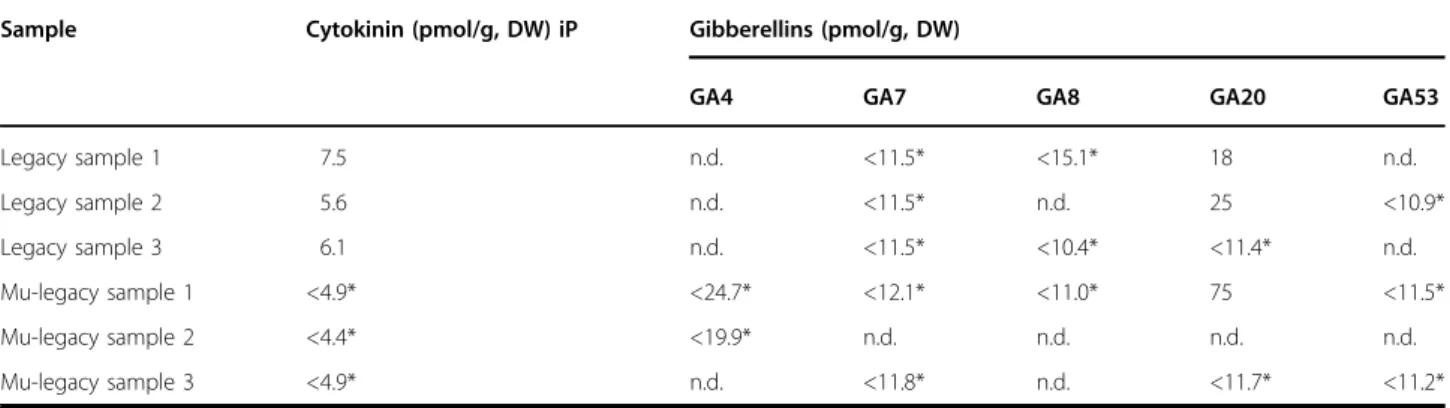
A total of 41 metabolites of six groups of hormones were analyzed in and compared between Mu-legacy and ‘Legacy’ plants (Fig. 2, Table 1). Of the 14 gibberellins (GAs) that were measured, GA19 was detected in the leaf samples of both Mu-legacy and ‘Legacy’ plants, and the Mu-legacy leaves, compared with‘Legacy’ leaves, showed much decreased GA19 (Fig.2a). GA20 was detected high
in the Mu-legacy sample [74.5 pmol/g dry weight (DW)] and low in two ‘Legacy’ samples (18.2 and 25.4 pmol/g DW, respectively) (Table1). More importantly, a low level of GA4, which is an active GA form36, was present in two Mu-legacy samples but absent in all ‘Legacy’ samples (Table 1), indicating that the active GA4 was likely responsible for the promotion offlower bud formation as well as the nonchilled flower bud break (Fig. 1a). Seven ABA and ABA metabolites analyzed were all detected. The Mu-legacy leaves had a higher total ABA content (7.8 vs. 4.7 nmol/g DW) than the‘Legacy’ leaves (Fig.2b). Of the six auxin and auxin metabolites, only IAA was detected, and the Mu-legacy leaves showed a significantly (p = 0.01) lower content than the ‘Legacy’ leaves (Fig.2c). The reduced IAA level likely contributed to the reduced size of the Mu-legacy plants (Fig.1a). Of the ten cytokinin and cytokinin metabolites measured, four were detected in ‘Legacy’ and Mu-legacy samples; measurable iso-pentenyladenine (iP) was only found in the‘Legacy’ leaves (Fig. 2d, Table 1). The overall levels of the detected cytokinin metabolites were higher in the ‘Legacy’ leaves (Fig. 2d). Salicylic acid (SA), jasmonic acid (JA), methyl jasmonate, and jasmonoyl isoleucine were measured and all detected in both the‘Legacy’ and the Mu-legacy leaves. For the contents of JA and JA metabolites, there was no
Fig. 1 Flowering of‘Legacy’, Mu-legacy, and Mu-legacy-T1plants under nonchilling conditions. a Six-year-old Mu-legacy and‘Legacy’ plants in
October 2017. b One of the six 4-year-old Mu-legacy-T1plants in October 2016. Noflower bud break was observed in the ‘Legacy’ plant; in contrast,
statistical difference between the‘Legacy’ and Mu-legacy samples (Fig. 2e). The SA content was slightly higher in the Mu-legacy leaves, although not significant (Fig. 2f). These results showed that overexpressed VcDDF1 and VcRR2 induced content changes of some hormones in the Mu-legacy leaves.
Differentially expressed genes in Mu-legacy leaves Previous comparisons of transcriptomic profiles of leaves between ‘Legacy’ and Mu-legacy plants have revealed that the increased expression of VcRR2 likely
co-functioned with the overexpressed VcDDF1 for the pro-motedflowering and dwarfing of the legacy and Mu-legacy-T1 plants25. In this study, we identified 2543 DE
transcripts (DETs) when transcriptomic profiles were compared between‘Legacy’ and the Mu-legacy leaves and these DETs were much more than the 260 DETs identi-fied in the previous transcriptomic comparison study [25]. Such a large difference likely reflects some variation in the biological samples (e.g., stages and sampling) and sequencing coverage. Nevertheless, among the 260 DETs identified from the previous study, 56 were overlapped
Fig. 2 Detected hormones and their concentrations measured in the‘Legacy’ and Mu-legacy leaves. a Gibberellin. b ABA and ABA metabolites. c Auxin. d Cytokinin and cytokinin metabolites. e JA and JA metabolites. f Salicylic acid. DW: dry weight. FW: fresh weight. Different letters represent a significant difference at P < 0.05 between ‘Legacy’ and Mu-legacy leaves. The bars without letters represent no significant differences at P < 0.05. GA19: Gibberellin 19. ABA: cis-Abscisic acid. DPA: dihydrophaseic acid. ABAGE: Abscisic acid glucose ester. PA: Phaseic acid. 7′ OH-ABA: 7′-Hydroxy-abscisic acid. neo-PA: neo-Phaseic acid. t-ABA: trans-Abscisic acid. IAA: Indole-3-acetic acid. t-ZR: (trans) Zeatin riboside. dhZR: Dihydrozeatin riboside. IPR: Isopentenyladenosine. MeJA: Methyl jasmonate, JA-Ile: jasmonoyl isoleucine
with the DETs found in the current study. The enriched RNA-seq data not only verified the overexpressed VcDDF1 and the increased expression of the VcRR2, but also provided more details to reveal the cause of the phenotypic changes in the Mu-legacy plant (Supplemen-tary Tables 1 and2).
Only two DE genes (DEGs) of the flowering pathway, including orthologues of Arabidopsis FRUITFULL (FUL) and Arabidopsis RAV1, showed up- and down-regulation, respectively; both of which had repressive effects on flowering bud formation and flowering in the 2018 RNA-seq data. Although this result is inconsistent with the previously identified three DE flowering pathway genes (i.e., VcTCP8, VcARP6, and VcNFYC1)25, it still supports the previous conclusion that no orthologs of the major Arabidopsis vernalization pathway genes, e.g., VcFT and VcSOC1, showed differential expression. RAV1 encodes an AP2/B3 domain and is a negative regulator of flower-ing by repressflower-ing both FT and GA37. If the function of the RAV1 in Arabidopsis is conserved in blueberries, the upregulated VcRAV1 would repress flowering of the Mu-legacy plants. FUL is redundant with APETALA1 (AP1) and CAULIFLOWER (CAL) in promoting to the transition to reproductive meristems38. The decreased expression of the VcFUL would repress flower bud formation, which is inconsistent with the promoted flower bud formation of the Mu-legacy plants. Overall, the two DE flowering pathway genes were not likely responsible for the pro-motedflowering in the Mu-legacy plants.
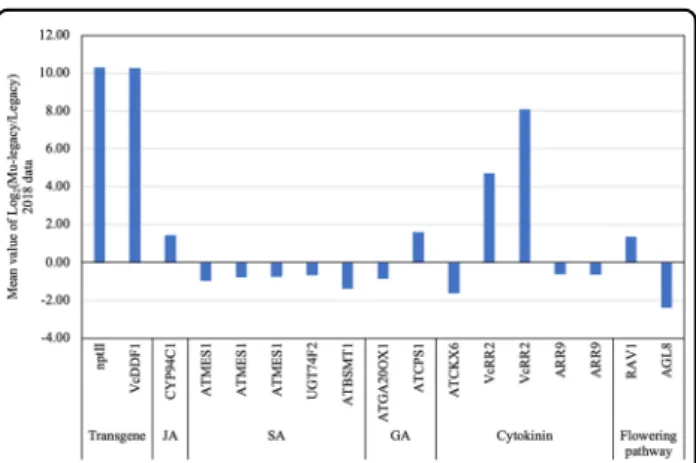
We identified seven DEGs related to the biosynthetic pathways of GA (2 DEGs), SA (3), JA (1), and cytokinin (1) but none for the ABA and auxin pathways (Table 2, Figs. 2, 3). VcCPS and VcGA20OX1 were the two GA related genes. We found that VcCPS expression increased while VcGA20OX1 expression decreased. Ent-COPALYL DIPHOSPHATE SYNTHASE (CPS) catalyzes the first step of GA biosynthesis39. The increased VcCPS could
lead to an increase in bioactive GAs, this matched the result of the presence of the GA4 in the Mu-legacy leaves but not in the ‘Legacy’ leaves36. GA20OX1 catalyzes a series of intermediate oxidation reactions during the biosynthesis of GA36, the slightly reduced expression of VcGA20OX1 should have reduced GA production. Whether the increased VcCPS and decreased VcGA20OX1 expression were part of the cause for the reduced GA19 and increased GA4 content is unknown. CYTOKININOXIDASE6 (CKX6) catalyzes the degrada-tion of cytokinins in Arabidopsis40, and we found that VcCKX6 expressed reduced in this study. The reduced VcCKX6 expression explained well the decreased content of cytokinins observed41. Similarly, we observed an increased expression of cytochrome P450 94C1 (CYP94C1), which is involved in the oxidation of jasmonoyl-L-isoleucine (JA-Ile) in Arabidopsis42. How-ever, the increased VcCYP94C1 did not lead to an increase of JA-Ile accumulation in this study. On the other hand, we found three SA-related DEGs in this study: SALICY-LATE/BENZOATE CARBOXYL METHYLTRANSFERASE (BSMT1), SGT1, and METHYLESTERASE 17 (MES17). Decreased expressions of these genes were found to lead to accumulation of SA in Arabidopsis43, accordingly there was no surprise that the decreased VcBSMT1, VcSGT1, and VcMES17 contributed to the increased SA in the Mu-legacy leaves. We observed the same association of increased expression of these genes (i.e., VcBSMT1, VcSGT1, and VcMES17) with increased accumulation of SA in the Mu-legacy leaves.
Because VcRR2 could enhance cytokinin responses35,44, we searched for the DETs of the orthologues of the other ARR genes. Two DETs of VcRR9 showed downregulation, which could potentially reduce cytokinin responses (Table2, Fig.3). Since cytokinins are often positively correlated to the IAA level45, the reduced cytokinin responses sup-ported the reduced IAA content (Fig.2c).
Table 1 Concentrations of non-detected (n.d.) and low (<) quantitative hormones that show difference between the leaf
tissues of‘Legacy’ and Mu-legacy plants. DW: dry weight
Sample Cytokinin (pmol/g, DW) iP Gibberellins (pmol/g, DW)
GA4 GA7 GA8 GA20 GA53
Legacy sample 1 7.5 n.d. <11.5* <15.1* 18 n.d. Legacy sample 2 5.6 n.d. <11.5* n.d. 25 <10.9* Legacy sample 3 6.1 n.d. <11.5* <10.4* <11.4* n.d. Mu-legacy sample 1 <4.9* <24.7* <12.1* <11.0* 75 <11.5* Mu-legacy sample 2 <4.4* <19.9* n.d. n.d. n.d. n.d. Mu-legacy sample 3 <4.9* n.d. <11.8* n.d. <11.7* <11.2* *p = 0.05
Table 2 Differentially expressed transcripts (DETs) of the hormone and fl owering genes identi fi ed from the comparison of leaf tissues of Mu-legacy and ‘Legacy ’ plants Qu ery id Subjec t id Blast_ e-value Pathway Gene name Annota tion by trinotate Log 2 (Mu-legac y/ Leg acy) 201 8 data Log 2 (Mu-le gacy / Leg acy –VcDDF 1-OX) 201 4 dat a Log 2 (Mu-legac y-T 1 / Leg acy) 201 4 data Log 2 (Legacy –VcDDF 1-OX / Leg acy) 201 4 dat a Log 2 (Mu-legacy/ Leg acy) 201 4 dat a c49456_g2 _i2 VcAR P6 ACTS_RAT #N/ A − 6.17 − 4.7 3 #N/ A − 5.98 c66039_g1 _i1 npt II KKA2_K LEPN 10. 29 #N/ A 9.7 9 10. 60 9.3 3 c92529_g4 _i2 VcRR2 ARR2_A RATH 8.0 8 5.77 6.1 5 #N/ A 6.0 6 c32575_g1 _i1 VcDDF1 DRE1E_ARAT H 10. 28 − 3.49 #N/ A 7.6 4 5.3 1 c96767_g2 _i12 VcRR2 – 4.7 0 4.00 5.0 7 #N/ A #N/ A A T2G27690 .1 c79501_g3 _i1 4.00E − 29 JA CYP9 4C1 C96AF_ARA TH 1.4 2 − 2.34 3.1 6 #N/ A #N/ A A T1G75450 .1 c83077_g1 _i1 0 Cytokin in ATCKX6, ATCKX5, CKX 5 CKX5_ARATH − 1.6 2 2.00 #N/ A #N/ A #N/ A A T2G23620 .1 c83935_g1 _i1 6.00E − 46 SA MES1, ATME S1 MES17_ ARATH − 0.9 7 1.18 − 1.6 1 − 0.82 #N/ A A T2G23620 .1 c83935_g1 _i2 2.00E − 45 SA MES1, ATME S1 MES17_ ARATH − 0.7 9 1.26 − 1.4 4 − 0.90 #N/ A A T2G23620 .1 c83935_g1 _i3 8.00E − 46 SA MES1, ATME S1 MES17_ ARATH − 0.7 5 1.27 − 1.6 8 − 0.82 #N/ A A T2G43820 .1 c85921_g3 _i2 2.00E − 84 SA GT, ATSAG T1, SGT 1, UGT7 4F2, SAGT1 UGT1_GAR JA − 0.6 8 1.34 #N/ A #N/ A #N/ A A T3G11480 .1 c97521_g2 _i1 2.00E −100 SA BSMT1, ATBSMT1 – − 1.3 8 − 3.54 #N/ A 1.3 1 #N/ A A T4G25420 .1 c89942_g2 _i1 5.00E − 55 GA ATGA2 0OX1, AT23 01, GA5, GA20 OX1 SRG1_AR ATH − 0.8 6 − 1.37 #N/ A #N/ A #N/ A A T4G02780 .1 c96791_g4 _i1 0 GA ATCPS 1, CPS, CPS1, GA1, ABC33 KSA_PEA 1.6 0 2.89 2.3 1 #N/ A #N/ A A T1G13260 .1 c83982_g1 _i1 8.00E −132 Flower RAV1, EDF4 RAV1_A RATH 1.3 5 3.07 − 4.6 6 #N/ A #N/ A A T5G60910 .1 c88116_g1 _i1 5.00E − 91 Flower AGL8, FUL AGL8_ SOLTU − 2.3 8 4.23 #N/ A #N/ A #N/ A A T4G02050 .1 c85501_g3 _i2 8.00E − 57 Sucrose STP7 – 1.5 7 − 1.62 1.5 2 #N/ A #N/ A A T4G21480 .1 c85501_g3 _i2 6.00E − 54 Sucrose STP12 – 1.5 7 − 1.62 1.5 2 #N/ A #N/ A A T1G10370 .1 c73618_g2 _i1 1.00E − 30 Sucrose – 3.0 4 − 1.97 3.2 3 1.6 6 #N/ A
The increasedVcRR2 expression promotes flower bud
formation in Mu-legacy and Mu-legacy-T1plants
A typical Legacy–VcDDF1-OX transgenic event, as expected, had the VcDDF1 gene overexpressed in its leaves but did not show altered flowering behavior The VcDDF1 gene was also overexpressed in the leaves of Mu-legacy Mu-Mu-legacy, which, however, was promoted to flower early. Interestingly, VcRR2 and VcCPS were also overexpressed in Mu-legacy, but not in Legacy –VcDDF1-OX, suggesting that VcRR2 and VcCPS were likely the causes forflowering promotion in Mu-legacy and had no direct connections with the overexpression of the VcDDF1 gene in the background (Table2). This conclu-sion was also confirmed in the Mu-legacy-T1 plants
derived from self-pollinated Mu-legacy. The Mu-legacy-T1plants showed a similarflowering behavior as the
Mu-legacy. Very fortunately, in the DEGs between the‘Legacy’ and Mu-legacy-T1 leaves, the VcDDF1 did not showed
differential expression but the VcRR2 and the VcCPS were both upregulated (Table2, Fig.3). This suggests that the increased VcRR2 and VcCPS promoted early flowering of the Mu-legacy-T1 plants under nonchilling conditions,
most likely, through the gibberellin pathway genes. DE hormone genes are involved in dormancy release in
nonchilledflower buds of Mu-legacy plants
We also examined the DETs in theflower buds from the Mu-legacy and‘Legacy’ plants as these DETs might have direct impact on both flower bud development and dor-mancy release of the nonchilled flower buds (NB). We mainly focused on the DETs related to flowering and hormone genes. In addition to the highly increased VcRR2 and four repressed DEGs in the flowering pathway [PROTEIN FD (FD), TERMINAL FLOWER 1 (TFL1), ACTIN-RELATED PROTEIN6 (ARP6), DOF ZINC FIN-GER PROTEIN5.3 (DOF5.3) (DOF5.3)25, we identified 29
Table 2 continued Qu ery id Subjec t id Blast_ e-value Pathway Gene name Annota tion by trinotate Log 2 (Mu-legac y/ Leg acy) 201 8 data Log 2 (Mu-le gacy / Leg acy –VcDDF 1-OX) 201 4 dat a Log 2 (Mu-legac y-T 1 / Leg acy) 201 4 data Log 2 (Legacy –VcDDF 1-OX / Leg acy) 201 4 dat a Log 2 (Mu-legacy/ Leg acy) 201 4 dat a ATGSTU 17, ERD9, GST30B , GST30, GSTU17 A T3G57040 .1 c83921_g3 _i2 3.00E − 76 ARR9, ATRR4 ARR9_A RATH − 0.6 2 #N/ A #N/ A #N/ A #N/ A A T1G10470 .1 c86949_g1 _i2 5.00E − 41 ARR4, MEE7, ATRR 1, IBC7 ARR9_A RATH − 0.6 4 #N/ A #N/ A #N/ A #N/ A Corresponding DETs identi fi ed from the comparisons of leaf tissues between Mu-legacy and Legacy –VcDDF1-OX, Mu-legacy-T 1 and ‘Legacy ’, Legacy –VcDDF1-OX and ‘Legacy ’, and Mu-legacy and ‘Legacy ’from a 2014 study were also included for the cross-comparison of the 2018 and 2014 data. #N/A: No differential expression
Fig. 3 Differentially expressed transcripts (DETs) (PDR < 0.05) of the hormone andflowering genes identified from the comparison of leaf tissues of Mu-legacy and‘Legacy’ plants in the current study (2018)
additional DETs, which are the orthologs of 17 A. thali-ana genes. These genes belong to the biosynthesis path-way genes offive groups of hormones (Table2, Fig.3) and are likely involved in the dormancy release of the NB of the Mu-legacy plants.
Eight DETs representing three genes (ABA2–4) in the pathway of ABA synthesis and the A. THALIANA BETA-GLUCOSIDASE 1 gene, which is a positive regulator of ABA-activated signaling pathway, were upregulated. These upregulated DETs could increase ABA content and enhance ABA signaling, thus potentially resulting in delayingflowering, which is contrary to the early flower-ing of the Mu-legacy (Table 3, Supplementary Table 2). Auxin interacts with ABA in controlling A. thaliana seed dormancy/germination46. Eight DETs of four auxin bio-synthetic genes exhibited a potential for an increase in auxin biosynthesis (Table3). Brassinosteroids (BRs) play a critical opposite role to ABA during seed germination and deficiency of BRs is often associated with dwarf pheno-types47. Five DETs of three genes in the pathway of BRs biosynthesis, including four upregulated and one down-regulated DETs (Table3), most likely inactivate BRs48,49. The reduced active BRs, working with others, can con-sequently lead to the dwarfing and delayed flowering in A. thaliana50. Cytokinins are multifunctional in plants. Four DETs representing three DE cytokinin genes similar to the CYP735A1, UGT85A1, and APT5 genes in Arabi-dopsis were identified (Table3), the overall impact of the DETs can lead to cytokinin-deficient plants due to their potential to reduce active cytokinins through enhanced O-glucosylation51–53. JA is involved in chilling-dependent dormancy release through its interaction with ABA54. Four DETs of four genes in the JA biosynthetic pathway were identified (Table 3), and they all showed an upre-gulation that could either increase or reduce the pro-duction of JA55,56. It is interesting that unlike in the leaf tissues we did not detect any DEGs of the GA pathway in the transcriptome comparison between the nonchilled buds of the Mu-legacy and the ‘Legacy’, suggesting that the promotedflowering of the nonchilled Mu-legacy buds had little to do with the expression the GA pathway genes in this case. Apparently, no convincing evidence shows that any of the individual hormone(s) or the DEG of these hormones is responsible for the promoted flowering of the no-chilled Mu-legacy buds.
Since hormone genes are involved in blueberry flower bud dormancy release22, we further looked into the expression of the 29 DETs of 17 hormone genes identified in the NB of Mu-legacy plants in CB and late-pink buds (LPB) of both Mu-legacy and‘Legacy’ plants (Table3). In the comparison of CB and NB of‘Legacy’, 23 transcripts showed differential expressions, of which 22 showed a consistent up- or down-regulation with those in the 29 DETs resulting from the comparison between NB of
Mu-legacy and‘Legacy’ (Table3), supporting that the 29 DETs are responsible for the promoted flowering of the “Mu-legacy” plants under nonchilling conditions. In the com-parison of CB and LPB of‘Legacy’, 18 of the 29 transcripts exhibited differential expression duringflower bud break (Table 3). On the other hand, according to the low per-centage of bud break and the reduced number offlowers per bud25, the 29 DETs did not initiate the normal flow-ering of nonchilled Mu-legacy plants, most likely because more chilling-driven DETs of other hormone genes or the flowering pathway genes are needed to induce normal flowering (Supplementary Table 2). In addition, two comparisons for Mu-legacy plants, including chilled buds versus nonchilled buds and LPB of the Mu-legacy plants, respectively, revealed 19 and 24 DETs of the 29 tran-scripts of 17 hormone genes were inducers of the Mu-legacy plantflowering under chilling conditions (Table3). This provides further evidence that the 29 DETs are responsible forflowering of the “Mu-legacy” plants under nonchilling conditions. The 17 DETs identified in the comparison of chilled‘Legacy’ buds and nonchilled “Mu-legacy” buds indicated that insufficient changes of these transcripts could also be responsible for the unusual flowering behaviors of the nonchilled Mu-legacy plants.
DEflowering pathway genes are involved in dormancy
release in fully chilledflower buds of Mu-legacy plants
Bud break of the CB of the Mu-legacy plants showed no obvious difference from that of the ‘Legacy’ plants, and the flowering time lasted about 2 weeks25. To look into the effect of fully chilling onflowering of the Mu-legacy plants at transcript levels, we compared transcriptome data of the CB with those of NB and LPB, respectively. In both comparisons, DE flowering pathway genes were identified, including 455 DETs in the comparison of the CB vs. the NB and 396 DETs in the comparison of the CB vs. the LPB (Supplementary Table 3). For the ‘Legacy’ plants, the comparison of the CB vs. the NB resulted in 413 DETs of theflowering pathway genes, of which 304 are shared with the 455 DETs of the“Mu-legacy” plants. Of the shared 304 DETs, 302 showed the same upregu-lations or downreguupregu-lations. The comparison of the CB vs. the LPB of the‘Legacy’ plants resulted in 642 DETs of the flowering pathway genes, in which 299 is shared in the 396 DETs of the “Mu-legacy” plants. Of the shared 299 DETs, 285 showed the same upregulations or down-regulations (Supplementary Table 3).
Only six DETs of four flowering pathway genes, including VcFD, VcTFL1, VcARP6, and VcDOF5.3, were detected and were all repressed in the NB of the Mu-legacy plants (compared with the nonchilled ‘Legacy’ buds)25. We analyzed expression of the six transcripts in the fully vernalizedflower buds and the LPB of the Mu-legacy plants. None of the six transcripts showed
Table 3 Differentially expressed transcripts (DETs) of hormone genes identi fi ed in the transcriptome comparison between nonchilled fl ower bud (NB) of the Mu-legacy and ‘Legacy ’ plants (2014 data) Qu ery id Subje ct id Blast_ e-value Pat hway Gene name Annota tion b y Trin otate Leg acy Mu-le gacy Log 2 (Mu-legacy NB / Legacy NB ) Log 2 (CB/NB) Log 2 (CB/LPB ) Log 2 (CB/N B) Log 2 (CB/L PB) c49456 _g2_i2 VcAR P6 ACTS_ RAT − 8.91 − 9.4 3 #N/ A − 5.5 5 6.89 c66039 _g1_i1 npt II KKA2 _KLEPN #N/ A #N/ A #N/ A #N/A − 8.57 c92529 _g4_i2 VcRR2 ARR2_ ARATH #N/ A #N/ A #N/ A #N/A − 7.26 c32575 _g1_i1 VcDDF1 DRE1E _ARAT H − 2.23 − 4.8 4 #N/ A #N/A − 6.75 c96767 _g2_i12 VcRR2 – #N/ A #N/ A #N/ A #N/A − 4.22 A T5G45340 .1 c69424 _g1_i1 2.00E − 65 A BA CYP7 07A3 ABAH 3_ORYS I 6.6 4 5.8 8 5.1 6 6.66 − 5.37 A T3G19270 .1 c69424 _g2_i1 5.00E − 124 A BA CYP7 07A4 ABAH 4_ARAT H 5.6 6 7.7 2 5.1 6 10.15 − 5.08 A T5G45340 .1 c69424 _g2_i1 8.00E − 100 A BA CYP7 07A3 ABAH 4_ARAT H 5.6 6 7.7 2 5.1 6 10.15 − 5.08 A T3G19270 .1 c83950 _g1_i2 0 A BA CYP7 07A4 ABAH 4_ARAT H 6.6 2 − 1.5 3 4.7 4 #N/A − 4.77 A T2G29090 .1 c83950 _g1_i1 0 A BA CYP7 07A2 – 6.4 1 − 1.3 8 4.7 4 #N/A − 4.60 A T1G52400 .1 c91881 _g1_i1 5.00E − 89 A BA BGL1 , A TBG1, BGLU18 HIU H_SOYBN 1.9 4 − 0.4 9 #N/ A − 2.5 1 − 1.67 A T1G52400 .1 c80508 _g1_i1 9.00E − 134 A BA BGL1 , A TBG1, BGLU18 RG1 _RAUSE #N/ A #N/ A #N/ A − 1.8 4 − 1.61 A T1G52400 .1 c91881 _g1_i2 7.00E − 82 A BA BGL1 , A TBG1, BGLU18 HIU H_SOYBN 1.3 8 #N/ A #N/ A − 2.0 3 − 1.18 A T2G22330 .1 c85230 _g2_i1 9.00E − 56 A uxin CYP7 9B3 C70A2 _ARAT H 11. 98 11. 82 0.5 0 10.93 − 7.88 A T4G31500 .1 c94863 _g6_i2 1.00E − 62 A uxin RNT1, RED1, SUR2, A TR4, CYP8 3B1 C81E 8_MED TR 2.7 5 #N/ A #N/ A − 2.8 7 − 1.85 A T4G31500 .1 c93443 _g1_i1 2.00E − 65 A uxin RNT1, RED1, SUR2, A TR4, CYP8 3B1 C81E 8_MED TR 2.0 6 2.5 3 #N/ A − 1.1 9 − 1.40 A T4G31500 .1 c93443 _g1_i3 1.00E − 65 A uxin RNT1, RED1, SUR2, A TR4, CYP8 3B1 C81E 8_MED TR 2.3 2 3.1 2 #N/ A − 1.5 9 − 1.20 A T1G08980 .1 c89856 _g5_i1 7.00E − 163 A uxin ATAMI 1, A MI1, TOC64-I , ATTOC6 4-I AMI1 _ARAT H #N/ A #N/ A #N/ A 0.66 0.66 A T4G31500 .1 c83219 _g1_i2 4.00E − 43 A uxin RNT1, RED1, SUR2, A TR4, CYP8 3B1 C78A5 _ARAT H − 1.36 4.0 8 0.5 4 2.46 1.05 A T2G22330 .1 c90066 _g1_i1 2.00E − 47 A uxin CYP7 9B3 C82A3 _SOYB N 0.9 5 4.9 7 0.5 6 #N/A 1.45 A T5G11320 .1 c87553 _g1_i1 7.00E − 85 A uxin AtYUC4 , YUC4 YUC 4_ARATH − 1.69 5.6 6 #N/ A − 1.5 4 1.91 A T2G36800 .1 c93075 _g2_i1 6.00E − 88 BR UGT7 3C5, DOGT 1 – 5.0 1 #N/ A #N/ A 2.32 − 1.80
Table 3 continued Qu ery id Subje ct id Blast_ e-value Pat hway Gene name Annota tion b y Trin otate Leg acy Mu-le gacy Log 2 (Mu-legacy NB / Legacy NB ) Log 2 (CB/NB) Log 2 (CB/LPB ) Log 2 (CB/N B) Log 2 (CB/L PB) A T2G26710 .1 c97437 _g3_i3 1.00E − 123 BR CYP7 34 A1, C YP72B1, BAS1 C7A22 _PANG I 1.8 5 #N/ A #N/ A − 1.8 7 − 1.42 A T1G17060 .1 c93255 _g4_i4 8.00E − 74 BR CHI2, SOB7, CYP72C1, SHK 1 C7A29 _PANG I #N/ A 2.5 1 #N/ A − 1.4 9 − 1.30 A T2G26710 .1 c93255 _g4_i5 9.00E − 140 BR CYP7 34 A1, C YP72B1, BAS1 C7A29 _PANG I #N/ A 2.7 4 #N/ A − 1.3 7 − 1.02 A T2G26710 .1 c54735 _g3_i1 6.00E − 112 BR CYP7 34A1, CYP7 2B1 , BAS1 C72A1 _CATR O − 2.01 − 7.6 6 6.6 7 − 7.8 5 3.35 A T1G22400 .1 c92329 _g1_i1 2.00E − 52 C ytokinin UGT8 5A1, A TUGT85A1 UFO G_VITV I 5.3 6 #N/ A #N/ A 1.15 − 3.31 A T2G36800 .1 c93075 _g2_i1 6.00E − 88 C ytokinin UGT7 3C5, DOGT 1 – 5.0 1 #N/ A #N/ A 2.32 − 1.80 A T5G11160 .1 c82929 _g1_i1 5.00E − 108 C ytokinin APT5 APT5 _ARAT H #N/ A #N/ A #N/ A 0.74 0.77 A T5G11160 .1 c82929 _g1_i2 2.00E − 109 C ytokinin APT5 APT5 _ARAT H #N/ A #N/ A #N/ A #N/A 1.28 A T1G20510 .1 c79869 _g1_i1 4.00E − 103 JA OPCL 1 4 CL L1_ARAT H 12. 22 11. 44 #N/ A 11.67 − 7.33 A T3G48520 .1 c93124 _g4_i1 3.00E − 95 JA CYP9 4B3 C70B 1_ARAT H 9.1 7 4.2 4 #N/ A 5.56 − 5.99 A T1G44350 .1 c91828 _g2_i1 0 JA ILL6 ILL6_AR ATH 2.5 5 #N/ A − 0.5 0 − 3.5 0 − 1.31 A T5G07010 .1 c90152 _g5_i1 4.00E − 86 JA ST2A SOT15 _ARAT H 1.0 9 1.2 7 #N/ A − 1.6 6 − 0.94 Corresponding DETs identi fi ed from the other four transcriptome comparison of the fl ower bud tissues, including chilled (CB) vs. NB and chilled vs. late-pink bud (LPB) for ‘Legacy ’and Mu-legacy plants, respectively, were also included. #N/A: No differential expression
differential expressions in the comparison of the CB with those of nonchilled CB. In contrast,five of the six tran-scripts showed differential expressions in the comparison of the CB with the LPB, of which expression of the VcARP6 was repressed and expression of the other three genes were upregulated (Supplementary Table 4). This indicates that the four genes were involved inflowering of the CB of the Mu-legacy plants. In the‘Legacy’ plants, we further looked into expression of the six transcripts in both the CB and the LPB. Five transcripts of the four genes were all repressed in the CB (compared with the NB). The result was similar to the six DETs identified in the comparison between the NB of the Mu-legacy plants and the NB of the ‘Legacy’ plants (Supplementary Table 4). This suggests that the four genes were chilling responsive in the‘Legacy’ flower buds and their expres-sion changes in the NB of the Mu-legacy plants were most likely responsible, at least in part, for theflowering of the nonchilled Mu-legacy plants. All of the six transcripts were differentially expressed in the LPB (compared with the CB) of the‘Legacy’ plants; the result is similar to that of the comparison of the CB with those of LPB of the Mu-legacy plants (Supplementary Table 4).
DE hormone genes are involved in dormancy release in
fully chilledflower buds of Mu-legacy plants
In the‘Legacy’ plants, 703 and 804 DETs of the genes of four hormones (i.e., ABA, ethylene, auxin, and GA) and ARR genes, were identified in CB (compared with NB) and LPB (compared with CB), respectively22. In the Mu-legacy plants, 565 and 276 DETs of nine groups of hor-mone genes were identified in CB (compared with NB) and LPB (compared with CB), respectively (Supplemen-tary Table 2).
Discussion
Cytokinins and gibberellins promoteflower bud formation
in the Mu-legacy plants
Leaves are the primary sources of florigen signals in inducing flowering57. For blueberries, overexpression of VcFT (VcFT-OX) is able to stimulate continuous flower bud formation of transgenic “Aurora” through both the DEflowering pathway genes and the DE hormone genes (compared with nontransgenic leaves)23,24,58, which was associated with changes in the contents of different hor-mones (unpublished data). Apparently, expression of hormone genes and hormones abundances are responsive to the VcFT-OX, although it is impossible to conclude whether or not these hormones are part of theflorigenic signals because of the well-documented leaves-to-buds transport of FT proteins in many herbaceous plants59–67. In another case, SOC1 is a major integrator downstream of FT10. Overexpression of the K-domain of the VcSOC1 (VcSOC1K-OX) in “Aurora” leaves enhanced flower bud
formation through a group of DE hormone genes and DE flowering pathway genes (compared with nontransgenic leaves) where the VcFT did not show differential expres-sion26. Thus, the promoted flower bud formation is not likely, at least at transcript levels, entirely through the enhanced VcFT production and transport. In fact, phe-notypic changes in both the VcFT-OX and the VcSOC1K-OX plants suggest that hormones could have played essential roles in flower bud formation and dormancy release23,26.
The Mu-legacy plants are phenotypically similar to both VcFT-OX and VcSOC1K-OX plants and showed pro-moted flower bud formation and flowering under non-chilling conditions25. However, the major difference is that only two DE flowering pathway genes (compared with nontransgenic ‘Legacy’ leaves), in contrast to the many more identified in the VcFT-OX and the VcSOC1K-OX plants24,26, were detected. More interestingly, the two DE flowering pathway genes, including the upregulated VcRAV1 and the downregulated VcFUL (Table2, Fig.3), have repressive effects on flowering bud formation and flowering. This provides evidence that the signals pro-motingflower bud formation in the Mu-legacy leaves are independent of expression of VcFT and flowering pathway genes. Therefore, we believe that the seven DEGs related to biosynthetic pathways of GA, SA, JA and cytokinin, especially the contents of cytokinins and GAs, were most likely responsible for the promotedflower bud formation in the Mu-legacy plants (Table2, Figs. 2,3).
Responses of blueberryflowering pathway genes during
dormancy release
Sufficient chilling hours and warm temperatures are two prerequisites to break blueberry dormancy for healthy flowering and growth4
. Accordingly, blueberry flower buds often experience two major changes of their phy-siological statuses, including transition from nonchilled to chilled buds following full chilling and then from chilled buds toflowers upon exposure to warmer temperatures. In the previous transcriptome comparisons for ‘Legacy’ plants, the comparison of chilled and NB resulted in dif-ferential expression of 89% of the blueberry flowering pathway genes; and, the comparison of CB and late-pink flower revealed differential expression of 96% of flowering pathway genes22. Apparently,flowering pathway genes are highly involved in dormancy release of blueberry buds at transcript levels. Interestingly, only four (3.8%) flower pathway genes, including VcFD, VcTFL1, VcARP6, and VcDOF5.3, showed differential expression in the non-chilled buds of Mu-legacy, of which ~50% were able to flower under nonchilling conditions25
. Although this does not look reasonable for the Mu-legacy plants at transcript levels, it is possible at post-transcriptional or translational levels because little is known about what physiological
signals are actually induced by these DEflowering path-way genes identified in dormancy release. One fact is that many DE hormone genes were also induced in ‘Legacy’ flower buds during dormancy release22
. It remains unclear whether the DEflowering pathway genes or DE hormone genes determine the dormancy release. Thus, the value of the Mu-legacy flowering under nonchilling conditions associated with only 4 DEflowering pathway genes is that it demonstrates that other pathway genes, e.g., the 29 DE transcripts of 17 hormone genes (Table 3), play a sig-nificant role in blueberry flower bud break.
Mechanism of chilling-mediatedflowering of the
Mu-legacy plants
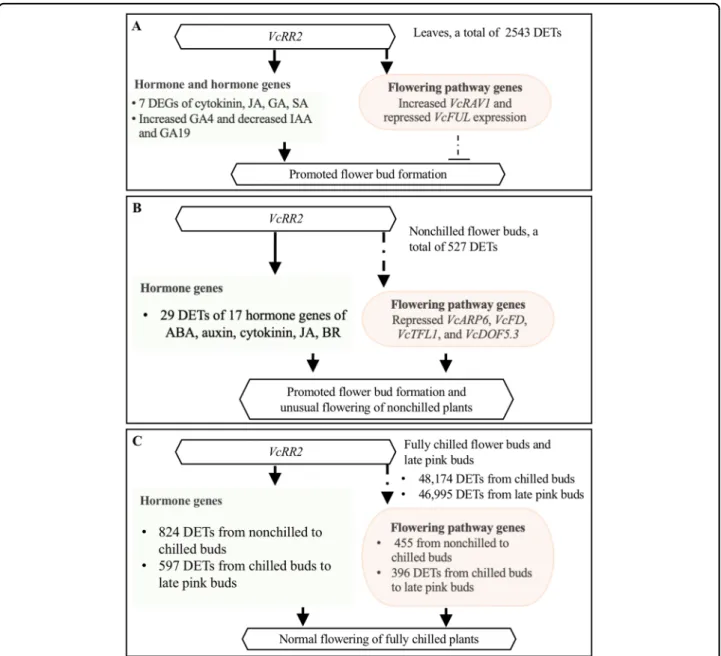
Mechanisms underlying release of bud endodormancy of deciduous trees are complicated due to the involve-ment and interaction of multiple pathways68,69. Hormone and flowering pathways are involved in the dormancy release of blueberryflower buds22. The Mu-legacy plants showed early flower bud formation in 1- and 2-year-old plants when fewflower buds were observed in the non-transgenic‘Legacy’ plants25. In addition, for the plants of the same age, the Mu-legacy plants had moreflower buds than the nontransgenic‘Legacy’ plants25. Only two DEGs of the flowering pathway genes, including zero in the previous comparison25 and two in this study, were detected in the two transcriptome comparisons between the leaf tissue of the Mu-legacy plants and that of the nontransgenic ‘Legacy’ plants. It was likely that the DE flowering pathway genes played a minor role in the pro-moted Mu-legacyflowering. Accordingly, if the florigenic signals for the promotedflower bud formation in the Mu-legacy plants were from leaves, the DETs of hormone genes were more likely the major cause than the DETs of the flowering pathway genes (Fig. 4a). Based on the transcriptome data and the hormone profile in the leaves of the Mu-legacy plants, we believe that it was the expression of VcRR2 that enhanced plant response to cytokinins, which consequently promoted flower bud formation through the changes of either the content of hormones (e.g., GA4) or the expression of the hormone genes (e.g., VcCPS) (Table2, Fig.4a).
In the NB of the Mu-legacy plants, only four DEGs of the flowering pathway genes, including VcFD, VcTFL1, VcARP6, and VcDOF5.3, were detected and were all repressed (compared with NB of the nontransgenic ‘Legacy’ plants)25
. In addition, 29 DETs of 17 hormone genes of ABA, auxin, cytokinin, JA, and BR were found (Table 3). These 4 DEGs flowering pathway genes 17 DEGs of hormone genes were associated with mainly by the expression of VcRR2 and resulted in unusual flowering of the NB (Fig.4b).
From nonchilled to CB and to LPB of both the‘Legacy’ and the Mu-legacy plants, a great number of flowering
pathway genes and hormone genes were involved (Sup-plementary Tables 2 and 3). For fully chilled plants, the interactions of these genes under warm conditions drove normal bud break andflowering (Fig.4c).
Materials and methods
Plant materials
Six 5-year-old plants for each of nontransgenic high-bush blueberry‘Legacy’ and transgenic Mu-legacy and 12 plants of three Legacy–VcDDF1-OX transgenic lines were grown in the courtyard between two greenhouses for phenotyping in 2017. The plants were moved into the greenhouse (heated for winter) in the October of 2017. In January of 2018, young leaf tissues, 5–10 g for each of the ‘Legacy’ and Mu-legacy plants, were harvested from multiple new shoots; half of these leaves were subjected to freeze drying immediately and another half were ground in liquid nitrogen and stored in a−80 °C freezer. Six Mu-legacy-T1 plants, which are from one self-pollinated T1
seed of Mu-legacy25, were grown for phenotyping in the greenhouse since 2016 and never exposed to chilling temperatures. All plants were developed from in vitro cultured shoots and grown under natural light conditions and a regular schedule of irrigation and fertilization using 0.2 g/L fertilizer (Nitrogen:Phosphorus:Potassium= 21:7:7)70.
Hormone profiling
Freeze-dried tissues of three plants each from ‘Legacy’ and Mu-legacy plants were used for profiling ABA and six ABA metabolites (ABAGE: Abscisic acid glucose ester, DPA: Dihydrophaseic acid, PA: Phaseic acid, 7′OH-ABA: 7′-Hydroxy-abscisic acid, neo-PA: neo-Phaseic acid, and t-ABA: trans-Abscisic acid), auxins [IAA: Indole-3-acetic acid, Asp: N-(Indole-3-yl-acetyl)-aspartic acid, IAA-Glu: (Indole-3-yl-acetyl)-glutamic acid, IAA-Ala: N-(Indole-3-yl-acetyl)-alanine, IAA-Leu: N-(Indole-3-yl-acetyl)-leucine, and IBA: Indole-3-butyric acid], cytoki-nins [t-ZOG: (trans) Zeatin-O-glucoside, c-ZOG: (cis) Zeatin-O-glucoside, t-Z: (trans) Zeatin, c-Z: (cis) Zeatin; dhZ: Dihydrozeatin, t-ZR: (trans) Zeatin riboside, c-ZR: (cis) Zeatin riboside, dhZR: Dihydrozeatin riboside, iP: Isopentenyladenine, and iPR: Isopentenyladenosine], and 14 gibberellins (GA1, GA3, GA4, GA7, GA8, GA9, GA19, GA20, GA24, GA29, GA34, GA44, GA51, and GA53). These hormones were measured by the National Research Council of Canada, Saskatoon, SK S7N 0W9 (http://www. nrc-cnrc.gc.ca/eng/solutions/advisory/plant_hormone. html). Fresh tissues of the same set of materials for RNA-seq and other hormone analysis were used for quantifi-cation of SA, JA, and two JA metabolites (MeJA: Methyl jasmonate, JA-Ile: jasmonoyl isoleucine). The samples were prepared following an Arabidopsis protocol71 and measured by the Mass Spectrometry and Metabolomics
Core of Michigan State University. ANOVA and Tukey’s test were conducted using RStudio (Version 1.0.136). RNA-seq and differential expression analysis
Total RNA of the same set of samples used in hormone analysis was each isolated from ~0.5 g of ground tissues using a CTAB method72, followed by using the RNeasy Mini Kit for on-column DNase digestion and RNA purification (Qiagen, Valencia, CA, USA). The integrity of the RNA samples was assessed using the Agilent RNA 6000 Pico Kit (Agilent Technologies, Inc., Germany). All RNA samples
submitted for RNA sequencing had an RNA quality score >8.0. Sequencing (150-bp pair-end reads) was conducted using the Illumina HiSeq4000 platform at the Research Technology Support Facility at Michigan State University (East Lansing, MI, USA). In total, 30–60 million reads were generated for each biological replicate. The FastQC program (www.bioinformatics.babraham.ac.uk/projects/fastqc/) was used to assess the quality of sequencing reads, with the per base quality scores ranging from 30 to 40.
The RNA-seq reads were analyzed using Trinity73and aligned to the transcriptome reference Reftrinity
Fig. 4 Schematic diagram illustrating the effect of the enhanced expression of theVcRR2 on flower bud formation and flowering of the Mu-legacy plants. a The differential expressed transcripts (DETs) of hormone genes (compared with‘Legacy’) and the changed contents of GAs in leaves could be responsible for the promotedflower bud formation. b In total, 29 DETs of 17 hormone genes played a major role in stimulating the flower bud break and unusual flowering of the Mu-legacy plants under nonchilling conditions. c Normal flowering of the Mu-legacy plants after full chilling was driven by the DETs of both hormone andflowering pathway genes
(GenBank accession number: SRX2728597)24, and the abundance for each of a single read was estimated using the Trinity command“align_and_estimate_abundance.pl”. The Trinity command “run_DE_analysis.pl–method edgeR” was used to conduct a differential expression analysis73. The differentially expressed (DE) genes or isoforms with ta false discovery rate (FDR) value below 0.05 (p-value < 0.001) were used for further pathway analysis. Fragments per kilobase of transcript per million mapped reads (FPKM) were used to evaluate expression abundance. Most of the analyses were performed using the resources at the High Performance Computing Center of Michigan State University.
We focused our analyses on the genes of three path-ways: hormone, sugar, and flowering. Synthesis pathway genes of nine phytohormones in Arabidopsis, including auxin, cytokinin, ABA, ethylene, gibberellin, brassinos-teroid, jasmonic acid, salicylic acid, and strigolactones, were retrieved from the RIKEN Plant Hormone Research Network (http://hormones.psc.riken.jp/). Similarly, sugar synthesis pathway genes in Arabidopsis were used as references in analyzing sugar-related genes in this study (Supplementary Table 5). All of the selected Arabidopsis genes were used as queries to blast against the tran-scriptome reference Reftrinity24 and the blueberry iso-forms showing e-values less than e−20 were used for further various transcriptome comparisons. On the other hand, blueberryflowering pathway genes identified in our previous study24were referenced for analyzing the DETs related toflowering pathways in this study.
Some additional transcriptome comparisons were car-ried out by using data from our previous reports22,25,74, as listed in Supplementary Table 6. The previous tran-scriptome data involved in the comparisons had three biological replicates for each sample and an RNA quality score above 8.0. The data were collected by sequencing 100-bp pair-end reads using the Illumina HiSeq2500 platform at the Research Technology Support Facility at Michigan State University (East Lansing, MI, USA). All the raw sequencing data had been deposited in GenBank.
Acknowledgements
This research was partially supported by AgBioResearch of Michigan State University (http://www.canr.msu.edu/research/agbioresearch/) and USDA-NIFA AFRI 1015241 to P.P.E. and G.S.
Author details
1Plant Biotechnology Resource and Outreach Center, Department of
Horticulture, Michigan State University, East Lansing, MI 48824, USA.
2Department of Horticulture, Michigan State University, East Lansing, MI 48824,
USA.3Aquatic and Crop Resource Development, National Research Council of
Canada, Saskatoon, SK S7N 0W9, Canada.4Grape Genetics Research Unit,
USDA-ARS, Geneva, NY 14456, USA
Author contributions
G.S. conceived and supervised the study; T.L., A.W., X.Z., G.H.D., E.M.T., P.C., X.H., and G.S. conducted the experiments; L.I.Z., P.P.E., G.Z., and G.S. analyzed and
interpreted the data; G.S. and T.L. wrote the paper. All authors read and approved the paper.
Conflict of interest
The authors declare that they have no conflict of interest.
Supplementary Information accompanies this paper at (https://doi.org/ 10.1038/s41438-019-0180-0).
Received: 14 March 2019 Revised: 5 July 2019 Accepted: 10 July 2019
References
1. Olsen, J. E. Light and temperature sensing and signaling in induction of bud dormancy in woody plants. Plant Mol. Biol. 73, 37–47 (2010).
2. Samish, R. M. Dormancy in woody plants. Annu. Rev. Plant Physiol. 5, 183–204 (1954).
3. Tanino, K. K., Kalcsits, L., Silim, S., Kendall, E. & Gray, G. R. Temperature-driven plasticity in growth cessation and dormancy development in deciduous woody plants: a working hypothesis suggesting how molecular and cellular function is affected by temperature during dormancy induction. Plant Mol. Biol. 73, 49–65 (2010).
4. Wilkie, J. D., Sedgley, M. & Olesen, T. Regulation offloral initiation in horti-cultural trees. J. Exp. Bot. 59, 3215–3228 (2008).
5. Arora, R., Rowland, L. J. & Tanino, K. Induction and release of bud dormancy in woody perennials: a science comes of age. Hortscience 38, 11 (2003). 6. Lobos, G. A. & Hancock, J. F. Breeding blueberries for a changing global
environment: a review. Front. Plant Sci. 6, https://doi.org/10.3389/ fpls.2015.00782(2015).
7. Atkinson, C. J., Brennan, R. M. & Jones, H. G. Declining chilling and its impact on temperate perennial crops. Environ. Exp. Bot. 91, 48–62 (2013). 8. Luedeling, E., Girvetz, E. H., Semenov, M. A. & Brown, P. H. Climate change
affects winter chill for temperate fruit and nut trees. PLoS ONE 6, e20155 (2011).
9. Melke, A. The physiology of chilling temperature requirements for dormancy release and bud-break in temperate fruit trees grown at mild winter tropical climate. J. Plant Stud. 4, 47 (2015).
10. Fornara, F., de Montaigu, A. & Coupland, G. SnapShot: control offlowering in arabidopsis. Cell 141,https://doi.org/10.1016/j.cell.2010.04.024(2010). 11. Michaels, S. D. & Amasino, R. M. FLOWERING LOCUS C encodes a novel MADS
domain protein that acts as a repressor offlowering. Plant Cell 11, 949–956 (1999).
12. Mateos, J. L. et al. Combinatorial activities of SHORT VEGETATIVE PHASE and FLOWERING LOCUS C define distinct modes of flowering regulation in Ara-bidopsis. Genome Biol. 16, 31 (2015).
13. Greenup, A., Peacock, W. J., Dennis, E. S. & Trevaskis, B. The molecular biology of seasonalflowering-responses in Arabidopsis and the cereals. Ann. Bot. 103, 1165–1172 (2009).
14. Bielenberg, D. G. et al. Sequencing and annotation of the evergrowing locus in peach [Prunus persica (L.) Batsch] reveals a cluster of six MADS-box tran-scription factors as candidate genes for regulation of terminal bud formation. Tree Genet. Genomes 4, 495–507 (2008).
15. Wang, Y., Georgi, L. L., Reighard, G. L., Scorza, R. & Abbott, A. G. Genetic mapping of the evergrowing gene in peach [Prunus persica (L.) Batsch]. J. Hered. 93, 352–358 (2002).
16. Jimenez, S., Lawton-Rauh, A. L., Reighard, G. L., Abbott, A. G. & Bielenberg, D. G. Phylogenetic analysis and molecular evolution of the dormancy associated MADS-box genes from peach. BMC Plant Biol. 9, 81 (2009).
17. Jimenez, S., Reighard, G. L. & Bielenberg, D. G. Gene expression of DAM5 and DAM6 is suppressed by chilling temperatures and inversely correlated with bud break rate. Plant Mol. Biol. 73, 157–167 (2010).
18. Sasaki, R. et al. Functional and expressional analyses of PmDAM genes asso-ciated with endodormancy in Japanese apricot. Plant Physiol. 157, 485–497 (2011).
19. Vander Kloet, S. P. The genus Vaccinium in North America. Res. Branch Agric. Can. Publ. 1828, 201 (1988).
20. Song, G. Q. & Hancock, J. F. Vaccinium. In Kole, C. (ed) Wild Crop Relatives: Genomic and Breeding Resources, 197–221 (Springer, Berlin Heidelberg, 2011).
21. Kovaleski, A. P., Williamson, J. G., Olmstead, J. W. & Darnell, R. L. Inflorescence bud initiation, development, and bloom in two southern highbush blueberry cultivars. J. Am. Soc. Hortic. Sci. 140, 38–44 (2015).
22. Song, G. Q. & Chen, Q. Comparative transcriptome analysis of nonchilled, chilled, and late-pink bud reveals flowering pathway genes involved in chilling-mediatedflowering in blueberry. BMC Plant Biol. 18, 98 (2018). 23. Gao, X., Walworth, A. E., Mackie, C. & Song, G. Q. Overexpression of blueberry
FLOWERING LOCUS T is associated with changes in the expression of phytohormone-related genes in blueberry plants. Hortic. Res. 3, 16053 (2016). 24. Walworth, A. E., Chai, B. & Song, G. Q. Transcript profile of flowering regulatory genes in VcFT-overexpressing blueberry plants. PLoS ONE 11, e0156993 (2016). 25. Song, G.-Q. & Walworth, A. An invaluable transgenic blueberry for studying
chilling-inducedflowering in woody plants. BMC Plant Biol. 18, 16 (2018). 26. Song, G.-Q. & Chen, Q. Overexpression of the MADS-box gene K-domain
increases the yield potential of blueberry. Plant Sci. 276, 10 (2018). 27. Peng, J. & Harberd, N. P. Gibberellin deficiency and response mutations
suppress the stem elongation phenotype of phytochrome-deficient mutants of Arabidopsis. Plant Physiol. 113, 1051–1058 (1997).
28. Huang, S. et al. Overexpression of 20-oxidase confers a gibberellin-overproduction phenotype in Arabidopsis. Plant Physiol. 118, 773–781 (1998).
29. Magome, H., Yamaguchi, S., Hanada, A., Kamiya, Y. & Oda, K. The DDF1 transcriptional activator upregulates expression of a gibberellin-deactivating gene, GA2ox7, under high-salinity stress in Arabidopsis. Plant J. 56, 613–626 (2008).
30. Magome, H., Yamaguchi, S., Hanada, A., Kamiya, Y. & Oda, K. Dwarf and delayed-flowering 1, a novel Arabidopsis mutant deficient in gibberellin biosynthesis because of overexpression of a putative AP2 transcription factor. Plant J. 37, 720–729 (2004).
31. Kang, H. G. et al. Overexpression of FTL1/DDF1, an AP2 transcription factor, enhances tolerance to cold, drought, and heat stresses in Arabidopsis thaliana. Plant Sci. 180, 634–641 (2011).
32. Schomburg, F. M., Bizzell, C. M., Lee, D. J., Zeevaart, J. A. & Amasino, R. M. Overexpression of a novel class of gibberellin 2-oxidases decreases gibberellin levels and creates dwarf plants. Plant Cell 15, 151–163 (2003).
33. Porri, A., Torti, S., Romera-Branchat, M. & Coupland, G. Spatially distinct reg-ulatory roles for gibberellins in the promotion offlowering of Arabidopsis under long photoperiods. Development 139, 2198–2209 (2012).
34. Hwang, I. & Sheen, J. Two-component circuitry in Arabidopsis cytokinin signal transduction. Nature 413, 383–389 (2001).
35. Mason, M. G. et al. Multiple type-B response regulators mediate cytokinin signal transduction in Arabidopsis. Plant Cell 17, 3007–3018 (2005). 36. Fleet, C. M. et al. Overexpression of AtCPS and AtKS in Arabidopsis confers
increased ent-kaurene production but no increase in bioactive gibberellins. Plant Physiol. 132, 830–839 (2003).
37. Matias-Hernandez, L., Aguilar-Jaramillo, A. E., Marin-Gonzalez, E., Suarez-Lopez, P. & Pelaz, S. RAV genes: regulation offloral induction and beyond. Ann. Bot. 114, 1459–1470 (2014).
38. Pabon-Mora, N., Ambrose, B. A. & Litt, A. Poppy APETALA1/FRUITFULL orthologs control flowering time, branching, perianth identity, and fruit development. Plant Physiol. 158, 1685–1704 (2012).
39. Smith, M. W., Yamaguchi, S., Ait-Ali, T. & Kamiya, Y. Thefirst step of gibberellin biosynthesis in pumpkin is catalyzed by at least two copalyl diphosphate synthases encoded by differentially regulated genes. Plant Physiol. 118, 1411–1419 (1998).
40. Werner, T. et al. Cytokinin-deficient transgenic Arabidopsis plants show mul-tiple developmental alterations indicating opposite functions of cytokinins in the regulation of shoot and root meristem activity. Plant Cell 15, 2532–2550 (2003).
41. Frebort, I., Kowalska, M., Hluska, T., Frebortova, J. & Galuszka, P. Evolution of cytokinin biosynthesis and degradation. J. Exp. Bot. 62, 2431–2452 (2011). 42. Widemann, E. et al. Sequential oxidation of Jasmonoyl-Phenylalanine and
Jasmonoyl-Isoleucine by multiple cytochrome P450 of the CYP94 family through newly identified aldehyde intermediates. Phytochemistry 117, 388–399 (2015).
43. Dempsey, D. A., Vlot, A. C., Wildermuth, M. C. & Klessig, D. F. Salicylic acid biosynthesis and metabolism. Arab. Book 9, e0156 (2011).
44. Muller, B. & Sheen, J. Arabidopsis cytokinin signaling pathway. Sci. STKE 2007, cm5 (2007).
45. Kolachevskaya, O. O. et al. Auxin synthesis gene tms1 driven by tuber-specific promoter alters hormonal status of transgenic potato plants and
their responses to exogenous phytohormones. Plant Cell Rep. 36, 419–435 (2017).
46. Liu, X. D. et al. Auxin controls seed dormancy through stimulation of abscisic acid signaling by inducing ARF-mediated ABI3 activation in Arabidopsis. Proc. Natl Acad. Sci. USA 110, 15485–15490 (2013).
47. Hu, Y. & Yu, D. BRASSINOSTEROID INSENSITIVE2 interacts with ABSCISIC ACID INSENSITIVE5 to mediate the antagonism of brassinosteroids to abscisic acid during seed germination in Arabidopsis. Plant Cell 26, 4394–4408 (2014).
48. Nakamura, M. et al. Activation of the cytochrome P450 gene, CYP72C1, reduces the levels of active brassinosteroids in vivo. J. Exp. Bot. 56, 833–840 (2005).
49. Bai, S. L. et al. Transcriptome analysis of Japanese Pear (Pyrus pyrifolia Nakai) flower buds transitioning through endodormancy. Plant Cell Physiol. 54, 1132–1151 (2013).
50. Li, J., Li, Y., Chen, S. & An, L. Involvement of brassinosteroid signals in the floral-induction network of Arabidopsis. J. Exp. Bot. 61, 4221–4230 (2010). 51. Jin, S. H. et al. Overexpression of glucosyltransferase UGT85A1 influences
trans-zeatin homeostasis and trans-trans-zeatin responses likely through O-glucosylation. Planta 237, 991–999 (2013).
52. Pineda Rodo, A. et al. Over-expression of a zeatin O-glucosylation gene in maize leads to growth retardation and tasselseed formation. J. Exp. Bot. 59, 2673–2686 (2008).
53. Veach, Y. K. et al. O-glucosylation of cis-zeatin in maize. Characterization of genes, 673enzymes, and endogenous cytokinins. Plant Physiol. 131, 1374–1380 (2003).
54. Xu, Q. et al. A role for jasmonates in the release of dormancy by cold strati-fication in wheat. J. Exp. Bot. 67, 3497–3508 (2016).
55. Bruckhoff, V. et al. Functional characterization of CYP94-genes and identi fi-cation of a novel jasmonate catabolite inflowers. PLoS One 11, e0159875 (2016).
56. Widemann, E., Smirnova, E., Aubert, Y., Miesch, L. & Heitz, T. Dynamics of Jasmonate metabolism uponflowering and across leaf stress responses in Arabidopsis thaliana. Plants (Basel) 5, 15 (2016).
57. Chailakhyan, M. K. New facts in support of the hormonal theory of plant development. Dokl. Akad. Nauk SSSR 4, 79–83 (1936).
58. Song, G. Q., Walworth, A., Zhao, D. Y., Jiang, N. & Hancock, J. F. The Vaccinium corymbosum FLOWERING LOCUS T-like gene (VcFT): aflowering activator reverses photoperiodic and chilling requirements in blueberry. Plant Cell Rep. 32, 1759–1769 (2013).
59. Corbesier, L. et al. FT protein movement contributes to long-distance signaling infloral induction of Arabidopsis. Science 316, 1030–1033 (2007).
60. Notaguchi, M. et al. Long-distance, graft-transmissible action of Arabidopsis FLOWERING LOCUS T protein to promoteflowering. Plant Cell Physiol. 49, 1645–1658 (2008).
61. Zhu, Y., Liu, L., Shen, L. & Yu, H. NaKR1 regulates long-distance movement of FLOWERING LOCUS T in Arabidopsis. Nat. Plants 2, 16075 (2016).
62. Yoo, S. J., Hong, S. M., Jung, H. S. & Ahn, J. H. The cotyledons produce sufficient FT protein to induceflowering: evidence from cotyledon micrografting in Arabidopsis. Plant Cell Physiol. 54, 119–128 (2013).
63. Putterill, J. & Varkonyi-Gasic, E. FT andflorigen long-distance flowering control in plants. Curr. Opin. Plant Biol. 33, 77–82 (2016).
64. Jaeger, K. E. & Wigge, P. A. FT protein acts as a long-range signal in Arabi-dopsis. Curr. Biol. 17, 5 (2007).
65. Mathieu, J., Warthmann, N., Küttner, F. & Schmid, M. Export of FT protein from phloem companion cells is sufficient for floral induction in Arabidopsis. Curr. Biol. 17, 6 (2007).
66. Turck, F., Fornara, F. & Coupland, G. Regulation and identity of florigen: FLOWERING LOCUS T moves center stage. Annu. Rev. Plant Biol. 59, 573–594 (2008).
67. Tamaki, S. et al. FT-like proteins induce transposon silencing in the shoot apex during floral induction in rice. Proc. Natl Acad. Sci. USA 112, E901–E910 (2015).
68. Beauvieux, R., Wenden, B. & Dirlewanger, E. Bud dormancy in perennial fruit tree species: a pivotal role for oxidative cues. Front. Plant Sci. 9,https://doi.org/ 10.3389/fpls.2018.00657(2018).
69. Yamane, H. Regulation of bud dormancy and bud break in Japanese apricot (Prunus mume Siebold & Zucc.) and peach [Prunus persica (L.) Batsch]: a summary of recent studies. J. Jpn. Soc. Hortic. Sci. 83, 187–202 (2014). 70. Song, G. Q. Blueberry (Vaccinium corymbosum L.). Methods Mol. Biol. 1224,
71. Zeng, W. Q. et al. A genetic screen reveals arabidopsis stomatal and/or apoplastic defenses against pseudomonas syringae pv. tomato DC3000. Plos Pathog. 7. https://doi.org/10.1371/journal.ppat.1002291
(2011).
72. Zamboni, A., Pierantoni, L., De Franceschi, P. & Total, R. N. A. extraction from strawberry tree (Arbutus unedo) and several other woodyplants. Iforest-Biogeosciences For. 1, 122–125 (2008).
73. Haas, B. J. et al. De novo transcript sequence reconstruction from RNA-seq using the Trinity platform for reference generation and analysis. Nat. Protoc. 8, 1494–1512 (2013).
74. Song, G. Q. & Gao, X. Transcriptomic changes reveal gene networks responding to the overexpression of a blueberry DWARF AND DELAYED FLOWERING 1 gene in transgenic blueberry plants. BMC Plant Biol. 17, 106 (2017).