Publisher’s version / Version de l'éditeur:
Construction Canada, 48, September 5, pp. 44-54, 2006-09-01
READ THESE TERMS AND CONDITIONS CAREFULLY BEFORE USING THIS WEBSITE.
https://nrc-publications.canada.ca/eng/copyright
Vous avez des questions? Nous pouvons vous aider. Pour communiquer directement avec un auteur, consultez la
première page de la revue dans laquelle son article a été publié afin de trouver ses coordonnées. Si vous n’arrivez pas à les repérer, communiquez avec nous à [email protected].
Questions? Contact the NRC Publications Archive team at
[email protected]. If you wish to email the authors directly, please see the first page of the publication for their contact information.
NRC Publications Archive
Archives des publications du CNRC
This publication could be one of several versions: author’s original, accepted manuscript or the publisher’s version. / La version de cette publication peut être l’une des suivantes : la version prépublication de l’auteur, la version acceptée du manuscrit ou la version de l’éditeur.
Access and use of this website and the material on it are subject to the Terms and Conditions set forth at Green, reflective, and photovoltaic roofs
Liu, K. K. Y.
https://publications-cnrc.canada.ca/fra/droits
L’accès à ce site Web et l’utilisation de son contenu sont assujettis aux conditions présentées dans le site LISEZ CES CONDITIONS ATTENTIVEMENT AVANT D’UTILISER CE SITE WEB.
NRC Publications Record / Notice d'Archives des publications de CNRC:
https://nrc-publications.canada.ca/eng/view/object/?id=f1c8083e-5f43-4b90-a5c3-1c5d14f7a825 https://publications-cnrc.canada.ca/fra/voir/objet/?id=f1c8083e-5f43-4b90-a5c3-1c5d14f7a825
http://irc.nrc-cnrc.gc.ca
Gre e n, re fle c t ive , a nd phot ovolt a ic roofs
N R C C - 4 8 6 9 2
L i u , K .
A version of this document is published in / Une version de ce
document se trouve dans : Construction Canada, v. 48, no. 5,
Sept. 2006, pp. 44-46, 48-50, 52-54
Green, Reflective, and Photovoltaic Roofs By Karen Liu, B.A.Sc., M.A.Sc., PhD
The construction industry is making progress in its efforts to meet societal expectations for sustainable development. Manufacturers, developers, designers, and contractors, along with many other players, are working toward a more efficient use of resources and a stronger commitment to protecting the environment. An integral part of these efforts is roofing.
A sustainable roof may be characterized as one that gives due consideration to energy, durability, and the environment throughout its lifecycle. This article presents an overview of three viable sustainable roofing systems—garden roofs, reflective roofs, and roof-mounted photovoltaics (PV), including some key design considerations.1
Garden roof systems
Green or garden roofs are specialized roofing systems that support vegetation growth. In addition to the roofing membrane, these systems consist of a growing medium, the vegetation itself, and layers which provide root resistance, drainage, and filtering. Components act together to provide a suitable environment for plant growth, without compromising the membrane’s waterproofing function. These systems can be installed on both conventional and protected membrane roofing assemblies (PMRAs) and can be categorized by weight as either extensive or intensive. Extensive garden roof systems are lightweight, have a shallow growing medium with small plants, and require a low level of maintenance.
An extensive garden roof system (150-mm [6-in.] growing medium planted with grasses) on the National Research Council’s (NRC’s) Institute for Research in Construction (IRC) field roofing facility in Ottawa.
In contrast, intensive garden roof systems are heavier and contain more growing medium to support shrubs and small trees. These require a higher level of maintenance.
An intensive garden roof system (350-mm [14-in.] growing medium planted with ornamental grasses) on the rooftop of the Vancouver Public Library in B.C. Conserving energy
Garden roof systems can reduce the energy demand on space conditioning by reducing heat flow through the roof by way of shading, insulating, evapotranspiration, and thermal mass. Foliage intercepts incident sunlight and reduces the amount of solar radiation reaching the roof underneath. The insulation is provided by the growing medium and plants. Evapotranspiration is a process in which leaves and soil convert incoming solar energy into latent heat through the evaporation of water, preventing it from being converted into sensible heat (i.e. the ability to feel the temperature increase). With moisture available, evapotranspiration can significantly cool the air temperature at the surface of the roof. The growing medium also acts as a thermal mass, which temporarily stores incident solar energy.
The National Research Council’s (NRC’s) Institute for Research in Construction (IRC) has studied the thermal performance of garden roof systems. Figure 3 shows the cumulative heat flow—or the total heat transfer between the building and its
environment—through a conventional roofing system, both with and without a garden roof (i.e. 150 mm [6 in.] of lightweight growing medium planted with wild flowers) for one year. The heat flow through the roof was about the same for both roofs during the winter months (i.e. January to March) due to the frozen growing medium and snow coverage.
Field-monitoring at the NRC-IRC roofing facility in Ottawa showed a garden roof system (150-mm [6-in.] growing medium planted with wild flowers) could significantly reduce heat flow through the roofing system, particularly in the spring
and summer.
However, the garden roof system greatly reduced the heat flow through the roof in spring and summer (i.e. April to September), as indicated by the diversion of the heat flow curves starting around the end of March. The two curves begin to rise at a similar rate again in early fall (i.e. October). This study showed garden roof systems can reduce heat flow through the roof (the annual reduction was about 50 per cent), thus lowering energy demands for space conditioning. It also found they are more thermally effective in the summer than in the winter.
Extending lifespan (durability)
Garden roof systems can extend the roof’s service life by protecting the membrane from ultraviolet (UV) radiation, extreme temperatures, hail, roof traffic, and other damaging forces. NRC-IRC found these systems can lower the maximum temperature (i.e. the highest temperature recorded daily) and reduce the diurnal temperature fluctuation (i.e. the difference between the daily maximum and minimum temperatures) experienced by the roof membrane. Both high temperatures and diurnal temperature fluctuations affect the long-term performance of the membrane. High temperatures accelerate the rates of chemical degradation, while diurnal temperature fluctuations induce thermal stresses— expansion and contraction—in the roof membrane. Therefore, by reducing the
temperature and diurnal fluctuation of the roof membrane, garden roof systems can contribute positively to membrane durability.
Preserving the environment
Garden roof systems can contribute to an urban area’s stormwater management strategy. Some of the rain is temporarily stored in the growing medium, where it can be taken up by the plants and returned to the atmosphere through evapotranspiration. NRC-IRC’s monitoring of garden roofs in Ottawa, Toronto, and Vancouver showed these systems could delay and reduce the rate and amount of roof runoff.
The delay is particularly important from a stormwater management point of view, as it reduces the ‘rush hour effect’ in the stormwater infrastructure at the beginning of a heavy rain and lowers the incidence of sewage overflow in cities with combined storm and sanitary sewage systems. In Ontario, an extensive green roof system can generally retain about 50 to 70 per cent of the annual rainfall. The latest data from the British Columbia Institute of Technology (BCIT) in Vancouver indicates similar garden roofs can only retain about 30 per cent of the annual rainfall, due to the continuous rain pattern in the winter months on the west coast.
In addition to managing runoff, dark building materials also absorb solar energy, causing the temperature of the surface and surrounding air to rise. This effect is compounded when there is no vegetation to provide shade, intercept solar radiation, and cool the air through evapotranspiration. These factors create the urban heat island, where the temperature in the city is 2 to 3 C (3.6 to 5.4 F) higher than the surrounding rural area. The excess heat not only increases the energy demand for air conditioning in the summer, but also the probability of smog formation. Garden roof systems increase vegetation coverage in urban areas and help to mitigate this heat island effect.
Design considerations for garden roof systems
Published by the Landscaping and Landscape Development Research Society (FLL) in Germany, The Guidelines for the Planning, Executing, and Upkeep of Green Roof Sites, is probably the most advanced garden roof standard anywhere today. It contains
information on specifications, construction, material testing, planting, maintenance, and safety and technical requirements.
Roof slope
The roof slope should be at least two per cent for extensive systems. For slopes greater than five per cent, growing mediums with fairly high water storage capacity or plants with low water demand, should be used to compensate for the greater amount of runoff. As the slope increases, special consideration should be given to protecting the system from shear and slide.
Root penetration
It is important to protect the membrane against root penetration by using protective sheeting, full surface treatment, or non-permeable concrete. The roots of certain plants, such as bamboo and many Chinese reeds, can be extremely aggressive and may require multiple barriers, which in many cases, are made up of overlapped polymeric sheets.
Drainage
Roof outlets should be permanently accessible and not covered with greenery or loose gravel. Plants must not be allowed to grow into the gutters, blocking the drainage paths. Roof drains located within vegetation areas should include inspection ports to ensure no plants are obstructing them. Outlets located away from vegetation areas are left lying loose in a strip of gravel or allowed to be flush with the upper edge of paving in paved areas.
Roof drains on garden roof systems should be easily accessible and regularly inspected to ensure proper drainage.
Wind uplift
When waterproofing and root-penetration barriers are not fully adhered, the growing medium needs to serve as a ballast to prevent wind uplift. At edges and corners where wind uplift forces are highest, gravel and concrete, or stone slabs, can be used.
Fire resistance
According to FLL guidelines, extensive garden roof systems can be deemed to have sufficient fire resistance when:
• the growing medium meets a composition and depth requirement; • the vegetation has a low fire load; or
• there is a minimum space of 500 mm (20 in.) between the vegetation areas and any roof penetrations.
Succulents (e.g. sedums) provide more fire resistance than grasses. An irrigation or sprinkler system further reduces the risk of fire.
Cautions
It is a good idea to perform a membrane leak-detection test before and after the
installation of the overburden. Building owners should be aware of the maintenance costs for both waterproofing and vegetation.
Garden roof systems are more effective at reducing heat gain in the summer than at stopping heat loss in the winter due to the heat transfer mechanisms involved. The additional growing medium material provides higher insulation and larger thermal mass, resulting in more evapotranspiration to keep the building cool in the summer. However, the insulation value of the growing medium greatly diminishes when it freezes in the winter. Thermal insulation, on the other hand, reduces heat flow all year round. Therefore, to maximize the garden roof system’s effectiveness, adequate conventional thermal insulation is required.
Reflective roofs and sustainability
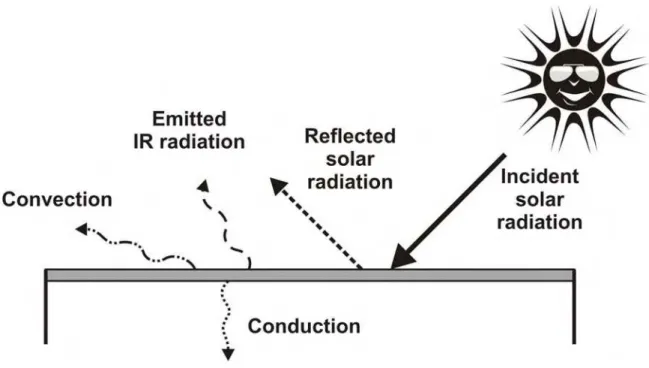
The temperature at the surface of the roof is affected by several heat transfer mechanisms as seen in Figure 5. When solar radiation hits the roof surface, it can either be reflected or absorbed. Absorbed heat raises the surface temperature. Some of the heat can be removed from the roof surface by convection and some dissipated into the atmosphere by
radiation. The amount of convective cooling by wind depends on the local climate and roof geometry. The remaining heat is transferred into the building by conduction, which can be reduced by using thermal insulation in the roof system. Designers can minimize the amount of heat entering the building by modifying the surface characteristics of the roof.
Heat transfer mechanisms of a reflective roof.
Two properties affect the incident solar radiation at the roof surface—solar reflectance (SR) and infrared emittance. Solar reflectance (reflectivity or albedo) is the fraction of incident solar energy reflected from the surface, while infrared emittance (or emissivity) is a measure of the surface’s ability to shed the absorbed solar energy in the form of infrared radiation. Therefore, to keep a roof surface cool in the sun, it is best to use products with high SR (i.e. ones that reflect the sun’s energy away from the roof so that it is not absorbed) and high infrared emittance (i.e. those radiating the energy away from the roof so it is not absorbed).
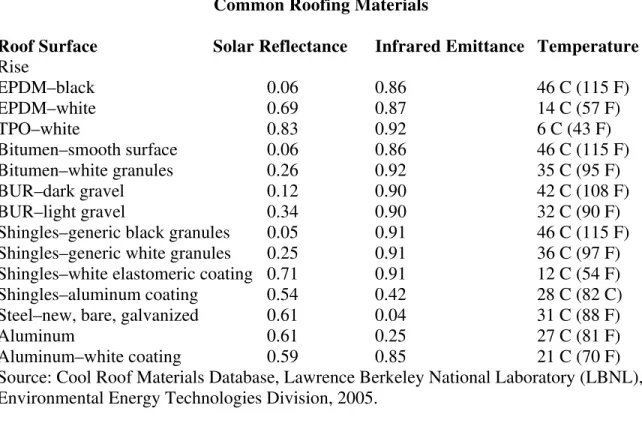
Table 1 shows the characteristics of some common roof surface materials. The
temperature rise is the roof surface temperature over and above the air temperature and is estimated by basic heat transfer equations.2 Conventional roofing materials have an SR of 0.05 to 0.25. Reflective roof coatings can increase the SR to more than 0.60. Most
roofing materials have an infrared emittance of 0.90 or higher, with the exception of metals, which have a low infrared emittance of about 0.25. Therefore, even though they are very reflective (i.e. SR greater than 0.60), bare metal roofs and metallic roof coatings tend to get hot since they cannot emit the absorbed heat effectively through cooling from radiation. Roofing coatings can raise the infrared emittance of metal roofs.
Table 1 also demonstrates that by increasing SR or infrared emittance, the roof surface temperature can be lowered (i.e. lower temperature rise). Generally, white coatings have a higher SR than coloured coatings—SR increases with coating thickness for some products. Asphalt shingles with white granules have a low SR—about 0.30—and less for coloured granules. A white elastomeric coating or aluminum coating can raise the SR to more than 0.50.
Table 1. Typical Values of Solar Reflectance (SR) and Infrared Emittance of Common Roofing Materials
Roof Surface Solar Reflectance Infrared Emittance Temperature Rise EPDM–black 0.06 0.86 46 C (115 F) EPDM–white 0.69 0.87 14 C (57 F) TPO–white 0.83 0.92 6 C (43 F) Bitumen–smooth surface 0.06 0.86 46 C (115 F) Bitumen–white granules 0.26 0.92 35 C (95 F) BUR–dark gravel 0.12 0.90 42 C (108 F) BUR–light gravel 0.34 0.90 32 C (90 F)
Shingles–generic black granules 0.05 0.91 46 C (115 F)
Shingles–generic white granules 0.25 0.91 36 C (97 F)
Shingles–white elastomeric coating 0.71 0.91 12 C (54 F)
Shingles–aluminum coating 0.54 0.42 28 C (82 C)
Steel–new, bare, galvanized 0.61 0.04 31 C (88 F)
Aluminum 0.61 0.25 27 C (81 F)
Aluminum–white coating 0.59 0.85 21 C (70 F)
Source: Cool Roof Materials Database, Lawrence Berkeley National Laboratory (LBNL), Environmental Energy Technologies Division, 2005.
Green roofs consist of a membrane, growing medium, and vegetation, along with root-resistant, drainage, and filtering layers. This can extend a roof’s service life by protecting components from ultraviolet (UV) radiation, roof traffic, and extreme temperatures.
Conserve energy
Monitoring of reflective roofs on 10 buildings in California and Florida showed highly reflective roof coatings reduced annual cooling energy use by 20 to 70 per cent.3 The reduction is a function of variables such as the amount of roof insulation, building configuration, type and efficiency of the cooling system equipment, cooling loads, and energy costs, as well as the local climate.
Extend lifespan
Reflective roofs lower the temperature of the membrane, thus reducing the rate of degradation. This cooler temperature also reduces the diurnal temperature fluctuations and the associated thermal stresses experienced by the roof membrane. Reflective roof coatings containing white pigment (e.g. titanium dioxide) can absorb about five per cent of the sun’s energy, which falls in the UV range, protecting the roof membrane from this kind of light.
Preserve the environment
Reflective roofs can reduce cooling demand and peak load during the summer, along with greenhouse gas emissions associated with energy production. Their widespread use in urban areas can reduce the urban heat island effect and reduce air pollution and smog formation.
Dirt accumulation
The SR of reflective roofs is degraded by weathering and dirt accumulation. Light-coloured roof surfaces typically lose about 20 per cent of their initial reflectance over a period of several years, with the biggest reduction occurring in the first year. This is due to light reflecting off dirt that has settled on the roof membrane over time, instead of the reflective surface. (Algae growing on the roof surface can have the same effect.) The dirt layer tends to diffuse the light and has a lower SR. As the layer builds up, light is still reflecting off this dirty surface, although it is now thicker and has more uniform coverage, so there is little change to the SR. However, a study on polyvinyl chloride (PVC) roofing materials in service for 15 to 22 years showed that wiping and rinsing with water restored the SR to 80 per cent of the original level.4 If the roof is covered with algae, washing with detergent and algae cleansers is necessary. Therefore, local air pollution levels, the product’s resistance to dirt accumulation, and the cost of cleaning should be considered when specifying a reflective roof.
In green roofs, wind uplift at edges and corners can be mimimized with gravel and concrete, or stone slabs. In cases where waterproofing and root-penetration barriers are not fully adhered, vegetation can serve as a ballast.
Climate considerations
Reflective roofs do not save heating costs in the winter. In hot climates, the cooling benefits in the summer significantly exceed the heating penalty in the winter. However, this is not the case in cold climates, where heating rather than cooling requirements predominate. A recent study showed that for the northern-most geographical band of the United States, the energy savings from the use of reflective roofs were either non-existent or negative.5 This band included many cold winter climates areas (e.g. Detroit, Mich.; Milwaukee, Wis.; and Minneapolis, Minn.) similar to Canada, or cool, cloudy summer climates (e.g. Portland, Ore., and Seattle, Wash.). Therefore, it is important designers perform detailed building energy calculations before specifying a reflective roof.
The risk of fire can be lessened with the use of an irrigation or sprinkler system. Thermal resistance versus solar reflectance
Thermal insulation reduces heat flow through a roof all year round, keeping the building cool in the summer and warm in the winter. Reflective roofs reduce heat flow in the summer and lower cooling load and peak demand, thereby producing the same effect as adding thermal insulation in the roof. However, these systems incur a heating ‘penalty’ in the winter. For this reason, when reflective roof products are used, the amount of thermal insulation should not be reduced or eliminated.
Glare and visual considerations
Designers should be aware newly installed white reflective roof products can generate excessive glare, cause visual discomfort, and even disorient pilots landing planes.6 Glare from reflective roofs can also cause visual discomfort to occupants in neighbouring buildings.
Where reflected light is focused on heat-absorbing materials on adjacent buildings, the focused heat buildup can cause physical damage to building components, such as lesser-quality vinyl sidings and windows. The highly reflective nature of these roof products can be hazardous to installers, who can be temporarily blinded or disoriented. Therefore, installers should use sunglasses and work clothes with adequate UV-protection.
Manufacturers produce cool roof coatings that make dark-coloured roof surfaces less hot. These products have low-visible reflectance (i.e. they are dark-coloured) but high near-infrared reflectance (i.e. they are effective in reflecting heat).
Protecting a roof’s membrane against root penetration is critical. Materials often used are protective sheeting, full surface treatment, or non-permeable concrete. Some plants have extremely aggressive roots, requiring multiple barriers.
Photovoltaic devices for roofs
Photovoltaic (PV) devices convert sunlight directly into electricity. Groups of PV cells (made of semiconductors, crystalline, or amorphous silicon) are then interconnected and encapsulated to produce PV modules. The conversion efficiencies of commercial
modules are generally higher for crystalline (12 to 15 per cent) than for amorphous (around seven per cent) silicon.
PV modules generate direct current (DC) electricity, which is usually converted to alternating current (AC) through an inverter to be compatible with most appliances. ‘Grid-connected’ systems allow excess solar energy generated on-site to flow to the utility (turning the utility meter backwards). However, when insufficient solar energy is generated on-site, utility power flows to the building. The customer then pays the net electricity bought from the utility in a process called net metering. These sophisticated systems require approval from the local utility company to ensure code compliance and safe operation. While many parts of the United States have provisions for net metering, the practice is not as common in Canada. However, ‘green energy’ groups are lobbying to change this. Currently, net metering is available from BC Hydro, Manitoba Hydro, and Toronto Hydro.7
Rooftops can be ideal locations for PV devices (particularly south-facing sloped roofs) given they are relatively free of obstructions and modules can be integrated into the roofing material, thereby saving on costs. They can also be installed on sloped or flat roofs. PV installation requires a combination of electrical, structural, and roofing skills.
A solar electric roofing system (flexible photovoltaic [PV] modules laminated on thermoplastic membrane) is integrated into the Frito-Lay distribution facility in Los Angeles, Calif.
Sloped roofs
PV modules can be mounted on roof tiles (e.g. shingles) or profiles (e.g. panels). They can also be integrated into roof tiles and shingles, which are installed with nails and battens in a similar fashion to traditional sloped-roof products. PV-integrated profiles can be installed on a new roof or mounted on an existing assembly. Rubber joints are
typically used to seal the panels for watertightness.
Flat roofs
PV modules can be mounted on the roof surface or integrated into an assembly’s materials. Modules may be mounted in the same plane as the roof (to maximize the collection area) or inclined at an angle (to maximize solar intensity). The modules are either mounted on racks or ballasted on the roof. PV systems typically weigh 25 to 75 kg/m2 (5 to 15 psf). Therefore, the roof structure must have the required load-bearing capacity. A new trend involves integrating the flexible PV modules into the roof membrane to reduce dead loads.
Green roofs, such as this one at Toronto City Hall, are becoming a more common sight in Canada’s urban areas as sustainable design moves to the forefront.
Roof slopes must be considered when designing rooftop gardens. As the slope increases, both the shear and slide should be taken into account in order to protect the system.
Wind uplift
Wind-induced billowing of certain membranes may displace roof-mounted PV modules. Wind loads are higher at roof corners and edges, so additional attachments or ballast may be required to increase the uplift resistance in these areas. The mounting materials should have good wind fatigue resistance and not be subject to thermal expansion and
contraction that would damage the PV system or the roof.
There are several considerations that should be taken into account when installing a garden roof, including the cost of maintaining waterproofing and vegetation.
The life expectancy of a PV system is about 25 years. Thus, the age and condition of the roof should be considered before installing such a system. (It makes better economic sense to install it on a new roof or one ready for re-roofing.) When installing PV modules around roof penetrations and rooftop equipment, sufficient space for future access must be taken into consideration. It is also critical to ensure the PV installation will not adversely affect the drainage pattern on the roof.
Notes
1
This article is a revised version of “Towards Sustainable Roofing,” an article by this author provided as background documentation for a national seminar series entitled
Roofing: Staying on Top of Technology and Change, presented in 2005 by the National
Research Council (NRC) Institute for Research in Construction (IRC).
2
See LBNL’s Cool Roof Materials Database. Visit eetd.lbl.gov/CoolRoofs for more information.
3
See L. Gartland’s, “Truth and Myths About Cool Roof Coating Systems” (National Coatings Corporation) or visit www.nationalcoatings.com/articles.
4
See H. Akbari, A. Berhe, R. Levinson, S. Graveline, K. Foley, A. Delgado, and R. Paroli, “Aging and Weathering of Cool Roofing Membranes” Proceedings of the Cool
Roofing…Cutting Through the Glare, a 2005 symposium held in Atlanta, GA, and hosted
by RCI Foundation, ORNL, and the National Research Council (NRC) Canada.
5
See J. Hoff’s “The Economics of Cool Roofing: a Local and Regional Approach” also from Proceedings of the Cool Roofing…Cutting Through the Glare Conference.
6
See C. Murphy’s “Cool Roof Design Considerations and Case Histories” also from
Proceedings of the Cool Roofing…Cutting Through the Glare Conference.
7
Visit www.pollutionprobe.org/whatwedo/greenpower/consumerguide/c2_4.htm for information on net metering Canada.
Karen Liu, B.A.Sc., M.A.Sc., PhD, is a research officer at the National Research Council’s (NRC’s) Institute for Research in Construction (IRC), and is now on
secondment with the Centre for the Advancement of Green Roof Technology (CAGRT), British Columbia Institute of Technology, Vancouver. She can be reached at