Graphitized Carbon Black in Quartz Tubes for the
Sampling of Indoor Air Nicotine and Analysis by
Microwave Thermal Desorption-Capillary Gas
Chromatography
Trinh Vu-Duc a n d Cong-Khanh Huynh
I n s t i t u t e of O c c u p a t i o n a l H e a l t h S c i e n c e s , U n i v e r s i t y of L a u s a n n e , 1 9 r u e d u B u g n o n , C H - 1 0 0 5 L a u s a n n e , S w i t z e r l a n d
Abstract
Nicotine in a smoky indoor air environment can be determined using graphitized carbon black as a solid sorbent in quartz tubes. T h e temperature stability, high purity, a n d heat absorption characteristics of the sorbent, as well a s the permeability of the quartz tubes to microwaves, enable the thermal desorption by means of microwaves after active sampling. Permeation and dynamic dilution procedures for the generation of nicotine in the vapor phase at low a n d high concentrations are used to evaluate the performances of the sampler. Tube preparation is described and the microwave desorption temperature is measured. Breakthrough volume is determined to allow sampling at 0 . 1 - 1 L/min for definite periods of time. T h e procedure is tested for the determination of gas and paticulate phase nicotine in sidestream s m o k e produced in an experimental chamber.
Introduction
Sidestream tobacco smoke, which is emitted from the burning end of a cigarette between puffs, is known as one of the major sources of indoor air pollution (1). The health effects, as well as the annoyance factor, to nonsmokers who passively inhale envi ronmental tobacco smoke (ETS) from active smokers have been reviewed (2). Specific markers of ETS are important for the measurement of exposure and for the assessment of exposure dose and health effects.
Nicotine is one of the compounds commonly used as a marker of exposure to ETS because it is rarely present in any airborne source and is found in high amounts in sidestream smoke (3). Its use as an indicator of smoke inhalation presents definite advan tages, which include the possibility for comparison with pre vious studies, the relationship with urinary cotinine, and from an analytical standpoint, the simplicity of its determination.
Recently, it has been found that nicotine is volatilized during air dilution of sidestream tobacco smoke so that in ETS, it oc curs almost exclusively in the vapor phase (4). Moreover, the equilibrium between the gas and particle phases generates a continuous revolatilization of nicotine condensed on surfaces and leads to long term decay of nicotine levels in smoky areas.
Early methods for the measurements of nicotine collected
suspended particulate matter from the air on filters with the aid of pumps (5,6). Condensed nicotine is reported to be captured by the use of an open-face glass Petri dish placed on the cooling surface of a thermoelectric cold plate (7,8), but the method suf fers limitations (9). Hammond et al. (10) described a treated filter method which allowed the combined sampling of particu late and gaseous nicotine. In these procedures, gas chromatog raphy is used to separate and analyze nicotine after liquid ex traction of the filter by an adequate solvent and liquid injections of the extract. The gas phase nicotine can also be collected with a passive sampler or a diffusive denuder (11,12).
Muramatsu et al. (13,14) were the first to report a nicotine analytical technique based on a sampler tube filled with Uniport-S coated with 10% silicon polymer OV-17. The tubes are ther mally desorbed onto a GC column. They needed ammonia vapor added to the carrier gas to effectively desorb nicotine because of the acidic property of the treated sorbent. Improvement of this method was described by Thompson et al. (15) and recently pub lished techniques made use of Tenax as adsorption material (16,17). An interesting paper dealing with the latest techniques in use and with an intercomparison of sampling devices for indoor air nicotine has been published recently (18). Our paper reports the use of a new adsorbent material for the sampling and a dif ferent thermal desorption principle for the determination of am bient air nicotine. The method was validated by generating nico tine in the vapor phase and also by sampling sidestream tobacco smoke in an experimental chamber.
Experimental
Preparation of Carbotrap tubes. Transparent quartz tubes
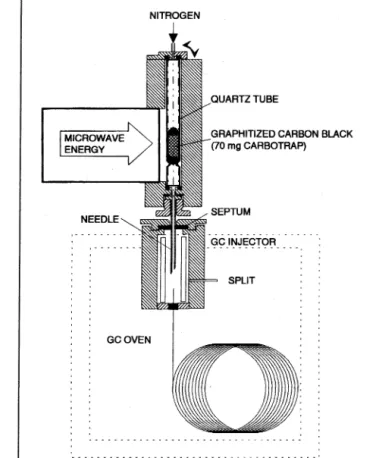
(Quartz & Silice, Les Miroirs, Defense 3, Paris, France) were cleaned in a boiling mixture of concentrated nitric and hy drochloric acids (1:1 v/v) for 15 min, then rinsed with deminer-alized water and dried at 120°C. The tubes were silanized using a solution of 10% dimethyldichlorosilane in toluene and left to react for 1 h. After rinsing with toluene and methanol, they were dried in an oven. Each tube was filled with 70 mg of Carbotrap graphitized carbon black, 20/40 mesh (Supelco 2-0287), and plugged with silanized quartz wool at the two ends (Figure 1). Prior to sampling, blank tubes were conditioned by thermally
desorbing any adsorbed trace contaminants three times for 10 s each. During this operation, the GC column was disconnected from the interface. Tubes were capped with plastic stoppers and stored in closed vials in preparation for sampling operations.
Microwave thermal desorption and GC conditions. The MW-1
microwave desorber (Rektorik, Geneva, Switzerland) was cou pled to a Varian GC Model 3400 equipped with a thermionic nitrogen specific detector (NPD) and capillary column. A slight modification was made to the gas system in the desorber. A sy ringe needle (SGE, Model 100-500 AN5) was mounted at the outlet of the desorber. The bypass, backflushing, and split system of the desorber were discarded and the gaseous effluent was guided directly into the injector of the GC, which was set in the split mode (Figure 2). Desorption conditions were as follows: in terface temperature, 200°C; desorption time, 4 s; desorption power, "Low." The heat temperature transferred by the mi crowaves to the tube was measured with the probe of a Cr-Alumel thermocouple introduced in the sorbent bed.
The 25-m × 0.25-mm i.d. WCOT fused-silica capillary column, coated with a 0.25-μπι film of CP-SÍ1-5CB (Chrom-pack) was used for the separation. GC conditions are as follows: injector t e m p e r a t u r e , 250°C; oven temperature, 120°C isothermal; split mode, 1.5:10; carrier gas, nitrogen with the manometer pressure set at 14 psi. The NPD was supplied with 4 mL/min hydrogen, 30 mL/min nitrogen (as the makeup gas), and 175-mL/min air, and was maintained at 280°C.
Generation of vapor phase nicotine. To test the performances
of the Carbotrap tubes, as well as the overall analytical procedure, nicotine was generated in the vapor phase by the permeation process (19) for the low concentration range (< 1 μg/L). A weighed amount of pure nicotine was contained in a small, open glass ampule connected to short silicone tubing and stoppered with a glass stopper. The liquid nicotine should not moisten the
Figure 1. Quartz tube and graphitized carbon black sorbent for thermal desorption by microwaves.
piece of silicone. The permeation device was placed in a tem perature-controlled permeation calibration apparatus equipped with gas inlet orifices (Metronics Dynacalibrators, Model 450). Nicotine diffused through the silicone surface, was flushed with nitrogen, and finally diluted with purified air before sampling. For higher concentrations of nicotine in air (ca 50 μg/L), a dy namic generation procedure was used. A measured amount of nicotine was slowly delivered by a Hamilton μι syringe pushed by a step motor into a heated flask. The flask temperature was controlled between 50 and 80°C depending on the desired con centration of nicotine. Vaporized nicotine was first diluted with nitrogen in the flask, then flushed with air through a multiorifice ampule where simultaneous samplings could be carried out. The Carbotrap tube was connected for 10 min to a personal pump (20) that aspirated the air at a flow rate of 0.1 L/min. The tube was ready for desorption with the MW-1 microwave desorber.
Desorption efficiency and calibration with standard vapor phase nicotine. A primary calibration curve was first constructed
from standard solutions containing known amounts of nicotine (> 97%, d: 1.008, Fluka 72290) in methanol by liquid injections in the GC with the desorber disconnected. The concentration of nicotine in gaseous effluents can be calculated from the genera tion systems, provided the weight or volume of nicotine delivered by the syringe, the flow rates of dilution gas, and other parame ters are under control. The stability of the generation process was assessed by multiple samplings over time at each concen tration. The quantities of nicotine in the tubes were calculated from the concentration in air and the volume of air sampled. This amount of vapor-phase nicotine sampled with Carbotrap tubes and generated under defined conditions was then experi mentally determined according to the thermal desorption proce dure. The areas of the respective GC peaks were then plotted versus the calculated values of nicotine, giving a vapor phase
ibration curve. An amount of nicotine corresponds to each of these areas from interpolations on the primary calibration curve. The amount of nicotine derived from the vapor phase calibration and the value associated with the liquid injections of standard were plotted using the linear regression function for the correla tion between both procedures.
Determination of the breakthrough volume Vtg of the tube.
Desired amounts of nicotine are sampled on several Carbotrap tubes. To determine the breakthrough volume, laboratory air is aspirated through a bottle containing active charcoal to remove organic impurities, then passes through the Carbotrap tubes for various definite periods of time. The breakthrough volumes are determined for flow rates of 0.1 and 1 L/min, respectively. The tubes are analyzed afterwards for their nicotine contents ac cording to the outlined procedure. The resulting volume of air that passed through the tube is calculated for each flow rate. Average values of nicotine from four tubes not submitted to the passage of air represents the initial 100% level.
Sampling of nicotine in sidestream smoke in an experimental chamber with Carbotrap tubes; intermethod comparisons. The
developed procedure was applied to the analysis of nicotine at various concentrations in sidestream tobacco smoke produced in an experimental chamber (21,22). Ambient air was drawn through Carbotrap tubes connected to personal sampling pumps operating at 0.1 L/min for definite periods of time between 15 min to several hours. The method of Hammond et al. (10) was used as a second method of sampling, simultaneously with the Carbotrap technique. Its principle is based on the liquid extraction of nicotine collected on a filter treated with sodium bisulfate.
On a few samples, the MW-1 desorber was directly coupled to the injector of a gas chromatography-mass spectrometry (GC-MS) system (Nermag R10-10) to verify that the nicotine peak is unique. The M+ at m/z 162 was monitored as well as
mass scans at the retention time of nicotine. The mass spectrum of nicotine in sidestream smoke was compared to that of refer ence standard nicotine injected under the same conditions.
Results and Discussion
Thermal desorption was presented as an effective means of sample introduction for GC analysis. The principles and charac teristics of desorption technique by means of microwave energy have been described (23) and applications to the analysis of var ious volatile compounds were reported (24,25). The schematic di agram of the lab-made Carbotrap tubes and the modification of the sample introduction mounting are shown in Figure 2. The mi crowave thermal desorption of solid traps requires that the tube be made of quartz to be permeable to microwaves. At the tem perature in this procedure, the quartz tube has a negligible reac tion to the heating effect and very low thermal inertia for the transfer of the electromagnetic energy to the Carbotrap. More over, the quartz tube exhibits excellent thermal stability, high chemical inertia, and a high degree of purity. Ceramic tubes have been tested and showed good performance, but they are more porous and less inert.
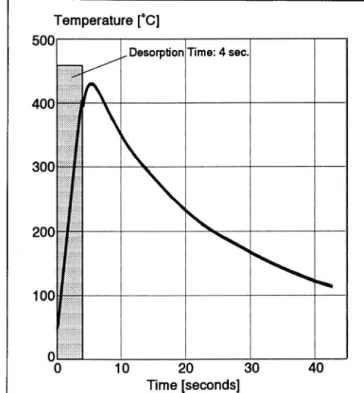
The MW1 desorber was not equipped with a display of the desorption temperature. For a given power, the desorption time can be set from 1 to 10 s during which the electromagnetic en ergy is produced and transformed into thermal energy. The ab sence of information on temperature generated by microwaves is
a major drawback. We solved the problem in calibrating a recorder scale and recorded the evolution of temperature in the desorption process. As seen in Figure 3, inertia is negligible and the temperature measured with the thermocouple reaches about 430°C in 4 s following a ballistic rise. The advantage of mi crowaves is that the temperature jump is instantaneous within seconds in contrast to other heat sources. A noticeable decom position of nicotine was not observed.
Chromosorb 102 or Tenax GC absorb little microwave energy and heat cannot be transferred into the sorbents for the desorption of analytes, unlike using a classical thermal heating source. Commercial Carbotrap is a graphitized carbon black which has no ions or active functional groups on its homogeneous surface structure (26). Its hydrophobic character makes its performance unaffected by humidity. Although of high purity, the Carbotrap was heat-desorbed to remove any contaminant until a blank base line was obtained at the analysis conditions.
Independently of the necessities imposed by the use of micro waves as the heating source, Carbotrap sorbent can withstand a higher temperature to allow desorption of larger and high-boiling point molecules such as nicotine, in comparison with other poly meric sorbents. Tenax releases residues like toluene, benzene, and trichloroethylene (26) during thermal desorption, while XAD-2 completely pyrolyzes at 250°C. Solvent desorption of nicotine is possible at the expense of the method sensitivity. The Carbotrap sorbent and tube are reusable after adequate treatments and con ditioning, although in this work the used sorbent was discarded. There is no particular difficulty in the preparation of the tubes. The use of 20/40 mesh size reduces the pressure drop, allowing the personal pump to operate without strain in the range of 0.1 to 1 L/min.
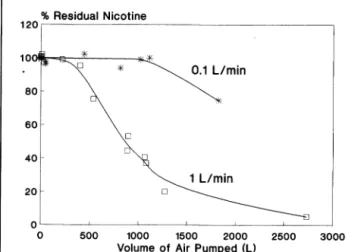
The retention capacity of the Carbotrap tube is dependent upon the sampling flow rate. The specific retention or breakthrough volume V tg of air needed to elute the adsorbate was determined
for nicotine (Figure 4). At 1 L/min the sampling time is limited to about 6.6 h to maintain a 90% retention. For ambient nicotine
0
Figure 3. Measured temperatures transferred by microwaves to the sor bent bed.
sampled at 0.1 L/min, a sampling time as long as 166 h is per mitted without loss of adsorption capacity for a 100% retention.
For the calculation of nicotine, it was logical to rely on a cali bration curve constructed from thermally desorbed, known amounts of nicotine. Experiments carried out with 10 μL of stan dard solutions deposited on top of the tubes showed that the sol vent elutes nicotine resulting in losses and nonreproducible re sults upon evaporation. The plot of a standard calibration curve cannot be made this way. The practice of quantitation of the thermally desorbed nicotine using a calibration curve constructed from liquid injections of known amounts of standard should be previously shown to be valid because the desorption efficiency was unknown. Calculation of the amount of nicotine using the vapor phase calibration curve and the curve derived from liquid injections of standard gave comparable results. This is illustrated in Figure 5; where the correlation function between the amounts of nicotine obtained from the thermal desorption using both the vapor phase and the liquid calibration curves shows a linear re lationship with a slope close to 1 and a correlation coefficient R =
0.998. It can be stated that the desorption efficiency is quantita tive over the concentration range and no irreversible adsorption is observed within the experimental errors of the method. On the other hand, the quantitation of nicotine by thermal desorption can be made relative to a liquid calibration curve constructed by in jections of standard solutions of known concentrations, thus sim plifying the use Of the method.
Under the defined experimental conditions, the limit of de tection of the method is 25 ng nicotine/tube (S/N = 10). Con sidering the low end concentration of 1 μg nicotine/m3 in the in
door air, the method is applicable to a 4-h sampling time at 0.1 L/min or a 30-min period at 1 L/min. The limit of detection of methods based on liquid injections of the extract is higher, e.g. 2 μg for a 1-h sample (10), because only an aliquot of the final volume is injected. The method is characterized by its speci ficity due to the resolving power of capillary column chro matography with nitrogen selective detection, and also by its sensitivity, as the whole analyte is desorbed and introduced at once in the column. With the mounting shown in Figure 2, the desorption is not made in two stages as with cold trapping, and is therefore less time consuming, although this is accomplished at the expense of sensitivity, because injections are made in the split mode. It is still possible to obtain a lower limit of detection by cryofocusing the desorbed effluent. The overall elapsed time between two chromatographic runs is less than 20 min. Because
Figure 4. Determination of the breakthrough volume of the graphitized carbon black sorbent tube.
thermal desorption is a one-shot analytical technique, it may be necessary to take care about the appropriate number of specimens to be sampled.
The second independent method was used to compare the re sults in the measurement of sidestream tobacco smoke gener ated in an experimental chamber, as neither are reference methods. The comparison is interesting because the two methods gave similar results, though they are based on different principles. Figure 6 shows the correlation (R = 0.993) between the two. This is relatively good, considering the global differences in the sampling and desorption processes. From the closeness of agree ment, we conclude that total nicotine (gas and particulate) can be determined by the Carbotrap tube procedure.
As a check of peak specificity, the microwave desorber has been mounted on a GC-MS system and ambient nicotine in a few sample tubes was identified by its mass spectrum. Mon itoring ion peaks at m/z 162 shows that no interference is present at the retention time of nicotine. The mass spectrum of nicotine in sidestream smoke and that of reference nicotine are similar. It can be anticipated that the technique of sampling by Carbotrap sor bent and desorption by microwaves developed for vapor and particulate nicotine in an indoor air environment is applicable to the desorption by a classical heating source.
Figure 5. Correlation between the amount of desorbed nicotine and the known amount of standard solutions injected.
Figure 6. Nicotine in sidestream smoke determined by graphitized carbon black tube-microwave thermal desorption and by filter treated method (10).
Acknowledgments
We appreciate the technical assistance of Mrs. Y. Friih, C. Kohler, and Mr. P. Boiteux. This research is partly funded by the Swiss National Science Foundation under grant No. 32-9522.88.
References
1. National Research Council. Indoor Pollutants. Sources and char a c t e r i z a t i o n of i n d o o r p o l l u t i o n : T o b a c c o s m o k e . N a t i o n a l Academy Press, Washington, D.C., 1 9 8 1 , pp. 1 4 9 - 6 8 .
2. The Health Consequences of Involuntary Smoking. A report of the S u r g e o n G e n e r a l . U.S. D e p a r t m e n t of H e a l t h a n d H u m a n Services. Rockville, Maryland, 1986, pp. 17-119.
3. National Research Council. Environmental Tobacco Smoke. Measuring exposures and assessing health effects. National Academy Press, Washington, D.C., 1986, pp. 6 9 - 1 0 0 .
4. L.W. Eudy, F.A. T h o m e , D.L. Heavner, C.R. G r e e n , and B.J. Ingebrethsen. Studies on the vapor-particulate phase distribu tion of environmental nicotine by selected trapping and detection methods. Proceedings of the 79th Annual Meeting of the Air Pollution Control Association. J u n e 2 2 - 2 7 M i n n e a p o l i s , Minnesota, 1986, paper 8 6 - 3 8 . 7 .
5. A. Weber and T. Fischer. Passive smoking at work. Int. Arch. Occup. Environ. Health, 4 7 : 2 0 9 - 2 2 1 (1980).
6. W.C. Hinds and M.W. First. Concentrations of nicotine and to bacco smoke in public places. New Engl. J. Med. 292: 8 4 4 - 4 5 (1975).
7. D.C. Williams, J.R. Whitaker, and W.G. Jennings. Air monitoring for nicotine contamination. J. Chromatogr. Sci. 2 2 : 2 5 9 - 6 1 (1984).
8. D.C. Williams, J.R. Whitaker, and W.G. Jennings. Measurements of nicotine in building air as an indicator of tobacco smoke levels. Environ. Health Perspect. 6 0 : 4 0 5 - 4 1 0 (1985).
9. C. Green, B. Ingebrethsen, and D. Heavner. Letter to the Editor. Environ. Health Perspect. 63: 249 (1985).
10. S.K. Hammond, B.P Leaderer, A.C. Roche, and M. Schenker. Collection and analysis of nicotine as a marker for environmental tobacco smoke. Atmos. Environ. 2 1 : 4 5 7 - 6 2 (1987),
11. S.K. Hammond and B.P. Leaderer. A diffusion monitor to measure exposure to passive smoking. Environ. Sci. Technol. 2 1 : 4 9 4 - 9 7 (1987).
12. D.J. Eatough, C. Benner, R.L. Mooney, D. Bartholomew, D.S. Steiner, L.D. Hansen, J.D. Lamb, E.A. Lewis, and N.L. Eatough. Gas and particle phase nicotine in environmental tobacco smoke. Proceedings of the 79th Annual Meeting of the Air Pollution Control Association, June 2 2 - 2 7 , Minneapolis, Minnesota, 1986, paper 8 6 - 6 8 . 5 .
13. M. Muramatsu, S. Umemura, T. Okada, and H. Tomita. Estimation of personal exposure to tobacco smoke with a newly developed nicotine personal monitor. Environ. Res. 35: 2 1 8 - 2 7 (1984). 14. M. Muramatsu, S. Umemura, J . Fukui, T. Arai, and S. Kira. Esti
mation of personal exposure to ambient nicotine in daily environ mental. Int. Arch. Occup. Environ. Health, 59: 5 4 5 - 5 0 (1987). 15. C.V. Thompson, R.A. Jenkins, and C.E. Higgins. A thermal de
sorption method for the determination of nicotine in indoor envi ronments. Environ. Sci. Technol. 23: 4 2 9 - 3 5 (1989).
16. H. Tang, C . L Benner, G.H. Richards, M . L Lee, E.A. Lewis, L.D. Hansen, and D.J. Eatough. Monitoring of environmental tobacco smoke nicotine with a sorbent bed-capillary gas chromatograph system. Intern. J. Environ. Anal. Chem. 3 3 : 1 9 7 - 2 0 8 (1988). 17. R.E. Bell. Determination of airborne nicotine by automatic
two-stage thermal desorption gas chromatography. Intern. J. Environ. Anal. Chem. 33: 2 1 9 - 3 2 (1988).
18. F.M. Caka, D.J. Eatough, E.A. Lewis, H. Tang, S.K. Hammond, B.P. L e a d e r e r , P. K o u t r a k i s , J . D . S p e n g l e r , A . F a s a n o , J . McCarthy, M.W. Ogden, and J . Lewtas. An intercomparison of sampling techniques for nicotine in indoor environments. Environ. Sci. Technol. 24: 1196-1203, (1990).
19. V. Dharmarajan and R.J. Rando. Dynamic calibration of a contin uous organo-isocyanate monitor for hexamethylene diisocyanate. Am. Ind. Hyg. Assoc. J. 4 1 : 4 3 7 - 4 1 (1980).
20. C.K. Huynh, M. Graf, and T. Vu-Duc. Development of a personal sampling pump. [Développement ď u n e pompě de prélěvement personnel]. Arch. Mai. Prof. 48: 638 (1987).
2 1 . T. V u - D u c and C.K. Huynh. Deposition rates of sidestream to bacco s m o k e particles in an experimental chamber. Toxicol. Letters, 35: 5 9 - 6 5 (1987).
22. T. V u - D u c and C.K. Huynh. Sidestream tobacco s m o k e c o n stituents in indoor air modelled in an experimental chamber-poly-cyclic aromatic hydrocarbons. Environ. Intern. 15: 5 7 - 6 4 (1989). 23. J . Rektorik. In Sample Introduction in Capillary Gas Chro
matography. Thermal desorption of solid traps by means of micro wave energy, P. Sandra, Ed., Alfred Huethig Verlag, Heidelberg, 1985, pp. 2 1 7 - 3 3 .
24. P. Wolkoff. Microwave desorption in occupational health. Pro ceedings of the 5th International Symposium on Capillary Chromatography, Riva del Garda, Italy, 1985, pp. 655.
25. G.A. Reineccius and R. Liardon. The use of charcoal traps and microwave energy for the analysis of headspace volatiles above h e a t e d t h i a m i n e solutions. Topics in flavour r e s e a r c h . Pro ceedings of the International Conference Freising-Weihen-stephan, April 1-2, 1985. H. Eichhorn, Ed., Marzling-Hangenham 25, Germany, 1985, pp. 1 2 5 - 3 6 .
26. Carbotrap—an excellent adsorbent for sampling many airborne contaminants. The Supelco Reporter, 5: 5 - 7 (1986).
Manuscript received November 29, 1990: revision received March 4 , 1 9 9 1 .