Publisher’s version / Version de l'éditeur:
Vous avez des questions? Nous pouvons vous aider. Pour communiquer directement avec un auteur, consultez la première page de la revue dans laquelle son article a été publié afin de trouver ses coordonnées. Si vous n’arrivez pas à les repérer, communiquez avec nous à [email protected].
Questions? Contact the NRC Publications Archive team at
[email protected]. If you wish to email the authors directly, please see the first page of the publication for their contact information.
https://publications-cnrc.canada.ca/fra/droits
L’accès à ce site Web et l’utilisation de son contenu sont assujettis aux conditions présentées dans le site LISEZ CES CONDITIONS ATTENTIVEMENT AVANT D’UTILISER CE SITE WEB.
Optica, 7, 6, pp. 586-592, 2020-05-27
READ THESE TERMS AND CONDITIONS CAREFULLY BEFORE USING THIS WEBSITE. https://nrc-publications.canada.ca/eng/copyright
NRC Publications Archive Record / Notice des Archives des publications du CNRC :
https://nrc-publications.canada.ca/eng/view/object/?id=c6898667-b632-46e6-8d9c-8062b87866fc
https://publications-cnrc.canada.ca/fra/voir/objet/?id=c6898667-b632-46e6-8d9c-8062b87866fc
NRC Publications Archive
Archives des publications du CNRC
This publication could be one of several versions: author’s original, accepted manuscript or the publisher’s version. / La version de cette publication peut être l’une des suivantes : la version prépublication de l’auteur, la version acceptée du manuscrit ou la version de l’éditeur.
For the publisher’s version, please access the DOI link below./ Pour consulter la version de l’éditeur, utilisez le lien DOI ci-dessous.
https://doi.org/10.1364/OPTICA.390665
Access and use of this website and the material on it are subject to the Terms and Conditions set forth at
Rotational quantum beat lasing without inversion
Richter, Maria; Lytova, Marianna; Morales, Felipe; Haessler, Stefan;
Smirnova, Olga; Spanner, Michael; Ivanov, Misha
Rotational quantum beat lasing without inversion
Maria Richter,
1,†,* Marianna Lytova,
2,5,†Felipe Morales,
1Stefan Haessler,
3Olga Smirnova,
1,4Michael Spanner,
2,5AND
Misha Ivanov
1,6,71Max-Born-Institute, Max-Born Straße 2A, 12489 Berlin, Germany 2Department of Physics, University of Ottawa, Ottawa K1N 6N5, Canada
3Laboratoire d’Optique Appliquée, CNRS, École Polytechnique, ENSTA Paris, Institut Polytechnique de Paris, 181 Chemin de la Hunière et des
Joncherettes, 91120 Palaiseau, France
4Technische Universität Berlin, Straße des 17. Juni 135, 10623 Berlin, Germany 5National Research Council of Canada, 100 Sussex Drive, Ottawa K1A 0R6, Canada 6Department of Physics, Humboldt University, Newtonstraße 15, 12489 Berlin, Germany 7Blackett Laboratory, Imperial College London, SW7 2AZ London, UK
*Corresponding author: [email protected]
Received 21 February 2020; revised 14 April 2020; accepted 17 April 2020 (Doc. ID 390665); published 27 May 2020
In standard lasers, light amplification requires population inversion between an upper and a lower state to break the reci-procity between absorption and stimulated emission. However, in a medium prepared in a specific superposition state, quantum interference may fully suppress absorption while leaving stimulated emission intact, opening the possibility of lasing without inversion. Here we show that lasing without inversion arises naturally during propagation of intense femtosecond laser pulses in air. It is triggered by the combination of molecular ionization and molecular alignment, both unavoidable in intense light fields. The effect could enable inversionless amplification of broadband radiation in many molecular gases, opening unusual opportunities for remote sensing.
Published by The Optical Society under the terms of theCreative Commons Attribution 4.0 License. Further distribution of this work must maintain attribution to the author(s) and the published article’s title, journal citation, and DOI.
https://doi.org/10.1364/OPTICA.390665
1. INTRODUCTION
A resonant light propagating through a medium will be absorbed by the medium in a lower state and will stimulate emission if the medium is excited. For a quantum system pumped into an excited state |e i, with an empty state |g i below, population inversion
between these two states leads to amplification of a probe light at the |e i → |g i transition frequency. For almost six decades,
this process has been exploited in conventional lasers. However, three decades ago, it was shown that lasing can also occur without population inversion [1–8].
The basic idea behind lasing without inversion (LWI) [9–11] is similar to conventional lasers—to prepare a medium where emis-sion is favored over absorption so that resonant light is amplified as it propagates in the medium. The difference lies in the medium preparation. Instead of creating population inversion between the lasing states, quantum interference is used to suppress pho-toabsorption while keeping photoemission intact. In the simplest scheme, two lower-lying states |g1iand |g2iare each coupled to
a common upper state |e1i. One can prepare a coherent
super-position of the two lower states such that the transition from this superposition to the upper state vanishes due to destructive inter-ference of the transition amplitudes |g1i → |e1iand |g2i → |e1i.
Now any population pumped incoherently into the upper state can provide gain.
A number of different schemes for lasing without inversion have been developed [9,10]. Taking advantage of destructive interference of different pathways in absorption, they gener-ally strive to maintain a specific phase relationship between the lower-lying states, which carry most of the population. Here we present a scheme that does not follow this tradition. It uses only the natural dynamics of a multilevel quantum system and requires no coherence between the excited and the lower electronic states; effectively, lasing without inversion comes “for free.” We also show that this mechanism is active in the highly efficient generation of 391 nm radiation during propagation of intense femtosecond laser pulses in air [12–16], under standard conditions, where the process known as laser filamentation [17–19] leads to self-guiding of light. The 391 nm line corresponds to the transition between the two ground vibrational levelsν00, ν0=
0 of the ground electronic state X26+
g (denoted as X ) and the second excited state B26
+
u
(denoted asB) in N+2.
Identifying the mechanism responsible for the amplification, commonly referred to as “air lasing,” has been a long-standing puzzle [20–45]. The main difficulty in resolving this puzzle stems from the apparent lack of a general physical mechanism capable of generating population inversion between the states X and B for
standard filamentation conditions, including the clamping of the laser intensity aroundI ∼ 1014 W/cm2[46–48].
Research Article Vol. 7, No. 6 / June 2020 / Optica 587
In the following section, we introduce the general scheme that can enable inversionless amplification of light in gas molecules, solely by excitation with a short, intense laser pulse. In its simplest form, this mechanism can be referred to as rotational quantum beat lasing without inversion. Subsequently, we examine the specific example of the amplification around the 391 nm line and show that this mechanism provides the key missing component of the puzzle. In the recent work of Ref. [35], a different lasing without an inver-sion mechanism has been proposed to cause the gain at the 391 nm line based on the existence of long-lived coherent polarizations coupling simultaneously the statesX , B, and the intermediate first
excited electronic stateA in N+2. The present amplification scheme
relies on rotational dynamics and does not require coherences between the electronic states of the ion, even though such coher-ence is inevitably created by the pump pulse driving the molecular ion after ionization of the neutral. Compared to the model in Ref. [35], we account for the light-induced vibrational and rotational dynamics of the molecule, which allows us to capture the effect of rotational quantum beat lasing without inversion.
2. ROTATIONAL QUANTUM BEAT LASING
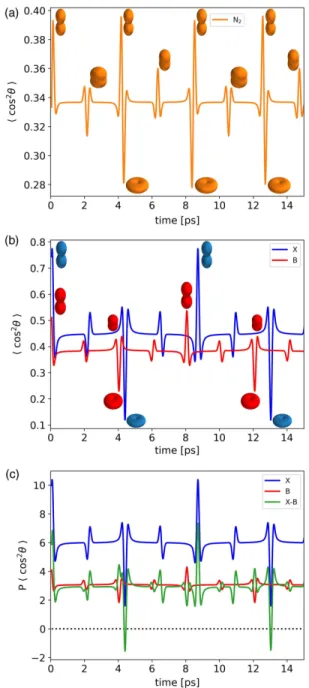
The mechanism of rotational quantum beat lasing is illustrated in Fig.1, and it can be easily understood in the time domain. When an intense femtosecond laser pulse interacts with a diatomic molecule, or its ion, it induces molecular alignment [49,50]. This alignment revives periodically after the pulse is gone [Fig.1(a)]. The revival dynamics demonstrate a sequence of alignment and anti-alignment with the revival period controlled by the rotational constant B0. Figure1(a) shows the evolution of the character-istic alignment measure, hcos2θi(t), for a nitrogen molecule at
room temperature (298 K), after interacting with a 23 fs FWHM, 800 nm pump pulse with a peak intensity of 1014 W/cm2(see
Supplement 1). Its minima correspond to anti-alignment and its maxima to maximum alignment with the direction of the linearly polarized aligning laser field.
Suppose now that similar rotational dynamics are induced in two electronic (vibronic) states, |1i and |2i, with a dipole-allowed electronic transition between them. In diatomics, electronic tran-sitions can be either parallel or perpendicular to the molecular axis; for definiteness, let this transition be parallel. Its probability is then proportional to cos2θ, where θ is the angle between the molecular axis and the laser electric field inducing the transition. For a molecule rotating in the lower vibronic state, the probability of parallel absorption |1i → |2i thus depends on hcos2θi
1(t)
aver-aged over the rotational dynamics in state |1i, which is controlled by its rotational constantB0
1. Conversely, for a molecule rotating
in the upper vibronic state |2i, the emission probability |2i → |1i depends on hcos2θi
2(t), with its time dependence controlled
byB20.
Opportunities for inversionless amplification of a short probe pulse, polarized parallel to the pump and delayed byτ, arise when the |1i state molecules are anti-aligned, so that hcos2θi
1(τ) is
minimum and the parallel |1i → |2i absorption is suppressed. This opportunity is further enhanced if the |2i state molecules are aligned at this time, so that hcos2θi
2(τ) is maximum and the
parallel |2i → |1i emission is enhanced. This possibility to use molecular alignment for inversionless amplification was previously pointed out by Popov and Slabko [51]. The converse is true if the |1i state molecules are aligned when the probe pulse arrives, while the |2i state molecules are anti-aligned, enhancing absorption. As
long asB0
1 and B20are different, the two rotations will go out of
sync, arriving at the point where the lower state is anti-aligned and the upper is still aligned and vice versa [Fig.1(b)]. Overall, tempo-ral windows of gain will be followed by windows of loss, leading to the rotational quantum beats in the time-resolved gain-loss of the short probe pulse.
Fig. 1. Schematic of a rotational quantum beat laser without inversion in the time domain using the example of N+2. Calculations are performed
for a 23 fs, 800 nm, 1014 W/cm2pump pulse and room temperature
(298 K); see text andSupplement 1for details. The 3D shapes in panels (a),(b) sketch the angular distributions of the rotating molecular ensem-bles. (a) Field-free molecular alignment of N2at 298 K induced by the
intense femtosecond pump pulse. (b) Field-free rotational dynamics in the two vibronic states |X, ν00=
0i and |B, ν0=
0i of N+
2 induced by
the same pump. (c) PXhcos2θiX(τ) (blue), PBhcos2θiB(τ) (red), and
PXhcos2θiX(τ) − PBhcos2θiB(τ) (green). Gain windows (at τ1'4.4 ps
andτ2'13.0 ps) without population inversion at a parallel transition
between the two vibronic states are enabled by the different angular distribution geometries of the rotating molecular ensembles in the upper and lower state; no coherence between the two rotational manifolds is required.
Figures 1(b)and 1(c) give the specific example. Figure1(b) shows the rotational dynamics in the two ground vibrational levels ν00, ν0=
0 of the electronic statesX and B in N+2, induced by the
same pump pulse interacting with N2[Fig.1(a)]. The short pump
pulse impulsively aligns the neutral N2molecules, generating the
rotational dynamics in Fig.1(a). It also ionizes some of the N2
molecules, producing molecular ions predominantly in the ground stateX but also in the excited A ( A25
u) andB states, and it
con-tinues to align them. After the end of the pulse, the ions continue to rotate, reaching maximum alignment att ' 90 fs for the X and B states [see Fig.1(b)], followed by periodic revivals of alignment and anti-alignment. They correspond to maxima and minima in the rotational ensemble-averaged hcos2θi
X,B(t), where subscripts
denote the ionic states (see Supplement 1). These revivals are different due to slight differences in the rotational constants B0X
andB0
B.
Frequency-integrated absorption at the parallel |X, ν00=0i →
|B, ν0=
0i transition behaves as Wabs(τ) ∝ PXhcos2θiX(τ),
wherePX is the |X, ν00=0i-state population (seeSupplement 1).
In emission,We(τ) ∝ PBhcos2θiB(τ). Gain windows open when
PBhcos2θiB(τ) > PXhcos2θiX(τ); see Fig.1(c). The populations
of theX and B states, PX,B, determine the length and the strength
of the gain windows; however, overall electronic population inver-sion is not needed [Fig. 1(c)]. The comprehensive quantitative analysis presented below shows that this naturally arising ampli-fication mechanism does indeed lead to gain at the rotational frequency band around 391 nm during filamentation of intense femtosecond laser pulses in air or N2gas, including the intensity
regimeI . 1014 W/cm2pertinent to laser filamentation.
3. THEORETICAL FRAMEWORK
Most experiments studying the amplification effect around the 391 nm line in N+2 are done in a pump-probe scenario [14,20– 22,24,26,27,30–32,34–39,41–44]: an intense pump pulse prepares the gas, and the transient absorption (or gain) of a delayed probe pulse is measured. The theoretical results presented below focus on this scenario, with the pump pulse carried at 800 nm. Details of our simulations are given inSupplement 1, and here we outline key issues requiring particular attention when addressing this rather challenging problem quantitatively.
Our theoretical description accounts for laser-induced align-ment of the neutral N2 molecule, its alignment-dependent
strong-field ionization into the laser-dressed states of the molecular ion, and full laser-induced electronic, vibrational, and rotational dynamics in the ion involving the X, A, B states. Our ab initio
simulations of strong-field ionization use the method of Ref. [52] and allow us to evaluate the excitation of the different ionic states induced by the recollision of the photoelectron with the parent ion in theX state [23,24,33–35,40]. The role of recollision is gauged by absorbing the electron wave packet before it is turned around towards the parent ion. Eliminating the recollision reduces the population of theB state by about 1% compared to the case when
the recollison is included. Thus, the recollision can be neglected and the photoelectron can be integrated out. Here, one must account for the electron-ion entanglement. Since the X and B
states have opposite parity, the photoelectron wave packets corre-lated to them will also carry opposite parity, remaining orthogonal to each other. This eliminates the coherence between the X
and B states that could have been produced during strong-field
ionization.
Regarding opticalX → B excitation by an 800 nm pump, the
|X, ν00=
0i → |B, ν0=
0i transition corresponds to absorption of two photons, which is parity forbidden; noticeable excitation is only generated at very high intensitiesI & 4 × 10¹⁴ W/cm2(the
domain of several recent pump-probe experiments but not relevant for standard laser filamentation conditions) when the system is strongly distorted and higher-order multiphoton transitions can occur. In this context, note that strong-field ionization populates not field-free [25,41,42,45,53] but already polarized (dressed by the field) ionicX , A, and B states. Indeed, optical tunneling results
from polarization of the many-body wave function of the neutral as one of the polarized electrons leaks through the potential barrier, leaving other electrons polarized. Comparison toab initio
simula-tions [52] shows that initializing population in the field-free ionic states at the peaks of the instantaneous electric field, where strong-field ionization takes place, generates spurious excitations of the
A and B states due to effectively abrupt turn-on of the laser–ion
interaction.
Moreover, the initial thermal rotational distribution must be included. Each rotational state in the initial thermal distribution gives rise to a rotational wave packet induced by the pump. Each wave packet leads to coherent effects in emission and absorption; these contributions are added incoherently with the corresponding weights.
With these aspects accounted for, our calculations reveal a robust physical mechanism leading to gain at the 391 nm line. In contrast to Ref. [35], it is based on the mechanism described in Fig.1; it requires neither parametric coupling between B and A
through quasi-resonant coupling of both states toX via the pump
and the probe nor population inversion betweenB and A. Efficient
population depletion fromX into A via resonant coupling after
ionization, driven by the pump pulse, is favorable for the balance between gain and loss; however, the rotational quantum beat lasing mechanism does not critically depend on the one-photon reso-nance. In our amplification scenario, the probe pulse follows the pump pulse without overlapping in time, so that the mechanism described in Ref. [35] is inoperative.
4. RESULTS AND DISCUSSION
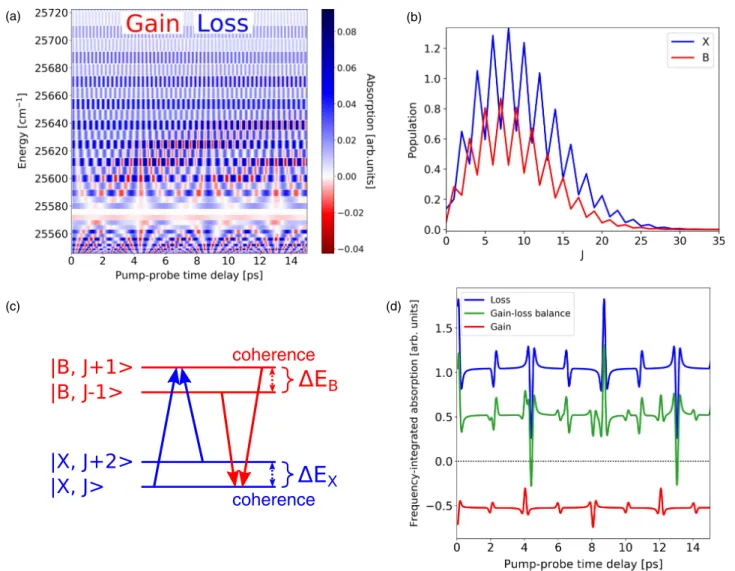
Figure2(a)shows the frequency-resolved transient absorption as a function of the pump-probe time-delay for a weak 20 fs Gaussian probe pulse with a central wavelength of 391 nm. Each vertical line shows the frequency-resolved absorption for a particular pump-probe time delay, integrated over the full duration of the pump-probe pulse. The horizontal white line around ˜ν ' 25575 cm−1marks the energy spacing ˜ν00 between the two ground rovibrational
levels of the electronic statesX and B. The spectral lines above this
energy are associated with the higher-energy branch (R branch). Those below 25575 cm−1to the lower-energy branch (P branch).
Time-dependent gain (red) emerges for virtually all pump-probe time delays and many transition frequencies, especially those associated with the lower-energy P branch. Most notably, for those time delays at which theX state molecules are anti-aligned
with the probe polarization direction, e.g., aroundτ ' 4.4 ps [cf. Fig. 1(b)], amplification occurs across the whole range of frequencies.
The details of the time- and frequency-dependent transient absorption are readily understood considering the rotational quantum beat lasing mechanism in the frequency domain. The short, intense pump pulse aligning and ionizing the N2molecules
Research Article Vol. 7, No. 6 / June 2020 / Optica 589
(b) (a)
(c) (d)
Fig. 2. Rotational quantum beat lasing without inversion in the frequency domain using the example of N+
2. Calculations are performed for the same
pump pulse and temperature as in Fig.1and a 20 fs, 391 nm, 1011 W/cm2probe pulse; see text andSupplement 1for details. (a) Full simulation of the
frequency-resolved gain (red) and loss (blue) of the weak probe interacting with the pumped system as a function of pump-probe delay. (b) Rotational distributions in the ground vibrational levels of theX and B states of N+
2 formed at the end of the interaction with the intense femtosecond pump pulse.
(c) Four-level system controlling absorption and emission at the |X, ν00=0, J i → |B, ν0=0, J + 1i transition. (d) Absorption (blue) and emission
(neg-ative absorption) (red) integrated over all frequencies follow the alignment dynamics in Fig.1(b). The total gain-loss balance integrated over all frequencies (green) follows the pattern ofPXhcos2θiX−PBhcos2θiBin Fig.1(c), showing the same gain windows for the inversionless medium (PX> PB).
generates broad rotational distributions in theX and B states of
N+2, with coherent excitation of many adjacent rotational states with similar amplitudes in each electronic state. Figure2(b)shows the rotational distributions in |X, ν00=
0i and |B, ν0=
0i for the case of the 800 nm, 23 fs FWHM pump pulse with an inten-sity of I = 1014 W/cm2 and the N
2 molecules initially at room
temperature (298 K).
Consider now frequency-resolved transient absorp-tion of a short probe pulse at the dipole-allowed transiabsorp-tion |X, J i → |B, J + 1i (with the vibrational quantum num-ber equal to zero in both cases); see Fig.2(c). For each initial rotational state of the neutral, rotational coherence gen-erated in the X state of the ion means that the absorption
|X, J i → |B, J + 1i, stimulated by a broadband probe, is inevi-tably accompanied by the absorption |X, J + 2i → |B, J + 1i
stimulated by the same probe; see Fig. 2(c). Their interfer-ence is governed by the relative phase between the two lower states φX(J + 2, J )(t) = 1EX(J + 2, J )t + φ0X(J , J + 2).
Here 1EX(J + 2, J ) = B0X[(J + 2)(J + 3) − J (J + 1)] is
the distance between the two rotational states in X , and φ0X
is their relative phase at the start of the field-free evolution when the pump is over. Destructive interference between the |X, J i → |B, J + 1i and |X , J + 2i → |B, J + 1i transitions occurs when φX(J + 2, J )(t) = (2N ± 1)π (N is an integer),
resulting in suppression of absorption of a short probe pulse arriving at this moment. Conversely, constructive interference enhances absorption whenφX(J + 2, J )(t) = 2Nπ. This leads
to the quantum beat in the time-dependent absorption rate of the short probe pulse with frequency1EX(J + 2, J ).
Emission at the same frequency, |B, J + 1i → |X , J i, is
inevitably accompanied by the transition |B, J − 1i → |X , J i;
see Fig.2(c). Their interference is governed by the relative phase φB(J + 1, J − 1)(t) = 1EB(J + 1, J − 1)t + φ0B(J − 1, J +
1) with 1EB(J + 1, J − 1) = B0B[(J + 1)(J + 2) − (J − 1)
J ]. Constructive interference between |B, J + 1i → |X , J i
J − 1)(t) = 2Nπ, while destructive interference occurs when
φB(J + 1, J − 1)(t) = (2N ± 1)π, leading to the
quan-tum beat in the time-dependent emission rate with frequency 1EB(J + 1, J − 1).
The difference between the rotational constants B0X and B0B
means that there are time windows where destructive interfer-ence of the |X, J i → |B, J + 1i and |X , J + 2i → |B, J + 1i
transitions in absorption [whenφX(J + 2, J )(t) = (2N ± 1)π]
coincides with constructive interference of the |B, J + 1i →
|X, J i and |B, J − 1i → |X , J i transitions in emission [when φB(J + 1, J − 1)(t) = 2Nπ] and vice versa. This leads to the
frequency-resolved gain (red) and loss (blue) windows as a function of the pump-probe time delay in Fig.2(a).
As many four-level systems such as the one shown in Fig.2(c) are formed by the pump, they generate a rich gain-loss pattern of frequency-resolved transient absorption of the probe pulse [Fig.2(a)]. Figure 2(a) incorporates the comprehensive model-ing of the whole process, startmodel-ing with the thermal ensemble of neutral molecules and accounting for (i) alignment of the neutral molecule; (ii) its angle-dependent strong-field ionization into the laser-dressed ionic states, with the ratio ofB to X state
popu-lations at 20% upon ionization; (iii) entanglement between the photoelectron and the ion, which negates the X –B coherence
once the photoelectron is integrated out; (iv) coupled electronic, vibrational, and rotational dynamics in the ion; and (v) com-prehensive calculations of transient absorption and emission of the probe pulse, including all interferences. Note that gain win-dows emerge with neither electronic nor rotational population inversion [cf. Fig.2(b)].
Figure2(d)connects the frequency-domain picture of Fig.2(a) to the time-domain picture of Figs.1(b)and1(c). It shows the frequency-integrated absorption from theX state (blue line) and
emission (negative absorption) from theB state (red line)
stimu-lated by the short probe pulse as a function of the pump-probe delay. The pattern of each line follows the alignment measure of the respective ion in Fig.1(b). This is not a coincidence. The same phase differences that control the interferences in tran-sient absorption by each (|X, J i, |X , J + 2i) pair control their
contribution to the ensemble-averaged hcos2θi
X measure of the
field-free rotations in theX state. The same applies to emission by
each (|B, J − 1i, |B, J + 1i) pair and the ensemble-averaged
hcos2θi
B measure. As shown in Supplement 1, integrating the
frequency-resolved absorption over all frequencies yields the total transient absorption probability Wabs(τ) ∝ PXhcos2(θ)iX(τ).
Analogous results hold for transient emission.
The green line in Fig.2(d)shows the overall gain-loss balance, integrated over all energies. As expected, the strongest gain win-dows coincide with anti-alignment of theX state [cf. Figs.1(b) and1(c)] when the gain-loss pattern in Fig.2(a)shows gain across the whole spectrum. If theX and B state molecules would
anti-align simultaneously during their field-free evolution, the net gain would vanish.
The results presented in Fig.2are robust with respect to the pump parameters, and the lasing mechanism described above is completely general. The only necessary ingredients are non-negligible population in theB state and molecular rotations, both
unavoidable during the interaction with an intense laser pulse. For the pump pulse parameters and temperature used for Fig.1and
Fig. 3. Rotational quantum beat lasing in N+
2 for different intensities
realistic in femtosecond laser filamentation experiments. Calculations are performed for a 23 fs, 800 nm pump pulse and the same probe pulse and temperature as in Fig.2. (a) and (b) Same as Fig.2(a), but for pump inten-sities of (a) I = 5.0 × 10¹³ W/cm2 and (b) I = 1.5 × 10¹⁴ W/cm2.
(c) Gain-loss balance for I = 1.5 × 10¹⁴ W/cm2 integrated over the
frequency windows (bins) indicated in panel (b). For both intensities, gain windows also emerge for the total gain-loss balance integrated over all frequencies, analogue to Fig.2(d). Gain windows emerge without population inversion of the medium (PX> PB).
Research Article Vol. 7, No. 6 / June 2020 / Optica 591
Fig.2, our simulations show that net gain sets in already at the ratio
PB/PX'10% upon ionization.
Figure3shows results for two other pump intensities realistic in laser filamentation (seeSupplement 1 for more information on the dependence of gain on the pump intensity). The expected clamping intensity is I . 1 × 10¹⁴ W/cm2, but pulse compres-sion during filamentation suggests that short intensity spikes can reach I ∼ 2 × 10¹⁴ W/cm2 [54,55]. For 800 nm driver fields
with intensities I . 2 × 10¹⁴ W/cm2, the B state population is
not strongly affected by laser-driven excitations fromX . However,
the higher the intensity, the stronger the depletion of theX state
into A [25,26] (especially for pump pulses shorter or compa-rable to the ∼18 fs vibrational period in theA state), yielding an
overall change of the gain-loss balance in favor of gain and hence the emergence of additional gain windows in time; see Figs.3(b) and3(c).
The results presented in Fig.3are in remarkably good agree-ment with recent experiagree-mental findings [38,39]. Ref. [38] reports on pump-probe femtosecond filamentation experiments in a nitrogen gas cell, measuring the delay-dependent amplification of the probe around the 391 nm line using a high-resolution spec-trometer. Our simulations closely reproduce all the main features of the measured time- and frequency-resolved gain, including the parabolic structure of the gain, the fast temporal modulation of each rotational line that increases withJ in the R branch, and the
slower temporal modulation, reflecting the molecular alignment dynamics and giving rise to the distinct gain windows, e.g., at τ ∼ 4.4 ps, where amplification occurs across the whole spectrum. Experiments that do not resolve each individual rotational line observe (the weighted sum of ) frequency-window-integrated, highly oscillating gain-loss structures such as the ones shown in Fig.3(c). For increasing pump intensity, the oscillating gain starts to occur for virtually all pump-probe time delays as observed in the nitrogen gas jet experiments in Ref. [39].
Taking into account the effects of gain narrowing and inelastic collisions that destroy the rotational coherences in the ionic states, our results reproduce the typical observations made in pump-probe “air lasing” experiments (see e.g., Refs. [14,21,38,39]): a rapid increase of the gain as a function of the pump-probe delay during the first few hundreds of femtoseconds, followed by a slow decay of the gain for delays up to tens of picoseconds that is periodically modulated by the molecular alignment dynamics.
In the present mechanism, amplification is enabled due to the stimulated emission triggered by the probe, while absorption is suppressed. Thus, the amplified emission can emerge without any delay after the probe, in contrast to the experimentally observed delays of ∼1 to 8 ps between the probe pulse and the enhanced 391 nm emission reported in Refs. [14,22,24,31,35,37]. This retardation has been attributed to the effect of probe-triggered superradiance [22,24,31,37], whereas the origin of the optical amplification is still debated. Ref. [35] offered an intriguing expla-nation, evoking long-lived coherences and coupling between the electronic statesX , A, and B, supported by the picosecond-long
tail of the pump pulse. Such long tails are explicitly absent in our analysis, which assumes that the pump pulse is fully over within a few tens of femtoseconds, with no temporal overlap between the probe and the pump pulses.
5. CONCLUSIONS AND OUTLOOK
We have discussed how molecular ionization and alignment, nat-urally induced by intense femtosecond laser pulses propagating
through molecular gas, can lead to amplification of light in an inversionless medium. Developing a comprehensive theoretical model for studying the amplification effect around the 391 nm line in N+2 in the intensity regime relevant for laser filamentation experiments (I ∼ 1 − 2 × 10¹⁴ W/cm2), we have shown that
nei-ther population inversion nor coherences between the electronic states of the ion are required for the air lasing phenomenon— the rotational quantum beat lasing without inversion makes it possible.
In the present mechanism, the gain window travels with the group velocity of the pump pulse so that amplification occurs only in the forward direction. To achieve lasing in the backward direction, highly desirable for remote sensing, one would greatly benefit from creating population inversion, at least between the rotational states. To this end, a sequence of two well-timed pump pulses can be used to control rotations of theX and B states of the
ion. Their different rotational periods mean that the second pulse can be timed to simultaneously accelerate rotations of theB state
and slow down the rotations of theX state, generating rotational
inversion. Optimization of such pulse sequence, including their carrier frequencies, energies, and time delay, should open a route for achieving robust and strong backward lasing in open air. Funding. Deutsche Forschungsgemeinschaft (IV 152/6-1, SM 292/5-1); Engineering and Physical Sciences Research Council / Defence Science and Technology Laboratory (MURI EP/N018680/1); Horizon 2020 Framework Programme (641789); Agence Nationale de la Recherche (ANR-10-LABX-0039-PALM).
Acknowledgment. The authors thank Daniil Kartashov, Andrius Baltuška, Mathew Britton, and Paul Corkum for many fruitful and stimulating discussions.
Disclosures. The authors declare no conflicts of interest. SeeSupplement 1for supporting content.
†These authors contributed equally to this work.
REFERENCES
1. O. A. Kocharovskaya and Y. I. Khanin, “Coherent amplification of an ultrashort pulse in a three-level medium without a population inversion,” Pis’ma Zh. Eksp. Teor. Fiz. 48, 581 (1988).
2. Y. I. Khanin and O. A. Kocharovskaya, “Inversionless amplification of ultrashort pulses and coherent population trapping in a three-level medium,”J. Opt. Soc. Am. B7, 2016–2024 (1990).
3. M. O. Scully, S.-Y. Zhu, and A. Gavrielides, “Degenerate quantum-beat laser: lasing without inversion and inversion without lasing,”Phys. Rev. Lett.62, 2813–2816 (1989).
4. S. E. Harris, “Lasers without inversion: interference of lifetime-broadened resonances,”Phys. Rev. Lett.62, 1033–1036 (1989). 5. A. Nottelmann, C. Peters, and W. Lange, “Inversionless amplification
of picosecond pulses due to Zeeman coherence,”Phys. Rev. Lett.70, 1783–1786 (1993).
6. E. S. Fry, X. Li, D. Nikonov, G. G. Padmabandu, M. O. Scully, A. V. Smith, F. K. Tittel, C. Wang, S. R. Wilkinson, and S.-Y. Zhu, “Atomic coherence effects within the sodium d1line: lasing without inversion via population
trapping,”Phys. Rev. Lett.70, 3235–3238 (1993).
7. W. E. van der Veer, R. J. J. van Diest, A. Dönszelmann, and H. B. van Linden van den Heuvell, “Experimental demonstration of light amplifi-cation without population inversion,”Phys. Rev. Lett.70, 3243–3246 (1993).
8. A. S. Zibrov, M. D. Lukin, D. E. Nikonov, L. Hollberg, M. O. Scully, V. L. Velichansky, and H. G. Robinson, “Experimental demonstration of laser
oscillation without population inversion via quantum interference in Rb,” Phys. Rev. Lett.75, 1499–1502 (1995).
9. O. Kocharovskaya, “Amplification and lasing without inversion,”Phys. Rep.219, 175–190 (1992).
10. M. O. Scully, “From lasers and masers to phaseonium and phasers,” Phys. Rep.219, 191–201 (1992).
11. M. O. Scully and M. Fleischhauer, “Lasers without inversion,”Science 263, 337–338 (1994).
12. Q. Luo, W. Liu, and S. Chin, “Lasing action in air induced by ultra-fast laser filamentation,”Appl. Phys. B76, 337–340 (2003).
13. J. Yao, B. Zeng, H. Xu, G. Li, W. Chu, J. Ni, H. Zhang, S. L. Chin, Y. Cheng, and Z. Xu, “High-brightness switchable multiwavelength remote laser in air,”Phys. Rev. A84, 051802 (2011).
14. J. Yao, G. Li, C. Jing, B. Zeng, W. Chu, J. Ni, H. Zhang, H. Xie, C. Zhang, H. Li, H. Xu, S. L. Chin, Y. Cheng, and Z. Xu, “Remote creation of coher-ent emissions in air with two-color ultrafast laser pulses,”New J. Phys. 15, 023046 (2013).
15. Y. Liu, Y. Brelet, G. Point, A. Houard, and A. Mysyrowicz, “Self-seeded lasing in ionized air pumped by 800 nm femtosecond laser pulses,”Opt. Express21, 22791–22798 (2013).
16. W. Chu, G. Li, H. Xie, J. Ni, J. Yao, B. Zeng, H. Zhang, C. Jing, H. Xu, Y. Cheng, and Z. Xu, “A self-induced white light seeding laser in a femtosecond laser filament,”Laser Phys. Lett.11, 015301 (2013). 17. A. Braun, G. Korn, X. Liu, D. Du, J. Squier, and G. Mourou,
“Self-channeling of high-peak-power femtosecond laser pulses in air,”Opt. Lett.20, 73–75 (1995).
18. A. Couairon and A. Mysyrowicz, “Femtosecond filamentation in transparent media,”Phys. Rep.441, 47–189 (2007).
19. L. Bergé, S. Skupin, R. Nuter, J. Kasparian, and J.-P. Wolf, “Ultrashort filaments of light in weakly ionized, optically transparent media,”Rep. Prog. Phys.70, 1633–1713 (2007).
20. J. Ni, W. Chu, C. Jing, H. Zhang, B. Zeng, J. Yao, G. Li, H. Xie, C. Zhang, H. Xu, S.-L. Chin, Y. Cheng, and Z. Xu, “Identification of the physical mechanism of generation of coherent emissions in air by femtosecond laser excitation,”Opt. Express21, 8746–8752 (2013).
21. H. Zhang, C. Jing, J. Yao, G. Li, B. Zeng, W. Chu, J. Ni, H. Xie, H. Xu, S. L. Chin, K. Yamanouchi, Y. Cheng, and Z. Xu, “Rotational coherence encoded in an “air-laser” spectrum of nitrogen molecular ions in an intense laser field,”Phys. Rev. X3, 041009 (2013).
22. G. Li, C. Jing, B. Zeng, H. Xie, J. Yao, W. Chu, J. Ni, H. Zhang, H. Xu, Y. Cheng, and Z. Xu, “Signature of superradiance from a nitrogen-gas plasma channel produced by strong-field ionization,”Phys. Rev. A89, 033833 (2014).
23. S. Mitryukovskiy, Y. Liu, P. Ding, A. Houard, A. Couairon, and A. Mysyrowicz, “Plasma luminescence from femtosecond filaments in air: evidence for impact excitation with circularly polarized light pulses,” Phys. Rev. Lett.114, 063003 (2015).
24. Y. Liu, P. Ding, G. Lambert, A. Houard, V. Tikhonchuk, and A. Mysyrowicz, “Recollision-induced superradiance of ionized nitrogen molecules,”Phys. Rev. Lett.115, 133203 (2015).
25. H. Xu, E. Lötstedt, A. Iwasaki, and K. Yamanouchi, “Sub-10-fs popu-lation inversion in N2+air lasing through multiple state coupling,”Nat.
Commun.6, 8347 (2015).
26. J. Yao, S. Jiang, W. Chu, B. Zeng, C. Wu, R. Lu, Z. Li, H. Xie, G. Li, C. Yu, Z. Wang, H. Jiang, Q. Gong, and Y. Cheng, “Population redistribution among multiple electronic states of molecular nitrogen ions in strong laser fields,”Phys. Rev. Lett.116, 143007 (2016).
27. D. Kartashov, S. Haessler, S. Ališauskas, G. Andriukaitis, A. Pugžlys, A. Baltuška, J. Möhring, D. Starukhin, M. Motzkus, A. Zheltikov, M. Richter, F. Morales, O. Smirnova, M. Y. Ivanov, and M. Spanner, “Transient inver-sion in rotationally aligned nitrogen ions in a femtosecond filament,” in Research in Optical Sciences, OSA Technical Digest (online) (Optical Society of America, 2014), paper HTh4B.5.
28. M. Richter, F. Morales, M. Spanner, O. Smirnova, and M. Ivanov, “Optical lasing during laser filamentation in the nitrogen molecu-lar ion: Ro-vibrational inversion,” in 2017 Conference on Lasers and Electro-Optics Europe & European Quantum Electronics Conference (CLEO/Europe-EQEC), Munich (2017).
29. A. Azarm, P. Corkum, and P. Polynkin, “Optical gain in rotationally excited nitrogen molecular ions,”Phys. Rev. A96, 051401 (2017). 30. M. Lei, C. Wu, A. Zhang, Q. Gong, and H. Jiang, “Population inversion
in the rotational levels of the superradiant N2+pumped by femtosecond
laser pulses,”Opt. Express25, 4535–4541 (2017).
31. X. Zhong, Z. Miao, L. Zhang, Q. Liang, M. Lei, H. Jiang, Y. Liu, Q. Gong, and C. Wu, “Vibrational and electronic excitation of ionized nitrogen molecules in intense laser fields,”Phys. Rev. A96, 043422 (2017). 32. H. Xu, E. Lötstedt, T. Ando, A. Iwasaki, and K. Yamanouchi,
“Alignment-dependent population inversion in N+
2in intense few-cycle laser fields,”
Phys. Rev. A96, 041401 (2017).
33. Y. Liu, P. Ding, N. Ibrakovic, S. Bengtsson, S. Chen, R. Danylo, E. R. Simpson, E. W. Larsen, X. Zhang, Z. Fan, A. Houard, J. Mauritsson, A. L’Huillier, C. L. Arnold, S. Zhuang, V. Tikhonchuk, and A. Mysyrowicz, “Unexpected sensitivity of nitrogen ions superradiant emission on pump laser wavelength and duration,”Phys. Rev. Lett.119, 203205 (2017). 34. M. Britton, P. Laferrière, D. H. Ko, Z. Li, F. Kong, G. Brown, A. Naumov, C.
Zhang, L. Arissian, and P. B. Corkum, “Testing the role of recollision in N+ 2
air lasing,”Phys. Rev. Lett.120, 133208 (2018).
35. A. Mysyrowicz, R. Danylo, A. Houard, V. Tikhonchuk, X. Zhang, Z. Fan, Q. Liang, S. Zhuang, L. Yuan, and Y. Liu, “Lasing without population inversion in N+
2,”APL Photon.4, 110807 (2019).
36. B. Xu, S. Jiang, J. Yao, J. Chen, Z. Liu, W. Chu, Y. Wan, F. Zhang, L. Qiao, R. Lu, Y. Cheng, and Z. Xu, “Free-space N+
2lasers generated strong laser
fields: the role of molecular vibration,”Opt. Express26, 13331–13339 (2018).
37. X. Zhong, Z. Miao, L. Zhang, H. Jiang, Y. Liu, Q. Gong, and C. Wu, “Optimizing the 391-nm lasing intensity from ionized nitrogen molecules in 800-nm femtosecond laser fields,”Phys. Rev. A97, 033409 (2018). 38. L. Arissian, B. Kamer, A. Rastegari, D. M. Villeneuve, and J.-C. Diels,
“Transient gain from N+
2 in light filaments,”Phys. Rev. A98, 053438
(2018).
39. M. Britton, M. Lytova, P. Laferrière, P. Peng, F. Morales, D. H. Ko, M. Richter, P. Polynkin, D. M. Villeneuve, C. Zhang, M. Ivanov, M. Spanner, L. Arissian, and P. B. Corkum, “Short- and long-term gain dynamics in N2+air lasing,”Phys. Rev. A100, 013406 (2019).
40. H. Li, Q. Song, J. Yao, Z. Liu, J. Chen, B. Xu, K. Lin, J. Qiang, B. He, H. Xu, Y. Cheng, H. Zeng, and J. Wu, “Air lasing from singly ionized N2driven by
bicircular two-color fields,”Phys. Rev. A99, 053413 (2019).
41. T. Ando, E. Lötstedt, A. Iwasaki, H. Li, Y. Fu, S. Wang, H. Xu, and K. Yamanouchi, “Rotational, vibrational, and electronic modulations in N+ 2
lasing at 391 nm: evidence of coherent B26+ u−X26
+
g−A25ucoupling,”
Phys. Rev. Lett.123, 203201 (2019).
42. H. Li, M. Hou, H. Zang, Y. Fu, E. Lötstedt, T. Ando, A. Iwasaki, K. Yamanouchi, and H. Xu, “Significant enhancement of N2+lasing by
polarization-modulated ultrashort laser pulses,”Phys. Rev. Lett.122, 013202 (2019).
43. A. Zhang, Q. Liang, M. Lei, L. Yuan, Y. Liu, Z. Fan, X. Zhang, S. Zhuang, C. Wu, Q. Gong, and H. Jiang, “Coherent modulation of superradiance from nitrogen ions pumped with femtosecond pulses,”Opt. Express27, 12638–12646 (2019).
44. A. Zhang, M. Lei, J. Gao, C. Wu, Q. Gong, and H. Jiang, “Subfemtosecond-resolved modulation of superfluorescence from ionized nitrogen molecules by 800-nm femtosecond laser pulses,”Opt. Express27, 14922–14930 (2019).
45. Q. Zhang, H. Xie, G. Li, X. Wang, H. Lei, J. Zhao, Z. Chen, J. Yao, Y. Cheng, and Z. Zhao, “Sub-cycle coherent control of ionic dynamics via transient ionization injection,”Communications Phys.3, 50 (2020). 46. J. Kasparian, R. Sauerbrey, and S. L. Chin, “The critical laser intensity of
self-guided light filaments in air,”Appl. Phys. B71, 877–879 (2000). 47. S. Xu, J. Bernhardt, M. Sharifi, W. Liu, and S. L. Chin, “Intensity
clamp-ing durclamp-ing laser filamentation by TW level femtosecond laser in air and argon,”Laser Phys.22, 195–202 (2012).
48. P. M. Solyankin, I. A. Nikolaeva, A. A. Angeluts, D. E. Shipilo, N. V. Minaev, N. A. Panov, A. V. Balakin, Y. Zhu, O. G. Kosareva, and A. P. Shkurinov, “THz generation from laser-induced breakdown in pressur-ized molecular gases: on the way to terahertz remote sensing of the atmospheres of Mars and Venus,”New J. Phys.22, 013039 (2020). 49. T. Seideman, “Revival structure of aligned rotational wave packets,”
Phys. Rev. Lett.83, 4971–4974 (1999).
50. P. W. Dooley, I. V. Litvinyuk, K. F. Lee, D. M. Rayner, M. Spanner, D. M. Villeneuve, and P. B. Corkum, “Direct imaging of rotational wave-packet dynamics of diatomic molecules,”Phys. Rev. A68, 023406 (2003). 51. A. K. Popov and V. V. Slabko, “Inversionless amplification by anisotropic
molecules,”Opt. Lett.30, 1719–1721 (2005).
52. M. Spanner and S. Patchkovskii, “One-electron ionization of multi-electron systems in strong nonresonant laser fields,”Phys. Rev. A80, 063411 (2009).
53. Y. Zhang, E. Lötstedt, and K. Yamanouchi, “Mechanism of population inversion in laser-driven N+
2,”J. Phys. B52, 055401 (2019).
54. M. B. Gaarde and A. Couairon, “Intensity spikes in laser filamentation: diagnostics and application,”Phys. Rev. Lett.103, 043901 (2009). 55. S. I. Mitryukovskiy, Y. Liu, A. Houard, and A. Mysyrowicz, “Re-evaluation
of the peak intensity inside a femtosecond laser filament in air,”J. Phys. B48, 094003 (2015).