HAL Id: hal-02598407
https://hal.inrae.fr/hal-02598407
Submitted on 15 May 2020
HAL is a multi-disciplinary open access
archive for the deposit and dissemination of sci-entific research documents, whether they are pub-lished or not. The documents may come from teaching and research institutions in France or abroad, or from public or private research centers.
L’archive ouverte pluridisciplinaire HAL, est destinée au dépôt et à la diffusion de documents scientifiques de niveau recherche, publiés ou non, émanant des établissements d’enseignement et de recherche français ou étrangers, des laboratoires publics ou privés.
To cite this version:
M.R. Khaledian, J.C Mailhol, Pierre Ruelle. No-Tillage impacts on soil hydraulic properties compared with conventional tillage. Journal of Biological & Environmental Sciences, 2012, 6 (18), pp.213-218. �hal-02598407�
1
No-tillage impacts on soil hydraulic properties compared with conventional tillage
Mohammadreza Khaledian1,2, Jean-Claude Mailhol1, Pierre Ruelle1
1) UMR G-EAU Cemagref-Cirad-Engref-IRD, BP 5095, 34196 Montpellier Cedex 05 France
2) Faculty of Agricultural Sciences, University of Guilan, Rasht, Iran; corresponding author email: [email protected]
Abstract. Soil hydraulic properties are very important in precision irrigation, water and
solute transport and irrigation scheduling. Tillage can change near surface soil hydraulic properties. In this study Beerkan methodwas used to better understand tillage and no-tillage impacts on transmission properties of topsoil. Beerkan is a simple in situ method using a single ring to measure infiltration rate. This method depends on an algorithm namely BEST to estimate soil hydraulic properties. This study was carried out at Cemagref experimental station in Montpellier in the South-eastern France. Three different infiltration measurement series were done in both no-tillage and conventional tillage treatments. The first infiltration measurement series was performed after harvest of durum wheat; the second one was performed after sowing of corn and finally the last one was performed after the harvest of corn. By using those three series as input data, BEST model estimated saturated hydraulic conductivity (Ks), sorptivity, the mean characteristics of hydraulically functional pore size and capillary length. The results
2
indicate that after harvest, hydraulic properties were not significantly different; however after sowing of corn, Ks was significantly higher in CT system (p<0.05). These conditions should be taken in account to perform irrigation, fertilization and agrochemical agent applications.
Keywords: Beerkan method, no-tillage, conventional tillage, soil hydraulic properties
Introduction
No-tillage (NT) is an ecological approach of soil management which has a higher efficiency than conventional tillage (CT) to improve soil quality. However, the response to NT depends largely on the climatic conditions, mulch quantity on the soil surface and soil management. Tillage largely influences pore size distribution. Soils under CT generally have lower bulk density and associated with a higher total porosity within the ploughed layer than no tillage (Liepic et al. 2006). The relationships between soil pore structure induced by tillage and infiltration play an important role in water and solutes transport characteristics in soil. An important function of soil is transmission of water, which directly affects plant productivity and environment. In NT, greater infiltration rate was attributed to greater contribution of flow-active macro-pores made by soil microorganisms, worms, and roots of preceding crops (Lampurlanes and Cantero-Martinez 2006). As cited by Sasal et al. (2006) such bio-pores are more effective for water and air movement and root growth, because they are more continuous, less tortuous, and more stable than macro-pores created during ploughing (Hubbard et al.
3
2001). However the effects of soil tillage and management on transmission properties are not uniform. The results of several study showed that no tillage as compared with CT had greater (McGarry et al. 2000), similar (Sasal et al. 2006) or lower infiltration rate (Ferreras et al. 2000, Moret and Arrue 2007).
Studying soil properties requires the determination of soil hydraulic parameters. This is important for understanding and characterizing the hydrological cycle and transfer of contaminants with water. Different functional relationships have been proposed in literature to describe the relationships between soil water variables i.e. soil water content, θ, pressure head, h, and hydraulic conductivity, K (Lassabatere et al. 2006). In this context, the Beerkan method, which is a simple in situ, using a single ring infiltration, provides field soil hydraulic properties. This method depends on an algorithm, BEST, which specifically relates to van Genuchten’s relation (van Genuchten 1980), for water retention curve, h( ), with the condition of Burdine (Burdine 1953), and to Brooks and Corey’s (Brooks and Corey 1964) relation for hydraulic conductivity, K( ). The hydraulic characteristic curves, h( ) and K( ), were defined by their form and scale parameters. The BEST algorithm enables us to estimate those parameters from particle size distribution, dry bulk density and from modelling the experimental infiltration trials (Mubarak et al. 2009 and 2010). The aim of the research reported here was to determine whether or not NT system improves soil hydraulic parameters as compared with CT. The results of this study can help us to better understand the NT impacts on water and solutes transfer in soils.
4
Materials and methods
A field experiment under irrigation condition was established at the experimental station of Cemagref at Montpellier in the South-eastern France. The average annual rainfall is 780 mm year-1 (1991-2011). Evaporation exceeds rainfall throughout the year under this Mediterranean climate. Those climate data were monitored at a weather station within the experimental station. Two different tillage treatments i.e. CT and NT have been applied since 2000. The precedent crop residue was kept in the field. Retained residues were incorporated if tilled (CT), or left on the surface with NT. This paper deals with the two cropping seasons i.e. 2005-2006 and 2006-2007. In CT plots, primary tillage for durum wheat with disc harrow was done to chop and bury the residues at the end of July 2005. Secondary tillage with plough was performed at the beginning of October. Depth of the tillage was close to 25cm in average. By using a harrow, seedbed was prepared and durum wheat sowing was performed using a seeder. Durum wheat was sown in both CT and NT in November 2005. In NT plots, a specific seeder for NT namely Semeato was used. After harvest in June 28, the experiment area was left completely fallow over summer. The first infiltration measurement series was performed from 17 to 23 July 2006 approximately one month after durum wheat harvest.
In October 2006, a mixed of oat, vetch and rape was planted in NT treatment as cover crop and was destroyed by glyphosat in April 2007 before sowing corn. In CT plots, at the end of July disc harrow was used to chop and bury the residues of durum wheat. At the middle of November tillage with plough was performed. Depth of the tillage was
5
close to 25cm in average. Using a harrow, seedbed was prepared and corn sowing was performed by the specific seeder. In NT plot, after destroying the cover crop we used only the same seeder for NT. The second infiltration measurement series was done in May 2007 one month after sowing. The third infiltration measurement series was done in September 2007, after harvest.
Infiltration measurements were performed in ten randomly selected sites of each plot. Soil samples were taken from the same sites to determine particle size and initial soil humidity. Soil bulk density ( d) was determined using a gamma probe (Troxler 3440).
For the installation of the cylinder, the surface residue or vegetation is removed while the roots remain in situ. Then the cylinder is positioned at the soil surface and driven 1 cm into to the soil to avoid lateral losses of ponded water at the soil surface. A defined volume of water is added into the cylinder (15-20 cm of diameter) at time zero, and the time elapsed during the infiltration should be measured. When the first volume has completely infiltrated, immediately the second known volume of water is added, and cumulative time is recorded. The procedure is repeated for a series of about 8 to 15 known volumes and cumulative infiltration is recorded. Finally, the data set is made up of a number of discrete points (ti, Ii). At the end of the experiment, the saturated soil is
sampled to determine the saturated volumetric water content (for more details refer to
(Braud et al. 2005, Lassabatere et al. 2006).
In this study, the BEST algorithm was used to determine soil hydraulic properties through the van Genuchten equation for the water retention curve, h(θ) (Eq. (1)) with
6
the Burdine condition (Eq. (2)) and the Brooks and Corey relation (Eq. (3)) for the soil hydraulic conductivity curve, K(h) (Burdine 1953, Brooks and Corey 1964, van Genuchten 1980):
Eq. 1
Eq. 2
where n and m are the dimensionless shape parameters of the water retention curve and ˛vG is simply called the alpha-parameter of the van Genuchten model (m−1). Ks is the saturated hydraulic conductivity (m s−1) and η is the shape parameter of the soil
hydraulic conductivity relationship.
By those data as input, BEST, a 3D infiltration model can estimate saturated hydraulic conductivity, sorptivity, the mean characteristic of hydraulically functional pore size and capillary length.
Soil total porosity (TP) was calculated as the function of total volume not occupied by soil assuming a particle density ( s) of 2.65 Mg m-3 using Eq. 4.
Eq. 3
( )
(
)
(
(
)
n)
m vG r s r h h =θ + θ −θ + α − θ 1 n m=1−2( )
η θ θθ θ θ − − = r s r s K K7
TP=1-( d/ s) Eq. 4
Treatment effects on measured variables were tested by analysis of variance (ANOVA) at P<0.05 using SPSS software package. In the event that significant F-values were found in analysis of variance, differences among treatments were separated using least significant differences (LSD).
Results and Discussion
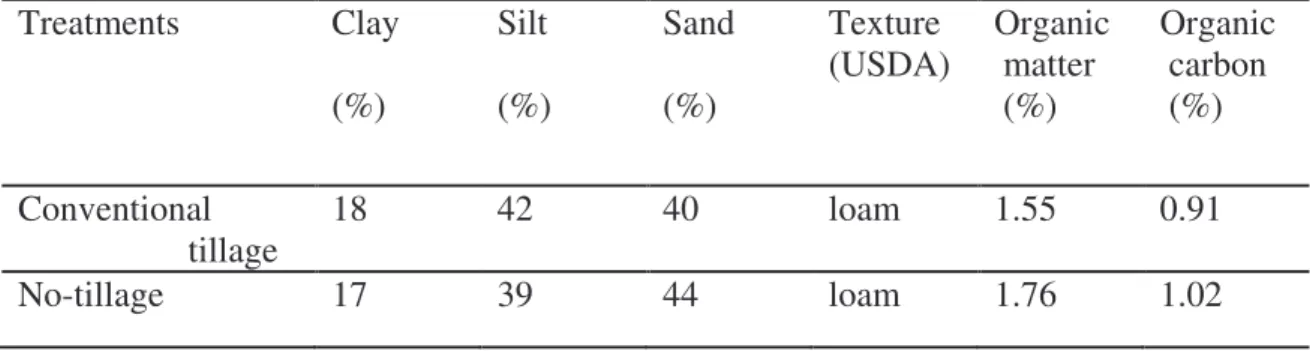
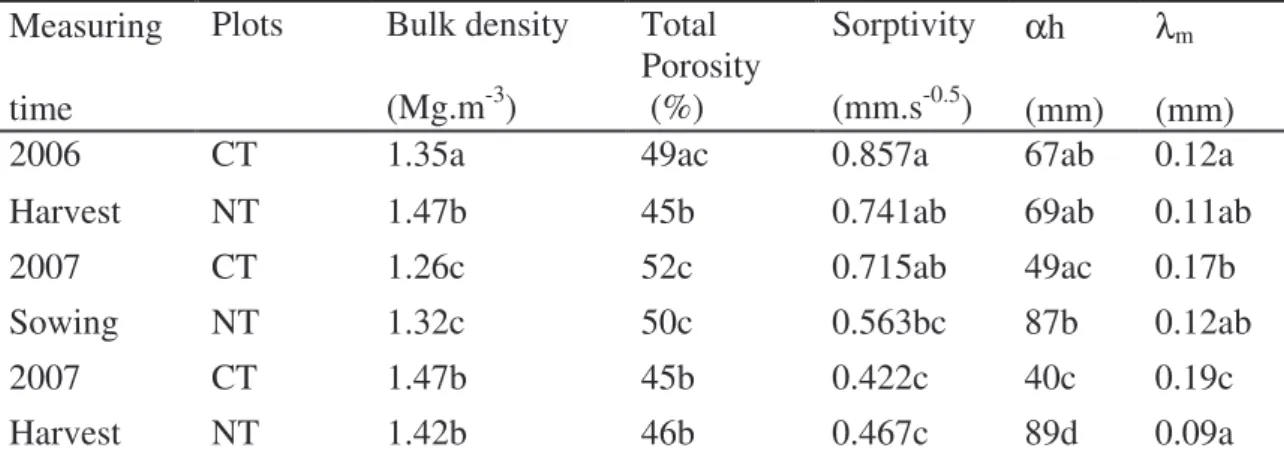
Table 1 presents the particle size, texture, organic matter and organic carbon of soil at both plots. There is the same soil texture according to USDA soil classification system. There is more organic matter and organic carbon in NT plot as the long-term benefits of NT system. The average of bulk density, total porosity and three outputs of BEST i.e. sorptivity, capillary length ( h) and the mean characteristic of hydraulically functional pore size (λm) of soil surface, are shown in Table 2. One month after the planting date of
corn in 2007, bulk density was significantly different as compared with harvest of 2006 and 2007, being the lowest among others. This is related to soil preparation before sowing in CT. The results of Osunbitan et al. (2005) are in agreement with these findings. In NT, bulk density has being decreased from 1.47 in 2006 to 1.32 g cm-3 in the beginning of 2007 season. That can be associated with the cover crop effects, producing more bio-pore due to the decayed root channels or the macro-pore made by soil fauna (Mubarak et al. 2009). In 2007, one month after sowing, bulk density was not
8
significantly different in CT and NT. The soil bulk density was higher in CT (1.47 vs. 1.42 g cm-3) after the harvest of corn in 2007; however the difference was not significant. The bulk density increased with time in CT from the beginning of season to harvest as the soil gradually get compacted under the influence of irrigation and rainfall and particle resettlement (Osunbitan et al. 2005). Total porosity was higher in CT except of 2007 harvest; however the differences were not significant. Higher porosity in CT was reported by Glab and Kulig (2008).
Sorptivity values, being indicative of soil water diffusivity and thus unsaturated hydraulic conductivity was higher in CT than NT beside of 2007 harvest; however the difference was not significant between tillage treatments. These results should be considered as approximate values, since initial soil moisture content was not identical among all measurements. Higher sorptivity in CT was reported by McGarry et al. (2000). Sorptivity, which is water uptake by soil when there is no gravitational effect, is a good index of how the tillage treatments have influenced soil structure. It provides information on the soil absorption rate and varies with initial water content and structural stability.
In this study h and λm were assessed in CT and NT. λm was not significantly different
in CT and NT for both 2006 and 2007 after sowing, but it was significantly lower in 2007 after harvest (0.19 vs. 0.09 mm in CT and NT, respectively). In 2006, h was not significantly different in CT and NT (67 vs. 69 mm in CT and NT, respectively). But in 2007, it decreased and increases significantly in CT and NT, respectively as compared
9
with 2006. However the difference between CT and NT was not significant. The reduction of h in CT can be related to decreasing in bulk density. In CT, decreasing in h and increasing in λm reflect the changes in pore sizes and hydraulic conductivity due
to soil loosening made by tillage. In NT 2007, the increase in h can be due to a different pore size distribution in the surface layer. The difference in αh values should
be interpreted resulting from differences in the soil pore system, which may have been induced by the tillage management. The differences in bulk density observed together with the greater macro-porosity probably induced by root or soil fauna in the surface layer (Mubarak et al. 2010).
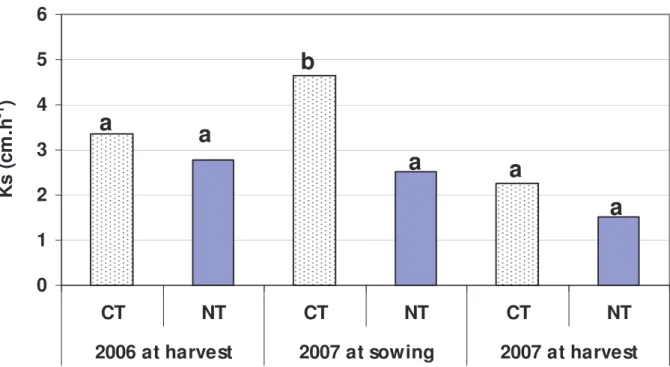
Saturated hydraulic conductivity (Ks) in both CT and NT treatments are shown in
Figure 1. Ks was not significantly different in CT and NT treatments in 2006, however Ks was higher in CT. That can be due to a higher plant density in CT, having more decayed root channels (264 vs. 200 plants m-2 in CT and NT, respectively). Furthermore, total porosity which can affect on Ks was higher in CT. Osunbitan et al. (2005) found strong and positive regression between soil hydraulic conductivity and total porosity with R2 value of 0.96 for both NT and CT. The relationships were significant at 5% probability level.
Ks was significantly different in 2007 after sowing, being higher in CT than NT. This can be related to soil preparation in CT treatment before planting resulting in a lower bulk density. In contrast, Ks was not significantly different in CT treatment for 2006 and 2007, however Ks was higher in 2007 (4.66 in 2007 as compared with 3.35 cm h-1
10
in 2006). For NT treatment, the difference was not significant for 2006 and 2007. However, Ks was higher in 2006 (2.79 in 2006 as compared with 2.51 cm h-1 in 2007). In spite of expected increase of Ks, due to soil decompaction i.e. decreasing bulk density from 1.47 in 2006 to 1.32 Mg m-3 in 2007, Ks decreased in NT 2007. The Ks diminution could be due to a different pore size distribution and their orientation rather than to total porosity in the surface layer. Ks depends not only on total porosity but also, and primarily, on the size of the conducting pores. Cracks, worm holes, and decayed root channels may affect flow in different ways. Anken et al. (2004) found that preferential flow channels were more continuous, even though macroporosity was smaller in NT as compared with moldboard plow or chisel plow. It is possible that differences in organic matter and organic carbon (Table 1) caused the differences in Ks in CT and NT as attested by some pedo-transfer functions (Rawls et al. 2005). Although NT can promote or preserve preferential flow channels or macroporosity in soils, other surface or subsurface characteristics in NT may have constrained water movement. Probably the presence of an organic layer overlying the soil restricts water movement. Partially and well decomposed organic matter in NT can form this layer. The importance of this organic layer actually regulating soil hydrological process has important implication for crop production (Sharrat et al. 2006). After the harvest of 2007 in CT, Ks was significantly lower. The saturated hydraulic conductivity of CT generally decreased with time after sowing due to soil resettlement and compaction effects of irrigation and rainfall (Kariba et al. 2001 and Mubarak et al. 2009). Ks was
11
lower in NT after the harvest of corn in 2007, however the difference was not significant.
Conclusion
Soil tillage is defined as mechanical or soil-stirring actions exerted on soil to modify soil conditions for the purpose of nurturing crops. Results of various investigations from almost all world climatic zones suggest that plowing often reveals common soil-related problems such as soil compaction, soil erosion, deteriorated water percolation, and high energy and time requirement (El Titi 2003). As a response to those problems, conservation tillage, including no-tillage (NT) was proposed. This system has often higher efficiency than conventional tillage (CT) to improve soil properties. Modifications of soil structure by soil tillage cause changes in conductivity and permeability characteristics for water and solute transport in soils and their spatial distribution. Using tillage resulted in increasing some hydraulic characteristics of topsoil, however these effects of tillage are short lived. So that in the environmental point of view there is higher risk of pollution transport in CT system especially after soil operation. The differences in CT and NT can be related to different soil layer which exist in the topsoil of NT which can cause a spatial heterogenity of hydraulic properties of the porous media while tillage has the homogenization effects in the topsoil of CT system. More study is necessary to better understand the porous media under NT system especially over the growing season.
12
References
Anken T, Weisskopf P, Zihlmann U, Forrer H, Jansa J, and Perhacova K (2004). Long-term tillage system effects under moist cool conditions in Switzerland. Soil Till Research 78: 171–183.
Braud I, De Condappa D, Soria JM, Haverkamp R, Angulo-Jaramillo R, Galle S, and Vauclin M (2005). Use of Scaled forms of the infiltration equation for the estimation of unsaturated soil hydraulics properties (the Beerkan method). Eur. J. Soil Science 56: 361-374.
Brooks RH, and Corey CT (1964). Hydraulics properties of porous media. Hydrol., Paper 3., Colorado State University, Fort Collins.
Burdine NT (1953). Relative permeability calculation from pore size distribution data. Petr Trans Trans Am Inst Min Metall Eng 198: 71-77.
El Titi A (2003). Soil Tillage in Agroecosystems. CRC Press LLC, USA.
Ferreras LA, Costa JL, Garcia FO, and Pecorari C (2000). Effect of no-tillage on some physical properties of structural degraded Petrocalcic Paleudoll of southern Pampa of Argentina. Soil Till Research 54: 31–39.
Gardner WR (1958). Some steady-state solutions of the unsaturated moisture flow equation with application to evaporation from a water table. Soil Science 85: 228–232. Glab T, and Kulig B (2008). Effect of mulch and tillage system on soil porosity under wheat (Triticum aestivum). Soil Till Research 99: 169-178.
13
Hubbard RK, Lowrance RR, and Williams RG (2001). Preferential flow in clayey Coastal Plain soil as affected by tillage. ASAE 261–262.
Kribaa M, Hallaire V, Curmi P, and Lahmar R (2001). Effect of various cultivation methods on the structure and hydraulic properties of a soil in a semi-arid climate. Soil Till Research 60: 43–53.
Lampurlanes J, and Cantero-Martinez C (2006). Hydraulic conductivity, residue cover and soil surface roughness under different tillage systems in semiarid conditions. Soil Till Research 85(1-2): 13-26.
Lassabatere L, Angulo-Jaramillo R, Soria Ugalde JM, Cuenca R, Braud I, and Haverkamp R (2006). Beerkan estimation of soil transfer parameters through infiltration experiments—BEST. SSSA Journal 70: 521–532.
Lipiec J, Kus J, Slowinska-Jurkiewicz A, and Nosalewicz A (2006). Soil porosity and water infiltration as influenced by tillage methods. Soil Till Research 89: 210-220. McGarry D, Bridge BJ, and Radford BJ (2000). Contrasting soil physical properties after zero and traditional tillage of an alluvial soil in the semi-arid subtropics. Soil Till Research 53(2): 105-115.
Moret D, and Arrue JL (2007). Dynamics of soil hydraulic properties during fallow as affected by tillage. Soil Till Research 96: 103-113.
Mubarak I, Angulo-Jaramillo R, Mailhol JC, Ruelle P, Boivin P, and Khaledian MR (2009). Temporal variability in soil hydraulic properties under drip irrigation. Geoderma 150: 158-165.
14
Mubarak I, Mailhol JC, Angulo-Jaramillo R, Ruelle P, Khaledian MR, and Vauclin M (2010). Spatial analysis of soil surface hydraulic properties: Is infiltration method dependent? Agr Water Manage 97: 1517-1526.
Osunbitan JA, Oyedele DJ, and Adekalu KO (2005). Tillage effects on bulk density, hydraulic conductivity and strength of a loamy sand soil in southwestern Nigeria. Soil Till Research 82(1): 57-64.
Rawls WJ, Nemes A, and Pachepsky YA (2005). Effect of soil organic matter on soil hydraulic properties, in development of pedotransfer functions in soil hydrology, edited by Pachepsky, Y.A., and Rawls, W.J. pp. 95-114, Elsevier, Amsterdam.
Sasal MC, Andriulo AE, and Taboada MA (2006). Soil porosity characteristics and water movement under zero tillage in silty soils in Argentinian Pampas. Soil Till Research 87(1): 9-18.
Sharratt BS, Zhang M, and Sparrow S (2006). Twenty years of tillage research in subarctic Alaska: I. Impact on soil hydraulic properties. Soil Till Research 91: 82–88. Van Genuchten MT (1980). A closed form equation for predicting the hydraulic conductivity of unsaturated soils. SSSA Journal 44: 892-898.
15
Table 1. Some soil physical and chemical properties at the Cemagref experimental station (all soil properties presented here are for 0-30 cm)
Treatments Clay (%) Silt (%) Sand (%) Texture
(USDA) Organic matter (%) Organic carbon (%) Conventional tillage 18 42 40 loam 1.55 0.91 No-tillage 17 39 44 loam 1.76 1.02
16
Table 2. The average of bulk density, total porosity, sorptivity, capillary length ( h) and the mean characteristic of hydraulically functional pore size (λm) of soil
surface measured at harvest of durum wheat (July 2006) and after sowing of corn (May 2007) in conventional tillage (CT) and no-tillage (NT) treatments Measuring
time
Plots Bulk density (Mg.m-3) Total Porosity (%) Sorptivity (mm.s-0.5) αh (mm) λm (mm) 2006 CT 1.35a 49ac 0.857a 67ab 0.12a Harvest NT 1.47b 45b 0.741ab 69ab 0.11ab 2007 CT 1.26c 52c 0.715ab 49ac 0.17b Sowing NT 1.32c 50c 0.563bc 87b 0.12ab 2007 CT 1.47b 45b 0.422c 40c 0.19c Harvest NT 1.42b 46b 0.467c 89d 0.09a * Data within the same column followed by the same letter are not significantly
17 0 1 2 3 4 5 6 CT NT CT NT CT NT
2006 at harvest 2007 at sowing 2007 at harvest
K s (c m .h -1 )
a
a
b
a
a
a
Figure 1: The average of saturated hydraulic conductivity in the soil surface measured after harvest of durum wheat (July 2006) and after sowing and harvest of corn (May and September 2007, respectively) in conventional tillage (CT) and no-tillage (NT) treatments. Different letters within tillage systems indicate significant differences (p<0.05).