Publisher’s version / Version de l'éditeur:
Vous avez des questions? Nous pouvons vous aider. Pour communiquer directement avec un auteur, consultez la première page de la revue dans laquelle son article a été publié afin de trouver ses coordonnées. Si vous n’arrivez pas à les repérer, communiquez avec nous à [email protected].
Questions? Contact the NRC Publications Archive team at
[email protected]. If you wish to email the authors directly, please see the first page of the publication for their contact information.
https://publications-cnrc.canada.ca/fra/droits
L’accès à ce site Web et l’utilisation de son contenu sont assujettis aux conditions présentées dans le site LISEZ CES CONDITIONS ATTENTIVEMENT AVANT D’UTILISER CE SITE WEB.
Paper (National Research Council of Canada. Institute for Research in
Construction), 1986
READ THESE TERMS AND CONDITIONS CAREFULLY BEFORE USING THIS WEBSITE. https://nrc-publications.canada.ca/eng/copyright
NRC Publications Archive Record / Notice des Archives des publications du CNRC : https://nrc-publications.canada.ca/eng/view/object/?id=d93f3e37-0abd-444c-bced-764dae0b5662 https://publications-cnrc.canada.ca/fra/voir/objet/?id=d93f3e37-0abd-444c-bced-764dae0b5662
NRC Publications Archive
Archives des publications du CNRC
This publication could be one of several versions: author’s original, accepted manuscript or the publisher’s version. / La version de cette publication peut être l’une des suivantes : la version prépublication de l’auteur, la version acceptée du manuscrit ou la version de l’éditeur.
For the publisher’s version, please access the DOI link below./ Pour consulter la version de l’éditeur, utilisez le lien DOI ci-dessous.
https://doi.org/10.4224/40001410
Access and use of this website and the material on it are subject to the Terms and Conditions set forth at
Elevator piston effect and the smoke problem
National Research
Conseil national
Ser
I
Council Canada
de recherches Canada
T H 1
N2
1d
Institute for
lnstitut de
1485 2". A 2 " -
Research in
recherche en
Construction
construction
c.2
I
RCElevator Piston Effect and the
Smoke
Problem
by John H. Klote and George Tamura
G ~ , s , t " ' X :C
Reprinted from
Fire Safety Journal
Vol. 11, No. 2, 1986
p. 227 - 233
(IRC Paper No. 1485)
Price $3.00
NRCC 28445
C e t t e e t u d e f a i t p a r t i e d ' u n p r o j e t m i x t e 6 t a t s - ~ n i s
-
Canada v i s a n t 3 e v a l u e r l a f a i s a b i l i t l d e 1 ' 6 v a c u a t i o n d e s p e r s o n n e s h a n d i c a p & & p a r a s c e n s e u r . Ce document a n a l y s e l e s d i f f e r e n c e s d e p r e s s i o n p r o d u i t e s p a r l e d e p l a c e m e n t d e s c a b i n e s d ' a s c e n s e u r e t donne d e s c o e f f i c i e n t s , bas& s u r d e s donnees d ' e s s a i , c a r a c t e r i s a n t les Ccoulements d ' a i r a u t o u r d e s c a b i n e s . El i n d i q u e l e s r s s u l t a t s d ' u n e e x p e r i e n c e e f f e c t u C e p o u r v s r i f i e r c e t t e a n a l y s e d e l ' e f f e t d e p i s t o n e t l e desenfumage d e s g a i n e s d ' a s c e n s e u r . Une e q u a t i o n e s t p r o p o s s e p o u r l a d e t e r m i n a t i o n d e l a l i m i t e s u p e r i e u r e de l a d i f f e r e n c e d e p r e s s i o n eaus&e p a r l ' e f f e t d e p i s t o n e t m e s u r k e n t r e l e s e x t r 6 m i t e e du s a s d e s a s c e n s e u r s . Ser National Research Council TH1 Canada. I n s t i t u t e f o r N21d Research i n Construction no. 1485Paper c . 2 Klote, John H. B LDG
-1 - - - - A - - -< -+nn n f f n p t a n d
Fire Safety Journal, 1 1 ( 1 9 8 6 ) 227
-
2 3 3Elevator Piston Effect and the Smoke Problem
JOHN H. KLOTE
Center for Fire Research, National Bureau o f Standards, Gaithersburg, MD 20899 ( U . S . A . ) GEORGE TAMURA
Division of Building Research, National Research Council o f Canada, Ottawa, Ont. K I A O R 6 (Canada) (Received May 1 , 1 9 8 6 ; in final form June 1 3 , 1 9 8 6 )
SUMMARY
The material in this paper is part o f a joint project between the United States and Canada
t o evaluate the feasibility of elevator evacua- tion o f the handicapped. This paper presents an analysis for the pressure differences pro- duced by elevator car motion and it presents flow coefficients for flow around cars in elevator shafts based o n test data. The results o f an experiment t o verify this piston e f f e c t analysis are presented. Also, practical con- siderations concerning piston effect and elevator smoke control are presented. An equation is developed t o determine the upper limit o f the pressure difference across an elevator lobby caused by piston e f f e c t .
INTRODUCTION
In most elevator lobbies in North America, there are signs indicating that elevators should not be used in fire situations; rather that stairs should be used. Unfortunately, some people cannot use stairs because of physical handi- caps. The use of elevators is a potential solution t o these problems. Logistics of evacuation, reliability of electrical power, elevator door jamming, and fire and smoke protection are long-standing obstacles t o the use of elevators for fire evacuation. All of these obstacles except smoke protection can be adressed by existing technology as dis- cussed by Klote [I].
The National Bureau of Standards (NBS) in the United States and the National Research Council of Canada (NRCC) are engaged in a joint project t o develop smoke control technology for elevators. The initial report
[2] of this project contained discussions and evaluations of elevator smoke control systems. The transient pressures due t o 'piston effect' when an elevator car moves in a shaft is a concern of building designers relative t o elevator smoke control. This paper addresses piston effect and evaluates it with respect t o elevator smoke control. The term 'smoke control' is used t o mean the limiting of smoke movement by pressurization pro- duced by mechanical fans. This meaning has attained some level of acceptance in North America.
ANALYSIS OF PISTON EFFECT
For short intervals when an elevator is traveling away from the fire floor, piston effect reduces the pressure difference from the elevator lobby t o the rest of the building. In extreme cases this could result in smoke infiltration into the elevator lobby.
The following analysis is intended t o provide an understanding of piston effect and its effect on the pressure difference from the elevator lobby t o the building. Also, the analysis may be useful in evaluating smoke movement in buildings when elevators are used for fire fighting and for rescue. For the sake of simplicity, buoyancy, wind, stack effect, and the HVAC system have been omitted from this analysis. Omitting stack effect is equivalent t o stipulating that the building air temperature is equal t o the out- side air temperature.
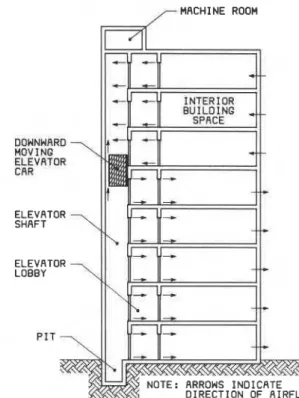
A downward-moving elevator car forces air out of the section of shaft below the car and into the section of shaft above the car as illustrated in Fig. 1. The law of conservation
d
MACHINE ROOMFig. 1 . Airflow due to downward movement of elevator car.
of mass can be written for the volume, Q,, above the car
Net mass flow Rate of mass change into a volume, Qa) = (within volume, Qa
where
m, = mass flow rate from outside t o volume, Qa
mba = mass flow rate from below the elevator car, Qb, t o volume, Qa
p = air density within shaft.
The volumes Qa and Qb are changing as the elevator car descends. For a downward elevator car velocity, V, and a cross-sectional area of the shaft, A,, the derivative of the volume, Q,, can be expressed as
The air density is essentially constant within the shaft. Therefore, substituting eqn.
(2) into eqn. (1) yields
Modern elevators operate at various speeds u p t o a maximum of 2000 fpm (10 ms-'). Strakosch [3] discusses elevator velocity and acceleration. In most cases an elevator will accelerate such that within a distance of one floor the car will be near or at its rated speed. Because acceleration time is relatively short and its influence on piston effect is minor if any at all, acceleration is eliminated from this analysis.
To expedite the analysis, the flow areas are chosen such that they are the same for each floor of the building and that the only vertical airflow in the building is within the elevator shaft. The mass flow rate from the outside t o Qa is
m, = NaCAe
d
m
)
(3)where
Na = number of floors above the car
C
= flow coefficientA, = effective flow area per floor between the shaft and the outside
Po = outside air pressure
Pa = shaft air pressure above the car.
Pressure difference due t o elevation (hydro- static pressure) has been eliminated from eqn. (3) because there is n o indoor-to-outdoor temperature difference. The effective flow area of a system of flow paths is the area that results in the same flow as the system when subjected t o the same pressure difference. The ASHRAE smoke control manual [4] presents a detailed discussion of effective flow areas.
For the space below the car, the mass flow rate from Qb t o the outside is
where
Nb = number of floors below the car
Pb = shaft air pressure below the car.
Because the absolute pressure in the shaft is nearly constant, the flow rate entering the shaft can be considered equal t o the flow rate of mass leaving the shaft. Thus, equating the right-hand sides of eqns. (3) and (4), cancel- ling like terms and rearranging yields
The pressure drop from the bottom t o the top of a moving elevator car is accounted for
by disturbances in the flow caused by ob- structions such as the car edges and protru- sions from the car and by friction. Again, neglecting hydrostatic pressure difference, the mass flow rate from below the car t o above it can be expressed as
m j 2 b a = Af Cc J ~ P ( P ~ -Pa) (6)
where
Af = free flow area in the shaft around the car or cross-sectional area of the shaft less the cross-sectional area of the car
C, = flow coefficient for flow around the car. To evaluate the flow coefficient, C,, tests were run on a twelve-story, two-car elevator shaft at the NBS administration building. A discussion of these tests is provided in the Appendix. For one car traveling in the two- car shaft the flow coefficient was 0.94, and for two cars traveling side-by-side together the flow coefficient was 0.83. The case with the two cars moving together was tested t o obtain an approximation of a car moving in a single car shaft.
Combining eqns. ( l a ) , (3), (5) and (6) yields
Aio = leakage area between the building and the outside.
For paths in series the pressure difference across one of the paths equals the pressure difference across the system times the square of the ratio of effective area of the system t o the flow area of the path in question. Thus, for flows above the elevator car, the pressure difference, APE, between the lobby and the building is
0
,
= (Po -Pa)(AeIAd2 (9)Substituting eqn. (7) into this yields
This relation expresses the pressure differ- ence,
APE,
produced above a downward- moving car as a function of the car velocity, the building flow paths and the position of the car.PISTON EFFECT EXPERIMENT
p - p = - o a ASV
NaCAe + C , A ~
dl
+ (N,/Nb)2 To test this calculation, experiments were conducted on an elevator in a hotel inFor the flow paths illustrated in Fig. 1 , the effective flow area per floor of the three paths in series from the shaft to the outside is
1
A , =
-
+
- + -
[A: A; A& whereAd = leakage area between the shaft and the elevator lobby
Ali = leakage area between the elevator lobby and the building
Toronto, Ontario, Canada. The elevator shaft was 1 5 stories tall with a height between floors of 8.53 ft (2.60 m). The flow areas and car velocity are listed in Table 1. Flow areas
Ad, AE, and Aio were determined by pres- surization tests. The areas A, and Af were evaluated by the same method as was used in the Appendix. The car velocity was based on the heights between floors. The effects of wind, buoyancy, stack effect and the HVAC system were not significant during these tests. The techniques of the experiments are those that have been used for many pressurization tests conducted by the NRCC [ 5
-
81. TABLE 1Experimentally determined data for.an elevator in a hotel in Toronto, Ontario, Canada
A,,, area between shaft and lobby 1.41 ft2 0.131 m 2
Ali, area between lobby and building 0.97 ft2 0.0901 m 2
Aio, area between building and outside 4.85 ft2 0.450 m 2
A,, cross-sectional area of shaft 59.37 ft2 5.515 m 2
A f , free area of shaft 20.96 f t 2 1.947 m 2
CALCULATED A P I i A /
-
0 5 1 0 15 2 0 2 5
T I M E ( s e c )
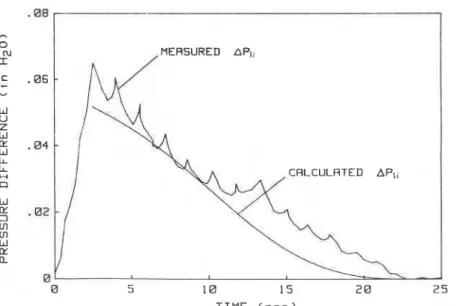
Fig. 2. Pressure difference, Uli, across the elevator lobby of a Toronto hotel due t o piston effect. Conversion factor: 1 in H 2 0 = 248.8 Pa.
The measured pressure difference, APE, for the elevator car descending from the top floor is shown on Fig. 2. The pressure difference was measured at the floor level of the top floor, and the pressure peak occurs as the top of the car passes the differential pressure transducer. With the exception of some pulsations the APli decreases as the car descends. Also Fig. 2 shows AP, calculated from eqn. (10) using the measured data from Table 1. The calculations are in good agree- ment with the measurements. The measured pulsations are believed t o be the result of effective change in shaft size as the car passes the housing for the automatic doors.
MAXIMUM VALUE OF
Examination of eqn. (10) shows that APli cannot exceed the limits of
where the subscript u denotes the upper limit. This relation assumes that the elevator piston effect is the only driving force of air movement in the building and that vertical flow can only exist in the elevator shaft. This relation is for elevator shafts which are un- vented or for which the vents are closed. Equation (11) was derived for a pressure
difference APli, on floors above the car for a descending car, however it is also valid for floors below an ascending car. Equation (11) can be used t o estimate the magnitude of pressure difference across the elevator lobby
due to piston effect.
The pressure difference, (APli)u, is strongly
dependent upon V, A, and
Af.
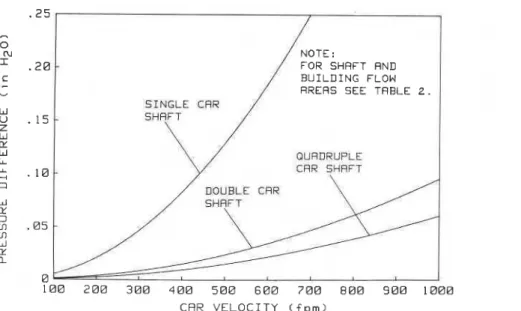
For example,Fig. 3 shows the calculated relationship between (APli)u and V due t o one car moving in a single car shaft, a double car shaft and a quadruple car shaft based on the flow areas listed in Table 2. These flow areas are based
on the measured values of As from the tests in
the NBS administration building reported in the Appendix and average values from Ap- pendix C of the ASHRAE smoke control manual for a building with a floor size of
46.0 ft X 222 f t (14.0 m X 67.7 m) and 10.17
ft (3.099 m) between floors. Leakage values for walls and floors listed in the ASHRAE smoke control manual are based on measure- ments by the National Research Council of Canada [ 5
-
81.As expected the (APli), is much greater in the case of the single shaft. It seems a safe recommelrdation that single car shafts should not be used for fire evacuation except when car velocities are very low. Freight elevators are of concern because they are often in single car shafts. In the above example, the same shaft dimensions were used for all the car velocities for the purpose of comparison.
NOTE :
/
/
FOR SHRFT RND B U I L D I N G FLOW RRERS SEE TABLE 2 . SINGLE CRR/
QUADRUPLE . 1 0-
ERR SHRFT DOUBLE CRR .05-
0 100 200 300 400 500 600 700 800 900 1000 CRR VELOCITY ( f p m )Fig. 3. Example pressure differences from building t o elevator lobby due t o piston effect. Conversion factors: 1 in H 2 0 = 248.8 Pa; 1 fpm = 0.00508 ms-I.
TABLE 2
Flow areas for elevator piston-effect analysis*
A d , area between shaft and lobby
Ali, area between lobby and building
Ai,, area between building and outside For single car shaft
A,, cross-sectional area of shaft
A f , free flow area around car For double car shaft
A,, cross-sectional area of shaft
A f , free flow area around car For quadruple car shaft
A,, cross-sectional area of shaft
A f , free flow area around car
- -
-*For a single car shaft a value of C , = 0.83 was used. For double and quadruple car shafts a value of C , = 0.94, was used.
Minimum shaft dimensions for electric, Toronto hotel experiment. Piston effect is hydraulic, hospital and observation elevators not a concern for slow-moving elevator cars are listed by the National Elevator Industry, in multiple car shafts. However, for fast cars Incorporated [9]. An analysis of piston- in single car shafts, the piston effect can be effect-induced pressure differences during considerable. Equation (11) can be used t o elevator shaft pressurization is planned for evaluate the magnitude of pressure differences a future paper. produced by piston effect for specific applica-
tions.
CONCLUSIONS
LIST O F SYMBOLS
The piston effect analysis was in very good A area
TABLE A1
Data and results from car flow coefficient tests
Shaft temperature 76 "F 24 "C Tests with 1 car moving
As 120.8 f t 2 11.22 m 2
A f 79.8 f t 2 7.41 m 2
Pb - P a at V = 496 fpm ( 2 . 5 2 m/s) 0.039 in H 2 0 9.8 Pa
Pb - P a a t V = 330 fpm (1.68 m/s) 0.016 in H 2 0 4 . 0 Pa
c c 0 . 9 4 0.94
Tests with 2 cars moving together
A s 120.8 f t 2 11.22 m 2
A f 38.8 f t 2 3.60 m 2
Pb - Pa at V = 496 fpm (2.52 m/s) 0.21 in H 2 0 53 Pa
Pb - P a a t V = 330 fpm (1.68 mls) 0.076 in H 2 0 19 Pa
c c 0.83 0.83
Table A l . Tests were performed with both concern in regard t o piston effect. However,
cars moving together. This was done in an the flow coefficients calculated at the lower
attempt t o simulate the effect of a single car speed differ only by 4% for a single car
moving in a single car shaft. moving and by 10% for two cars moving
The flow coefficients listed in Table A1 together. This tends t o support the treatment
were calculated from the greater car speed in the paper of the flow coefficient as being
T h i s p a p e r i s being d i s t r i b u t e d i n r e p r i n t form by t h e I n s t i t u t e f o r Research i n C o n s t r u c t i o n . A l i s t of b u i l d i n g p r a c t i c e and r e s e a r c h p u b l i c a t i o n s a v a i l a b l e from t h e I n s t i t u t e may be o b t a i n e d by w r i t i n g t o t h e P u b l i c a t i o n s S e c t i o n , I n s t i t u t e f o r R e s e a r c h i n C o n s t r u c t i o n , N a t i o n a l Research C o u n c i l of C a n a d a , O t t a w a , O n t a r i o , KIA 0R6.
Ce document e s t d i s t r i b u B sous forme de ti&-3-part p a r l ' l n s t i t u t de r e c h e r c h e e n c o n s t r u c t i o n . O n p e u t o b t e n i r une l i s t e d e s p u b l i c a t i o n s de 1 ' I n s t i t u t p o r t a n t s u r l e s t e c h n i q u e s ou l e s r e c h e r c h e s en matisre d e b a t i m e n t e n B c r i v a n t 3 l a S e c t i o n d e s p u b l i c a t i o n s , I n s t i t u t de r e c h e r c h e en c o n s t r u c t i o n , C o n s e i l n a t i o n a l d e r e c h e r c h e s du Canada, Ottawa ( O n t a r i o ) , KIA OR6.