HAL Id: hal-01583068
https://hal.archives-ouvertes.fr/hal-01583068
Submitted on 6 Sep 2017
HAL is a multi-disciplinary open access
archive for the deposit and dissemination of
sci-entific research documents, whether they are
pub-lished or not. The documents may come from
teaching and research institutions in France or
abroad, or from public or private research centers.
L’archive ouverte pluridisciplinaire HAL, est
destinée au dépôt et à la diffusion de documents
scientifiques de niveau recherche, publiés ou non,
émanant des établissements d’enseignement et de
recherche français ou étrangers, des laboratoires
publics ou privés.
A Mouth Opening Effect Based on Pole Modification for
Expressive Singing Voice Transformation
Luc Ardaillon, Axel Roebel
To cite this version:
Luc Ardaillon, Axel Roebel. A Mouth Opening Effect Based on Pole Modification for Expressive
Singing Voice Transformation. Interspeech 2017, Aug 2017, Stockholm, Sweden. pp.1288 - 1292,
�10.21437/Interspeech.2017-1453�. �hal-01583068�
A mouth opening effect based on pole modification for expressive singing voice
transformation
Luc Ardaillon, Axel Roebel
IRCAM - UMR STMS (IRCAM - CNRS - Sorbonne Universits) Paris, France
[email protected], [email protected]
Abstract
Improving expressiveness in singing voice synthesis systems re-quires to perform realistic timbre transformations, e.g. for vary-ing voice intensity. In order to svary-ing louder, svary-ingers tend to open their mouth more widely, which changes the vocal tract’s shape and resonances. This study shows, by means of signal analysis and simulations, that the main effect of mouth opening is an in-crease of the 1stformant’s frequency (F1) and a decrease of its
bandwidth (BW1). From these observations, we then propose
a rule for producing a mouth opening effect, by modifying F1
and BW1, and an approach to apply this effect on real voice
sounds. This approach is based on pole modification, by chang-ing the AR coefficients of an estimated all-pole model of the spectral envelope. Finally, listening tests have been conducted to evaluate the effectiveness of the proposed effect.
Index Terms: mouth opening, intensity, speech transformation, singing synthesis, spectral modelling
1. Introduction
If singing voice synthesis systems have nowadays reached a rather satisfying quality, generated voices still lack of expres-siveness compared to real singers. One of the major current challenges to improve expressiveness in such systems is to al-low for realistic voice timbre changes for varying pitch, inten-sity, and voice quality. For statistical-based and concatenative approaches, all those timbre variations should ideally be in-cluded in the system’s database in order to be reproduced ac-curately. However, due to the very wide variety of timbres and parameters to be considered, this task is hardly achievable. It is therefore necessary to design perceptually relevant rules and al-gorithms to allow realistic and flexible timbre transformations.
Past studies have already permitted to gather knowledge about how various voice spectral features may change during singing, which could be exploited in synthesis systems by defin-ing a set of rules, as proposed in [1] with formant tundefin-ing for pitch change. But if such rules are easy to implement in formant synthesizers like [2], where all source and formants’ parameters can be explicitly controlled, this task is much more complicated for systems based on signal transformations like [3] and [4].
Our current research is focused on producing vocal inten-sity variations in the context of concatenative singing voice synthesis. For this purpose, various aspects have to be con-sidered. As pointed out in several sources [5, 6, 7], a vocal effort increase is physiologically linked to an increase in sub-glottal pressure, an increase in vocal-fold tension, and a wider mouth opening. From the view point of the source-filter model, the well-known effect of increasing the vocal folds’ tension on the source’s spectrum is an increase of the glottal formant fre-quency and a decrease of the spectral tilt, while the main effect
Work supported by the ANR project ChaNTeR (ANR-13-CORD-011)
related to a wider mouth opening is an increase of the 1st for-mant frequency (F1), as observed in many studies [5, 6, 7, 8, 9].
Additional aspects to be considered may be the level of aspira-tion noise, or the singing formant’s prominency [10]. For a fully realistic effect, all those aspects should ideally be considered.
A first possible approach to create such transformations of vocal intensity is spectral morphing, that uses target templates recorded at different levels of low and high vocal effort, as pro-posed in [11, 12] and [13] for diphone speech synthesis. We also explored the potential of such a morphing approach for singing in a previous study [14]. The advantage of this method is that it includes both the effects on the source and the vocal tract. However, the target envelopes are taken from stable parts of phonemes only and thus don’t allow to correctly reproduce the timbre variations occurring on coarticulation parts, which may create unnatural transitions at vowels’ boundaries. Moreover, recordings at different vocal intensities are not always available. It thus seems pertinent to use a parametric approach to produce such effect without the requirement of additional recordings.
In that direction, [15] and [16] focus on the source-related spectral characteristics, filtering in the spectral domain to mod-ify spectral tilt and glottal formant. The perceived tenseness of the source can also be modified by changing the Rd
parame-ter of the transformed LF model [17] in parametric voice re-synthesis, as done in [18]. However, modifying only the source spectrum is not sufficient for producing a convincing effect, and the Vocal Tract Filter (VTF) should also change accordingly.
[5] proposes a mean to add missing high-frequencies har-monics in the spectrum for weak-to-loud transformations, and compares morphing and spectral modelling approaches for modifying the spectral tilt and F1, thus including an effect of
the VTF. In [19], authors also employ a spectral modelling ap-proach to apply intensity transformations of singing voice, us-ing a parametric model of spectral envelope based on 4-pole resonators to modify gain, spectral tilt, and formants’ frequen-cies and bandwidths, based on regressions computed from 60 recorded vowels. However, it requires to properly extract the parameters of all formants, which is not straightforward with-out manual correction. Another drawback in [19] is that the regressions are computed from all vowels, without considering the gender of the singer or the type of vowel. This probably oversmoothes the variations and doesn’t allow to observe the typical move of F1, as mouth opening can’t physiologically be as prominent for closed vowels like /u/ than for open vowels like /a/.
Thus, it would be advantageous to decompose the effect of intensity variations in several physiologically meaningful com-ponents that can then be adapted to the context of vowel, gender, or singing style. This work presents a first step towards a com-plete parametric vocal intensity transformation, focusing on ef-fects induced by mouth opening. First, real signals analysis and simulations allowed us to get more insight on the variation of
F1 and BW1with intensity and mouth opening, and to
quan-tify it to infer a simple rule to be used for synthesis. Then, an approach based on pole modification from an all-pole envelope model is proposed in order to apply this rule on real sounds. Finally, an evaluation has been conducted to validate the effec-tiveness of the proposed rule and approach.
2. Real signals analysis
As a starting point for our study, we analyzed spectral envelopes on the 15 French vowels recorded by a professional male singer, sustained on 1 pitch (135Hz) and 5 levels of intensity, from
pi-anissimo (pp) to fortissimo (ff ). In order to observe the change in the vocal tract’s resonances, we employed the following pro-cedure for estimating the VTF:
• First, the DAP algorithm [20] with order 50 was used to estimate an all-pole model of the spectral envelope; • Then, the Rdparameter of LF source model was
esti-mated based on algorithm described in [21, 22], and the contribution of the source was removed by spectral divi-sion of the DAP envelope with the spectral shape associ-ated with the estimassoci-ated Rdvalue.
Informal observations of these analysis confirmed an in-crease of F1 with intensity in many cases, especially for open
vowels like /a/, and sometimes a decrease of BW1. However,
these observations present an important variability, depending on the vowel, but also maybe related to some limitations of the analysis algorithms, or to the consistency of the recordings across the various intensity levels. This variability makes it dif-ficult to infer a precise rule to be used in a synthesis system, based on those observations only. For this purpose, we thus em-ployed a simulation approach, as described in the next section.
3. Simulations
As seen in sections 1 and 2, it is rather clear that F1 should
increase with mouth opening. But it is not clear to what ex-tent, and most studies don’t evoke a possible change of BW1.
Another possible approach to make assumptions on the voice characteristics behaviours is to use simulations.
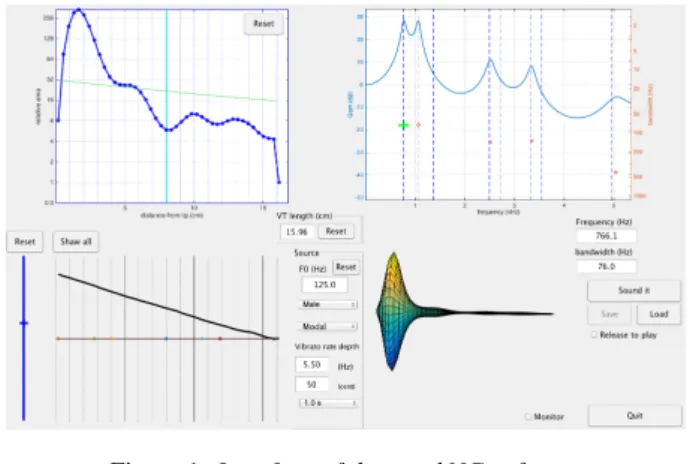
As explained in [23, 24], there is a direct equivalence be-tween the simple acoustic tube model of the vocal tract and linear prediction. We can thus use this relation to estimate a Vocal Tract Shape (VTS) from an all-pole model, modify this VTS to simulate mouth opening, and convert it back to the all-pole model to observe the effect on formants parameters. For this purpose, reflection coefficients can be computed from the AR coefficients using the step-down procedure (and conversely the step-up procedure to recover back AR coefficients), and the area ratios of the acoustic tube model (and from there the vocal tract area function) are deduced from the reflection coefficients, as explained in [24]. In the following experiment, we used the open-source sparkNG software [25, 26], that implements those procedures to convert back and forth between the VTS and its equivalent all-pole model, while providing a convenient GUI to manipulate, display, and store both.
3.1. Simulation procedure
Figure 1 shows the interface of the software. In the top left panel, the VTS is displayed from the lips to the glottis as areas of the acoustic tube model; the top right panel shows the corre-sponding all-pole spectral envelope model. The frequency and bandwidth of the formants can be displayed just below the plot.
Figure 1: Interface of the sparkNG software
0 2 4 6 8 10 12 14 16 distance to lips (cm)
10
010
110
2 log areapp
mf
ff
Figure 2: Estimated VTS for vowel /a/ at intensities pp, mf, ff The bottom left panel allows to draw a modification curve to be added to the original VTS, and the all-pole model is automati-cally re-computed. The slider on the left allows to set the degree of this modification. A button also allows to synthesize the cor-responding sound, giving an idea of the perceptual effects.
Based on the analysis exposed in section 2, we used the es-timated all-pole models to get the corresponding VTS. Figure 2 shows as an example the estimated VTS for the vowel /a/ sung at 3 different intensity levels (pp, mf and ff ). As could be ex-pected, it clearly exhibits an increasing mouth opening from pp to ff. Similar results can be obtained for other open vowels, but not for closed vowels like /u/.
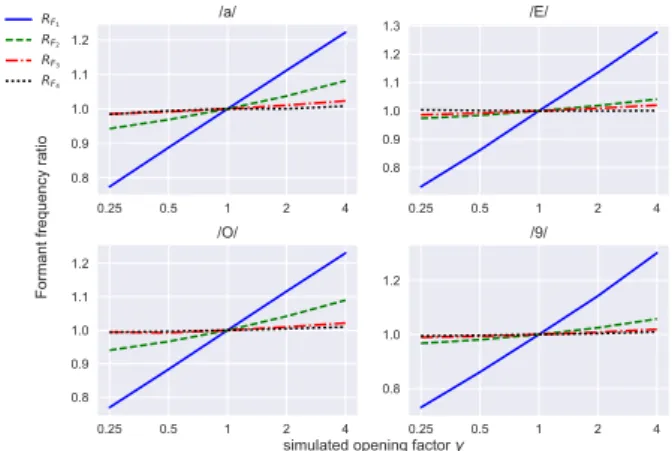
For the rest of our experiment, we thus only used the 4 most open vowels: /a/, /E/, /9/ and /O/ (in SAMPA notation). As a first approximation of the VTS change induced by mouth open-ing, we used a linear slope from the glottis to the lips, as shown in figure 1, and applied it to the estimated VTS of the 4 vow-els sung at medium intensity level (mf ). By scaling this shape modification curve using the slider, such that the opening at the lips was multiplied by factor γ ∈ [0.25, 0.5, 1., 2, 4] (on a lin-ear scale), we could then measure the variations of the formants parameters induced according to the degree of mouth opening. 3.2. Results
Figure 3 shows the ratios of the estimated formants frequencies (RFi) after modification of the shape over the original values,
for the 4 vowels (with γ displayed on a log scale). Similarly, figure 4 shows the ratios for the estimated bandwidths (RBWi).
As one can see, the main effect of the simulated mouth opening is a linear increase of F1and linear decrease for BW1
(accord-ing to log(γ)), similarly for the 4 vowels. Comparatively, the effect on the 3 other formants is negligible. Again, this increase of F1 is coherent with previous studies and observations, but
0.25 0.5 1 2 4 0.8 0.9 1.0 1.1 1.2 /a/ 0.25 0.5 1 2 4 0.8 0.9 1.0 1.1 1.2 1.3 /E/ 0.25 0.5 1 2 4 0.8 0.9 1.0 1.1 1.2 /O/ 0.25 0.5 1 2 4 0.8 1.0 1.2 /9/
simulated opening factor
Formant frequency ratio
RF1 RF2 RF3 RF4
Figure 3: Ratios of new and original formants frequencies as a function ofγ (in log scale) for vowels /a/, /E/, /O/ and /9/
0.25 0.5 1 2 4 0.6 0.8 1.0 1.2 1.4 /a/ 0.25 0.5 1 2 4 0.8 1.0 1.2 /E/ 0.25 0.5 1 2 4 0.6 0.8 1.0 1.2 1.4 /O/ 0.25 0.5 1 2 4 0.8 1.0 1.2 1.4 /9/
simulated opening factor
Formant bandwidth ratio
RBW1 RBW2 RBW3 RBW4
Figure 4: Ratios of new and original formants bandwidths as a function ofγ (in log scale) for vowels /a/, /E/, /O/ and /9/ such a change in bandwidth is rarely reported in the literature. However, a decrease of all formants bandwidths with intensity was reported in [19], and [27] also evokes an increase of the 1st formant bandwidth in soft breathy voices, which is thus coher-ent with the results of the prescoher-ent simulation.
4. Mouth opening effect
4.1. Rule for formant’s modification
From these simulations, a simple rule has been inferred, based on the mean slope for F1and BW1over the 4 simulated vowels.
This rule is given by the following 2 equations:
F1new = F1· (1 + 0.25α) (1)
BW1new = BW1· (1 − 0.4α) (2)
where α ∈ [−1; 1] is the opening factor, and F1new and
BW1new are the new values of F1and BW1to be applied for
transforming the original sound. The gain of the formant was not included in this rule, as it is not independent from its band-width and from interaction with other close formants.
4.2. Proposed transformation approach
In order to apply the defined rule, the spectral envelope has to be modified appropriately to include the change in F1 and
0 500 1000 1500 2000 2500 3000 3500 4000 Hz 70 60 50 40 30 20 dB = 1 = 0 = 1
Figure 5: Transformation of vowel /a/ with α ∈ [−1, 0, 1] BW1. In [28], frequency warping is used in order to
trans-form the spectral envelope to create natural pitch changes in singing voice. However, it is not easy to precisely change the formants parameters using frequency warping. Especially, the natural increase of amplitude when bandwidth decreases is not reproduced, and formants can’t be merged together when get-ting closer as they should.
Another possible approach that we propose to use here is pole modification, based on an all-pole model of spectral envelope. This possibility is mentioned in [29], but has been discarded for being too complicated. A similar approach was used in [30] and [31] to modify formants, focusing on controlling pole interaction. These works are also mentioned in [32], but author evokes as a limit that the amplitude and bandwidth of the formants can’t be controlled independently. However, we assume that this is not necessary, as amplitude should naturally change when bandwidth is modified, as stated in [27]. The proposed method is described below.
An all-pole model can be defined by its transfer function: H(z) = G 1 + P P k=1 akz−k (3)
where the ak are the AR coefficients of the model, P is the
model order, and G is a fixed gain coefficient. With such a representation, assuming the model is estimated with an appro-priate order, the most important formants of the voice should be associated with a conjugate poles pair.
From the AR coefficients, the roots riof the polynomial
can be computed. Then, the frequencies and -3dB bandwidths of the poles, in Hz, are given by the following formulas [32]:
Fi= fs 2π∠ri (4) BWi= − fs πln(|ri|) (5) Once the frequency and bandwidth of each pole are known, the values corresponding to the 1stformant can be selected and modified according to equations 1 and 2. From there, functions defined in equations 4 and 5 can be inverted in order to get the new roots of the model. Finally, these modified roots are con-verted back to the AR coefficients of the new transfer function, using Leja ordering to limit effects of rounding errors in com-putation [33]. Figure 5 shows an example of using this pole modification approach to apply the given rule on a spectral en-velope of the vowel /a/, for α ∈ [−1, 0, 1].
The transformation is then applied by inverse filtering the original sound by the estimated spectral envelope, and filtering it back with the newly modified envelope.
5. Evaluation
In order to evaluate the proposed transformation, 2 online lis-tening tests have been run for evaluating both the quality of the transformed sounds in term of naturalness, and the proper per-ception of the degree of mouth opening produced by the effect. A demo page with the sounds used in the tests can be found at url [34]. All sounds were normalized at the same level, and listeners had to use headphones or earphones to do the tests. 5.1. Original sounds
For the 2 tests, recordings of the vowels /a/, /E/, /9/ and /O/, sung by both a male and a female professional singer, at a fixed pitch (135Hz for the male voice, and 250Hz for the female one) and a medium intensity (mf ), were selected. On each of these sounds, the transformation was applied with α ∈ [−1; −0.5; 0; 0.5; 1], 0 meaning no transformation. A total of 40 sounds (8 original sounds × 5 α values) were thus used in the tests.
5.2. AR model estimation
For the transformations, the spectral envelope was first analyzed for each sound, using an implementation of the DAP algorithm [20] in the SuperVP software [35]. An important parameter to be considered for analysis is the order of the model. From the results of [36, 37] and informal tests on our database, we used an order of 50 which seemed appropriate in our case.
5.3. Estimation of the 1stformant
Ideally, the pair of conjugate poles with the lowest absolute fre-quency should correspond to the 1stformant, but depending on the analysis, this may not always be the case. For a more robust estimation of the 1stformant, we thus imposed as a constraint
that F1 ∈ [350 − 1000]Hz. However, this ranges could
po-tentially be adapted according to the analyzed voice and vowel. Then, the pair of conjugate poles with the lowest frequency fol-lowing this constraints is selected.
5.4. Stable frames selection
For transforming a sound, the pole modification has to be ap-plied on each frame. Neighbouring frames should have similar formants and therefore pole parameters. However, the analy-sis may sometimes exhibit some jumps in the estimated poles’ frequencies from one frame to another, which could create arti-facts. To avoid this, the median value of the F1over the central
stable part of the vowel is computed. Then, only the 25% of the frames for which the estimated F1are the closest to the median
are kept. The other frames are discarded and the remaining ones are interpolated after transformation, in order to fill the gaps. 5.5. Test 1: Quality of the transformation
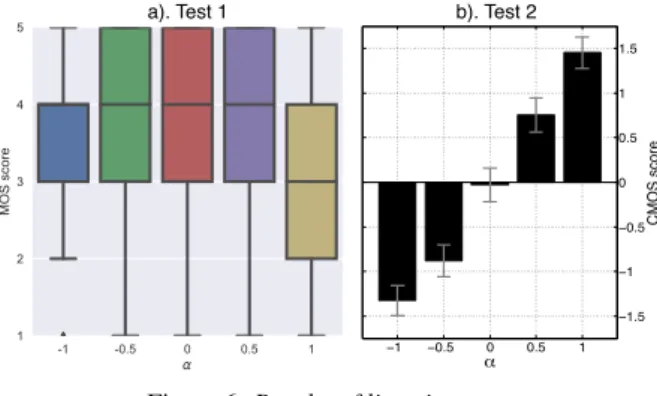
In the first test, 15 of the 40 sounds where randomly selected and presented in random order, with no repetition. The sounds then had to be rated on a 1 to 5 scale by listeners following a standard MOS test procedure [38], according to the perceived naturalness of the sounds.
48 listeners answered this test. Figure 6 shows the results for the different α values. As one can see, the answers highly overlap and span the whole [1-5] range for all sounds categories, with no difference between α values -0.5, 0, and 0.5. The mean rating is however a bit lower for higher transformations levels -1 and 1. The results were slightly better for the male voice. As a result, we can thus assume that the proposed approach can apply the transformation appropriately without important degradation of the naturalness and sound quality.
−1 −0.5 0 0.5 1 −1.5 −1 −0.5 0 0.5 1 1.5 CMOS score α
a). Test 1 b). Test 2
Figure 6: Results of listening tests 5.6. Test 2: Perception of transformed mouth opening The second test presented 15 pairs of sounds to the listener. For each pair, one voice (male or female) and one vowel where first randomly selected, and 2 different sounds were randomly cho-sen among the 5 possible transformation levels to form the pair. Then, for each pair, a grade from 0 to 3 had to be given accord-ing to which sound seemed to be related to a more widely open mouth and how big was the perceived difference between the 2 sounds, following a standard CMOS procedure [39].
Before starting the test, listeners were given, as a reference, sounds of a vowel /a/ recorded with 5 degrees of mouth opening (from maximally closed to maximally open), in order to give an idea of the expected perceptual effect. Also, as the transforma-tion may sometimes change the perceptransforma-tion of the vowel identity (an /a/ pronounced with a closed mouth may sound almost like an /o/ or /2/), the vowel was given above each pair of sounds. 36 persons answered this test. As one can see on figure 6, those results perfectly reflect the expected effect of the transforma-tion. None of the confidence intervals overlap, which means that the difference between each degree of the applied effect is clearly perceived by listeners, and the results were very simi-lar for both voices. As a result, one can assume that the pro-posed rule and transformation method are effective for simulat-ing mouth opensimulat-ing.
6. Conclusions
From signal analysis and simulations, we proposed a rule for modifying the frequency and bandwidth of the 1stformant in order to produce a mouth opening effect. An approach to ap-ply it on real sounds was proposed, using pole modification based on an all-pole model of the spectral envelope. 2 listen-ing tests were conducted in order to validate the effectiveness of the transformation in terms of naturalness of the transformed sounds and of perception of the degree of mouth opening in-duced. The results of these tests revealed that the transforma-tions were perceived as expected, and that the proposed rule and method were thus very effective for simulating mouth opening on real voice sounds, with very few degradation of the natural-ness and sound quality.
In future work, this mouth opening effect should be in-cluded as part of a more general intensity transformation, ac-companying a modification of the source characteristics (glottal formant, spectral tilt, noise level, and singing formant). How-ever, it should be noted that the effect should be adapted to the nature of the transformed vowel, as the degree of mouth open-ing is physiologically limited for some closed vowels like /i/ or /u/.
The same approach could also be used for applying other rules, such as proposed in [1] or [29] for tuning formants fre-quencies to the f0for more realistic pitch transformations.
7. References
[1] N. Henrich, J. Smith, and J. Wolfe, “Vocal tract resonances in singing : Strategies used by sopranos , altos , tenors , and bari-tones,” 2010.
[2] L. Feug`ere, C. D’Alessandro, B. Doval, and O. Perrotin, “Cantor Digitalis: chironomic parametric synthesis of singing,” EURASIP Journal on Audio, Speech, and Music Processing, vol. 2017, no. 1, p. 2, 2017.
[3] H. Kenmochi and H. Ohshita, “VOCALOID Commercial singing synthesizer based on sample concatenation,” no. August, pp. 3–4, 2007.
[4] L. Ardaillon, G. Degottex, and A. Roebel, “A multi-layer F0 model for singing voice synthesis using a B-spline representation with intuitive controls,” Proceedings of the Annual Conference of the International Speech Communication Association, INTER-SPEECH, vol. 2015-Janua, no. April 2016, pp. 3375–3379, 2015. [5] O. Perrotin and C. D’Alessandro, “Vocal effort modification for singing synthesis,” in Proceedings of the Annual Conference of the International Speech Communication Association, INTER-SPEECH, vol. 08-12-Sept, 2016, pp. 1235–1239.
[6] H. Traunm¨u Ller and A. Eriksson, “Acoustic effects of variation in vocal effort by men, women, and children,” Journal of the Acous-tical Society of America, vol. 107, no. 6, pp. 3438–3451, 2000. [7] J. S. Li´enard and C. Barras, “Fine-grain voice strength estimation
from vowel spectral cues,” in Proceedings of the Annual Confer-ence of the International Speech Communication Association, IN-TERSPEECH, no. August, 2013, pp. 128–132.
[8] J. S. Li´enard and M. G. Di Benedetto, “Effect of vocal effort on spectral properties of vowels.” The Journal of the Acoustical So-ciety of America, vol. 106, no. 1, pp. 411–22, 1999.
[9] J. E. Huber, E. T. Stathopoulos, G. M. Curione, and T. A. Ash, “Formants of children , women , and men : The effects of vocal intensity variation,” no. October 1999, 1999.
[10] J. Sundberg, “Level and center frequency of the singer’s formant,” Journal of Voice, vol. 15, no. 2, pp. 176–186, 2001.
[11] M. Schr¨oder and M. Grice, “Expressing vocal effort in concatena-tive synthesis,” 2003, pp. 2589–2592.
[12] O. Turk, M. Schroder, B. Bozkurt, and L. M. Arslan, “Voice Qual-ity Interpolation for Emotional Text-To-Speech Synthesis,” no. 2, 2005.
[13] C. Defez, J. C. Socor, and R. A. J. Clark, “Parametric model for vocal effort interpolation with Harmonics Plus Noise Models,” 2013, pp. 25–30.
[14] G. Degottex, L. Ardaillon, and A. Roebel, “Multi-Frame Am-plitude Envelope Estimation for Modification of Singing Voice,” IEEE/ACM Transactions on Audio Speech and Language Process-ing, vol. 24, no. 7, pp. 1242–1254, 2016.
[15] C. Alessandro and B. Doval, “Voice quality modification for emo-tional speech synthesis.” no. January 2003, 2003.
[16] C. Alessandro, B. Doval, and O. Cedex, “Experiments in voice quality modification of natural speech signals : The spectral ap-proach,” 1998.
[17] G. Fant, “The LF-model revisited . Transformations and fre-quency domain analysis,” 1995.
[18] S. Huber, “Voice Conversion by modelling and transformation of extended voice characteristics,” Ph.D. dissertation, 2015. [19] E. Molina, I. Barbancho, A. M. Barbancho, and L. J. Tard,
“Para-metric model of spectral envelope to synthesize realistic intensity variations in singing voice,” pp. 634–638, 2014.
[20] A. El-Jaroudi and J. Makhoul, “Discrete All-Pole Modeling,” IEEE transactions on signal processing, vol. 39, 1991.
[21] G. Degottex, A. Roebel, and X. Rodet, “Phase Minimization for Glottal Model Estimation,” IEEE Trans. Audio, Speech, and Lan-guage Processing, vol. 19, no. 5, pp. 1080–1090, 2011.
[22] S. Huber and A. Roebel, “On the use of voice descriptors for glottal source shape parameter estimation,” Computer Speech and Language, vol. 28, no. 5, pp. 1170–1194, 2014.
[23] H. Wakita, “Direct Estimation of the Vocal Tract Shape by Inverse Filtering of Acoustic Speech Waveforms,” IEEE Transactions on Audio and Electroacoustics, vol. 21, no. 5, pp. 417–427, 1973. [24] J. D. Markel and A. H. J. Gray, Linear prediction of speech.
Springer Science & Business Media, 2013, vol. 12.
[25] H. Kawahara, “SparkNG: Interactive MATLAB tools for intro-duction to speech prointro-duction, perception and processing funda-mentals and application of the aliasing-free L-F model compo-nent,” Proceedings of the Annual Conference of the International Speech Communication Association, INTERSPEECH, vol. 08-12-Sept, pp. 1180–1181, 2016.
[26] “sparkNG software download page,” 2017.
[On-line]. Available: http://www.wakayama-u.ac.jp/
kawa-hara/MatlabRealtimeSpeechTools/
[27] H. Park, “Time Course of the First Formant Bandwidth,” no. 1, pp. 213–224, 2002.
[28] M. Dong, P. Chan, L. Cen, and S. W. Lee, “Spectral Transforma-tion of Singing Vowels by Dynamic Frequency Warping,” pp. 3–6, 2011.
[29] J. L. Santacruz, L. J. Tard´on, Isabel Barbancho, and A. M. Bar-bancho, “Spectral Envelope Transformation in Singing Voice for Advanced Pitch Shifting,” 2011.
[30] H. Mizuno, M. Abe, and T. Hirokawa, “Waveform-based speech synthesis approach with a formant frequency modification,” pp. 195–198, 1993.
[31] Y. Hsiao and D. Childers, “A new approach to formant estimation and modification based on pole interaction,” Signals, Systems and Computers, . . ., pp. 783–787, 1996. [Online]. Available: http://ieeexplore.ieee.org/xpls/abs all.jsp?arnumber=601162 [32] M. E. Lee, “Acoustic Models for the Analysis and Synthesis of
the Singing Voice,” Ph.D. dissertation, 2005.
[33] C. F. Pedersen, “Leja ordering LSFs for accurate estimation of predictor coefficients,” Proceedings of the Annual Conference of the International Speech Communication Association, INTER-SPEECH, pp. 2545–2548, 2011.
[34] “demo page,” 2017. [Online]. Available:
http://recherche.ircam.fr/anasyn/ardaillon/mouthOpening2017/demo.php
[35] “SuperVP software,” 2017. [Online]. Available:
http://anasynth.ircam.fr/home/english/software/SuperVP [36] F. Villavicencio, A. R¨obel, and X. Rodet, “All-pole spectral
enve-lope modelling with order selection for harmonic signals,” 2007. [37] A. R¨obel, F. Villavicencio, and X. Rodet, “On cepstral and all-pole
based spectral envelope modeling with unknown model order,” 2007.
[38] ITU-T, “Recommendation ITU-T-P.800.2 : Mean opinion score interpretation and reporting,” Tech. Rep., 2016.
[39] ITU, “BS.1284-1 General methods for the subjective assessment of sound quality,” pp. 1–13, 2003.