HAL Id: hal-01924032
https://hal-mines-albi.archives-ouvertes.fr/hal-01924032
Submitted on 15 Nov 2018
HAL is a multi-disciplinary open access
archive for the deposit and dissemination of
sci-entific research documents, whether they are
pub-lished or not. The documents may come from
teaching and research institutions in France or
abroad, or from public or private research centers.
L’archive ouverte pluridisciplinaire HAL, est
destinée au dépôt et à la diffusion de documents
scientifiques de niveau recherche, publiés ou non,
émanant des établissements d’enseignement et de
recherche français ou étrangers, des laboratoires
publics ou privés.
Applying Process Mining and RTLS for Modeling, and
Analyzing Patients’ Pathways
Sina Namaki Araghi, Franck Fontanili, Elyes Lamine, Ludovic Tancerel,
Frederick Benaben
To cite this version:
Sina Namaki Araghi, Franck Fontanili, Elyes Lamine, Ludovic Tancerel, Frederick Benaben. Applying
Process Mining and RTLS for Modeling, and Analyzing Patients’ Pathways. HEALTHINF 2018 - 11th
International Conference on Health Informatics, Jan 2018, Funchal, Madeira, Portugal. pp.540-547,
�10.5220/0006651605400547�. �hal-01924032�
Applying Process Mining and RTLS for modeling, and analyzing
patients’ pathways
Sina Namaki Araghi
1, Franck Fontanili
1, Elyes Lamine
1, Ludovic Tancerel
2, Frederick Benaben
11Industrial Engineering Center of Ecole des Mines d’Albi-Carmaux, University of Toulouse, Allée des science, Albi, France 2Maple High Tech, Toulouse, France
1{firstname.surname }@mines-albi.fr, 2 {firstname.surname}@maplehightech.com
Keywords: Business Process Management, Process Mining, Real Time Location Systems
Abstract: Purpose: This paper aims at introducing a generic approach for visualizing, analyzing and diagnosing
patients’ pathways. This approach could be categorized as a business intelligence approach to extract knowledge for decision makers in healthcare organizations. The analyses provided by this approach are based on the location data which are being recorded in the information system (IS) by indoor-Real-Time Location
Systems (RTLS). Findings: Healthcare organizations are getting more eager to learn from the execution of
their processes. They seek different tools and approaches to analyze the processes and visualize the problems. This paper presents one of the possibilities to provide more understanding of process executions and it is based on the locations of the patients inside the organization. Approach: Business intelligence approaches provide new technical and technological solutions for business analysts to improve the quality of products and services within organizations. The approach of this work helps to visualize patients’ pathways and analyze them by associating real-time localization and process mining. This approach consists of four phases in which several functionalities have been defined. These phases are Data, Information, Awareness, and Governance (DIAG). Additionally, a case study has been designed to illustrate the DIAG approach.
1 INTRODUCTION
The clinical pathways or patients’ pathways consist of several activities and different steps with the objective of receiving a service which is the health treatment. A clinical pathway is a complex intervention for the mutual decision-making and organization of care processes for a well-defined group of patients during a well-defined period (Vanhaecht et al., 2010). It is desirable to visualize these pathways as the business processes, which have the objectives and consist of different tasks and actors to reach those objectives.
Many initiatives have been introduced within the last decade to improve the management of clinical processes. The clinical pathways aim at enhancing the quality of healthcare services by improving the risk-adjusted patients’ outcomes, promoting patient safety, increasing patient satisfaction, and optimizing the use of resources. These organizational
enhancements can be only justified on the basis of a relevant diagnosis of the reality behind the processes’ executions and their management on the field. Hence, equipping decision-makers with tools and methods to facilitate and support their actions could beneficiate the organization and its clients.
This paper aims at describing a study case which illustrates a developing approach named as DIAG. This method investigates different aspects of the patients’ pathways and uses multiple sets of techniques to visualize and analyze the performance level of each pathway. DIAG has four different phases; Data, Information, Awareness, and
Governance. This paper focuses on the “information”
phase to highlight the core of this method. It describes how a proper set of location data from patients’ movements could beneficiate healthcare organizations by acquiring qualitative and quantitative analysis.
In the following, section 2 presents the features of two main tools and techniques in DIAG method. The
third section explains the DIAG through exhibiting a summary of a study case, which has been performed at a hospital in France. Finally, the last section shows the summary of the works and the perspective for the future works.
2 STATE OF THE ART
This section presents the notion of designing business process models, the functionality of indoor-RTLS and process mining.
To analyze the performance level of the operational processes, organizations are trying to move from the “data-aware” information systems to “process-aware” information systems (Aalst, 2004). This motivates organizations to use business process management approaches, which consists of modeling processes and performing quantitative analysis on top of the process models.
To discover and analyze the business processes several actions must be taken. To clarify, one should understand the “life cycle of process modeling”. In order to design business processes, different activities should be taken into consideration such as gathering information, clarification of data and designing the process flows. After acquiring such models experts should define criteria in accordance with their strategies, then a performance measurement should be defined (Looy and Shafagatova, 2016).
Currently, to gather data related to the process executions an interview-based process discovery approach is being used (Marlon Dumas, 2013.). To succeed in such approach, it necessitates to carry out a huge load of works to do the on-field observations and perform interviews with processes’ actors. Eventually, the quality of the gathered data is in doubt and it is dependent on the experience of the interviewer and the process analysts.
The evidence-based process discovery is another approach which helps to automatically perform process discovery from the information systems. However, there are several inconsistencies in the case of gathered data in the hospital information systems. For example in the case of patients’ pathways, one could extract the data from hospital information system to observe the amount of time that each patient has spent in the hospital sectors. Since people are in charge to record the patients’ data, there are lots of inaccuracies with the registered data.
This research work seeks for an efficient way of gathering accurate data for visualizing the patients’ pathways. The final results should be a process diagnosing platform which is able to visualize and analyze the activities within patients’ pathways. In addition to the process awareness, the platform could
provide an awareness of the location of each event. This platform could support the transformation of current information systems to process and location-aware information system. The approach in this research work aims at supporting this transformation of the information systems by the application of I-RTLS and process mining. In the following, these two fields (indoor localization and process mining) will be explained.
2.1 Indoor Localization Systems
The objective of these systems is to track objects inside indoor environments. Their functionality is similar to Global Positioning Systems (GPS) (Drawil et al., 2013). GPS works by using NAVSTAR satellites. The GPS functionality does not suit the indoor localization and the corresponding signals are not capable of finding an object inside buildings with accurate coordinates (x, y, z). Therefore, indoor localization technology is being used for this matter. These systems consist of two main parts. First, mobile nodes or tags which are attached to objects that need to be located. Second, sensors or readers which find the position of the tags or mobile nodes.
Multiple communication technologies are being used for indoor positioning of objects in healthcare and industry. RFID (Radio Frequency Identification), and Wireless Local Area Networks (Wi-Fi, ZigBee, Z-Wave, Bluetooth, etc.) are playing a huge role in these organizations. RFID is an electronic identification technology used for tracking goods and people (Curran et al., 2011). This technology uses radio frequency waves to transfer data between tags and readers. RFID tags function in three different states; active, semi-passive, and passive. Active tags are using an internal battery, or sometimes they are connected to an external power source. These tags offer a wide range of hundred feet or more. Passive tags do not have any energy source, and their accuracy and readability are limited (Want, 2006). On the other hand, semi-passive tags use batteries and they need an external power source to communicate with readers (Lai et al., 2005). The Readers have the role of transferring radio frequency signals to the tags and receiving them back in regulated version (Jin et al., 2008). Thanks to the semantic event processing, the system could translate the signals of the tags to the location data (Bok and Yoo, 2017).
In the context of locating objects, RFID is being used mainly in manufacturing sectors (Lu et al., 2006). In the case of healthcare organizations, RFID could not satisfy all the needs. It could identify the tagged objects which are passing nearby the different stations, but the tags should be moving through a very well structured operation. Also, RFID systems do not
necessarily display the real-time location data. The real-time information could be very useful in manufacturing and hospitals, especially in emergency situations. Consequently, in some cases, researchers have integrated RFID with WLAN to acquire real-time data (Adame et al., 2016).
The other localization systems are classified as Indoor-Real Time Localization Systems. These systems have three main parts. Tags, which are attached to the objects. These tags are active and they emit signals continuously. Sensors or beacons; these devices would receive the signals and send them to the third part of the system which is the location engine. This part would use different algorithms and techniques to calculate the exact locations of the tags. Some of these algorithms are Triangulation, Trilateration, Angle of Arrival (AOA), Time Difference of Arrival (TDOA), and Received Signal Strength Indicator (RSSI) (Luo et al., 2011). Multiple wireless local area networks have been introduced in markets for indoor-RTLS, some of them are Wi-Fi, and ZigBee which has been seen in previous works that this technology could be applicable in service sections. It has low energy consumption and multi-channel control systems, alarm systems, and lighting control (Cheng, 2009). Ultra-Wide Band (UWB), these systems have short period pulses as a result UWB is suitable for indoor positioning technologies. UWB performance seems to be better than other technologies as well as in terms of accuracy (less than 30 cm) and of course the range which is up to 200 meters within an open space. The weakness of this system is inside buildings with thick walls and full metal structures, due to the fraction and reflection of signals in those types of buildings. Bluetooth or Bluetooth Low Emission (BLE) is the other technology which is being used in similar approaches and it has a very low consumption level.
Some aspects of indoor localization have been discussed in this section. The next part will introduce process mining and highlights its association with I-RTLS in the context of healthcare.
2.2
Process
MiningIt is obvious that quality of services in hospitals could directly influence the lives of people. Thus, it is inevitable that hospitals should plan and act on the improvement of their processes. The quality of healthcare processes is highly dependent upon the way they are being executed. This idea is motivating researchers to provide healthcare organizations with new approaches such as process mining to illustrate the execution of the processes. In addition, execution of medical and non-medical processes within the healthcare organizations would result in numerous
recorded events within information systems. These data would be displayed as a log file. A log file would consist of a multiple information such as case id, timestamp start, timestamp end, details of activities, resources, and other types of information. One of the challenges for organizations is to extract meaningful information from these log files (Mans et al., 2013).
Process mining is a set of techniques and methods which are subjected to discover the business processes from event logs. Process mining consists of three main activities: (i) process discovery, (ii) conformance checking, (iii) enhancement (Aalst, 2016). By using this method information systems are capable of translating raw log files into usable sets of information. This information could be the process models, general statistical analysis of processes, bottleneck analysis, analysis of a variety of cases in event logs and etc. There are multiple advantages for organizations in applying process mining techniques. In the context of healthcare, study cases show that process mining could beneficiate directors by providing several perspectives for decision-making (Rojas et al., 2016). A control-flow perspective could show the execution of the processes. A performance perspective highlights the problems and bottlenecks while executing the processes. Currently, these analyses are basically related to analyzing the time-oriented data (Fernandez-Llatas et al., 2015). Additionally, conformance checking would help organizations to see where the deviations are in a process. The resource usage analysis is the other perspective offered by process mining (Caron et al., 2014).
Process mining techniques and algorithms are being developed in many tools. ProM (http://www.processmining.org/) , Disco (https://fluxicon.com), QPR (https://www.qpr.com) , Celonis (https://www.qpr.com) are front-runners in the market. Most of the healthcare cases are being developed by ProM (Rojas et al., 2016), which is extremely powerful in applying multiple techniques on event logs (Dongen et al., 2005). Disco is a user-friendly and powerful tool, however, it does not contain all the analyzing techniques like ProM. On the other hand, Celonis and QPR are two tools which are known and being used mainly in manufacturing industries.
Applying process mining and indoor localization systems did not receive sufficient amount of attention, however, it shows promising results in healthcare. For instance, Fernandez-Llatas et al used this idea in order to monitor the behavior of the patients in a nursing home by analyzing the pathways of the patients (Fernández-Llatas et al., 2013). In
another case, they presented an approach for applying RTLS and process mining in a hospital in Valencia which also shows intriguing outcomes in case of observing the movement of patients and to analyze the time aspect of the process execution (Fernandez-Llatas et al., 2015). In both cases, they have used PALIA ILS suits which is a web-based process mining tool to discover the process maps. PALIA stands for Parallel Activity-based Log Inference Algorithm and is able to infer workflows from activity log samples. And ILS is for Indoor Localization Systems. Also, they have introduced a methodology which supports their application. This methodology consists of several steps as ILS installation, ILS data gathering, a semantic aggrupation of areas, process filtering, process discovery, process conformance, process enhancement, and process improvement. In their methodology the difference between process enhancement and process improvement is vague. In this paper, the process improvement actions are outside the application of process mining and indoor localization systems because the resolution to improve and change a process is only feasible by decisions coming from human knowledge.
In modern businesses, due to the challenges of designing and monitoring business processes, there is a necessity of using suitable analysis techniques (Aalst, 1998). Also, it has been inferred from other works that analyzing business processes with exclusive criteria is necessary in order to classify the business processes’ attributes, identify the bottlenecks, and compare process variants (Vergidis et al., 2008). Additionally, Vergidis et al have classified process analysis into three groups of diagrammatic models, business process languages, and mathematical models. Needless to say, their approach is based on the primary analysis of processes which is the method one could use to visualize the processes.
It has been seen in the work of Zakarian in (Zakarian, 2001) that using diagrammatic process modeling techniques provide a qualitative notation on the process executions. However, these techniques suffer from the lack of tools which show the quantitative analysis and performance level of processes. Furthermore, generating business process models is impractical without diagnosis based on relevant key performance indicators. This analysis should be in line with the main objective, which is improving the performance of physical processes. Improving business processes is only feasible by understanding the features of each activity and events in the process in accordance with customer and
process owner’s perspectives. For example, a task such as recording the history of patient’s treatment could be a non-value added activity from patient’s perspective. But from the hospital’s point of view, this task should be identified as a value-added activity. As Dumas et al define in (Marlon Dumas, 2013) we could have three types of activities, value-added, non-value value-added, and business value-added activities. This research work aims at analyzing business processes based on this classification of activities. However, the question is how to discover the activities in the business processes and how to distinguish them.
3 DETAILED PROPOSAL
It has been shown that business intelligence (BI) approaches in healthcare present new solutions for business analysts within the organizations especially the healthcare sector for improving the quality of medical care and patient’s quality of life (Machado and Abelha, 2001). It could be inferred that BI approaches encompass the strategies and technologies used by enterprises to help business analysts to understand and improve the quality level of business processes (Dedić and Stanier, 2016). It’s been proven that BI tools are working efficiently with healthcare data and they are able to generate real-time information and knowledge relevant to the success of healthcare organizations. Moreover, BI approaches profit healthcare professionals in making vital decisions inside hospitals, clinics, paramedics’ circulation and management of the administrative works.
This paper aims at suggesting DIAG approach which is embracing the BI notion and tries to generate knowledge from the location data for decision makers in hospitals. DIAG stands for four levels which could transform the raw data into knowledge and awareness for healthcare experts. These levels are Data,
Information, Awareness, and Governance.
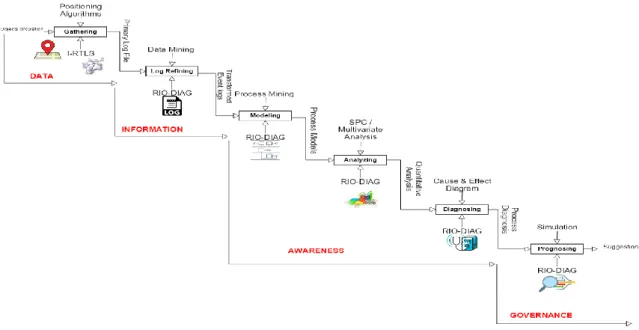
The IDEF0 model presented in figure1 gives an
overview of the DIAG approach. In the first phase, one function has been defined as gathering. This function is mainly concerned with monitoring the movements of the objects and receiving the primary data come from localization systems. As it has been explained before, these systems use the positioning algorithms to locate the tags. The log refining function executes different data mining techniques in the context of RIO-DIAG platform. This function cleans and transforms the collected data in the first function into the proper event logs which suit the process mining techniques in the following function
Figure 1. The DIAG methodology
modeling. The modeling function uses the process
discovery algorithms and illustrates the execution of a processes based on the qualitative process analysis. Fourth, in analyzing function, different techniques are being used in order to provide a quantitative analysis for users. The performance level of processes will be evaluated in this function, and one could see and comprehend the way patients are circulating in the organization to receive their treatment.
In the diagnosing function, multiple sets of techniques will be used to highlight the real cause behind the problems and weaknesses in the performance of processes. Last but not least, in the
prognosing by using queuing theory and other
simulation techniques different scenarios and improvement actions will be suggested. RIO-DIAG is the platform which is working based on these functions, and by fulfilling four different phases of DIAG approach provides opportunities to apply BI on monitoring patients’ pathways. Describing all the functionalities is out of the scope of this paper, however, modeling and analyzing, two of the main functions of this approach will be illustrated. To clarify this method a study case has been developed to show how one could visualize and analyze the patients’ pathways. In this experiment, an indoor-RTLS had been used to collect the location data. After installing the sensors and calibrating the location systems, patients received the tags. These tags communicate with sensors by UWB technology.
The transmitted signals would be calculated in the location engine by using TDOA and AOA measurement techniques. In this experiment, fourteen patients have been monitored. Each patient has a case ID based on the tag identification. In this case, there was no return of the same patient to the hospital. Twelve different activities have been identified based on the name of the zones in the hospitals. Each time a patient went inside or outside a section an event had been registered in the primary log file. The entities in the log file are related to the type of indoor-RTLS. In this experiment, the log file consists of patients’ ID, activities’ details, timestamp start, and timestamp end. Figure 2 shows a part of the event log related to the patient 171. The primary event log consists of one hundred events, and it is transformed and prepared for the modeling function. As it has been shown, the first and last events related to the case 171 have the duration of “00:00”. This indicates that these events are only instants while the process is being executed and they have been seen as a “passage” in the facility. Figure 3 shows that the longest event for the patient 171 was staying in the “Consultation Box 1” to meet with the doctor. In addition to this data, the distance of the whole pathway was two hundred and sixty-two meters. In addition, it has been shown that the patient has spent approximately 54 minutes in the facility. Ability to reach such analysis is the result of applying RTLS and acquiring the accurate data related to the processes’ executions. Now, the question is the value
classification of these activities and which share of the process duration was value-added for the patients. This knowledge of the value class of activities is being provided by the healthcare experts. Furthermore, there is a need to select the data about one specific patient’s pathway and to analyze it separately.
Figure 2. The event log for the case 171
Figure 3. The basic analysis for patient 171.
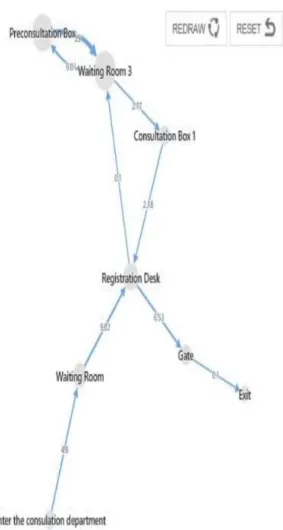
To analyze the patient’s pathways as the business processes, it would be formidable to acquire a qualitative analysis by displaying the process map and a quantitative analysis based on different aspects of the performance of the process. Thanks to process mining, figure 4 shows the process map related to the patient 171. Such process map provides a care-flow perspective on the patient’s pathways. Explanations regarding the discovery algorithms are broader than the scope of this paper since the core and possible outcomes of DIAG approach is being illustrated in this article.
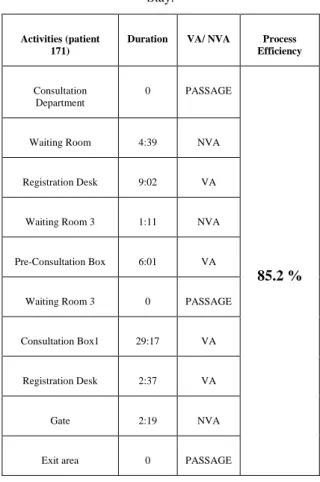
To acquire a performance perspective on process’ execution, a Critical To Quality (CTQ) (Montgomery, 2007) has been defined for this experiment as “Process Efficiency” in the hospital. A quantitative indicator has been proposed as “Length of Stay” or duration to analyze the performance level of the processes based on the CTQ. The analysis related to the indicator has been shown in table 1.
These analyses are based on the value-class of the activities and the data coming from localization systems. By looking at the process efficiency, one could observe that the 85% of the process duration was related to executing the value-added activities and close to 15% of process duration was associated with the waiting time and staying in the queue. The decision-making actions are now dependent on the knowledge of the healthcare experts to determine how they can improve the non-value added parts of the process. Although, the simulation step could be a compatible solution to see several options for enhancing the situation.
Indeed, one could infer that a logical decision could be made only by receiving the proper knowledge which is the aim of this approach. As it has been presented, this approach could support the quality of the decisions by providing the care-flow and performance perspectives on the processes.
Table 1. Process efficiency analysis based on Length of Stay.
Activities (patient 171)
Duration VA/ NVA Process
Efficiency
Consultation Department
0 PASSAGE
85.2 %
Waiting Room 4:39 NVA
Registration Desk 9:02 VA
Waiting Room 3 1:11 NVA
Pre-Consultation Box 6:01 VA
Waiting Room 3 0 PASSAGE
Consultation Box1 29:17 VA
Registration Desk 2:37 VA
Gate 2:19 NVA
Exit area 0 PASSAGE
4
CONCLUSION
This paper aimed at presenting the possibilities and advantages of applying process mining on location data to provide more awareness regarding the patients’ pathways. This paper identified the DIAG approach which uses the indoor-RTLS, process mining, and business process management techniques to visualize, analyze and diagnose the patients’ pathways. This approach embraces the hierarchy of data, information, awareness, and knowledge which extract the location data from the movements of the patients and transform these data to the knowledge. The real-time location data provide more accuracy in tracking patients’ activities in the hospitals and process mining permits to model those activities as business process models. The advantage in this approach is in providing the quantitative and qualitative analysis based on the value class of the activities in the organizations.
To illustrate the possible outcomes of this approach an experiment has been performed at a hospital in France. Additionally, an overview has been provided
for the major techniques and technologies in this approach.
To evolve this research work, the upcoming works are oriented towards refining this approach and providing the details about the rules and regulations for transforming the location data into prepared event logs for process mining tools.
REFERENCES
Aalst, W.M.P.V.D., 1998. The Application of Petri Nets to Workflow Management.
Aalst, W.M.P. van der, 2016. Process Mining: Data Science in Action. Springer.
Aalst, W.M.P. van der, 2004. Business Process Management Demystified: A Tutorial on Models, Systems and Standards for Workflow Management, in: Desel, J., Reisig, W., Rozenberg, G. (Eds.), Lectures on Concurrency and Petri Nets, Lecture Notes in Computer Science. Springer Berlin Heidelberg, pp. 1–65. Adame, T., Bel, A., Carreras, A., Melià-Seguí, J., Oliver, M., Pous,
R., n.d. CUIDATS: An RFID–WSN hybrid monitoring system for smart health care environments. Future Gener. Comput. Syst. doi:10.1016/j.future.2016.12.023 Bok, K., Yoo, J., 2017. RFID Based Indoor Positioning System Using Event Filtering. J. Electr. Eng. Technol. 12, 335– 345. doi:10.5370/JEET.2017.12.1.335
Caron, F., Vanthienen, J., Vanhaecht, K., Limbergen, E.V., De Weerdt, J., Baesens, B., 2014. Monitoring care processes in the gynecologic oncology department.
Comput. Biol. Med. 44, 88–96.
doi:10.1016/j.compbiomed.2013.10.015
Cheng, Y.M., 2009. Using ZigBee and Room-Based Location Technology to Constructing an Indoor Location-Based Service Platform, in: 2009 Fifth International Conference on Intelligent Information Hiding and Multimedia Signal Processing. Presented at the 2009 Fifth International Conference on Intelligent Information Hiding and Multimedia Signal Processing, pp. 803–806. doi:10.1109/IIH-MSP.2009.106 Curran, K., Furey, E., Lunney, T., Santos, J., Woods, D.,
McCaughey, A., 2011. An Evaluation of Indoor Location Determination Technologies. J Locat Based Serv 5, 61–78. doi:10.1080/17489725.2011.562927 Dedić, N., Stanier, C., 2016. Measuring the Success of Changes to
Existing Business Intelligence Solutions to Improve Business Intelligence Reporting, in: Research and Practical Issues of Enterprise Information Systems, Lecture Notes in Business Information Processing. Presented at the International Conference on Research and Practical Issues of Enterprise Information Systems,
Springer, Cham, pp. 225–236. doi:10.1007/978-3-319-49944-4_17
Dongen, B.F. van, Medeiros, A.K.A. de, Verbeek, H.M.W., Weijters, A.J.M.M., Aalst, W.M.P. van der, 2005. The ProM Framework: A New Era in Process Mining Tool Support, in: Applications and Theory of Petri Nets 2005. Presented at the International Conference on Application and Theory of Petri Nets, Springer, Berlin, Heidelberg, pp. 444–454. doi:10.1007/11494744_25 Drawil, N.M., Amar, H.M., Basir, O.A., 2013. GPS Localization
Accuracy Classification: A Context-Based Approach. IEEE Trans. Intell. Transp. Syst. 14, 262–273. doi:10.1109/TITS.2012.2213815
Fernández-Llatas, C., Benedi, J.-M., García-Gómez, J.M., Traver, V., 2013. Process Mining for Individualized Behavior Modeling Using Wireless Tracking in Nursing Homes. Sensors 13, 15434–15451. doi:10.3390/s131115434 Fernandez-Llatas, C., Lizondo, A., Monton, E., Benedi, J.-M.,
Traver, V., 2015. Process Mining Methodology for Health Process Tracking Using Real-Time Indoor Location Systems. Sensors 15, 29821–29840. doi:10.3390/s151229769
Fundamentals of Business Process Management | Marlon Dumas | Springer, n.d.
Fundamentals of Business Process Management | Marlon Dumas | Springer, n.d.
Jin, X., Lee, X., Kong, N., Yan, B., 2008. Efficient Complex Event Processing over RFID Data Stream, in: Seventh IEEE/ACIS International Conference on Computer and Information Science (Icis 2008). Presented at the Seventh IEEE/ACIS International Conference on Computer and Information Science (icis 2008), pp. 75– 81. doi:10.1109/ICIS.2008.60
Lai, E., Redfern, A., Wright, P., 2005. Vibration Powered Battery-Assisted Passive RFID Tag, in: Embedded and Ubiquitous Computing – EUC 2005 Workshops. Presented at the International Conference on Embedded and Ubiquitous Computing, Springer, Berlin,
Heidelberg, pp. 1058–1068.
doi:10.1007/11596042_108
Looy, A.V., Shafagatova, A., 2016. Business process performance measurement: a structured literature review of indicators, measures and metrics. SpringerPlus 5, 1797. doi:10.1186/s40064-016-3498-1
Lu, B. h., Bateman, R. j., Cheng, K., 2006. RFID enabled manufacturing: fundamentals, methodology and applications. Int. J. Agile Syst. Manag. 1, 73–92. doi:10.1504/IJASM.2006.008860
Luo, X., O’Brien, W.J., Julien, C.L., 2011. Comparative evaluation of Received Signal-Strength Index (RSSI) based indoor localization techniques for construction jobsites. Adv.
Eng. Inform., Information mining and retrieval in design 25, 355–363. doi:10.1016/j.aei.2010.09.003 Machado, J., Abelha, A., 2001. Applying Business Intelligence to
Clinical and Healthcare Organizations. IGI Global. Mans, R.S., Aalst, W.M.P. van der, Vanwersch, R.J.B., Moleman,
A.J., 2013. Process Mining in Healthcare: Data Challenges When Answering Frequently Posed Questions, in: Lenz, R., Miksch, S., Peleg, M., Reichert, M., Riaño, D., Teije, A. ten (Eds.), Process Support and Knowledge Representation in Health Care, Lecture Notes in Computer Science. Springer Berlin Heidelberg, pp. 140–153.
Miclo, R., Fontanili, F., Marquès, G., Bomert, P., Lauras, M., 2015. RTLS-based Process Mining: Towards an automatic process diagnosis in healthcare, in: 2015 IEEE International Conference on Automation Science and Engineering (CASE). Presented at the 2015 IEEE International Conference on Automation Science and Engineering (CASE), pp. 1397–1402. doi:10.1109/CoASE.2015.7294294
Montgomery, D.C., 2007. Introduction to statistical quality control. John Wiley & Sons.
Rojas, E., Munoz-Gama, J., Sepúlveda, M., Capurro, D., 2016. Process mining in healthcare: A literature review. J.
Biomed. Inform. 61, 224–236.
doi:10.1016/j.jbi.2016.04.007
Vanhaecht, K., Sermeus, W., Peers, J., Lodewijckx, C., Deneckere, S., Leigheb, F., Decramer, M., Panella, M., 2010. The impact of care pathways for exacerbation of Chronic Obstructive Pulmonary Disease: rationale and design of a cluster randomized controlled trial. Trials 11, 111. doi:10.1186/1745-6215-11-111
Vergidis, K., Tiwari, A., Majeed, B., 2008. Business Process Analysis and Optimization: Beyond Reengineering. IEEE Trans. Syst. Man Cybern. Part C Appl. Rev. 38, 69–82. doi:10.1109/TSMCC.2007.905812
Want, R., 2006. An introduction to RFID technology. IEEE
Pervasive Comput. 5, 25–33.
doi:10.1109/MPRV.2006.2
Zakarian, A., 2001. Analysis of Process Models: A Fuzzy Logic Approach. Int. J. Adv. Manuf. Technol. 17, 444–452. doi:10.1007/s001700170162