HAL Id: inria-00331231
https://hal.inria.fr/inria-00331231
Submitted on 15 Oct 2008
HAL is a multi-disciplinary open access
archive for the deposit and dissemination of
sci-entific research documents, whether they are
pub-lished or not. The documents may come from
teaching and research institutions in France or
abroad, or from public or private research centers.
L’archive ouverte pluridisciplinaire HAL, est
destinée au dépôt et à la diffusion de documents
scientifiques de niveau recherche, publiés ou non,
émanant des établissements d’enseignement et de
recherche français ou étrangers, des laboratoires
publics ou privés.
Processing in CDN
Manal El Dick, Esther Pacitti, Bettina Kemme
To cite this version:
Manal El Dick, Esther Pacitti, Bettina Kemme. Flower-CDN: A hybrid P2P overlay for Efficient Query
Processing in CDN. 12th International Conference on Extending Database Technology (EDBT), Mar
2009, Saint-Petersbourg, Russia. �inria-00331231�
a p p o r t
d e r e c h e r c h e
0249-6399 ISRN INRIA/RR--6689--FR+ENG Thème COMFlower-CDN: A hybrid P2P overlay for Efficient
Query Processing in CDN
Manal El Dick — Esther Pacitti — Bettina Kemme
N° 6689
Centre de recherche INRIA Rennes – Bretagne Atlantique
Query Processing in CDN
Manal El Dick
∗, Esther Pacitti
∗, Bettina Kemme
†Th`eme COM — Syst`emes communicants ´
Equipe-Projet Atlas
Rapport de recherche n➦ 6689 — Octobre 2008 — 27 pages
Abstract: Many websites with a large user base, e.g., websites of non-profit organizations, do not have the financial means to install large web-servers or use specialized content distribution networks such as Akamai. For those websites, we have developed Flower-CDN, a locality-aware peer-to-peer based content-distribution network in which the users that are interested in a website support the distribution of its content. The idea is that peers keep the web-pages they re-trieve and later serve them to other peers that are close to them in locality. Our architecture is a hybrid between structured and unstructured networks. When a node requests a web-page from a website for the first time, a locality-aware DHT quickly finds a peer in its neighborhood that has the web-page available. Additionally, all peers in a given region that maintain content of a particular website build an unstructured content overlay. Within a content overlay peers gossip information about their content allowing the system to maintain accurate information despite failures and churn. In our detailed performance evaluation, we compare Flower-CDN with Squirrel, which is a content distribution network that is strictly based on DHTs and not locality aware. Compared to Squirrel, Flower-CDN reduces lookup latency by a factor of 9 and the transfer distance by a factor of 2. We also show that Flower-CDN’s gossiping has low overhead and can be adjusted according to hit ratio requirements and bandwidth availability. Key-words: CDN, P2P, locality-awareness, interest-awareness, gossip, DHT
∗Atlas, INRIA/LINA-Universit´e de Nantes †McGill University, Montreal, Canada
traitement efficace de requˆ
etes dans un CDN
R´esum´e : Dans ce rapport de recherche, nous proposons Flower-CDN, un r´eseau de distribution de contenu (CDN) utilisant la technologie pair-`a-pair (P2P). Pour ´eviter de surcharger le r´eseau et les serveurs d’origine, Flower-CDN permet aux clients de contribuer `a la distribution du contenu des websites qui les int´eressent afin de profiter d’un acc`es rapide au contenu. Pour traiter effi-cacement les requˆetes des participants, Flower-CDN ´elabore une infrastructure de recherche qui repose sur un r´eseau pair-`a-pair hybride: ce r´eseau exploite les localit´es et les int´erˆets des participants et combine l’efficacit´e des DHTs `
a la robustesse des protocoles ´epid´emique face aux changements dynamiques. L’´evaluation des performances montre que Flower-CDN r´eduit consid´erablement le temps de recherche ainsi que la distance r´eseau entre les pairs demandeurs et les pairs fournisseurs du contenu demand´e.
1
Introduction
Content Distribution Networks (CDN) such as Akamai [1], are well-known tech-nologies for distributing the content of web-servers to large audiences. The main mechanism is to replicate the requested content at dedicated and widely dispersed machines. By efficiently serving clients’ queries, these technologies decrease the workload on the original web-servers, reduce bandwidth costs, and keep the client’s perceived latency low.
Unfortunately, non-profit websites (e.g., related to charities, social organiza-tions, scientific associaorganiza-tions, etc.) often cannot afford the expenses of deploying and administrating a dedicated CDN infrastructure. Nevertheless, such web-sites often attract substantial loads, either due to their international audience or by being referenced by other popular websites. Thus, their under-provisioned servers become easily overloaded with queries and may fail to maintain an ac-ceptable quality of service to their clients. In this paper, we propose to use peer-to-peer (P2P) technology to build a CDN infrastructure that aims at serving popular websites that cannot afford their own proprietary infrastructure. Peer-to-peer (P2P) technology is an attractive alternative for redistributing content at large scale with low costs, by exploiting the underutilized resources of clients. In fact, many projects have demonstrated that users are willing to contribute to websites with content they are interested in (e.g., fund-raising and editing in Wikipedia, sharing idle computer resources in SETI@home, etc.).
Any CDN has to address four main issues: response time, scalability, hit ratio and liveness. By replicating the content across the CDN, the CDN can serve many client requests leading to a high hit ratio and availability despite indi-vidual node failures. Additionally, response times are short if efficient routing algorithms find replicas close to the client. Finally, scalability is achieved by increasing the CDN size as the load increases, thus always providing a balanced network load. When designing such a CDN over a P2P infrastructure, particular challenges arise because the peers are autonomous and volunteer participants. Additionally churn rate is much higher than in dedicated CDN infrastructures. In many existing P2P solutions, the queried content is replicated on demand at requesting peers, resulting in a random replica placement spread over the P2P overlay (e.g., [18, 15]). Different from on demand replication, some ap-proaches (e.g., [13]) increase the degree of replication by replicating content among peer neighborhood and thus forcing peers to store content they may not be interested in. Independently of who stored replicas, in most existing ap-proaches [14, 13, 18, 19, 20], incoming queries are routed without considering whether the content requested in the query is available in a peer that is phys-ically close to the requestor. In contrast, traditional CDN generally consider locality-awareness to take advantage of close-by replicas as it has the potential to dramatically reduce response times [4] as well as bandwidth consumption and thus increase system scalability. Therefore, we make locality-awareness a top priority in the development of a P2P CDN.
Furthermore, the particular properties of P2P require the directory service used to locate content to be carefully distributed over participant peers because no participant peer should be subject to overload nor should the system expose a single-point of failure or bottleneck. Many existing P2P approaches do not sufficiently address this issue: they either rely on blind searches which induce heavy traffic and limit scalability (e.g., [20]), or they centralize the directory at
a single peer, in particular the web-server, which becomes quickly overloaded (e.g., [18]). In contrast, we believe that the directory service itself should be implemented in a peer to peer manner in order to face churn and failures, and to assure liveness
Considering all these issues, we propose a locality and interest aware P2P CDN, Flower-CDN, that enables any under-provisioned website to efficiently distribute its content, with the help of the non-profit community interested in its content. To handle this, Flower-CDN combines efficient DHT indexing to provide fast lookup with gossip robustness for replica distribution and self-monitoring. The basic idea is to let each peer be connected to a content overlay which represents a cluster of peers that have the same interest and reside close to each other. Peers in a content overlay keep content of a certain website. A peer posing a query can find a close-by content overlay through a special directory service, called D-ring, which implements a locality-aware DHT. Content overlays and their connection to the D-ring are maintained via low-cost gossip techniques among participant peers.
More precisely, this paper makes the following contributions:
❼ We propose a scalable P2P directory service D-ring built over a locality-aware DHT. Each directory peer of D-ring indexes the content of a specific content overlay. D-ring is based on novel locality- and interest-aware key management and routing services. It can be easily integrated into existing DHT overlays.
❼ We show how each directory peer interacts with its related content overlay and how the content overlay is managed by the use of gossiping protocols. Our gossiping mechanisms allow directory peers and participant peers to maintain accurate information despite dynamic changes and failures. ❼ We present an efficient query routing algorithm for Flower-CDN that first
seeks for some content in the content overlay related to the locality in which the query was submitted. If this search is unsuccessful, the query is forwarded to other localities or falls back to the web-server.
❼ Finally, we present a detailed performance evaluation. Our experimental results show that Flower-CDN can reduce lookup latency by a factor of 9 and the transfer distance by a factor of 2, compared to an existing P2P CDN (Squirrel [14]). Moreover, Flower-CDN incurs very acceptable overhead in terms of gossip bandwidth, which can also be tuned according to hit ratio requirements and bandwidth availability.
The rest of this paper is structured as follows. Section 2 gives an overview of Flower-CDN and defines the main terms used in the paper. Section 3 describes D-ring. It introduces its locality- and interest-aware key management, and presents routing and query routing services. Section 4 presents the details of the content overlay of Flower-CDN. Section 5 discusses how Flower-CDN is managed in the presence of churn and failures. Section 6 presents a detailed simulation-based performance analysis. Section 7 discusses related work. Finally, Section 8 concludes the paper.
2
Overview of Flower-CDN
In this section, we present a general overview of Flower-CDN, introducing the main terms and assumptions used in the remainder of the paper.
Flower-CDN is designed to support a set W of different websites each of them having its own set of web-pages and documents. Flower-CDN exploits the will-ingness of the clients of a website to cooperate in order to redistribute the content they are interested in. A website ws is thus added to W on either the website’s own initiative or some of its clients’ initiative.
In order to implement locality-awareness in Flower-CDN, we assume that the Internet is split into network localities, which can be provided by a landmark-based technique [12]. Each peer of Flower-CDN knows the number k of localities and can detect via some latency measurements, to which locality loc it belongs. Participant peers belonging to the same locality loc and interested in the same website ws build together an overlay noted content-overlay(ws, loc), using gossip techniques. These peers, called content peers and noted cws,loc, store, manage
and exchange content of ws (e.g., web pages, documents), thus considerably relieving the server of ws from its query load1
. Flower-CDN charges one peer of each content-overlay(ws, loc), the role of a directory peer (noted dws,loc): dws,loc
knows about all content peers cws,loc and keeps information about their stored
content.
Directory peers are also embedded in a structured overlay called D-ring based on a Distributed Hash Table (DHT ), to support queries coming from new clients, that request objects of content provided by any of the websites in W (e.g., query for web page with given URL). DHTs are a special form of overlay over a set of peers that enables queries to be routed quickly to their destination peers. In our context, we use D-ring to support queries coming from new clients, that request objects of content provided by any of the websites in W (e.g., query for web page with given URL). Furthermore, directory peers of the same website ws may collaborate to provide content of ws.
In summary, Flower-CDN relies on a hybrid architecture consisting of a set of independent content overlays linked via one directory overlay (i.e., D-ring), as illustrated in Fig. 1. Instead of querying server ws, a new client located in loc, submits its query to D-ring and gets directed to the directory peer in charge of ws wrt. loc i.e., dws,loc. Then, dws,loc tries to resolve the query while relying
on its content overlay or some other content overlays of ws. The query is hence redirected to some content peer cws,loc that holds the requested object; cws,loc
serves the query, i.e., it directly transfers the object to the client. Then, the client can join content-overlay(ws, loc) as a content peer cws,loc, if it is willing
to contribute storage resources wrt. content of ws. For further queries, cws,loc
searches directly in its content-overlay(ws, loc) instead of relying on D-ring. This means that in Flower-CDN all peers that are willing to support a certain website ws ∈ W become part of one of the content-overlays of ws helping ws to distribute its content. We denote this set of peers as Pws:
∀ws ∈ W : Pws=S0≤loc<kcontent-overlay(ws,loc)
1There must also be some consistency management in place in case the website changes
the content. Consistency mechanisms developed for web-caches could be applied. Such con-sistency policies are, however, out of the scope of this paper.
Figure 1: Flower-CDN architecture with websites α and β and four localities
Figure 2: The peer ID structure in D-ring
3
D-ring Model
In this section, we present the P2P directory overlay, D-ring, which ensures a fast and reliable access to Flower-CDN. D-ring is a structured overlay with a novel DHT mechanism, that leverages interests and network localities of peers to construct the overlay and efficiently route queries. We describe here the different aspects of D-ring: key management, routing service, directory structure and finally query processing.
3.1
Key Management
In order to ensure a fast lookup, D-Ring can be integrated into any existing structured overlay based on a standard DHT (e.g., Chord [7], Pastry [17]). For each website ws ∈ W , the directory overlay enables k participant peers from Pws, where k is the number of localities, to join as directory peers for ws: each
locality loc is covered by a directory peer dws,loc, to empower locality-aware
redirection of queries. Consider the example shown in Figure 1: Flower-CDN covers 2 websites α and β and 4 localities, i.e., k = 4. Thus, both websites α and β have 4 directory peers participating in the D-ring.
In DHT-based systems, peer identifiers (noted ID) are chosen from an identi-fier space S = [1 · · 2m− 1]; where m is the ID length in bits. Based on these
identifiers data placement is then typically determined by a hash function which maps data identifiers to peer identifiers. That is, every object receives a key, and the peer with the ID closest to the object key is responsible for storing the
object or pointers to the locations of object replicas. When a client looks for an object with a given key, it now contacts any peer in the DHT and the request is routed through the DHT until the peer with the ID closest to the object key is found. This routing service takes typically in the order of log(n) hops where n is the number of peers in the DHT.
In Flower-CDN, we do not want to map data items to peers but we want that a query for website ws posed by a peer in locality loc quickly finds the directory peer dws,loc. To achieve this, the only thing we have to do to exploit the
ex-isting DHT infrastructure is to assign a directory peer a very specific peer ID, namely an identifier based on the website and locality it represents. As shown in Figure 2, the m bits of a peer ID are split into 2 segments, a website ID and a locality ID:
❼ locality ID:
– identifier of the locality to which the directory peer belongs. It is expressed using the lowest bit-segment of length m1.
– Each locality is mapped to an ID between [0 · · k − 1]; m1should be
chosen such that 2m1 ≥ k.
❼ website ID:
– identifier of the website which the directory peer serves. It is ex-pressed using the highest bit-segment of length m2= (m − m1).
– The website ID related to ws is obtained by hashing the url of ws (noted hash(ws)). The hash function assigns identifiers to websites from the subspace S′= [1 · · 2m2− 1].
Directory peers in the same locality have the same locality ID. Moreover, direc-tory peers for the same website have the same website ID; they have successive peer IDs and therefore are neighbors on D-ring. As shown in Figure 1, for website β, dβ,0 is succeeded by dβ,1, then dβ,2, etc. The same order applies to
website α. If a query for an object of website ws is now submitted to D-Ring from locality loc, its not the object key that is the input for the DHT routing service. Instead the search key is the concatenation of ws and loc. The under-lying DHT infrastructure will then find dws,loc as its peer ID exactly matches
the search key.
An example is given in Figure 3 with k = 8, W = {α, β}, 4 bits for both the website ID and 3 bits for the locality ID. With hash(α) = 0, the website ID related to α is 0. To obtain the range of peer IDs assigned to the directory peers of α, we vary the locality ID from 0 and 7 (i.e., (k − 1)) and concatenate it to the website ID of α. Thus, peer IDs (and search keys) for α range between 0 and 7. Similarly, with hash(β) = 15, peer IDs and search keys for β range between 240 and 247.
3.2
Routing Service
In its stable structure, D-ring has a directory peer for each tuple (website, lo-cality). A message targeting the website ws and the locality loc is routed using the key composed of the website ID of ws and the locality ID of loc. Thus, the message is delivered by the DHT key-based routing service to its destination,
Figure 3: D-ring distribution of keys given that k = 8 and W = {α, β}.
i.e., to the directory peer in charge. However, the targeted directory dws,loc
peer may be momentally unavailable or it may not have joined D-ring yet. In such cases, another directory peer of the same website ws should handle the message. Actually, the DHT key-based routing service redirects the message to the directory peer that has an ID that is numerically closest to dws,loc. Since the
directory peers of ws are neighbors on the identifier circle, it’s highly probable that the message reaches one of them, but it might be redirected to a directory peer of another website. To guarantee the appropriate redirection, we apply a slight modification to the traditional DHT key-based routing service, in order to guarantee that the message is routed towards a directory peer belonging to the same website ws as dws,loc.
To clearly show the modifications implied by D-ring, we first define the key-based routing API for structured overlays, based on [6]. The operation route(key,msg) is used to send/forward a message msg towards the peer with the ID equal or numerically closest to key. Algorithm 1 shows the DHT standard route, which is run at each DHT peer p that receives msg. p performs a local lookup using its routing table. If it determines it is the closest peer, then the message has reached its destination and is delivered. Otherwise, p selects among the peers it knows of the peer p′ whose ID is the closest to the key. To use D-Ring on
Algorithm 1 - DHT Standard route(key,msg)
// find closest peer to key, p′, from routing table or itself
Peer p′← local lookup(key)
if p == p′ then
deliver msg else
forward(key, msg) to p′
end if
top of any existing structured overlay, 2 steps are added to the standard route; the D-ring version of route is depicted in Algorithm 2. Once the normal local lookup is performed at peer p, the website ID of p′is checked against the website
it searches for the numerically closest peer to key with the same website ID as key, that p knows about (p′ may have a different locality ID than key). If no
such peer is found, the previously found p′ is kept as a result.
Algorithm 2 - D-ring route(key,msg)
// find closest peer to key, p′, from routing table or itself
Peer p′← local lookup(key);
if p == p′ then
deliver msg
else if p′.websiteID ! = key.websiteID then
// find closest peer to key, p′, with equal websiteID
p′← conditional local lookup(key, key.websiteID);
end if
forward(key, msg) to p′;
3.3
Directory Peer Structure
To handle submitted queries, a directory peer dws,loci uses two local data
struc-tures:
1. Directory-index (ws, loci): a directory that indexes the content of ws stored
in content-overlay(ws, loci). The directory contains an entry for each
con-tent peer cws,loci, consisting of 3 fields:
❼ information about the address of cws,loci (e.g., IP address)
❼ age field useful for failure and leave detection (presented in Sec. 4.2) ❼ list of object identifiers (e.g., hash(url)) describing the content held
by cws,loci
We say that dws,loci has a complete view of its content-overlay(ws, loci).
2. A small set of Directory-summaries(ws, locj): these are summaries of
directory-indexes maintained by other directory peers dws,locj (i 6= j).
dws,locj refers to any other directory peer of ws that dws,loci knows via
its routing table. Directory-summary(ws, locj) is represented by a Bloom
filter, in a similar way as has been done for cache summaries in [9], using the identifiers of the objects listed in directory-index (ws, locj).
Figure 4 shows a simplified D-ring and focuses on the directory peer dβ,1 and
three content peers for (β, 1), namely A, B and C. dβ,1 maintains
directory-index (β, 1) that lists, for each peer in content-overlay(β, 1), their objects (e.g., A holds objects x and y which are initially provided by website β). Moreover, dβ,1stores directory summaries received from its direct neighbors i.e., dβ,0 and
dβ,2.
3.4
Query Processing
In the following, we refer by ows to an object of the content of ws and by
query(ows) to the query requesting ows.
Figure 4: Query submitted by F , a new client of β in locality loc = 1 Algorithm 3 - process(query(ows)) at dws,loci
cws,loci ← directory-index (ws, loci).lookup(ows)
if cws,loci != null and cws,loci is alive then
redirect query(ows) to cws,loci;
else
dws,locj ← directory-summaries.lookup(ows);
if dws,locj != null and dws,locj is alive then
redirect query(ows) to dws,locj;
else
redirect query(ows) to ws
end if end if
to the directory peer in charge of ws in the client’s locality loci: the routed
key is generated using loci and ws, as described in Sec. 3.1. Upon the
re-ception of query(ows), dws,loci processes it as shown in Algorithm 3. dws,loci
searches first its directory index for the requested object ows. If
directory-index (ws, loci) shows that ows is stored by some content peer cws,loci, dws,loci
redirects query(ows) to cws,loci after checking its aliveness. Otherwise, dws,loci
queries the directory summaries, to check if some dws,locj might have the
re-quested object in its directory index. In case dws,locj is found, query(ows) is
redirected to dws,locj which proceeds with process(query(ows)). When no
sat-isfying directory or content peer is found, query(ows) is redirected to the website
ws.
In the example of Figure 4, let us consider a client F of website β that submits its query q to D-ring: q requests β’s object x. Assuming that client F is located in loc = 1, q is forwarded to the peer dβ,1 which searches its directory index
for x. Then, dβ,1redirects q to content peer A or C, which hold a copy of the
requested object x and thus can serve the query. When the client F requests x′, which is not contained by any peer in content-overlay(β, 1), d
β,1 first checks
itsdirectory-summaries for, (β, 0) and (β, 2) to see if they might have x′ in their
directory index. If it appears so, dβ,1 redirects q accordingly to either dβ,0 or
dβ,2. Otherwise, dβ,1 redirects q to the website β.
After processing q, the client F becomes a content peer cβ,1. dβ,1optimistically
adds a new entry in its directory index: peer F with its requested object, i.e., x or x′, and age zero. The next section explains how d
of its directory entries.
Once a client has become a content peer cws,loc, any subsequent queries that the
client poses for website ws directly use the content − overlay(ws, loc) instead of the D-ring (more details in Sec.4). Thus, D-ring only serves as a first access to content overlays, letting a new peer located in loc and interested in ws find its content − overlay(ws, loc).
4
Content Overlay Model
In this section, we describe how the content overlays are constructed and main-tained via gossip algorithms, and how they interact with D-ring to process queries.
4.1
Construction
Recall that a content-overlay(ws, loc) consists of one directory peer dws,loc and
several content peers cws,loc, all of which reside in the same locality loc and are
interested in the content provided by ws.
Content overlays are dynamically built as follows. dws,locis the starting point of
its content-overlay(ws, loc). After the directory peer is established, subsequent peers in loc wishing to support ws, join the content overlay as content peers cws,loc. In practice, this occurs when a peer p performs its first search for an
object owsof ws. Therefore, p first accesses dws,loc, using the key-based routing
service described in Sec. 3.2. Then, after being served, p keeps its copy of ows
for subsequent requests; p thus becomes content peer cws,loc and is added to
directory-index (ws, loci) as introduced in Sec. 3.4.
As a client of ws, a content peer cws,loc may wish to access objects of ws other
than those available in its local storage. To avoid having all subsequent queries of content peers be directed to the directory peer, content peers exchange, within their overlay, summaries of their stored content of ws (more details are given in Sec. 4.2). Hence, cws,loccan search the summaries of its content-overlay(ws, loc)
to see where a copy of its requested object might be stored.
By serving queries, Flower-CDN enables progressive replication of an object of W throughout content-overlay(ws, loc), based on its popularity in locality loc. Therefore, at the redirection of queries for owsby directory peer dws,loc, the load
would tend to be spread rather evenly accross the set of content peers cws,loc
holding copies of ows.
4.2
Gossip-based Management
Gossip-style communication is used throughout a content overlay to disseminate summaries and their updates in an epidemic manner [5]. Peers also gossip to dis-cover new members in their overlay and to detect failed ones. We chose gossip-style communication for 3 reasons. First, it enables robust self-monitoring of clusters: each peer is in charge of monitoring a few random others, sharing the monitoring cost and thus ensuring load fairness [16, 21]. Second, it eases in-formation dissemination, such that peers discover new content and new peers providing some content [11]. Finally, it is easy to deploy, robust and resilient to failure.
Basically, gossip proceeds as follows: a peer pi knows a group of other peers or
contacts, which are maintained in a list called pi’s view. Periodically (with a
gossip period noted Tgossip), pi selects a contact pj from its view to gossip: pi
sends its information to pj and receives back other information from pj. The
gossip algorithm used in Flower-CDN is inspired by gossip-based approaches for P2P membership management, such as [21, 10].
Each cws,loc manages locally the following data structures:
1. content-list(cws,loc): a list of the object identifiers of the content currently
held by cws,loc. The list is used during gossip exchanges in two ways:
❼ current content-summary(cws,loc): a summary of the current
content-list(cws,loc) built using a Bloom filter.
❼ ∆list(cws,loc): a sublist that reflects the new changes in the list (i.e.,
object deletion or insertion) wrt. a threshold of changes (detailed later in this section)
2. view (cws,loc): a partial view of content-overlay(ws, loc), which contains a
fixed number Vgossip of entries, each one referring to some other c′ws,loc.
A view entry referring to a contact c′
ws,loc contains 3 fields:
❼ information about the address of c′
ws,loc (e.g., IP address)
❼ age: numeric field that denotes the age of the entry since the moment it was created (not an indication of c′
ws,loc’s lifetime)
❼ content-summary(c′ ws,loc)
Whenever cws,locgossips with c′ws,loc, cws,locupdates the entry related to c′ws,loc
in view (cws,loc) as follows: the age of c′ws,locis set to zero, and a current
content-summary(c′
ws,loc) is received from c′ws,loc; thus the age zero refers to the most
recent entry status. Periodically (i.e., with period Tgossip), cws,loc increments
by 1 the age of all its view entries. Thus, a high age reflects that cws,loc has not
heard recently about c′
ws,loc in order to refresh its view entry.
When cws,loc joins content-overlay(ws, loc), view (cws,loc) is initialized upon its
first contact with a peer from its content overlay (i.e., another c′
ws,locor dws,loc).
In Figure 4, the new client F that has contacted dβ,1for a query, may initialize
its view in two different ways. In case its query is served from some cβ,1 (e.g.,
A), F ’s view is initialized from a subset of A’s view. In all other cases (i.e., query served from ws or content-overlay(β, 2)), it is dβ,1 that provides F with
a subset of its view, i.e., its directory-index (β, 1); then, F ’s initial view will not have content summaries but will progressively fill them via gossip exchanges. The gossip behavior of each content peer cws,loc is illustrated in Algorithm 4:
the active behavior describes how cws,loc initiates a periodic gossip exchange,
while the passive behavior shows how cws,loc reacts to a gossip exchange
initi-ated by some other content peer c′′
ws,loc. For simplicity, we refer to view (cws,loc)
in the algorithm by view.
The active behavior is launched after each time interval Tgossip. After
incre-menting the age of its view entries, cws,loc selects from its view: (1) c′ws,loc,
the oldest contact via select oldest() and (2) viewSubset, a random susbet of Lgossipview entries ( 0 < Lgossip≤ Vgossip) via select subset(). Then, cws,loc
sends to c′
ws,loc gossipM sg, a message that contains viewSubset and a current
Algorithm 4 Gossip behavior of cws,loc
// active behavior loop
wait(Tgossip)
view. increment age() c′
ws,loc← view.select oldest()
viewSubset ← view.select subset()
gossipM sg ← hcontent-summary(cws,loc), viewSubseti
send gossipM sg to c′ ws,loc
receive gossipM sg′ from c′ ws,loc
viewEntry ← hc′
ws,loc, 0, content-summary(c′ws,loc)i
buf f er ← merge(view, gossipM sg′.viewSubset, viewEntry)
view ← buf f er.select recent() end loop
// passive behavior loop
waitGossipMessage() receive gossipM sg′′ from c′′
ws,loc
viewSubset ← view. select subset()
gossipM sg ← hcontent-summary(cws,loc), viewSubseti
send gossipM sg to c′′ ws,loc viewEntry ← hc′′ ws,loc, 0, content-summary(c ′′ ws,loc)i
buf f er ← merge(view, gossipM sg′′.viewSubset, viewEntry)
view ← buf f er.select recent() end loop
similar information from c′
ws,loc; cws,loccreates viewEntry, a view entry related
to c′
ws,loc, with the age 0 and the current summary of c ′
ws,loc. The procedure
merge() collects in a buffer all the entries from both the local view and the received information from c′
ws,loc, and discards the duplicates: if 2 entries
re-lated to the same contact exist, only the instance with the smallest age value is kept. Then, the procedure select recent() selects the most recent Vgossip
entries from the buffer i.e., the ones with the smallest age values, in order to limit the view size to Vgossip.
The passive behavior is triggered when cws,loc receives a gossip messsage
con-taining summary and view information from some content peer c′′
ws,loc. Then,
cws,loc answers by sending back a gossip message with its own summary and
view information, and updates its local view via merge() and select recent() as described previously for the active behavior.
Through both active and passive behaviors of Algorithm 4, cws,locand its gossip
partner, i.e., c′′
ws,loc or c ′
ws,loc, exchange their current content summaries; they
add new view entries of each other in their local views or refresh the existing ones in case they already know each other.
4.2.1 Directory Management
As a member of content-overlay(ws, loc), a directory peer dws,locis also involved
track of the current dws,loc and maintains, in its view, a special entry for dws,loc
that only contains its address and age information. cws,loc periodically
incre-ments the age of dws,loc’s entry, as it does with all its view entries. In every
gossip exchange between content peers, cws,loc sends its view entry related to
dws,loc, along with its gossip message. This process spreads continuous updates
about the directory peer throughout its content overlay, especially to ensure failure recovery (see Sec. 5.2).
In order to update directory-index (ws, loc), content peers cws,loccommunicate
Algorithm 5 Push behavior of cws,loc
loop
counter ← list. count changes() if counter ≥ threshold then
∆list ← list. extract changes() pushM sg ← h∆listi
send pushM sg to dws,loc;
reset age(dws,loc)
counter ← 0 end if
end loop
with dws,loc via one-way gossip exchange, refered to as push and depicted in
Algorithm 5. Each content peer monitors the changes, i.e., object deletions and additions, in its content-list(cws,loc) noted list for simplicity; whenever the
per-centage of new changes reaches a threshold, cws,loc creates ∆list to be pushed
to dws,loc (via extract changes()). Then, the pushing cws,loc resests to 0 its
age field of dws,loc.
Algorithm 6 Behavior of dws,loc
// active behavior loop
wait(Tgossip)
view. increment age() end loop
// passive behavior loop
waitPushMessage() receive push from cws,loc
directory-index.update(cws,loc, push.∆list)
reset age(cws,loc)
end loop
Recall that dws,loc maintains a complete view of its content overlay which
is its own directory index (see Sec. 3.3). To monitor the liveness of its content peers, dws,loc periodically increments the age fields of its view entries and waits
for a push message as shown in Algorithm 6. When receiving a push message, dws,loc updates the entry related to the pushing cws,loc in its directory index,
A directory peer also has to maintain its directory summaries, which are sum-maries of the directory-indexes of other directory peers. A directory peer only sends a refreshed directory summary to its neighbor directory peers when the percentage of new object identifiers (that are not reflected in the old summary) reaches a threshold. This delayed propagation is warranted as [9] has shown that directory summaries do not have to be updated every time the related di-rectory index changes. Hence, the use of didi-rectory summaries has low demand on bandwidth and memory, while achieving a low probability of false positives.
5
Dealing with Dynamicity
In this section, we discuss how our system deals with the dynamicity of peers wrt. failures and leaves, scale up and change of locality .
5.1
Redirection failure
Recall that a directory peer redirects a query to some content peer that stores a copy of the requested object. However, the targeted content peer may have failed or disconnected resulting in a redirection failure. In such cases, the directory peer removes the invalid directory entry and tries another redirection destination (i.e., another content or directory peer, or the web-server), until an available copy of the requested object is found.
Our system minimizes the number of query redirection failures, by maintaining directory indexes with recently updated entries. For this purpose, we exploit a feature inherent to P2P systems, the usage of keepalive messages, which are periodic messages sent to check links between peers. Thus, cws,loc regularly
sends keepalive messages to dws,loc. Upon the reception of the message dws,loc
resets the age of cws,loc’s entry in directory-index (ws, loc) to zero. Moreover,
dws,loc constantly checks the age of each directory entry and removes it if its
age reaches the age limit noted Tdead.
5.2
Directory failure
A directory failure occurs when the directory peer either fails or leaves volun-tarily. Normally, the DHT-based overlays replace the failed/departed peer, by reorganizing the DHT and redistributing the stored data accordingly [7, 17]. However, our system adopts its own replacement strategy, in order to preserve the D-ring model.
A directory peer dws,loc’s replacement is done by a peer from content-overlay(ws, loc),
because these peers share the interest in the same website’s content and belong to the same locality. Thus, in Figure 4, one of peers A, B, C and D becomes the new directory peer dβ,1 if the old one fails or leaves voluntarily. The replacing
peer is assigned the same identifier as dβ,1, because they both belong to the
same locality 1 and serve the same website β (i.e., same website and locality IDs).
When a directory peer dws,loc leaves voluntarily, it picks a content peer from
its content-overlay(ws, loc), according to some considerations predefined by the system such as peer stability, storage availability. In Example 2, assuming that the chosen content peer is A, the current dβ,1 transfers to A its directory and
its routing table; A becomes the new dβ,1.
When a directory peer dws,loc fails, some content peers cws,loc detect its failure
while sending keepalive or push messages (recall that content peers regularly contact their directory peer to update it about their content cf. Sec. 4.2.1). Each content peer that detects the failure tries to replace dws,loc as follows: it
uses the common key assigned for dws,loc and attempts to joins D-ring via the
normal join procedure of the underlying structured overlay [7, 17]. The join message eventually reaches the closest directory peer to the target ID in D-ring. If the directory position has already been appropriated by another content peer, the join message gets to the new dws,loc; thus the content peer that was trying
to join D-ring gets acquainted with its new directory peer and informs other content peers while gossiping. The new dws,loc gradually builds its directory
upon receiving push messages. Meanwhile, dws,loc answers first queries from its
content summaries.
Subsequent to the directory replacement presented above, existing peers of the directory overlay should be informed to update their routing tables. For that, we rely on the stabilization procedures that are normally used in structured over-lays [7, 17]. They will detect the old dws,loc’s departure and the new dws,loc’s
presence.
5.3
Scaling up
In the basic solution of Flower-CDN, we restrict the number of participant peers that can contribute to the system, by limiting the size of each content overlay. This is aimed at keeping content overlays at a manageable size, so that their directory peers are not overloaded with the maintenance of the overlay information. However, in this case the P2P system may attract more participant peers than the content overlay capacity. To address this case and warrant the extensive deployment of Flower-CDN to larger scale, Flower-CDN may allow more than one directory peer for each tuple (website, locality), to consecutively join D-ring. Each of them manages its own content-overlay, resulting in several content overlays for the same locality. To achieve this solution in practice, the peer ID shoud be extended by adding b extra bits at the end of it (to preserve the locality and website identification). We plan to further investigate such scenarios in the future and we adopt the basic solution in the current performance evaluation.
5.4
Updating Localities
Given that the underlying network dynamically changes, participant peers might change their locality. Thus, some peers would have to switch to another content overlay. Flower-CDN can handle such situations as it manages failures: the peer p that changes its locality, whether a directory or a content peer, naturally joins its new content overlay as a new client and then updates its directory peer about its held content. When peers from p’s previous overlay contact p via gossip or query search, they are informed of this change and thus remove p from their contacts as they do with dead peers.
6
Performance Evaluation
We evaluate the performance of Flower-CDN through event-driven simulation using PeerSim [3]. Our performance evaluation consists mainly in quantifying the gains due to locality-awareness in Flower-CDN. Furthermore, we evaluate the price to be paid for achieving these gains, by examining the trade-off between hit ratio and gossip bandwidth consumption. For these purposes, we use the metrics below:
❼ Background traffic: the average traffic in bps experienced by a content or directory peer due to gossip and push exchanges.
❼ Hit ratio: the fraction of queries satisfied from the P2P system. Hit ratio is an indicator of the degree of server load relief achieved, given that the fraction of queries reflected by the hit ratio are not redirected to the server.
❼ Lookup latency: the average latency taken to resolve a query and reach the destination that will provide the requested object (original server or content peer). Lookup latency is an indicator of the system’s search effi-cency, because it measures how fast objects are found.
❼ Transfer distance: the average network distance, in terms of latency, from the querying peer to the peer that will provide the requested object. Used with queries satisfied from the P2P system, the transfer distance reflects how well the system exploits the locality-awareness in finding close results to clients.
In the following, we first argue the choice of simulation parameters, then we discuss the simulation results. Recall that in this paper we do not deal with cache issues such as cache expiration and replacement policies, for both Flower-CDN and Squirrel [14], an approach chosen for performance comparison.
6.1
Simulation Setup
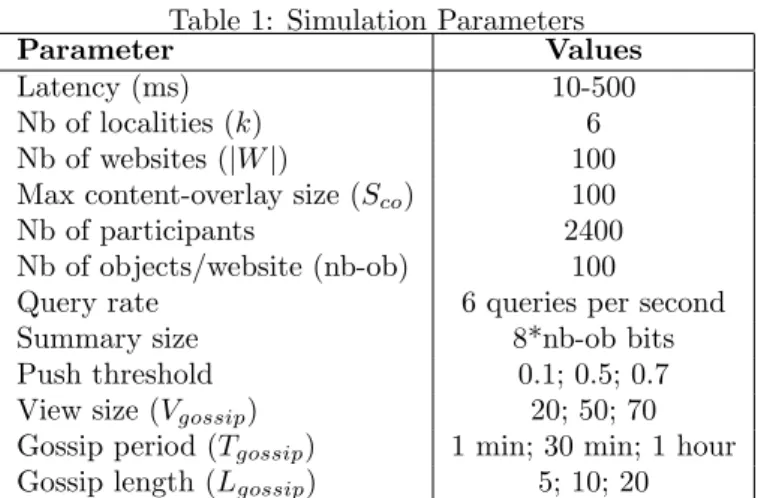
PeerSim enables us to model the latency of each individual link; however, it does not provide support for simulating bandwidth and CPU resources. Given that P2P networks are built on top of the Internet, we generate an underlying topol-ogy of 5000 peers connected with links of variable latencies; the model inspired by BRITE [2] assigns latencies between 10 and 500 ms. Network localities are modeled using a landmark-based technique [12]. We use k = 6 localities which are non-uniformly populated. The simulation parameters are summarized in Table 1.
Given that D-ring relies on any existing structured overlay (cf. 3.1), we choose to simulate Chord for its simplicity; we adapt its key management and routing mechanisms as explained in Sec.3.1, to be able to simulate the D-ring protocol. We compare Flower-CDN with Squirrel [14], where all participant peers are part of one structured overlay based on a traditional DHT (i.e., Chord here). Squirrel stores for each requested object a small directory of pointers to recent down-loaders of the object. The storing peer, which is comparable to our directory peer, is identified by the hash of the object’s identifier without any locality or interest considerations. In Squirrel, a query always navigates through the DHT
Table 1: Simulation Parameters Parameter Values Latency (ms) 10-500 Nb of localities (k) 6 Nb of websites (|W |) 100 Max content-overlay size (Sco) 100
Nb of participants 2400 Nb of objects/website (nb-ob) 100
Query rate 6 queries per second Summary size 8*nb-ob bits Push threshold 0.1; 0.5; 0.7 View size (Vgossip) 20; 50; 70
Gossip period (Tgossip) 1 min; 30 min; 1 hour
Gossip length (Lgossip) 5; 10; 20
and then receives a pointer to a peer that potentially has the object. We chose this approach of Squirrel because it shares some similarities with Flower-CDN wrt. the directory structure.
For our query workload we use synthetically generated data because available web traces reflect object accesses while we are interested in website accesses. Each website provides 500 objects which are requestable and cacheable (e.g., web page of 10-100 KB, though we do not model object size). Our simulation model assumes no correlation between different website communities and ap-plies zipf distribution for object requests submitted to each single website [8].
Each experiment is run for 24 hours, which are mapped to simulation time units. Experiments start with a stable D-ring: for each couple (website, lo-cality), there is one directory peer with an empty directory. Although we use |W | = 100 websites in the construction of D-ring, we restrict the query gen-eration to 6 websites of W . Content overlays related to the 6 active websites, are build progressively during the simulation as new clients join in. Queries are generated with a rate of 6 queries per second, distributed between the 6 active websites2
. For each query intended to a given website ws, two selections are carried out: (1) a new client or a content peer of ws is chosen from a random locality as the query originator, and (2) the queried object is selected, using zipf law, among ws objects. Then, new clients become content peers and join their corresponding overlay. When a content overlay reaches its maximum size noted Sco (set by default to 100), no new clients may join the overlay. With
this, we avoid that the directory peer is overloaded with the maintenance of the content overlay information. In consequence, the content overlays of a given website evolve at different rythms and sizes. Eventually, we should have up to N = |W | ∗ k ∗ Sco participant peers. However, since we are only looking at 6
active websites, N = |W | ∗ k + (6 ∗ k ∗ Sco) which is equal to 4200 participant
peers in the current configuration.
We assume that a content peer has enough storage potential to avoid replacing its content through the experiment’s duration. As a peer only stores content it
2We could not submit larger workloads because of the simulator limitations in terms of
memory constraints. However, the chosen workload still gives us a good understanding of the relative behavior.
Table 2: Effect of Gossip Bandwidth Variation
Lgossip Hit ratio Background BW
5 0.823 37 bps 10 0.86 74 bps 20 0.89 147 bps
(a) Varying Lgossip with (Tgossip= 30 min; Vgossip= 50)
Tgossip Hit ratio Background BW
1 min 0.94 2239 bps 30 min 0.86 74 bps 1 hour 0.81 37 bps
(b) Varying Tgossip with (Lgossip= 10; Vgossip= 50)
Vgossip Hit ratio Background BW
20 0.78 74 bps 50 0.86 74 bps 70 0.863 74 bps
(c) Varying Vgossipwith (Lgossip= 10; Tgossip= 30 min)
has requested, this is a reasonable assumption given the usual browsing activity of individual users. In Table 1, summary size denotes the size of the Bloom fil-ter representing the content summary; we assume that the maximum number of objects held by a content peer is limited by the total number of objects provided by its website (i.e., nb-ob), thus we set summary size according to the analysis in [9], to minimize both false positives and storage requirements. Push threshold refers to the percentage of new changes beyond which a content peer launches a push exchange with its directory peer (cf. Sec. 4.2.1). View size Vgossipis the
maximum number of contacts that a content peer’s view can contain. Gossip period Tgossip defines the time interval between two gossip exchanges initiated
by each content peer, while gossip length Lgossip refers to the size of the view
subset exchanged in a gossip round (a detailed discussion of gossip parameters is provided in [11]). To correctly tune the gossip parameters and adapt them to our protocol, we tested their variation in the experiments presented in Sec. 6.2.
6.2
Trade off: Impact of gossip
The first experiments evaluates the trade-off of Flower-CDN. Therefore, we in-vestigate the impact of background traffic, on the performance of Flower-CDN, by varying the gossip parameters: gossip length (i.e., Lgossip), gossip period
(i.e., Tgossip) and view size (i.e., Vgossip). We also varied push threshold ; but we
do not show the results which illustrate similar performance (i.e., almost same gains and same trade-off) for different values of push threshold (0,1; 0,5; 0,7). In each experiment, we vary one of the 3 gossip parameters (Lgossip, Tgossip,
Vgossip) and fix the two other parameters; then after 24 simulation hours, we
collect the results for each parameter value. Table 2 lists the results obtained for the 3 experiments, in terms of hit ratio and background bandwidth. Due to lack of space, we do not show lookup latency and transfer distance results which are quite unaffected by the gossip parameters’ variation.
Figure 5: Trade off between hit ratio and bandwidth in Flower-CDN
Table 2(a) shows the results of the variation of Lgossip. When increasing the
gossip length, more information is sent at each gossip exchange and thus more background bandwidth is consumed at each involved peer. Indeed, if Lgossip
increases from 5 to 20, the background bandwidth increases by a factor of 4 as shown in Table 2. Yet, the increase in hit ratio is not substancial.
Table 2(b) shows the results of the variation of Tgossip. When increasing the
gossip period, gossip exchanges are more spaced and thus less fequent, which has a similar effect on bandwidth consumption as the decrease of gossip length. Background bandwidth is reduced by a factor of 60 by augmenting Tgossipfrom
1 minute to 1 hour, while the hit ratio is decreased by 0.13.
Therefore, the choice of the 2 gossip parameters (Lgossipand Tgossip) is a
trade-off between two factors: (1) the application requirements for hit ratio conver-gence speed, i.e., how fast Flower-CDN reaches a maximal hit ratio, and (2) the network available resources in terms of network bandwidth availability. For relatively fast convergence, i.e., hit ratio of 0.86 within 24 hours, we could set Tgossip = 30 min and Lgossip = 10. A peer would experience 74 bps, which is
very low bandwidth that could be sustained even by modem connections. For less demanding applications with limited bandwidth availability, we could set (Tgossip= 1 hour, Lgossip= 10) or (Lgossip= 5, Tgossip= 30 min) resulting in
the negligible amount of 37 bps per peer.
Table 2(c) illustrates the results of the variation of Vgossip. As shown,
increas-ing the view size does not affect bandwidth consumption, while the hit ratio presents a slight increase of 0.083 when enlarging the view from 20 to 70 con-tacts. In fact, a larger view size only requires more storage space but does not affect the amount of information exchanged between content peers.
For the rest of the simulation, we set Tgossip = 30 min, Lgossip = 10 and
Vgossip = 50, because this setting provides good performance with an
accept-able overhead in terms of background traffic (i.e., on average 74 bps per peer). However, we believe that different query workloads and churn rates may in-fluence the results for Tgossip and Lgossip which should be tuned accordingly.
To conclude, we show in Figure 5 the variation of background traffic and hit ratio with time, for the setting chosen above. The hit ratio keeps on increasing with time, given that copies of queried content are progressively spread into the different content overlays as more queries are generated and thus more content
Figure 6: Comparing hit ratio in Flower-CDN and Squirrel
peers are served. While the hit ratio continues to improve, the backround traffic stabilizes at 74 bps after 5 hours.
6.3
Hit ratio
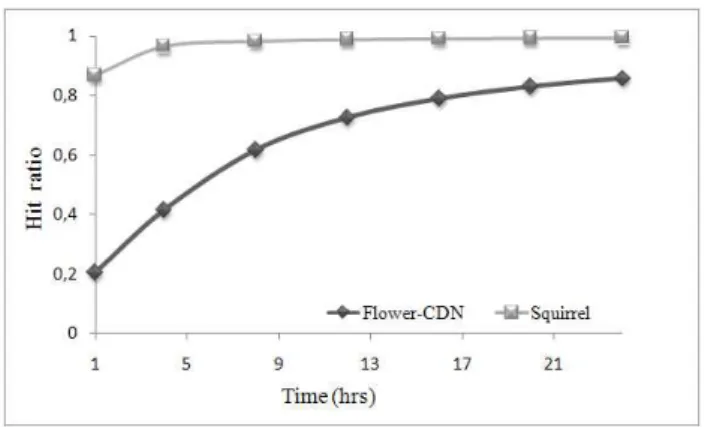
The following results compare Squirrel and Flower-CDN wrt. hit ratio. Figure 6 shows that the hit ratio eventually converges to 1 for both Squirrel and Flower-CDN, but convergence takes longer for Flower-CDN given that the search space is partitioned into content overlays. In fact, after 24 hours, the hit ratio of Flower-CDN is less than that of Squirrel by 13%. This difference can be justified by the following. Once a copy of an object owsis stored in Squirrel, a subsequent
query for owssearches all the overlay and eventually finds it in case of a stable
environment. In comparison, Flower-CDN restricts the search for ows in the
targeted content-overlay(ws, loci) wrt. locality of the client (i.e., loci) as well
as content-overlay(ws, locj) where dws,locj is a direct neighbor of dws,loci on
D-ring (guided by the directory summaries as explained in Sec. 3.3), in order to achieve locality-awareness. Moreover, an object ows becomes available in
content-overlay(ws, loc) only after a peer from the overlay has submitted a query for ows. Thus, once a copy of ows is available in each content-overlay,
Flower-CDN achieves a hit ratio similar to Squirrel wrt. ows.
In general, a smaller hit ratio means less queries are served from the P2P and instead go to the server. This is not bad as long as the original server is not overloaded. Furthermore, as we will see in the next section, Squirrel achieves the better hit-ratio by using peers as content providers that are far away from the requester. In practice, it might be faster to retrieve the requested webpage from the web-server than a far away peer.
6.4
Locality-awareness
In this set of experiments, we evaluate the gains due to locality-awareness in Flower-CDN, by measuring lookup latency and transfer distance. Again we compare with Squirrel which does not leverage locality-awareness.
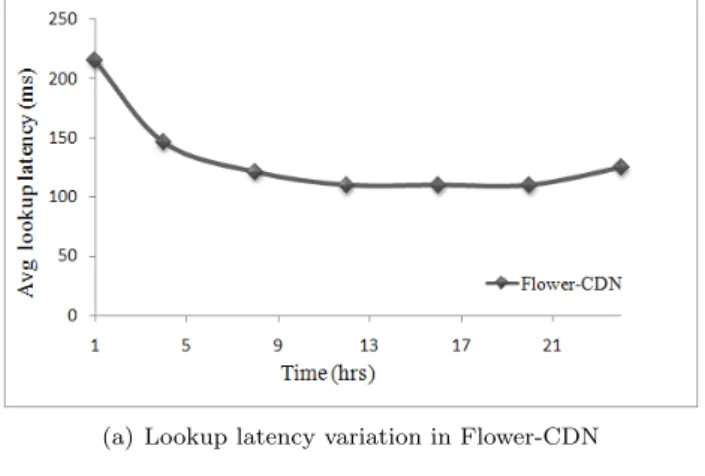
The first experiment, illustrated in Figure 7, measures the lookup latency. Fig-ure 7(a) shows the variation of the average lookup latency of a query with time:
the lookup latency starts by decreasing and stabilizes around 120 ms shortly after the system warms up (i.e., less than 5 hours in this experiment). Fig-ure 7(b) shows the latency distribution of queries for both solutions: 87% of our queries are resolved within 150 ms while 61 % of Squirrel’s queries take more than 1050 ms. In Flower-CDN, only first queries of new participant peers have to go through D-ring and result in long lookup latencies. Afterwards, queries are resolved within the local content overlay, achieving very short delays. In contrast, Squirrel routes every single query through the DHT. Thus, we can conclude that the locality-aware hybrid overlay of Flower-CDN performes very well in providing efficient lookup.
The second experiment focuses on transfer distance. We are interested in this metric because it has a significant impact on network usage and object download speed which affects response times perceived by users. At the underlying net-work level, higher distances generally involve more intermediate links and nodes to carry the traffic, which contributes to the aggregate network utilization and may overlaod the network. Furthermore, additional delays are introduced by the extra stages traversed by the data, due to acknowledgments and retransmissions at each visited node, etc. Figure 8(a) shows the variation of the average trans-fer distance of a query with time: the transtrans-fer distance is high at first when object transfers (i.e., downloads) are done via the original servers. After the warm-up period the transfer distance drops significantly to 80 ms when many transfers start to be performed within the same locality. Figure 8(b) shows the transfer distance distribution of queries for both solutions: 59 % of our queries are served from a distance within 100 ms compared to 17% of Squirrel’s queries. Thus, Flower-CDN provides excellent results by reducing the average tranfer distance by a factor of 2 in comparison with Squirrel. Flower-CDN ensures data transfers over short distances, which limits the network load and reduces the response times perceived by users.
6.5
Discussion
We learnt two main lessons through our experiments. First, the usage of gossip when confined in clusters (i.e., content overlays) appears to be quite efficient with an acceptable overhead in terms of bandwidth consumption. Moreover, the bandwidth overhead could be adapted to the available network resources by tuning the gossip parameters, while respecting hit ratio requirements. Second, combining structured and gossip-based overlays with locality-aware considera-tions proved to be quite performing especially in performing fast searches (i.e., low lookup latency) and finding close-by results (i.e., low transfer distance). In Flower-CDN, D-Ring is only used to provide a first reliable access, for new participant peers wrt. a content overlay. Afterwards, they become part of this content overlay and direct subsequent queries directly to the content-overlay in-stead of D-ring. In contrast, Squirrel relies on the DHT-based overlay for every single query leading to high lookup latencies. Furthermore, although not mea-sured in our experiments, the high lookup rates very likely also lead to higher loads on DHT participants.
(a) Lookup latency variation in Flower-CDN
(b) Lookup latency distribution in Flower-CDN and Squirrel
Figure 7: Lookup latency
7
Related Work
Several approaches exist that can be used to store web content on peer nodes. Many of these approaches rely on DHT to achieve fast lookup. Built over Pas-try, Squirrel [14] proposes two strategies to be applied for organization-wide networks. The first strategy (home-store) replicates web objects at peers with ID numerically closest to the hash of the URL of the object. Thus, queries find the peer that has the object by navigating through the DHT. To deal with highly popular objects, object replicas are progressively put along neighbors as the number of requests increases. The second strategy (directory) stores at the peer identified by the hash of the object’s URL a small directory of pointers to recent downloaders of the object. In this case, a query first navigates through the DHT and then receives a pointer to a peer that potentially has the object. PoPCache [13] proposes an approach similar to the home-store strategy while refining the replication technique along neighbors and computing the number of replicas per object as a function of its popularity. Backslash [19] applies similar strategies as Squirrel by inserting an object replica or its related direc-tory at peers identified by the DHT. However, there are two main drawbacks in the DHT-based approaches described above. First, unless using a
locality-(a) Transfer distance variation in Flower-CDN
(b) Lookup latency distribution in Flower-CDN and Squirrel
Figure 8: Transfer distance
aware overlay combined with proactive replication, they serve requests from random physical locations, which may deteriorate the user-perceived latency and consume considerable network resources. In contrast, Flower-CDN relies on a locality-aware directory that directs each query according to the physical location of the client. Second, the DHT-based approaches force the peers to store objects that they have not requested by themselves, while our approach exploits the interests of clients.
Proofs [20] uses an ustructured overlay in which peers’ neighborhoods are con-tinuously changing. This provides each peer with a random view of the system for each search operation. Peers keep their requested objects and can then pro-vide them to other participants. To locate one of the object replicas, a query is flooded to a random subset of neighbors with a fixed time-to-live (TTL) i.e., the max number of hops. However, searches for not-so popular objects induce heavy traffic overheads and high user-perceived latency, while Flower-CDN can locate any object within a bounded number of hops. Moreover, neither the overlay nor the search incorporate any information about the underlying network topology to forward queries to physically close results.
OLP [18] adopts a hybrid architecture where the website plays the role of a super-peer: it maintains a directory of peers to which its objects have been
transferred in the past and manages the redirection of queries. To avoid redi-rection failures in a P2P dynamic environment, OLP models the object lifetime and proposes a strategy that guides the website’s selection for peers (i.e., to choose the peer to which the query should be redirected). Compared to Flower-CDN where the P2P network shares the redirection workload with the server, the redirection in OLP may overload the server in case of intense flash crowds. Moreover, redirection in OLP does not take into account the physical locations of object replicas. CoopNet [15] also uses a hybrid architecture rooted at the web-server. After receiving a request, the web-server sends a list of nearby peers to the client. CoopNet tries to avoid the server redirection by creating small groups of clients. However, it does not elaborate a well-defined and decentral-ized structure to support searches within groups. Moreover, CoopNet does not deal with dynamic aspects such as detection of peer failures and leaves.
8
Conclusion
In this paper, we proposed Flower-CDN, an interest- and locality-aware P2P CDN, that enables any under-provisioned website to efficiently distribute its content, with the help of the community interested in its content. Flower-CDN combines efficient DHT indexing to provide fast lookup with gossip robustness for replica distribution and self-monitoring. The basic idea is to exploit peer interests and localities in order to cluster participant peers in content overlays and to build a P2P directory service via D-ring. D-ring relies on a novel DHT mechanism that can be easily integrated into existing structured overlays. We proposed to use gossip-based algorithms to spread accurate information through content overlays and to robustly maintain D-ring and content overlays in face of churn. Through simulation experiments, Flower-CDN proved to be quite performing especially in performing fast searches and finding close-by results. Furthermore, gossip techniques incured acceptable overhead in terms of band-width consumption, which could be adapted to the available network resources and the hit ratio requirements.
We are pursuing this work in several directions. We are empirically analysing the behavior of Flower-CDN in presence of churn. We are also investigating the scalabilty of content overlays by adjusting the number of directory peers per tuple (website, locality). We also intend to introduce active replication by pushing popular contents from some content overlay towards other overlays of the same website. Finally, we plan to explore consistency aspects, in particular, cache expiration and replacement policies.
9
Acknowledgments
We would like to thank Anne-Marie Kermarrec, Davide Frey and Vincent Leroy for their insightful discussions.
References
[2] Brite. http://www.cs.bu.edu/brite/.
[3] Peersim p2p simulator. http://www.peersim.sourceforge.net.
[4] Manal El Dick, Vidal Martins, and Esther Pacitti. A topology-aware ap-proach for distributed data reconciliation in P2P networks. In Euro-Par, 2007.
[5] Alan Demers et al. Epidemic algorithms for replicated database mainte-nance. In PODC, 1987.
[6] Frank Dabek et al. Towards a common api for structured P2P overlays. In IPTPS, 2003.
[7] Ion Stoica et al. Chord: A scalable P2P lookup service for internet appli-cations. In SIGCOMM, 2001.
[8] Lee Breslau et al. Web Caching and Zipf-like Distributions: Evidence and Implications. In INFOCOM, 1999.
[9] Li Fan et al. Summary cache: A scalable wide-area web cache sharing protocol. In SIGCOMM, 1998.
[10] Mark Jelasity et al. The peer sampling service: experimental evaluation of unstructured gossip-based implementations. In Middleware, 2004.
[11] Patrick T. Eugster et al. Epidemic information dissemination in distributed systems. IEEE Computer, 37(5), 2004.
[12] Sylvia Ratnasamy et al. Topologically-aware overlay construction and server selection. In INFOCOM, 2002.
[13] Weixiong Rao et al. Optimal proactive caching in P2P network: analysis and application. In CIKM, 2007.
[14] Sitaram Iyer, Antony I. T. Rowstron, and Peter Druschel. Squirrel: a decentralized P2P web cache. In PODC, 2002.
[15] Venkata N. Padmanabhan and Kunwadee Sripanidkulchai. The case for cooperative networking. In IPTPS, 2002.
[16] Robbert Van Renesse, Yaron Minsky, and Mark Hayden. A gossip-style failure detection service. In Middleware, 1998.
[17] Antony I. T. Rowstron and Peter Druschel. Pastry: Scalable, decentralized object location, and routing for large-scale P2P systems. In Middleware, 2001.
[18] Young-Suk Ryu and Sung-Bong Yang. An effective P2P web caching system under dynamic participation of peers. IEICE Transactions, 88-B(4), 2005. [19] Tyron Stading, Petros Maniatis, and Mary Baker. P2P caching schemes to
address flash crowds. In IPTPS, 2002.
[20] Angelos Stavrou, Dan Rubenstein, and Sambit Sahu. A lightweight, robust P2P system to handle flash crowds. In ICNP, 2002.
[21] Spyros Voulgaris, Daniela Gavidia, and Maarten van Steen. Cyclon: Inex-pensive membership management for unstructured P2P overlays. J. Net-work Syst. Manage., 13(2), 2005.
Contents
1 Introduction 3 2 Overview of Flower-CDN 5 3 D-ring Model 6 3.1 Key Management . . . 6 3.2 Routing Service . . . 73.3 Directory Peer Structure . . . 9
3.4 Query Processing . . . 9
4 Content Overlay Model 11 4.1 Construction . . . 11
4.2 Gossip-based Management . . . 11
4.2.1 Directory Management . . . 13
5 Dealing with Dynamicity 15 5.1 Redirection failure . . . 15 5.2 Directory failure . . . 15 5.3 Scaling up . . . 16 5.4 Updating Localities . . . 16 6 Performance Evaluation 17 6.1 Simulation Setup . . . 17
6.2 Trade off: Impact of gossip . . . 19
6.3 Hit ratio . . . 21 6.4 Locality-awareness . . . 21 6.5 Discussion . . . 22 7 Related Work 23 8 Conclusion 25 9 Acknowledgments 25
Centre de recherche INRIA Bordeaux – Sud Ouest : Domaine Universitaire - 351, cours de la Libération - 33405 Talence Cedex Centre de recherche INRIA Grenoble – Rhône-Alpes : 655, avenue de l’Europe - 38334 Montbonnot Saint-Ismier Centre de recherche INRIA Lille – Nord Europe : Parc Scientifique de la Haute Borne - 40, avenue Halley - 59650 Villeneuve d’Ascq
Centre de recherche INRIA Nancy – Grand Est : LORIA, Technopôle de Nancy-Brabois - Campus scientifique 615, rue du Jardin Botanique - BP 101 - 54602 Villers-lès-Nancy Cedex
Centre de recherche INRIA Paris – Rocquencourt : Domaine de Voluceau - Rocquencourt - BP 105 - 78153 Le Chesnay Cedex Centre de recherche INRIA Saclay – Île-de-France : Parc Orsay Université - ZAC des Vignes : 4, rue Jacques Monod - 91893 Orsay Cedex
Centre de recherche INRIA Sophia Antipolis – Méditerranée : 2004, route des Lucioles - BP 93 - 06902 Sophia Antipolis Cedex
Éditeur
INRIA - Domaine de Voluceau - Rocquencourt, BP 105 - 78153 Le Chesnay Cedex (France)