Science Arts & Métiers (SAM)
is an open access repository that collects the work of Arts et Métiers Institute of Technology researchers and makes it freely available over the web where possible.
This is an author-deposited version published in: https://sam.ensam.eu
Handle ID: .http://hdl.handle.net/10985/6564
To cite this version :
Jean-Philippe GITTO, Nicolas MARANZANA, Frédéric SEGONDS, Bertrand BESSIERE - Bolted Joints Disassembly: A Field Study for Thermal Influence on Large Diameters - 2013
Any correspondence concerning this service should be sent to the repository Administrator : [email protected]
Bolted Joints Disassembly: A Field Study for Thermal Influence on
Large Diameters
Jean-Philippe GITTO
1, a, Nicolas MARANZANA
1, b, Frédéric SEGONDS
1, c,
Bertrand BESSIERE
2, d1
Arts et Metiers ParisTech, LCPI, 151 boulevard de l’Hôpital, 75013 Paris, France. 2
Usitorque Engineering, 57 voie Saint-Exupéry, Parc d'activité de l'Aérodrome, 76430 St-Romain-de-Colbosc, France
{ajean-philippe.gitto, bnicolas.maranzana, cfrederic.segonds}@ensam.eu, d
Keywords: Threaded fastener, Seizure, Galling, Disassembly, Corrosion, Maintenance.
Abstract.During maintenance operations, technicians have to work as quickly as possible. But they
are often stopped during disassembly by blocked bolts or studs. This paper examines causes of blockage and suggests new method for disassembling bolted joint in this case. Several methods are analyzed and tested with finite element simulations. An experimental protocol to test a new disassembling method is also introduced in this paper.
Introduction
Nowadays, in the industrial maintenance sector, small and medium enterprises (SME) need to adapt to more and more complex markets with a high competitiveness [1]. Dealing with this growing international competition, these companies have to optimize their costs, quality and deadlines to keep their market share and to win new ones. In this context, the development of new technologies to upgrade currently used tools, can improve the rapidity and the quality of the offered services. Dealing with increasingly complex industrial systems, the world of maintenance is particularly sensitive to this issue [2].
This paper is based on an industrial work led with the company Usitorque Engineering (Fidgi group). This SME is specialized in on-site machining and controlled tightening and disassembly of bolted joints. In many cases, during operation, technicians have difficulties with elements which are blocked because of galling or corrosion. The company is looking for a new safer and faster technique for loosening threaded elements with large diameters (up to 60 mm).
First, the causes of the problem are going to be identified and analyzed thanks to the results of a bibliographical research. Then, the different solutions that are considered to disassembly bolted joints will be introduced and the first results of the finite element method will be displayed. Finally, we will propose an in-field validation of these simulations.
State of the art
The problems of threaded elements unscrewing depend on many combined parameters that occur all along the lifecycle of the assembly (installation, servicing, and disassembly). This makes difficult the understanding of the causes of blockages as a whole. Some cases of failure are studied on bolts exposed to corrosive atmospheres or used in petrochemical plant [3, 4]. Thus, the main damages that have been observed are due to corrosion or seizure.
Firstly, the corrosion can be caused by the condensation of a portion of the water vapor contained in the atmosphere. Furthermore, they are different kind of corrosion. The phenomenon depends on many factors [5] such as the composition of the atmosphere, the operating temperature or the presence of vibrations. In contact with surfaces, water reacts with the metal to form oxides (Fe2O3, Cr(OH)3, Cr2O3, NiO…). Vibrations or small movements that may exist in the joint
All rights reserved. No part of contents of this paper may be reproduced or transmitted in any form or by any means without the written permission of TTP, www.ttp.net. (ID: 193.50.216.130-30/10/12,10:33:48)
accelerate this phenomenon by exposing non-corroded surfaces. This can lead to corrosion pitting and micro cracks on the threads (Fig. 1). It causes and changes conditions of friction between the internal and external threads and this also weakens screws or studs.
Figure 1: Details from the threads of the stud failed: (a, b) Pits and corrosion products; (c, d) microcracks at the surface. [4]
Bolts and studs used for assembly in petrochemical industries are usually made of alloyed steel according to standard ASTM 193 B7 [6]. On such elements, the anticorrosion coating is thin and easily damaged during assembly. If some preconizations are not followed during assembly (lubrication, adjustment, maximum torque...), corrosion may appear and this even though there is a coating steel (Ni-Cr-Zn or Cd) [4].
The galling phenomenon occurs when there is a large difference in hardness between the assembled parts or when the lubrication is insufficient during the assembly [7]. Inadequate functional clearance can also foster this phenomenon by inducing very high stresses at the contact zone between the two parts. The result is the same when exceeding the recommended tightening torque [8]. The galling is characterized by a tearing of material on one of the parts or by the creation of a weld between the two threads.
Figure 2: Cracked stud and cold welding between threads [4]
The primary causes of blocking are numerous and varied (mounting method, operating conditions, nature of the atmosphere, temperature ...). They first occur during assembly [9]. The type of coatings placed on the surface of threads can also induce fragility [10]. Furthermore there are the effects of temperature [11, 12], the effects of fatigue stress [13, 14] and the distribution of stress concentrations [15] which change according to the chosen type of screw element. Encountered situations are often unique, with random phenomena, and multiple factors are involved [16]. It is then difficult to establish precisely the cause of the failure, the relationships and the effects between these different determinants [17]. However, some comprehension on the involved phenomena is required in order to find new solutions for disassembly. A series of experiments has to be considered to determine the influence of each parameter in blocking of threads and to analyze the mode of action of the different ways to disassembly bolted joint. Various solutions are considered first for easy removal. They are introduced in the next section.
Disassembly procedures
In order to make easier the removal of seized or corroded bolts, various solutions are considered: chemical action, vibration, shock, and thermal action. Currently, blocked or broken studs in bolted joint are extracted by drilling. During this phase, the wasted time is about 6 hours, and a re-machining of the bore is required when the stud is removed. The main criterion to select a dismantling solution is the wasted time during its execution. The process must also be easily implemented by technicians during maintenance operations, the working area can be difficult to access and it can be impossible to work directly on the affected area because it is trapped between the threads.
Chemical processes are based on the principle of the dissolution of corrosion or seizure products. But this process is too slow. Moreover, it is difficult to insert a substance into the seized area between the threads, especially for horizontal assemblies or when the stud’s head is upside. It is also difficult to guarantee that there will be no deterioration of the rest of the assembly.
The vibrations could help to generate movement between parts and to extract bodies which block the stud. However, it is impossible to make assemblies with the size of the ones encountered, as a steam turbine for instance (mass of several tons), vibrate. Vibration may also lead to an additional galling.
For a quick release, a method which enables to destroy the screws by impacting the screw’s head is also developed [18]. By striking the screw through a transmitter body, the operator increases the maximum stress in the screw head and causes its break. This process is hardly transposable to studs with high diameter (up to 135mm), because it would require a high quantity of energy and this would not enable the removal of the broken stud from its bore.
The last considered method is the thermal process. Currently, when technicians are unable to unscrew a nut, they heat it with a blowtorch. Once the nut is expanded, it is possible to unscrew it easier. The question is to know whether this technique can be transposed to studs seized in a bore. Given that the part in which the bore is made must not be damaged, it is better to act directly on the stud. By drilling a small diameter hole in the center of the stud, it is actually possible to inject a cold fluid (around -180°C) to cause the diminution of the stud’s diameter, and thus make its release easier.
For the studied case, the technicians have to act quickly during a maintenance shutdown; therefore, the thermal method seems the most relevant to develop. So, thermal simulations are performed to conclude about the efficiency of this method.
Thermal simulation
Several configurations of thermal process exist. There is a need to define the best parameters to implement for an easier disassembly. After that, conclusion can be drawn on the purpose of testing solution and on the relevance of the range of parameters. Numerical simulations are performed to
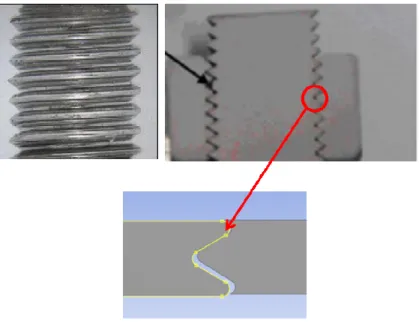
assess the effects of thermal methods and determine which solutions have to be developed. To perform those simulations, the contact between a stud and its bore was modeled on a grip length of one thread pitch by using the finite element modeling software ANSYS® (fig. 3).
Figure 3: Model of thread
The thread profile is defined by ISO standard [19]. A 6 mm thread pitch is chosen (size commonly used). It is a 2D and axisymmetric model, induced by the part’s geometry. The studied area is considered to be on the middle of the threaded zone. A first set of simulations is performed to quantify the diameter’s reduction in threads region according to the dimensions of the stud. It is considered that the bore inside the stud is keep at a temperature of -180 ° C by applying liquid nitrogen. The results of the simulation are given in table 1, with the temperature of the bore and the threads after cooling.
Table 1: Results of numerical simulation
Diameter Tbore [°C] TThread [°C] Cooling time [s]
Diameter reduction [mm] M60 -180 -15 2 0,075 M80 -180 -28 8 0,106 M100 -180 -22 16 0,120 M120 -180 -19 27 0,134 M140 -180 -23 46 0,160
Below a diameter of 80 mm, displacements are insignificant compared to the clearance between the threads. This technique is therefore inappropriate for small diameter studs.
Then the same cooling is simulated on a case of seizing on a M80 stud. The concept is to drill a small diameter hole (30mm) in the middle of the stud in order to cool the interior to reduce its diameter and ease its removal. Initially, using dry ice is considered to cool the stud. At ambient conditions dry ice sublimates at a temperature of -68 ° C, and enables the cooling of objects with which it is in contact. This substance is widely available, cheap and can be manipulated by everyone, so it is interesting to use it as a cold source. However, as the ice is slow to sublime, it is difficult to effectively cool the studs. Thus, liquid nitrogen is chosen (boiling at -195 ° C), as a more efficient cooling solution.
Additional simulations are performed for temperatures around -180 ° C. In this model, threads are welding by seizing. Some local constraints of several hundred MPa are noticed at the contact between the threads (around 350 MPa). To determine whether the thermal effect will be well present and effective, a series of experiments is required. Disassembling tests of elements in real
working conditions are planned. The results of those tests would lead to a conclusion on the effectiveness of this method of disassembling. In the next section, the experimental protocol that will be implemented is introduced.
Experimental protocol
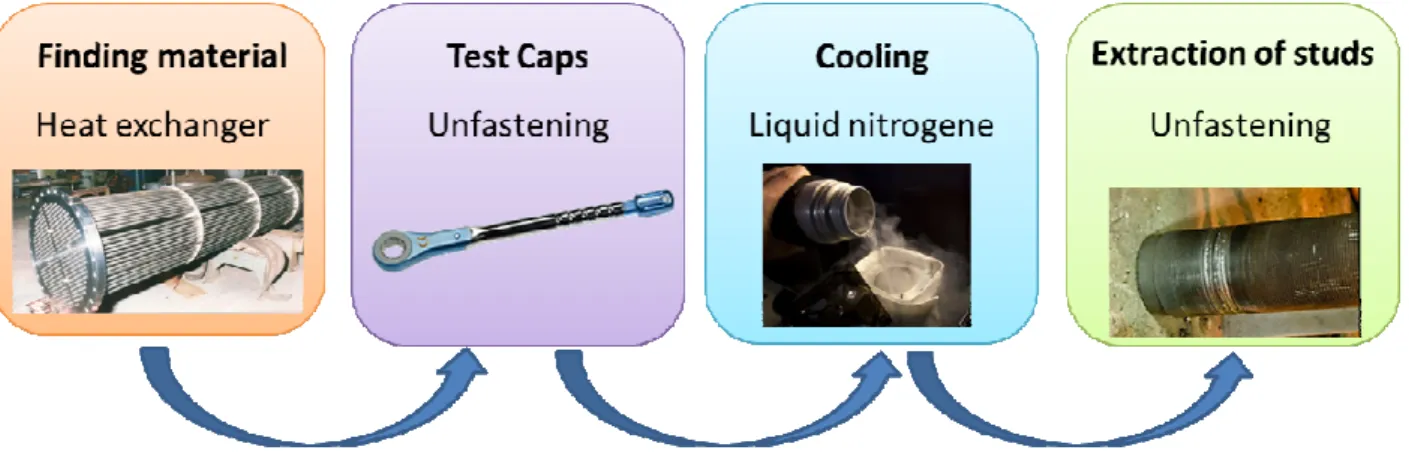
For infield validation of simulations, experiments on a heat exchanger are planned (fig. 4). On this kind of equipment there are a lot of threaded stoppers that are often blocked. It is impossible to predetermine which caps will cause problems. Each cap must be tested with a calibrated torque wrench. This operation must be done by one technician who uses always the same tool to limit the dispersions. The blocked caps are marked and the maximum torque applied on recorded for comparison.
Then the disassembly device can be tested on blocked caps (about 5 to 10). To do this, a 30 mm diameter hole in the center is drilled. Then, the hole is filled with liquid nitrogen by using a suitable device. During the operation, the temperature is measured with a thermometer at the junction between the stopper and the exchanger. Once the temperature reaches -20 ° C, cooling is stopped to not denature the steel which composes the structure. Then, the cap is released with the same key used previously and the loosening torque is measured. We are able to compare the torque required in each case for disassembly and also have a qualitative comparison of the effort experienced by the technician.
Figure 4: Experimental protocol phases Conclusion
The disassembling problem of large diameter threaded elements is complex because of the multiplicity of the physical parameters involved and the uniqueness of each case encountered by the technicians. In this article, probable causes of blockage have been identified. Solutions to eliminate their effects have been proposed
Corrosion and seizure have been pointed out as the most common causes. For these cases, using a thermal process to contract the stud to facilitate its removal is proposed. Numerical simulations show a good potential for this method. As a future work, mechanical tests will allow us to evaluate this potential.
References
[1] Ming, X. G., Yan, J. Q., Wang, X. H., Li, S. N., Lu, W. F., Peng, Q. J., & Ma, Y. S. (2008). Collaborative process planning and manufacturing in product lifecycle management. Computers in Industry, 59(2-3)
[2] Marais, K. B., Saleh, J. H. (2009). Beyond its cost, the value of maintenance: An analytical framework for capturing its net present value. Reliability Engineering & System Safety, 94(2). [3] Tavares, S. S. M., Corte, J. S., Menezes, L., Moura, V., & Corte, R. R. a. (2009). Failure
analysis of an austenitic stainless steel stud in seawater oil platform. Engineering Failure Analysis, 16(1).
[4] Tavares, S. S. M., Pardal, J. M., Corte, J. S., Scandian, C., & Herculano, L. F. G. (2009). Failure induced by severe wear between studs and nuts of 17-4PH steel. Engineering Failure Analysis, 16(5).
[5] Jensen, W. J, (2003). Corrosion in Threaded Fasteners. ASM International.
[6] ASTM International, (2004), Standard Specification for Alloy-Steel and Stainless Steel Bolting Materials for High Temperature Service
[7] Eliaz, N., Gheorghiu, G., Sheinkopf, H., Levi, O., Shemesh, G., Ben-Mordechai, A., & Artzi, H. (2003). Failures of bolts in helicopter main rotor drive plate assembly due to improper application of lubricant. Engineering Failure Analysis, 10(4),
[8] Baggerly, R. (2000). Evaluating the Effects of Overtorque in Bolts. Journal of Failure Analysis and Prevention, 41-46.
[9] Dahl, J. S., Lu, L.-wu, Fisher, J. W., & Abruzzo, J. (1996). Comparative Effectiveness of Tightening Techniques for A4901 Vi-in . Diameter Bolts. Engineering, (3), 77-80.
[10] Gordon, D. F. (2005). Hydrogen re-embrittlement susceptibility of ultra high strength steels. Thesis. Cranfield University.
[11] Kodur, V., Kand, S., & Khaliq, W. (2012). Effect of Temperature on Thermal and Mechanical Properties of Steel Bolts. Journal of Materials in Civil Engineering.
[12] Hobbs, J. M. (2010). High Temperature Fastener Fatigue. Thesis. University of Utah.
[13] Fares, Y. (2006). Fatigue design of bolted joints using multiaxial fatigue criteria. Thesis. INSAT
[14] Koning, A. D., & Henriksen, T. (1996). Damage tolerance analysis of bolt/nut assemblies. Nationaal Lucht EN.
[15] Zhao, H. (1998). Stress concentration factors within bolt-nut connectors under elasto-plastic deformation. Int. J. Fatigue, 20(9).
[16] Agatonović, P. (2011). Structural integrity analysis of multi-bolted connections using the innovative beam model. Integritet i vek konstrukcija, 11(3).
[17] Garrigou, A., Carballeda, G., Daniellou, F. (1998). The role of “know-how” in maintenance activities and reliability in a high-risk process control plant. Applied Ergonomics, 29(2),
[18] Pak, K. G., & Sodhi, R. (2002). Destructive Disassembly of Bolts and Screws by Impact Fracture. Journal of Manufacturing Systems, 21(1994).
[19] ISO 68-1: 1999-03
![Figure 2: Cracked stud and cold welding between threads [4]](https://thumb-eu.123doks.com/thumbv2/123doknet/7313948.210234/3.892.224.672.820.1149/figure-cracked-stud-cold-welding-threads.webp)