HAL Id: hal-02448130
https://hal.archives-ouvertes.fr/hal-02448130
Submitted on 22 Jan 2020
HAL is a multi-disciplinary open access
archive for the deposit and dissemination of
sci-entific research documents, whether they are
pub-lished or not. The documents may come from
teaching and research institutions in France or
abroad, or from public or private research centers.
L’archive ouverte pluridisciplinaire HAL, est
destinée au dépôt et à la diffusion de documents
scientifiques de niveau recherche, publiés ou non,
émanant des établissements d’enseignement et de
recherche français ou étrangers, des laboratoires
publics ou privés.
Distributed under a Creative Commons Attribution - NonCommercial - NoDerivatives| 4.0
International License
Parallel, cascaded, interactive processing of words
during sentence reading
Yun Wen, Joshua Snell, Jonathan Grainger
To cite this version:
Yun Wen, Joshua Snell, Jonathan Grainger. Parallel, cascaded, interactive processing of words during
sentence reading. Cognition, Elsevier, 2019, �10.1016/j.cognition.2019.04.013�. �hal-02448130�
Contents lists available atScienceDirect
Cognition
journal homepage:www.elsevier.com/locate/cognit
Brief article
Parallel, cascaded, interactive processing of words during sentence reading
Yun Wen
⁎, Joshua Snell, Jonathan Grainger
Laboratoire de Psychologie Cognitive, Aix-Marseille Université, Centre National de la Recherche Scientifique, Marseille, France
A R T I C L E I N F O Keywords:
Sentence superiority effect Parallel word processing
Rapid parallel visual presentation (RPVP) Interactive-activation
ERPs Reading
A B S T R A C T
Single words are easier to identify in a briefly presented syntactically correct word sequence compared with a scrambled version of the same set of words: a sentence superiority effect. Interactive-activation models of sentence comprehension can account for this phenomenon by implementing parallel processing of word iden-tities. The cascaded and interactive nature of such processing allows sentence-level structures to influence on-going word processing. Alternatively, prior observations of a sentence superiority effect in post-cued word-phrase identification might be due to the sophisticated guessing of word identities on the basis of partial in-formation about the target word and the surrounding context. Here, for the first time, we used electro-physiological recordings to plot the time-course of the sentence superiority effect. According to an interactive-activation account of this phenomenon, the effect should be visible in the N400 component, thought to reflect the mapping of word identities onto higher-level semantic and syntactic representations. Such evidence for changes in highly automatized linguistic processing is not predicted by a sophisticated guessing account. Our results revealed a robust and widespread sentence-superiority effect on the N400 component that onsets around 270 ms post-sentence onset, thus lending support to the interactive-activation account.
1. Introduction
How do skilled readers read? This question has been of central in-terest to experimental psychologists ever since the pioneering work of James McKeen Cattell more than 130 years ago. Cattell is well known for the “word superiority effect” that he established, but it is less well known that Cattell also discovered a “sentence superiority effect”.
Cattell (1886; reported inScheerer, 1981) found that sentences con-sisting of seven words could be recalled correctly after a single brief exposure, whereas only three to four words could be recalled if se-quences of words were unrelated. Given that current theories of reading predominantly adopt a one-word-at-a-time incremental processing ap-proach (see Reichle, Liversedge, Pollatsek, & Rayner, 2009, for a re-view),Snell and Grainger (2017)asked whether Cattell’s sentence su-periority effect could be taken as evidence against such theories, and on the contrary provide support for theories that appeal to rapid parallel processing of syntactic and semantic information across multiple words during sentence reading (Snell, Declerck, & Grainger, 2018; Snell, Meeter, & Grainger, 2017). Snell and Grainger noted that the
methodology used in Cattell’s experiments left open possible roles for extra-linguistic factors such as short-term memory and guessing, and therefore, following the methodological innovation offered byReicher (1969) and Wheeler (1970)in order to counter similar explanations of the word superiority effect, they set-out to study the sentence super-iority effect using a post-cued partial report procedure combined with the rapid parallel visual presentation (RPVP) of word sequences (see
Fig. 1).1
Snell and Grainger (2017)found that word identification was more accurate in grammatically correct normal word sequences than in un-grammatical scrambled sequences. Crucially, this sentence superiority effect was obtained in conditions that minimized any potential influ-ence of between-word semantic relatedness or predictability, as de-termined by cloze probability measures, thus pointing to syntactic re-presentations as the source of the effect. Additionally, the effect was equal in size across target positions, hence speaking against a serial left-to-right processing approach, which would have predicted stronger effects for right- than leftward target positions, given that ongoing processing of targets at later positions may be constrained by the
https://doi.org/10.1016/j.cognition.2019.04.013
Received 11 May 2018; Received in revised form 29 March 2019; Accepted 13 April 2019
⁎Corresponding author at: Laboratoire de Psychologie Cognitive, CNRS, AMU, LPC UMR 7290, Campus St Charles, 3 Place Victor Hugo, 13331 Marseille, France.
E-mail address:[email protected](Y. Wen).
1We note here that the sentence superiority effect has also been studied as a memory phenomenon whereby it is easier to recall a list of words that form a
syntactically correct sequence compared with an unstructured list of the same words (e.g.,Baddeley, Hitch, & Allen, 2009;Bonhage et al., 2017;Jones & Farrell, 2018;Miller & Isard, 1964). The post-cued partial-report RPVP procedure used bySnell and Grainger (2017)and in the present study was expressly designed to limit the role of memory factors. Nevertheless, the 500 ms delay between stimulus offset and cue onset that was implemented in the present study (seeFig. 1) in order to reduce contamination of the EEG signal by preparatory hand movements, could have allowed memory factors to intervene. We address this issue in the Discussion.
0010-0277/ © 2019 The Authors. Published by Elsevier B.V. This is an open access article under the CC BY-NC-ND license (http://creativecommons.org/licenses/BY-NC-ND/4.0/).
preceding context while processing of targets at earlier positions cannot be constrained by the upcoming context. These findings taken together, Snell and Grainger argued that the parallel partial identification of multiple words generates an elementary syntactic representation of the word sequence when the sequence is grammatical, and this syntactic representation then constrains on-going identification processes through feedback to word identities. This explanation of the sentence superiority effect appeals to the key principles of interactive-activation (McClelland & Rumelhart, 1981), parallel, cascaded, and interactive processing, that have been applied to sentence comprehension in the
work of Rumelhart (1977) and MacDonald, Pearlmutter, and
Seidenberg (1994). The explanation also appeals to the rapid genera-tion of a syntactic frame (e.g.,Koriat & Greenberg, 1994) that guides on-going lexical processing (Snell et al., 2017).
Here, we seek further evidence in favor ofSnell and Grainger (2017)
account of the sentence superiority effect. This is motivated by the fact that incremental processing theorists could still argue that participants in the Snell and Grainger study were gleaning partial information about several words simultaneously, without identifying more than one word at a time, and were using that partial information to guess the identity of the target word. Thus, for example, given the sentence “the man can run” and cued to identify the third word, having identified a noun at position 2, and having information that the target is a 3-letter word beginning with “c”, participants could search for a 3-letter verb be-ginning with “c”. We refer to this as “sophisticated guessing”, bor-rowing a term used in the debate concerning different possible inter-pretations of the word superiority effect (e.g.,Johnston, 1978).
Sophisticated guessing is a slow inferential process because it in-volves an explicit evaluation of the available information in order to narrow down the possible candidates. Therefore, in order to exclude this interpretation of the sentence superiority effect, and to unequi-vocally provide evidence in favor of an interactive-activation explana-tion, here we measured the time-course of the effect using electro-physiological recordings. If rapidly activated sentence-level structures can influence on-going word identification processes, then we should find evidence for this influence in the N400 ERP component (Kutas & Federmeier, 2011), thought to reflect resonant processing between word identities and higher-level semantic and syntactic information (Grainger & Holcomb, 2009). Such evidence for changes in highly au-tomatized linguistic processing is not predicted by a sophisticated guessing account.
2. Methods
2.1. Participants
Twenty-four participants (16 females; mean age: 21.2 years, SD = 3.0 years) were paid €20 to participate in the experiment. All participants reported to be native French speakers, right-handed, having no history of neurological, psychiatric or language impairment, and having normal or corrected-to-normal vision. One participant was excluded due to excessive artifacts in the EEG data. For 23 participants included in the analyses, the average self-rated language proficiency
score was 8.5, SD = 1.0 (10-point scale, 1 = virtually non-existing, 10 = prefect), and the average LexTALE vocabulary score (Brysbaert, 2013) was 89.5, SD = 4.3.
2.2. Materials and design
We adapted 200 word sequences fromSnell and Grainger (2017). Each sequence consisted of four words with the average word length of 4.03 letters, SD = 0.82. The average word frequency in Zipf values was 5.66, SD = 1.08 (Ferrand et al., 2010; van Heuven, Mandera, Keuleers, & Brysbaert, 2014). All sequences were grammatically correct and se-mantically neutral (seeSnell & Grainger, 2017, for details). One of the four words in each sequence was used as the target word, and 50 targets were selected from each word position. To construct a scrambled ver-sion of every sequence, all words except for the target switched posi-tions so that the scrambled sequences were syntactically incorrect. Examples of the word sequences are presented in Table S1. Two counterbalanced lists were created, and participants were randomly assigned to one of the lists. As such, all word sequences were presented in both conditions (normal and scrambled), but in only one condition per participant. The full list of materials is presented in the
Supplementary Materials.
2.3. Procedure
The study was approved by the “Comité de Protection des Personnes SUD-EST IV” (No. 17/051). All participants gave their written informed consent before the experiment started. Participants were seated in a comfortable chair in a dimly-lit shielded testing room. Each participant received a unique pseudo-randomized presentation order of the stimuli, with the same condition (normal vs. scrambled) occurring no more than five times in a row, and the same target position no more than three times in a row. Stimuli were presented on a CRT monitor (1024 × 768 pixels, 75 Hz) controlled by OpenSesame (Mathôt, Schreij, & Theeuwes, 2012). Each trial began with two vertical fixation bars presented for 500 ms at the screen center, and participants were instructed to fixate between the fixation bars. Next, a sequence of four words was presented for 200 ms, followed by a backward mask with hash marks. After 500 ms presentation of the backward mask, a post-cue was presented with a dot above the target location (balanced across the four possible positions), and participants were asked to report the target by typing in their response on a keyboard (seeFig. 1for an illustration of visual events in the RPVP paradigm). Feedback was then provided with a green (correct) or red (incorrect) dot presented for 500 ms. The inter-trial interval was set at 500 ms. Participants were instructed to mini-mize blinks, eye-movements, and body movements during the pre-sentation of word sequences. Prior to the experiment, eight practice trials were used to familiarize the participants with the procedure. The experiment lasted approximately two hours.
2.4. EEG recording and preprocessing
The electroencephalogram (EEG) was recorded at a 1024-Hz sample
500 ms 200 ms 500 ms keyboard response
the man can run ### ### ### ### ### ### ### ### answer
Fig. 1. Illustration of the sequence of events in the post-cued partial report Rapid Parallel Visual Presentation (RPVP) procedure. In the example here, the target word
(“can”) is embedded in a grammatically correct sequence. An example of a corresponding ungrammatical scrambled sequence would be “run the can man” with the target word at the same position.
Y. Wen, et al. Cognition 189 (2019) 221–226
rate with 64 active electrodes (Biosemi ActiveTwo) arranged in the 10/ 20 system. Two additional electrodes placed close to Pz (CMS and DRL) were used for online referencing (Metting van Rijn, Peper, & Grimbergen, 1990; Schutter, Leitner, Kenemans, & van Honk, 2006). Two external electrodes were placed at left and right mastoids for off-line re-referencing. Four external electrodes were placed below and at the outer canthus of each eye to monitor eye movements. The electrode offset was kept below 30 mV.
EEG data were preprocessed using EEGlab (Delorme & Makeig, 2004) and ERPlab (Lopez-Calderon & Luck, 2014). The continuous EEG was re-referenced off-line to the averaged mastoids and filtered with a high-pass filter at 0.1 Hz. EEG data were then segmented in epochs of 900 ms starting 100 ms before the sentence onset, and baseline-cor-rected. The epochs were low-pass filtered at 30 Hz. Trials with incorrect target word identification were discarded (34.7% of the data). Bad channels were interpolated. Epochs contaminated by drifts and muscle activity were manually dismissed (2.3% of the data), and epochs con-taining ocular artifacts were automatically rejected (4.7% of the data). A minimum of 30 epochs were required for each condition (Thierry & Wu, 2007).
2.5. Statistical analysis
For the behavioral accuracy data, we conducted mixed-effects lo-gistic regression (Jaeger, 2008) using the lme4 package (Bates, Maechler, Bolker, & Walker, 2015) in R (Core, 2017). Participants and items were included as random effects (Baayen, Davidson, & Bates, 2008), and random slopes were also included in the analysis (Barr, Levy, Scheepers, & Tily, 2013). For the ERP data, the cluster-based random permutation test implemented in FieldTrip (Maris & Oostenveld, 2007; Oostenveld, Fries, Maris, & Schoffelen, 2010) was conducted from 0 ms to 700 ms post-stimulus on all 64 electrodes (see
Supplementary Materials for information about this test).
3. Results
3.1. Behavioral results
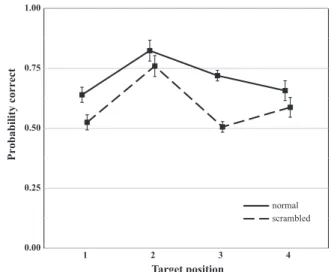
Consistent withSnell and Grainger (2017), identification accuracy rates were significantly higher for words presented in the normal con-dition than in the scrambled concon-dition (average identification accuracy rates: 71.0% vs. 59.5% respectively, z = 7.345, p < .001, seeTable 1
andFig. 2).2
Additional analyses were conducted to investigate the impact of target position on the behavioral sentence superiority effect. The results of four separate mixed-effect modelling analyses revealed that identi-fication accuracy was significantly higher for words presented in the normal condition than in the scrambled condition at all positions (po-sition 1: b = 0.8033, SE = 0.1850, z = 4.341, p < .001; po(po-sition 2:
b = 0.7219, SE = 0.2914, z = 2.477, p = .0132; position 3: b = 1.26943, SE = 0.20197, z = 6.285, p < .001; position 4: b = 0.5125, SE = 0.1837, z = 2.790, p < .01). Therefore, the
beha-vioral sentence superiority effect observed here is not driven by stimuli at a specific target position. We also explored possible interactions with presentation condition (normal vs. scrambled) and position. Given the numerically larger effects seen at position 3 (seeFig. 2), this was used as the reference in order to test whether the effects at this position were significantly larger than at the other positions. The interaction was significant at position 2, b = −0.61220, SE = 0.26911, z = −2.275,
p = .0229, and position 4, b = −0.70490, SE = 0.24750, z = −2.848, p < .01, and marginally significant at position 1, b = −0.46395,
SE = 0.23688, z = −1.959, p = .0502. Further analyses of a potential impact of target position investigated interactions between presentation condition (normal vs. scrambled) and leftward vs. rightward targets in one analysis, and central vs. peripheral targets in another analysis. The only effect to reach marginal significance was the interaction with central vs. peripheral targets, z = −1.835, p = 0.067 (all other |z|s < 1.5, ps > 0.15). This reflects the stronger effects observed with central targets, and particularly at position 3, as is clearly visible in
Fig. 2.3
3.2. ERP results
Only trials for which target words were correctly identified were included in the ERP analysis.4 ERP amplitude was reduced in the normal condition compared to the scrambled condition from 274 to 410 ms (cluster with p = .018, seeFig. 3for results of the permutation test). As can be seen inFig. 3, the reduced N400 in the normal condition was widely distributed.
4. Discussion
An ERP experiment tested post-cued identification of one word within a sequence of four briefly presented (RPVP) horizontally aligned words. The four words could either represent a grammatically correct Table 1
Results of mixed-effects logistic regression analysis.
Random effects Variance SD
Item Intercept 1.21969 1.1044 Scrambled vs. Normal 0.54789 0.7402 Subject Intercept 0.80226 0.8957 Scrambled vs. Normal 0.05945 0.2438
Fixed effects Estimate SE z value p
Scrambled vs. Normal 0.8097 0.1102 7.345 < .001 0.00 0.25 0.50 0.75 1.00 1 2 3 4 Target position Probability correct normal scrambled
Fig. 2. Mean identification accuracy rates with 95% confidence intervals
(Cousineau, 2005) at the four target positions in the normal sentence condition (solid line) and in the scrambled condition (dashed line).
2Post-hoc analyses of the behavioral data examined a potential role of type of
syntactic structure (dominant vs. non-dominant), and none was found (see Supplementary Materials for details of this analysis).
3It should be noted that the frequency and length of targets are similar across
target positions (average word frequency in Zipf values at position 1: 5.99, position 2: 4.97, position 3: 5.88, position 4: 4.92; average number of letters at position 1: 3.7, position 2: 4.3, position 3: 4.02, position 4: 4.3).
4We also conducted an analysis of the EEG data that included correct and
sequence (e.g., she can work now) or an ungrammatical scrambled se-quence of the same words (now she work can), and the probability of a correct identification of the same word (“work” in these examples) at the same position was compared across the two contexts. Snell and Grainger (2017)had previously reported that post-cued word identifi-cation accuracy was higher when the word was embedded in a syn-tactically correct sequence compared with an ungrammatical scrambled sequence. They interpreted this finding as reflecting a combination of parallel processing of word identities and the cascaded, interactive nature of processing that connects words with sentence-level structures. In the present work we recorded electrophysiological activity in order to rule out an alternative sophisticated-guessing account of this sentence superiority effect. The interactive-activation account of the sentence superiority effect predicted that the effect should be seen in the N400 ERP component, a component thought to reflect the inter-active processing between word identities and higher-level re-presentations (e.g.,Grainger & Holcomb, 2009). That is, rapidly acti-vated sentence-level structures should provide facilitatory feedback to on-going word identification processes when the target word is
embedded in a correct sentence. This was expected to reduce N400 amplitude, in line with prior work showing reductions in N400 am-plitude by priming single word targets with semantically related primes (e.g.,Bentin, McCarthy, & Wood, 1985; Holcomb, 1988) and prior work showing modulation of N400 amplitude as a function of the cloze probability of the target word in a sequence of words (e.g.,Freunberger & Roehm, 2017; Lau, Phillips, & Poeppel, 2008; Stites, Payne, & Federmeier, 2017). On the other hand, since the N400 is thought to reflect highly automatized linguistic processing, the slow inferential processes associated with sophisticated-guessing were not expected to modulate N400 amplitude.
The results of the present study are unequivocal. We found a robust widespread influence of sentence structure on the N400, with the effect becoming significant just before 300 ms post-sentence onset. This im-plies that by this time an initial representation of sentence structure had already been generated on the basis of partial information extracted from several words in parallel, and that sentence-level structures had already began to influence on-going word identification. Furthermore, post-hoc analyses (see Footnote2 andSupplementary Materials) re-vealed that the behavioral sentence superiority effect was not driven by a dominant syntactic structure inducing participants to expect certain word categories at certain positions.
FollowingSnell and Grainger (2017), we interpret the sentence superiority effect as reflecting interactive processing operating between word identities and sentence-level structures.Snell et al. (2017) pro-posed that during sentence reading, feedback from a sentence-level representation to individual word positions constrains the identification of these words via semantic and syntactic constraints. This is akin to using general sentence-level information to predict word identities, a process that would operate sequentially (incrementally) under standard RSVP presentation conditions, and in parallel under the present RPVP presentation conditions. This is why we predicted an effect on the N400 ERP component and not on syntactic components such as the left anterior negativity (LAN:Friederici, Hahne, & Mecklinger, 1996) or the P600 (Osterhout & Holcomb, 1992).Hagoort (2003)summarizes the ERP evidence for semantic and syntactic effects during sentence com-prehension, and the present findings fit well with the theoretical con-clusions that were drawn on the basis of this evidence.Hagoort (2003)
presents the arguments in favor of an incremental-interactive theory of sentence processing based on Vosse and Kempen (2000) model of sentence parsing (seeHagoort, 2013, for neuro-cognitive extensions of this computational model). The quasi-exclusive use of serial presenta-tion techniques (RSVP) in prior ERP research on written sentence comprehension is the likely reason for the incremental nature of pro-cessing that is advocated in this theorizing. In the present work we were able to demonstrate simultaneous processing of multiple words by using the novel RPVP paradigm.
Could our ERP sentence superiority effect be a reflection of differ-ences in working memory load in the normal vs. scrambled conditions? It might have been the case that grammatically correct sequences were more easily retained in memory during the 500 ms interval between stimulus offset and cue onset that was used in the present study. The fact that we observed the same pattern of behavioral effects as theSnell and Grainger (2017)study, where the partial-report cue appeared im-mediately after stimulus offset, suggests that this is unlikely to be the main factor driving our findings. Furthermore, our N400 sentence su-periority effect is clearly distinguishable from the pattern of ERP effects typically observed with visual short-term memory paradigms (e.g.,
Vogel & Machizawa, 2004). At the same time, it is likely that the sen-tence superiority effect seen in serial recall does reflect a combination of memory-specific mechanisms (e.g., chunking, redintegration) and linguistic sentence comprehension processes (e.g., Bonhage, Meyer, Gruber, Friederici, & Mueller, 2017; Jones & Farrell, 2018), and it is also clear that sentence comprehension must involve some form of short-term memory, as outlined in our own theoretical work (Snell et al., 2017). Future research could therefore investigate the similarities Fig. 3. Results of ERP analyses. (A) ERPs time-locked to the onset of word
se-quences. Up: ERPs at the Cz electrode; Down: Topography of voltage differences (normal minus scrambled) between 274 and 410 ms with the white star marking the location of the Cz electrode. (B) Results of the permutation test.
Y. Wen, et al. Cognition 189 (2019) 221–226
and differences in the sentence superiority effect observed in memory paradigms and the partial report RPVP paradigm as a means to tease apart the relative contribution of extra-linguistic factors (e.g., memory, attention) and the processing of linguistic information to the observed findings.
Finally, one notable difference with respect to the behavioral results reported by Snell and Grainger (2017)concerns the greater effect of sentence structure at position 3 found in the present work (seeFig. 2). This was supported by analyses revealing significant interactions be-tween the effects of presentation condition at position 3 and the effects observed at both positions 2 and 4. Here we tentatively suggest that small differences in eye fixation location could be the underlying factor. Indeed, there is evidence from eye-tracking studies that people tend to fixate to the right of a central fixation point (Jordan, Patching, & Milner, 1998). Therefore, the numerically larger effect at position 3 might be due to eye fixations tending to be closer to this position than to the other positions, and we note that future research with eye-movement recordings is needed to examine the impact of eye fixation location on the behavioral sentence superiority effect.
In sum, the current results provide evidence in favor of highly in-teractive processing operating between word-level and sentence-level representations during written sentence comprehension, and more generally for an account of reading that assumes a certain amount of parallel word processing guided by sentence-level constraints (Snell et al., 2017). Of course, given the abundant evidence for serial pro-cessing obtained from research recording eye movements during nat-ural reading (seeRayner, 2009, for a review), one could argue that the evidence for parallel processing is due to the specific paradigm that was used (RPVP). This might indeed be the case. However, assuming that no single paradigm is perfect, here we would simply advocate the use of multiple paradigms in reading research, each one providing a different window on the underlying mechanisms. It is by combining these dif-ferent views that future research can aspire to a greater understanding of how skilled readers derive meaning from text.
Acknowledgments
This research was supported by grants ERC ADG 742141, ANR-16-CONV-0002 (ILCB), and ANR-15-CE33-0002-01 (BLRI). We thank Agnès Guerre-Genton, Cécile Mahnich, Gabriela Meade and Jonathan Mirault for help with stimuli creation and data collection.
Declarations of interest
None.
Appendix A. Supplementary material
Supplementary data to this article can be found online athttps:// doi.org/10.1016/j.cognition.2019.04.013.
References
Baayen, R. H., Davidson, D. J., & Bates, D. M. (2008). Mixed-effects modeling with crossed random effects for subjects and items. Journal of Memory and Language, 59, 390–412.https://doi.org/10.1016/j.jml.2007.12.005.
Baddeley, A. D., Hitch, G. J., & Allen, R. J. (2009). Working memory and binding in sentence recall. Journal of Memory and Language, 61(3), 438–456.https://doi.org/10. 1016/j.jml.2009.05.004.
Barr, D. J., Levy, R., Scheepers, C., & Tily, H. J. (2013). Random effects structure for confirmatory hypothesis testing: Keep it maximal. Journal of Memory and Language,
68, 255–278.https://doi.org/10.1016/j.jml.2012.11.001.
Bates, D., Maechler, M., Bolker, B., & Walker, S. (2015). Fitting linear mixed-effects models using lme4. Journal of Statistical Software, 67, 1–48.
Bentin, S., McCarthy, G., & Wood, C. C. (1985). Event-related potentials, lexical decision and semantic priming. Electroencephalography and Clinical Neurophysiology, 60(4), 343–355.https://doi.org/10.1016/0013-4694(85)90008-2.
Bonhage, C. E., Meyer, L., Gruber, T., Friederici, A. D., & Mueller, J. L. (2017). Oscillatory EEG dynamics underlying automatic chunking during sentence processing.
NeuroImage, 152, 647–657.https://doi.org/10.1016/j.neuroimage.2017.03.018. Brysbaert, M. (2013). LEXTALE_FR: A fast, free, and efficient test to measure language
proficiency in French. Psychologica Belgica, 53, 23–37. https://doi.org/10.5334/pb-53-1-23.
Cattell, J. M. (1886). The time it takes to see and name objects. Mind, 11(41), 63–65. Cousineau, D. (2005). Confidence intervals in within-subject designs: A simpler solution
to Loftus and Masson’s method. Tutorials in Quantitative Methods for Psychology, 1(1), 42–45.https://doi.org/10.20982/tqmp.01.1.p042.
Delorme, A., & Makeig, S. (2004). EEGLAB: An open source toolbox for analysis of single-trial EEG dynamics including independent component analysis. Journal of
Neuroscience Methods, 134, 9–21.https://doi.org/10.1016/j.jneumeth.2003.10.009. Ferrand, L., New, B., Brysbaert, M., Keuleers, E., Bonin, P., Méot, A., & Pallier, C. (2010).
The French lexicon project: Lexical decision data for 38,840 French words and 38,840 pseudowords. Behavior Research Methods, 42, 488–496.https://doi.org/10.3758/ BRM.42.2.488.
Freunberger, D., & Roehm, D. (2017). The costs of being certain: Brain potential evidence for linguistic preactivation in sentence processing. Psychophysiology, 54(6), 824–832.
https://doi.org/10.1111/psyp.12848.
Friederici, A. D., Hahne, A., & Mecklinger, A. (1996). Temporal structure of syntactic parsing: Early and late event-related brain potential effects. Journal of Experimental
Psychology. Learning, Memory, and Cognition, 22(5), 1219–1248.https://doi.org/10. 1037/0278-7393.22.5.1219.
Grainger, J., & Holcomb, P. J. (2009). Watching the word go by: On the time-course of component processes in visual word recognition. Language and Linguistics Compass, 3, 128–156.https://doi.org/10.1111/j.1749-818X.2008.00121.x.
Hagoort, P. (2003). Interplay between syntax and semantics during sentence compre-hension: ERP effects of combining syntactic and semantic violations. Journal of
Cognitive Neuroscience, 15(6), 883–899.https://doi.org/10.1162/ 089892903322370807.
Hagoort, P. (2013). MUC (Memory, Unification, Control) and beyond. Frontiers in
Psychology, 4, 416.https://doi.org/10.3389/fpsyg.2013.00416.
Holcomb, P. J. (1988). Automatic and attentional processing: An event-related brain potential analysis of semantic priming. Brain and Language, 35(1), 66–85.https://doi. org/10.1016/0093-934X(88)90101-0.
Jaeger, T. F. (2008). Categorical data analysis: Away from ANOVAs (transformation or not) and towards logit mixed models. Journal of Memory and Language, 59(4), 434–446.https://doi.org/10.1016/j.jml.2007.11.007.
Johnston, J. C. (1978). A test of the Sophisticated Guessing Theory of word perception.
Cognitive Psychology, 10(2), 123–153.https://doi.org/10.1016/0010-0285(78) 90011-7.
Jones, T., & Farrell, S. (2018). Does syntax bias serial order reconstruction of verbal short-term memory? Journal of Memory and Language, 100, 98–122.https://doi.org/10. 1016/j.jml.2018.02.001.
Jordan, T. R., Patching, G. R., & Milner, A. D. (1998). Central fixations are inadequately controlled by instructions alone: Implications for studying cerebral asymmetry. The
Quarterly Journal of Experimental Psychology Section A, 51(2), 371–391.https://doi. org/10.1080/713755764.
Koriat, A., & Greenberg, S. N. (1994). The extraction of phrase structure during reading: Evidence from letter detection errors. Psychonomic Bulletin & Review, 1(3), 345–356.
https://doi.org/10.3758/BF03213976.
Kutas, M., & Federmeier, K. D. (2011). Thirty years and counting: Finding meaning in the N400 component of the event-related brain potential (ERP). Annual Review of
Psychology, 62, 621–647.https://doi.org/10.1146/annurev.psych.093008.131123. Lau, E. F., Phillips, C., & Poeppel, D. (2008). A cortical network for semantics:
(de)con-structing the N400. Nature Reviews Neuroscience, 9, 920–933.https://doi.org/10. 1038/nrn2532.
Lopez-Calderon, J., & Luck, S. J. (2014). ERPLAB: An open-source toolbox for the analysis of event-related potentials. Frontiers in Human Neuroscience, 8, 213.https://doi.org/ 10.3389/fnhum.2014.00213.
MacDonald, M. C., Pearlmutter, N. J., & Seidenberg, M. S. (1994). The lexical nature of syntactic ambiguity resolution. Psychological Review, 101(4), 676–703.https://doi. org/10.1037/0033-295X.101.4.676.
Maris, E., & Oostenveld, R. (2007). Nonparametric statistical testing of EEG-and MEG-data. Journal of Neuroscience Methods, 164, 177–190.https://doi.org/10.1016/j. jneumeth.2007.03.024.
Mathôt, S., Schreij, D., & Theeuwes, J. (2012). OpenSesame: An open-source, graphical experiment builder for the social sciences. Behavior Research Methods, 44(2), 314–324.https://doi.org/10.3758/s13428-011-0168-7.
McClelland, J. L., & Rumelhart, D. E. (1981). An interactive activation model of context effects in letter perception: I. An account of basic findings. Psychological Review,
88(5), 375–407.https://doi.org/10.1037/0033-295X.88.5.375.
Metting van Rijn, A. C., Peper, A., & Grimbergen, C. A. (1990). High-quality recording of bioelectric events. Medical & Biological Engineering & Computing, 28, 389–397. Miller, G. A., & Isard, S. (1964). Free recall of self-embedded english sentences.
Information and Control, 7(3), 292–303.https://doi.org/10.1016/S0019-9958(64) 90310-9.
Oostenveld, R., Fries, P., Maris, E., & Schoffelen, J. M. (2010). FieldTrip: Open source software for advanced analysis of MEG, EEG, and invasive electrophysiological data.
Computational Intelligence and Neuroscience, 2011, 1–9.https://doi.org/10.1155/ 2011/156869.
Osterhout, L., & Holcomb, P. (1992). Event-related brain potentials elicited by syntactic anomaly. Journal of Memory and Language, 31, 785–806.https://doi.org/10.1016/ 0749-596X(92)90039-Z.
R Core Team. (2017). R: A Language and Environment for Statistical Computing. Rayner, K. (2009). Eye movements and attention in reading, scene perception, and visual
org/10.1080/17470210902816461.
Reicher, G. M. (1969). Perceptual recognition as a function of meaningfulness of stimulus material. Journal of Experimental Psychology, 81(2), 275–280.https://doi.org/10. 1037/h0027768.
Reichle, E. D., Liversedge, S. P., Pollatsek, A., & Rayner, K. (2009). Encoding multiple words simultaneously in reading is implausible. Trends in Cognitive Sciences, 13(3), 115–119.https://doi.org/10.1016/j.tics.2008.12.002.
Rumelhart, D. E. (1977). Toward an interactive model of reading. In S. Dornic (Ed.). Attention and performance (pp. 573–603). Hillsdale, NJ: Erlbaum.
Scheerer, E. (1981). Early German approaches to experimental reading research: The contributions of Wilhelm Wundt and Ernst Meumann. Psychological Research, 43(2), 111–130.https://doi.org/10.1007/BF00309825.
Schutter, D. J. L. G., Leitner, C., Kenemans, J. L., & van Honk, J. (2006).
Electrophysiological correlates of cortico-subcortical interaction: A cross-frequency spectral EEG analysis. Clinical Neurophysiology, 117, 381–387.https://doi.org/10. 1016/j.clinph.2005.09.021.
Snell, J., Declerck, M., & Grainger, J. (2018). Parallel semantic processing in reading revisited: effects of translation equivalents in bilingual readers. Language, Cognition
and Neuroscience, 33(5), 563–574.https://doi.org/10.1080/23273798.2017. 1392583.
Snell, J., & Grainger, J. (2017). The sentence superiority effect revisited. Cognition, 168, 217–221.https://doi.org/10.1016/j.cognition.2017.07.003.
Snell, J., Meeter, M., & Grainger, J. (2017). Evidence for simultaneous syntactic proces-sing of multiple words during reading. PLoS ONE, 12(3),https://doi.org/10.1371/ journal.pone.0173720.
Stites, M. C., Payne, B. R., & Federmeier, K. D. (2017). Getting ahead of yourself: Parafoveal word expectancy modulates the N400 during sentence reading. Cognitive,
Affective, & Behavioral Neuroscience, 17(3), 475–490.https://doi.org/10.3758/ s13415-016-0492-6.
Thierry, G., & Wu, Y. J. (2007). Brain potentials reveal unconscious translation during foreign language comprehension. Proceedings of the National Academy of Sciences of
the USA, 104, 12530–12535.https://doi.org/10.1073/pnas.0609927104. van Heuven, W. J. B., Mandera, P., Keuleers, E., & Brysbaert, M. (2014). SUBTLEX-UK: A
new and improved word frequency database for British English. The Quarterly Journal
of Experimental Psychology, 67, 1176–1190.https://doi.org/10.1080/17470218. 2013.850521.
Vogel, E. K., & Machizawa, M. G. (2004). Neural activity predicts individual differences in visual working memory capacity. Nature, 428, 748.https://doi.org/10.1038/ nature02447.
Vosse, T., & Kempen, G. (2000). Syntactic structure assembly in human parsing: A computational model based on competitive inhibition and a lexicalist grammar.
Cognition, 75(2), 105–143.https://doi.org/10.1016/S0010-0277(00)00063-9. Wheeler, D. D. (1970). Processes in word recognition. Cognitive Psychology, 1(1), 59–85.
https://doi.org/10.1016/0010-0285(70)90005-8.
Y. Wen, et al. Cognition 189 (2019) 221–226