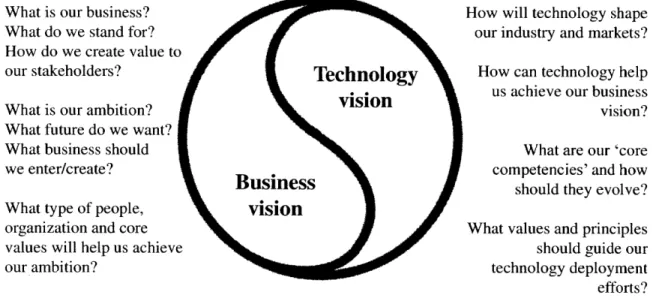
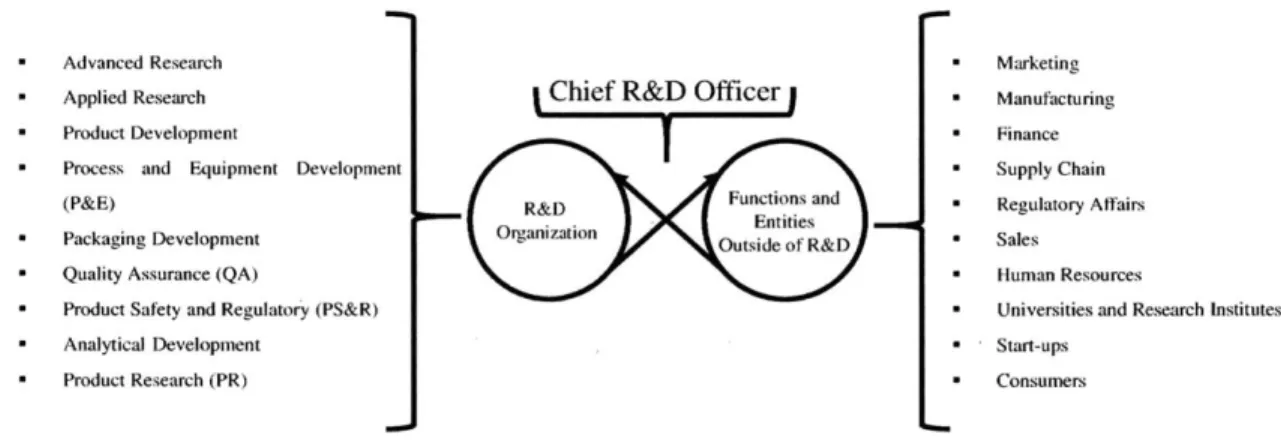
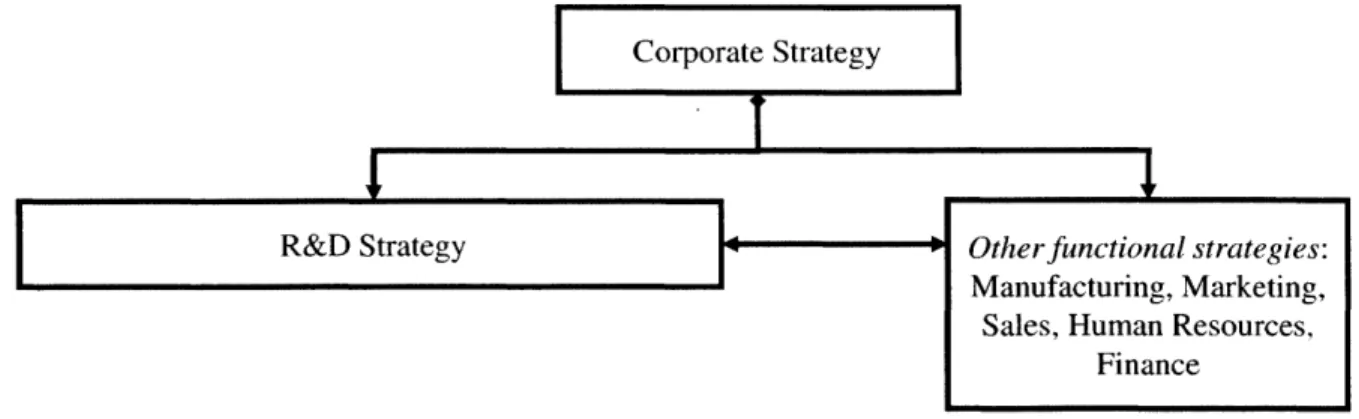
The Chief Research and Development (R&D) Officer's Contribution to
Innovation: A Study in Consumer Packaged Goods Multinationals
by
Javier Rodriguez Hefferan
B. Eng., Chemical Engineering Universidad Iberoamericana, Mexico, 2009
Submitted to the System Design and Management Program in Partial Fulfillment of the Requirements for the Degree of
Master of Science in Engineering and Management
MASSAcUSrS INSTITUTE
at the OF TECHNOLOGY
Massachusetts Institute of Technology
OCT 2
6
2016
September 2016
LIBRARIES
Javier Rodriguez Hefferan. All rights reserved.
AmCHIVES
The author hereby grants to MIT permission to reproduce and to distribute publicly paper andelectronic copies of this thesis document in whole or in part in any medium now known or hereafter created.
Signature redacted
Signature of Author:Javier Rodriguez Hefferan System Design and Management Program August 5, 2016
Signature redacted
Certified by:
David Nifno, Ph. D. Se ibr Lecturer, Gordon-MIT Engineering Leadership Program Thesis Supervisor
Signature redacted
Accepted by:
Warren Seering eber-Shaughness Professor of Mechanical Engineering
The Chief Research and Development (R&D) Officer's Contribution to
Innovation: A Study in Consumer Packaged Goods Multinationals
by
Javier Rodriguez Hefferan
Submitted to the System Design and Management Program on August 5, 2016 in Partial Fulfillment of the
Requirements for the Degree of
Master of Science in Engineering and Management
Abstract
The Consumer Packaged Goods (CPG) industry faces challenges that are making it increasingly harder for CPG multinational companies to compete. The lack of differentiation in CPG, evolving consumer preferences, and the need to offer the consumer a unique and valuable experience is requiring CPG multinational companies to continuously innovate. The Research and Development (R&D) function helps to overcome the pressing challenges that the CPG industry faces by contributing to the overall innovation that a firm can deliver. The underlying question is how R&D creates innovation in the context of a CPG multinational. Such innovation, in the form of new products and processes, would seemingly require a central R&D executive, defined in this thesis as the Chief R&D Officer, the person who is accountable for creating innovation for the firm in the R&D context. To contribute to innovation, the Chief R&D Officer must not only set the direction for R&D, but also execute this direction in terms of formulating the R&D strategy, and then managing the R&D organizational structure and leading the R&D organizational culture. The proposition is that the evolving role of the Chief R&D Officer is demanding that these senior executives think systematically about these elements to guarantee the short-term and long-term competitiveness of the R&D organization. If the Chief R&D Officer fonrulates the right strategy but has an inefficient organizational structure or lacks an innovative organizational culture, then the R&D organization will fail in creating innovation for the firm. This thesis also explores how Chief R&D Officers in the CPG multinational companies have coped with these key elements to achieve successful innovation..
Thesis Supervisor: David Niflo, Ph. D.
Title: Senior Lecturer, Gordon-MIT Engineering Leadership Program Massachusetts Institute of Technology
Acknowledgement
I would like to express my sincere gratitude to my advisor, Professor David Niho for taking me under his wing throughout this thesis journey. His guidance, support, patience and empowerment made this experience truly rewarding for me. I am indebted to him for deeply listening to my questions and providing valuable answers, for keeping me on focus, and for being my mentor. I would also like to thank Patrick Hale, Director of MIT's System Design and Management (SDM) Program for believing in me and granting me the unique opportunity to study for my postgraduate degree in one of the most prestigious and renowned universities in the world. My gratitude also extends to the SDM staff for all their help and dedication throughout this academic experience. Moreover, I would also like to thank my SDM Fellow classmates as well as all the people I established bonds with during this past year. Establishing these bonds has allowed me to gain a wider view of the world and has nurtured me immensely as an individual.
Dedication
I would like to dedicate this thesis to the central pillars of my life, my mother, Blanca, and my father, Fernando, who have always unconditionally supported and praised the decisions I have made in my life. Their infinite love has always given me the courage and strength to follow my dreams and to fight for them. To my sister, Monica for always providing me counsel in moments of struggle and for always making me feel that fraternal bonds are stronger than anything in this world. Last but not least, I want to thank the love of my life, Rodrigo, for providing the proof that love can move mountains. This last year would have not been the same without you supporting me and encouraging me to always aspire for greater things in life. Your kind, enormous heart and shining light have always been guiding me and supporting me throughout these years. I am forever grateful for having you by my side every day of my life and for always bringing out the best of me.
Table of Contents
Abstract... 3 Acknowledgem ent... 4 Dedication... 4 List of Figures...8 List of Acronym s ... 10 Chapter 1 1 Introduction... 111.1 1 Research M otivation and Research Question...I 1 1.2 Thesis Organization ... 15
Chapter 2 1 Consumer Packaged Goods (CPG): Industry and Product Characteristics... 18
2.1 I I Introduction to CPG ... 18
2.2 I General Characteristics of CPG and CPG Industry... 19
2.3 I Largest CPG M ultinational Companies ... 21
2.4 I Trends and Challenges in the CPG Industry ... 25
2.5 I Overview of Challenges in CPG Organizations: Impact on Research and Development (R&D) .. 27
2.6 I Key Takeaways: CPG Industry and Product Characteristics ... 28
Chapter 3 I Innovation and Research and Development (R&D)... 29
3.1 1 Definition of Innovation...29
3.2 I Types of Innovation and New Product Classification... 33
3.3 I W hy Do CPG Companies Need Innovation?... .. . .. . .. . .. .. . .. . .. . . ... . .. . .. . .. . . 36
3.4 I W hat is Research and Development (R&D)?... 37
3.4.1 I Definition of "Research" and "Development"... 38
3.4.2 Types of R&D ... 39
3.4.3 I Strategic Role of R&D: Contribution to Innovation ... 41
3.5 1 Key Takeaways: Innovation and R&D ... 42
Chapter 4 I The Role of the Chief Research and Development (R&D) Officer ... 44
4.1 1 The Evolution of the Chief R&D Officer's Role ... 44
4.1.1 1 The Emergence of the Chief R&D Officer's Role ... 44
4.1.2 I Chief R&D Officer in CPG: Innovation, Technology and R&D ... 45
4.2
I
Chief R&D Officer's Core Responsibilities... 484.2.1 1 Difference between M anaging and Leading ... 48
4.2.2 1 Setting the direction for R&D ... 49
4.2.3 1 Chief R&D Officer's Managing and Leading Responsibilities ... 51
4.3 1 Integration of Diverse Functions: R&D CPG Organization ... 53
Chapter 5 I Formulating the R&D Strategy ... 57
5.1 1 Alignment of Corporate Strategy and R&D Strategy: An overview... 57
5.1.1 1 Definition of Corporate Strategy ... 58
5.1.2
I
Corporate Strategy and R&D Strategy ... 585.2 I Formulating the R&D Strategy: Chief R&D Officer Key Decisions... 60
5.2.1 1 Decision 1: Technology Roadmap ... 64
5.2.2 1 Decision 2: R&D Project Portfolio ... 65
5.2.3 I Decision 3: Investment in Corporate R&D ... 67
5.2.4
I
Consequences of the R&D strategy ... 685.3 Case study from Nestld's former Chief R&D Officer... 68
5.3.1
1
Nestl6: Company Overview ... 695.3.2 1 Chief R&D Officer's Key Pillars for aligning R&D strategy with corporate strategy ... 70
5.4
I
Key Takeaways: Formulating the R&D Strategy ... 75Chapter 6 I Managing the R&D Organizational Structure ... 77
6.1 1 Five structural elements of the R&D Organization: Chief R&D Officer Choices...77
6.2
I
Structural Elements I and 2: Functional versus Project versus Matrix R&D Organization ... 806.2.1 1 Input-Oriented (Functional) versus Output-Oriented (Project) Structure ... 81
6.2.2
I
Line versus Matrix versus Project Organization ... 836.2.3 1 Nestld's Matrix Organization: Leveraging R&D Capabilities ... 85
6.3
I
Structural Elements 3 and 4: The Global R&D Organization...876.3.1 1 Factors driving Global R&D ... 87
6.3.2
I
Five typical forms of international R&D organizations ... 886.3.3 1 Nestld's R&D Hub Model... 96
6.4
I
Structural Element 5: Open Innovation versus Closed Innovation in R&D ... 986.4.1
I
Overview of Open Innovation versus Closed Innovation ... 996.4.2
1
Open Innovation Models in the CPG Multinational Companies... 1026.4.3 1 Procter and Gamble's (P&G) "Connect and Develop" Program... 105
6.5
I
Key Takeaways: Managing the R&D Organizational Structure ... 107Chapter 7 I Leading the R&D Organizational Culture... 109
7.1 1 Elements that Influence R&D Organizational Culture: Chief R&D Considerations...109
7.1.1
1
Overview of Organizational Culture and Leadership... 1097.1.2
1
Overview of the elements that influence R&D Organizational Culture...111
7.2
1
Element 1: Vision and Strategy... 1137.3
I
Element 2: Structure, Breaking R&D Isolation... 1147.3.1 1 Nestld's R&D MicroMBA Program: Breaking Silos... 115
7.3.2
I
Overview of Building a Culture of Open Innovation (01)... 1177.4
I
Element 3: Support Mechanisms in R&D... 1197.5.1
I
Characteristics of R&D activities and R& D environment ... I22...7.5.2
I
Behaviors, values and practices beneficial for R&D ... 1247.6
I
Key Takeaways: Leading R&D Organizational Culture... 128Chapter 8 I Practical and Research Im plications...130
8.1 1 Practical Implications for Chief R&D Officers... 130
8.2 I Research
Implications
...133
Chapter 9 I Conclusions... 134
List of Figures
Number Page
Figure 1. Thesis topics in the Research and Development (R&D) context ... 13
Figure 2. Fifty largest CPG companies based on Net Sales in Million U.S. dollars ... 22
Figure 3. The Innovation Radar ... 30
Figure 4. New Product Classification ... 35
Figure 5. The interdependence of technology and business visions ... 50
Figure 6. The Chief R&D Officer Relevance: Integration of Diverse Functions ... 55
Figure 7. Corporate strategy and R&D strategy. ... 59
Figure 8. The Chief R&D Officer as the 'architect' of the R&D organization ... 61
Figure 9. Generic example of a technology roadmap ... 65
Figure 10. Innovation/Renovation Five-generation Pipeline ... 72
Figure 11. Typical Organization issues in R&D... 78
Figure 12. Selecting appropriate R&D structures... 84
Figure 13. Nestl6 Matrix Organization, including R&D ... 86
Figure 14. Five concepts of R&D organizational design... 89
Figure 15. Ethnocentric Centralized R&D... 91
Figure 16. Geocentric Centralized R&D... 92
Figure 17. Polycentric Decentralized R&D ... 93
Figure 18. R & D H ub M odel ... 94
Figure 19. Integrated R&D Network ... 96
Figure 20. Nestl6 R&D Global Strength/Local Development ... 98
Figure 21. Closed Innovation Paradigm ... 99
Figure 22. Open Innovation Paradigm... 100
Figure 23. Sharing is Winning (SiW) Model... 103
List of Tables
Number Page
Table 1. Top fifteen leading CPG companies ... 21
Table 2. Details of CPG companies: Products and General Structure ... 24
Table 3. The Twelve Dimensions of Business Innovation... 31
Table 4. Key functions involved for creating new products ... 49
Table 5. Advantages of different types of R&D organizations... 83
Table 6. Five ideal forms of international R&D organization ... 90
AGs BTC CEO CFO CIO CSO CTO C&D CPG EVP FMCG HR MIT M&A NIHS NRC NIH NHW 0I P&E P&G PD PR PS&R PTCs
QA
RB R&D SVP SiW SBUs STC TTM VP WFGMList of Acronyms
Application GroupsBusiness Technology Center Chief Executive Officer Chief Financial Officer Chief Innovation Officer Chief Scientific Officer Chief Technology Officer Connect and Develop Consumer Packaged Goods Executive Vice President Fast moving consumer goods Human Resources
Massachusetts Institute of Technology Mergers and Acquisitions
Nestle Institute of Health Sciences Nestle Research Center
Not-Invented-Here
Nutrition, Health and Wellness Open Innovation
Process and Equipment Development Procter & Gamble
Product Development Product Research
Product Safety and Regulatory Product Technology Centers Quality Assurance
Reckitt Benckiser
Research and Development Senior Vice President Sharing is Winning Strategic Business Units System Technology Center Time-to-market
Vice President
Chapter 1 I Introduction
1.1 I Research Motivation and Research Question
The Consumer Packaged Goods (CPG) industry faces challenges that are making it increasingly harder for CPG multinational companies to compete. At a macro level, the CPG industry operates in a mature market. Mature markets are characterized by less market potential and less product differentiation, but higher competitive forces (Kalish, 2007). At the micro level, consumers have become more demanding and selective, and their preferences are evolving faster than ever before. As a consequence, product lifecycles have been reduced. This leads to a higher number of available offerings to the consumers in the marketplace, and therefore, a higher risk of substitution (Noordman & Meijer, 2010). In addition, there has been an increasing awareness in consumers regarding health and wellness. Consumers are demanding healthier and environmentally sustainable products. This high-pressure environment is challenging CPG companies to introduce highly successful and differentiated new products in the marketplace at faster rates. At the same time, these products need to offer a unique and valuable experience to the consumer. If the consumer dislikes the product, the repurchase cycle ends. To cope with these challenges, CPG multinational companies need to continuously create innovation.
This research focuses on how the Research and Development (R&D) function in the CPG industry creates innovation for the firm. In fact, the R&D function is at the forefront of the innovation process and is responsible for discovering new knowledge and ideas in scientific and technological areas and materializing these ideas into new products, processes or services (Carleton, Cockayne & Sawatani, 2015). Moreover, innovation can be viewed as holistic as it can generate value for the consumer in multiple dimensions. Innovation can be created by a firm through four main dimensions: (1) the form of the products it produces, (2) the customers it serves, (3) the processes it utilizes and (4) the markets where its offerings are available (Sawhney, Wolcott & Arroniz, 2007). This thesis proposes that R&D acts as a key contributor in three of the four main dimensions. Therefore, R&D acts as a key contributor to create innovation for the firm.
Furthermore, new products and process innovations vary along two different degrees of innovation: incremental and radical. Incremental innovation refers to making slight modifications to the existing products. Radical innovation refers to new products delivered in entirely new ways,
therefore, offering the consumer an entirely new value proposition (Davila, Epstein & Sheldon, 2006). The CPG industry generally creates incremental innovations rather than radical innovations (Grunert et al., 1997). While incremental innovations secure the short-term survival of a company, radical innovations are necessary to sustain the company's long-term growth (Tushman & O'Reilly, 2008). Innovation generated by R&D creates sustainable growth in a company and that R&D brings value to the firm in three dimensions: (1) creating differentiated products, (2) decreasing the time-to-market, and (3) delivering radical innovations (Holtzman, 2008). Thus, the value that the R&D organization creates helps to overcome the pressing challenges that the CPG industry is facing by the delivery of both types of innovation.
However, the delivery of successful innovation by R&D in the context of a CPG multinational company is a complex task. It requires asking strategic questions about: (1) when to make the necessary investments on the technologies that are going to sustain the business of tomorrow, (2) how to globalize the R&D activity, (3) how to balance both short- and long-term R&D strategy, (4) how to structure the R&D organization so that it can be more responsive to the business, and (5) how to change the mindset of the R&D organization by introducing a stronger business focus. The need to have a central R&D executive who addresses the decisions and trade-offs associated with these strategic questions and who leads and manages the R&D organization is the core of what is explored in this research paper. More specifically, this research examines the role of the central R&D executive, defined in this thesis as Chief Research and Development (R&D) Officer, the person who is accountable for generating innovation in the R&D context.
The Chief R&D Officer must not only set the direction for R&D, but also execute this direction in terms of formulating the R&D strategy, and then managing the R&D organizational structure and leading the R&D organizational culture. In this thesis, the proposal is that the Chief R&D Officer needs to approach these elements from a holistic perspective so that the R&D organization can contribute positively to innovation. Consequently, this thesis explores the following question:
In the context of the CPG industry, how does the Chief R&D Officer contribute to innovation by taking a systematic approach in terms of formulating R&D strategy, managing the R&D organizational structure and leading the R&D organizational culture?
The system to be explored in this is portrayed in Figure 1.
Figure 1. Thesis topics in the Research and Development (R&D) context.
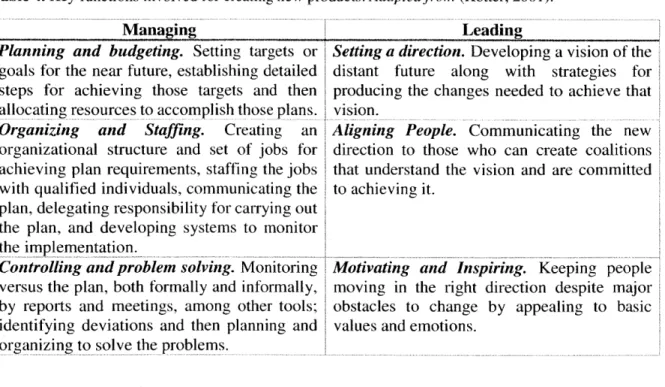
This thesis will cover the following topics to help answer the central question of this research paper. First, it is necessary to clarify that leadership and management are different but complementary, and they depend on each other to function (Kotter, 2001). Management copes with complexity, which implies planning, providing organizational structure, controlling and problem solving. Leadership copes with change, which implies setting a direction, and aligning, motivating and inspiring people in an organization. Due to the inherent dependency of these two systems of action, this thesis suggests that a great part of the Chief R&D Officer's core responsibilities reside in:
Formulating the R&D strategy. In the corporate context, Crawley, Cameron and Selva (2016) define corporate strategy as the "means by which the firm achieves corporate goals, such as increasing profitability and building competitive shareholder value." Chiesa (2001 ) elaborates that that R&D strategy consists of "the definition of set R&D initiatives required to achieve the fixed objectives defined within the overall strategic framework of the firm."
Research and
Leadership Development
and (R&D)
Management Context
R&D R&D R&D
Strategyv Organizational Organizational
Structure Culture
The Chief R&D Officer not only has to set the direction for R&D, but also has to decide which initiatives are going to be pursued. These initiatives must be closely aligned with the overall firm's strategy.
" Managing the organizational structure once the R&D strategy has been decided. This includes decisions regarding the centralization or decentralization to internationalize R&D activities, the allocation of R&D resources, the orientation of the organization (project, function or matrix organization), and the use of external versus internal resources (Galbraith, 2002; Rouseel, Saad & Erickson, 1991).
* Leading the organizational culture to nurture the R&D structure and contribute to the R&D strategy. Leading the R&D organizational culture involves transforming the R&D organization by instilling a sense of purpose, direction and focus in all technical departments and changing the mindset in R&D so the R&D organization can be more responsive to business demands. Schein (2010) argues that the impact that leaders have is
crucial for establishing or influencing the culture of an organization.
Finally, on a personal note, I worked in an R&D organization for a CPG multinational company before starting my postgraduate degree at the Massachusetts Institute of Technology (MIT) and I was always interested to explore the Chief R&D Officer's role in this dynamic and demanding industry and understand the challenges associated with leading and managing the R&D organization. In fact, managing and leading the R&D organization poses both internal and external challenges if compared with other functions. Internal challenges are associated with: (1) the art of integrating the efforts of many disciplines (Jain, Triandis & Wagner, 2010) due to the diverse internal teams that comprise the R&D organization and the wide array of functions that R&D must interact with (e.g., marketing) to bring new products and processes to the market; (2) the alignment and integration of R&D with the rest of the organization to execute the overall firm's strategy; and (3) the unique culture of the R&D organization, as it is assumed to have highly creative people, with above-average intelligence quotients and advanced graduate training (Roussel, Saad & Erickson, 1991). External challenges are associated with (1) the highly uncertain and unpredictable environment in which the R&D activities generally take place; and (2) the globalization of markets, the diversification of technical and scientific expertise, and the continuous change in technologies (Traill & Grunert, 1997). Exploring these challenges in terms of the central R&D topics this thesis
proposes (R&D strategy, R&D organizational structure, and R&D organizational culture) could provide an initial insight regarding the complexity associated with leading and managing the R&D organization in a CPG multinational company. Thus, this research paper could be a valuable contribution for aspiring R&D leaders and managers in the CPG industry as they build their careers in the R&D organization.
1.2 1 Thesis Organization
This thesis is organized as follows. First, this research introduces an overview of the CPG industry, the challenges the CPG industry is facing and the necessity of having an R&D function that drives the firm's innovation. Next, it explores the term "innovation" and specifically details how does the R&D function contributes to the firm's innovation. Then, the thesis details the relevance of the Chief R&D Officer's role and the implications for formulating the R&D strategy, managing the R&D organizational structure and leading the R&D organizational culture.
Chapter 2 I Consumer Packaged Goods (CPG): Industry and Product Characteristics This chapter outlines the general characteristics of the consumer packaged goods (CPG) industry and the scope of CPG multinational companies that are explored in this thesis. It also introduces the challenges and trends this industry is facing and highlights the importance of introducing successful new products to the market to guarantee the firm's competitiveness. The chapter concludes by elucidating the particular challenges in the CPG organization and the impact they have on R&D with regard to strategy, structure and culture.
Chapter 3 1 Innovation and Research and Development (R&D)
This chapter provides an overview of the definition of innovation, types of innovation, and classification of new products. It specifies the need of having innovation in the CPG industry to differentiate products and create value for consumers. Moreover, this chapter remarks how specifically R&D contributes to the overall firm's innovation and clarifies the distinction between
Research and Development. It also provides an insight on how the transition is made between Research and Development in CPG multinational companies.
Chapter 4 I The Role of the Chief Research and Development (R&D) Officer
This chapter provides an overview of the evolution of the Chief R&D Officer's role and the emergence of a senior executive as part of the executive leadership team of a multinational company. The Chief R&D Officer's role evolution has demanded this senior executive to not only lead, but also manage the R&D organization. This chapter explains the role of the Chief R&D Officer in CPG multinational companies as the person who has an oversight of Innovation, Technology and R&D. It also establishes the comparison against other industries (e.g. high-tech) and then provides the Chief R&D Officer's core responsibilities and establishes that this senior executive has to not only set the direction for R&D, but also execute this direction in terms of formulating the R&D strategy, managing the R&D organizational structure and leading the R&D organizational culture.
Additionally, this chapter provides an overview of the functions that can interact with R&D in a CPG Organization and the internal functions that can comprise an R&D CPG organization. This explanation is presented to support Jain et al.'s (2010) point that managing and leading the R&D organization is the art of integrating the efforts of many disciplines. The objective of introducing this overview is to emphasize that the Chief R&D Officer has to establish the strategy, structure and culture to enable the collaboration internally, across the R&D organization as well as externally, with business functions and external partners.
Chapter 5 I Formulating the R&D Strategy
This chapter provides an overview of corporate strategy and the need for alignment of the R&D strategy with the company's strategy. It then addresses the key decisions the Chief R&D Officer has to make when formulating the R&D strategy: deciding the amount to invest in R&D, designing a technology roadmap and selecting on the R&D project portfolio. The chapter includes a case study from the CPG industry to illustrate the Chief R&D Officer's relevance in aligning R&D strategy with corporate strategy.
Chapter 6 I Managing the R&D Organizational Structure
This chapter introduces the dimensions of structural choice distinguished by Rouseel, Saad and Erickson (1991) that need to be addressed by the Chief R&D Officer. This chapter explores these dimensions by introducing the frameworks related to the use of external versus internal resources, centralization or decentralization of R&D. allocation of R&D resources, and the orientation of the organization (project, function or matrix organization). Examples and case studies from Chief R&D Officers from the CPG Industry are included to clarify the frameworks.
Chapter 7 I Leading the R&D Organizational Culture
This chapter explores the implications of leading the R&D organizational culture. The Chief R&D Officer needs to understand the elements that influence R&D organizational culture so he or she can act upon them. In addition, this chapter highlights Schein's (2010) theory about the impact that leaders have in influencing the culture and also explains how the Chief R&D Officer can leverage the organizational culture for fostering innovation. The chapter includes practices and behaviors from Chief R&D Officers in CPG multinational companies that demonstrate the importance of these R&D senior executives in shaping the culture of an R&D organization.
Chapter 8 I Practical and Research Implications
This chapter provides a comprehensive summary of the need for Chief R&D Officers to understand the implications of formulating the R&D strategy, managing the organizational structure and leading the organization culture of an R&D organization to achieve the desired outcome: innovation. The chapter elaborates on theories of the evolving role of the Chief R&D Officer and the potential implications for the CPG companies. The chapter ends with the research implications that are based on, or extensions of, this thesis.
Chapter 9 I Conclusions
Chapter 2 I Consumer Packaged Goods (CPG): Industry and Product
Characteristics
This chapter provides an overview of CPG, the CPG industry and the largest CPG multinational companies. Understanding the CPG characteristics both on a macro level (CPG industry) and micro level (CPG consumer) is important as it sets the stage for showcasing the trends and challenges that CPG multinational companies face nowadays. CPG multinational companies need to react to these trends and challenges in order to guarantee its short- and long-term competitiveness. The R&D function, as part of the CPG organization, is influenced by the firm's strategy. As a consequence, decisions and trade-offs associated with strategy, structure and culture need to be made in the R&D organization.
2.1 1 Introduction to CPG
This section provides the context to understand how CPG differ from the broad universe of products. Products can be classified intro three groups according to durability and tangibility
(Kotler & Keller, 2016):
1. Nondurable goods are tangible goods that are normally consumed in one or a few uses. Because these goods are purchased on a frequent basis, the appropriate strategy is to make them readily available in many locations, charge only a small markup, and advertise heavily to induce trial and build preference. Shampoo, beverages, and laundry soaps are examples of nondurable goods.
2. Durable goods are tangible goods that normally survive many uses. These require more personal selling and service, have a higher margin, and require more seller guarantees. Refrigerators, clothing, and machine tools are examples of durable goods.
3. Services are intangible, inseparable and variable products that generally require more quality control, supplier credibility, and adaptability. Haircuts and legal advice are examples of services.
Therefore, from this classification, consumer packaged goods (CPG) usually refer to nondurable products that are purchased on a frequent basis by consumers with minimal effort (Kotler & Keller, 2016). Since CPG are generally replaced on a more frequent basis, they are sometimes referred to as fast moving consumer goods (FMCG) (Geissel, 2008).
Additionally, these products have a short lifecycle (due to their high demand or their perishability) and sell quickly at relatively low cost. Even though the absolute profit made by these types of products is low, the selling volume is usually very high and the cumulative profit can be significant. Therefore, the CPG industry is classified as a low margin and high volume business (Roshif, 2015).
Majumdar (2007) classifies CPG in four main categories:
1. Personal Care Products. Comprises oral care, hair care, personal wash, cosmetics and toiletries, deodorants, perfumes and paper products (e.g. tissues, diapers, sanitary), among others.
2. Household Care Products. Includes household cleaners and fabric wash (laundry soaps and detergents), among other products.
3. Branded Packaged Foods and Beverages. Includes beverages, carbonated soft drinks, cereals, food snacks, tea, coffee, bottled water, dairy products, processed fruits and vegetables and meat, among other products.
4. Alcoholic Beverages and Tobacco.
This research paper mainly studies multinational companies associated with products in the first three categories.
2.2 I General Characteristics of CPG and CPG Industry
Understanding the general characteristics of both CPG from a consumer perspective and the CPG industry is important, as it provides information about the landscape in which CPG companies operate.
From a consumer perspective CPG have the following characteristics:
* Most of the purchasing decisions in CPG are emotional rather than rational (Geissel, 2008). This emotional appeal is generally associated with the approval and social appreciation derived from consuming the product rather than the basic usage of it. Personal motives such as image, prestige, lifestyle or fashion can have a great impact on the buyer's decision. * CPG are classified as low involvement products (Kotler & Keller, 2016). This implies that purchasing decisions require less effort for these types of produces since they are usually less expensive and purchased more frequently than high involvement products (e.g. durable
goods). Additionally, CPG within a specific category can be relatively homogeneous. For example, soft drinks can often be differentiated only by price, brand, packaging and attributes such as flavor or color. To consumers, often these products seem similar and therefore price, brand, differentiation and perceived value are the major drivers that influence in the purchasing decision.
Furthermore, the CPG industry has the following characteristics:
" CPG companies operate in a mature market (Kalish, 2007). Mature markets, as opposed to growth markets, are characterized by less market potential and less product differentiation, but higher competitive forces. Therefore, introducing new products in saturated markets is challenging and also market success might be less probable. Zaltman (2003) mentions that approximately 80% of all new products fail within six months.
" The CPG industry operates in a low-technology sector (Christensen et al., 1996). Low-tech, as opposed to the high-tech sector, might not consider the most advanced technology available for their new products or processes. The Organization for Economic Co-operation and Development (OECD) clarifies that the distinction between high-tech and low-tech resides in the R&D intensity (Hatzichronoglou, 1997). The R&D intensity, in the context of multinational companies, is the R&D spending as a percent of the firm's revenue (Jaruzelski, Schwartz & Staack, 2015). Examples of high-tech industries include pharmaceuticals and computing and electronics. For comparison purposes, Jaruzelski, Schwartz and Staack (2015) in the "Global Innovation 1000 " Strategy & Report indicate that R&D intensity for the healthcare and computing and electronics sector was 21.3% and 24.5% respectively, while for CPG R&D intensity was 3%. This indicates that due to the high amount of investment in the high-tech sector, there are greater possibilities to develop the most advanced technology for new products, processes or services.
" CPG manufacturers normally sell their products through retailers, including brick-and-mortar stores and through e-commerce (e.g. Amazon). Therefore, CPG companies are not in direct contact with the end customer of their product (Geissel, 2008). Information that might be relevant for new product development, such as buying motives, preferences or consumer problems, is generally not collected directly through retailers and, due to this lack of information, CPG companies conduct marketing research to close this gap.
" CPG companies try to achieve wide distribution networks to reach out to as many potential consumers as possible. This increases their presence in the market (Majumdar, 2007). " The CPG market is highly competitive. Therefore, building customer loyalty through
branding is imperative to sustain sales growth (HIavinka & Gomez, 2007).
2.3 I Largest CPG Multinational Companies
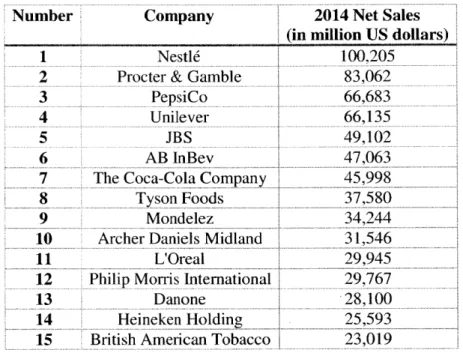
Once having defined the general characteristics of this sector, it is important to explore which are the largest CPG companies, as this thesis explores examples and case studies from these multinationals. Exploring the largest CPG companies also sets the context for understanding the global presence of these organizations. The leading fifteen CPG companies worldwide in 2014 based on net sales in million US dollars can be found in Table 1.
Table 1. Top fifteen leading CPG companies. Source: OC&C Statista (2014). Company
Nestle Procter & Gamble
PepsiCo Unilever
JBS AB InBev
The Coca-Cola Company Tyson Foods
Mondelez Archer Daniels Midland
L'Oreal
Philip Morris International. Danone
HeinekenHolding_ British American Tobacco
2014 Net Sales (in million US dollars)
100,205 83,062 66,683 66,135 49,102 47,063 45,998 37,580 34,244 31,546 29,945 29,767 28,100 25,.593 23,019 ---Number 1 2 3 4 5 6 7 8 9 12 14 15
The complete list of the fifty largest CPG companies (2014) is found in Figure 2.
MI
Fi r 2. Fift lrges C CG c an e base a. <e wae w:icc < n M o U.S d/Iar (2D (-4)
< 0
meanw il Ta Y 8 prv e apaal piL.r 1'f th<o 5paesi heC GidsrFgr
pr e t
muotinatFotty lomari Pcmaie s et rce bamedo (N&G) Saeps li~o, Ui llers The ocaCo)
listd i Fiure2; oweerit source: C&Cdre Stta (2014) nl.Teresntosuy hs
TableIandalrmpes, confide the point tmadeteaseierethatsCderedtheikeyvClumedusiness Thaers globeausese ftes pulCPGnormpnane enabls aeaalbttd them tohvscrig e sale Furhermsre.
mnwileoTable is peressaey a padrtadtueo thege of1 plaes mintenaCs, indutry pFigude 2h provides thescompleteepicture.nThiseisonecessay becused thi thesistexpleseamltesromas these multinational companies:haNestlwiderocters&fGaablen(PfG)rodepsi. Unileer The Ca-rtColar bComdpan sOel, Rektgeeie R) eneraleblin fdlaso eeu Mill and cMas. Thses companyis naoe
ld n FC
mutntinlcmpne. eie tefc tha ths arcnsiee h e Pnutypaes
is
~~
I beas usfu public inomtio an moesaeaalbet 0tdyte o hupsso thi research.fInadiio, tisncesayt)idrtn h antd fteemliainla it- prvdsh
multiple operating segments across the globe, both in emerging and developed markets, to capitalize on opportunities for growth that continue generating profits for the companies.
Moreover, to achieve a broad and globalized product portfolio, CPG multinational companies need to have not only an impeccable execution in the market, but also a robust organizational engine that deeply understands the consumer, discovers new knowledge and applies that knowledge to create new products or processes that delight the consumers.
Furthermore, all these CPG multinational companies have a senior executive who is in charge of leading and managing the R&D function. These senior executives have different titles that generally include Technology and Innovation. In the CPG industry, data suggests that the Chief R&D Officer, as defined in this thesis, is also responsible for Technology and Innovation. Chapter 4 provides further detail about these titles.
Finally, Table 2 provides further information about CPG multinational companies, their product portfolios, their operating segments, general structure and global presence, major brands and products as well as the titles for these top R&D executives.
Table 2. Details of CPG companies: ProdUcts and General Structure.
Number lCompany Ilroducts
Beverages. rilk-based products, ice cream,' prepared dished and pharmaceutical prOducts.
Personal Care products, hcuselihOld
care prOIducts. and
snacks.
Operating Segments and General Strocture
Divided in three geographic zones (Europe, Americas. Asia, Oceania and Africat and lour lobally managed businesses tNestle Waters. Nestle Nutrition. sther Food
and Beverages and Pharmai. Ias presence in 18,i couniries.
Presurice in A\mericas, Europe, Middle Fast and Atrica (ErAEA) arid Asia. Classified into six divisions: reauty, 'rooming, healthcare. snacks and pet care, fabric care
and home care, and taby care and family care.
Comprised of four divisions: Global Business Units
(GBUs), Global Operations, Global Business Services ((BS>, and Corporate Functions (CFt I iws presence in
Over 180 cOUntries. Ma jor Products and Brands Nescafe, Nestea. Nesquik, Nespressio. Perrier. Vittell
Braun, Gillette, Oral
B. Olay, Crest, Pampers Source MarketWatch: Global Rounil-up1. .11112010, Vol. 9 Issue 7, p. 60-67 MarketWatch: Personal Care. Oct 201 1, Vol. 10 Issue 10. p. 13-2(1
Top R&D Executive
Executive Vice President,
Chiefl'echnols.y il icer
(CTO), I lead (f
Innovation, 'Technology'
Research arnd
Developmentl
Chief TechiI Officer
CFO)
Operates through three business units: PepsiCo Americas Foods PAF) including Frito-Lay North
America (FLNA), Quaker Foods North America . MarketWatch:
Salty, sneer and grain , Chectos. Doritos, Vice Chairmran aid Chief hased snacks: a L A ids PepsiCo .FN Frito-Lay, Gatorade, Global Ro - Scientic Officer CSO),
3 PepsiCo Americas Beverage s(PtAB) tincluding PepsiCo .up. Nov 2009,
carbonated and non- y
N i P i l \n Lw's, Pepsi. V, l 8 Isue Global Research and
carbonated beverages. B t Quaker, SoBe _ Development
,eeae .LAB)| and PepsiCo Intemationail (PI) p 05
|bUsinesses in UK, FrIipe, Asia, Middle Fast, and AlriCa l Has presence in nearly 20)) countries.
Operatin' segment his three geographic regions: Asia- MarkerWatch
Food prodUcts. lAfrica. Central and Eastern Europe. The Atericas and Dose. Ponduls, , Global Round- C hie Rueueitch and
household care Western Europe. ProduCts fall under four categories:
LUnilever products and personal savory, dressings and spreads- ice cream and CoretRo Vol. 9 Issue S p Otticr care products. beverages: personal care: and home care. Has presence 94-101
in over 170 countries.
Operates through six business segments: North MarketWatch:
The Coca- Sparkling beverages America, Eurasia and Africa, Europe, Latin Atoerica, Coca-Cola, Dasam, Global Round- Seior Vice President,
5 Cola - - Pacilic and Bottling Investments. Thlie coMpaty divides Fanta. Minute Maid, ip. Scp 2(X.09, Chief Technical Officer and still beverages.
Company its operations into segments based on geographic Poerade, Sprite Vol. 8 Issue , p. (C TO) operations. Has presence in nearly 20H) countries. 51-58
Perfume, make-up, hair and skin care produicrs.
personal Care products, household
care products and health products.
Food products.
Snack foods, main
real foods, beverages
and pet care products.
Operates thrOsgh three business segments: cosmetics,
The Body Shop and detiratology. The cosmetics
division functions through four operating segents: professional products, consumer products, luxury products and active cosmetics. The Body Shop is a chain of cosimetic stores. The dermtiology segments is co pruptised of ermatlogical and phallaceItical
activities. presencu in tir' 30 countries.
Operates through eight business divisiois: health and personal care, fabric care, surface care, home care. dishwashing, phartaceuticals, loods, andt other
household. I las presence in over 180 countries. Operates throth three husiness divisions: LIS retail,
bakeries and foodsurvice, and international tcomprises operations in Canada, Latin Aterica. Europe and the
ASia Pacilic region). las presence in over 100 CutrIS Outside the US.
Operates throtth sic business sermients: chocolate. petcare, gum and confectionary, food, beverages and
symbioscience. Has presence in over 75 countries.
LOreal Paris, Gamier, Maybelline' Kerastase, Redken MarketWatch: Global Round-tip. Feb 2010, Vol. 9 Issue 2, p. 94-100
Executive Vice President, Research and innovation
(R&l)
]-
1
Stk-arkerWatch: IAir Wick, Finish,
French's. Iarpic, BuCt CaI.eoin Betts Crocker, Green Giant, Ilaagen Dazs. ttill'Ury, \ oplit Milky Way, Snickers, M& M s, Uncle Blen's, Whiskas G lobal Round-tip. Jan 2010, Vol. 9 Issue 1, p. 107-113 MarketWatch: Global RoUnd-tip. Mar 2009, Vol. 8 Issue 3, p. 108-1 18 MarketWatch: Global Round-tip. Ju[ 2010, Vol. 9 Issue 7, 1. 92-97
Senior Vice President,
Head of Global R&D
Executive Vice President, Innovation, Technology
and Quality
Vice President, Supply. Research and Development, and Protcurenent Nesitid Procter & Gamble 6 7 LOreal Reckitt Benckiser General Mars I
2.4 1 Trends and Challenges in the CPG Industry
An introduction to the current and future trends and challenges in the CPG industry is also helpful as they influence the overall company's strategy, including the R&D organization. Changes in the business environment in the CPG industry influence the companies' approach and organization with respect to innovation. In addition, since the world is becoming increasingly connected, consumer preferences are evolving faster. As a consequence, product lifecycles have shortened (Noordman & Meijer, 2010).
According to reports from consulting firms issued in 2014 (Accenture) and 2010 (McKinsey & Company), the CPG industry faces the following challenges and trends:
1. A billion new middle-class consumers in emerging markets. New consumers have appeared in emerging countries like China and India. CPG companies have to understand these new consumers and meet their needs by creating value-oriented products according to the characteristics of each market.
2. The rise of the digital consumer. Technology plays an important role that involves strategic decisions regarding: a) expanding the business base through online retail channels, b) brand building through social media and c) how to understand, connect and communicate better with the consumer through technology.
3. The shift to value brands. This involves a consumer's preference to "trade down" to cheaper brands to save money, which imposes difficulty for building brand loyalty among consumers. This trend also includes private labels offered by retailers. Value brands and retailer's private labels increase competition for shelf space and make it harder for CPG companies to differentiate their products.
4. Consumption patterns induced by the impact of demographic shifts. The shift to an aging global population increases the need for CPG companies to meet the needs of these potential consumers. This trend also includes the rise of younger consumers in key markets
and micro-demographic shifts (e.g. Hispanic segment market in the United States). 5. The increasing bargaining power of retailers. The retail landscape has changed
significantly over the last years and, as a consequence, retailers have diminished privileges from CPG companies especially in pricing and delivery. CPG companies need to balance
this relationship because it can affect their finished product supply chain and reach of distribution networks.
6. The rise of alternative stores. Consumers have started to seek alternative stores for low-as well low-as high-priced goods. Alternative stores for low-priced goods such low-as high discounters, have caused the decline in sales for traditional retailers and suppliers. Alternative stores for high-priced goods include specialty stores, which offer alternative categories and brands, such as organic products. The share of consumers that regularly shop at traditional retail stores, to which CPG companies generally supply, has shifted to some extent to these alternative stores.
7. The need for differentiation. Since there is a wide selection of consumer products available, it is becoming harder for CPG companies to achieve differentiation and create truly new products that discover unmet consumer needs. CPG companies need to find new ways to capture more meaningful consumer insights and translate them to generate new and transformative products.
8. Generalized shift in consumers' preferences towards health and wellness. The consumers' awareness regarding health and wellness has increased over the last years. This shift includes rising health concerns related to human health conditions such as obesity or diabetes. This has caused consumers to have greater awareness about the choices related to their daily consumption patterns, and has also shifted consumer preferences to look for healthier and more nutritious product alternatives. In addition, consumers have become
more aware of the environmental impact and demand more environmentally sustainable products in the market.
9. Increasing government regulation. Governments have become involved in the health and wellness trend, and there are increasing amounts of regulation and consumer protection. Examples range from taxes on sugared beverages to specifying information on food labels
such as allergens and detailed nutritional information.
10. Shortening of product lifecycle. Consumer preferences are evolving faster than before and this has shortened the CPG product lifecycle. As a consequence, firms have developed greater advances in scientific and technological development to reduce the time-to-market.
These trends and challenges indicate the evolving landscape of the CPG industry where CPG multinationals operate. Moreover, these trends and challenges occur at a macro level, such as the increasing government regulation, opportunities in emerging markets, and the rise of digital technologies; and at a micro level the consumer is becoming more demanding, more selective, and more health-conscious. These challenges require CPG multinational companies to react and adapt, so they can guarantee their short- and long-term survival.
2.5 I Overview of Challenges in CPG Organizations: Impact on Research and Development (R&D)
The trends and challenges reviewed in the previous sections can influence the CPG companies' strategic choices about introducing new products in the market and opening new markets. Also, they impact the decisions associated with developing the required organizational capabilities and nurturing the culture to survive in this fast-paced and demanding environment.
Neely and Pandrangi (2013) argue that one of the greatest challenge for most CPG companies nowadays is to decide on how to organize for different markets around the world since there are both emerging markets that represent growth opportunities, and mature markets which are large and growing at a slower rate. CPG companies need to balance their choices to deliver what each market requires. Pressures to deliver ongoing profitable growth and the need for introducing differentiated new products in the market that provide value to the consumer adds another challenge that CPG companies have to face. The introduction chapter explains that the R&D function can help to deliver new products and processes (Bone, 2014), be a major source to create growth or the company (Holtzman, 2008), and assist to overcome part of the challenges that the CPG industry faces.
Moreover, CPG companies have to define where to play and focus on building their differentiating capabilities. In other words, CPG companies have to design an optimal strategy that guarantees their short- and long-term sources of competitive advantage. Defining this strategy demands the involvement of all the functional areas of a firm, including R&D (Roussel, Saad & Erickson, 1991). Since R&D function is part of the overall firm's strategy, the R&D organization needs to align to this strategy so it can produce value for the firm. Aligning this strategy creates challenges in the R&D organization such as how to globalize R&D activities, how to structure the R&D
organization so that it can be more responsive to the business and how to change the mindset of the R&D organization by introducing a stronger business focus. The underlying challenge is how
to provide direction to R&D so that it can produce value for the company.
2.61 Key Takeaways: CPG Industry and Product Characteristics
The CPG industry operates in a mature and low-technology sector, which is characterized by high competition and low differentiation and might not consider cutting edge-technology to develop
new products or services. Moreover, CPG are frequently bought by consumers with minimal effort. Consumers' involvement is low when buying the product. This implies there might be a high degree of substitution when similar products are presented to the consumer. The saturated market, along with the high degree of competition, constantly changing consumer trends, and consumer digitalization, make it increasingly harder for CPG companies to achieve differentiation and provide a unique value to consumers.
The last section indicates that the R&D function can be a major source for the company's growth and help to overcome some of the challenges the CPG industry faces. Moreover, it suggests that directing the R&D organization in the context of a CPG multinational is a challenging task. Elements associated with R&D strategy, R&D structure and R&D culture need to be addressed so that the R&D organization can achieve its desired outcome. Finally, the R&D function can help to deliver new products and processes (Bone, 2014) and help to overcome part of the challenges that the CPG industry faces. The following chapter specifies how the R&D function adds value to the firm by creating new products and processes and how R&D contributes to the overall innovation a firm can create for the consumer.
Chapter
3
I Innovation and Research and Development (R&D)
This chapter introduces the definition of innovation and then specifically focuses on how R&D contributes to innovation. Innovation can generate value for the customer in multiple dimensions and be delivered by the company in multiple ways. In the CPG context, firms need to continuously generate innovation to cope with the pressing challenges the industry faces. This chapter explains how R&D serves as a key contributor to create innovation for the firm. Finally, it also clarifies the distinction between the terms "Research" and "Development" and applies this distinction to the CPG context.
3.11 Definition of Innovation
Innovation is often considered the lifeblood of our global economy (Christensen, Gregersen & Dyer, 2011). In fact, many CEOs view innovation as critical for corporate success (Sawhney, Wolcott & Arroniz, 2007). Davila, Epstein and Sheldon (2006) elaborate on this point and mention that for any organization, innovation represents not only the opportunity to grow and survive but
also the opportunity to influence the direction of the industry.
A particular definition of innovation is difficult to obtain as it can vary according to the context in which it is applied. However, generally many of existing definitions for innovation include the terms new and intiroduction. This research considers innovation as holistic, which implies that it can be delivered in multiple dimensions (Sawhney, Wolcott & Arroniz, 2007). Defining innovation as holistic sets the context to establish how the R&D function contributes to the overall innovation a firm can create.
Schumpeter (1982) offers a now-classic definition of innovation as the implementation of new factor combinations in the following dimensions:
- The introduction of a new good -that is, one with which consumers are not yet familiar or a new quality of good (or improved good).
- The introduction of a new method of production, which can be based upon a scientific discovery, and can also exist in a new way of handling a commodity commercially. - The opening of a new market, that is, a market into which the particular branch of
- The conquest of a new source of supply of raw materials or half-manufactured goods. independent of whether this source already exists or whether it was first created.
- The carrying out of a new organization of any industry, like the creation or breaking up of a monopoly position.
Moreover, Sawhney, Wolcott and Arroniz (2007) build upon Schumpeter's innovation dimensions and propose the term "business innovation." Business innovation is defined by these authors as "the creation of substantial new value for customers and the firm by creatively changing one or more dimensions of the business system." Innovation is relevant only if it creates value for the customers, and therefore for the firm.
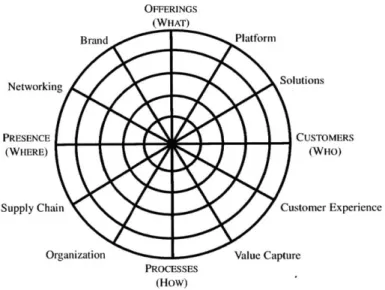
Furthermore, these authors suggest that managers should think holistically about innovation by considering all the aspects of a business. By using this systemic view of innovation, Sawhney, Wolcott and Arroniz (2007) developed and validated a new framework called the "Innovation Radar," which consists of all the dimensions in which a company can innovate for the customers. This innovation radar consists of four key dimensions: (1) the offerings (what) a company produces, (2) the customers (who) it serves, (3) the processes (how) it utilizes and (4) the markets where its offerings are available. Between these four key dimensions, there are eight additional dimensions in which a firm can create innovation. Therefore, this radar contains a total of 12 innovation dimensions. Figure 3 illustrates the "Innovation Radar."
OFFERINGS (WHAT) Brand Platform Networking SOL16ionS PRESENCE CUSTOMERS (WHERE) (WHo)
SIppIy Chain Customer Experience
Or-anization Value Capture
PROCESSES
(How)
Figure 3. The
Innovation
Radar.Details of each of these dimensions and examples from these dimensions in the CPG industry can be found in Table 3.
Table 3. The Twelve Dimensions of Business Innovation. Adaptedfrom (Sawhney, Wolcott & Arroniz, 2006).
Dimension Definition and Example in CPG Industry
Offerings Create new products or services that are valued by customers.
In the CPG industry an example is the introduction of Procter and Gamble's (P&G) Crest Whitestrips. This is a product that created value for the consumers because the consumers could have a convenient and affordable way to whiten their teeth.
Platform Use common components or building blocks to create derivative offerings.
In the CPG industry, an example is how the R&D function has created new ingredients (e.g. artificial and natural sweeteners, natural colors, flavors) that can be applied to different types of beverages.
Solutions Create integrated and customized solutions that solve end-to-end customer problems
In the CPG industry, an example is how PepsiCo has established a call center to solve any problems or ask any questions about PepsiCo's products.
Customers Discover unmet customer needs or identify underserved customer segments.
In the CPG industry, the Nespresso Machine created a new and unique offering to the consumer and has redefined the concept of personalized coffee. The Nespresso Machine discovered unmet customer needs in the personalized coffee market.
Customer Experience Redesign customer interactions across all touch points and all moments of contact.
In the CPG industry, PepsiCo has created a soda dispenser machine that has redefine how the consumer interacts with this machine. For
example, live videos or interactive displays allow the consumer to customize the beverage.
Value Capture Redefine how the company gets paid or create innovative new revenue streams.
In the CPG industry, CPG companies such as PepsiCo or P&G are selling their products through e-commerce (e.g. Amazon) to increase their revenue streams.
Processes Redesign core operating processes to improve efficiency and effectiveness.
In the CPG industry, Unilever created the R&D Operations team to identify areas for improvement in the R&D organization and make all the teams work consistently across the R&D organization with standard operating procedures.