HAL Id: hal-02995236
https://hal.archives-ouvertes.fr/hal-02995236
Submitted on 9 Nov 2020
HAL is a multi-disciplinary open access
archive for the deposit and dissemination of sci-entific research documents, whether they are pub-lished or not. The documents may come from teaching and research institutions in France or abroad, or from public or private research centers.
L’archive ouverte pluridisciplinaire HAL, est destinée au dépôt et à la diffusion de documents scientifiques de niveau recherche, publiés ou non, émanant des établissements d’enseignement et de recherche français ou étrangers, des laboratoires publics ou privés.
Back to plastic pollution in COVID times
Giuliana Gorrasi, Andrea Sorrentino, Eric Lichtfouse
To cite this version:
Giuliana Gorrasi, Andrea Sorrentino, Eric Lichtfouse. Back to plastic pollution in COVID times. Environmental Chemistry Letters, Springer Verlag, 2021, 19, pp.1-4. �10.1007/s10311-020-01129-z�. �hal-02995236�
Environmental Chemistry Letters
https://doi.org/10.1007/s10311-020-01129-z
EDITORIAL
Back to plastic pollution in COVID times
Giuliana Gorrasi1 · Andrea Sorrentino2 · Eric Lichtfouse3,4
The great problem of social chemistry we call poli-tics, is to discover what desires of mankind may be gratified, and what must be suppressed, if the highly complex compound, society, is to avoid decomposition Thomas Huxley (1871)
In this article, we show that the chaos and urgency induced by the coronavirus disease 2019 (COVID-19) pandemic has led to massive fossil fuel-derived plastic production, largely ignoring recent environmental policies. Solutions for a sustainable and circular economy require radical inno-vations, consumer education and most importantly political willingness.
The plastic evil
The world health crisis caused by the spread of COVID-19 is not only damaging people’s health and the world economy but is also threatening environmental sustainability (Sharma et al. 2020). Numerous media have warned about the eco-logical disaster caused by this pandemic (Canning-Clode et al. 2020; Aragaw 2020). For instance, there is a sharp increase in plastic waste from personal protective equipment such as masks and gloves, and from the massive return to using plastic shopping bags to prevent cross-contamination, whereas many nations had started to ban at least partly the use of non-biodegradable bags before the COVID era (Klemeš et al. 2020; Fadare and Okoffo 2020). Moreover,
the lockdown has highly fostered e-commerce, resulting in massive consumption of materials for containment and pack-aging (Patrício Silva et al. 2021; Han et al. 2020). Medical waste has grown up to 370% and packaging plastic demand up to 40% (Patrício Silva et al. 2021). The fight against the virus has thus overshadowed environmental protection poli-cies. For example, the recent drop of oil prices, which may appear as a benefit for drivers, has in fact prompted a real setback of policies aimed at reducing plastic materials of synthetic origin (Sun and Han 2020). We even observe the rise of opposing factions ready to challenge each other to prove their ideas: on one hand, some people think that plas-tic is the absolute evil to be eliminated in any way; on the other hand, others argue that it is impossible to change the current lifestyle (Czigany and Ronkay 2020). The truth is that both sides aim to solve a very complex problem with simplistic solutions. Indeed, plastic waste is a problem that simultaneously involves economic, social and technological aspects (Vanapalli et al. 2021; Prata et al. 2020). In other words, all society issues cannot be solved anymore by the painkiller approach in a globalized word, but required a new world system involving fast evaluation and actions taking into account all aspects of a problem (Lichtfouse 2009,2010; Lichtfouse et al. 2012).
An old problem
Long before the world knew about COVID-19, millions of tons of plastic ended up daily in the sea with serious dam-age to the environment and with an unacceptable waste of precious resources (Haward 2018). Macroscopic residues from the degradation of common objects such as bottles or food packaging are only a small percentage of these wastes (Wang et al. 2019; Tofa et al. 2019). The main part is rep-resented by micro- and nanoparticles, e.g., microplastics, produced by common operations such as the discharge of wastewater from our washing machines, the use of cosmetics and detergents, and the consumption of car tires (Padervand et al. 2020; Naqash et al. 2020). Certainly, the solution can-not be solely to eliminate plastic materials, including those
* Giuliana Gorrasi [email protected]
1 Department of Industrial Engineering, University of Salerno,
Via Giovanni Paolo II 132, 84084 Fisciano, SA, Italy
2 Institute of Polymers, Composites and Biomaterials (IPCB),
National Research Council of Italy (CNR), Via Previati 1/C, 23900 Lecco, Italy
3 Aix-Marseille Univ, CNRS, IRD, INRAE, Coll France,
CEREGE, 13100 Aix en Provence, France
4 State Key Laboratory of Multiphase Flow in Power
of synthetic origin. This would be a utopian solution, tech-nically unsustainable and destined to succumb to multiple socioeconomic interests. Of course, this does not mean that any kind of behavior can be excused. There are millions of cotton swabs, toy balloons and drinking straws that end up on our beaches every year.
Forgotten bioplastics
The emergency caused by COVID-19 is highlighting, once again, the extreme fragility of our systems of management, disposal and recycling of plastic waste (Nanda and Berruti
2020a). To fight this health emergency, we have quickly needed large quantities of inexpensive, safe and easy-to-find materials. In the rush, the only choice available was to use petroleum-derived polymers such as polypropylene and polyethylene as disposable materials. This does not mean that alternatives based on biodegradable materials, often of natural origin, were not available (Brandelli et al. 2017). Indeed, scientists have recently made available various biodegradable polymers (Qasim et al. 2020; Amorim et al.
2020). Some biopolymers even display high performances and unique new functions compared to traditional materials (Morin-Crini et al. 2019). However, these biopolymers are not yet the first choice when there is a need for a quick and efficient response to a real problem. This is because, from a commercial point of view, these materials are still poorly known, expensive and often difficult to handle. Moreover, there are still no biorefineries capable of supplying high vol-umes of bioplastics fast, in a sustainable way and at com-petitive costs. Similarly, there are still too few companies able to recycle these materials. Furthermore, many scientists argue that the massive use of biodegradable materials could create serious issues for the few existing treatment plants (Wojnowska-Baryła et al. 2020; Meeks et al. 2015). Indeed, when working with expiring materials, it is not enough to produce and market them, but it is also necessary to plan their correct management, use and disposal. In the absence of adequate management plans, the massive use of biopoly-mers, in addition to being dangerous for consubiopoly-mers, may also become a problem for the environment.
Political will
The COVID-19 pandemic has disclosed the limits of the current economic system and challenged us to rethink and redesign this system into a more resilient, circular and low-carbon economic model (Wuyts et al. 2020). The COVID-19 crisis has revealed the brittleness of many global supply chains (Ibn-Mohammed et al. 2021; Sarkis et al. 2020). Here, circular principles such as recyclability and reusability offer
credible solutions in terms of resilience and competitive-ness (Fawzy et al. 2020). Maintaining the value of products, materials and resources for as long as possible by reinsert-ing materials into the product cycle at the end of their use allows to minimize waste generation. However, the buildup of plastic recyclability is still a challenge because it requires specific regulations. In many countries, the use of waste as a raw material for other products is shrunk by regulations that prevent material transport and marketing. Changing these regulations typically leads to conflicts between stakehold-ers (Gunarathne et al. 2019). Similar conflicts arise when diverting biogenic waste streams from use in energy and composting to other uses (Nanda and Berruti 2020b). Today, we have all research and development capabilities to set up rapidly to new solutions and technologies on a large scale. Yet, what is still missing is a real political willingness to do so. As a consequence, the circular economy is much more than minimizing the production of waste or inventing bio-degradable materials; the circular economy is a radically different economy, which overcomes the traditional conflicts between socioeconomic and environmental interests (Aldaco et al. 2020). Only when governments will set a clear direc-tion for circular innovadirec-tion in the private sector, will it be possible to combine economic regeneration, better social outcomes and climate ambitions.
Additive manufacturing
Much more effort must be dedicated to new materials and alternative production processes. Biodegradable materials must certainly continue to be developed. Low-cost, renew-able materials with adequate properties and caprenew-able of rapid degradation in environment must be developed. New assembly and processing techniques are also necessary to avoid the inevitable shortcomings of new materials (Olivieri et al. 2020). For instance, additive manufacturing is a revo-lutionary technology that offers new freedom in materials employed and expands the range of possibilities for design, production and performances of novel products and systems (Sanchez-Rexach et al. 2020). In additive manufacturing, complex three-dimension objects are obtained with high pre-cision by depositing materials in a layer-by-layer fashion. This provides several benefits such as the complete control of the object properties and significant savings in terms of time and cost (Balla et al. 2019).
Circular economy
From an economic point of view, it must be clear that any solution will fail without taking into account the ben-efit for all. For instance, incentive policies for the use of
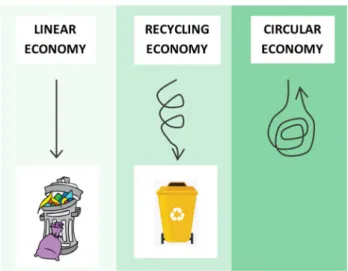
bio-sustainable raw materials must be strengthened. Moreo-ver, the calculated cost of a material cannot be only that of the raw material, but should take into account the impact on the environment. To do so, the whole production sys-tem must be considered, including waste generation, col-lection, transport, recycling and treatment, use of recovered resource and disposal of remains. Here, the circular approach allows both to reduce dependency on resource markets and decreases disposal costs (You et al. 2020) (Fig. 1). From a social point of view, the implementation of circular econo-mies on a local basis can solve many problems related to the disasters produced by the uncontrolled globalization in recent decades. Bio-based products need new supply chains (Kosheleva et al. 2019) because the reduced life of bioprod-ucts requires a denser location of production plants and strong collaborations between goods companies, retailers, consumers, waste management companies and legislators. This should induce social benefits such as increasing job creation at the local level and better employment conditions.
Radical innovation
We have to fundamentally rethink the value we assign to the objects of our everyday life (Prideaux et al. 2020) and get out of the ‘I shop therefore I am’ mantra evidenced by Bar-bara Kruger in 1987, to go back to the original quote ‘I think therefore I am’ from René Descartes in 1637. To do this, we need to understand the social and environmental values of products, and how to keep them in circulation for as long as possible (Milios et al. 2018). Designing products that are easier to disassemble and recycle and creating infrastruc-tures that facilitate the return of products to manufacturers are also needed (Nithya et al. 2020). Radical innovation in an
holistic way is thus critical to enable businesses and govern-ments to reach their goals.
Consumers psychology
In the post-pandemic world, some of our COVID-19 hab-its will probably hang on for a long time. For example, e-commerce sales will continue to grow as many consum-ers will not give up on the benefits in terms of convenience and choice. This growth will lead to a significant increase in packaging material and associated problems of treatment and recycling. The COVID-19 pandemic is expected to spur a rapid transition to new models of circular economy. In particular, we need urgent and coordinated efforts to develop larger and more efficient systems and infrastructures for plastic waste management. Strict policies must force com-panies to reduce the use of natural materials in favor of those coming from recycling. In addition, working on the psycho-logical aspects of consumers and encouraging sustainable products and processes through efficient tax policies would help to achieve sustainable development. Plastics are impor-tant because they provide many advantages, yet instead of demonizing, we should learn to use plastics responsibly.
References
Aldaco R, Hoehn D, Laso J, Margallo M, Ruiz-Salmón J, Cristobal J, Kahhat R, Villanueva-Rey P, Bala A, Batlle-Bayer L et al (2020) Food waste management during the COVID-19 outbreak: a holis-tic climate, economic and nutritional approach. Sci Total Environ 742:140524
Aragaw TA (2020) Surgical face masks as a potential source for micro-plastic pollution in the COVID-19 scenario. Mar Pollut Bull 159:111517
Balla VK, Kate KH, Satyavolu J, Singh P, Tadimeti JGD (2019) Addi-tive manufacturing of natural fiber reinforced polymer composites: processing and prospects. Compos Part B Eng 174:106956 Brandelli A, Brum LFW, dos Santos JHZ (2017) Nanostructured
bio-active compounds for ecological food packaging. Environ Chem Lett 15:193–204
Canning-Clode J, Sepúlved P, Almeida S (2020) Monteiro J (2020) Will COVID-19 containment and treatment measures drive shifts in marine litter pollution? Front Mar Sci 7:691
Czigany T, Ronkay F (2020) The coronavirus and plastics. Express Polym Lett 14:510–511
de Amorim JDP, de Souza KC, Duarte CR, da Silva Duarte I, de Assis Sales Ribeiro F, Silva GS, de Farias PMA, Stingl A, Costa AFS, Vinhas GM et al (2020) Plant and bacterial nanocellulose: pro-duction, properties and applications in medicine, food, cosmet-ics, electronics and engineering. A review. Environ Chem Lett 18:851–869
Fadare OO, Okoffo ED (2020) Covid-19 face masks: a potential source of microplastic fibers in the environment. Sci Total Environ 737:140279
Fawzy S, Osman AI, Doran J, Rooney DW (2020) Strategies for mitigation of climate change: a review. Environ Chem Lett 18:2069–2094
Gunarathne V, Ashiq A, Ramanayaka S, Wijekoon P, Vithanage M (2019) Biochar from municipal solid waste for resource recovery and pollution remediation. Environ Chem Lett 17:1225–1235 Han J, Zhang X, He S, Jia P (2020) Can the coronavirus disease be
transmitted from food? A review of evidence, risks, policies and knowledge gaps. Environ Chem Lett. https ://doi.org/10.1007/ s1031 1-020-01101 -x
Haward M (2018) Plastic pollution of the world’s seas and oceans as a contemporary challenge in ocean governance. Nat Commun 9:667 Ibn-Mohammed T, Mustapha KB, Godsell J, Adamu Z, Babatunde
KA, Akintade DD, Acquaye A, Fujii H, Ndiaye MM, Yamoah FA et al (2021) A critical analysis of the impacts of COVID-19 on the global economy and ecosystems and opportunities for circular economy strategies. ResourConservRecycl 164:105169 Klemeš JJ, Fan YV, Tan RR, Jiang P (2020) Minimising the present and
future plastic waste, energy and environmental footprints related to COVID-19. Renew Sustain Energy Rev 127:109883
Kosheleva RI, Mitropoulos AC, Kyzas GZ (2019) Synthesis of acti-vated carbon from food waste. Environ Chem Lett 17:429–438 Lichtfouse E (2009) Climate change, society issues and
sustain-able agriculture. In: Climate change, intercropping, pest control and beneficial microorganism; sustainable agricul-ture reviews, vol 2. Springer, Berlin, pp 1–7. https ://doi. org/10.1007/978-90-481-2716-0_1
Lichtfouse E (2010) Society issues, painkiller solutions, depend-ence and sustainable agriculture. In: Sociology, organic farm-ing, climate change and soil science; sustainable agricul-ture reviews, vol 3. Springer, Berlin, pp 1–17. https ://doi. org/10.1007/978-90-481-3333-8_1
Lichtfouse E, Schwarzbauer J, Robert D (2012) Social chemis-try. Environ Chem Lett 10:1–4. https ://doi.org/10.1007/s1031 1-011-0333-3
Meeks D, Hottle T, Bilec MM, Landis AE (2015) Compostable biopol-ymer use in the real world: stakeholder interviews to better under-stand the motivations and realities of use and disposal in the US. ResourConservRecycl 105:134–142
Milios L, Holm Christensen L, McKinnon D, Christensen C, Rasch MK, HallstrømEriksen M (2018) Plastic recycling in the Nordics: a value chain market analysis. Waste Manag 76:180–189 Morin-Crini N, Lichtfouse E, Torri G, Crini G (2019) Applications of
chitosan in food, pharmaceuticals, medicine, cosmetics, agricul-ture, textiles, pulp and paper, biotechnology, and environmental chemistry. Environ Chem Lett 17:1667–1692
Nanda S, Berruti F (2020) Municipal solid waste management and landfilling technologies: a review. Environ Chem Lett. https ://doi. org/10.1007/s1031 1-020-01100 -y
Nanda S, Berruti F (2020b) Thermochemical conversion of plas-tic waste to fuels: a review. Environ Chem Lett. https ://doi. org/10.1007/s1031 1-020-01094 -7
Naqash N, Prakash S, Kapoor D, Singh R (2020) Interaction of fresh-water microplastics with biota and heavy metals: a review. Envi-ron Chem Lett. https ://doi.org/10.1007/s1031 1-020-01044 -3
Nithya R, Sivasankari C, Thirunavukkarasu A (2020) Electronic waste generation, regulation and metal recovery: a review. Environ Chem Lett. https ://doi.org/10.1007/s1031 1-020-01111 -9
Olivieri F, De Capitani C (2020) Additive manufacturing for biode-gradable polymers. In: Marturano V, Ambrogi V, Cerruti P (eds)
Sustainability of polymeric materials. De Gruyter, Berlin, pp 235–252. ISBN: 9783110590586
Padervand M, Lichtfouse E, Robert D, Wang C (2020) Removal of microplastics from the environment. A review. Environ Chem Lett 18:807–828
Patrício Silva AL, Prata JC, Walker TR, Duarte AC, Ouyang W, Barcelò D, Rocha-Santos T (2021) Increased plastic pollution due to COVID-19 pandemic: challenges and recommendations. Chem Eng J 405:126683
Prata JC, Silva ALP, Walker TR, Duarte AC, Rocha-Santos T (2020) COVID-19 Pandemic Repercussions on the Use and Management of Plastics. Environ Sci Technol 54:7760–7765
Prideaux B, Thompson M, Pabel A (2020) Lessons from COVID-19 can prepare global tourism for the economic transformation needed to combat climate change. Tour Geogr 22:667–678 Qasim U, Osman AI, Al-Muhtaseb AH, Farrell C, Al-Abri M, Ali
M, Vo D-VN, Jamil F, Rooney DW (2020) Renewable cellulosic nanocomposites for food packaging to avoid fossil fuel plastic pollution: a review. Environ Chem Lett. https ://doi.org/10.1007/ s1031 1-020-01090 -x
Sanchez-Rexach E, Johnston TG, Jehanno C, Sardon H, Nelson A (2020) Sustainable materials and chemical processes for additive manufacturing. Chem Mater 32:7105–7119
Sarkis J, Cohen MJ, Dewick P, Schröder P (2020) A brave new world: lessons from the COVID-19 pandemic for transitioning to sustain-able supply and production. ResourConservRecycl 159:104894 Sharma VK, Jinadatha C, Lichtfouse E (2020) Environmental
chem-istry is most relevant to study coronavirus pandemics. Environ Chem Lett 18:993–996
Sun S, Han J (2020) Unflushable or missing toilet paper, the dilemma for developing communities during the COVID-19 episode. Envi-ron Chem Lett. https ://doi.org/10.1007/s1031 1-020-01064 -z
Tofa TS, Kunjali KL, Paul S, Dutta J (2019) Visible light photocatalytic degradation of microplastic residues with zinc oxide nanorods. Environ Chem Lett 17:1341–1346
Vanapalli KR, Sharma HB, Ranjan VP, Samal B, Bhattacharya J, Dubey BK, Goel S (2021) Challenges and strategies for effective plastic waste management during and post COVID-19 pandemic. Sci Total Environ 750:141514
Wang Z, Qin Y, Li W, Yang W, Meng Q, Yang J (2019) Microplastic contamination in freshwater: first observation in Lake Ulansuhai, Yellow River Basin, China. Environ Chem Lett 17:1821–1830 Wojnowska-Baryła I, Kulikowska D, Bernat K (2020) Effect of
bio-based products on waste management. Sustainability 12:2088 Wuyts W, Marin J, Brusselaers J, Vrancken K (2020) Circular economy
as a COVID-19 cure? ResourConservRecycl 162:105016 You S, Sonne C, Ok YS (2020) COVID-19: resource recovery from
plastic waste against plastic pollution. Cogent Environ. Sci. 6:1801220