Publisher’s version / Version de l'éditeur:
Journal of the Structural Division, ASCE, 108, ST8, pp. 1916-1925, 1982-08
READ THESE TERMS AND CONDITIONS CAREFULLY BEFORE USING THIS WEBSITE. https://nrc-publications.canada.ca/eng/copyright
Vous avez des questions? Nous pouvons vous aider. Pour communiquer directement avec un auteur, consultez la première page de la revue dans laquelle son article a été publié afin de trouver ses coordonnées. Si vous n’arrivez pas à les repérer, communiquez avec nous à [email protected].
Questions? Contact the NRC Publications Archive team at
[email protected]. If you wish to email the authors directly, please see the first page of the publication for their contact information.
NRC Publications Archive
Archives des publications du CNRC
This publication could be one of several versions: author’s original, accepted manuscript or the publisher’s version. / La version de cette publication peut être l’une des suivantes : la version prépublication de l’auteur, la version acceptée du manuscrit ou la version de l’éditeur.
Access and use of this website and the material on it are subject to the Terms and Conditions set forth at
Loads due to drifted snow
Templin, J. T.; Schriever, W. R.
https://publications-cnrc.canada.ca/fra/droits
L’accès à ce site Web et l’utilisation de son contenu sont assujettis aux conditions présentées dans le site LISEZ CES CONDITIONS ATTENTIVEMENT AVANT D’UTILISER CE SITE WEB.
NRC Publications Record / Notice d'Archives des publications de CNRC:
https://nrc-publications.canada.ca/eng/view/object/?id=2b78c3da-1283-4255-87a6-87168d13271c https://publications-cnrc.canada.ca/fra/voir/objet/?id=2b78c3da-1283-4255-87a6-87168d13271cSer
TH1
/
0
4
y:
3---
National Research
Conseil national
N21d
1
#
Council Canada
de recherches Canada
o .
1083
@. 2
,
m
G
- - - -
LOADS DUE TO DRIFTED SNOW by J.T. Templin and W.R. Schriever
A N A L Y Z E D
Reprinted from
Journal of the Structural Division Proceedings of the
American Society of Civil Engineers, ASCE, Vol. 108, No. ST8, August, 1982
p. 1916
-
19256
I-
C I S T lBLDG.
R".
i 1L $ ? P A R ~
i(
i II
I1
%3-
04-
]
p
;
DBR Paper No. 1083Division of Building Research
1
f.4
I
B
i
C
Re&.
5
i.im. IL-.
4
Price $1.00 OTTAWA NRCC 20983
I
-
RiSU&
-
1 +. i- 0'Souvent l ' e a u a r r i v e 3 t r a v e r s e r l e s t o i t s p l a t s : e l l e r 6 d u i t a l o r s l a r 6 s i s t a n c e thermique de l ' i s o l a n t e t f a i t p a r f o i s p o u r r i r l a couverture. Diverses m5thodes d ' s l i m i n a t i o n de l ' e a u ont S t 6 6 t u d i 6 e s mais il e s t habituellement d i f f i c i l e de r 6 a l i s e r un sschage e f f i c a c e en r a i s o n de l a f a i b l e s s e des f o r c e s n a t u r e l l e s d ' e x t r a c t l o n de l'eau.
Ilne p a r t i e de l ' e a u peut Btre drainEe. Le drainage n ' e s t cependant pas e f f i c a c e , d'habitude, c a r l a pente e s t s o i t n u l l e s o i t t r o p f a i b l e e t p a r c e q u e d e s f o r c e s d ' a b s o r p t i o n f a v o r i s e n t l a r g t e n t i o n de l ' e a u . Pourque l e drainage s o i t e f f i c a c e , il f a u d r a i t vaincre ces f o r c e s . Cela e s t p o s s i b l e . Dans une 6,-,,& t.nn a Y ~ h r l - . r I*..- C - 1 - --<-A1----
-
%- - 4e 2 % , 0 p e r l l 11s c mois Dam-
lo1 re1 a sut t e l un for a a s l f a t d e batII
3
I I
1809
I 11
11Ilji4il
02
o
I
2553
n
I I
1111111
17284 AUGUST 1982 ST8
By J. T. Templi' and W. R. Schriever,' M. ASCE
A a s m c ~ : Roof failures due to snow loads are often the result of heavy drifts rather than uniform snow loads. Codes and standards such as Standard A58.1 of the American National Standards Institute (ANSI) and the National Building Code of Canada contain procedures for estimating snow loads on basic struc- tures only. An understanding of elementary fluid mechanics and snow accu- mulation henomena allows a designer to predict regions of tentially heavy snow loagng in situations not covered by the codes. ~everaPObasic principles are presented and illustrated by examples of air flow around commonly shaped structures and the regions of snow accumulation. Modelling of snow drifting supplies qualitative information on snow accumulation in complex situations; advantages and limitations are examined.
A high percentage of roof failures resulting from snow loads are caused by heavy drift loads rather than uniformly distributed snow. Severe winters in 1978 and 1979 brought many failures from combinations of heavy snowfall, drifting, and, sometimes, long periods of cold weather that allowed accumulations to build up from several storms.
In a recent paper, Chin, et al. (3) reported a number of investigations of fail- ures in the Chicago area, confirming that the highest loads often occur in drifts on the lower of two-level roofs. From measured depths and densities, they cal- culated the reaction forces of the purlins or roof beams, using these forces as general indicators of the magnitude of overload existing on the roofs at the time of failure. The reactions were two to three times the values obtained from the design loads given in the Chicago and American National Standards Institute (ANSI) building codes. The study also indicated that the ground snow load of 20 psf (1 P a ) for the Chicago area recommended by ANSI A58.1-1972 is rather low since the actual ground load from about 14 January-20 February 1979 was 31 psf (1.5 P a ) .
Another striking example of high drift loads occurred on the roof of a large warehouse in the greater Boston area, largely as a result of the storm of 6-7
'Research Officer, Building Structures Section, Div. of Building Research, National Research Council of Canada, Ottawa, Canada KIA 0R6.
'Former Head, Building Structures Section, Div. of Building Research, National Re- search Council of Canada, Ottawa, Canada KIA 0R6.
Note.-Discussion open until January 1, 1983. To extend the closing date one month, a written request must be filed with the Manager of Technical and Professional h b l i - cations, ASCE. Manuscript was submitted for review for possible publication on Septem- ber 11, 1981. This paper is part of the Journal of the Structural Division, Roceedings of
th.e American Society of Civil Engineers, OASCE, Vol. 108, No. ST8, August, 1982.
ST8 DRIFTED SNOW LOADS
FIG. 1.48) Removal of Snow from S d o n of Roof Shown in Fig. l(b) East of Collapsed
Bay (Courtesy Maurice A. Reidy Engineers, Boston, Mass.); (b) Seetion Through Drift
on Large Warehouse in Boston (Bawd on Drawings by Maurice A. Reidy Engineers)
February 1978 that produced a snowfall of 27.5 in. (70 cm). On the lower of two-level sections of the roof, triangular drifts up to 16 ft (4.9 m) in depth (Fig. 1) were formed, and the maximum load was found to be 287 psf (13.7 kPa), an exceptionally high load. Surprisingly, only a single bay collapsed, and al- though the design loads were exceeded on many parts of the roof and some roof members showed signs of distress, the rest of the roof held. The designers of the building, Maurice A. Reidy Engineers, also carried out the investigation of the failure. One of the reasons for the good performance of this roof under ex- ceptionally high loads was the fact that the designers, on their own initiative, had used in 1968 the recommendations of the 1965 National Building Code of Canada (12) with its drift loads of up to three times the ground load. In this instance, even this design load was exceeded.
The importance of drift loads has been recognized not only in North America but also in northern Europe (16), and several codes for structural loads have introduced drift load provisions in recent years, among these the new snow load code of the International Standards Organization (ISO) (2).
Some shapes of roofs tend to accumulate more significant drifts and unbalanced loads than others. Two-sided roofs of either the c w e d cylindrical type or the straight-sided gable roof type may accumulate significant unbalanced loads as a result of the transfer of snow from one side to the other by wind. Some of the older skating arenas in Ontario, for instance, were designed and built before much attention was given to loads other than uniformly distributed ones, and after a number of failures many of these roofs had to be replaced or strengthened
AUGUST 1982
FIG. 2.-Unbalanced Snow Load on Gable Frame (from Ref. 3).
(18). Straight-sided gable roofs sometimes accumulate unbalanced loads even if the slope is moderate (Fig. 2), a point difficult to cover in codes without becoming too conservative.
In 1956, the Division of Building Research of the National Research Council of Canada recognized that little information on roof loads was available, although considerable data on ground snow depth existed. Surveys of actual snow loads on roofs were, therefore, started in order to determine how roof loads differ from ground loads. It soon became evident, particularly in cold and windy areas, that the average loads on most roofs are considerably lower than the ground loads, but on certain parts of some roofs significantly heavier drift loads occur. It was clear that to design such roofs for uniformly distributed load only was both unsafe and uneconomical.
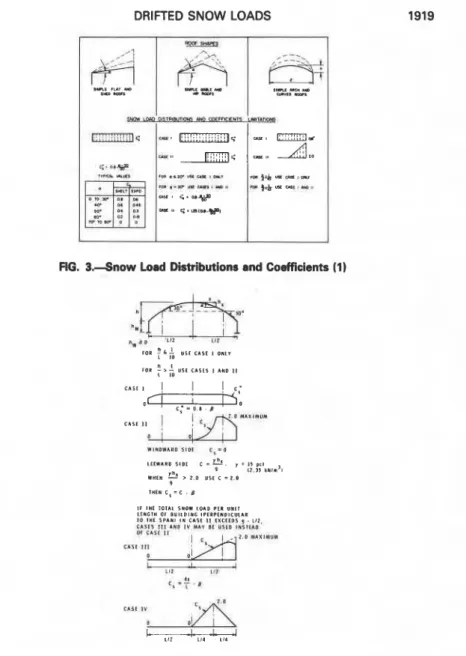
The surveys of actual roof loads led to the introduction of "snow load coef- ficients" or shape factors in the 1965 edition of the National Building Code of Canada (NBCC). Most of these coefficients were also used in the 1972 edition of ANSI A58.1 (1) (Fig. 3). Although simplistic for some situations, they have generally been satisfactory for the common shapes and sizes of roofs, such as two-level industrial and commercial types and peaked roofs. Refinements of the coefficients continue to be added to codes; Taylor (19,20) has described snow loads in the 1977 and 1980 editions of the NBCC (Fig. 4) and provides examples with photographs.
Unfortunately, these coefficients cannot be applied easily to more complex building geometries, and in such cases other methods of predicting the distri- bution of snow must be found. An understanding of the aerodynamics of build- ings is of great benefit for certain configurations. The following sections of the paper will be devoted to a review of some of the principles of air flow and snow deposition on roofs and of the possible use of modelling of snow drifting in wind tunnels and water flumes.
Although the detailed mechanisms involved in the snow drifting process are
1 complex, some drift patterns can be predicted by applying basic knowledge of
' fluid mechanics. Two simple rules help to explain many phenomena. The first is that snow is picked up or scoured in areas where wind speeds are high and deposited and accumulated where wind speeds are low. The second is that snow
I generally cannot move from a low surface to a higher surface, except up a con-
S f 8 DRIFTED SNOW LOADS 1919
FIG. I . - s n o w Load Distributions and Coefficients (1)
roa urr car[ I o ~ r r
L 10 l F I R E T O T A L I N O W L O A D P I I U M l l L t N C l H Or B U l l D l l L I P I I P E I O I C U L A I 10 l H I S P A N 1 I N C A S C 11 I X L C E O I q . L12, C A S l ) I l l LND I V MA11 A U I I B I * S I I A I 0, C 1 5 I 11
,
,
*M"
* I I 111 Llt c,.: #FIG. 4.--Modified Snow Loads on Arch-Shaped Roofs (from Ref. 20)
The first rule can be applied to many situations if the flow patterns around or over structures can be predicted. For example, the flow around an obstacle on the ground is accelerated; therefore, snow is scoured around the comers. Behind the same object, there is a turbulent wake region protected from the main wind stream and, therefore, tends to be filled with snow. The flow around com- plex objects tends to be complex, so that judgement based on experience or flow visualization from model studies should be used.
1920 AUGUST 1982 ST8
The second rule places limits on the amount of snow that can accumulate in any region. It can only come from upwind on the same surface or from higher surfaces. The primary mechanism of snow drifting is called saltation, and in- volves the movement of individual snow particles that bounce across the surface, dislodging other particles as they go. Most of the particle paths rise no more than 1 ft (300 mm) above the snow surface (11) so that very little rises from lower to higher surfaces. As an example, snow can be lifted from the ground to the roof only if it piles up on the upwind side of the structure, providing a ramp for saltating snow particles. The significance of this behavior will be ex- amined later with regard to multilevel roofs.
Snow accumulation patterns vary depending on whether or not snow is falling while wind is blowing. If it is falling, there is clearly a supply of snow in addition to that already on the ground. This allows more snow to accumulate in some regions than would otherwise be available from high-level roofs or other snow reservoirs.
For some geographic regions, the prevailing wind during snow storms is not the same as the prevailing wind with no precipitation. As an example, in Mon- treal and Ottawa, Canada, the wind is often from the east when snow is falling, whereas the prevailing high-wind direction is west or northwest. Drifts that form with east winds tend, therefore, to be deeper than those resulting from west or northwest winds, although the latter occur more frequently.
Multilevel Flat Roofs.--One of the most common examples of snow accu-
mulation from wind is the drifting of snow from a high roof to a lower one. Fig.
5 shows a two-level roof. When the wind blows from left to right, the snow is blown off the upper roof and deposited downwind. In this case, the lower roof catches the snow, and the entire zone B can be filled, forming a triangular drift. This is most likely when the upper roof if large, supplying a large amount of snow. If the upper roof is small, the snow accumulation will be less because the total amount of snow in zones B and C cannot exceed the available snow from the upper roof, unless snow is falling while the wind is blowing.
There is a tendency for snow to accumulate on the ground around most build- ings, both upwind and downwind (zones A anc C). This does not affect the structural loading except when snow in zone A piles so high as to allow ground snow to reach the roof. There is usually, however, a vortex formed on the upwind
FIG. 5.--Snow Accumulation on Multilevel Flat Roofs
ST8 DRIFTED SNOW LOADS 1921
side of the structure that prevents zone A from extending to the side of the building.
Gable or Hip Roofs.--On a roof that has one slope facing the wind and another on the lee side, the wind flow tends to sweep the front face clean as it accelerates over the building (Fig. 6). It separates from the building at the peak, leaving a region of low velocity on the downwind slope where snow accumulates
in zone B. The shape of the drift in zone B is determined partly by the flow over the roof, which limits the height of the drift, and by the maximum angle of repose of the snow, which is determined by its stickiness. The loads resulting from snow sliding to a lower surface, although difficult to handle, must be con- sidered. In Fig. 6, the drift in zone C may be increased by snow sliding from zone B. If this drift can accumulate on a roof rather than on the ground, the design roof load may have to be increased to account for the sliding snow.
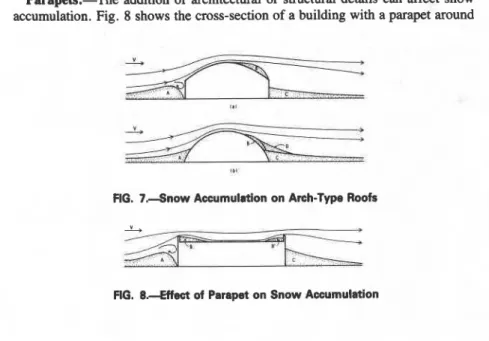
Arched Roofs.-An arched roof on a straight-walled structure (Fig. 7(a)) has characteristics similar to those of a gabled roof, with added complications. The point of separation of the flow is not so easily defined, although it is usually just downwind of the peak of the arch. This causes the upwind face as well as the peak to be clear of snow, while zone B starts a short distance away from the peak. The slope of the roof increases towards the edge, and the shape of the drift will vary greatly, depending, for instance, on the cohesiveness of the snow and on the slipperiness and temperature of the roof surface.
In Fig. 7(b) the arched roof extends to the ground, with a potentially different load distribution. The shape of the structure is relatively streamlined, so that there is no significant upwind vortex to prevent zone A from extending up the side of the structure, allowing transfer of more snow from the ground to the rest of the roof. The downwind zones, B and C, can merge if there is sufficient snow, causing zone D to fill also. This can create large unbalanced loads on the structure, although there is often insufficient snow or wind duration to create a serious problem.
Parapets.-The addition of architectural or structural details can affect snow accumulation. Fig. 8 shows the cross-section of a building with a parapet around
FIG. 7.--Snow Accumulation on Arch-Type Roofs
AUGUST 1982
rn
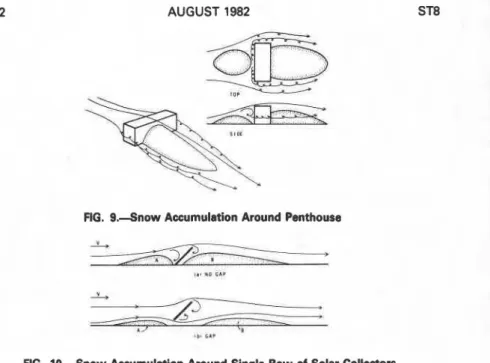
I".FIG. 9.--Snow Accumulation Around Penthouse
FIG. 10.--Snow Accumulation Around Single Row of Solar Collectors
the roof. The upwind parapet acts as a barrier, allowing snow to accumulate downwind of it in zone B, but this will only occur when snow is falling since
there is no other source of snow upwind. Snow will also accumulate in zone B'
in front of the downwind parapet. The effect of the parapet is to reduce removal of snow from the roof and to redistribute it, instead, causing accumulations near the parapets.
Obstacles, Such as Penthouses.-Penthouses and other similar objects on
roofs act as small buildings. Accelerated flow scours snow that then is deposited in the relatively calm region behind the obstruction. If the object is small enough, the wind can scour a large part of the downwind zone, but an object that presents a wide face to the wind can accumulate snow in a drift behind it as well as in front (Fig. 9). The downwind drift is not so wide as the object, and projects no more than five heights downwind, depending on its width. The upwind drift is smaller. When relatively narrow objects are considered, snow accumulation pat- terns are quite sensitive to wind direction, and there is reduced accumulation because of the random variation in the wind. Under normal conditions, therefore, it is unlikely that the regions in Fig. 9 will fill completely.
Solar Collectors.-Questions regarding the accumulation of snow around so- lar collectors on flat or sloping roofs have been raised in recent years. Fig. l o ( ~ ) shows a collector row in contact with the roof and indicates the sort of accu- mulation that could occur. If a sufficiently large gap is left under the collectors, as in Fig. 10(b), the wind can actually be used to reduce snow accumulation or at least prevent excessive build-up by accelerating the flow of air under the col- lectors. The effects of the support structure are minor if it does not block the flow.
ST8 DRIFTED SNOW LOADS 1923
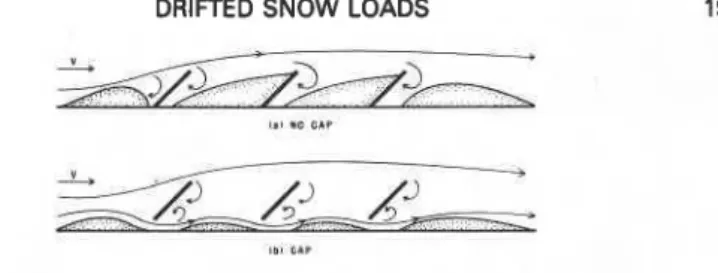
FIG. 11.--Snow Accumulation Around Multiple Rows of Solar Collectors
than will a single collector by reducing the wind speed further. Fig. 11 shows an array of solar collectors on a flat roof. The gap under the panels becomes less effective if there are several rows because the over-all resistance to flow of
air between the roof and collectors increases. The Ontario Ministry of Housing is engaged in a model study, and the Division of Building Research of the Na- tional Research Council of Canada is starting a field study to determine more accurately the probable accumulation of snow around collectors. Observations in the eastern United States have led to some design recommendations (4,14). The flow is more complicated for wind directions at an angle to structures. Vortices form from the upwind comers for diagonal wind directions and cause drift patterns that are difficult to predict.
Many more complicated situations may be investigated using physical mo- delling techniques. Commercial testing facilities that use sand in a wind tunnel or water flume can be used to determine regions of potential snow accumulation. Whether air or water is the medium (8,21), a model can provide a good simu- lation of the flow around structures. Sand provides a visual indication of regions of relative calm where snow can be expected to accumulate. By comparing the differences between accumulations of sand in different models, optimum con- i
figurations of building details can be determined. I
The state-of-the-art of snow drift modelling prevents the measurement of quan- titative results. The theory of modelling has been examined extensively (7,9,
1
10,13,14,17), but no satisfactory method has been developed to model the details of snow movement in air accurately. No estimate of a time scale or choice of !
materials for modelling is universally accepted, but such difficulties may be re-
solved in the future with the aid of full-scale experiments. Field work has been carried out on basic snow drifting (5,ll) a d on snow accumulation around snow fences and buildings (6,15); but extensive measurements of snow accumulation on roofs and of wind speed and direction during individual storms are required to provide the details of snow transport and accumulation on structures. The variations in snow properties throughout North America and the effect on snow drifting should also be determined.
Inherent limitations in modelling, which cannot easily be overcome, arise in part from the great variation in snow properties. Simulation materials cannot model sticky snow, which forms cornices extending beyond the edges of roofs or accumulates in steep-sided drifts. Because modelling materials like sand will
1924 AUGUST 1982 ST8
not stay on surfaces steeper than 30" or 40°, it is difficult to simulate snow
accumulations on steep slopes where snow will accumulate before eventually sliding off.
The principles of snow accumulation and uses of modelling that have been reported cannot solve the snow accumulation problem completely. Other factors must be considered. In model studies, only one wind direction is usually con- sidered at a time. The overall seasonal environment, however, consists of a se- quence of snow storms and high winds from different directions. The final snow accumulation depends, therefore, on the chronological order and duration of the storms and on temperature, sunshine, humidity, and thermal losses from the building throughout the winter.
Very high winds may cause increased density of snow drifts, effectively in- creasing the loads in snow accumulation zones. The snow drifts that caused the
failure of the roof in Boston (Fig. 1) had a density at least 50% higher than that
usually assumed for new snow.
Surrounding terrain may also affect total snow accumulation and drift patterns on structures. If an area, such as heavily wooded terrain or a deep mountain
valley, is well protected from wind, loads due to drifting snow may be small
and the uniform loads on roofs may approach the ground loads. In exposed. windy regions, there may never be appreciable accumulation of snow on elevated
surfaces (unless there is also sufficient snow to allow large drifts to form from
the ground to roofs).
In addition, some effects are unrelated to wind, e.g., temperature effects.
Melting of snow on roofs as a result of solar radiation or heat loss from the building can either reduce the snow load (if the melted snow is allowed to drain) or increase it locally (if ice or slush accumulate or snow slides from one surface to another).
All these difficulties reinforce the need for design decisions to be based on
all pertinent factors and good engineering judgement. Codes and standards such
as the National Building Code of Canada and ANSI A58.1 are intended to pro-
vide guidance for common roof shapes and situations. The purpose of this paper is to give designers a better understanding of the snow accumulation process and to describe the role of model tests in the design process, particularly for uncom- mon roof shapes.
This paper is a contribution from the Division of Building Research, National Research Council of Canada, and is published with the approval of the Director
of the Division. Material for Fig. 3 was reproduced with permission from ANSI
"Building Code Requirements for Minimum Design Loads in Buildings and
Other Structures (1).
ST8 DRIFTED SNOW LOADS 1925
Structures," ANSI A58.1, American National Standards Institute, Inc., 1972.
2. "Bases for Design of Structures-Determination of Snow Loads on Roofs," Drafr
International Standard ISO/DIS 4355, International Standards Organization, Tech- nical Committee 98, 1978.
3. Chin, I. R., Gouwens, A. J., and Hanson, J. M., "Review of Roof Failures in the
Chicago Area under Heavy Snow Loads," presented at the Apr. 14-18 ASCE Annual
Convention and Exposition, held at Portland, Oregon. (Reprint 80-145).
4. Corotis, R. B., Dowding, C. H., and Rossow, E. C., "Snow and Ice Accumulation
at Solar Collector Installations in the Chicago Metropolitan Area," NBS GCR 79-
181, National Bureau of Standards, Washington, Aug., 1979.
5. Dyunin, A. K., "Solid Flux of Snow-Bearing Air Flow," Technical Translation
1102, National Research Council of Canada, Ottawa, Canada, 1963.
6. Hogbin, L. E., "Snow Fences," Report LR362, Road Research Laboratory, Ministq
of Transport, Crowthome, Berkshire, 1970.
7. Isyumov, N., "An Approach to Prediction of Snow Loads," thesis presented to the
University of Western Ontario, London, Canada, in 1971, in pamal fulfilment of the
requirements for the degree of Doctor of Philosophy.
8. Isyumov, N., and Davenport, A. G., "A Probabilistic Approach to the Prediction
of Snow Loads," Canadian Journal of Civil Engineering, Vol. 1, No. 1, Ottawa,
Canada, Sept., 1974, pp. 28-49.
9. Iversen, J. D., "Drifting Snow Similitude," Journal of the Hydraulics Division,
ASCE, Vol. 105, No. HY6, June, 1979, pp. 737-753.
10. Kind, R. J., "A Critical Examination of the Requirements for Model Simulation of
Wind-Induced Erosion/Deposition Phenomena such as Snow Drifting," Atmospheric
Environment, Vol. 10, 1976, pp. 21%227.
11. Kobayashi, D., "Studies of Snow Transport in Low-Level Drifting Snow," Institute
of Low Temperature Sciences, Series A, No. 24, Sapporo, Japan, 1972, pp. 1-58.
1
12. "National Building Code of Canada," Committee on the National Building Code,
National Research Council of Canada, Ottawa, Canada, 1965.
13. Odar, F., "Simulation of Drifting Snow," Research Report 174, U.S. Army Cold
Regions Research and Engineering Laboratory, 1965.
14. O'Rourke, M. J., "Snow and Ice Accumulation around Solar Collector Installations,"
NBS GCR 79-180, National Bureau of Standards, Washington, Aug., 1979.
15. Pugh, H. L. D., and Price, W. I. J., "Snow Drifting and the Use of Snow Fences,"
Polar Record, Vol. 7, No. 47, 1954.
16. Schriever, W. R., and Otstanov, V. A., "Snow Loads-Preparation of Standards for
Snow Loads on Roofs in Various Countries, with Particular Reference to the U.S.S.R.
and Canada," Report No. 9, International Council for Building Research Studies and
Documentation, 1967, pp. 13-33.
17. Strom, G., et al., "Scale Model Studies on Snow Drifting," Research Report 73,
U.S. Army Snow, Ice and Permafrost Research Establishment, 1962.
18. Taylor, D. A., "Survey of Snow Loads on Roofs of Arena Type Buildings in
Canada," Canadian Journal of Civil Engineering, Vol. 6, No. 1, Ottawa, Canada,
Mar., 1979, pp. 85-96.
19. Taylor, D. A., "Roof Snow Loads in Canada," Canadian Journal of Civil Engi-
neering, Vol. 7, No. 1, Ottawa, Canada, Mar., 1980, pp. 1-18.
20. Taylor, D. A., and Schriever, W. R., "Unbalanced Snow Distribution for the Design
of Arched-Shaped Roofs in Canada," Canadian Journal of Civil Engineering, Vol.
7, No. 4, Ottawa, Canada, Dec., 1980, pp. 651-656.
21. Theakston, F. H., "Snow Control by Model Analysis," Annual Conference, Roads,
and Transportation Association of Canada, Halifax, Canada, Oct., 1973.
This publication i s being distributed by the Division of Building Reeearch of the National Reeearch Council of Canada. I t shouldnot be reproduced i n whole o r in p a r t without permission of the original publisher. The Di- vision would be glad to be of assistance in obtaining
such permission.
Publications of the Division may be obtained by mail- ing the appropriate remittance (a Bank, Express, o r Poet Office Money Order, o r a cheque, made payable to the Receiver General of Canada, c r e d i t NRC) to the National Research Council of Canada, Ottawa. K1A OR6. Stamps a r e not acceptable.
A l i s t of allpublications of the Division i s available and may be obtained f r o m the Publications Section. Division of Building Research, National Research Council of Canada. Ottawa. KIA 0R6.