Publisher’s version / Version de l'éditeur:
Vous avez des questions? Nous pouvons vous aider. Pour communiquer directement avec un auteur, consultez la Questions? Contact the NRC Publications Archive team at
[email protected]. If you wish to email the authors directly, please see the first page of the publication for their contact information.
https://publications-cnrc.canada.ca/fra/droits
L’accès à ce site Web et l’utilisation de son contenu sont assujettis aux conditions présentées dans le site LISEZ CES CONDITIONS ATTENTIVEMENT AVANT D’UTILISER CE SITE WEB.
Proceedings of 5th International Workshop on Software Configuration
Management (SCM5), 1995
READ THESE TERMS AND CONDITIONS CAREFULLY BEFORE USING THIS WEBSITE. https://nrc-publications.canada.ca/eng/copyright
NRC Publications Archive Record / Notice des Archives des publications du CNRC :
https://nrc-publications.canada.ca/eng/view/object/?id=2dcff837-95fe-4ce0-967e-9dc77ff5ca67 https://publications-cnrc.canada.ca/fra/voir/objet/?id=2dcff837-95fe-4ce0-967e-9dc77ff5ca67
NRC Publications Archive
Archives des publications du CNRC
This publication could be one of several versions: author’s original, accepted manuscript or the publisher’s version. / La version de cette publication peut être l’une des suivantes : la version prépublication de l’auteur, la version acceptée du manuscrit ou la version de l’éditeur.
Access and use of this website and the material on it are subject to the Terms and Conditions set forth at
The State-of-the-Art in Concurrent, Distributed Configuration
Management
National Research Conseil national Council Canada de recherches Canada Institute for Institut de technologie Information Technology de l’information
The State of the Art in
Concurrent, Distributed
Configuration Management
Stephen A. MacKay
Software Engineering
This report also appears in the “Proceedings of the 5th International Workshop on Software Configuration Management (SCM5), Seattle, WA, April 24–25 1995. To be published in the Springer-Verlag Lecture Notes in Computer Science (LNCS) series, 1995.
Copyright 1995 by
National Research Council of Canada
Permission is granted to quote short excerpts and to reproduce figures and tables from this report, provided that the source of such material is fully
acknowledged.
Additional copies are available free of charge from:
Publication Office
Institute for Information Technology National Research Council of Canada Ottawa, Ontario, Canada
K1A 0R6
Copyright 1995 par
Conseil national de recherches du Canada
Il est permis de citer de courts extraits et de reproduire des figures ou tableaux du présent rapport, à condition d’en identifier clairement la source.
Des exemplaires supplémentaires peuvent être obtenus gratuitement à l’addresse suivante: Bureau des publications
Institut de technologie de l’information Conseil national de recherches du Canada Ottawa (Ontario) Canada
The State of the Art in Concurrent, Distributed
Configuration Management
Stephen A. MacKay
Institute for Information Technology—Software Engineering National Research Council of Canada
Ottawa, Ontario K1A 0R6 Canada Phone: 613-993-6553, Fax: 613-952-7151
E-Mail: [email protected] WWWeb: http://wwwsel.iit.nrc.ca/
Introduction
The most widely used definition of software configuration management (SCM) comes from the standards community [IEEE87, IEEE90a, IEEE90b, Buck93].
Con-figuration management (CM) is a discipline that oversees the entire life-cycle of a
software product (or family of related products). Specifically, CM requires
identifica-tion of the components to be controlled (configuraidentifica-tion items) and the structure of the
product, control over changes to the items (including documentation), accurate and complete record keeping, and a mechanism to audit or verify any actions. This defini-tion is not complete. Dart [Dart92] suggests that the definidefini-tion should be broadened to include manufacturing issues (optimally managing the construction of the product),
process management (ensuring adherence to the defined processes) and team work
(supporting and controlling the efforts of multiple developers). Tichy [Tich88] pro-vides a definition that is popular in the academic and research communities: software configuration management is a discipline whose goal is to control changes to large software system families, through the functions of: component identification, change
tracking, version selection and baselining, software manufacture, and managing simul-taneous updates (team work).
We prefer these definitions because the emphasis is on evolution of and access to software components by teams of developers, rather than control or prevention of ac-cess in the standards definition. Concurrent (or parallel), distributed configuration
management is simply a recognition of the true state of software development in the
1990’s—managing the evolution of software produced by geographically distributed teams, working semi-autonomously, but sharing a common software base.
We recently conducted a survey of both commercial and freely available SCM sys-tems for an industrial collaborator and were struck by the lack of support, in most systems, for true concurrent, distributed software development. The purpose of this paper is to examine why distributed and concurrent activities in software development are important, to describe some of the currently popular mechanisms for handling concurrency, and to describe how we handle distributed, concurrent software develop-ment in our own research vehicle, the Database and Selectors Cel approach to con-figuration management (DaSC). This paper ties some of the survey results together with thoughts based on over ten years of research into software configuration man-agement. The survey examined the features and limitations of 33 commercial and free CM systems [MacK94] through data provided by the suppliers of each CM system
(marketing literature, manuals, and conversations with staff). The following categories of data were collected:
• name, • supplier, • CM model,
• repository abstraction, • repository mechanism,
• system/subsystem modelling ability, • distributed development support, • concurrent modification support, • branching support,
• merge support, • user interface, • revision numbering,
• handling of non-ASCII files,
• multiple development architectures support, • handling of historical releases,
• logging facilities, • directory tracking, • ability to generate deltas, • price, and
• other comments.
In a broad survey such as this, there is a tremendous amount of overloading of terminology. In this paper we will use terms that we have been using throughout our research project, but to ensure there is no confusion, we provide the following defini-tions:
Variants of configuration items are different implementations that remain valid at a
given instant in time, created to handle environmental differences (for example, differ-ent execution platforms). Revisions are the steps a configuration item goes through over time, whether to handle new features, fix bugs or to support permanent changes to the environment (e.g., operating systems upgrades, if the old one is no longer sup-ported). Variants and revisions provide a two-dimensional view into the repository, with variants incrementing along one axis as required and revisions incrementing through time on the other.
Versions of configuration items are understood by the SCM community to be
syn-onymous with either revisions or variants [Tich88]. Therefore a version of a single configuration item denotes an entry in the two-dimensional view of the repository reached from an origin through some path of revisions and variants. In this paper we will use the term, version-set†, to denote a collection (module, product, package,
pro-gram, system) of configuration item variants taken from specified revision levels. A release is a version-set that has passed some defined quality assurance measures (which, in some cases, are regrettably defined as “none”) and is ready for a “customer” (which may be another group within the development organization).
† In the DaSC project, we have been using the tighter version-set definition of the term
version since about 1986. We do not refer to versions of individual configuration items
because it tends to diminish the concept of variants, which were so long ignored [Mahl94]. To reduce confusion for the reader, we will refer to DaSC versions as version-sets.
Distributed Development
There was a time, not long ago, when distributed development in a software project meant that some programmers could connect their VT100 terminals to the central mainframe through telephone or other slow communication lines. While the computer viewed them as equal participants in the project, using the same tool set as the other developers, the remote developers themselves often saw it differently. Low bandwidth or expensive communication lines (sometimes both), coupled with revision control tools that simply locked them out of particular pieces of source without explanation or indication of when it would be available, made this type of environment virtually unworkable. An alternate strategy was to break the project into completely self-contained pieces that could be worked on in isolation without sharing or on-going communication among the teams. The problem was that development proceeded in isolation without sharing or on-going communication among the teams.
Today, the bulk of software development has moved to the desktop. Workstations and personal computers dominate the workplace and networking is a necessity. Soft-ware development has changed greatly, but some things remain the same. The soft-ware repository generally resides on one node (or is split across a small number of nodes), so from the point of view of the computers, everyone is still equal, accessing the repository using the same protocols through a standard shared file system (like NFS). Bandwidth is higher and costs have decreased so that even developers continents away have almost immediate access to the source. Most of the current commercial configuration management tools are designed to work in this type of environment.
Intermittently Connected Developer
While today’s modern high-speed networks allow remote developers to share code at speeds almost as high as on the local networks, temporary access by the intermittently
connected developer—someone who, for a variety of reasons, may unpredictably come
and go from the network—presents a problem. For example, a software field installer with a notebook computer may need to make minor field customizations or bug fixes with customer ‘A’ this week, ‘B’ next week, etc. From the point of view of the field developer, assuming that he is a full-fledged member of the team, it is the software repository that is intermittently connected.
Additionally, large multi-company software projects, typified by military contracts or realtime, embedded system projects, cannot make use of shared software reposito-ries. Joint projects come and go and today’s partner may be tomorrow’s competitor. Prime contractors depend on subcontractors (likely physically remote) to deliver specific components of the final systems. For reasons of security or physical incom-patibility, companies cannot grant each other full network access, leaving the software development effort stuck in the isolation model of the past. This is a recognized area for further SCM research [vand95].
Software Customer
Distributed configuration management not only affects the development organiza-tion—the needs of the customers must be considered as well. It is not infrequent that, over time, a customer will obtain a sequence of releases of a piece of software from a developer. Upon receiving each release the customer will need to apply his own changes. It is rare however, for the customer and developer to have the software under common configuration management (particularly when the customer is only one of many for some commercial software product). Another view of the same problem is when a subcontractor delivers a product, which the customer incorporates and changes,
and then the customer goes back to the subcontractor for revision and further develop-ment. Questions arise such as, “What should the prime contractor provide to the sub-contractor as a base for CM on the revisions?”, “What kind of CM hooks should developers supply for the customers?”, or “Given that the developer ships with no CM support for the customer, how can the customers do an appropriate merge?”
Commercial Support
Virtually all of SCM systems available today support some amount of distributed development. At the very least, all systems support a single repository available on some kind of network (usually a LAN) that is accessible to a distributed group of users. Remote CVS extends the LAN to a WAN to allow worldwide connectivity. Microsoft Delta, and SPARCworks/TeamWare from SunPro, like our DaSC meth-odology, allow users to take a copy of all or part of the repository and synchronize any modifications at convenient times so that intermittently connected developers may benefit from full configuration management. Only the CCC family of products from Softool advertise an ability to include vendors’ products under configuration control, which is surprising, given the number of organizations that experience the upgrade problem.
Concurrent Modifications
To fully support environments composed of intermittently connected developers or cooperating independent contractors, complete concurrent access to individual software configuration items (read and write) is a requirement. However, any notion of devel-opers making concurrent modifications to the same configuration item has tradition-ally been seen as contrary to the concept of configuration management—if an item could be modified in parallel, then it could not be controlled! Fortunately, concurrent development is increasingly being recognized as an important tool in good software engineering. If developers are allowed to take their time, develop changes carefully, and test extensively, before returning code to the repository (with a high degree of confidence of correctness), then it is inevitable that more than one developer is going to touch the same configuration item. In 1993, support for true concurrent develop-ment was found in few commercial CM systems, mainly in very high-end tools, such as CaseWare/CM from CaseWare (now Continuus/CM from Continuus Software), and Expertware’s CMVision/CMFacility and in Aide-de-Camp from Software Main-tenance and Development Systems. In 1994 various forms of distributed concurrency are appearing in product upgrades or in new, more comprehensive products (not all of which are available for review at the time of this writing)—SPARCworks/TeamWare has CodeManager to coordinate simultaneous development across multiple sites on multiple development platforms, Atria has released ClearCase MultiSite to support parallel development across geographically distributed teams and Adele, from Verilog, has recently added rich workspace support to its branch and merge features [Estu94, Estu95]. New offerings or upgrades are also available from Softool (CCC/Harvest), Continuus (Continuus/CM), IBM (CMVC) and Legent (Endevor/WSX, formerly TeamTools from TeamOne Systems).
The two most common mechanisms for handling concurrent modification of soft-ware configuration items are branching (usually found in tools implementing the check-out/check-in model of development) and optimistic methods such as copy-modify-merge, workspaces and transactions. We will examine these techniques in more detail as well as looking at how concurrency is handled with tools implementing change sets.
Branching
Branching is a low-level revision control technique, usually found in tools support-ing the check-out/check-in model of development. Branchsupport-ing allows a configuration item to follow simultaneously several paths of development and may be employed to accomplish a number of goals. Branching is generally represented as directed acyclic graph, often called a version tree or version graph.
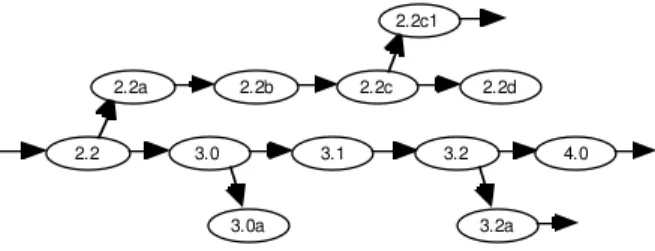
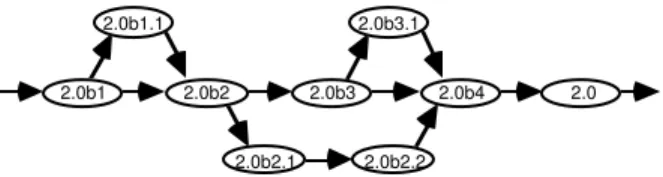
Branches may be created when a variant of a configuration item is needed for a new version of the product (e.g., new software development platform). Such branches are likely to be long lived and merging will rarely take place (Figure 1). A similar situa-tion exists when bugs need to be fixed in released software, perhaps several genera-tions old, usually in large legacy systems (e.g., telephone switches). Merging rarely takes place because the baselines will have changed substantially or the type change required may be quite different, if it is needed at all. These branches usually do not survive as long as in the variant example (Figure 2). When a configuration item is required to fix a bug in the midst of new development, branches usually exist only while the configuration item is locked on the main development path for new en-hancements or until a release point when many bug fixes may be incorporated into the main branch for testing. A structure where branching is used solely for bug fixes on the current development path is shown in Figure 3.
2.0 DOS 2.1 DOS 2.2 DOS 2.3 DOS
1.0 Unix 1.1 Unix 1.2 Unix
2.0 Win 2.1 Win 2.2 Win
1.3 Unix 1.0 Mac 1.1 Mac
3.0 PPC
Figure 1. Branching to support new variants. Ovals represent the changing configuration item—horizontal arrows represent revisions, diagonal arrows, variant creation. Terminal
ovals indicate that a particular variant is no longer maintained (e.g., hardware no longer available or market sector no longer considered worthy of support).
2.2
2.2a 2.2b 2.2c 2.2d 2.2c1
3.0 3.1 3.2 4.0
3.0a 3.2a
Figure 2. Branching to support historical revisions. Ovals represent the changing con-figuration item—horizontal arrows represent primary revisions, diagonal arrows, creation of another revision that is part of an earlier release. Terminal ovals indicate that a particular
version is no longer maintained (e.g., all customers have finally upgraded to a newer release).
More commonly, branching is used in all three forms simultaneously, complicating the situation significantly, such that drawing a complete picture, even for an individ-ual configuration item, is difficult to attempt. Branching for full concurrent develop-ment is not an effective tool—the model becomes difficult to understand and maintain. Commercial CM systems that support branching, usually discourage its use for full concurrency, even though it is the only mechanism they provide for development to proceed simultaneously on a single configuration item. Some products, including many of those derived from RCS, provide emergency commands to override check-out locks or permit the locks to be turned off, but these features are treated as back-doors and are not recommended by the respective suppliers. Others, such as CMVision/CMFacility, hide RCS or SCCS style branching under a richer interface. With CMVision/CMFacility, virtual views (links to files so that they only appear once in the repository) allow optional concurrent modifications to take place. The line between these systems, and those based on workspaces, often gets a little fuzzy.
Change Sets
The change set method of configuration management focuses on logical changes to the product, not on revisions of the individual configuration items. A bottom-up (sometimes called Chinese menu) view of the change set method tracks individual revisions, but collects them into logical groups, called change sets. New versions of the product are then created by applying relevant change sets to a previously baselined version. Different change sets define alternate versions. The change set model would appear to be a natural way of dealing with parallel modifications, however concurrency control is outside this view of the change set abstraction and is handled separately. For example, Peter Miller’s aegis, a free program that implements the change set model, maintains changes at the file level, but sits on top some other revision controls system (another example of branching hidden below the user level). Aide-de-Camp, the only commercial example of the change set model, maintains changes in a database, at the line-of-code level, with an optimistic copy-modify-merge scheme to handle concur-rent modifications. A top-down view of the change set method, where the change sets themselves are treated as first-class objects, is analogous to the workspace model of SCM, discussed below.
Optimistic Concurrency
Optimistic concurrency is not a single method but a different way of thinking about doing software development. It is a recognition that the software development organi-zation encourages multiple development threads to happen simultaneously, widely distributed or at a single site, but that at some well-defined points in the development cycle some coordination and synchronization of the different streams will have to
hap-2.0b3.1
2.0b1 2.0b2 2.0b3 2.0b4 2.0 2.0b1.1
2.0b2.1 2.0b2.2
Figure 3. Branching to support simultaneous bug and feature revisions. Ovals represent the changing configuration item. A horizontal arrow represents a main development re-vision and a diagonal arrow leaving an oval represents a bug fix rere-vision. Multiple arrows
pen. For optimistic methods to be effective, there is an underlying assumption that management practices will insure that having multiple developers working on a single configuration item is not the norm, but when it is required, there will be no penalty.
One of the most effective ways of managing concurrency and minimizing overlap is to ensure that the granularity of the configuration items is as small as appropriate. This is not to say that developers must continually work with fine-grained fragments that do not present enough context, but the CM tools must take care of the mapping between what the developer needs to see and what is stored in the repository.
The most commonly implemented mechanism for optimistic concurrency among the current generation of CM tools can be categorized as copy-modify-merge. Upon re-quest, a developer is provided with a copy of the requested software configuration item—a direct copy from a file-based repository, or generated from delta-based reposi-tory or from a database reposireposi-tory. The developer then has an unlocked copy of the item and the time to modify it properly, but no one else is blocked from working with the same item. When the modification is complete and fully tested, the item is re-turned to the repository. Because other modifications may have been made while the local copy existed, the procedure for returning the configuration item must check for potential clashes. Depending on the implementation, a merge may be done on each write to the repository, or more intelligently, the parallel changes are managed separately until a human authorizes and supervises the merge.
Workspaces and Transactions
Dart presented a set of 14 categories that describe the functionality of CM systems [Dart90, Dart92]. Of these, three are particularly suited to model concurrent software development: workspaces, transparent views and transactions. The workspace model is a more general form of copy-modify-merge. A workspace is an area where a user can take configuration items from the repository and modify them independently, without disturbing or being disturbed by other developers. Any changes committed to the repository by other users after the files are placed in the workspace are not auto-matically visible, however developers can choose to see what has changed in the re-pository at convenient milestones. Dart refers to this as insulated, not isolated [Dart94]. When a certain level of satisfaction is reached (such as completion of a major feature or approval by the CM administrator), the items in the workspace are returned to the central repository. There is an implication that the workspace itself is under revision control (possibly private), rather than simply a working directory (i.e., a local history is maintained). A workspace can be used to implement a top-down view of a first-class change set. The transparent view extends the workspace model by providing a view into the central repository, but only the variants and revisions of interest are visible. Configuration items may exist in either the workspace or the repository. All those requiring a particular view may share the workspace. Continuus/CM, CMVision/CMFacility, and DRTS from ILSI implement various flavours of workspaces. Transactions further enhance the workspace and transparency categories with a set of commands or protocols that coordinate and synchronize the workspaces with each other and with the repository. Feiler, in his attempt to classify CM systems [Feil91], provides more detail on transactions. Often referred to as “long transactions” to differentiate them from simple database transactions, the configuration items can remain out of the repository for weeks or even months. In the extreme case, the workspaces and transactions last indefinitely and become the repository. The focus is on revisions of the configuration and concurrency control. Endevor/WSX from
Legent (formerly TeamTools from TeamOne Systems) is a good example of transaction-based CM.
DaSC Approach
The Database and Selectors Cel (DaSC) approach to software configuration manage-ment, developed in our laboratories at the National Research Council of Canada, in-cludes top-down change set, workspace, transparency and transaction features. The con-cepts of DaSC have evolved over 10 years of practical software development ex-perience, but from the beginning support for concurrent, distributed development was fundamental. The first published description of DaSC and early results from our re-search into software configuration management appear in [Gent89], a discussion of DaSC and the importance of a good visual metaphor for configuration management can be found in [Wein92], and the evolution of our DaSC model and of the supporting tools will be discussed in a forthcoming paper [Wein95].
A s s u m p t i o n s
The initial target for DaSC was the realtime and embedded systems community, however we have found it applicable to a wide range of applications. As yet, the only environments where DaSC gave us little advantage were those where the configuration items were extremely large-grained and, due to project requirements, we were not able to sub-divide them into smaller entities. The chief assumptions behind DaSC are:
• Small companies or small teams—groups of cooperating individuals, numbering in the tens.
• Distributed development (within and across teams and companies)—the intermit-tently connected developer model is assumed.
• Software components—the basic building blocks are fined-grained entities. • Cost-sensitive—no expensive, highly specialized development tools or
environ-ments are assumed.
• Not device independent—the software structure must be such that alternate im-plementations are easily integrated.
• Not just a temporal evolution—a family of programs sharing common com-ponents and evolving together (not necessarily in lock-step) over a long period of time (typically decades).
• Two-box world—separate host development environment and specialized target hardware is the norm (also assumed that development may occur simultaneously on a variety of hosts, using a variety of file systems and cross-compilation tools).
Source Code Database
DaSC is based on the principles of managing multi-version software through a soft-ware database, and handling concurrent, distributed evolution through a multi-layered approach (analogous to the cel used by film animators). DaSC represents a methodol-ogy for configuration management and may be implemented in a number of valid ways. Our examples frequently will refer to source code, but the DaSC model can be applied to any other configuration items, such as documentation and other binary files, as long as there is some form of fine-grained database representation and an appropriate method of selection.
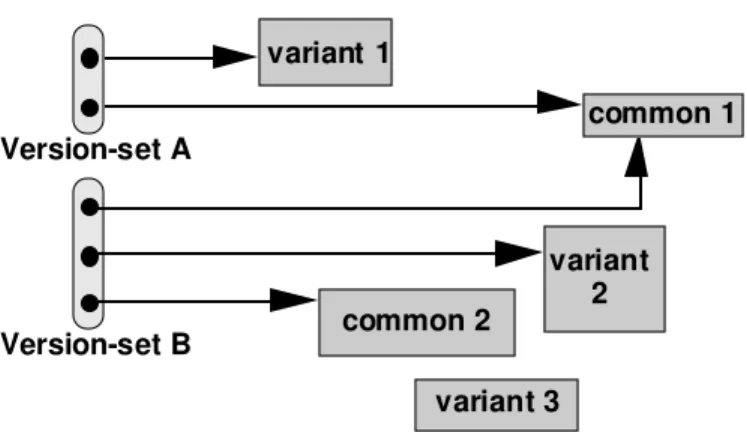
Figure 4 shows a simple example of a DaSC database. Five configuration items are represented by rectangles and two sets of database selectors are represented by ovals.
Individual configuration items may be characterized as common or variant. Common items, common 1 and common 2 in Figure 4, are those that are (or are expected to be) referenced by a number of selector sets. Variants variant 1, variant 2, and variant 3 provide the same functionality and are selected based on the context. For example, they may represent code appropriate for Unix, Macintosh, or DOS file systems, or for three dif-ferent compilers, GNU, Borland, or MPW. A DaSC version-set (or selector set) is simply a collection of selectors into the database of common and variant configuration items. In Figure 4, Version-set A selects common 1 and variant 1, and Version-set B selects
common 1, common 2, and variant 2.
In order to achieve our goals of portability of host environments and to provide small companies with a low cost entry point, our initial implementation of the DaSC software repository used the file system tree as the database and an inclusion file technique (e.g., files that consist solely of a number of C language #include statements) for database selectors. In addition to providing an effective selection tool, inclusion files also isolate all local file system dependent names in a single substructure.
In DaSC, revisions are represented by new cels or layers. Figure 5 shows an ex-ample of a revision layer that might be placed on top of the baseline in Figure 4. Additions are simply shown by new rectangles or ovals, depending on whether a ver-sion-set or a database item is being added (e.g., Version-set C, common 3, and variant 4). Changes to an item are represented by a newer copy appearing at the same location on the new layer (e.g., Version-set A and variant 2). A special marker that “paints over” the original item below it is used to denote deletions—the item is not physically removed (e.g., the cross-hatches over the position of variant 1).
Revisions therefore extend the concept of version-sets. A version-set can select com-mon code or a variant from any valid revision layer. In Figure 5, note that the selec-tors on the revision layer always point to the appropriate spot on the baseline. We provide a tool in DaSC, called derive, which given a version-set and a list of revision layers to be considered, will generate a version-set description that points to the correct configuration items. Figure 6 shows what the database would look like if we looked through the revision layer of Figure 5 onto the baseline of Figure 4.
In the initial implementation of DaSC, cels were realized as parallel file system trees. A set of scripts and tools free the user from concerns about the mapping be-tween the file system and the layered model.
variant 1 variant 2 variant 3 common 2 common 1 Version-set B Version-set A
common 3 variant 4 Version-set C Version-set A variant 2
Figure 5. A revision layer.
variant 1 variant 2 variant 3 common 2 common 1 Version-set B Version-set A common 3 variant 4 Version-set C Version-set A variant 2
DaSC for Concurrent, Distributed Development
The layered approach to software evolution is ideally suited to software development by a group of developers working in parallel in a distributed environment. Cels pro-vide a representation of change without violating the integrity of the original source— first-class change sets. Evolution in time (revision) is supported by adding subsequent layers to a master repository. Layers may be exchanged among developers to synchronize their activities.
Layers exist for as long as is necessary. Layers can exist for short periods of time, to allow a developer to experiment temporarily with a creative idea (later expanded to a full feature or thrown away), for quick bug fixes (later combined with other layers), or even as a sketch for a feature that may eventually be implemented, but is not part of the current product. As in the transaction model of configuration management, indi-vidual layers can last “forever” and become the repository of software history. Usually a new layer is created to facilitate a single logical change to the software. It is a logically complete entity—applying the new layer to the layer (or layers) below it will result in stable and complete rendition of the software with the change applied to it. Thus long developer assignments are encouraged. Unlike the check-out/check-in model of development where individuals are urged to return the configuration item to the repository as soon as possible so that others can have access to it, DaSC allows for fully distributed development in the workspace model. The developer is given the time necessary to implement and test changes because the layer is invisible to other developers. They continue to access and modify items in their own layers, taken from the same baselined, master repository. Note that because there are never any check-out locks, intermittently connected developers can take a local copy of all or part of the repository as required.
As development proceeds, many layers are created and they are either considered stacked or adjacent, depending on their relationship with the other layers. Con-ceptually, a new layer may be stacked on top of previous layers if it has been devel-oped with prior knowledge of the layers below it (e.g., an individual developer making a series of modifications). Any configuration item appearing on an upper layer will always appear to overwrite the identically specified item on any lower layer (as shown in Figure 6). Layers are adjacent to each other if each layer was developed independ-ently of the other—most commonly by separate developers working in parallel. At convenient times, the layers from individual developers can be combined for integra-tion testing and release, in a process we call consolidaintegra-tion.
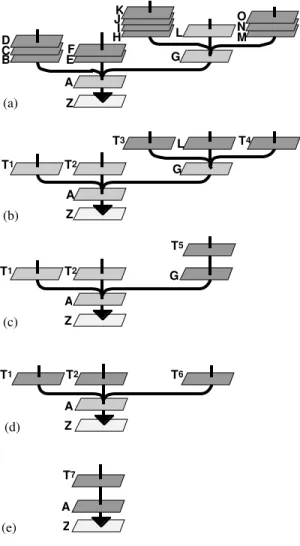
We have built a tool, consolidate, that manages the process. Figure 7 shows a typical layer diagram and the steps toward consolidation. In step (a), the consolidate tool collapses stacked layers B, C, and D downwards to create a new temporary layer,
T1. Likewise, layers
E and F are simultaneously collapsed onto T2, layers
H, I, J, and K
onto T3, and M, N, and O onto T4. In step (b), adjacent layers T3, L, and T4 are reconciled
for clashes by comparing each layer with the others to find identically specified con-figuration items. If any clashes are detected among the three layers, some minor man-ual intervention will be needed before consolidating sideways to create layer T5 (if no
clashes are found the layers are simply merged to create T5). In step (c), T5 is collapsed
with G to create T6. Layers
T1,
T2, and
T6 are then reconciled in step (d) and the
result-ing temporary layer, T7, is collapsed, in step (e), with A to create layer Z, the result of
the consolidation. While any consolidation of this size, results in some clashes being detected, it is extremely rare that the same line of code was touched, so correction is
usually trivial. Planned improvements to the consolidate tool will allow it process situations, like the one shown in Figure 7, with even less manual intervention [Nodd94].
The layer resulting from a consolidation can then be re-tested and considered part of the master repository. The new layer can be sent to customers as an upgrade or it can be distributed to other developers who may not have been involved in the consolida-tion (for example, if they are working on more long term development paths). They can then consolidate their code with the new layer at a time that is convenient, such as when they reach a milestone—they are not forced to co-exist with possibly incom-patible code until they reach a point when it is reasonable to consider all the ramifica-tions of the new layer and make the appropriate changes, if any are required, to their own code. Z A T1 T2 G L T3 T4 (b) Z A T1 T2 T6 (d) Z A T7 (e) Z A T1 T2 G T5 (c) Z A B C D EF G L MN O HI JK (a)
Conclusions and Further Research
Modern software development is a team effort, and in today’s global marketplace, we cannot assume that the teams are in the same geographic location. We also cannot assume that it is possible to provide continuous shared access to the same software re-pository. As a result, concurrent development is becoming the norm and vendors of commercial CM systems are reacting with improved features for full optimistic con-currency. The SCM research community needs to investigate a unified representation for concurrent development [vand95]—the branching model is no longer adequate and workspace/change set concepts are too general. The DaSC layer model (or similar models, such as Tandem’s Fully Populated Paths [Schw95]) could serve as the basis for such a representation.
In surveying the currently available CM tools, we were struck by the lack of sup-port for dealing with configuration items that were not represented in ASCII text, including word processor produced documentation, databases (e.g., test cases), the pro-ject files for advance graphical user interface generators (e.g., XVT), and “source code” for non-textual languages (e.g., Prograph CPX). Most tools will allow the entire “binary” entity to be placed under configuration control, but they do not have the ability to answer such basic questions as, “What has changed in this non-textual con-figuration item?”, “What are the differences between these version-sets?”, “How can we revise item B in a manner similar to the revision already applied to A?” We believe that DaSC is ideally suited to work in this environment and plan to extend the imple-mentation fill the void.
Acknowledgments
Thanks are due to the entire DaSC team for their efforts in this research project: Morven Gentleman, Charles Gauthier, Darlene Stewart, Marceli Wein and Anatol Kark. I would also like to thank the many readers of the early drafts of this paper and of the CM survey for their helpful suggestions and references to additional CM sys-tems.
References and Bibliography
[Berl92] H. Ronald Berlack. Software configuration management. John Wiley and Sons, New York, NY, USA. 1992. 330 pages.
[Buck93] Fletcher J. Buckley. Implementing configuration management: hardware,
software, and firmware. IEEE Press, New York, NY, USA. 1993. 249
pages.
[Dart90] Susan Dart. Spectrum of functionality in configuration management sys-tems. Carnegie Mellon University, Software Engineering Institute Tech-nical Report: CMU/SEI-90-TR-11, December 1990. 38 pages.
[Dart92] Susan Dart. The past, present, and future of configuration management. Carnegie Mellon University, Software Engineering Institute Technical Re-port: CMU/SEI-92-TR-8, July 1992. 28 pages.
[Dart94] Susan Dart. Configuration Management: the KEY to Process Improve-ment. Talk to the Groupe d’amélioration des processus de génie logiciel, Centre de Recherche Informatique de Montréal, April 20, 1994.
[Estu94] Jacky Estublier and Rubby Casallas. The Adele Configuration Manager.
Configuration Management (Walter F. Tichy, ed.). John Wiley and Sons,
[Estu95] Jacky Estublier. Work Space Management in Software Engineering Envi-ronments. Private communication.
[Feil91] Peter Feiler. Configuration management models in commercial environ-ments. Carnegie Mellon University, Software Engineering Institute Technical Report: CMU/SEI-91-TR-7, March 1991. 54 pages.
[Gent89] W.M. Gentleman, S.A. MacKay, D.A. Stewart, and M. Wein. Commer-cial realtime software needs different configuration management.
Proceed-ings of 2nd International Workshop on Software Configuration Man-agement (SCM), Princeton, NJ. October 24-27, 1989. Published as Software Eng. Notes, 17(7): 152-161; 1989. NRC 30695.
[IEEE87] IEEE/ANSI. IEEE Guide to software configuration management.
ANSI/IEEE Std 1042-1987. IEEE Press, New York, NY, USA. 1987. 92
pages.
[IEEE90a] IEEE/ANSI. IEEE Standard glossary of software engineering terminology.
IEEE Std 610.12-1990 (revision and redesignation of IEEE Std 729-1983).
IEEE Press, New York, NY, USA. 1990. 83 pages.
[IEEE90b] IEEE/ANSI. IEEE Standard for software configuration management plans.
IEEE Std 828-1990. IEEE Press, New York, NY, USA. 1990. 16 pages.
[MacK94] Stephen A. MacKay. An Evaluation of Configuration Management Sys-tems and Tools. In preparation.
[Mahl94] Axel Mahler. Variants: Keeping Things Together and Telling Them Apart.
Configuration Management (Walter F. Tichy, ed.). John Wiley and Sons,
Chichester, England. 1994. pp. 73–97.
[Nodd94] K.E. Noddin. Derive and Consolidate in the DaSC Configuration Man-agement Model. National Research Council of Canada, Institute for In-formation Technology Technical Report. In preparation.
[Schw95] Bill Schweitzer. Fully Populated Paths: A Conservative, Simple Model for Parallel Development. Proceedings of 5th International Workshop on
Software Configuration Management (SCM-5), Seattle, WA. April 24-25,
1995. (These Proceedings).
[Tich88] Walter F. Tichy. Tools for Software Configuration Management.
Proceed-ings of the International Workshop on Software Version and Configuration Control, Grassau, FRG. January 27–29, 1988. pp. 1–20.
[vand95] André van der Hoek, Dennis Heimbigner, and Alexander Wolf. Does Con-figuration Management Research Have a Future? Proceedings of 5th
Inter-national Workshop on Software Configuration Management (SCM-5),
Seattle, WA. April 24-25, 1995. (These Proceedings).
[vend94] Various papers, manuals, advertising brochures, electronic mail messages, etc. supplied by the CM vendors.
[Wein92] M. Wein, Wm. Cowan, and W.M. Gentleman. Visual Support for Version Management. Proceedings of the 1992 ACM/SIGAPP Symposium on
Applied Computing (SAC), Kansas City. March 1–3, 1992. pp. 1712–
1723. NRC 33170.
[Wein95] M. Wein, S.A. MacKay, W.M. Gentleman, D.A. Stewart and C.-A. Gauthier. Evolution is Essential for Software Tool Development.
Proceed-ings of the Eighth International Workshop on Computer-Aided Software Engineering (CASE ’95), Toronto. July 9-14, 1995.