RESEARCH OUTPUTS / RÉSULTATS DE RECHERCHE
Author(s) - Auteur(s) :
Publication date - Date de publication :
Permanent link - Permalien :
Rights / License - Licence de droit d’auteur :
Bibliothèque Universitaire Moretus Plantin
Institutional Repository - Research Portal
Dépôt Institutionnel - Portail de la Recherche
researchportal.unamur.be
University of Namur
Developing and Deploying a Taxi Price Comparison Mobile App in the Wild
Noulas, Anastasios; Salnikov, Vsevolod; Hristova, Desislava; Mascolo, Cecilia; Lambiotte,
Renaud
Published in: ArXiv pre-print Publication date: 2017 Link to publicationCitation for pulished version (HARVARD):
Noulas, A, Salnikov, V, Hristova, D, Mascolo, C & Lambiotte, R 2017, 'Developing and Deploying a Taxi Price Comparison Mobile App in the Wild: Insights and Challenges', ArXiv pre-print.
General rights
Copyright and moral rights for the publications made accessible in the public portal are retained by the authors and/or other copyright owners and it is a condition of accessing publications that users recognise and abide by the legal requirements associated with these rights. • Users may download and print one copy of any publication from the public portal for the purpose of private study or research. • You may not further distribute the material or use it for any profit-making activity or commercial gain
• You may freely distribute the URL identifying the publication in the public portal ?
Take down policy
If you believe that this document breaches copyright please contact us providing details, and we will remove access to the work immediately and investigate your claim.
Developing and Deploying a Taxi Price Comparison
Mobile App in the Wild: Insights and Challenges
Anastasios Noulas
∗, Vsevolod Salnikov
†, Desislava Hristova
‡, Cecilia Mascolo
‡and Renaud Lambiotte
† ∗Data Science InstituteLancaster University [email protected] †Department of Mathematics University of Namur [email protected] ‡Computer Laboratory University of Cambridge [email protected]
Abstract—As modern transportation systems become more complex, there is need for mobile applications that allow travelers to navigate efficiently in cities. In taxi transport the recent proliferation of Uber has introduced new norms including a flexible pricing scheme where journey costs can change rapidly depending on passenger demand and driver supply. To make informed choices on the most appropriate provider for their journeys, travelers need access to knowledge about provider pricing in real time. To this end, we developed OpenStreetcab a mobile application that offers advice on taxi transport comparing provider prices. We describe its development and deployment in two cities, London and New York, and analyse thousands of user journey queries to compare the price patterns of Uber against major local taxi providers. We have observed large heterogeneity across the taxi transport markets in the two cities. This motivated us to perform a price validation and measurement experiment on the ground comparing Uber and Black Cabs in London. The experimental results reveal interesting insights: not only they confirm feedback on pricing and service quality received by professional drivers users, but also they reveal the tradeoffs between prices and journey times between taxi providers. With respect to journey times in particular, we show how experienced taxi drivers, in the majority of the cases, are able to navigate faster to a destination compared to drivers who rely on modern navigation systems. We provide evidence that this advantage becomes stronger in the centre of a city where urban density is high.
I. INTRODUCTION
The development of ubiquitous location sensing technolo-gies and the resulting availability of data layers of human mobility in urban transport and road networks have enabled the proliferation of urban transport mobile apps. These systems are further fueled by the increase in APIs provided by transport authorities [8], [6] or, in certain cases, hacktivists publishing online large amounts of mobility datasets that were previously inaccessible, stored away in old devices of public organisations [5], [25]. The focus of this wave of apps has been primarily on assisting citizens with navigation in rail or bus transportation systems. It is, to a large extent, the growing complexity of these urban systems [9] that has brought forward the necessity for such intelligent solutions. Some of these are
now exploited by millions of users globally so as to navigate urban environments efficiently by minimizing financial costs and journey time duration [16], [4]. However, there is little knowledge on tools to cater for the increasing complexity of taxi provider selection.
The necessity for making intelligent choices as we travel has risen not only from the fact that typically a large number of providers operate in the same geographic space, but also due to the large temporal variability in the quality of services offered, as well as in prices. With respect to taxi transport specifically, tariff-based prices have been traditionally in place, which imply standard costs per mile and per second travelled. Despite the existence of tariffs, however, compared to fixed-line transportation systems, those that are based on vehicle movement are inherently harder to track due to variations in travel times driven by urban congestion or alternative routes picked by drivers [21]. Hence, the exact price a customer would pay is not easily predictable ahead of a journey’s start time. More recently, the new pricing scheme introduced in the industry by Uber, popularly known as surge pricing [23], [22], has made the choice of the cheapest taxi provider even more complex. Prices change in real time in accordance to passenger demand and driver supply. What is more, in comparison to aviation and flight search services online, in the case of taxi transport, users will typically need to access information on pricing on the move and in real time.
In response to the growing complexity of taxi transport dynamics, which affects a growing number of cities around the world [28], we describe the process of development of OpenStreetCab, a mobile application that aims to assist users in choosing a taxi provider in a city in real time, offering estimates on taxi prices. We reflect on our design decisions and discuss the application’s usage and pricing statistics between two cities and two taxi providers. We provide a validation of the app’s price estimates and a comprehensive study of price and journey time measurement through a real world experiment which compared taxi providers in the city of London.
More specifically we make the following contributions:
• We describe the development and refinement process of OpenStreetCab available on Android and iOS that provides taxi journey price estimates to users in real time, given as input their journey’s origin and destination.
• Through the app, we collect a dataset on origin/destination price queries, generated by thousands of users that have used it in London and New York. By conducting an analysis of user queries in the two cities, we observe variations in terms of how Uber’s cheapest service, Uber X, compares to the local cab companies in each city. For example, Uber X tends to be more expensive on average than Yellow Cabs in New York, but the same is not true for Black Cabs in London.
• Motivated by the data driven and user insights we acquire, we performed a set of experiments on the ground in order to validate the price estimates provided by OpenStreetCab, but also to understand routing behavior and measure journey timings of the two taxi services in London.
• We show how integrating feedback in the application’s logic leads to better price estimates and alleviates sys-tematic inaccuracies on the prediction of routes and their corresponding driving times provided by pricing APIs.
• We demonstrate how professional and trained taxi drivers present a better routing skill in a dense and complex urban environment where computer navigation systems struggle. Drivers are more likely to pick side streets which can potentially help them navigate away from traffic, especially within the urban core of the city where street, place and vehicle density maximise. This advantage however is being progressively lost as we move to the more sparsely populated and larger in area size urban outskirts. These results highlight not only the trade-offs between pricing and journey durations in taxi mobility, that could be taken into account by related applications and services, but addition-ally, they reveal interesting differences between human and computer-assisted routing in urban environments. Overall, our findings are relevant for mobile developers and researchers active in the domain of urban transport.
II. RELATEDWORK
Digital traces of travelers in transportation systems such as underground rail and bus networks have been heavily employed to study travel behavior and suggest better travel routines and improvements [1], [12], [18], [7].
At the same time, mobile applications which aim at easing travelling experience have become increasingly popular. Google Maps has, aside from routing support via car or public transport, added an Uber integration feature, through which Uber users can search for a destination on Google Maps and directly receive information on journey times as well as costs [26]. CityMapper [4] and MapWay [16] are offering even more specialized information on transport options with respect to the requested route. For instance, CityMapper now reports the expected number of calories a person would burn when navigating through a particular route, given a transport mode (e.g. bike vs walk). Price comparison services exists for flights
or trains. However these services, even if provided with apps, work at a much slower timescale than any city taxi or urban transport services: the booking of long distance train and flight is usually done days if not months in advance, allowing ample time for the system to learn trends and apply corrections.
Cycle sharing networks have been also extensively studied, popularized in many cities as a sustainable mode of trans-port [11]. In these systems, the pricing model is usually flat, with standard charges on a per hour basis. Cycles can only be picked up from specific locations, making the price estimation problem easier. None of the systems analyzed have more than one providers for the service, which also simplifies the problem. In terms of taxi studies, some work have mined the mobility trajectories of taxis [30], [32] with applications in route discovery, activity recognition or privacy aware mobility models to name a few examples. In ubiquitous computing, applications have been powered by the analysis of datasets that describe taxi trajectories. For example Zheng et. al in [32] analyze taxi data to identify regions with traffic problems and correlations amongst geographic areas in terms of taxi mobility to assess the effectiveness of urban planning projects. The modeling of taxi sharing, otherwise known as taxi pooling, schemes has been another subject of study [20] due to its potential in relieving cities from traffic congestion. Routing behavior of drivers and its relationship with navigation systems and traffic congestion has been a related topic of study [13] on vehicle and taxi movement. Our work is partly related to taxi trajectories analysis [31], however mainly in relationship to the goal of understanding how we can improve the information we give to users. Finally, in terms of taxi mobile applications, there are numerous that have appeared in mobile marketplaces offering taxi booking services [14], [27], [10] some of which provide information on the costs and other characteristics of taxi providers [29]. In [17] we discussed aspects of the spatio-temporal dynamics of surge pricing in the context of OpenStreetCab and used mobility data external to Uber to predict surge across geographic areas in New York. Our goal in this work is to provide insights on taxi price comparison focusing on the deployment in two cities (Sections III and IV). Further, by comparing providers through a measurement driven experiment on the ground, we identify critical aspects in routing behavior that can help better estimating time and prices (Section V).
III. APPLICATION ANDSYSTEMDESIGN
We now present in detail OpenStreetCab’s application logic and system architecture. After the initial screen where a user is prompted to choose a city (Figure1.a), she is presented with a simple screen requesting origin and destination geographic coordinates of the imminent journey she is intending to take (Figure1.b). The app then returns price estimates on two major taxi providers and a recommendation on the cheapest one (Figure1.c and 1.d).
Fig. 1: The application’s user interface. From left to right, (a) city selection screen, (b) journey query submission screen and price estimation screens for (c) New York and (d) London.
A. User interface
We have first launched the app in New York City in March 2015, and subsequently in London in the very beginning of January 2016. As mentioned above, users that install the app need first to select their city of interest (London or New York). Subsequently in the journey query submission screen they can specify their trip’s origin and destination. We provide two functionalities to enable user localisation: first, a button next to the origin input tab that automatically sets the origin address, given the user’s geographic location (through GPS / WiFi sensing), and, second, a text-input geocoding that parses user input and matches it to the most similar address name.
After setting the origin and destination addresses for a journey the user can press a button, ‘Uber or Yellow?’ in New York or ‘Uber or Black’ for London for comparison between Uber X and Yellow Cabs or Black Cabs respectively. This will push the input query to our server where Uber prices are compared to the competing local provider (see Section III-B for the specifics on calculations). Next, the user is presented
Fig. 2: Information flow in the application.
with a screen where price estimates are provided, including an indication on the price difference (‘Savings’), with an additional projection of a colored header at the top of the screen clearly indicating the taxi provider for which the estimate is lower (e.g., Yellow for yellow taxis in New York).
B. How the App works
In addition to the user input, data is collected on the time of the user query: a GPS sample of the user’s current location and the application installation unique identification number. The latter has been useful to associate users with submitted queries over time, as we required no registration information for our users. Once the user input is gathered this is pushed to our servers for computation. We use a flexible architecture framework moving as much as possible of the application’s logic to the server side. This approach avoids delays due to approval times required primarily by the App Store in case of minor modifications of the app or urgent bug corrections required (the App Store can sometimes take more than two weeks to approve a new version of a submitted app).
Uber prices for the journey are collected through the Uber developer API [2]. The API returns two values, min and max, that define a price range for the costs of its Uber X service. Next, the mean estimate is calculated from these values, rounding to the closest integer value. We chose to provide the mean as opposed to ranges, as in a list of a few providers it would be easier to compare on a single value as opposed to a range. Traditional taxi providers do not typically provide APIs on pricing. Instead, different taxi companies use different tariff schemes. We therefore combine information on tariffs for Yellow and Blacks Cabs in New York and London respectively, with routing information offered by HERE Maps 1. HERE Maps return a shortest, in terms of time duration, routing path that is sensitive to traffic information the company gathers from a variety of sources. We then simulate the taxi’s meter along the route and estimate the price of a journey according to the tariff information in each city. Black Cabs in London feature a more complex tariff logic2 than the Yellow Taxi company in
1https://here.com/
New York3. In principle, tariff schemes apply a flat cost known as flag in the beginning of the journey when passenger boards and then the price meter increases as a function of time and distance. For example, a rule may suggest that fare increases by a fixed ammount (e.g. X U.S. Dollars) after Y meters or Z seconds (whatever comes first). HERE Maps returns the routes as a set of segments, technically referred in the system as manoeuvres. For each route segment there is information on the length in kilometers and the typical driving time taken to drive on the segment. We exploit this information to increment the fare of the journey according to the tariff rules. Tariff rules depend also on time (e.g. morning versus night) and dates (e.g. holidays versus regular days) and we have integrated this aspect of pricing into OpenStreetCab as well. What is more, special destination or origin points such as airports or train stations can imply additional costs as well as costs that are specific to the route of the journey taken such as tolls. As currently there is no system that provides such information on routes, we have relied on keeping our system to date through manual labour and very critically on user feedback.
An overview of the system’s architecture is provided in Figure 2. The client side component is handling the following: the user input and interactions that were described in the previous paragraph, location geocoding (including reverse geocoding) according to functionality provided in the cor-responding platform (iOS or Android) and the output of the html-formatted response coming from the server.
The user input is pushed to a Python-based backend server, operating with Flask 4microframework, which communicates with two price estimation APIs to retrieve estimates based on the origin and destination geographic coordinates provided through the user input. User journey queries and pricing data are pushed and saved on the MySQL database server after being collected temporarily in an SQLite database on the client side. The data is also stored on the MySQL database server.
IV. USERGROWTH ANDAPPLICATIONSTATISTICS
In this section we provide an overview of our application usage statistics. We then introduce an analysis on queries submitted by its users focusing on price comparisons and differences across the two cities in which we have launched. A. Data Collection
Overall, since the launch of the app in March 2015, more than 13, 000 users have installed it in the two cities with around 75% of all installs taking place on an iOS platform and the rest on Android. In Figure 4 we present the number of OpenStreetCabs users that have submitted at least one journey query. Approximately 8000 users have submitted a query, more than 70% of those ever installed the application. Usage trends vary seasonally, but the number of total users with at least one query every three months is in the range of 1500 to 2000. The average number of queries per user is equal to 3.12 with almost 350 user having submitted 10 queries or
3http://www.nyc.gov/html/tlc/html/passenger/taxicab_rate.shtml 4http://flask.pocoo.org/
Fig. 3: Query distribution in New York considering journey origin.
Application Statistics City iOS installs Android installs Queries
New York 9340 3095 25804 London 1030 345 3371
TABLE I: Summary of application statistics across platforms and cities.
more. In Table I we provide a summary of the statistics by city together with the total number of journey queries submitted. Regarding the number of queries, in New York there were a total of 25, 804 queries submitted to our server. The geographic dispersion of user queries is shown on the map of New York in Figure 3, where the heatmap shows the spatial variations in query frequency. As expected most activity is concentrated in Manhattan with occasional hotspots in peripheral areas that include New York’s La Guardia airport.
We have measured an average saving of 8 U.S. Dollars per journey considering the mean difference between provider prices in each query. This corresponds to total potential savings of almost 206, 000 U.S. Dollars for the app’s users assuming that they always choose the cheapest provider. The number of queries in London are 3, 371 with potential savings of 12, 405 British Pounds on an average price difference of 3.68 GBP (Great British Pounds). While this number may not be reflective of the real amount of money saved, since users may not pick always the cheapest provider (e.g. due to personal criteria regarding service quality), its scale is indicative of the potential financial impact that similar apps can have on the taxi market. B. Data analysis
We now focus on taxi journey price estimates across providers. Tariffs differ between providers not only due to different vehicle maintenance and insurance costs. Black Cabs in London are historically luxurious, offering even wheel
Apr2015Jun2015Aug2015Oct2015Dec2015Feb2016Apr2016Jun2016Aug2016Oct2016 Date 0 1000 2000 3000 4000 5000 6000 7000 8000 9000 N um be ro fA ct iv e U se rs
Fig. 4: User growth over time considering users with at least one query since install.
chair accessibility. Another difference between the two cities’ traditional providers is that Yellow Cabs in New York are operated by large companies that own large fleets of those, while in London Black Cab drivers typically are the owners of the vehicle as well. One cannot drive a Black Cab without extensive professional training (more details on driver training are provided in Section Taxi Experiments in the Wild). Overall these differences can imply different operational costs and point to the direction of potential variations in journey prices as well. Licensing, if any, is typically less complex and much less costly for Uber drivers.
Black Cabs in London operate on a tariff scheme 5 that determines pricing depending on both time and distance, following the rule For each X meters or Y seconds (whichever is reached first) there is a charge of Z GBP with the actual numbers depending on the time of the day and current meter price. The minimum charge is 2.4 GBP (almost 3.55 U.S. Dollars). For New York the initial charge is 2.5 U.S. Dollars with extra 50 cents charged every 5th of a mile or the same amount for 50 seconds in traffic or when the vehicle is stopped. Uber X applies a minimum fare of 5 GBP in London6and a charge of 0.15 GBP per minute and 1.25 GBP per mile. For New York the base fare is 2.55 dollars, with a charge of 35 cents per minute and an additional charge of 1.75 USD per mile. Due to surge pricing however, Uber X fares can increase with the total amount being multiplied by a surge multiplier. As previous works have shown, surge pricing can happen rather frequently and can be highly sensitive in spatio-temporal terms with changes happening across distances of a few meters or a few seconds [3]. Note also that Uber has been changing their tariffs rather frequently as opposed to traditional providers that typically change their tariffs rather slowly. For instance in New York City yellow cab fares increased in 2012 after eight years [24].
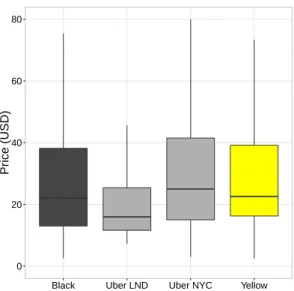
The box-and-whisker plot, shown in Figure 5, describes the distribution of price queries from our app split into quartiles. Each box represents the mid-quartile range with the black line in the middle representing the median of the distribution, while
5https://tfl.gov.uk/modes/taxis-and-minicabs/taxi-fares/tariffs 6https://www.uber.com/cities/london/ 0 20 40 60 80
Black Uber LND Uber NYC Yellow
Pr
ice (USD)
Fig. 5: Box-and-whisker plot showing price query distributions for Black Cab in London, Uber in London, Uber in New York and Yellow Cab in New York (from left to right).
0.0 2.5 5.0 7.5 10.0 12.5
Black Uber LND Uber NYC Yellow
Pr
ice per km (USD)
Fig. 6: Box-and-whisker showing price distributions normalised by distance for Black Cab in London, Uber in London, Uber in New York and Yellow Cab in New York (from left to right).
the “whiskers" represent the top and bottom quartiles of the distribution. The median values are 25 USD for Uber X in New York, 22.5 USD for Yellow Cabs, 16.6 USD for Uber X in London and 23.8 USD for Black Cab in London, respectively. We note that while Uber X is on average more expensive in New York City as compared to the local provider, this is not the case for London where the service appears considerably cheaper. Even in the latter case however, a surge multiplier of 1.5 or more could translate to a more expensive trip. As the tariffs discussed above would suggest, Black Cab should be
0 2 4 6 8 10 Trip Distance [km] 10 20 30 40 50 Pr ice in U .S .Dollars Uber LDN Black LDN Uber NYC Yellow NYC
Fig. 7: Prices versus journey distance for taxi providers in London and New York.
0 5 10 15 20 25 30 Distance in km 0.00 0.02 0.04 0.06 0.08 0.10 0.12 0.14 0.16 0.18 Nor med Frequency London New York
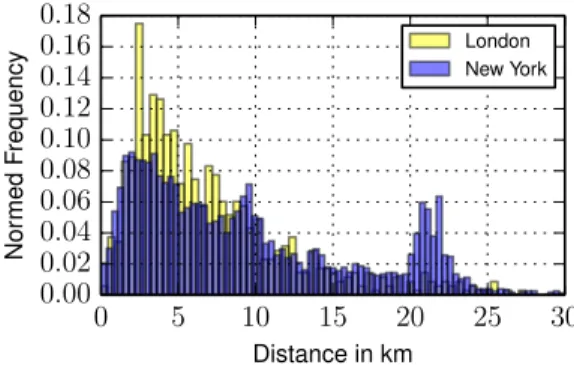
Fig. 8: Geographic distance histograms of journey queries.
more expensive compared to the New York providers. This is confirmed in Figure 6 where prices are normed by distance showing that Black Cabs are more expensive on a per km basis. As also implied through normalisation by distance users in New York tend to make longer journey queries. In Figure 7 the mean journey price is shown in relation to distance as measured through the app’s user queries. We note a steeper increase over distance for Black Cabs. While they are clearly getting more expensive as distance grows it is worth noting that in practice long journeys beyond 5 km are relatively rare. In terms of the geographic distances for journey queries submitted through our application, the two cities appear to show similar trends as shown in Figure 8 with a peak at small distances of 2 or 3 kilometers. However, in New York journey distances of approximately 20 km are particularly common due to a large number of queries submitted for journeys to and from JFK airport. Interestingly, Uber X is much cheaper in London than in New York. It is hard to explain this difference as it could relate to aspects of its pricing model or marketing reasons. For instance, lower prices could be due to higher availability of drivers in relation to user demand. On the other hand, the company may have put forward a strategy of lower fares in London sacrificing perhaps short term revenue in order to increase demand and its share in a more competitive market.
● ● ● ● ● ● ● ● 5.0 7.5 10.0 12.5 15.0 17.5 5.0 7.5 10.0 12.5 15.0 17.5 Price Estimate (GBP) Actual Pr ice (GBP) provider ●Black Uber
Fig. 9: Application price estimates versus average actual amounts paid in London. The errors bars correspond to standard errors.
V. TAXIEXPERIMENTS IN THEWILD
So far we have observed high variability between the prices of taxi providers in the two cities through our app. In order to validate the app’s price estimates however, we need to collect ground truth evidence on taxi journeys. We therefore ran a three day experiment on the ground in the city of London. Beyond validating prices, we took this opportunity to measure journey times and routing behavior for the two competing taxi providers in the city of London: Uber – focusing on their basic Uber X service, and the city’s traditional Black Cab service. There are some well known differences between the two services which we take into consideration in analyzing the output of our experiments. To acquire a license in London, Black Cab drivers need to attend a school that takes about three years to complete and pass The Knowledge [19] test that thoroughly examines the ability of drivers to know by heart the whereabouts of a large number of streets and points of interest in central London. Notably, medical tests on these drivers have suggested that their training and profession results to a larger number of cells in the hippocampus region of the brain which is the region that hosts the spatial navigation mechanism for mammals [15]. Another advantage of the Black Cab service is that they are licensed with Transportation for London, which means they can use bus lanes across the city. On the other hand, Uber drivers do not receive any special training and rely exclusively on their navigation system. These differences are noticeable to users of the two services in the city but no quantifiable data-driven insights exist on these differences until now.
A. Experimental Setup and Conduct
The experiment took place in London over three consecutive days in February 2016. Two researchers performed 29
side-by-side journeys comparing the prices, times and routes between Uber X and Black Cab in London. Using an in-built route tracking functionality (not yet enabled for standard users), the GPS coordinates of trajectories followed by each provider were recorded along with their respective timestamps, start and stop journey times and price estimates from the app. Black Cab and Uber receipts were collected in the end of each trip so estimates could be compared to actual prices.
The journeys selected for the experiment were based on popular user queries for the app in London. Each researcher commenced the journey from the same geographic origin to the same destination at approximately the same time taking either Uber or Black Cab. Temporal synchronicity is very important in this setting, especially in central areas of the city, where traffic conditions could change dramatically in a matter of a few of minutes. Whereas absolute temporal synchronicity is almost impossible in a realistic context, to minimise temporal differences in start times, an Uber X was booked through the Uber app at a location where it was easy to pick up a Black Cab. That was either possible at locations where Black Cab ranks were present or busy intersections where it was possible to hail one easily. At peripheral areas where it was not easy to hail a Black Cab, the application Hailo was used [10]. The latter allows the booking of Black Cabs in London offering a very similar functionality to Uber. Special attention was also paid to geographic coverage with the intention of covering central busy parts of the city, but also peripheral areas in the North, South, West, and East of central London. Overall, over the course of three days, operating roughly between 11am and 10pm, in total more than 300 km were covered.
B. Incorporating Driver Feedback
While map APIs provide information on shortest routes given origin and destination information, also taking into account real time traffic information as HERE Maps or Google Maps do, these systems are configured to reflect the behavior of a regular car drivers. We hypothesize that this may not necessarily reflect the routing and driving capabilities of professional drivers. Furthermore, many Black Cab drivers mentioned that they do not use a navigation system as they know whereabouts in the city well through training and experience. In light of this possibility, following drivers’ feedback, we have introduced a reduction coefficient to the price estimates of Black Cabs, assuming they are able to typically route faster in a territory they are trained and experienced in driving.
Through the application’s feeback mechanism, drivers got in touch to report issues and reflect on the app. In some cases, we received metered validation tests run by a driver for a number of routes.
Your taxi fares estimate always seems high. There are a few regular journeys I inputted and did the same with quite a few jobs and every time I have come in under your taxi estimate.
3 examples were: New Kings Rd, SW6 to Grovesnor Crescent, SW1, usually £9, your app says 11 £, Belgrave Sq, SW1 to Heathrow Terminal 5 usually £55, your app says 60 £, New Kings Rd to Canary Wharf usually £38 when your app says 40 £. (Ross, Driver, London).
Following his suggestion in addition to others we decided to reduce estimates for Black Cabs by adding a multiplier coefficient of 0.9 (reduction by 10%). As we validate in Section V, the correction has improved predictions overall.
We then asked the same driver to run a few more tests and provide feedback.
I compared your estimates with about 10 jobs I done today and your pretty much spot on. A couple were pounds 1-2 over, a couple were under and some were on the button! Another thing I thought of is to maybe let people know that these estimates are for the Taxi day rate (rate 1) and for Uber without a surge price in effect.
For taxis there are 3 rates, rate 1 from 06:00-20:00, rate 2 from 20:00-22:00 and rate 3 from 22:00-06:00. To be honest there isn’t much difference between rates 1 and 2, but rate 3 does make it a bit more expensive. (Ross, Driver, London).
Next, we show results of fare estimate prediction with and without using the reduction coefficient.
C. Experimental Results
Price Estimates: For every journey with an Uber X or a Black Cab in the experiment, we have compared our application’s estimate measured as described in Section User Growth and Application Statistics against the actual price charged by the provider. In Figure 9 we plot the mean actual price charged for a given price estimate and the corresponding standard error. We consider the overall estimates for both providers satisfactory, yet deviations exist. For Black Cabs deviations were higher for journeys that cost between 7 and 9 GBP. In the case of Uber, estimates tend to be more stable, however, deviations still remain. We provide more detail, in Table II, where we show statistics in terms of absolute and percentage values on the maximum price difference in GBP (column Max Abs Diff ), mean price difference (column Mean Abs Diff) and the standard deviations (column Mean Std Dev) between actual and price estimates for three estimate scenarios: Black Cab after incorporating driver feedback on top of the original price estimates, reducing price estimates by 10%, the case when feedback is ignored (no feedback) and the estimates provided by the Uber API on Uber X. In the case of Uber X price estimates have deviated from actual ones on average by 10%. For Black Cabs estimates deviated on average by 15%. It is worth noting that prior to introducing a reduction coefficient of 0.9 in response to driver feedback estimates were deviating more, on average by 18%. The Pearson’s ρ
(a) Trafalgar Square - Old Street
(b) London Bridge - Trafalgar Square
(c) Battersea Park - Clapham Common
(d) Shadwell Basin - Shored-itch
Fig. 10: Taxi provider trajectories in four areas of London. Black Cab in black color and Uber X in pink. Origins are marked with a Green circle and Destinations with a Red triangle.
Journey Estimation Statistics
Provider Max Abs Diff Mean Abs Diff Std Diff Max % Dev Mean % Dev Std % Dev Pearson’s ρ
Black Cab 4.4 0.06 1.96 0.45 0.15 0.11 0.81 Black No feedback 3.5 −1.04 2.01 0.59 0.18 0.16 0.81 Uber X 3.31 0.03 1.08 0.32 0.10 0.06 0.83
TABLE II: Accuracy of price estimates for Black Cabs, Black Cabs prior to receiving feedback from drivers and Uber X. Mean, standard deviations and maximum price difference are shown in terms absolute (abs) or fractional (%) values.
correlations between estimated and actual price values are 0.81 for Black Cabs and 0.83 for Uber. While the introduction of a reduction coefficient may appear overly simplistic at first glance, deploying more complex strategies can in fact yield worse estimates. The heterogeneity of routing decisions is very high in complex urban street networks which typically unfold in large cities and in this setting we found that simple engineering decisions are more robust than introducing a complex logic in the price estimation engine.
In general, the variations in price estimates may be due to inherent differences between predicted and actual routes, urban congestion changes that are not accurately picked up by navigation systems or the ability of drivers to route themselves differently to what is predicted by navigation systems. Driver input, as we have observed in the previous section, may reflect aspects of Black Cab driver behavior that are not picked by modern routing APIs. In fact, none of the Black drivers used a navigation system during the experiment and they are likely to pick different routes than what a computer system would suggest. However, we can see that even in the case of Uber where drivers typically follow the company’s navigation system predictions cannot be perfect. We note that Uber provides ranges of price estimates (min and max values) for prices. We chose to use only a single average value (mean) to make direct comparisons between providers easier. Users may expect and tolerate some variation between predicted and actual prices and the average here serves as an indicator on how much cheaper a provider may be compared to another. In future versions of the app, aside from the possible inclusion of price ranges, that could be inspected for instance with a click on the provider price (in case a user is willing to access more details regarding
−4 −2 0 2 4 6 8 10 12 Price Difference [GBP] −10 −5 0 5 Time Diff erence [mins]
Fig. 11: Price versus time differences where price difference is defined as Black Cab price minus Uber price in GBP and time difference as Black Cab journey time minus Uber X journey time in minutes. Black colored circles correspond to faster journey times for Black Cabs, pink for Uber X and yellow for ties.
pricing) other information could be added such as journey time estimation. We discuss a related analysis in the next paragraph. Provider Comparison: We have empirically observed significant variations in terms of how the two providers compare in terms of actual and estimated prices, with routing choices being the most probable reason for these deviations. In Figure 10 we show four characteristic journeys where routes had very little geographic or no overlap at all between the two providers. Black cab drivers tend to take more complex routes in terms of picking side streets as opposed to larger main streets that are recommended more often by GPS navigation systems as part of shortest path routing. As already implied in
−0.2 0.0 0.2 0.4 0.6 0.8 1.0 Price Gain [GBP] 0 2 4 6 8 10 Frequency Median : 0.354838709677
(a) Frequency distribution for price gains for all journeys. Price gains are higher for Uber.
−0.5 0.0 0.5 1.0 1.5
Time Gain [minutes]
0 2 4 6 8 10 12 Frequency Median : 0.1
(b) Frequency distribution of time gains for all journeys. Time gains are higher for Black Cabs.
Fig. 12: Price and time gains for 29 side-by-side journeys between Black Cab and Uber X in London.
previous sections by tariffs applied Black Cabs were in general more expensive. Uber X would cost on average 74% of a Black Cab’s journey price.
Nevertheless, Black Cabs were faster and took on average 88% of an Uber’s trip duration, where average journey time has been 14.06 minutes Black Cabs and 16.34 minutes for Uber (Uber or Black Cab waiting times excluded). Out of the 29 journeys, Black Cabs were faster in 18 cases, there were 4 ties and Uber X was faster in 7 instances. Figure 11 presents a scatter plot reflecting the relationship between price and time differences. The faster Black Cabs have been, as one would expect by definition of the pricing schemes that depend on time in addition to route length, the smaller the price difference. Further, when Black Cabs have been faster, in almost half of the occasions (10 times) they have been faster by 5 minutes or more. To better understand the price and time differences across journeys and providers we define the relative gains of the two variables as:
PriceGain=PriceU ber− PriceBlack
PriceBlack (1)
for prices, and for times as:
TimeGain=TimeU ber− TimeBlack
TimeBlack (2)
The corresponding frequency distributions are shown in Fig-ures 12a and 12b respectively. These contrasting results between price and time gains point to a clear trade-off between time and price when considering the choice of a provider. From a user perspective, should they be in a hurry to catch the next train or a meeting, according to these results, Black Cab would appear to be a safer bet. Should they just be willing to save money on the particular journey then Uber X could be favored. The Impact of Urban Density: Throughout the experiment we noticed that Black Cabs tend to be more time effective in the urban core of the city. This advantage would become less clear in journeys taking place towards more peripheral areas of the city. To empirically explore this intuition we characterized routes in terms of their average place density. We exploit Foursquare’s venue database to do so. Foursquare is a local search service which provides a semantic location API 7, allowing us to retrieve the number of businesses in
an area and therefore is a proxy to the urban density of a particular area. For every coordinate sampled for a route of a provider, we defined a 200 meter radius around it and counted the number of Foursquare places in vicinity, considering almost a set of 40, 000 venues in London becoming available through the services venue API. We then took the mean across all GPS points and across the two providers. Formally, we characterise the average urban density of a trip as:
Trip_Density = 1 |T |
∑|T |i=1P(x = lngi, y = lati, r = 200m)
π r2
where T is the union set of the two provider trajectories made of GPS coordinates encoded as latitude and longitude values, and P is a function that returns the number of Foursquare places that fall within a disc area, given as parameters a radius rset equal to 200 meters, a geographic center represented by latitude lati and longitude lngi coordinates, when considering
a given point i in set T . The unit of measurement is number of places per square kilometer (hence the division by the area size πr2).
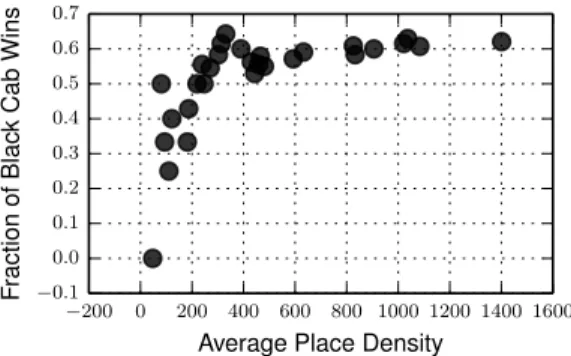
In Figure 13 we plot the fraction of Black Cab wins, counted as faster journey achieved, versus the total number of trips that have a density smaller or equal to a given value x. We can observe, albeit the noise due to a small number of samples, that as density values increase so does the relative cumulative probability Black Cab being faster. This result provides an indication that Black Cab drivers are especially effective in parts of the city where urban complexity in terms of urban congestion, street network and population density rises. In this setting navigation systems may be less effective in terms of reflecting actual traffic in real time and being able to provide quicker routes for drivers.
Discussion, limitations and future directions: The empiri-cal findings presented in this section provide novel insights not only on differences in the service characteristics between taxi providers, but also on differences in routing behavior between drivers relying on navigation systems to reach a destination,
−200 0 200 400 600 800 1000 1200 1400 1600
Average Place Density
−0.1 0.0 0.1 0.2 0.3 0.4 0.5 0.6 0.7 Fraction of Blac k Cab Wins
Fig. 13: Fraction of Black Cab wins in terms of faster journey times for different place density values. To extract the fraction value we count the number of Black cab wins over the total number of journeys that feature a mean place density smaller or equal to a given value. The unit of density measurement is number of places per square kilometer.
versus drivers who have been trained for years in wayfinding in the city. We show how experienced human navigators are able to choose alternative routes that can improve journey times, especially in the city center, where urban complexity increases. The results highlight the importance of integrating journey time as a significant economic factor in taxi and urban transport recommendations, but also point to potential weaknesses of navigation systems when those are used in dense and congested urban environments. In future versions of our app we plan to integrate journey time comparisons together with that of prices and help users make more informed choices on the provider that fits their journey preferences best.
From the point of view of experimental conduct there is considerable space for improvement. The 29 rides with each provider correspond to a limited sample and is only a first modest step towards understanding driver routing behaviour and provider service quality. Rerunning the experiment more times would not be sustainable from a financial and time cost perspective. We have therefore enabled crowdsourcing as a solution to scaling data collection on routes of different providers through tracking user trajectories. While the latter approach lacks the viewpoint of direct and controlled compari-son between different taxi providers, it has the advantage of enabling the collection of a larger number of route samples for a given origin-destination pair. This could shed light, for instance, on heterogeneities that may exist in terms of driving and routing behaviour over a well defined network of streets.
VI. CONCLUSIONS
In this paper we have described our experience with the development and deployment of a price comparison mobile app for taxi rides. The app was deployed in the wild in two cities and we show how the feedback received from both users and drivers drove further app updates and validation tests. The main lesson learned from the deployment and the feedback has been the importance of driver experience in route finding:
our study has given ample evidence of this. The inclusion of these factors into a route finding system or even simply in an app like ours is not trivial and the object of our future work. Moreover, in future work we intend to introduce further crowdsourcing in terms of route selection and user experience (e.g., journey times, driver behavior).
REFERENCES
[1] B Agard, C Morency, and M Trépanier. Mining public transport user behaviour from smart card data. In 12th IFAC symposium on information control problems in manufacturing-INCOM, pages 17–19, 2006. [2] Uber API, 2016. https://developer.uber.com/.
[3] L Chen, A Mislove, and C Wilson. Peeking beneath the hood of uber. In Proceedings of the 2015 ACM IMC, pages 495–508. ACM, 2015. [4] CityMapper, 2016. www.citymapper.com.
[5] NYC’s Taxi Trip Data, 2015. https://goo.gl/Tw3s5U.
[6] Metropolitan Transport Authority Real Time Feeds, 2016. datamine.mta. info/.
[7] S Foell, G Kortuem, R Rawassizadeh, S Phithakkitnukoon, M Veloso, and C Bento. Mining temporal patterns of transport behaviour for predicting future transport usage. In Proceedings of the 2013 ACM conference on Pervasive and ubiquitous computing, 2013.
[8] Transport for London API, 2016. api.tfl.gov.uk.
[9] R Gallotti, M A Porter, and M Barthelemy. Lost in transportation: Information measures and cognitive limits in multilayer navigation. Science Advances, 2016.
[10] Hailo, 2016. www.hailoapp.com.
[11] A Kaltenbrunner, R Meza, J Grivolla, J Codina, and R Banchs. Urban cycles and mobility patterns: Exploring and predicting trends in a bicycle-based public transport system. Pervasive and Mobile Computing, 2010. [12] N Lathia and L Capra. Mining mobility data to minimise travellers’
spending on public transport. In Proceedings of SIGKDD, 2011. [13] A Lima, R Stanojevic, D Papagiannaki, P Rodriguez, and M C González.
Understanding individual routing behaviour. Journal of The Royal Society Interface, 2016.
[14] Lyft, 2016. www.lyft.com.
[15] E A Maguire, D G Gadian, I S Johnsrude, C D Good, J Ashburner, R SJ Frackowiak, and C D Frith. Navigation-related structural change in the hippocampi of taxi drivers. PNAS, 2000.
[16] MapWay, 2016. www.mapway.com/.
[17] A Noulas, V Salnikov, R Lambiotte, and C Mascolo. Mining open datasets for transparency in taxi transport in metropolitan environments. EPJ Data Science, 4(1):1, 2015.
[18] O O’Brien, J Cheshire, and M Batty. Mining bicycle sharing data for generating insights into sustainable transport systems. Journal of Transport Geography, 2014.
[19] The Public Carriage Office. The knowledge, 2016. www.the-london-taxi. com/Public_Carriage_Office.
[20] P Santi, G Resta, M Szell, S Sobolevsky, S H Strogatz, and C Ratti. Quantifying the benefits of vehicle pooling with shareability networks. Proceedings of the National Academy of Sciences, 2014.
[21] Isaac Skog and Peter Händel. In-car positioning and navigation technologies. Intelligent Transportation Systems, IEEE Transactions on, 10(1):4–21, 2009.
[22] Slate. The mirage of the marketplace, 2015. http://goo.gl/gZQ66v. [23] TIME, 2014. http://time.com/3633469/uber-surge-pricing/.
[24] The New York Times. Taxi fares in new york to rise by 17 http: //goo.gl/7SbiiJ.
[25] RealTime Trains, 2016. www.realtimetrains.co.uk.
[26] Uber. Get moving with google maps, 2014. https://newsroom.uber.com/ get-moving-withgoogle-maps/.
[27] Uber, 2016. www.uber.com.
[28] Uber. Uber list of cities, 2016. https://www.uber.com/cities/. [29] Way2Ride, 2016. www.way2ride.com.
[30] J Yuan, Y Zheng, C Zhang, W Xie, X Xie, G Sun, and Y Huang. T-drive: driving directions based on taxi trajectories. In Proceedings of the 18th SIGSPATIAL in GIS. ACM, 2010.
[31] Y Zheng, Y Liu, J Yuan, and X Xie. Urban computing with taxicabs. In Proceedings of the 13th international conference on Ubiquitous computing, pages 89–98. ACM, 2011.
[32] Y Zheng and X Zhou. Computing with spatial trajectories. Springer Science & Business Media, 2011.