HAL Id: hal-02154401
https://hal.archives-ouvertes.fr/hal-02154401
Submitted on 25 May 2020
HAL is a multi-disciplinary open access
archive for the deposit and dissemination of
sci-entific research documents, whether they are
pub-lished or not. The documents may come from
teaching and research institutions in France or
L’archive ouverte pluridisciplinaire HAL, est
destinée au dépôt et à la diffusion de documents
scientifiques de niveau recherche, publiés ou non,
émanant des établissements d’enseignement et de
recherche français ou étrangers, des laboratoires
Nanostructured biopolymers obtained from blends by
extrusion
J. H. R. Llanos, C. C. Tadini, Emmanuelle Gastaldi
To cite this version:
J. H. R. Llanos, C. C. Tadini, Emmanuelle Gastaldi. Nanostructured biopolymers obtained from
blends by extrusion. TechConnect Briefs, 2018, 3, pp.8-11. �hal-02154401�
Nanostructured biopolymers obtained from blends by extrusion
J.H.R. Llanos
*, C.C. Tadini
**and E. Gastaldi
****
University of São Paulo, FZEA,
Fernando Costa Campus, Pirassununga, Brazil,
[email protected]
**
University of São Paulo, EP, FoRC/NAPAN, Main Campus, São Paulo, Brazil,
[email protected]
***Université de Montpellier, UMR IATE, CIRAD, INRA, Montpellier, France,
[email protected]
ABSTRACT
The extrusion of biopolymers is a promising technology since enables to lead to wide range of innovative and environmentally friendly products displaying many advantages for the food packaging sector [1–3]. In this study nanostructured films of starch/chitosan blends (100/0; 75/25 and 50/50 g/100 g) were prepared from homo pellets and masterbatch-base nanostructured pellets, in order to obtain a final nanocomposite concentration of (0.5 and 1.0) g of nanofillers per 100 g of blend (Fig. 1).
The use of natural –Na+ montmorillonite (MT) or bamboo fibers as nanofillers to structure the blends allow to create a tortuous pathway throughout the film increasing the path length for the diffusion of water molecule. The starch nanostructure films with 0.5 g MT/100 g exhibited a WVT of 155 g m-2 d-1. These films show great competitiveness with some already marketed, such as Bionolle® (Polybutylene-succinate) (330 g m-2 d-1) and Polybutylene adipate-co-terephthalate (PBAT) Ecoflex® (272 g m-2 d-1)
[4]. Subsequently, the films produced from the blends starch/chitosan structured with MT or BNFs exhibited a decrease of WVT with the increase of nanoparticles concentration allowing their possible application in several industrial sectors.
Keywords: starch, chitosan, clay nanoparticles, bamboo
nanofibers, biodegradable films
1
INTRODUCTION
The constant demand for food products also follows a demand pattern of plastic materials to provide protection for these products from daily handling and contaminants meaning in a global waste disposal problem.
The biopolymers are a great option to replace the plastic used in the food packaging sector due their no toxic and biodegradable properties. However their use in large scale is limited due to their poor physicochemical properties and the use of nanofillers to reinforce the polymeric matrix provides higher mechanical resistance and gas barrier [5]. According to Souza and Fernando [5], the nanofillers are capable of improving physical properties when used in quantities less than 5 g/100 g, as well as change the biodegradability mechanism of composites based on the
chemical interaction between the polymers and the nanomaterial.
Starch (St) is one of the most commonly available and cost-effective biopolymer with high biodegradability and renewability and the chitosan (Cs) is a natural polysaccharide stemming from the deacetylation of chitin which can be considered as the largest world widespread biomaterial after cellulose in terms of utilization and distribution. On the other hand, the montmorillonite (MT) is used as nanofiller to design bio-based packaging due to their capacity of improving gas barrier and mechanical properties [6]. In contrast, the bamboo fibers (BNFs) which also can be used as nanofillers have a great potential to substitute the synthetic fibers in many applications in function of their various active sites to react and improve the composite mechanical properties [7].
Extrusion of biopolymers represents a relevant alternative to develop biodegradable food packaging materials from renewable resources. In the extrusion process, the polymers are brought to their molten state by combining heating and shearing and the screw forces the molten polymer through a die forming a desired shape [8].
The present study aims to understand how the use of montmorillonite or bamboo fibers influences the principal physicochemical properties of the starch/chitosan-based composites obtained by extrusion. In this paper, the results of the cristallinity and water vapor transmission of the extruded films are shown.
2
MATERIAL AND METHODS
Chitosan (Cs), with a deacetylation degree greater than 85 %, an average molecular weight of 190–310 kDa (Polymar/Brazil) and native cassava starch (Cargill Agricole, France), were used as matrix. Natural –Na+ montmorillonite, with CEC 129 meq 100 g-1 and a basal distance value d001 = 12.7 nm (Dellite HPS, Laviosa, Italy)
and bamboo fibers (Bambusa tuldoides), kindly supplied by NMBFT Co Ltd (Ningbo-Malvy Bamboo Fiber Technology, Thailand), were used as fillers. Glycerol (Pure Chem, Trade Chem, UK), stearic acid (Prolabo, France) and glacial acetic (Sigma, Aldrich, France) were used as plasticizer, antioxidant for the blends and solvent agent for chitosan, respectively.
2.1
Preparation of nanocomposites
Nanostructured films were prepared from the mixture of homo pellets and masterbatch-base nanostructured pellets to adjust a final nanocomposite concentration at (0.5 and 1.0) g of nanofillers per 100 g of composite. The pellets were obtained from the extrusion of pre-mixture of cassava starch, glycerol, water and stearic acid at following proportions: 58:25:15:2 g/100 g, to obtain the thermoplastic starch (TPS). On the other hand, the thermoplastic chitosan (TPC) was obtained from the pre-mixture of chitosan, glycerol, water and acetic acid at the following proportions: 34:39:22:5 g/100 g, respectively. The pellets were extruded using co-rotating twin-screw extruder (Thermo Scientific® EuroLab 16) with a L/D ratio of 40 and a screw diameter of 16 mm equipped with ten heating zones and a plate die which was connected to a calendaring system (2 Roll Haul 567-5040, Germany), producing 160 mm wide and 0.3 mm thickness films. The temperature profile of the first four heating zones was the same for all runs (120, 120 130 and 135) °C. For the six last heating zones, the temperature profile and the screw speed for the pre-mixtures (TPS/TPC), at proportions of 100/0, 75/25 and 50/50 were (135, 135, 145, 145, 125 and 125) °C, at 150 rpm; (140, 140, 140, 138, 125 and 120) °C, at 175 rpm; and (145, 145, 135, 130, 125 and 115) °C, at 200 rpm, respectively. The temperature of the calendaring system was fixed in 55 ºC. All produced films were previously conditioned at temperature of 25 ºC and at 75 % of RH for characterization.
2.2
Characterization of nanocomposites
X-ray diffraction analyses of nanostructured films were performed with a Philips X’Pert MPD - diffractometer equipped with the X’Celerator detector with Cu K radiation ( = 1.5418 Å) and nickel filter at the re ection mode. Films samples were stored in dry atmosphere under vacuum for seven days. The spectra was recorded at 25 °C, over a range of diffraction angles 2 = 2° to 40° with a scan rate of 2° (2 ) per minute and a step size of 0.02° (2 ). The water vapor transmission (WVT) of the films was determined by gravimetric method based on ASTM E96/E96M [9] with some alterations. The samples (34 mm diameter, conditioned at 75 % RH) were sealed over a circular opening glass cells of 9.1 cm2 containing 25 g of silica gel (0 % RH). The cell with the film was stored in a desiccator containing distilled water (100 % RH) and incubated in a room at 25 °C ± 0.2 °C. The mass gain of the system was measured at intervals of 12 h over a period of 7 days. The WVT (g m-2 d-1) was calculated according to the following equation:
(1)
wherein G is the weight change (g), t is the time during which G occurred (h), A is the area of exposed film surface (9.1 cm2), and G/t is the slope of straight line of weight gain
vs. time (g h-1).
3
RESULTS AND DISCUSSION
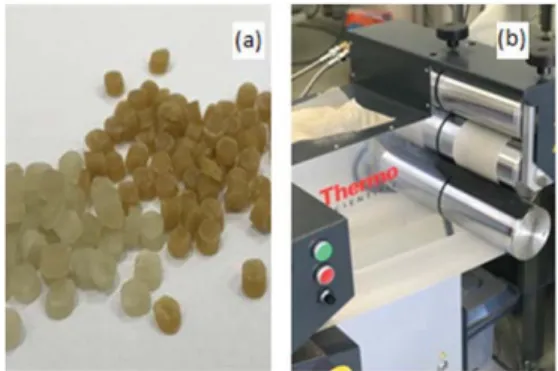
The figure 1 shows the extruded TPS and TPC in pellets form (Fig. 1a) and the produced composites films (Fig. 1 b) from homo and masterbatch pellets. It was possible to obtained composites films by a continuous process with an acceptable handling.
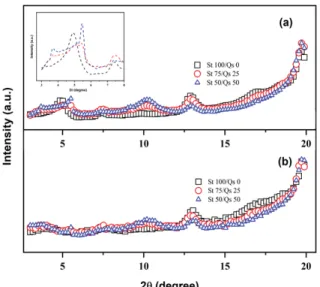
Figure 1: Production of pre-mixture (starch/chitosan) extruded in homo and masterbatch-base nanostructured pellets (a), TPS nanostructured films without chitosan (b). Therefore, the processing conditions selected for the extrusion and concentrations of the components allowed a good dispersion of fillers in the biopolymeric matrix due to the nanoclay exfoliated structure. Concerning the bamboo nanofibers, an intercalated composite was obtained, as can be observed by the XRD patterns shown in Figure 2. The nano structuration of blends also generates changes in the composites crystallinity, as can be seen in the Figure 2a, there was a peak shift of clay agglomerates from 2 = 7.2 º to 2 = 5 º, due to interaction of polymer chains into clay layers by the combination of high shearing at temperature process supplied by the extruder, allowing a disperse and a partial exfoliation of clay in the composite. It can also be observed the presence of peaks at 2 = 12.94º, which were directly related to the formation of a new semi-crystalline region by hydrogen bonds due to interactions of actives sites of polymers to form the blend.
On the other hand, the presence of peaks at 2 = 10.2º for the different blends refers to the presence of chitosan crystals which are represented by the orthorhombic configuration of molecular arrangement of chitosan [10].
Figure 2: XRD patterns of TPS/TPC blends structured with MT particles and zoom of the principal interaction of clay
with the matrix (a) and of (b) TPS/TPC blends structured with NFBs.
In contrast, the blends nanostructured with BNFs did not show a significant change in the crystalline lattice, consequently the non-presence of characteristic peaks of bamboo fibers denotes a possible increase of amorphous region due to interaction between the fillers and polymeric chains by hydrogen bonds.
Table 1 shows the decrease of the WVT for the films produced from TPS/TPC blends reinforced with clay or bamboo nanoparticles due to formation of an intercalated structure in the starch/chitosan blends, resulting in a tortuous pathway throughout the film increasing the path length for the diffusion of water molecules as well as the solubility of water in the films [11]. The blends structured with MT show a statistically significant decrease (p<0.05) for WVT as a function of the increase of MT concentration due to formation of an intercalated nanostructures. These results are supported by the XRD patterns evidencing the shift of the characteristic MT peak (Fig. 2a). Then, the observed increase of water vapor transmission in the blends structured at the same fillers concentration may be due to the formation of nanoparticles agglomerates, besides, the presence of insolubilized chitosan particles which tend to decrease the tortuosity path allowing the increase of water molecules transmission. On the other hand, a significant decrease (p<0.05) was also observed for the NFBs structured blends, but with values above those obtained for blends structured with MT. This behavior can be attributed to the hydrophilic nature of the bamboo fibers that could be absorbing and retaining a certain amount of moisture generating changes in the transmission of water molecules through the film [12]. In contrast, the results show that the blends without fillers showed no statistically significant difference for the WVT when the chitosan concentrations
reached up to 50 g/100 g, however the tendency of the decrease is due to surface hydrophobicity due to the presence of hydrophobic acetyl groups present in the structure of incompletely deacetylated chitosan [13].
Nanofillers Nanofillers concentration (g/100 g) TPS/TPC proportions WVT (g m-2 d-1) MT 0 100/0 512.8 ± 42.3aA 75/25 444.1 ± 53.5aAB 50/50 469.1 ± 44.1aAB 0.5 100/0 155.3 ± 31.7bD 75/25 329.9 ± 46.8aBC 50/50 365.1 ± 17.3aABC 1.0 100/0 139.9 ± 5.4bD 75/25 227.2 ± 7.9bCD 50/50 423.4 ± 12.3aAB NFBs 0 100/0 512.8 ± 42.3aA 75/25 444.1 ± 53.5aAB 50/50 469.1 ± 44.1aA 0.5 100/0 155.2 ± 3.0bC 75/25 392.0 ± 14.2aAB 50/50 300.1 ± 43.3abBC 1.0 100/0 358.0 ± 12.4bAB 75/25 447.9 ± 31.1aA 50/50 494.2 ± 35.9aA
Means in the same column, with the same lowercase letter are not significantly different (p>0.05), in relation to starch/chitosan concentration for each filler concentration.
Means in the same column, with the same capital letter are not significantly different (p>0.05), in relation to filler concentration.
Table 1. Water vapor transmission (WVT) of composites based on starch/chitosan blends obtained by extrusion process reinforced with clay (MT) or bamboo nanofibers
(NFBs).
4
CONCLUSIONS
The selected processing conditions to obtain the extruded nanostructured starch/chitosan blends allowed to obtain a partial exfoliation of MT and high intercalation of NFBs in the polymer matrix, allowing to decrease the WVT of the composites. Therefore, the produced films show a great competitiveness in relation to some of the already commercialized, such as polybutylsuccinate (PBS) Bionolle® and Polybutylene adipate-co-terephthalato (PBAT) Ecoflex®, demonstrating their possible use in various industrial sectors.
Acknowledgments
The authors acknowledge São Paulo Research Foundation (FAPESP) under grants 2014/01100-1 and 2016/18157-1. We would like to thank to the Food Research Center – FoRC for the financial support under FAPESP grant 2013/07914-8.
REFERENCES
[1] V.M. Azevedo, S.V. Borges, J.M. Marconcini, M.I. Yoshida, A.R.S. Neto, T.C. Pereira, C.F.G. Pereira, Effect of replacement of corn starch by whey protein isolate in biodegradable film blends obtained by extrusion, Carbohydr. Polym. 157 (2017) 971–980. [2] J.R. Rodríguez-Núñez, A. Domínguez-López, C.
Domínguez-López, P. Quintana Owen, J. López-Cervantes, D.I. Sánchez-Machado, D.E. Rodríguez Félix, M. Plasencia Jatomea, V. Peña Caballero, T.J. Madera Santana, Evaluation of Physicochemical and Antifungal Properties of Polylactic Acid–
Thermoplastic Starch–Chitosan Biocomposites, Polym. Plast. Technol. Eng. 56 (2017) 44–54. [3] R.P. Rathod, U.S. Annapure, Physicochemical
properties, protein and starch digestibility of lentil based noodle prepared by using extrusion processing, LWT - Food Sci. Technol. 80 (2017) 121–130. [4] G.L. Robertson, Food Packaging: Principles and
Practice, 3rd ed., Taylor & Francis Group, 2013. [5] V.G.L. Souza, A.L. Fernando, Nanoparticles in food
packaging: Biodegradability and potential migration to food—A review, Food Packag. Shelf Life. 8 (2016) 63–70.
[6] H. Angellier-Coussy, E. Gastaldi, F.C. Da Silva, N. Gontard, V. Guillard, Nanoparticle size and water diffusivity in nanocomposite agro-polymer based films, Eur. Polym. J. 49 (2013) 299–306. [7] M.A. Berthet, H. Angellier-Coussy, V. Chea, V.
Guillard, E. Gastaldi, N. Gontard, Sustainable food packaging: Valorising wheat straw fibres for tuning PHBV-based composites properties, Compos. Part A Appl. Sci. Manuf. 72 (2015) 139–147.
[8] M. Aider, Chitosan application for active bio-based films production and potential in the food industry: Review, LWT - Food Sci. Technol. 43 (2010) 837– 842.
[9] ASTM E96/E96M, Standard Test Methods for Water Vapor Transmission of Materials, ASTM Int. West Conshohocken, PA,. (2014).
[10] M.T. Yen, J.L. Mau, Physico-chemical
characterization of fungal chitosan from shiitake stipes, LWT - Food Sci. Technol. 40 (2007) 472–479. [11] H. Staroszczyk, K. Gottfried, E.
Malinowska-Pa czyk, I. Ko odziejska, Clay-filled starch films. Malinowska-Part I: Effect of clay kind and glycerol concentration on functional properties of composites, Starch - Stärke. 69 (2017) 1500325.
[12] T. Phattaraporn, S. Waranyou, A. Fazilah, Thawien, Characteristics and properties of rice starch films reinforced with palm pressed fibers, Int. Food Res. J. 17 (2010) 535–547.
[13] P. Kampeerapappun, D. Aht-ong, D. Pentrakoon, K. Srikulkit, Preparation of cassava
starch/montmorillonite composite film, Carbohydr. Polym. 67 (2007) 155–163.