
HAL Id: hal-00409255
https://hal.archives-ouvertes.fr/hal-00409255
Submitted on 25 May 2019
HAL is a multi-disciplinary open access
archive for the deposit and dissemination of
sci-entific research documents, whether they are
pub-lished or not. The documents may come from
teaching and research institutions in France or
abroad, or from public or private research centers.
L’archive ouverte pluridisciplinaire HAL, est
destinée au dépôt et à la diffusion de documents
scientifiques de niveau recherche, publiés ou non,
émanant des établissements d’enseignement et de
recherche français ou étrangers, des laboratoires
publics ou privés.
polyacrylamide ferrogels
Jose Alberto Galicia, Fabrice Cousin, Emmanuelle Dubois, Olivier Sandre,
Valérie Cabuil, Régine Perzynski
To cite this version:
Jose Alberto Galicia, Fabrice Cousin, Emmanuelle Dubois, Olivier Sandre, Valérie Cabuil, et al..
Static and dynamic structural probing of swollen polyacrylamide ferrogels. Soft Matter, Royal Society
of Chemistry, 2009, 5 (13), pp.2614-2624. �10.1039/b819189a�. �hal-00409255�
final edited and published work see http://pubs.rsc.org/en/Content/ArticleLanding/2009/SM/b819189a
1
Static and dynamic structural probing of swollen Polyacrylamide
ferrogels
J.A. Galicia
1,2, F.Cousin
3, E. Dubois
1, O. Sandre
1, V. Cabuil
1, R. Perzynski
1,*1
Université Pierre et Marie Curie – PECSA – UMR 7195 CNRS – UPMC – ESPCI, case 51, 4 Place Jussieu, 75252 Paris cedex 05 – France 2 Fac. de Ing. Quimica, Benemerita Universidad Autonoma de Puebla, Edif 147/102 Ciudad Universitaria,18 sur y San Claudio, Puebla, Pue. Mexico 3 Laboratoire Léon Brillouin, UMR 12 CNRS-CEA, CE-Saclay, 91191 Gif-sur-Yvette - France
Received 30th October 2008, Accepted 3rd April 2009
First published on the web as an Advance Article on the web 15th May 2009 DOI: 10.1039/b819189a
* corresponding author, e-mail : [email protected]
The local structure of hybrid ferrogels resulting from the incorporation of γ-Fe2O3 nanoparticles in a polyacrylamide polymeric network is probed from a static and a dynamic point of view, in various synthesis conditions and at swelling equilibrium. Relaxation of magneto-optical birefringence and Small Angle Neutron Scattering measurements show an adsorption of the nanoparticles onto the polymer ascribed to H-bonds. These measurements allow sorting out the conditions leading either - to a homogeneous scaffold reinforced by the nanoparticles or - to a nano-structured composite with a 2D nanoparticle decoration on the walls of percolating pockets, initially filled by the ferrofluid during the synthesis and leaking out during the swelling. Two parameters rule the structure and the properties of these ferrogels : - the osmotic pressure ratio RΠ (ratio of the osmotic pressure of the initial ferrofluid to that of the hydrogel) and the steric parameter RS (ratio of the nanoparticles volume to the mesh volume of the polymeric hydrogel).
Introduction
Ferrogels are hybrid materials resulting from the mixing of either micrometric or nanometric magnetic particles with polymeric chains. Such composites are usually developed for their magneto-elastic properties.1,2 The particles, frequently aggregated, reinforce the polymeric matrix mechanically.3,4,5 More generally, nanocomposites successfully combining polymers and magnetic nanoparticles result from the synthesis of multifunctional 3D architectures rationally assembled at the nanoscale. We disperse here magnetic nanoparticles of controlled size and coating inside polyacrylamide (PAM) hydrogels. PAM is well known for its swelling properties in aqueous media, it is often used as super-absorbing microbeads and in biochemistry.6 Our aim here is to monitor the local structure of our ferrogel by using the nanoparticles both as fillers and as probes, an aspect quite rarely reported in literature7 even though polymers are widely used to template different complex nanoparticles assemblies.8 By tuning the physico-chemical parameters of the system, we are able to control for example - the volume fraction of internalized nanoparticles and their release, - the swelling of the ferrogel, - the local homogeneity of the hybrid material, - the proportion of internalized nanoparticles free to rotate and those blocked in rotation. The control of the fraction of the internalized particles at equilibrium after swelling is specifically important for the mechanical properties, as it has been shown that the Young modulus of the ferrogel strongly depends on this fraction.2,9
The synthesis 9 is performed by polymerizing acrylamide (AM) monomers in an aqueous suspension of maghemite (γ-Fe2O3) nanoparticles in the presence of the cross-linking agent (BAM). The ratio CL = BAM/AM allows a tuning of the mesh-size of the polymeric network. The ferrogels are then let to reach their equilibrium inside a swelling bath because they are out-of-equilibrium materials in the synthesis conditions.
To probe our ferrogels from both a static and a dynamic point of view, we take advantage of the physical properties of the dispersed nanoparticles. We study their local organization inside the medium by Small Angle Neutron Scattering (SANS)10,11, taking benefit from the possibility to match the scattering length density of PAM in mixture of H2O and D2O. Being magnetic monodomains and also optically uniaxial, the nanoparticles give optical responses to magnetic solicitations. We perform a nano-mechanical probing of the hybrid system by a magneto-optical birefringence method, which is specific to ferrofluids.12,13,14 We are thus able to obtain a local, structural and rheological information on the hybrid system at the length scale of the nanoparticles.
In the following, we first discuss the parameters of the initial hydrogels and ferrofluids that can influence the local structure of ferrogels. After exposing our choices for the current study, we present the synthesis and the physico-chemical properties of the ferrogels. Their structural and magneto-relaxational properties are then presented and discussed in terms of homogeneity/inhomogeneity of the complex magnetic medium.
1. Choice of components for designing ferrogels
with versatile structures
If one wants to define a reproducible procedure for synthesizing ferrogels, versatile enough to tune the structure of the ferrogel from very homogenous to heterogeneous, the first
step is to find physico-chemical conditions for the synthesis at
which the individual components of the system are homogenous prior to mixing.
This implies to choose dispersions of magnetic nanoparticles with an interparticle potential dominated by repulsion in order to avoid any kind of aggregation of the nanoparticles before ferrogel synthesis. This has led us to work with ionic
final edited and published work see http://pubs.rsc.org/en/Content/ArticleLanding/2009/SM/b819189a
2 dispersions of magnetic nanoparticles based on maghemite
(γ-Fe2O3), of typical size 10 nm, coated by citrate species that provide them with a negative charge in water at neutral pH.15 For a citrate salt concentration [Na3Cit] lying between 2.10-3 mol.L-1 and 10-2 mol.L-1, the electrostatic repulsion dominates the interparticle attraction and the phase behavior is well described by the usual fluid-solid phase diagram of a repulsive system, even when a magnetic field is applied.16 We have
decided to fix the pH to 7.2 for all the experiments described in the paper and the citrate salt concentration [Na3Cit] to 8. 10-3
mol.L-1.
For the hydrogel, it means to work in a range of cross-linking CL where single hydrogels have both (i) good mechanical performances and (ii) an homogeneous structure. We have thus
decided to work in a range of CL lying between 0.5% and 2%
because the gels are too soft to be manipulated below CL = 0.5% and PAM hydrogels are known to present local heterogeneities of cross-linkers17,18 above CL = 2%. For these cross-linking ratios 0.5% ≤ CL ≤ 2%, the mesh-size ξsynth of the polymeric hydrogel after the synthesis ranges between 11 and 17 nm (see Table SI.1 of Supporting Informations (SI)).
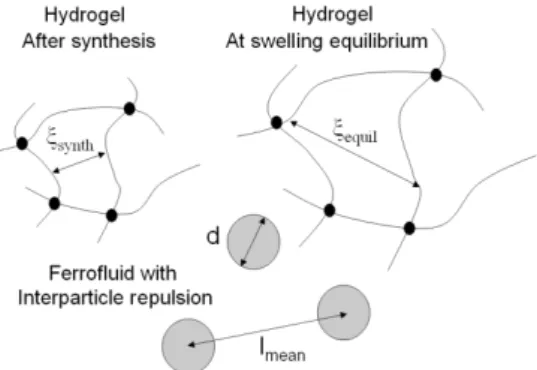
Figure 1 – Characteristic sizes of the individual components which
are mixed together to form the ferrogel – Hydrogel : mesh size after
synthesis ξsynth, (upper left) and at swelling equilibrium ξequil (upper
right). Ferrofluid : characteristic diameter d of the magnetic nanoparticle and interparticle distance lmean (down).
Two parameters may play a decisive role on the structure and on the properties of the ferrogel when the components are mixed:
- the osmotic parameter RΠ, ratio of the osmotic pressure of the suspension of magnetic nanoparticles and that of the hydrogel, - the steric parameter RS, ratio of the characteristic volumes of these components.
Both RΠ and RS depend on the nanoparticle characteristics and on the choice of cross-linking ratio, RΠ being also dependent on the volume fraction Φsynth of the initial ferrofluid (which fixes the initial interparticle distance lmean).
The osmotic parameter RΠ = ΠFF/Πswl HG
is the ratio of the osmotic pressures that characterizes the two components of the mixture in the initial conditions (see SI). If the osmotic pressure ΠFF
of mixing of the nanoparticles with the solvent in the pure ferrofluid is much larger than the initial swelling pressure Πswl
HG
of the pure hydrogel, it may be impossible to incorporate nanoparticles in the gels.
The steric parameter RS = 3 3
synth
d ξ is the ratio between the nanoparticle characteristic volume and the mesh volume ξsynth
3
of the polymeric hydrogel, supposed homogeneous, immediately after synthesis. If RS is too large, the presence of the nanoparticles may prevent to form a homogeneous gel.
Prior to mix any components, it is thus important to choose carefully the mesh size ξsynth of the hydrogel after synthesis as
well as its swelling pressure Πswell
HG , together with the
nanoparticle size and the osmotic pressure ΠFF
of the ferrofluid dispersion. The way in which all these details are obtained, is given in SI.
2. Ferrogels: synthesis and characterizations
a) SynthesisThe polymerization of the ferrogels is performed by a free radicalar polymerization at a given CL, in the aqueous dispersion of magnetic nanoparticles, at a given Φsynth tuned from 1% to 7% and at [Na3Cit] = 8.10
-3
mol.L-1. All chemicals, including the monomer AM and the cross-linker BAM are purchased from Sigma-Aldrich. The reactional mixture of global volume 3mL, contains acrylamide monomers AM (concentration 0.5 mol.L-1), cross-linking agent N,N’-methylen-bis-acrylamide (BAM) and the initiator (Ammonium persulfate at a concentration of 4.10-4 mol.L-1. Solutions are degassed under nitrogen for 5 minutes to eliminate oxygen, which would hamper the polymerization. The solutions are maintained at 70°C during two hours to achieve the completion of the reaction. The ferrogel appears as a red/orange material because of the trapped γ-Fe2O3 particles.
At the end of the synthesis, the ferrogels are molden as cylinders of polymeric concentration synth
AM
ϕ ~ 3%. They are carefully removed from their vessel and then swollen in an aqueous solution at [Na3Cit] = 0.008 mol.L-1. The swelling equilibrium of the ferrogels is reached in three weeks during which the swelling bath is changed several times. The particles, which are not trapped, are released in the swelling bath.9 Both phenomena of solvent swelling and particle release change the volume fraction of particles Φequil inside the gel which is then smaller than Φsynth.
b) Conditions chosen for the synthesis of ferrogels
The determination of the characteristic spatial scales of the individual components (table 1 and 2 of SI) enable us to choose conditions for synthesis of ferrogels where RS is higher or lower than 1 and RΠ is varied on a large range. Two different batches of ferrofluids with slightly different typical size of nanoparticles (FFA with d = 12 nm and FFB with d = 11 nm) are used here. Ferrogels prepared with nanoparticles FFA (resp. FFB) are denoted FGA (resp. FGB).
For CL = 0.5% and 1%, RS is less than 1 for both kinds of nanoparticles FFA and FFB. The case of FFA with CL = 1% has been already considered in 9. In the following we thus limit ourselves to the synthesis of ferrogels at CL = 0.5% with FFA to picture ferrogels with RS < 1 and we compare the results with the ones from 9. To picture ferrogels with RS ≥ 1 we consider both FFA and FFB for CL = 2% as RS > 1 for FFA and RS ~ 1 for FFB. Table 1 summarizes the values of RS in the various conditions of ferrogel synthesis.
FGA CL = 0.5 % FGA CL = 1 % FGB CL = 2 % FGA CL = 2% RS = 0.35 RS = 0.7 RS = 1 RS = 1.3 Table 1 – Steric parameter RS values for the various ferrogels
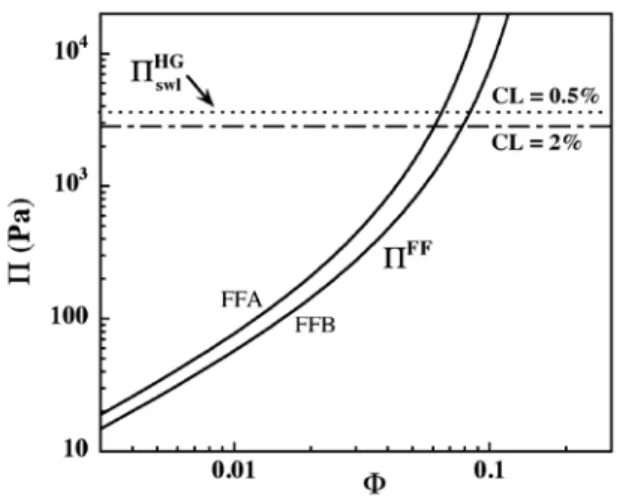
Figure 2 compares the swelling pressure Πswl HG
of the hydrogels to the equation of state ΠFF (Φ) of the ferrofluid dispersions at
[Na3Cit] = 8. 10-3 mol.L-1 as given by the Carnahan-Starling formalism – equ. (SI.7). It allows us, by using osmotic stress, to
final edited and published work see http://pubs.rsc.org/en/Content/ArticleLanding/2009/SM/b819189a
3 adjust precisely the osmotic pressure ΠFF
inside the ferrofluid used for preparing ferrogels and thus also the volume fraction of particles Φsynth. We prepare ferrogels in a large range of known osmotic parameter RΠ varying from RΠ << 1 to RΠ ∼ 1. Let us point out that it has not been possible here to synthesize macroscopic homogeneous ferrogels FGA at CL = 2%, that would correspond to RΠ ≥ 1.
Figure 2 – Hydrogels : Initial swelling pressure Πswl HG
at CL=0.5% (horizontal dotted line) and at CL = 2% (horizontal dashed-dotted line (Table SI.1 of SI). Ferrofluids : Carnahan Starling adjustments of the osmotic pressure ΠFF(Φ) of nanoparticles FFA and FFB following equ.
(SI.7) – full lines (parameters : see table SI.2).
c) Structural and rotational probing of the ferrogels
We probe the structural organization of nanoparticles in the ferrogels on a local scale by SANS. The experiments are performed in LLB (Saclay, France) on the PAXY spectrometer. We play on the neutronic contrast of the solvent to match the polymer scattering. The solvent is a mixture H2O/D2O (44/56 vol%). Its density of neutron scattering length is equal to that of the polymer, taking into account the exchange between hydrogen and deuterium of the two labile protons of the PAM repetition unit. In these conditions, the scattering coming from the nanoparticles is mainly of nuclear origin, with a contrast ∆ρ2
equal to 1.33 .1021 cm-4, the magnetic contribution being less than 7% of the nuclear one.19 The scattered intensity is :
I(q,Φ) Φ = ∆ρ
2F q
( )
S q,( )
Φ(1)
where F(q) is the form factor of the nanoparticles and S(q,Φ)
the structure factor of the dispersed nanoparticles. The structure factor in swollen ferrogels at various volume fractions of nanoparticles are obtained by dividing the scattering of ferrogels by the form factor of the nanoparticles measured with pure and dilute ferrofluids (shown for FFB in Fig SI.2 of SI). The shape of the structure factor reflects the homogeneity/inhomogeneity of the nanoparticles dispersion and allows measuring the most probable value of the interparticle distance inside the complex medium.
A complementary probing of the rotational degree of freedom of the nanoparticles at the nanoscale, inside the medium where they are dispersed, is also realized. Each nanoparticle of maghemite bears a magnetic moment µ and an optical anisotropy axis e , which are linked together by the anisotropy energy. Under an applied field
H , the magnetic
moment µ of each nanoparticle orientates along the field direction. If the nanoparticle is free to rotate in its carrier medium, this also rotates mechanically the core of the
nanoparticle together with its optical axis. The alignment (even partial) of the optical axis e of the nanoparticles imparts the system with a macroscopic optical birefringence ∆n. Comparing the birefringence induced in a ferrogel to that induced in a ferrofluid based on the same nanoparticles allows quantifying the proportion of nanoparticles free to rotate in the ferrogel and to characterize dynamically this rotation (see part 3 of SI). Two magneto-optical experiments are here performed to probe the rotation :
- A static measurement of the birefringence up to high fieldsH (of the order of 103 kA/m)20; In high fields, the birefringence ∆n saturates and is then proportional to the number of nanoparticles that can rotate within the sample (see SI - part 2). - A dynamic measurement of the optical birefringence relaxation after a pulse of magnetic field with a small amplitude; this relaxation can be written as a stretched exponential decay
I(t)= Io exp(-(t/το)α) (2) where το is a characteristic time of rotation and the exponent α is related to the width of the distribution of relaxation times in the dispersion. In a pure and dilute ferrofluid, this relaxation reduces to the rotational diffusion of the nanoparticles.
More details on these experiments are given in part 2 of SI. They provide us with a powerful structural and rheological probing of the ferrogels on the nanoscale.
d) Swelling ratio and particle release of the ferrogels
These ferrogels present remarkable swelling properties in particular because they are out-of-equlibrium in the synthesis conditions. During the swelling process, some internalized nanoparticles may escape from the gel and are released in the swelling bath.
The swelling ratio of the ferrogels G is here defined as : part dry dry FG polymer dry water m m m m m m G − − = = (3)
It is measured as follows. The ferrogel is weighed (mFG)
and dried at 70°C in order to obtain the mass of the dry ferrogel (mdry). The mass of γ-Fe2O3 (mpart) in the ferrogel is deduced
from iron concentration determination by using either chemical titration or Atomic Absorption Spectroscopy.
Note that following expression (3), the swelling ratio of the ferrogel Gsynth at the end of the synthesis (thus before swelling)
is already of the order of a few tens in our conditions. Hereafter we denote by Gequil the swelling ratio of the ferrogel at swelling
equilibrium.
In the pure hydrogels, the corresponding swelling ratios Gsynth
HG
and Gequil HG
are obtained by using exp. (3) with mpart = 0. At swelling equilibrium, the ratio of nanoparticle release is calculated with: synth part equil part synth part m m m R= − (4) where mpart
synth is the initial mass of γ-Fe2O
3 introduced at the ferrogel synthesis. The release ratio R is a characteristic parameter of the swollen ferrogels. It quantifies the nanoparticles ability to escape from the gel during swelling. The ferrogel always reaches an equilibrium state for which both
final edited and published work see http://pubs.rsc.org/en/Content/ArticleLanding/2009/SM/b819189a
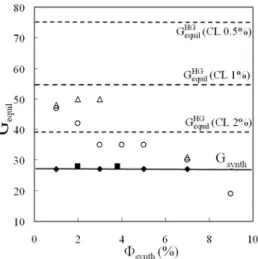
4 Figure 3 presents the swelling ratio Gequil of the ferrogels as
a function of Φsynth. For a comparison, the values obtained in ref 9 are also plotted. The full line corresponds to the value
Gsynth at the end of the synthesis before swelling. It is
independent on the nanoparticle size distribution and varies from 25 to 27 in our range of Φsynth. Whatever Φsynth and CL (except for Φsynth = 9% and CL=1%) the value Gequil at the end
of the swelling process is larger than Gsynth. Moreover,
whatever the volume fraction Φsynth introduced, Gequil is lower
than the swelling ratio of the hydrogel GequilHG
at the same cross-linking ratio CL (see Fig. 3). The introduction of nanoparticles within the polymeric network strongly modifies the affinity of solvent for the polymer, expressing that the swelling pressure
Πswell
HG of the ferrogel is weaker than the one of the
corresponding hydrogel.
Figure 3 – Swelling ratio of swollen ferrogels Gequil as a function of the
initial volume fraction of nanoparticles Φsynth: FGA with CL=0.5% (open triangles), CL=1% (open circles – data from 9) and CL=2% (solid squares); FGB – CL=2% (solid diamonds); The horizontal lines correspond to the swelling ratio Gsynth at the end of synthesis (full line)
and to the swelling ratio of hydrogels at various CL (dashed lines). As observed for the hydrogels, the swelling ratio Gequil of
ferrogels at constant Φsynth decreases with increasing the cross-linking ratio. If Φsynth increases at constant CL, Gequil decreases
except for CL= 2%, ferrogels then do not swell (Gequil is ~ Gsynth
for FGA and FGB).
Figure 4 shows the evolution of the release ratio R as a function of the initial volume fraction Φsynth in the ferrogels.
For FGA ferrogels, the release ratio R increases with Φsynth more or less linearly up to Φsynth = 4% (RΠ ≤ 0.2) and is independent on CL. For higher Φsynth (RΠ > 0.2), it stops at a maximal value of the order of 45% for CL = 0.5% as it was observed in ref 9 with FGA samples at CL = 1%.
For FGB ferrogels at CL = 2%, there is no release at low Φsynth (RΠ < 0.2) and a very large release ratio (about 85%) at larger Φsynth (RΠ > 0.2). The difference of release ratios R between FGA and FGB samples at cross-linking ratio of 2% at low Φsynth (both associated with RΠ ≤ 0.2) points out the important role of RS. Both systems do not swell. But samples made with FFA (RS > 1) release nanoparticles while samples made with FFB (RS ~ 1) do not.
The mass conservation implies:
equil synth synth equil G G R) 1 ( − Φ = Φ (5)
This relation is well verified experimentally. The evolution of the volume fraction Φequil obtained at the end of the swelling process as a function of Φsynth is presented in figure 5 for the different ferrogels.
Figure 4 – Release ratio R versus Φsynth. Same symbols as in Figure 3. The dashed line corresponds to R proportional to Φsynth at RΠ≤ 0.2 for FGA.
At low cross-linking ratios (CL = 0.5% and 1% - FGA – open symbols) the results in Fig. 5 are roughly equivalent up to Φsynth = 7% : Φequil is an increasing function of Φsynth with Φequil, always smaller than Φsynth. As the samples swell, the mesh size of the polymeric network initially larger than particles still increases allowing the nanoparticles release. On the contrary for CL = 2% - FGB (solid diamonds), we have to distinguish two situations: Φsynth ≤ 3% (RΠ ≤ 0.2) and Φsynth > 3% (RΠ > 0.2). At low Φsynth we obtain R=0 and Gequil = Gsynth and thus
Φequil = Φsynth (see Fig. 5). As the samples do not swell, the mesh size of the polymeric network remains always constant and close to the particle diameter. This indeed limits the translational diffusion of particles within the network and prevents release. For Φsynth > 3% the behavior drastically changes : R is large (Fig. 4) and Φsynth decreases to a value of the order of 1% (Fig. 5).
Figure 5 – Swollen ferrogels – Volume fraction of nanoparticles Φequil at swelling equilibrium versus the initial volume fraction Φsynth for various ferrogels. Same symbols as in Figure 3. The dashed line corresponds to Φequil = Φsynth.
3. Ferrogels at R
s< 1
We study here the structure and properties of ferrogels before and after swelling in the limiting case where RS <1. We choose thus to work with FGA samples at CL = 0.5 % (see table 3) and we vary RΠ in a large range.
final edited and published work see http://pubs.rsc.org/en/Content/ArticleLanding/2009/SM/b819189a
5
a) Rheological probing before swelling
The nanoparticles able to rotate in the samples before swelling are probed dynamically by relaxation of birefringence for three different Φsynth (1%, 3% and 7%). The experiments are performed on ferrogels instantaneously after the synthesis before they are placed in their swelling bath. The measurement of the relaxation time το and of the initial intensity Io enable to obtain the volume fraction of rotating nanoparticles in ferrogel
Φsynth
rot by comparison with the values of the pure ferrofluid (see
principle in part 3 of SI). The values of Φsynth
rot /Φsynth, Φ synth rot and of Φsynth block (= Φsynth -Φ synth rot
) are collected in table 2. Although the average mesh size of the polymeric network is superior to the particle diameter (RS = 0.35), there is a large amount of nanoparticles which are not allowed to rotate within the ferrogel. This suggests an interaction with the polymeric network. However the proportion of rotating particles increases from 15% at Φsynth = 1% up to 64% at Φsynth = 7%.
Φsynth (%)
το (µs) rot synth
Φ /Φsynth Φrotsynth
(%) block synth Φ (%) 1 3.2 0.15 0.15 0.85 3 2.7 0.34 1.0 2 7 1.9 0.64 4.5 2.5
Table 2 - Non swollen ferrogels. FGA-CL=0.5% - Low field magneto-optical birefringence. Φsynth volume fraction of nanoparticles in the ferrogel; το characteristic relaxation time; Φsynth
rot and Φ synth block volume
fractions of respectively rotating and blocked nanoparticles. For FFA dilute ferrofluids, we obtain τo
FF= 5.4 µs (see Table SI.2 of SI).
The decay of intensity can be adjusted by a stretched exponential of relaxation time το which stretched exponent α is always close to 0.75, smaller than that of the pure ferrofluid which is close to ~ 1. An advanced data treatment, presented in SI, enables to compare quantitatively the time distribution of rotating nanoparticles within ferrogels to the ones in the ferrofluid (see figure SI.4 of SI). It shows that in these unswollen ferrogels only short times are remaining. Nanoparticles of longer relaxation time seem to be blocked by the polymer within the ferrogels.
At low volume fractions Φsynth of nanoparticles (Φsynth =1% and 3%, RΠ < 0.1), a large amount of nanoparticles is blocked by the presence of the polymeric chains. Let us note however that, at these Φsynth, the proportion of nanoparticles free to rotate Φsynth
rot /Φsynth in the ferrogels at the end of synthesis is
roughly equal to R the release ratio of nanoparticles during the swelling process (see table 2 and figure 4). When RΠ becomes large, this is no more true, namely at Φsynth = 7% (RΠ ~ 0.5),
Φsynth
rot /Φsynth is found significantly larger than R.
b) Rheological probing at swelling equilibrium
We study here the rheological properties of ferrogels after swelling when the synthesis is at thermodynamic equilibrium. We perform here both static magneto-optical experiments in high magnetic fields and dynamic magneto-optical experiments in low magnetic fields. If both experiments can provide the amount of particles blocked in the ferrogels, one has to keep in mind that magnetic energy applied to a nanoparticle to produce its mechanical rotation are very different. In high fields experiments, it is of the order of its magnetic anisotropy energy, namely here ~ 2kTamb.
21
The blocked nanoparticles in high field experiments should thus be strongly coupled to the polymeric network, at least through an energy 8.10-21 J.
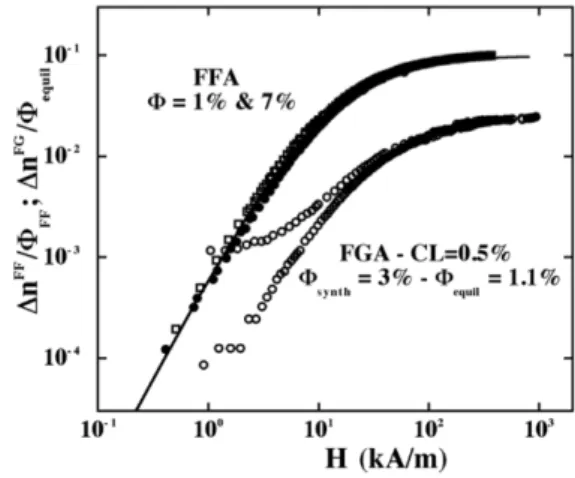
Figure 6 – Reduced birefringence ∆nFF/ΦFFof ferrofluids FFA at
Φ = 1% (solid circles) and 7% (open squares) – full line best fit by Langevin formalism (see part 2 of SI); ∆nFG/Φequil of ferrogel FGA at
swelling equilibrium (at CL = 0.5, Φsynth = 3%, Φnequil = 1.1%) as a function of applied field H.
Figure 6 plots the birefringence ∆nFG as a function of magnetic field for a ferrogel at Φequil = 1.1 % (Φsynth = 3%) and compares it to that of pure ferrofluid ∆nFF, normalized by the volume fraction inside the medium. Even though, both curves saturate in high fields, however they saturate at different values ∆nS/Φ. In the ferrogel it is equal to 0.024 to be compared to the corresponding value 0.1 in ferrofluid FFA (see table SI.2 in SI). This difference comes from the fact that inside the ferrogel a significant amount of nanoparticles is unable to rotate mechanically within ferrogel under the action of a high magnetic field. In the ferrogel, 76% of the nanoparticles are tightly blocked by the polymeric network at 103 kA/m.
Moreover, a hysteresis is observed when the field is decreased back to zero. At the time scale of the experiment (about 15 mn for the field decrease), an important proportion of nanoparticles keeps their mechanical orientation in zero field. This hysteresis disappears within a few hours denoting the existence of slow relaxations in the swollen system. The mechanical rotation of the nanoparticles are thus hindered by the polymers inside these ferrogels, even in fields as high as 103 kA/m. Φsyn th (%) Φequil (%) Φequilrot /Φ synth Φequil rot (%) Φequil block (%) το (µs) LF HF LF HF LF HF LF 1 0.5 0.34 0.05 0.17 0.02 0.33 0.48 4.4 3 1.1 0.24 0.10 0.26 0.11 0.84 0.99 3.5 7 3.0 0.14 0.21 0.42 0.63 2.58 2.37 2.5 Table 3 - Ferrogels at swelling equilibrium. FGA-CL=0.5% - Magneto-optical birefringence. Φsynth initial volume fraction; Φequil volume fraction at swelling equilibrium ; το characteristic relaxation time; Φequil
rot
and Φequil block
volume fractions of respectively rotating and blocked nanoparticles. HF refers to High-Field experiments and LF to Low-Field experiments.
Table 3 reports the respective volume fractions of blocked particles and of particles free to rotate within the ferrogel for Φequil = 0.5%, 1.1 % and 3%. After swelling, the volume fraction Φequil
rot
of blocked nanoparticles in high field is close to Φequil. The volume fractions of rotating nanoparticles obtained in low fields in dynamic magneto-optical experiments are very
final edited and published work see http://pubs.rsc.org/en/Content/ArticleLanding/2009/SM/b819189a
6 similar to the ones deduced from high fields measurements
(table 3). It shows that the ratio of blocked nanoparticles in low field experiments corresponds to the particles coupled with the polymeric network. The characteristic times το of rotation remains short compared to the one of pure ferrofluid (see the distribution times in SI).
c) Comparison of ratios of nanoparticles blocked in ferrogel before and after swelling
If the nanoparticles, blocked before swelling, remain blocked at swelling equilibrium, it means that their number can be obtained with: Φequil block = Φsynth block Gsynth/Gequil (6)
The comparison of table 2 and 3 enables to check this assumption. We compare in table 4 the experimental values
Φequil block
to the calculated ones (using equation 6). This is in very good accordance. The particles blocked just after synthesis
remain blocked during swelling. It also means, because the
volume fraction of polymer ϕAM is proportionnal to 1/G (see SI), that the ratio Φblock/ϕAM (either equal to Φ
synth block /ϕAM synth or to Φequil block /ϕAM equil
) remains constant during the swelling process (see table 4). Φsynth (%) Φsynthblock meas. (%) Φequilblock meas. (%) Φequilblock calc. (%) Φsynth block /ϕAM synth meas. Φequil block /ϕAM equil meas. 1 0.85 0.48 0.48 0.30 0.31 3 2 0.99 1.08 0.72 0.66 7 2.5 2.37 2.17 0.90 1.00
Table 4 – FGA - CL=0.5% - Volume fraction of blocked nanoparticles in ferrogels at swelling equilibrium (Φequil
block
) and in synthesis conditions (Φsynth
block
). Comparison between measurements of tables 2 and 3, and calculation with equation 6; Φsynth
block/ϕ AM synth
: volume ratio of nanoparticles with respect to polymer in the synthesis conditions;
Φequil block/ϕ
AM equil
: volume ratio of nanoparticles with respect to polymer at swelling equilibrium.
d) SANS experiments and structure of ferrogels
Figure 7 –Ferrogels at swelling equilibrium FGA – CL = 0.5 % -
Structure factor of the nanoparticles S(q) versus q at Φequil = 0.5% (solid triangles), 1.1% (open circles) and 3% (solid diamonds).
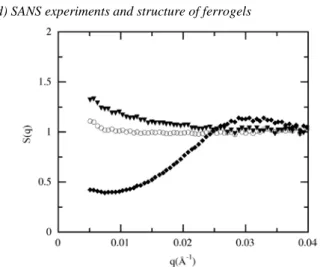
The structure factor S(q,Φ) of swollen ferrogels at various
volume fractions are presented in figure 7. They are obtained by dividing the scattering of ferrogels by the form factor of the ferrogels measured on pure ferrofluids. As almost all the
particles remaining in the ferrogels are coupled to the polymeric network, the structure is not at all similar to that of a pure ferrofluid solution. It is the structure of a matched
polymeric network decorated with nanoparticles. For Φequil =
0.5 % and 1 %, the structure factor is roughly equal to 1, except at low q where there is a slight upturn. The nanoparticles behave like a dilute system where nanoparticles are randomly organized with a low effective attraction.
At Φequil = 3%, which corresponds to a sample synthesized in concentrated regime (Φsynth = 7%), there is still the slight upturn at low q and a correlation peak at 0.032 Å-1 (~ 200 Å in real space). This peak corresponds to the most probable interparticle distance inside the polymeric network. Let us assume that the polymeric network is homogeneous with a mesh size ξ. In the framework of this hypothesis, the initial mesh size before swelling would be here 170 Å (see table 1 of SI) and would remain of the order of 170 Å after swelling (see Fig 3). ξ is of the same order of magnitude as the most probable interparticle distances. It is thus a rather homogeneous polymeric network that the nanoparticles are ‘decorating’.
Figure 8 – Route 1 : RS < 1 - FFA CL = 0.5% - Pictures of gels at the
end of the synthesis (left) and at swelling equilibrium (right), (a) low Φsynth (1% or 3%); (b) high Φsynth (7%).
Moreover the correlation peak corresponds also to the mean distance between nanoparticles in a pure ferrofluid solution at 3% in repulsive regime (see Fig SI.2). The particles fill thus all the available space in the swollen ferrogel and each mesh contains a nanoparticle. The covering of the polymeric network by nanoparticles is thus close to saturation. Note that if in this structure 80% of the nanoparticles are blocked in rotation, 20% still rotates as if in a liquid environment, without polymer hindrance, with a size of the order of the mesh of the network.
The structures of the ferrogels made with CL = 0.5% with FFA (at the end of the synthesis and at swelling equilibrium) are pictured in figure 8 for the whole range of Φsynth).
4. Ferrogels at R
s~ 1
We study here the structure and properties of ferrogels after swelling when RS ~ 1. We choose thus to work with FGB samples at CL = 2 % (see table 1) and we vary RΠ in a large range. As seen in Fig 3, there is no swelling at all for such samples: Gequil remains very close to Gsynth. However, there are
two different releasing behaviors depending on Φsynth. At low Φsynth (1% and 3%), there is no release. Oppositely above Φsynth = 3%, there is a very large release, as Φequil decreases to a value of the order of 1%. The following measurements enlighten these two very different behaviors
final edited and published work see http://pubs.rsc.org/en/Content/ArticleLanding/2009/SM/b819189a
7
a) Rheological probing at swelling equilibrium
We have deduced from low-field dynamical birefringence the volume fractions Φequil
rot of rotating nanoparticles and Φ equil block
of blocked nanoparticles in the swollen ferrogels (see table 5). A large proportion of the nanoparticles is blocked whatever Φsynth. Table 5 gives also the ratio Φequil
block
/ϕAM
equilfor each Φsynth.
Φsynth (%) Φequil (%) το (µs) Φequil rot Φequil Φequil rot (%) Φequil block (%) Φequil block ϕAM equil meas. 1 0.97 4.4 0.05 0.05 0.92 0.33 3 2.95 2.24 0.26 0.76 2.19 0.79 5 0.75 3.6 0.08 0.06 0.69 0.25 7 0.82 3.43 0.26 0.22 0.60 0.22
Table 5 - Ferrogels at swelling equilibrium. FGB-CL=2% - low field
magneto-optical birefringence.- Same notations as in table 3
There is a majority of blocked nanoparticles at any Φsynth. However in the samples at Φsynth = 3% and 7%, about ~ 25% of the amount of nanoparticles entrapped in the swollen system are still rotating. This is clearly different from the case where Rs < 1 where most of the particles free to rotate at the end of the synthesis are released during the swelling process since almost all of the particles remaining in ferrogels are blocked at swelling equilibrium. This is indeed related here to the tight mesh size of the network when Rs ~ 1. Moreover the characteristic time το of the rotating nanoparticles is here still of the same order of magnitude asτo
FF
(the relaxation time in the pure ferrofluid – see Table SI.2) and the stretched exponent has a constant value of ~ 0.9, also close to the one of the pure ferrofluid. It shows that the movement of the rotating nanoparticles is not strongly hindered by the polymeric network nor related to the existence of large nanoparticle agglomerates. These rotating nanoparticles should be located in a liquid environment within the sample. It enables us to conclude that the network is not homogeneous. Indeed, since Rs ~ 1 and since the ferrogel does not swell, an homogeneous network is not compatible with particles in a liquid environment.
At Φsynth > 3%, the very strong release of nanoparticles from ferrogels that do not swell implies the existence of large inhomogeneities within the synthesized samples. The volume fraction of blocked nanoparticles being quite constant in these swollen samples, it also suggests a saturation of the fraction of the polymeric network accessible to the nanoparticles.
b) SANS experiments and structure of ferrogels
The SANS structure factors of the four ferrogels are presented in Figure 9. At low Φsynth (1 %) S(q) is rather flat, while at larger Φsynth, S(q) presents a slight upturn at low q together with a maximum at a wave-vector qmax = 2π/lmp associated with the most probable interparticle distance lmp.
For sake of reasoning, let us first assume that the polymer network is here homogeneous. It would lead to a mesh size ξhom ~ 110 Å (see table SI.1) very close to the size of the nanoparticles. A network decorated with one nanoparticle per mesh (as in part 3) would present a maximum of S(q) at 2π/ξhom ~ 0.057Å-1 (see inset of figure 9 – dashed line) much larger than the experimental qmax=2π/lmp (open circles). This is
in any case not possible because it would imply much larger volume fractions of nanoparticles than the present ones.
Let us now assume that the spatial distribution of nanoparticles in the ferrogel is homogeneous with a mean interparticle distance lmean
( )
Φ = doπ
6Φ
3
. The maximum of S(q) will then be located at qmean(Φ) = 2π/lmean =
2π do 6Φ π 3 , which is plotted as a full line in inset of Fig. 9. Surprisingly, in these ferrogels, qmax is experimentally very close to 2π/lmean(Φsynth) (and for Φsynth > 3% sensibly larger than what would be expected for 2π/lmean(Φequil)). It allows to conclude that for: - the spatial distribution of nanoparticles is clearly hetero-geneous in the ferrogel.
- lmean(Φsynth) is close to lmp, even if slightly larger. The swollen ferrogel has a kind of “memory” of the initial large volume fraction of nanoparticles in the synthesis bath.
Figure 9 - Ferrogels at swelling equilibrium. FGB CL = 2% Structure factor S(q) versus q at Φsynth = 1% ( Γ ), Φsynth = 3% ( λ ) ; Φsynth = 5% (open squares) ; Φsynth = 7% (σ). Inset – q versus Φ (Dashed line : qmax = 2π/ξhom ; Full line : qmean versus Φ; Open circles : experimental qmax. =2π/lmp from fig.9a versus Φsynth)
The increase of the structure factor at low q observed for Φsynth ≥ 3% also shows that the nanoparticles are here organized in a very heterogeneous way within the ferrogels. There are areas of the ferrogel in which there is a high density of nanoparticles and areas empty of nanoparticles. In the areas of the ferrogel rich in nanoparticles, two situations can be considered: (i) the nanoparticles are locally concentrated or (ii) the nanoparticles form large aggregates. This second situation is not possible because we do not observe a correlation peak corresponding to the contact of two particles at 2π/d0 ~ 0.08 Å-1 which should be obtained in case of the presence of dense aggregates.22 There are thus spatial regions of the ferrogels where nanoparticles have been concentrated.
Since a large amount of the nanoparticles is coupled with the polymeric network inside the swollen ferrogel, the heterogeneous spatial distribution of nanoparticles shows that the polymeric network is also heterogeneous with regions of high polymer density coexisting with regions of low polymer density. The mass conservation of the polymer implies then that there are some regions of the ferrogel where the mesh size
final edited and published work see http://pubs.rsc.org/en/Content/ArticleLanding/2009/SM/b819189a
8 of the network is inferior to the diameter of the nanoparticles.
These parts are thus not accessible to the nanoparticles. The structure of the samples is thus composed of: (i) some regions with a high density of polymer and a small mesh size without nanoparticles, (ii) some regions where the nanoparticles are linked to the polymeric network and (iii) some pockets where there are no polymers and eventually some free nanoparticles in a fluid environment.
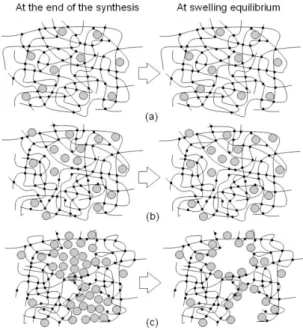
Figure 10 – Route 2 : RS∼ 1 - FFB CL = 2% - Pictures of gels at the end of the synthesis (left) and at swelling equilibrium (right), (a) low Φsynth (1%); (b) intermediate Φsynth (3%); (c) high Φsynth (5% or 7%).
At Φsynth ≥ 3%, the presence of liquid pockets containing nanoparticles may explain why we observe a correlation peak. The situation of the nanoparticles in the pockets is close to the one observed with pure ferrofluid solutions with a concentration of the order of ~ 7-8% (at Φsynth >3%). It leads to a correlation peak at the same wavevector (see the scattering spectra of the pure FFB ferrofluid at Φ = 7% in figure SI.2), but with an interparticle distance less defined. However in these systems, the total amount of rotating nanoparticles is at most 25% (of Φequil), the majority of the nanoparticles is blocked in rotation and thus linked to the polymeric network. Taking into account the observed intensity of the correlation peak, these blocked nanoparticles must also contribute to the peak and they thus should decorate the polymeric network with the same most probable distance. In this context, we can easily imagine that, during the swelling process, the pockets of the already very heterogeneous networks can percolate favoring the release of nanoparticles. This process then leaves behind a decoration of (blocked) nanoparticles on the surface of the empty pockets with the same interparticle distance as the ferrofluid previously contained in these pockets. This explains in the swollen ferrogels (prepared with Φsynth = 5% and Φsynth = 7%) : (i) their large release ratio (see Fig. 4), (ii) their low value of Φequil because the polymeric network outside the pockets is very tight, (iii) their large proportion of blocked nanoparticles and
(iv) the potential remaining of some isolated fluid pockets.
If we assume that at RS ~ 1, the particles blocked after the synthesis remain blocked after the swelling process as it is observed at RS < 1, it would also explain the rather low proportion of blocked nanoparticles at the end of the synthesis. The blocked nanoparticles are mainly decorating the pockets and are not introduced in the regions with a tight polymeric
network. Indeed at Φsynth = 3%, decorated pockets full of nanoparticles in a liquid environment also exist but remain isolated. The nanoparticles cannot be released because they cannot cross the regions where the polymeric mesh size is lower than their diameter. The pocket decoration confirms the existence of a specific interaction between the nanoparticles.
The structures of FGB ferrogels at CL = 2% (at the end of the synthesis and after swelling) are pictured in figure 10 for the whole investigated range of Φsynth.
5 - Discussion
The different local structures of ferrogels obtained in parts 3 and 4 shows that the homogeneity of ferrogels is controlled
by the synthesis conditions and is tuned by both RS and RΠ. Indeed as the polymeric network is cross-linked by covalent bonds its homogeneity cannot change during swelling.
RS is the main parameter that influences the homogeneity of
the ferrogel in the synthesis conditions. If RS < 1, the nanoparticles can easily enter in the meshes of the hydrogel without any distortion. Oppositely, for RS >1 an entrapped nanoparticle will necessary forces the mesh size in its immediate surrounding to be larger than the average mesh. The presence of the nanoparticles will thus bring inhomogeneities within the whole ferrogel. The difference of release ratios between FGA and FGB samples, at CL = 2% and low Φsynth, illustrates this point. Samples made with FFA release nanoparticles though samples made with FFB do not. For such a high cross-linking ratio, the polymeric network is heterogeneous with zones of pure polymer network and pockets of ferrofluid. The zones of pure polymeric network are so dense that the diffusion of free nanoparticles through them is impossible. Nanoparticles can only be released during swelling if they can follow an open percolating path. This happens in FGA samples (RS > 1) not in FGB (RS ~ 1) where the heterogeneities are less pronounced. It allows to sort out two families of ferrogel structures.
If RS < 1, the polymeric network is weakly modified by the nanoparticles and the ferrogel is homogeneous. This is the situation observed whatever Φsynth, as long as RΠ < 0.5. For RΠ ~ 0.5, the polymeric network becomes slightly heterogeneous. There are some nanoparticles able to rotate within the ferrogel. This is the situation for FGA at Φsynth = 7% and a cross-linking ratio CL = 0.5%.
If RS≥ 1, the system is heterogeneous. At low RΠ, there may be some nanoparticles able to rotate within the ferrogel in ferrofluid pockets. This is the situation for FGB at Φsynth = 3% and CL = 2%, with RΠ ∼ 0.2. For RΠ > 0.2 the polymeric network is very heterogeneous at the synthesis. The pockets of ferrofluid percolate to form continuous zones, free of polymer, within the ferrogel, that can empty during the swelling process. This explains the large release ratio observed with FGB ferrogels at CL = 2% for Φsynth = 5% and Φsynth = 7%. This is also the reason why FGA ferrogels at CL = 2% and Φsynth ≥ 5% break down during swelling.
Apart from the conditions that play on the homogeneity of the ferrogel during the synthesis, a very important feature of the ferrogels is evidenced here whatever their homogeneity. It is an attractive interaction between the nanoparticles and the polymer chains that induces a strong adsorption of the
nanoparticles on the polymer network. The existence of an
attractive interaction is clearly proved by the reduction of the swelling ratio of the ferrogel compared to the swelling ratio of
final edited and published work see http://pubs.rsc.org/en/Content/ArticleLanding/2009/SM/b819189a
9 the hydrogel at the same cross-linking ratio CL. Without
interaction between the nanoparticles and the polymeric chains, the addition of nanoparticles bearing a negative charge in the hydrogel would have increased the chemical potential of water inside the gel and thus the swelling of the hydrogel (like in a dialysis bag). As one observes exactly the opposite behavior even at low Φsynth, it points out an attractive part in the sum of interaction between nanoparticles and polymer chains. When Φsynth is increased in the network, the effect increases and the swelling ratio Gequil of the ferrogel decreases (see Figure 4).
These attractive interactions existing between iron oxide nanoparticles and the PAM chains in the ferrogels are ascribed to hydrogen bonds between the carbonyl groups of the polymer (each monomer bearing a primary amide function) and hydroxyl functions at the iron oxide surface, either Fe-OH directly at the solid surface or hydroxyl end-groups from the citrate ligands coating the nanoparticles. The hypothesis of H-bonds formation between PAM and many oxides was proposed long ago.23 It was evidenced by techniques like the shift of infra-red absorption bands of the polymer24 and the shift of the iso-electric point of the oxide surface measured by potentiometric titration and zetametry.25 Such H-bonds were also invoked in the kinetics of adsorption of PAM onto the haematite (α-Fe2O3) surface, which has a chemical reactivity close to maghemite (γ-Fe2O3).
26
The completely different mechanism of complexation by direct chelation of FeIII ions by polar groups of the polymer is very unlikely in our case of ferrogels, because the iron oxide surface is already covered by a dense layer of citrates, which offer many hydroxyl moities to establish H-bonds with the polymer.
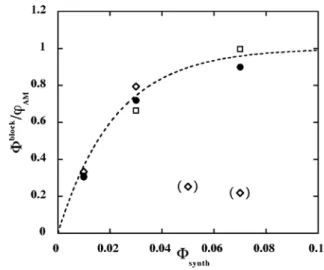
A second experimental evidence of this interaction is given by the observation of blocked nanoparticles just after synthesis, remaining blocked all along the swelling process, even if the mesh is larger than the nanoparticles (RS < 1). As a release is geometrically possible, the remaining nanoparticles are thus all adsorbed to the polymeric network and decorate it. Depending on the synthesis conditions they are then decorating either a homogeneous polymer network (RS < 1) or the pockets (empty or full of ferrofluid) of an heterogeneous network (RS ~ 1). The birefringence experiment in large fields gives an indication about the binding energy of the nanoparticles to the polymeric network : it is larger than 2kTamb, a hydrogen bond being of the order of 4kTamb. Figure 11 quantifies the adsorption of the nanoparticles on the polymer chains through the Φsynth-dependence of the ratio Φblock/ϕAM
, volume fraction of blocked nanoparticles over polymeric volume fraction. It collects for homogeneous networks the previous observations of Tables 4 and 5:
- Φ block/ϕAM
remains constant before swelling and at swelling equilibrium, as adsorbed nanoparticles cannot diffuse outside the gel,
- the cross-linking ratio has no influence on Φblock/ϕAM, as the adsorption process is indeed related to an interaction between the polymeric chains and the nanoparticles,
- Φ block/ϕAM only depends on Φsynth and saturates at large Φsynth, this plateau being consistent with SANS experiments on FGA at CL=0.5% and Φsynth = 7% that shows that the covering of the polymeric network by nanoparticles is close to saturation.
In the two heterogeneous swollen samples FGB at CL=2% and large Φsynth, the values of block
equil
Φ / equil
AM
ϕ can no longer be located on the absorption curve of figure 11 because a large
part of the heterogeneous network is not accessible to the nanoparticles and does not participate to the adsorption process (see diamonds at large Φsynth in Fig. 11).
Figure 11 – Nanoparticle adsorption - Volume ratio of nanoparticles with respect to polymer in the synthesis conditions block
synth
Φ / synth
AM
ϕ (full circles: FGA - CL = 0.5%) and at swelling equilibrium block
equil
Φ / equil
AM
ϕ (open squares : FGA – CL = 0.5%; open diamonds : FGB – CL = 2% ) versus initial volume fraction of nanoparticles Φsynth.
Nanoparticle adsorption also limits the nanoparticle release during swelling, however it is not always the only cause for a low release. Because of local heterogeneities in the polymeric network, pockets of ferrofluid, with nanoparticles able to rotate, can be entrapped in the ferrogel even after swelling (see for example FGB at CL=2% and Φsynth =3%).
This strong adsorption of the nanoparticles on the polymeric chains can explain the large mechanical reinforcement obtained in 9 with FGA ferrogels at CL=1%. In such ferrogels, the synthesis conditions were chosen to get a ferrogel decorated by the nanoparticles with an homogeneous structure (RS<1 and RΠ<1). It leads to a relative increase of the Young modulus EFG-EHG/EHG varying exponentially with Φequil /ϕAM (see inset of Figure 12) reaching for Φsynth =7% (Φequil =3%) a value 10 times larger than that of the corresponding hydrogel. It means that the number of cross-links mediated by the nanoparticles is then 10 times larger than the BAM cross-links.
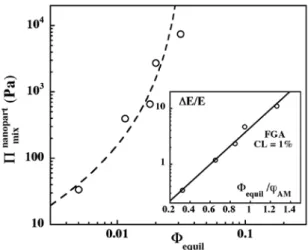
Let us note as a last point that in the ferrogel (as it is true in the hydrogel – see SI) the Young modulus at swelling equilibrium is directly proportional to Πmix
FG
the osmotic pressure of mixing of all the components of the system. By substracting Πmix
HG
the mixing osmotic pressure of the pure hydrogel (see SI), it is then possible to deduce the osmotic pressure Πmix
nanop
associated to the mixing of the nanoparticles in the system “polymer + solvent”. These determinations for FGA at CL=1% are plotted in figure 12 as a function of Φequil. Adjusted by a Carnahan-Starling formalism (see SI), a much larger repulsion range (δ = 12nm) is found with respect to that of ΠFF of the initial ferrofluid FFA (δ = 4.5 nm). In these homogeneous ferrogels, the nanoparticles are distributed as in a dispersion of very strongly repulsive Hard-Spheres, this effective repulsion being mediated by the polymer chains on which the nanoparticles are adsorbed. This let suspect only weak effects from an applied magnetic field, as in standard strongly repulsive ferrofluids27, a softening of the structure
final edited and published work see http://pubs.rsc.org/en/Content/ArticleLanding/2009/SM/b819189a
10 being necessary to make them observable. As in ferrofluids,
such effects could be induced if the ionic strength is increased either in the synthesis conditions or in the swelling bath.
Figure 12 – Homogeneous ferrogels FGA at swelling equilibrium
CL=1% - Nanoparticle contribution Πmix nanopart
to mixing pressure of ferrogels versus Φequil (open circles – dashed line: its Carnahan-Starling adjustment). Inset: Reduced variations (EFG-EHG)/EHG of the elastic modulus (from 9) in these swollen ferrogels as a function of Φ
equil/ϕAM in a log-log representation. The full line is an exponential fit.
Summary and perspectives
Magnetic nanocomposite materials of low Young modulus are here synthesized by dispersing maghemite nanoparticles in a PAM polymeric network. We show how the local structure of a ferrogel can be tuned from a very homogeneous structure to a very heterogeneous one by the synthesis conditions. These local structures are elucidated here thanks to the combined use of physico-chemical determinations, of magneto-optical dynamic birefringence and of static Small Angle Neutron Scattering. These measurements reveal an adsorption of the nanoparticles on the polymeric chains, which allows keeping some nanoparticles inside the swollen gels. This adsorption limits the swelling process and decorates the polymeric network with nanoparticles, which explains the reinforcement observed in 9 with these ferrogels at CL = 1% because entrapped nanoparticles behave as supplementary cross-linkers in the network. If the ratio RS (defined as the nanoparticle effective volume over the polymeric mesh one in the homogeneous hydrogel) is too large the system becomes very heterogeneous and decorated pockets are observed. If RS<1, a homogeneous network decorated at the spatial scale of the polymeric mesh is observed for RΠ ≤ 1. When the ratio of volume fraction of nanoparticles to volume fraction of polymer Φequil/ϕAM reaches 1, the polymeric array is saturated. If RS ≥1, it is no longer possible to form homogeneous ferrogels during the synthesis. The ferrogels are formed by connected networks of polymers with a tight mesh size without nanoparticles coexisting with pockets free of polymers decorated by nanoparticles. It becomes then difficult to keep the properties of the ferrogels under control.
We have thus shown how it is possible to monitor the mechanical properties of the ferrogels. As the key point of the monitoring of the properties is the interaction between the different partners of this complex system, we will investigate in a further work how the salinity of the medium modifies this
interaction and how it can change the properties of these swollen ferrogels.
Acknowledgements
We thank Delphine Talbot for the synthesis of the ferrofluids. This work was supported by CONACYT Mexico.
References
[1] Z. Varga, G. Filipcsei, M. Zrinyi, Polymer 47 (2006) 227 [2] S. Abramchuk, E. Kramarenko, G. Stepanov, L.V. Nikitin, G. Filipcsei, A.R. Khokhlov, M. Zrinyi, Polym. Adv. Technol. 18 (2007) 883
[3] J. Oberdisse, P. Hine, W. Pyckhout-Hintzen, Soft Matter 3 (2007) 476
[4] J. Oberdisse, A. El Harrak, G. Carrot, J. Jestin, F. Boué,
Polymer 46 (2005) 6695
[5] J. Jestin, F. Cousin, I. Dubois, C. Ménager, J. Oberdisse, R. Schweins, F. Boué, Adv. Mat. 20 (2008) 2533-2540
[6] J. Shigeura et al, US Patent 5338426 (1994)
[7] A.V. Texeira, I. Morfin, F. Ehrburger-Dolle, C. Rochas, E. Geissler, P. Licinio, P. Panine, Phys. Rev. E 67 (2003) 021504 [8] R. Shenhar, T.B. Norsten, V.M. Rotello, Adv. Mater. 16 (2005) 657-669
[9] J.A. Galicia, O. Sandre, F. Cousin, D. Guemghar, C. Ménager, V. Cabuil, J. Phys.: Condens. Matter 15 (2003) S1379
[10] C. Rivière, C. Wilhelm, F. Cousin, V. Dupuis, F. Gazeau, R. Perzynski, Eur.Phys.J. E 22 (2007) 1
[11] S. Lecommandoux, O. Sandre, F. Checot, R. Rodriguez-Hernandez, R . Perzynski, Advanced Mat. 17 (2005) 712 [12] G. Mériguet, E. Dubois, V. Dupuis, R. Perzynski, J. Phys.:
Condens. Matter 18 (2006) 10119
[13] C. Wilhelm, F. Gazeau, J. Roger, J.N. Pons, M.F. Salis, R. Perzynski, J.-C. Bacri, Phys. Rev. E 65 (2002) 031404 [14] E. Hasmonay, A. Bee, J.-C. Bacri, R. Perzynski, J Phys
Chem B 103 (1999) 6421-6428
[15] E. Dubois, V. Cabuil, F. Boué, R. Perzynski, J. Chem.
Phys. 111 (1999) 7147
[16] F. Cousin, E. Dubois, V. Cabuil, Phys. Rev. E 68 (2003) 021405
[17] L. Benguigui, F. Boué, Eur. Phys. J. B 11 (1999) 439 [18] D. Asnaghi, M. Giglio, A. Bossi, P.G. Righetti
Macromolecules 30 (1997) 6194
[19] F. Gazeau, F. Boué, E. Dubois, R. Perzynski, J. Phys.:
Condens. Matter 15 (2003) S1305
[20] E. Hasmonay, E. Dubois, J.-C. Bacri, R. Perzynski, Yu. L. Raikher, V.I. Stepanov, Eur. Phys. J. B 5 (1998) 859
[21] F. Gazeau, J.-C. Bacri, F. Gendron, R. Perzynski, Yu. Raikher, V. Stepanov, E. Dubois, J. Mag. Mag. Mat. 186 (1998) 175
[22] J. Fresnais, J.-F. Berret, L. Qi, J.-P. Chapel, J.-C. Castaing, O. Sandre, B. Frka-Petesic, R. Perzynski, J. Oberdisse, F. Cousin, Phys. Rev. E, 78 (2008) 040401
[23] O. Griot, J. A. Kitchener, Trans. Faraday. Soc. 61 (1965) 1026
[24] M. J. McGuire, J. Addai-Mensah, K. E. Bremmell, J. Coll.
Inter. Sci 299 (2006) 547-555
[25] S. Chibowski, M. Wisniewska, Coll. Surf. A 208 (2002) 131-145
[26] A. K. Bajpai, S. K. Bajpai, Coll. Surf.A 101 (1995) 21-28
[27] G. Mériguet, F. Cousin, E. Dubois, F. Boué, A. Cebers, B. Farago, R. Perzynski, J. Phys. Chem. B 110 (2006) 4378-438
final edited and published work see http://pubs.rsc.org/en/Content/ArticleLanding/2009/SM/b819189a
11
Supporting Information
Static and dynamic structural probing of swollen Polyacrylamide
ferrogels
J.A. Galicia
1,2, F.Cousin
3, E. Dubois
1, O. Sandre
1, V. Cabuil
1, R. Perzynski
1,*1 Université Pierre et Marie Curie – PECSA – UMR 7195 CNRS – UPMC – ESPCI, case 51, 4 Place Jussieu, 75252 Paris cedex 05 – France 2 Fac. de Ing. Quimica, Benemerita Universidad Autonoma de Puebla, Edif 147/102 Ciudad Universitaria,18 sur y San Claudio, Puebla, Pue. Mexico 3
Laboratoire Léon Brillouin, UMR 12 CNRS-CEA, CE-Saclay, 91191 Gif-sur-Yvette - France
* corresponding author,
e-mail : [email protected]
1 Hydrogels
1.1 - Synthesis
The hydrogels are obtained by a free radicalar polymerization as described in part 2a of the main article replacing the ferrofluid by an aqueous solution of trisodium citrate (Na3Cit) at a concentration 8.10-3 mol.L-1. The range (0.5-2%) of cross-linker ratio is chosen for the following reasons :
(i) Below CL = 0.5%, the gels are too soft to be manipulated (ii) Above CL = 2%, PAM hydrogels are known to present local heterogeneities of cross-linkers.1,2,3
1.2 Swelling of the hydrogel
At the end of the synthesis, the hydrogel is out of thermodynamical equilibrium. Placed inside a water bath at the same concentration [Na3Cit] as the synthesis medium, it absorbs a large volume of water. The swelling equilibrium is reached when the hydrogel mass does not evolve anymore (typically after 3 weeks). Before reaching equilibrium, the bath is changed several times in order to accelerate the equilibration process. When equilibrium is reached, the swollen gel is weighed (mswollen), then dried at 70°C during 12 hours, and weighed again (mdried). mdried is very close to the mass of polymer mpolymer because the polymerization yield is measured equal to 98%. This allows to determine the swelling ratio GHGequil
at equilibrium through
(
mswollen− mdried)
mpolymer= mH2O mpolymer. GHG
equil
depends on the degree of cross-linking CL (see table SI.1). It is related to the volume ratio of polymer at equilibrium through ϕAM
equil=ρ
H2O ρ GHG
equil with ρ ρ
H2O = 1.35, ρ being the
polymer density. The same formula stands at the end of the synthesis : ϕAM synth =ρH2O ρGHG synth where ϕAM synth and GHG synth are the
volume ratio of polymer and the swelling ratio in the preparation state (after cross-linking and before swelling).
1.3 –Swelling pressure of hydrogels and mesh size of the hydrogel polymeric array
Once GHG equil
is measured, it is possible to calculate the initial swelling pressure Πswl
HG (at polymer volume fraction ϕ
AM = ϕAM
synth
) following Flory-Rehner theory knowing the Flory parameter χ . It is also possible to calculate the number of monomers NC between two cross-links and to estimate the
mesh size of the polymeric network ξequil either from the
volume density of cross-links or from the gyration radius of a polymer branch between two cross-links, that give very similar results. All the results are summed up in table SI.1 for the three cross-linking ratios CL used here.
CL (%) GHG synth ϕ AM synth (%) GHG equil ϕAM equil (%) Nc = Mc / M ξequil ξΘ (nm) ξsynth (nm) Πswl HG (kPa) 0.5 25.9 2.78 74.4 0.99 1.55103 24.0, 23.0 16.8 3.60 1 25.4 2.83 54.0 1.35 8.3 102 17.5, 16.5 13.4 3.52 2 24.9 2.88 38.9 1.87 4.2 102 12.5, 12.0 10.8 2.93
Table SI.1- Characteristics of the hydrogels – CL cross-linking ratio; GHGsynth
and ϕAM synth
: swelling ratio and polymeric volume ratio of the hydrogel determined immediately after synthesis; GHG
equil
and ϕAM equil
: swelling ratio and polymeric volume ratio at swelling equilibrium; Nc is
the number of monomers between two cross-links, Mc being the molar
mass of polymer between cross-links deduced at equilibrium from equ.(SI.4) and M the molar mass of monomer AM; ξequilis the mesh
size of the hydrogel at swelling equilibrium deduced from equ.(SI.5), ξΘ the mesh size of PAM in a Θ solvent; ξsynth is the mesh size of the
hydrogel immediately after synthesis, Πswell HG
the initial swelling pressure of the hydrogel at ϕAM= ϕAM
synth
.
The thermo-dynamical equilibrium of a neutral polymeric array, with a homogeneous distribution of reticulation nodes is ruled by a balance between osmotic and elastic forces. The swelling pressure of the hydrogel Πswl is given by 4,5 :
Πswl HG= −1 V1 µ1 gel−µ 1 bath
(
)
= Πmix HG− Π el HG (SI.1) where µ1 gel (resp. µ 1 bath) is the chemical potential of water inside the hydrogel (resp. inside the bath), V1 is the molar volume of the aqueous solvent (= 18 cm3/mol), Πmix
HG
is the contribution coming from entropic and enthalpic effects due to the polymer/solvent mixing, ΠelHG
is the elastic pressure associated to the stretching of the polymeric chains with respect to their reference molten state (without solvent). We forget here any contribution coming from electrostatic interactions between chains. The mixing pressure writes :
ΠmixHG= −RoT V1 ln 1−ϕ
(
AM)
+ϕAM+χϕAM 2(
)
≅RoT V1 1 2−χ ϕAM 2 if ϕAM <<1 (SI.2) where Ro is the Perfect Gas constant, T the temperature inKelvin, ϕAM the volume fraction of polymer inside the hydrogel and χ the Flory parameter which is here equal to 0.47.6,7

![Figure SI.2a presents the SANS scattered intensity (divided by Φ) for sample FFB at various Φ and low ionic strength [Na 3 Cit] = 8.10 -3 mol.L -1](https://thumb-eu.123doks.com/thumbv2/123doknet/13474076.412820/13.892.90.417.97.375/figure-presents-scattered-intensity-divided-sample-various-strength.webp)
