BETWEEN RHETORIC AND REALITY:
EXPLAINING THE RUSSIAN FEDERATION'S NUCLEAR FORCE POSTURE by
Olga Oliker
M.P.P., Harvard University, 1993 B.A., Emory University, 1991
Submitted to the Department of Political Science in Partial Fulfillment of the Requirements for the Degree of
Doctor of Philosophy in Political Science at the
MASSACHUSETTS INSTITUTE OF TECHNOLOGY
September 2016
2016 Olga Oliker. All rights reserved.
The author hereby grants to MIT permission to reproduce and to distribute publicly paper and electronic copies of this thesis document in whole or in part in any
medium now known or hereafter created.
Signature of Author:
Certified by:
Signature redacted
3 Department of Political Science September 1, 2016
Signature redacted
Z'7 Accepted by: MASSACHUSETTS INSTITUTE OF TECHNOLOGYOCT 2
6
2016
- - Barry R. PosenF nternational Professor of Political Science Thesis Supervisor
Signature redacted
Ben Ross Schneider Ford International Professor of Political Science Chair, Graduate Program Committee
Between Rhetoric and Reality: Explaining the Russian
Federation's Nuclear Force Posture
by
Olga Oliker
Submitted to the Department of Political Science on September 1, 2016 in Partial Fulfillment of the Requirements for the Degree of
Doctor of Philosophy in Political Science ABSTRACT
This dissertation proposes and evaluates the performance of three theories that aim to explain Russia's nuclear force posture choices since the collapse of the Soviet Union. Two are rooted in concepts of inter-state competition. Of these, one begins with a central hypothesis that nuclear weapons, being more destructive than other weapons, are sufficient to deter a broad range of threats and will be preferred for doing so. The second argues that nuclear weapons contribute to a state's overall power and prestige, but are not sufficient to define it. They are preferred to deter nuclear, but not conventional, threats. The third theory postulates that strategic culture shapes which government actors will be most successful at garnering resources, resulting, in Russia's case, in a proclivity for offensive, ground-based weapons.
I develop these theories and test them against the reality of Russia's nuclear rhetoric
and force structure from 1992-2012. I find strongest support for the explanation rooted in cultural and bureaucratic factors. However, this theory predicts only force structure. In contrast, the theory that predicts states will treat nuclear weapons as one contributor to power and prestige appears to successfully predict Moscow's declaratory policy, but not its force structure (except between 2009 and 2012, when force structure is compatible with both this theory and the culture and bureaucracy theory).
My analysis indicates that cultural and bureaucratic factors appear to play an
important role in Russia's force structure choices, and help explain a continued emphasis on silo-based systems. Systemic factors appear crucial to Russian
declaratory policy, but their impact on force structure is less pronounced, with the exception of Russia's desire for prestige driving larger force size. The divergence between declaratory policy and force structure is a notable finding not predicted by my theories (although allowed for by the culture and bureaucracy theory). Finally, I hope that with my culture and bureaucracy theory, I have proposed a useful way forward in operationalizing cultural factors for testing and analysis.
Thesis Supervisor: Barry R. Posen
Acknowledgements
This took a while. That means there are a lot of folks who supported, inspired, challenged and otherwise helped me along the way. There is no way I will thank all of you. But I will make a start of it. My parents, Ze'ev Oliker and Lena Matis, are first. You gave me life, you brought me to the United States, and you've kept me reading, thinking, and arguing this whole time. Spasibo. Toda.
Tremendous thanks, of course, to my dissertation committee: Barry Posen, Roger Petersen, and Taylor Fravel. Your willingness to take on a returning student when you already had full loads, and to give this effort your intellectual attention and horsepower has meant a lot to me. I am grateful for your insights, for your critiques, and for your time. I am also very appreciative of the Massachusetts Institute of Technology (MIT) Department of Political Science as a whole for its support, with particular thanks to Susan Twarog, whose aid in navigating processes and
procedures was tremendously valuable.
I get so much from my village: insights into deterrence theory, Russian history,
defense budgeting, and chapter structure; belays and book recommendations; shared wine, whisky, beer, BBQ, and cheese boards. Again, I am grateful to many more people than I can name. Here, I'm calling out those whose substantive inputs made this thesis more viable and/or who were particularly crucial to maintaining my sanity. I suck at asking for help. You gave it anyway. Thank you. In no particular order: Audra Grant, Stacy Stoller, Olga Grushin, Karen Usdin, Bruce Hayward, Lisa-Joy Zgorski, Stacy Closson, Jim Quinlivan, Michael Kabran, Keith Crane, Steve Watts,
Miriam Lanskoy, Karl Mueller, Ronny Gal, Adam Grissom. Big thanks to Andrew Radin and Miranda Priebe for last-minute advice at key points in this process. Among my friends, I am incredibly lucky to count my sister, Aviva Oliker Miller, and
my brother, Yosef Oliker. One may not get to choose one's family, but I'd choose you both any day. Also among my friends but getting a special, collective shout-out is
everyone who's been on the leadership team of Girls Rock! DC since I joined
(2014ish?) and, indeed, Girls Rock! DC as a whole. Y'all are amazing. What we do is the best thing I do.
The MIT Security Studies Program provided the financial support that got me started on this, back when the earth was young. The RAND Corporation covered some of the time I spent writing and helped with tuition costs, as did the Center for Strategic and International Studies (CSIS). I am particularly indebted to Nancy Pollock, who ensured that I had time to work on this dissertation while at RAND. I am also grateful to RAND and CSIS for enabling me to pursue these topics
Table of Contents
Abstract 3
Acknowledgements 5
Table of Contents 7
Chapter One: Explaining Nuclear Force Posture 9
Introduction 9
Why Study Russian Nuclear Posture? 11
What is Posture? 11
Types of Nuclear Doctrine and Posture 13
Chapter Two: Two Structural Realist Theories 21
Introduction 21
The Absolute Weapon 24
Internal Balancing and Prestige 30
Variables 36
Chapter Three: A Theory of Russian Nuclear Weapon Strategic Culture and
Bureaucracy 39
Introduction 39
Culture in International Relations 40
Defining Culture 42
Culture and Organizations 45
Building a Cultural Thesis 46
Bringing Bureaucracy Back In 48
Developing a Cultural/Bureaucratic Argument 50
Russian Strategic Culture 52
The History of Soviet Nuclear Weapons: Origin and Development 65
Defining Soviet Nuclear Weapons Culture(s) 77
From Descriptions to Hypotheses 81
Variables 85
Chapter Four: Approach 87
Introduction 87
Revisiting the Theories 87
Measuring the Variables 88
Evaluating the Data 106
Chapter Five: 1992-1998, Economic Weakness and Strategic Change 109
Introduction 109
Defining Russian Force Posture 112
Explaining Russian Force Posture 138
How the Theories Perform 154
Chapter Six: 1999-2002, The Beginning of Economic Resurgence 161
Introduction 161
Defining Russian Force Posture 166
Explaining Russian Force Posture 191
How the Theories Perform 205
Conclusion 208
Chapter Seven: 2003-2008, The Boom Years 211
Introduction 211
Defining Russian Force Posture 216
Explaining Russian Force Posture 239
Conclusion 251
Chapter Eight: 2009-2012, Military Revitalization 255
Introduction 255
Defining Russian Force Posture 259
Explaining Russian Force Posture 289
How the Theories Perform 298
Conclusion 300
Chapter Nine: Findings and Implications 303
Introduction 303
Which Theories Performed Best 304
Force Structure 307
The Relationship Between Declaratory Policy and Force Structure 313
Implications 313
Bibliography 317
Chapter One: Explaining Nuclear Force Posture
Introduction
In this dissertation, I propose three ways to explain nuclear posture and test them against the historical experience of post-independence Russia. Two of these theories are neorealist "systemic" explanations, that is, they are rooted in the nature of the international system. The third is a domestic politics explanation, rooted in the strategic culture of the Russian defense establishment and its bureaucratic proclivity to reinforce the organizational strength of one sort of force over others. Specifically, the theories I develop and test are:
1) The Absolute Weapon. This theory holds that nuclear weapons, by their nature, are so powerful, and have so changed the nature of conflict, that the possibility of nuclear use is sufficiently threatening to make most
hostile actions against nuclear weapon states deeply unappealing, making a nuclear deterrent universal and effective, even at minimal levels. This leads to the hypothesis that Russia will build minimal nuclear capabilities to deter conflict and its escalation, with the specifics of posture
determined by whether threats are nuclear, conventional, or both. 2) Internal Balancing. This theory posits that nuclear weapons are one tool
among many that states will use to attain their security goals, and that they will be postured in ways that send clear and credible signals to adversaries. Moreover, it views nuclear weapons capability as a source of prestige, which also enhances a state's capacity to influence and affect others. This leads to the hypothesis that Russian force postures will reflect its threat environment, (but with different predictions for at least some conditions than the Absolute Weapon theory), and will, to the extent resources permit, be built to attain parity with, and if possible supremacy over, other nuclear weapon states.
3) Culture and Bureaucracy. This theory posits that organizations whose cultures are in line with broader strategic culture will be more successful.
On this basis, it argues that Russian preference for large-scale firepower and artillery as a warfighting approach led Moscow to privilege the Strategic Rocket Forces (SRF) among not just nuclear, but all military capabilities during the Soviet period and since. This has also led the SRF to emphasize silo-based forces over mobile missiles, and to prefer large-scale capabilities that, insofar as possible, dwarf those of the adversary. As long as the SRF remain unchallenged in the bureaucracy, Russia will continue to emphasize silo-based ICBM capabilities over other capabilities and seek to build large, heavy forces. If it is effectively challenged, either by parts of the military or by civilians, other force structures will emerge, but this will be unsustainable absent a broader shift in strategic culture.
Russian nuclear posture is the dependent variable for all three theories. The two systemic theories share the independent variable of threat environment, which is determined by whether threats are nuclear, conventional, or mixed. The
Cultural/Bureaucratic theory has a different independent variable. This is whether the Strategic Rocket Forces are challenged or unchallenged by others. In addition, all three theories incorporate an intervening variable1: the state of the economy, which bounds the resources available to Russia's military to build and develop its nuclear forces.
In the balance of this chapter, I present the postures possible for a state like Russia, the dependent variable for all three theories. In Chapter Two, I present in depth the two systemic theories, Absolute Weapon and Internal Balancing/Prestige. For each, I highlight their predictions and the relevant independent variables. In Chapter Three, I do the same for the third theory, the Cultural/Bureaucratic theory. In Chapter Four, I explain how I intend to test the theories in the balance of this
1 1 define intervening variable as "a variable that explains a relation, or provides a causal link,
between other variables." This definition is found in W. Paul Vogt and R. Burke Johnson, Dictionary of
Statistics & Methodology: A Nontechnical Guidefor the Social Sciences (Los Angeles, London, New
Delhi, Singapore, Washington DC: Sage, 2011), p. 187. The economic situation could also be termed a condition variable if one uses the definition for this term used by Steven Van Evera: "a variable framing an antecedent condition...govern the size of the impact of IVs or IntVs on DVs and other
IntVs." Van Evera's definition of an intervening variable is narrower, requiring that it provide a causal link between the independent and dependent variable Stephen Van Evera, Guide to Methods
dissertation. Chapters Five through Eight test the theories in different periods of Russian history. The final chapter, Chapter Nine, presents my conclusions.
Why Study Russian Nuclear Posture?
Russia is one of only two countries in the world with a long-standing, large-scale nuclear capability. Both Russia's and the United States' arsenals dwarf those of any other state. As a result, how Russia's nuclear posture is determined is important for both policy and theoretical reasons. From the policy perspective, understanding the underpinnings of one of the world's two largest nuclear arsenals is critical. From the political science perspective, the study of Russian nuclear force posture explores strategic decision-making generally and nuclear policy and posture specifically.
To explain Russian nuclear posture is to explain one half of the nuclear postures that exist at this complexity and level of capability. Moreover, there is less literature already devoted to Russian nuclear decision-making than to U.S. nuclear decision-making. For example, Frank Gavin2 does an excellent job of covering the evolution of U.S. posture and rhetoric regarding nuclear weapons, and a wealth of other scholars have examined components of this over the course of the last few decades. However, while there is some analysis of Soviet behavior, there is nothing currently available that comprehensively looks at Russia's post-independence nuclear posture.
What is Posture?
While one could argue that force posture is simply the sum of forces, I, like most others who use the term, see posture as a broader concept. Specifically, I define posture as a combination of a state's force structure, that is, the mix of forces it deploys; its operational doctrine for its forces; and its declaratory policy. Because
I am focused on Russia's nuclear posture specifically, I am interested in how Russia
2 e.g., Francis J. Gavin, Nuclear Statecraft: History and Strategy in America's Atomic Age (Ithaca, NY: Cornell University Press, 2012).
structures its nuclear forces and how it thinks and talks about their value and possible use.
Because posture combines force structure, strategy, operational doctrine, and declaratory policy, it is, inherently, a part of military doctrine, which Barry Posen has usefully defined as "that subcomponent of grand strategy that deals explicitly with military means."3 Doctrine itself is, of course, part of overall defense and foreign policy. Thus, to explain posture, we look to the same tools that explain states' actions in the international sphere more broadly. There is no shortage of postulated explanations for what makes states do the things they do. These fall into two main categories. One set assumes that states respond to their environment in rational ways, seeking to maximize benefit to the country as a whole and minimize costs. Doctrine, (and thus posture) should reflect the range of environmental and systemic factors that affect the state. Specifically, strategy, doctrine, posture, and actions can be expected to be closely aligned with one another and recognizable as responses to the international system, working to guarantee security through means of effective and relevant forces, partnerships, and other mechanisms.
Other explanations seek to explain state behavior as a response to various domestic factors, because states are not monolithic. These factors can be
bureaucratic or cultural, or they may pertain specifically to the individuals making
policy.4 They lead these individuals and organizations to promote and carry out actions that diverge from the state's rational best interests. This should not be assumed to be a matter of malice. To the contrary, the literature on bureaucratic politics generally posits that policymakers genuinely seek to guarantee security for the state. However, they also want maintain personal and/or organizational security and power, and may not themselves differentiate between what's good for them or their organizations and what's good for the state.5
3 Barry Posen, Sources of Military Doctrine (Ithaca and London: Cornell University Press, 1984).
4Kenneth N. Waltz, Man, the State, and War (New York: Columbia University Press, 1959), also Graham T. Allison, Essence of Decision: Explaining the Cuban Missile Crisis (Glenview, Illinois and London, England: Scott, Foresman, and Company, 1971).; Morton H. Halperin, Bureaucratic Politics
and Foreign Policy (Washington, D.C.: The Brookings Institution, 1974).
s Graham Allison, Essence of Decision: Explaining the Cuban Missile Crisis (Glenview, Il, and London: Scott, Foresman, and Company, 1971).; Halperin, Bureaucratic Politics and Foreign Policy.; on
Types of Nuclear Doctrine and Posture
Military doctrine is often grouped into three categories: offensive, defensive, and deterrent. States with offensive doctrines believe that there is advantage to be gained in striking first, those with defensive doctrines believe it is better to respond,
and those with deterrent doctrines seek to prevent attack by threatening
unacceptable damage to the prospective adversary through either counterattack or particularly vicious defense.6 This means, importantly, that deterrence approaches can be either defensive or offensive. Moreover, the notion of unacceptable damage also allows for a range of possibilities. Damage can be unacceptable because it renders the attack pointless in the first place (deterrence by denial), because it is too painful (deterrence by punishment), or both.
Because deterrence has come to be seen as inherent to nuclear weapons, nuclear doctrine, or strategy, is generally seen as reflecting the intent to retaliate and/or to strike first with deterrent intent. Herman Kahn's "Type I deterrence" is deterrence of nuclear attack on oneself through a credible threat of retaliation (punishment).7 Vipin Narang, focusing on a regional power context, terms this "Assured Retaliation."8 Alternatively, a state may not fear an adversary's nuclear attack, but may want to deter a conventional attack, attacks on allies, or other behavior. This means threatening one's own first use of nuclear weapons. Kahn's Type II deterrence is the threat of nuclear first use in the event of attacks on allies.9 His Type III deterrence, characterized as a retaliatory action that negates the value of the initial action, covers efforts to deter in the midst of conflict, to prevent further escalation (here, nuclear weapons are used to deter both by punishment and by denial). Both Kahn's Type II and Type III are subsumed by Narang's category of
resultant misperception specifically, see Robert Jervis, Perception and Misperception in International Politics (Princeton, NJ: Princeton University Press, 1976).
6 Posen, Sources of Military Doctrine, pp. 67-73
7 Herman Kahn, On Thermonuclear War (Princeton: Princeton University Press, 1960).
8 Vipin Narang, Nuclear Strategy in the Modern Era, Regional Powers and International Conflict, (Princeton: Princeton University Press, 2014). e-book, pp. 31-33
"Asymetric Escalation:" a willingness to use nuclear weapons first to deter a broad range of threats.10 In principle, both Kahn and Narang divide nuclear deterrence into threat of response to nuclear attack on oneself, and threat of nuclear use to prevent other sorts of actions.
Posture, which combines forces with doctrine, makes this a bit more
complicated, because it adds the component of capability. Capability is important for several reasons. First, it can render a doctrine credible, or not. The forces actually fielded can demonstrate that a doctrine is not backed up by the capabilities at hand, or, conversely, prove government statements true. For example, a state that
eschews the capacity to launch a first strike that eliminates that adversary's capacity to retaliate (for instance by having far fewer weapons) sends a strong signal that the role of its forces is truly deterrent, at least in the strategic context. The importance of capabilities was highlighted by both Brodie and Kahn, among others, early on (Kahn outlined detailed views of what force combinations were needed for various goals).1 In line with these theoretical discussions, planners in the United States and the Soviet Union felt that their deterrents were made more credible if the adversary knew that they had actual plans for how to use those weapons, and their force structures were developed in part to demonstrate that they did have such plans.1 2
Second, different sorts of force structure can support the same doctrine. A state that seeks to deter a strategic nuclear attack should, in principle, seek a secure, survivable, retaliatory capability, even after absorbing a first strike.13 However, if it cannot afford to build such a capability, it may build cheaper, less survivable forces,
10 Narang, Nuclear Strategy in the Modern Era, Regional Powers and International Conflict, pp. 33-36.
Narang also postulates a third posture which is not relevant to my analysis. This is a catalytic posture of ambiguous/questionably operational nuclear capability and aligned declaratory policy that aims to induce a stronger third party to intervene for fear of the deterring state's nuclear first use. Ibid., pp.
30-33.
11 Kahn, On Thermonuclear War.
12 The work of Albert Wohlstetter demonstrates this approach. See, for example, Albert Wohlstetter, The Delicate Balance of Terror (Santa Monica, CA: RAND, 1958). In addition, Austin Long provides an informative discussion of how U.S. analysts thought about counterforce targeting and deterrence during the Cold War in Austin Long, Deterrence From Cold War to Long War: Lessons from Six Decades of RAND Research (Santa Monica, CA: RAND, 2008), esp. Chapter 4.
13 Robert Jervis, The Meaning of the Nuclear Revolution (Ithaca and London: Cornell University Press,
and intend to launch some or all them when and if it believes an adversary strike is en route.
The converse of this is when declaratory policy is necessary to define doctrine, because force posture on its own is ambiguous. Vipin Narang has made a strong argument regarding the importance of nuclear posture (including
declaratory policy) for sending deterrent signals.14 And, indeed, while a non-survivable posture precludes a retaliatory strategy, non-survivable systems can also be used first.15 Thus, a state with survivable forces and no intentions to use them first must rely on its declaratory policy (and perhaps some technical measures, such as safeguards) to indicate its strategy to others.
I draw on Kahn's and Vipin Narang's typologies of deterrence postures to
propose five types of posture, each reflecting a combination of strategy, reflected in declaratory policy and doctrine, and force structure.
I characterize declaratory policy based on what is said in documents and by
officials about:
1. willingness to use nuclear weapons first in a conflict;
2. willingness and plans to use nuclear weapons against non-nuclear weapon states;
3. whether and under what circumstances nuclear forces are described as
tools of deterrence or tools of warfighting, and how this varies from situation to situation, adversary to adversary, and weapon to weapon; 4. attitudes towards parity, minimalism, and survivability.
For force structure, I focus on the following components:
e Nonsurvivable, first use strategic weapons: silo-based ICBMs and long-range bombers
* More survivable systems: mobile ICBMs and SLBMs * Non-strategic systems
1 Vipin Narang, "What Does It Take to Deter? Regional Power Nuclear Postures and International Conflict," Journal of Conflict Resolution (2012).
15 Ibid. makes this point. For a discussion that argues that survivable forces can meet all of a state's
(in this case, the United States') needs because they are capable of both see Owen Cote, "The Trident and the Triad: Collecting the D-5 Dividend," International Security 16, no.2 (1991).
e Early warning capabilities * Safeguards16
I outline some assumptions regarding targeting for each of the postures, with the
caveat that targeting plans are generally classified, so this aspect of the posture is difficult to discern except in a very general sense.
The five types of posture I outline comprise four that are inherently strategic, that is, focused on peer adversaries in large-scale conflict. One is non-strategic. The postures are not meant to be exclusive of one another. Rather, they can be combined and, in particular, it may make sense for the non-strategic posture to be pursued along side one or more of the strategic postures.
The postures, and their associated strategies, are:
Assured.17 An Assured strategy and posture is a second-strike strategy and posture. It aims to deter other states' large-scale use of nuclear weapons by means of a credible threat of retaliation. It includes a declaratory policy which abjures first use of nuclear weapons, but threatens large-scale retaliation in response to attack. In terms of force structure, it calls for second strike capabilities that signal to
opponents that one will ride out a first strike and retaliate, either against remaining capabilities or against population centers or other targets of value to the
opponent.18 Submarine and mobile ICBM systems are preferred in this posture. Effective early warning capabilities are also very helpful, since they will enable the state to move or otherwise prepare survivable weapons if needed (i.e., send
submarines to sea, flush mobile ICBMs). Bombers and silo-based ICBMs are less relevant because they make it difficult to signal the absence of an intent to strike first. The state may signal that its assured forces will not be used first by limiting
16 1 do not include command and control in my analysis because it is difficult to find credible information regarding Russian command and control.
17 Throughout this dissertation, I capitalize the names of the postures when they are referring to the
posture types.
18 This is closely aligned with Narang's assured retaliation posture and to a lesser extent with Kahn's
Type I deterrence. (Kahn, On Thermonuclear War, esp. pp. 126-127, 127-138; Narang, "What Does It Take to Deter? Regional Power Nuclear Postures and International Conflict.")
their potential to do so with various safeguards, e.g., those that make it more difficult to launch weapons.
Strategic Escalatory (SE). An Escalatory strategy and posture is designed to deter and prevent both nuclear use and conventional dangers through the threat of a
nuclear attack, that is to say, first use.19 This requires a declaratory policy that explicitly allows for first use. An Escalatory force structure meant to deter large-scale nuclear attack by an adversary relies on strategic offensive weapons: ICBMs and bombers, without much interest in safeguards on survivable systems. The deterrent threat is usually against enemy weapons (nuclear or otherwise, and including command and control and other related capabilities). The idea is that one can eliminate, or at least significantly limit, the danger that these pose with a first strike. This approach is often termed "damage limitation." However, it makes sense only when the state believes that it can truly limit damage significantly by striking first-if the adversary has substantial survivable capabilities, this strategy is most likely suicidal.20 A state may also threaten different sets of targets to signal restraint,
or to threaten punishment, but this requires careful calibration, faith in one's signaling capacity, and confidence that the adversary will not escalate further. If a state with such a posture faces adversaries with similar strategic nuclear
capabilities and is concerned that those adversaries may also seek to strike first, effective early warning will be desirable. While launching weapons on warning will not be preferred, a state with this posture will be forced to do so if its adversary strikes first, having no capacity to reliably ride out a large-scale attack. However, if the state is not concerned about adversary first strike capabilities (for instance if the adversary does not have nuclear weapons), it will not pursue early warning.
Warfighting Escalatory WE). A state that looks to deter conventional conflict or smaller-scale nuclear conflict with its nuclear weapons will develop a posture
19 This comprises Narang's asymmetric escalation posture and Kahn's Type II and Type III deterrence. 20 For brief discussions of the U.S. history of damage limitation approaches, see Long, Deterrence
From Cold War to Long War: Lessons from Six Decades of RAND Research, pp. 26-43 and Jeffrey Lewis, "Minimum Deterrence," The Bulletin of the Atomic Scientists 64, no. 3 (2008).
centered on theater-appropriate weapons: bombers and non-strategic weapons first of all. These may threaten counter-force or symbolic strikes. They may also threaten punishment against population centers or other targets the adversary values.21 Scalability is important. For the deterrent to be credible, it should be calibrated to the threat, lest it risk escalation. This is particularly salient if the adversary is also nuclear-armed. Safeguards are not desired and early warning is not relevant. Most larger-scale strategic systems do not make sense unless this posture is combined with another.
Launch on Warning (LoW). A Launch on Warning strategy anticipates launching at least some nuclear weapons when an adversary strike is believed to be en route,2 2 and deterring attack by means of clearly signaling that intent.23 It is not a first use, Escalatory strategy-the intent is to use these forces only in response to an
adversary attack.24 However, the force structure is very similar to that of a Strategic Escalatory posture in that it relies on less survivable systems (which is why the ride-out approach of an Assured strategy is not feasible). Declaratory policy is therefore very important to this posture and must be clear. In a large-scale conflict, because many or all of the adversary's weapons are already on their way, they cannot credibly be the targets of this posture: rather, command and control capabilities and perhaps population centers or other objects of value to the
adversary are the most likely targets (as for an Assured posture). If the adversary attack is smaller, some counter-force strikes are also possible. The force structure is nearly identical to that for a Strategic Escalatory posture except that will strongly
21 It will not do this in large-scale nuclear contexts due to the threat of retaliation.
22 The term "launch on warning" is often used interchangeably with "launch-under-attack,"
particularly in the United States. In contrast, Russian analysts have historically differentiated them, defining launch-under-attack as requiring certainty that an attack is underway (whether because of adversary statements, or one or more adversary weapons reaches its target). "Launch on warning," by contrast, implies credible warning but not proof. See Valery E. Yarynich, C3: Nuclear Command,
Control Cooperation (Washington, DC: Center for Defense Information, 2003), pp. 27-28 and Sergei
Rogov et al., "Sud'ba Strategicheskikh Vooruzhenii Posle Pragi," Nezavisimoe Voennoe Obozrenie, August 27 2010.
23 Thus, this, like an Assured posture, is also Kahn's Type I deterrence and Narang's Assured
approach.
24 Thus, this, like an Assured posture, is also Kahn's Type I deterrence and Narang's Assured
emphasize early warning. Safeguards may be considered, though likely not emphasized.
Versatile. This posture allows for both retaliation and first use. A state pursuing this strategy will build weapons suitable for a second strike capability, such as
submarines and mobile ICBMs, but plan and signal the intent to use nuclear weapons first under certain, if not all, circumstances. This includes damage limitation strikes, for which all the caveats discussed above in the context of the Strategic Escalatory posture apply. A state pursuing this posture will eschew safeguards. As in an Assured posture, the state's intention to retaliate if an adversary uses nuclear weapons first requires some attention to early warning capabilities that will enable it to more effectively prepare.
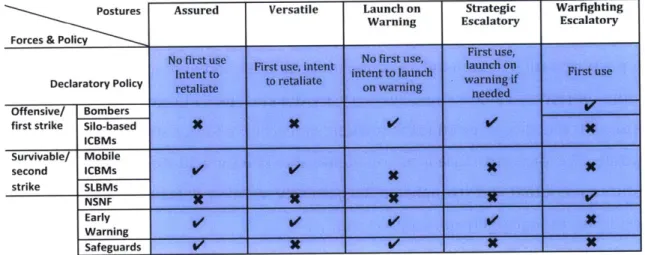
These five types of postures are presented in Table 1.1, below. Table 1.1 Postures
Postures Assured Versatile Launch on Strategic Warfighting
Warning Escalatory Escalatory Forces & Policy
No first use No first use, First use,
Intent to First use, intent launch on
Declaratory Policy retaliate to retaliate intent to laUnch warning if First use on warning needed
Offensive/ Bombers V
first strike Silo-based K X V
ICBMs Survivable/ Mobile second ICBMs V V K strike SLBMs NSNF K K X X Early Warning Safeguards V K K
A final component of posture is the size of the force. Here, three approaches
are possible: a state may seek minimalism, parity, or supremacy, that is, either the smallest capability that could meet operational requirements, a capability that is equal to that of the most likely adversary, or one that supersedes that of all adversaries.
As I noted above, these postures can be combined. A state may want both a Warfighting Escalatory capability and one of the other sets of strategically-focused
capabilities (e.g., Assured or Strategic Escalatory), particularly if it seeks to deter a variety of dangers and threats.
A state may also build both offensive and defensive capabilities. It may plan
to launch some weapons on warning, while letting more survivable systems ride out the attack. It may also seek to develop nuclear weapons for other purposes than deterrence of threats, e.g., as a means of coercion, in which case Versatile and Escalatory strategies will likely make sense. But while these five categories are not complete, these posture types reflect the possibilities most relevant to Russia: a state that inherited a large and diverse nuclear force that is rivaled by that of only one other state, and which may seek to deter a broad range of threats.
I also do not expect any state to match any of these postures perfectly at any
time. These are, to a large extent, archetypes. In reality, strategies can change faster than force structures, and some components are more important than others: because safeguards are limited in their true impact, they are less critical than early warning. However, to the extent that one can identify emphasis on some systems
over others in line with what I have laid out, one can assess whether the declaratory policies and force structures match these "ideal" postures, singly or in combination, in a general sense.
Chapter Two: Two Structural Realist Theories
IntroductionIn Theory of International Politics, Kenneth Waltz built on the work of
"realists" such as Hans Morgenthau who posited international relations as a struggle for power.25 Waltz advanced a parsimonious theory based in the notion of the
international system as one of anarchy, and therefore self-help. In the absence of any overarching global order, countries seek to increase their security and balance against threats. They do this both by aligning with others and by increasing their own independent capabilities.26
Political scientists who followed Waltz have sought to improve on and clarify his theory, in the process presenting more complicated variations on it. Stephen Walt argued that states do not, by and large, balance simply against power, as power in and of itself is not always threatening. Rather, he postulated that states balance against threat, or, more accurately their perception of threat, which he saw as based in a combination of power, geographical proximity, offensive capability, and
aggressive intent on the part of other states.27
Much of the neorealist literature that has followed accepts Walt's correction, and seeks to understand balance of perceived threat, rather than balance of more easily measured power. But this is difficult to measure: history provides substantial evidence that states often have a difficult time reading their threat environment accurately, instead over-balancing, under-balancing, or finding other alternatives, such as "buck-passing, bandwagoning, appeasement, engagement, distancing, or
2s Hans Morgenthau, Politics Among Nations: The Struggle for Power and Peace (New York: Alfred A. Knopf, 1948).
26 Kenneth N. Waltz, Theory of International Politics (New York: McGraw-Hill, Inc, 1979).
27 Stephen M. Walt, The Origins ofAlliances (Ithaca, NY: Cornell University Press, 1987). Walt agrees
that in some circumstances, sufficient power may be enough to lead to perceptions of threat, even if distance and aggressive intent are absent Note that Walt's balance of threat hypotheses are also supported by a statistical analysis presented in Paul Fritz and Kevin Sweeney, "The (De)limitations of Balance of Power Theory," International Interactions 30 (2004).
hiding."28 Many of the reasons advanced for why states will respond less then optimally to the threat environment are rooted in domestic factors, an approach that has more recently been termed "neoclassical" realism.29
The literature on balance of power/balance of threat is rich. However, only a small component of it is relevant to my purposes. While most of the literature focuses on balancing (or lack thereof) by means of alliances, states also seek to attain security by developing and deploying capabilities. When one studies military, and perhaps especially nuclear, posture, it is this mainly internal balancing that is of interest. Military doctrine and posture may include some aspects of external
balancing or bandwagoning, particularly in the context of reliance on partners and allies, but they are at their core expressions of a state's own capabilities.
The military doctrine literature recognizes this, and focuses on how states formulate doctrine and approaches to warfighting. Specifically, this body of literature tends to focus on doctrinal innovation, a trend begun by Posen with his foundational Sources of Military Doctrine. There has been little effort to deconflict doctrine and innovation since.30 And while studying doctrinal innovation and how it drives doctrinal change is important to understanding doctrine, these approaches may overlook evolutionary changes in doctrine as well as emulation and adaptation
28 Randall L. Schweller, "Bandwagoning for Profit: Bringing the Revisionist State Back In,"
International Security 19, no. 1 (1994); "Unanswered Threats: A Neoclassical Realist Theory of Underbalancing," International Security 29, no. 2 (2004). Schweller's "nonbalancing" may also be viewed as similar to, if not synonymous with, the concept of "soft balancing." In 2002, both Joseph Joffe and Walt discussed (Joffe more explicitly) tacit, or implicit balancing which involves coalitions focused on economic, rather than security issues; public statements; bandwagoning; buck-passing; and so forth (Stephen M. Walt, "Keeping the World 'Off Balance'," in America Unrivaled: The Future of the Balance of Power, ed. G. John Ikenberry (Ithaca, N.Y.: Cornell University Press, 2002).; Joseph Joffe, "Defying History and Theory: The United States as the 'Last Superpower'," in America Unrivaled: The Future of the Balance of Power, ed. G. John Ikenberry (Ithaca, N.Y.: Cornell University Press, 2002).); T.V. Paul and Robert A. Pape each termed this "soft balancing (T.V. Paul, "Soft Balancing in the Age of
U.S. Primacy," International Security 30, no. 1 (2005).; Robert A. Pape, "Soft Balancing Against the United States," International Security 30, no. 1 (2005).). Brooks and Wohlforth, however, reject the soft balancing premise, arguing that all the "soft" coalitions of the 1990s and 2000s were formed for the members' own reasons, unrelated to U.S. power or actions (Stephen G. Brooks and William C. Wohlforth, "Hard Times for Soft Balancing," International Security 30, no. 1 (2005).) Schweller, "Unanswered Threats: A Neoclassical Realist Theory of Underbalancing."
29 Gideon Rose, "Neoclassical Realism and Theories of Foreign Policy," World Politics 51, no. 1 (1998). 30 Indeed, this focus is so prevalent that Adam Grissom terms his excellent review of the field a
review of the doctrinal innovation literature (Adam Grissom, "The Future of Military Innovation Studies," Journal of Strategic Studies 29, no. 5 (2006).)
that fall short of innovation (although some definitions of innovation in fact incorporate one or both of these).31
My dissertation seeks to explain Russian nuclear force posture. In part, this
means looking at when it changes, or fails to, in response to other factors. These changes may or may not result from innovation: I am interested in doctrinal and posture shifts whether they are innovative or not. The two theories that I develop that are systemic in nature draw on key aspects of the international system, most importantly the nature of the threats a state faces, to predict posture and doctrine. The main difference between them is in their different interpretations of the role that nuclear weapons play in that system. They thus predict different responses to similar threat and resource conditions, in at least some cases. I do not ask why the state interprets nuclear weapons in this way or whether either theory is the better
reflection of the realities of the international system as a whole: I can simply test to see whether one or the other of them better reflects Russian perspectives driving their nuclear weapons posture.
The first theory, the Absolute Weapon theory, postulates a view of nuclear weapons as extremely powerful, capable of deterring all aggression. The threat environment, that is, whether the most relevant threats are nuclear, conventional, or mixed, will shape posture, with a minimal role for resource constraints (because very few nuclear weapons are needed to deter, and there is no need to build more than is needed). The second theory, the Internal Balancing and Prestige theory, views nuclear weapons as capable of deterring nuclear use, but of more limited
(albeit not negligible) utility vis-A-vis conventional weapons, and as an important tool of prestige. Again, the threat environment (whether threats are nuclear or
conventional) will shape force posture, but resource constraints or lack thereof are
31 Indeed, some scholars have looked quite extensively at emulation and the spread of doctrine. Terry
Terriff and Theo Farrell, "Military Change in the New Millenium," in The Sources of Military Change:
Culture, Politics, Technology, ed. Theo Farrell and Terry Terriff (Boulder, CO: Lynn Reinner Publishers,
2002); Theo Farrell and Terry Terriff, "The Sources of Military Change," in The Sources of Military
Change: Culture, Politics, Technology, ed. Theo Farrell and Terry Terriff (Boulder, CO: Lynn Reinner
Publishers, 2002).;Michael C. Horowitz, The Diffusion of Military Power: Causes and Consequencesfor
more important, and states will actively seek to build larger forces (and ones with greater capabilities), to the extent they can afford to.
The Absolute Weapon
I start with the Absolute Weapon theory. This theory is rooted in that part of
the deterrence literature that views nuclear weapons as suigeneris. It holds that nuclear weapons have changed the way that nuclear states and those who interact with them view conflict, such that the possibility of nuclear use is sufficiently threatening to make most hostile actions against nuclear weapon states
prohibitively unappealing. Simply put, it posits that nuclear weapons are universal deterrents: they are so potent that even a small amount of nuclear capability is sufficient to leave adversaries unwilling to threaten a nuclear power.
To explain the logic behind this approach, I turn to nuclear deterrence theory. But before I delve into the specifics of nuclear deterrence, I will briefly discuss
deterrence more generally. For a very simple definition of deterrence, I borrow from Glenn Snyder.32 Snyder's formulation tells us that deterrence will work if a party's perceived gain from action [g(a),] is outweighed by the perceived loss caused him/her by the deterrer's threatened reaction [l(t)] multiplied by the deterrer's credibility to carry out that threat [c(t)] (again as perceived).33 Thus, deterrence functions when:
c(t)*1(t)>g(a)
Note that this simple formulation is dependent neither on rationality nor on perfect perception. Instead, the variables are defined by their value as perceived by the party to be deterred, regardless of whether their perception is accurate or
rational. Moreover, the perceived loss can include both punishment and the inability to attain one's goal (denial), as discussed earlier.
32 Glenn Herald Snyder, Deterrence and Defense (Princeton: Princeton University Press, 1961). 33 While the argument is Snyder's both the notation for the variables and the specific formulation of
the equation are mine. Further, Snyder includes another variable, for the probability of attaining the gain from the action being deterred. I subsume this within the g(a) variable. Snyder argues that this probability variable is more affected by the deterred party's c(t) estimate while the perceived gain variable [our g(a)] is more closely linked to the l(t) variable, I find it more useful to simply note that both are interdependent. For my limited purposes here, there is no need to separate out the
While countries and sub-national groups have doubtless been using the threat of war and ever-more destructive weapons to deter one another since the dawn of humanity, nuclear deterrence theorists posited that the splitting of the atom changed things categorically.
In 1946, Bernard Brodie described the nuclear bomb as "The Absolute Weapon" in an edited volume of the same name. As Lawrence Friedman notes, it took some time before the ideas in that volume garnered much attention. However, Brodie's basic concept, that nuclear weapons fundamentally changed the course of conflict by making military planning about preventing, rather than executing, war eventually became the core of nuclear deterrence theory (even if Brodie himself
later came to argue that certain nuclear weapons might be usable3 4).35 The
underlying argument is that nuclear weapons surpass all others in their destructive capability (empirically not true in all cases, although certainly true in the
aggregate36) and therefore in their ability to deter unwanted behavior by an adversary. While a general threat of war might fail to deter, either because the threat is not credible or the danger not perceived as all that great (that is, war is worth risking), a nuclear weapon is so threatening that an adversary will forego the potential gains of war in its face.37
Brodie's "absolute weapon" argument is at its core a realist argument about technology, defining the nuclear weapon as having changed the international system, trumping other weapons because of its greater destructive capability. Returning to the simple formula above, those who argue that nuclear weapons can deter all sorts of aggression believe that the value for l(t) in the nuclear context is so high that even a very low value for c(t) will still outweigh the predicted gains. This is Thomas Schelling's "threat that leaves something to chance." Key to Schelling's conception of a very high value for nuclear threat is the notion that an adversary armed with
34 Bernard Brodie, "The Development of Nuclear Strategy," International Security 2, no. 4 (1978).
3s Lawrence Freedman, The Evolution of Nuclear Strategy (Houndsmill and New York: Palgrave
Macmillan, 2003).; Deterrence (Cambridge: Polity, 2004).
36 1 have not done the calculations, nor can I identify anyone who has, but I think it is safe to argue that the combined capability of all the nuclear weapons that might plausibly be used together outweighs that of all the conventional weapons that might plausibly be used at one time.
nuclear weapons may not be fully rational, and thus the state being deterred cannot assume that they will only be credible in the context of nuclear use that is rational (that is, that makes sense to the state being deterred).38
Waltz rejected this to some extent in Theory of International Politics, arguing that the superpowers are superpowers whether or not they possess nuclear
weapons, and a smaller state with nuclear weapons does not necessarily rise in the international system. However, Waltz does argue that nuclear weapons usefully function in the hands of both greater and lesser powers to both deter nuclear use (and potentially other aggression) and prevent escalation.39 Moreover, he made an absolute weapon argument at a later date when he wrote that nuclear forces ought, because of their destructive capability, be more than sufficient to deter not only nuclear attack, but also conventional.40
The absolute weapon approach was also inherent in early views of nuclear deterrence in U.S. doctrine. Before the Soviet Union had the capacity to threaten the United States in return, the United States saw its nuclear arsenal as deterring a wide range of possible Soviet conventional aggression and adventurism. 41 After the Soviet Union developed its own nuclear capability and intercontinental range in the 1950s, the concept of mutual assured destruction, or MAD, characterized a standoff of terror, in which both countries were kept in check by the capacity of the other to completely destroy them.42 According to MAD, both were deterred from
conventional as well as nuclear action due to the fear of escalation to this point.
38 The Strategy of Conflict (Cambridge, Massachusetts and London: Harvard University Press, 1960),
pp. 187-203.
39 Waltz, Theory of International Politics.; "More May Be Better," in The Spread of Nuclear Weapons: A Debate, ed. Scott Sagan and Kenneth N. Waltz (New York: W.W. Norton, 1995).
40 "More May Be Better." See also Waltz's arguments in later editions, including Scott Sagan and
Kenneth N. Waltz, The Spread of Nuclear Weapons: a Debate Renewed (New York: W.W. Norton, 2002) and The Spread of Nuclear Weapons: An Enduring Debate (New York: W.W. Norton, 2012).
41 Freedman, The Evolution of Nuclear Strategy, p. 50, 66-69.
42 For a Russian view which supports the idea that both the USSR and the United States saw the situation similarly, see Aleksei Fenenko, "Trans formatsiia Sderzhivaniia," Rossiia v Global'noi Politike
Escalation to large-scale destruction is at the root of the absolute weapon argument for some to this day.43 But others have postulated that the destructive power of nuclear weapons is sufficient to deter even well short of the capacity to utterly demolish the adversary. They argue that the devastation presented by even a single nuclear weapon should deter others, and that it should do so even if they are better armed. l(t) is again so high, in the nuclear context, that it outweighs g(a) even with low-scale nuclear use. This is important because it suggests that, in a change from the pre-nuclear past, an inferior arsenal should be able to deter even a substantially superior one.44 And even credibility is not that important, as Waltz notes, because the threat is so dire. The result is greater caution overall.45 Herman Kahn, among others, took fundamental issue with this argument, and with the MAD paradigm, holding that it was possible to imagine and model nuclear conflict from which one or both sides could recover.46 Kahn's concern reflects the fact that this argument rests on a view of nuclear weapons as more powerful than their actual capability, an approach that seems to veer somewhat beyond realist parameters.
The Absolute Weapon theory presented here holds that nuclear weapons are perceived by states as surpassing all others in their destructive capability and therefore in their ability to deter unwanted behavior by others. While a threat of conventional war might fail to deter, either because the threat is not credible or the war is seen as winnable and thus worth risking, the threat of nuclear use and escalation is sufficiently threatening that an adversary will forego any potential gains of war in its face.47
I reject the idea that the absolute weapon argument, if it holds, would make
posture irrelevant, since the capacity for response is critical if more than one of the states involved has nuclear capability: nuclear states will deter each other and
43 See, for example, Susan B. Martin, "The Continuing Value of Nuclear Weapons: A Structural Realist Analysis," Contemporary Security Policy 34, no. 1 (2013).
44 Bernard Brodie, The Anatomy of Deterrence, Research Memorandum (Santa Monica, CA: The RAND Corporation, 1958).
4s Waltz, "More May Be Better." 46 Kahn, On Thermonuclear War.
47 Schelling, Arms and Influence. Kahn discusses this viewpoint as "minimum deterrence," and finds it faulty (Kahn, On Thermonuclear War, pp. 7-13)
posture in part to signal intent. I do agree that it calls for minimal numbers of weapons. I also argue that posture is, under some conditions, also affected by resourcing. The question of economic resources is embedded into the broad range of writing on strategy, doctrine, and posture. Economic power is among the
components of power and threat identified by Waltz, Walt, and everyone who has followed them as critical to balancing decisions.
Limitations on resources constrain a state's capacity to respond to the threat environment as policy-makers weigh military spending against other requirements and different components of the armed forces against one another. When resources are tight, the state may be pushed towards cheaper ways to attain the same goals. What makes a given approach cheaper will depend in part on what is at hand:
although some things are cheaper than others when built from scratch, that does not necessarily mean that for an existing nuclear weapon state those will be the more affordable options: it is less expensive, for example, to maintain an existing force structure than to build new forces. Thus, there is a certain path dependency inherent in resource-constrained choices. Therefore, while threat environment is the independent variable that defines posture for this theory, economic conditions, which affect resourcing for defense generally and nuclear weapons specifically, are an intervening variable-they affect what a state can do to respond to threats.
Hypotheses
Master hypothesis: Countries view nuclear weapons as sufficient and credible to
deter all undesired behavior, including but not limited to nuclear use. They will posture their nuclear weapons to send signals about what they are deterring, but they will not seek either superiority or parity in numbers, just adequate capability. What is adequate will be defined by their view of the threat environment,
specifically whether or not potential adversaries are nuclear-armed. However, because nuclear weapons are seen as superseding all others, there are no conditions under which large numbers, or even numbers equal to those of adversaries, are needed. Nuclear-armed states will be viewed as threats, because of their capabilities.
Conventionally-armed states may also be viewed as threats or potential adversaries for other reasons.4 8
This leads to the following subsidiary hypotheses:
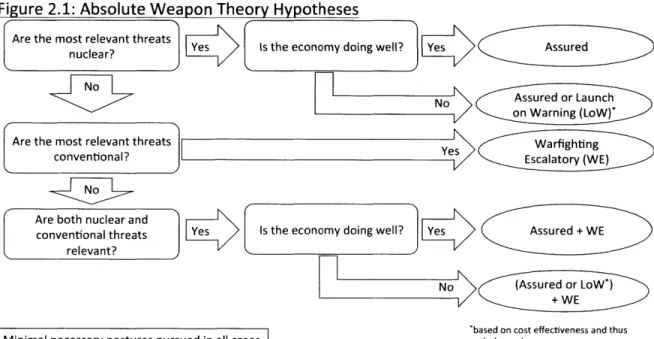
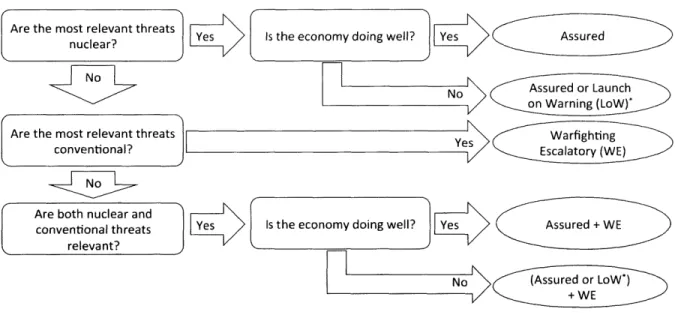
- AH When the primary threat is perceived as the strategic nuclear
capabilities of a prospective adversary, a nuclear-armed state will develop an Assured retaliation posture with small (minimal) numbers of weapons. If an Assured posture is unaffordable but a Launch on Warning (LoW) posture is feasible (for example, because less survivable systems are cheaper to build or maintain), it will opt for the latter, still at minimal levels. Thus, the Launch on Warning posture, according to this theory, will in at least some cases be the poor country's alternative to an Assured posture.
e AH2 When conventional threats are the primary concern, a nuclear-armed state will use its nuclear capacity to deter them. Because adversaries will not pose real threats to the nuclear arsenal, survivability and early warning are not relevant. This means a Warfighting Escalatory (WE) posture, at minimal levels needed to meet needs.
* AH3 Given resources and faced with adversaries that pose both nuclear and
conventional threats, a nuclear weapon state will develop a posture with both Assured and Warfighting Escalatory elements. This means survivable strategic nuclear weapons poised to deter strategic nuclear threats and non-strategic nuclear capabilities to deter conventional threats. If resources are constrained, however, the state will do whatever is more affordable. This means that a Warfighting Escalatory posture will be combined with either an Assured or a Launch on Warning posture, whichever is cheaper to build and maintain (this will be based in part on what a state already has in its arsenal). Any first use rhetoric will be focused on non-nuclear threats (i.e., not damage limitation). Because survivable systems tend to be more expensive, for most countries in this situation, constrained resources will lead to Launch on
4 e.g., if they are aligned with threatening states, or if Russia has expansionist aims vis-a-vis those states.
Warning, rather than Assured, postures combined with Warfighting Escalatory postures.
These hypotheses are summarized in Figure 2.1, below:
Figure 2.1: Absolute Weapon Theory Hypotheses
Are the most relevant threats Is the economy doing well? Assured
nuclear? YeAsud No
No Assured or Launch
on Warning (LoW)
Are the most relevant threats Y Warfighting
conventional? Yes Escalatory (WE)
Are both nuclear and
conventional threats Yes Is the economy doing well? Yes Assured + WE
relevant?
No ssured or LoW
.based on cost effectiveness and thus
Minimal necessary postures pursued in all cases path dependency
Internal Balancing and Prestige
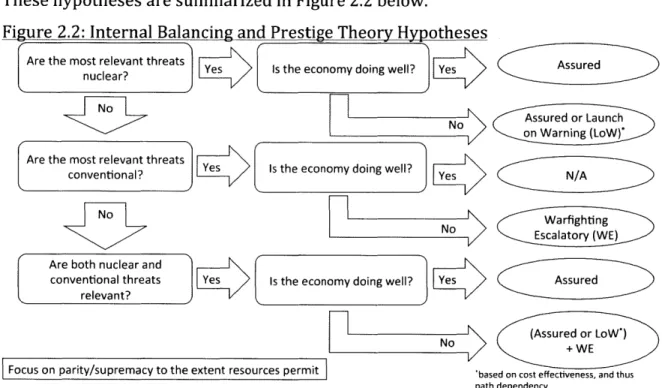
The second theory I present views nuclear weapons as one mechanism among many that states use to enhance their capabilities vis-a-vis other states, that is, to balance. It posits that nuclear weapons, for all their destructive capability, are not an "absolute" and universal deterrent. While they are a capable and preferred deterrent of large-scale nuclear use by adversaries, this requires force postures that can truly threaten retaliation. Moreover, their role in conventional deterrence varies, because states prefer to counter and deter conventional capabilities with other conventional capabilities and will rely on nuclear weapons for this only when they cannot afford both options and also need the nuclear deterrent. Finally, nuclear weapons are also an important source of prestige, which leads to a preference for force postures that demonstrate numerical and/or capability parity with or
supremacy over other nuclear powers (over and above what is needed for a credible deterrent).
This approach therefore is different in several important ways from the Absolute Weapon theory. Although that theory is also based on a balancing
argument, it assumes that nuclear weapons are ultimate balancing tools. This theory does not. It is based in an assessment of the lived experience of the nuclear world, which raises strong doubts that nuclear weapons truly trump all other interests and threats. While there have been no wars between nuclear weapon states, nuclear weapon states have gone to war. Moreover, many states have eschewed nuclear weapon development. At the same time, nuclear weapons do appear to affect behavior and change interests for both the states that possess them and others. As Frank Gavin writes, posturing in regard to Germany in the early years of the Cold War would have taken a different shape had Russia and the United States not been nuclear-armed.49
The non-use of nuclear weapons over the past seven decades has led some to postulate that a norm exists that leads most countries to prefer not to use nuclear weapons, although they may brandish them and certainly will rely on them to deter nuclear use against themselves by others.50 Some argue that for states with high conventional capabilities (e.g., the United States), the threat of nuclear use in a conventional context is simply not credible.s1 Some may argue that nuclear
deterrence of conventional war is demonstrated by the fact that no nuclear weapon states has fought another, except on a very small scale, since the dawn of the nuclear age.52 While true, this is based on a sample set too small for full confidence.
4 Gavin, Nuclear Statecraft: History and Strategy in America's Atomic Age.
s5 The work of Nina Tannenwald makes this argument, particularly in regards to the United States,
but also more broadly. See Nina Tannenwald, "The Nuclear Taboo: The United States and the Normative Basis of Nuclear Non-Use," International Organization 53, no. 3 (1999); "Stigmatizing the Bomb: Origins of the Nuclear Taboo," International Security 29, no. 4 (2005) and the book-length treatment in The Nuclear Taboo: The United States and the Non-Use of Nuclear Weapons Since 1945 (Cambridge: Cambridge University Press, 2007). Daryl G. Press, Scott Sagan, and Benjamin A. Valentino, "Atomic Aversion: Experimental Evidence on Taboos, Traditions, and the Non-Use of Nuclear Weapons," American Political Science Review (2013) argue that there is not a strong taboo. They base this conclusion on public opinion survey research conducted in the United States. However, public opinion may not be indicative of elite or decisionmaker views, and U.S. opinion may not reflect Russian views. Moreover, given that Soviet rhetoric and propaganda may well have played an
important role in creating and cementing the taboo (Tannenwald, "Stigmatizing the Bomb: Origins of the Nuclear Taboo."), it may be more likely that such a taboo would hold for Russians.
51 Scott Sagan, "The Case for No First Use," Survival: Global Politics and Strategy 51, no. 3 (2009).